by
ROHAN PORWAL
BINEET MAURYA
 in countries which experience extreme weather condition special problems
are encountered in preparation, placement and curing of concrete.
 India has regions of extreme hot weather (hot –humid and hot-aird)as well as
cold weather .
 The Indian standards dealing with extreme weather concreting are:-
IS: 7861 (Part 1-1975)- Hot weather concreting
IS: 7861 (Part 2-1981)- cold weather concreting
 Hot weather concreting
 Cold weather concreting
 hot weather is any combination of the following conditions that tends to impair
the quality of freshly mixed or hardened concrete by accelerating the rate of
moisture loss and rate of cement hydration, or otherwise causing detrimental
results:
 High concrete temperature;
 Low relative humidity;
 Wind speed
 Solar radiation.
 High ambient temperature.
 Increased water demand.
 Accelerated slump loss.
 Increased rate of setting.
 Increased tendency of plastic shrinkage cracking.
 Critical need for prompt early curing
 Certain precautions should be taken in order to reduce the difficulties in hot
weather conditions.
 Temperature ranging from 10 to 15˚C is desirable, but such temperatures are not
always practical.
 Many specifications require that concrete when placed should have a
temperature of less than 29 to 32˚C.
 Type of construction.
 Characteristics of the materials being used.
 The experience of placing and finishing crew in dealing with the atmospheric
conditions in the site.
 Use materials and mix proportions that have a good record in hot weather conditions.
 Cool the concrete or one or more of its ingredients.
 Use a concrete consistency that allows rapid placement.
 Reduce the time of transporting, placing, and finishing as possible.
 Schedule concrete placements to avoid extreme weather, such as at night or during
favorable weather conditions.
 Consider the methods to limit moisture loss during placing and finishing such as
sunshades, wind screens, fogging, and spraying.
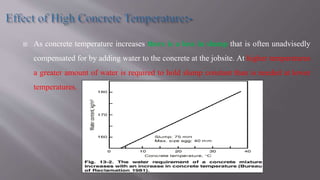
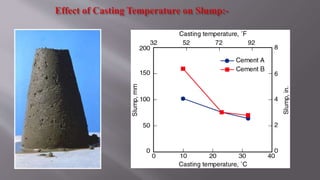
 As concrete temperature increases there is a loss in slump that is often unadvisedly
compensated for by adding water to the concrete at the jobsite. At higher temperatures
a greater amount of water is required to hold slump constant than is needed at lower
temperatures.
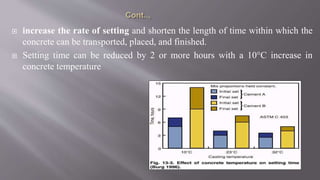
 increase the rate of setting and shorten the length of time within which the
concrete can be transported, placed, and finished.
 Setting time can be reduced by 2 or more hours with a 10°C increase in
concrete temperature
 There is an increased tendency for cracks to form both before and after hardening.
 Rapid evaporation of water from freshly placed concrete can cause plastic-shrinkage
cracks before the surface has hardened.
 Cracks may also develop in the hardened concrete because of increased drying shrinkage
due to higher water contents or thermal volume changes as the concrete cools.
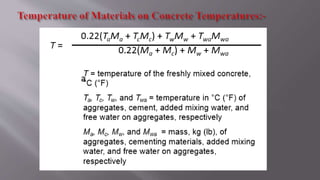
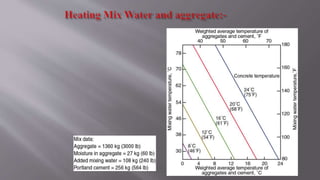
 Lower the temperature of concrete materials before mixing.
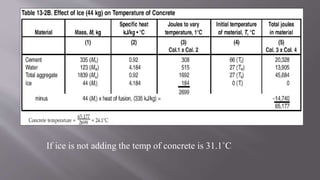
 The contribution of each material is related to
 Temperature.
 Specific heat.
 Quantity of each material.
 where Mi is the mass in kilograms of ice
If ice is not adding the temp of concrete is 31.1˚C
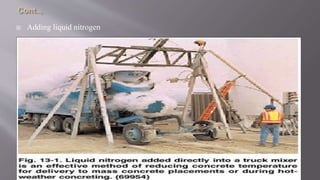
 Adding liquid nitrogen
 The use of supplementary materials (fly ash, ground granulated blast furnace
slag) can help in hot weather conditions.
 These material slow the rate of setting as well as the rate of slump loss.
 Mixers, chutes, conveyor belts, hoppers, pump lines, and other equipments for handling
concrete should be shaded, painted white, or covered with wet burlap to reduce solar
heat.
 Forms, reinforcing steel, and subgrade should be fogged or sprinkled with cool water
just before concrete is placed.
 Restrict placement of concrete to early morning, evening, or night time hours,
especially in arid climates. This will help in minimizing thermal shrinkage and
cracking of thick slabs and pavements.
 Should be done as quickly as practical during hot weather.
 Delays contribute to the loss of slump and increase in concrete
temperature.
 Prolonged mixing should be avoided.
 Associated with hot-weather concreting,
 It can occur any time ambient conditions produce rapid evaporation of moisture from the
concrete surface.
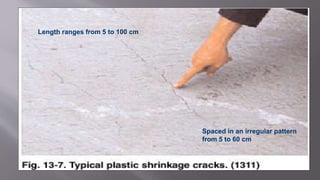
 These cracks occur when water evaporates from the surface faster than it can rise to the
surface during the bleeding process.
 Rapid drying shrinkage creates tensile stresses in the surface that often result in short,
irregular cracks.
 Plastic shrinkage cracking increases with:
1. Low air temperature
2. High concrete temperature
3. Low humidity
4. High wind speed
Length ranges from 5 to 100 cm
Spaced in an irregular pattern
from 5 to 60 cm
1. Moisten concrete aggregates that are dry and absorptive.
2. Keep the concrete temperature low by cooling aggregates and mixing water.
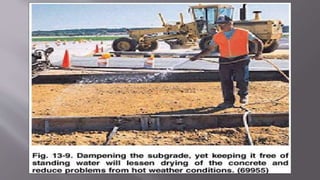
3. Dampen the subgrade (Fig. 13-9) and fog forms prior to placing concrete.
4. Erect temporary windbreaks to reduce wind velocity over the concrete surface.
5. Erect temporary sunshades to reduce concrete surface temperatures.
6. Protect the concrete with temporary coverings, such as polyethylene sheeting, during
any appreciable delay between placing and finishing.
7. Add plastic fibers to the concrete mixture to help reduce plastic shrinkage crack formation.
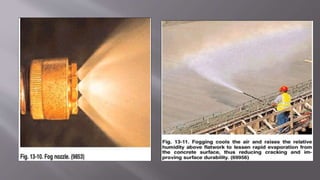
 Use of a fog spray will raise the relative humidity of the ambient air over the slab,
thus reducing evaporation from the concrete.
 Fog nozzles atomize water using air pressure.
 Spray application of temporary moisture-retaining films (usually polymers).
 Reduction of time between placing and the start of curing by eliminating delays
during construction.
 The need for moist curing of concrete slabs is greatest during the first few hours after
finishing.
 To prevent the drying of exposed concrete surfaces, moist curing should commence as
soon as the surfaces are finished.
 When the air temperature is at or above 27°C, curing during the basic curing period
should be accomplished by water spray or by using saturated absorptive fabric
 For mass concrete, curing should be by water for the basic curing period when the air
temperature is at or above 20°C, in order to minimize the temperature rise of the
concrete.
 A retarding admixtures can be very helpful in delaying the setting time, despite
increased rate of slump loss resulting from their use.
 A hydration control admixture can be used to stop cement hydration and setting.
As a general rule a 5°C to 9°C temperature rise per 45 kg of Portland cement can be
expected from the heat of hydration.
 Cold weather is defined by ACI Committee 306 as a period when for more than
3 successive days the average daily air temperature drops below 5°C (40°F) and stays
below 10°C (50°F) for more than one-half of any 24 hour period.
 Under these circumstances, all materials and equipment needed for adequate
protection and curing .
 Normal concreting practices can be resumed once the ambient temperature is above
10°C (50°F) for more than half a day.
PREPERATION FOR CONCRETING
 Preparations should be made to protect the concrete; enclosures, windbreaks, portable
heaters, insulated forms, and blankets should be ready to maintain the concrete
temperature.
 Forms, reinforcing steel, and embedded fixtures must be clear of snow and ice at the
time concrete is placed.
 Thermometers and proper storage facilities for test cylinders should be available to
verify that precautions are adequate.
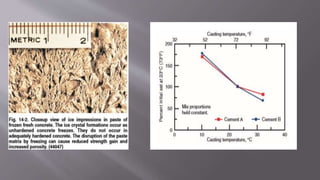
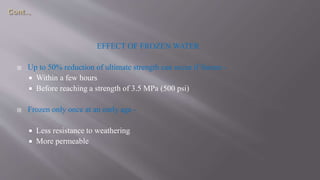
EFFECT OF FROZEN WATER
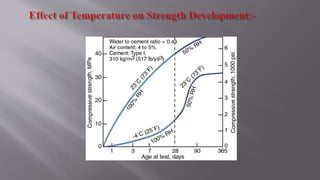
 Up to 50% reduction of ultimate strength can occur if frozen -
 Within a few hours
 Before reaching a strength of 3.5 MPa (500 psi)
 Frozen only once at an early age -
 Less resistance to weathering
 More permeable
 “For every 10°C (18°F) reduction in concrete temperature, the times of setting of
the concrete double, thus increasing the amount of time that the concrete is
vulnerable to damage due to freezing.”
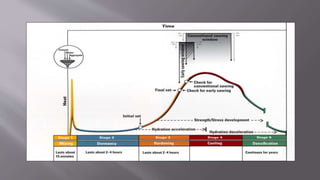
 Heat of hydration is useful in winter concreting as it contributes to the heat needed to
provide a satisfactory curing temperature; often without other temporary heat sources,
particularly in more massive elements.
 High strength at an early age is desirable in winter construction to reduce the length
of time temporary protection is required.
 High-early-strength concrete can be obtained by using one or a combination of the
following:
1. Type III or HE high-early-strength cement
2. Additional Portland cement (60 to 120 kg/m3 or 100 to 200 lb/yd3)
3. Chemical accelerators
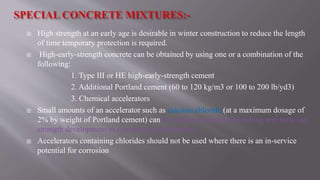
 Small amounts of an accelerator such as calcium chloride (at a maximum dosage of
2% by weight of Portland cement) can be used to accelerate the setting and early-age
strength development of concrete in cold weather.
 Accelerators containing chlorides should not be used where there is an in-service
potential for corrosion
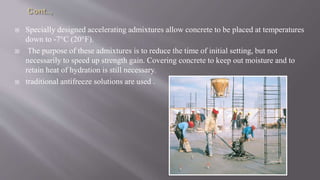
 Specially designed accelerating admixtures allow concrete to be placed at temperatures
down to -7°C (20°F).
 The purpose of these admixtures is to reduce the time of initial setting, but not
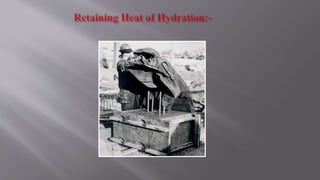
necessarily to speed up strength gain. Covering concrete to keep out moisture and to
retain heat of hydration is still necessary.
 traditional antifreeze solutions are used .
 To reduce freezing and thawing we can use air entrained concrete .
 Air entrainment provides the capacity to absorb stresses due to ice formation within
the concrete.
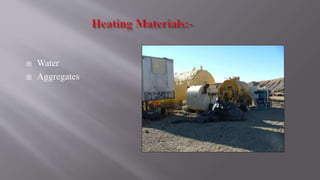
 Water
 Aggregates
 Wood
 Canvas
 Tarpaulins
 Polyethylene Film
THANKU

hot and cold weather concreting

  • 1.
  • 2.
     in countrieswhich experience extreme weather condition special problems are encountered in preparation, placement and curing of concrete.  India has regions of extreme hot weather (hot –humid and hot-aird)as well as cold weather .  The Indian standards dealing with extreme weather concreting are:- IS: 7861 (Part 1-1975)- Hot weather concreting IS: 7861 (Part 2-1981)- cold weather concreting
  • 3.
     Hot weatherconcreting  Cold weather concreting
  • 4.
     hot weatheris any combination of the following conditions that tends to impair the quality of freshly mixed or hardened concrete by accelerating the rate of moisture loss and rate of cement hydration, or otherwise causing detrimental results:  High concrete temperature;  Low relative humidity;  Wind speed  Solar radiation.  High ambient temperature.
  • 5.
     Increased waterdemand.  Accelerated slump loss.  Increased rate of setting.  Increased tendency of plastic shrinkage cracking.  Critical need for prompt early curing
  • 6.
     Certain precautionsshould be taken in order to reduce the difficulties in hot weather conditions.  Temperature ranging from 10 to 15˚C is desirable, but such temperatures are not always practical.  Many specifications require that concrete when placed should have a temperature of less than 29 to 32˚C.
  • 7.
     Type ofconstruction.  Characteristics of the materials being used.  The experience of placing and finishing crew in dealing with the atmospheric conditions in the site.
  • 8.
     Use materialsand mix proportions that have a good record in hot weather conditions.  Cool the concrete or one or more of its ingredients.  Use a concrete consistency that allows rapid placement.  Reduce the time of transporting, placing, and finishing as possible.  Schedule concrete placements to avoid extreme weather, such as at night or during favorable weather conditions.  Consider the methods to limit moisture loss during placing and finishing such as sunshades, wind screens, fogging, and spraying.
  • 9.
     As concretetemperature increases there is a loss in slump that is often unadvisedly compensated for by adding water to the concrete at the jobsite. At higher temperatures a greater amount of water is required to hold slump constant than is needed at lower temperatures.
  • 10.
     increase therate of setting and shorten the length of time within which the concrete can be transported, placed, and finished.  Setting time can be reduced by 2 or more hours with a 10°C increase in concrete temperature
  • 11.
     There isan increased tendency for cracks to form both before and after hardening.  Rapid evaporation of water from freshly placed concrete can cause plastic-shrinkage cracks before the surface has hardened.  Cracks may also develop in the hardened concrete because of increased drying shrinkage due to higher water contents or thermal volume changes as the concrete cools.
  • 12.
     Lower thetemperature of concrete materials before mixing.  The contribution of each material is related to  Temperature.  Specific heat.  Quantity of each material.
  • 14.
     where Miis the mass in kilograms of ice
  • 15.
    If ice isnot adding the temp of concrete is 31.1˚C
  • 16.
  • 17.
     The useof supplementary materials (fly ash, ground granulated blast furnace slag) can help in hot weather conditions.  These material slow the rate of setting as well as the rate of slump loss.
  • 18.
     Mixers, chutes,conveyor belts, hoppers, pump lines, and other equipments for handling concrete should be shaded, painted white, or covered with wet burlap to reduce solar heat.  Forms, reinforcing steel, and subgrade should be fogged or sprinkled with cool water just before concrete is placed.  Restrict placement of concrete to early morning, evening, or night time hours, especially in arid climates. This will help in minimizing thermal shrinkage and cracking of thick slabs and pavements.
  • 19.
     Should bedone as quickly as practical during hot weather.  Delays contribute to the loss of slump and increase in concrete temperature.  Prolonged mixing should be avoided.
  • 20.
     Associated withhot-weather concreting,  It can occur any time ambient conditions produce rapid evaporation of moisture from the concrete surface.  These cracks occur when water evaporates from the surface faster than it can rise to the surface during the bleeding process.  Rapid drying shrinkage creates tensile stresses in the surface that often result in short, irregular cracks.  Plastic shrinkage cracking increases with: 1. Low air temperature 2. High concrete temperature 3. Low humidity 4. High wind speed
  • 21.
    Length ranges from5 to 100 cm Spaced in an irregular pattern from 5 to 60 cm
  • 22.
    1. Moisten concreteaggregates that are dry and absorptive. 2. Keep the concrete temperature low by cooling aggregates and mixing water. 3. Dampen the subgrade (Fig. 13-9) and fog forms prior to placing concrete. 4. Erect temporary windbreaks to reduce wind velocity over the concrete surface. 5. Erect temporary sunshades to reduce concrete surface temperatures. 6. Protect the concrete with temporary coverings, such as polyethylene sheeting, during any appreciable delay between placing and finishing. 7. Add plastic fibers to the concrete mixture to help reduce plastic shrinkage crack formation.
  • 23.
     Use ofa fog spray will raise the relative humidity of the ambient air over the slab, thus reducing evaporation from the concrete.  Fog nozzles atomize water using air pressure.  Spray application of temporary moisture-retaining films (usually polymers).  Reduction of time between placing and the start of curing by eliminating delays during construction.
  • 26.
     The needfor moist curing of concrete slabs is greatest during the first few hours after finishing.  To prevent the drying of exposed concrete surfaces, moist curing should commence as soon as the surfaces are finished.  When the air temperature is at or above 27°C, curing during the basic curing period should be accomplished by water spray or by using saturated absorptive fabric  For mass concrete, curing should be by water for the basic curing period when the air temperature is at or above 20°C, in order to minimize the temperature rise of the concrete.
  • 27.
     A retardingadmixtures can be very helpful in delaying the setting time, despite increased rate of slump loss resulting from their use.  A hydration control admixture can be used to stop cement hydration and setting. As a general rule a 5°C to 9°C temperature rise per 45 kg of Portland cement can be expected from the heat of hydration.
  • 28.
     Cold weatheris defined by ACI Committee 306 as a period when for more than 3 successive days the average daily air temperature drops below 5°C (40°F) and stays below 10°C (50°F) for more than one-half of any 24 hour period.  Under these circumstances, all materials and equipment needed for adequate protection and curing .  Normal concreting practices can be resumed once the ambient temperature is above 10°C (50°F) for more than half a day.
  • 29.
    PREPERATION FOR CONCRETING Preparations should be made to protect the concrete; enclosures, windbreaks, portable heaters, insulated forms, and blankets should be ready to maintain the concrete temperature.  Forms, reinforcing steel, and embedded fixtures must be clear of snow and ice at the time concrete is placed.  Thermometers and proper storage facilities for test cylinders should be available to verify that precautions are adequate.
  • 32.
    EFFECT OF FROZENWATER  Up to 50% reduction of ultimate strength can occur if frozen -  Within a few hours  Before reaching a strength of 3.5 MPa (500 psi)  Frozen only once at an early age -  Less resistance to weathering  More permeable
  • 33.
     “For every10°C (18°F) reduction in concrete temperature, the times of setting of the concrete double, thus increasing the amount of time that the concrete is vulnerable to damage due to freezing.”
  • 35.
     Heat ofhydration is useful in winter concreting as it contributes to the heat needed to provide a satisfactory curing temperature; often without other temporary heat sources, particularly in more massive elements.
  • 37.
     High strengthat an early age is desirable in winter construction to reduce the length of time temporary protection is required.  High-early-strength concrete can be obtained by using one or a combination of the following: 1. Type III or HE high-early-strength cement 2. Additional Portland cement (60 to 120 kg/m3 or 100 to 200 lb/yd3) 3. Chemical accelerators  Small amounts of an accelerator such as calcium chloride (at a maximum dosage of 2% by weight of Portland cement) can be used to accelerate the setting and early-age strength development of concrete in cold weather.  Accelerators containing chlorides should not be used where there is an in-service potential for corrosion
  • 38.
     Specially designedaccelerating admixtures allow concrete to be placed at temperatures down to -7°C (20°F).  The purpose of these admixtures is to reduce the time of initial setting, but not necessarily to speed up strength gain. Covering concrete to keep out moisture and to retain heat of hydration is still necessary.  traditional antifreeze solutions are used .
  • 39.
     To reducefreezing and thawing we can use air entrained concrete .  Air entrainment provides the capacity to absorb stresses due to ice formation within the concrete.
  • 41.
  • 45.
     Wood  Canvas Tarpaulins  Polyethylene Film
  • 48.