INNOVATIVE WAY TO
DEVELOP A FIRE EXTINGUSIHER
Project Guide - Dr. Anita Kumari
Authors- Saurabh Deshpande
Tanvay Shinde
Afreen Shaikh
College-Thadomal Shahani Engineering
College – Mumbai
B.E – Chemical Engineering
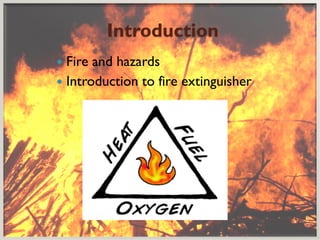
Introduction
 Fire and hazards
 Introduction to fire extinguisher
Types of fire and fire extinguisher used
Types of Fire extinguisher
 PORTABLE TYPE
 WATER TYPE FIRE EXTINGUISHER
 FOAM FIRE EXTINGUISHER
 DRY POWDER FIRE EXTINGUISHER
 DRY CHEMICAL EXTINGUISHER
 CARTRIDGE OPERATED DRY CHEMICAL
Two main type of fire extinguisher
1)Stored pressure 2)Cartridge operated
Source- safety108.blogspot.com
Innovation in fire extinguisher
 Fire Extinguisher improvements
 Materials improvement
 Chemicals Change
 Design change
What we did?
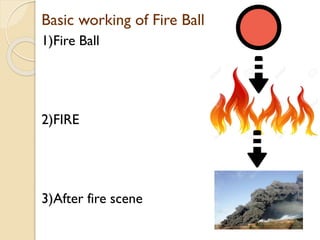
Basic working of Fire Ball
1)Fire Ball
2)FIRE
3)After fire scene
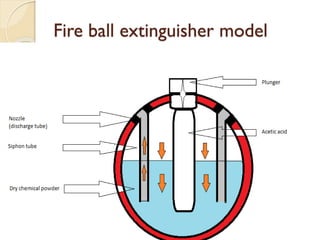
Fire ball extinguisher model
Implications of this method
 Human safety
 Easy to use
 No Technical Knowledge required
 Less space required.
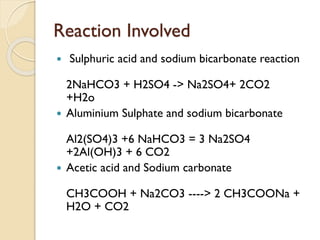
Reaction Involved
 Sulphuric acid and sodium bicarbonate reaction
2NaHCO3 + H2SO4 -> Na2SO4+ 2CO2
+H2o
 Aluminium Sulphate and sodium bicarbonate
Al2(SO4)3 +6 NaHCO3 = 3 Na2SO4
+2Al(OH)3 + 6 CO2
 Acetic acid and Sodium carbonate
CH3COOH + Na2CO3 ----> 2 CH3COONa +
H2O + CO2
Calculations
For the Reaction of Sulphuric acid
and Sodium bicarbonate
2NaHCO3+H2SO4 = Na2SO4 +
2H2O
+ 2CO2
Weight of NaHCO3 taken 168gms
Volume of H2SO4 taken 53.26 cm3
Calculation-
*No of moles = weight/molecular
weight
Weight =moles× molecular
weight
=2×84
Weight =168 gms of NaHco3
*Volume of sulphuric acid
for the other two reactions.
No of moles = weight/molecular
weight
Mass = moles×molecular
weight
= 1×98
Mass =98gms
Density = 1.84 gm/cm3
Volume = mass/density
= 98/1.84
= 53.26 cm3
Total amount of reactants=
98+168= 266 gms
Calculations
Enthalpy Calculation
∆H(NaHCO3)= -947.68 Kj/mol
∆H(H2SO4)= 1295.23 Kj/mol
∆H(CO2)= -393.51 Kj/mol
∆H(H2O)= -241.82 Kj/mol
∆H(Na2SO4)= -1387.1 Kj/mol
∆H®=∆H(reactants)-∆H(products)
=(2(-393.51)+2(-241.82)+(-
1387.1))-(2(947.68)+1295.23)
= -2057.63 Kj/mol
∆H= -2057.63 Kj/mol
Entropy Calculation
∆S(NaHCO3)= 102
∆S(H2SO4)= 2392
∆S(CO2)= 219
∆S(H2O)= 69.95
∆S(Na2SO4)= 149.6
∆S®=∆S(reactans)-∆S(products)
=(2(219)+2(69.95)+149.64)-
(2(102)+157)
=366.54 j/mol k
∆S=366.54 j/mol k
In the similar manner calculations
were conducted for other two
reactions was conducted.
Comparison of the reactions
Reactant Products Amount of heat
released
Entropy Amount of
CO2
Acetic
acid,Sodium
bicarbonate
Carbon
dioxide,Water,Sodium
Acetate
1282.96 Kj/Mol -2509.9 J/MolK 264
gms
Sulphuric
acid,Sodium
bicarbonate
Carbon
dioxide,Water,Sodium
sulphate
-2057.63 Kj/Mol 366.54 J/MolK 88
gms
Aluminium
Sulphate,Sod
ium
bicarbonate
Aluminium
hydroxide,Carbon
dioxide,Sodium sulphate
67.72 Kj/Mol -1139.4 J/MolK 264
gms
Specifications
Amount of co2 produced- 264 gm
Materials –
poly vinyl chloride
poly vinyl ether
Reaction time – 3-4 secs
FUTURE PROSPECTS
 Manufacturing of Fire extinguisher
material
 Design of the Fire Extinguisher
 Improve Impact distance
CONCLUSION
 Our proposed method is an innovative
way to use an fire extinguisher.
 The Enthalpy Calculation was conducted
to find out suitable pressure which will be
determine the material of construction.
 In this method we are constantly studying
and finding better way to reduce the cost
of this method so that it can be
economically feasible.
Acknowledgment
 This project was supported by Thadomal
Shahani Engineering College,Chemical
Department,Mumbai.
 We would like to show grattitude to our
guide Dr.Anita Kumari mam,HOD Dr.
S.J.Purohit mam.
References
 "Staffordshire PastTrack -"Petrolex" half
gallon fire extinguisher". Retrieved2009-05-
25.
 Loran and the fire extinguisher at p-
lab.org (Russian)
 U.S. Patent 1,010,870,filed April 5,
1910.
 U.S. Patent 1,105,263,filed Jan 7, 1911.
 "Pyrene Fire Extinguishers".Vintage Fire
Extinguishers. Retrieved 23
December 2009.
 "The Fire Safety Advice Centre".
 "Disposal Of Halon - Envirowise".
 Wasserfilmbildendes Schaummittel -
Extensid AFFF PDF 071027
intersales.info
 "Handheld Fire Extinguishers".
Retrieved 2012-04-09.
 "CarbonTetrachloride Health and Safety
Guide". IPCS International Programme on
Chemical Safety. Retrieved 25
December 2009.
 McCarthy, Robert E (1992-06-18). Secrets
of Hollywood special effects - Google
Books. ISBN 978-0-240-80108-7.
Retrieved 2010-03-17.
 https://www.gov.uk/government/uploads
/system/uploads/attachment_data/file/27
610/JSP_418_Leaflet07.pdf
 http://www.epa.gov/ozone/snap/fire/qa.
html#qB11
 "Halon Disposal". Ozone
Protection.Australian Government Departm
ent of the Environment and Heritage
(Australia). Retrieved 2006-12-12.
 http://www.extinguisheradvice.org.uk/ty
pes-of-fire-extinguisher.php

Fire ball extinguisher

  • 1.
    INNOVATIVE WAY TO DEVELOPA FIRE EXTINGUSIHER Project Guide - Dr. Anita Kumari Authors- Saurabh Deshpande Tanvay Shinde Afreen Shaikh College-Thadomal Shahani Engineering College – Mumbai B.E – Chemical Engineering
  • 2.
    Introduction  Fire andhazards  Introduction to fire extinguisher
  • 3.
    Types of fireand fire extinguisher used
  • 4.
    Types of Fireextinguisher  PORTABLE TYPE  WATER TYPE FIRE EXTINGUISHER  FOAM FIRE EXTINGUISHER  DRY POWDER FIRE EXTINGUISHER  DRY CHEMICAL EXTINGUISHER  CARTRIDGE OPERATED DRY CHEMICAL
  • 5.
    Two main typeof fire extinguisher 1)Stored pressure 2)Cartridge operated Source- safety108.blogspot.com
  • 6.
    Innovation in fireextinguisher  Fire Extinguisher improvements  Materials improvement  Chemicals Change  Design change What we did?
  • 7.
    Basic working ofFire Ball 1)Fire Ball 2)FIRE 3)After fire scene
  • 8.
  • 9.
    Implications of thismethod  Human safety  Easy to use  No Technical Knowledge required  Less space required.
  • 10.
    Reaction Involved  Sulphuricacid and sodium bicarbonate reaction 2NaHCO3 + H2SO4 -> Na2SO4+ 2CO2 +H2o  Aluminium Sulphate and sodium bicarbonate Al2(SO4)3 +6 NaHCO3 = 3 Na2SO4 +2Al(OH)3 + 6 CO2  Acetic acid and Sodium carbonate CH3COOH + Na2CO3 ----> 2 CH3COONa + H2O + CO2
  • 11.
    Calculations For the Reactionof Sulphuric acid and Sodium bicarbonate 2NaHCO3+H2SO4 = Na2SO4 + 2H2O + 2CO2 Weight of NaHCO3 taken 168gms Volume of H2SO4 taken 53.26 cm3 Calculation- *No of moles = weight/molecular weight Weight =moles× molecular weight =2×84 Weight =168 gms of NaHco3 *Volume of sulphuric acid for the other two reactions. No of moles = weight/molecular weight Mass = moles×molecular weight = 1×98 Mass =98gms Density = 1.84 gm/cm3 Volume = mass/density = 98/1.84 = 53.26 cm3 Total amount of reactants= 98+168= 266 gms
  • 12.
    Calculations Enthalpy Calculation ∆H(NaHCO3)= -947.68Kj/mol ∆H(H2SO4)= 1295.23 Kj/mol ∆H(CO2)= -393.51 Kj/mol ∆H(H2O)= -241.82 Kj/mol ∆H(Na2SO4)= -1387.1 Kj/mol ∆H®=∆H(reactants)-∆H(products) =(2(-393.51)+2(-241.82)+(- 1387.1))-(2(947.68)+1295.23) = -2057.63 Kj/mol ∆H= -2057.63 Kj/mol Entropy Calculation ∆S(NaHCO3)= 102 ∆S(H2SO4)= 2392 ∆S(CO2)= 219 ∆S(H2O)= 69.95 ∆S(Na2SO4)= 149.6 ∆S®=∆S(reactans)-∆S(products) =(2(219)+2(69.95)+149.64)- (2(102)+157) =366.54 j/mol k ∆S=366.54 j/mol k In the similar manner calculations were conducted for other two reactions was conducted.
  • 13.
    Comparison of thereactions Reactant Products Amount of heat released Entropy Amount of CO2 Acetic acid,Sodium bicarbonate Carbon dioxide,Water,Sodium Acetate 1282.96 Kj/Mol -2509.9 J/MolK 264 gms Sulphuric acid,Sodium bicarbonate Carbon dioxide,Water,Sodium sulphate -2057.63 Kj/Mol 366.54 J/MolK 88 gms Aluminium Sulphate,Sod ium bicarbonate Aluminium hydroxide,Carbon dioxide,Sodium sulphate 67.72 Kj/Mol -1139.4 J/MolK 264 gms
  • 14.
    Specifications Amount of co2produced- 264 gm Materials – poly vinyl chloride poly vinyl ether Reaction time – 3-4 secs
  • 15.
    FUTURE PROSPECTS  Manufacturingof Fire extinguisher material  Design of the Fire Extinguisher  Improve Impact distance
  • 16.
    CONCLUSION  Our proposedmethod is an innovative way to use an fire extinguisher.  The Enthalpy Calculation was conducted to find out suitable pressure which will be determine the material of construction.  In this method we are constantly studying and finding better way to reduce the cost of this method so that it can be economically feasible.
  • 17.
    Acknowledgment  This projectwas supported by Thadomal Shahani Engineering College,Chemical Department,Mumbai.  We would like to show grattitude to our guide Dr.Anita Kumari mam,HOD Dr. S.J.Purohit mam.
  • 18.
    References  "Staffordshire PastTrack-"Petrolex" half gallon fire extinguisher". Retrieved2009-05- 25.  Loran and the fire extinguisher at p- lab.org (Russian)  U.S. Patent 1,010,870,filed April 5, 1910.  U.S. Patent 1,105,263,filed Jan 7, 1911.  "Pyrene Fire Extinguishers".Vintage Fire Extinguishers. Retrieved 23 December 2009.  "The Fire Safety Advice Centre".  "Disposal Of Halon - Envirowise".  Wasserfilmbildendes Schaummittel - Extensid AFFF PDF 071027 intersales.info  "Handheld Fire Extinguishers". Retrieved 2012-04-09.  "CarbonTetrachloride Health and Safety Guide". IPCS International Programme on Chemical Safety. Retrieved 25 December 2009.  McCarthy, Robert E (1992-06-18). Secrets of Hollywood special effects - Google Books. ISBN 978-0-240-80108-7. Retrieved 2010-03-17.  https://www.gov.uk/government/uploads /system/uploads/attachment_data/file/27 610/JSP_418_Leaflet07.pdf  http://www.epa.gov/ozone/snap/fire/qa. html#qB11  "Halon Disposal". Ozone Protection.Australian Government Departm ent of the Environment and Heritage (Australia). Retrieved 2006-12-12.  http://www.extinguisheradvice.org.uk/ty pes-of-fire-extinguisher.php