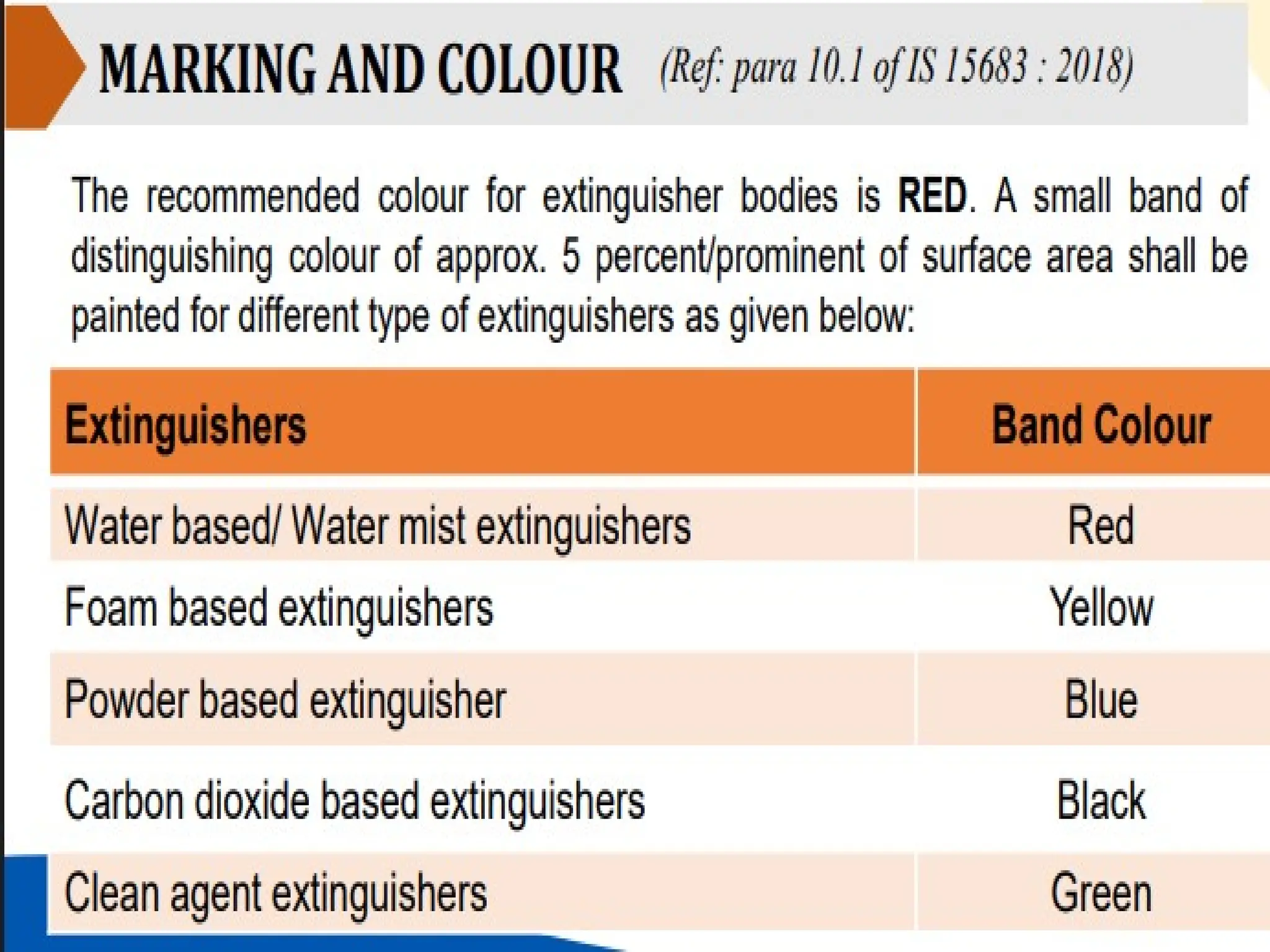
FIRE FIGHTING
2
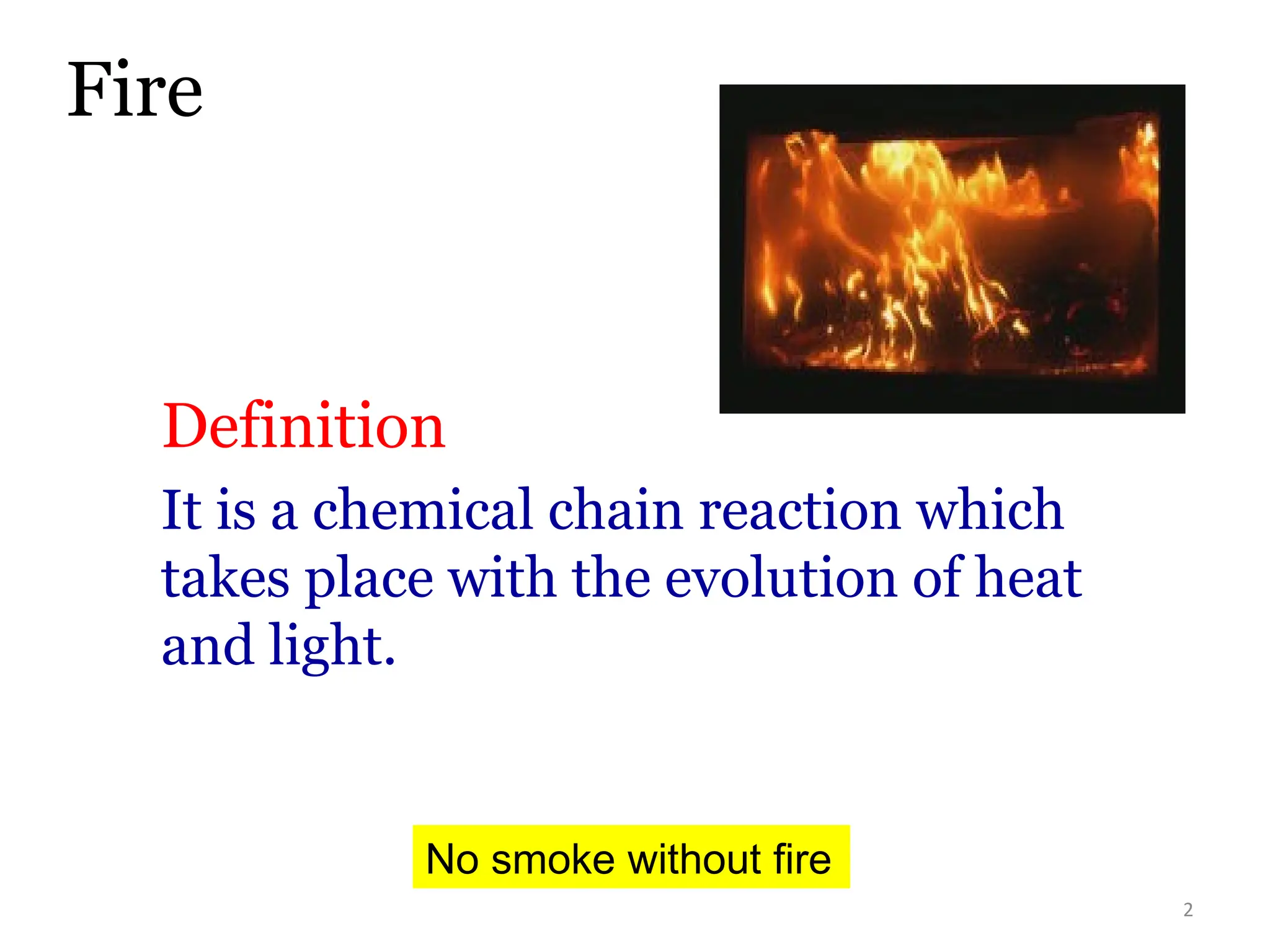
Fire
Definition
It is a chemical chain reaction which
takes place with the evolution of heat
and light.
No smoke without fire
3
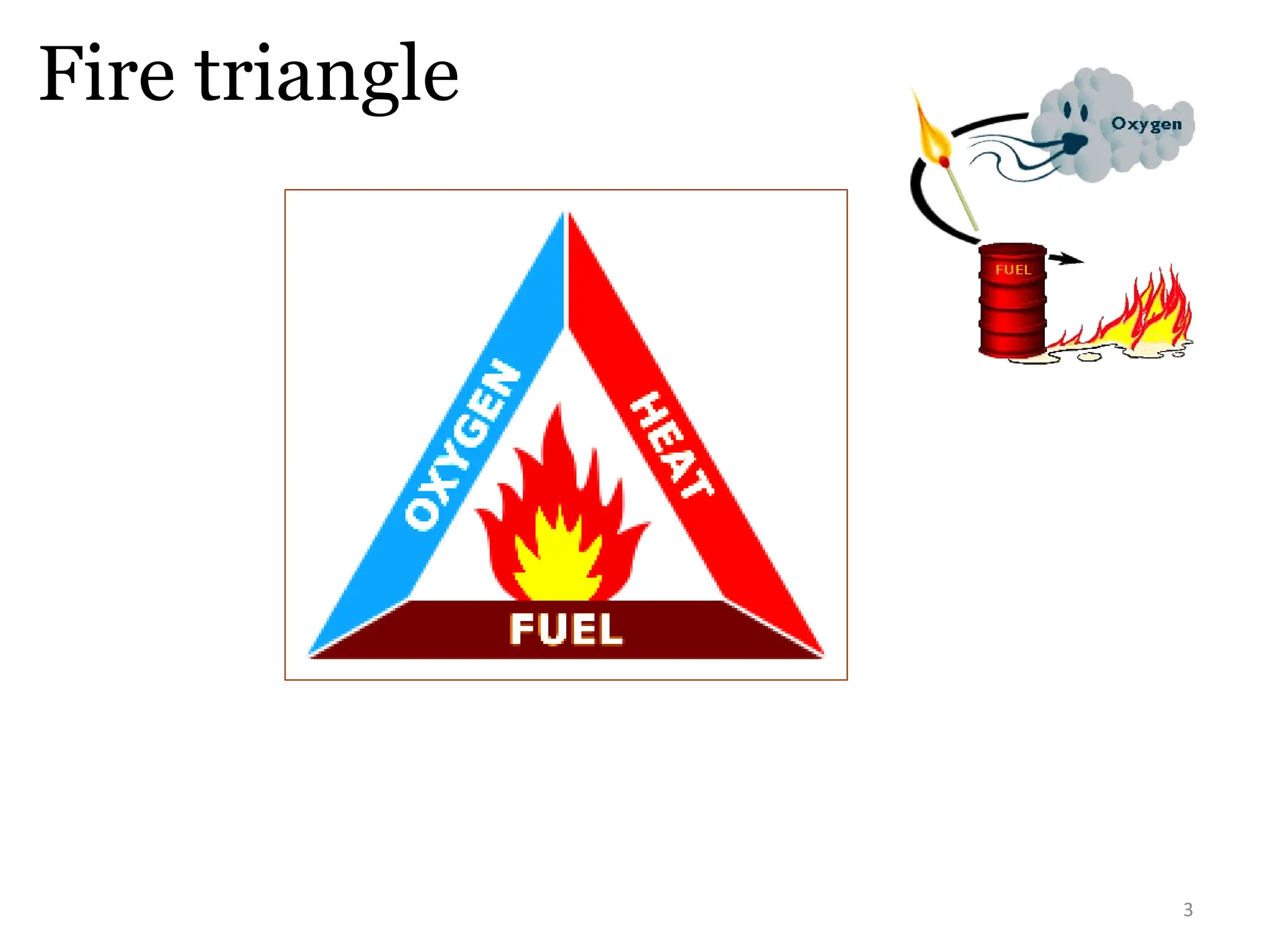
Fire triangle
4
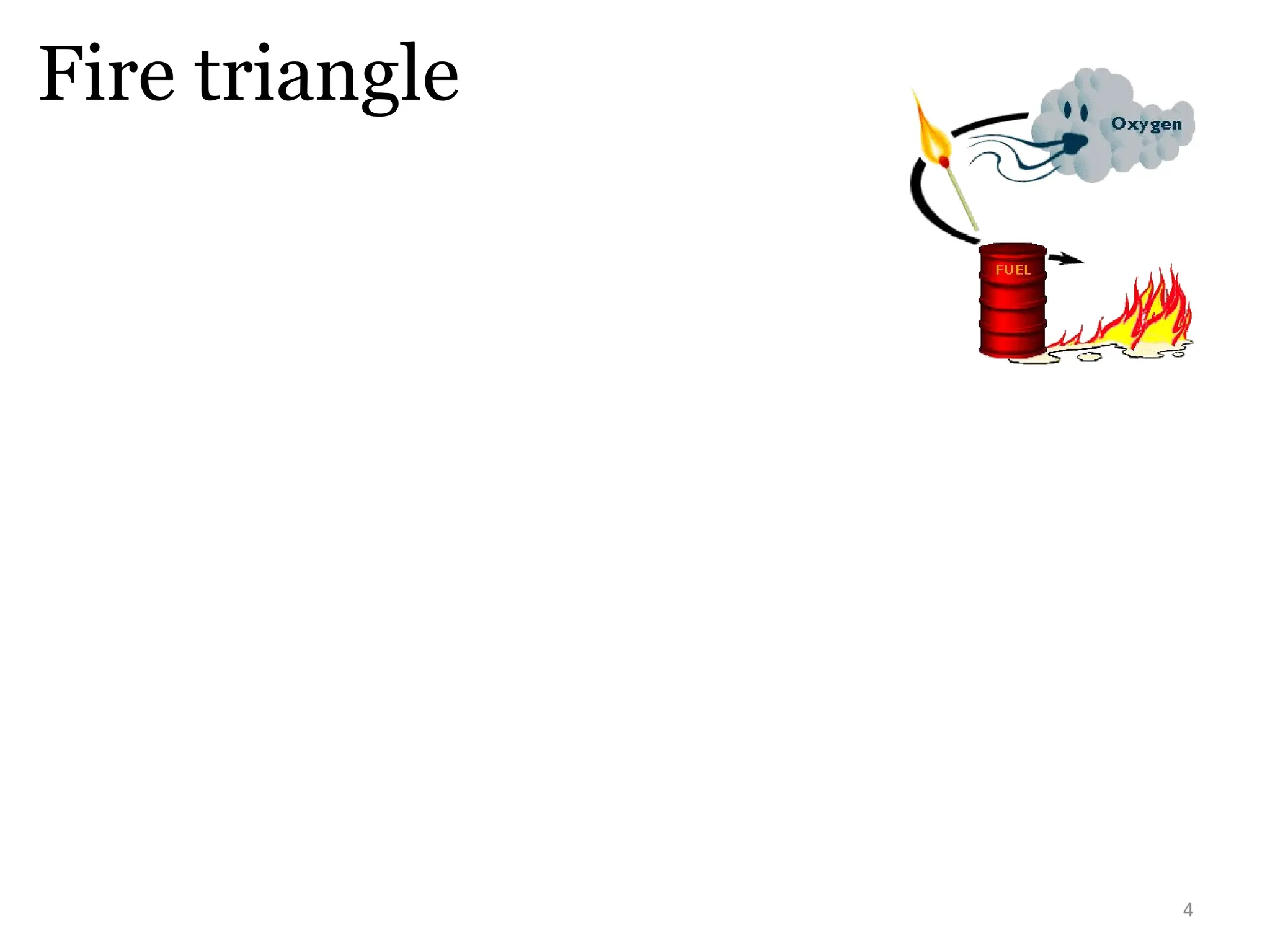
Fire triangle
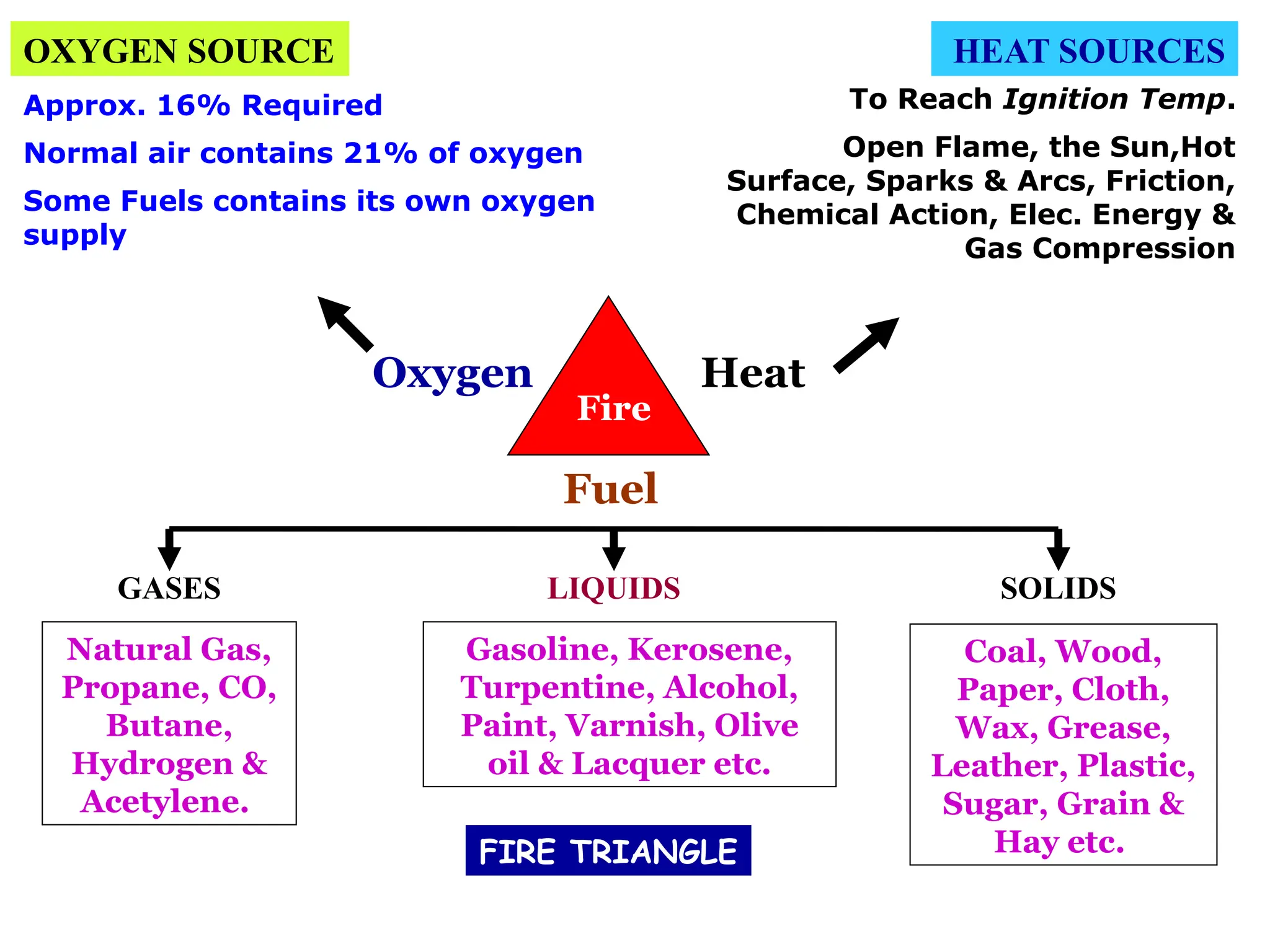
Oxygen Heat
Fuel
OXYGEN SOURCE HEAT SOURCES
Approx. 16% Required
Normal air contains 21% of oxygen
Some Fuels contains its own oxygen
supply
GASES
To Reach Ignition Temp.
Open Flame, the Sun,Hot
Surface, Sparks & Arcs, Friction,
Chemical Action, Elec. Energy &
Gas Compression
LIQUIDS SOLIDS
Natural Gas,
Propane, CO,
Butane,
Hydrogen &
Acetylene.
Gasoline, Kerosene,
Turpentine, Alcohol,
Paint, Varnish, Olive
oil & Lacquer etc.
Coal, Wood,
Paper, Cloth,
Wax, Grease,
Leather, Plastic,
Sugar, Grain &
Hay etc.
FIRE TRIANGLE
Fire
6
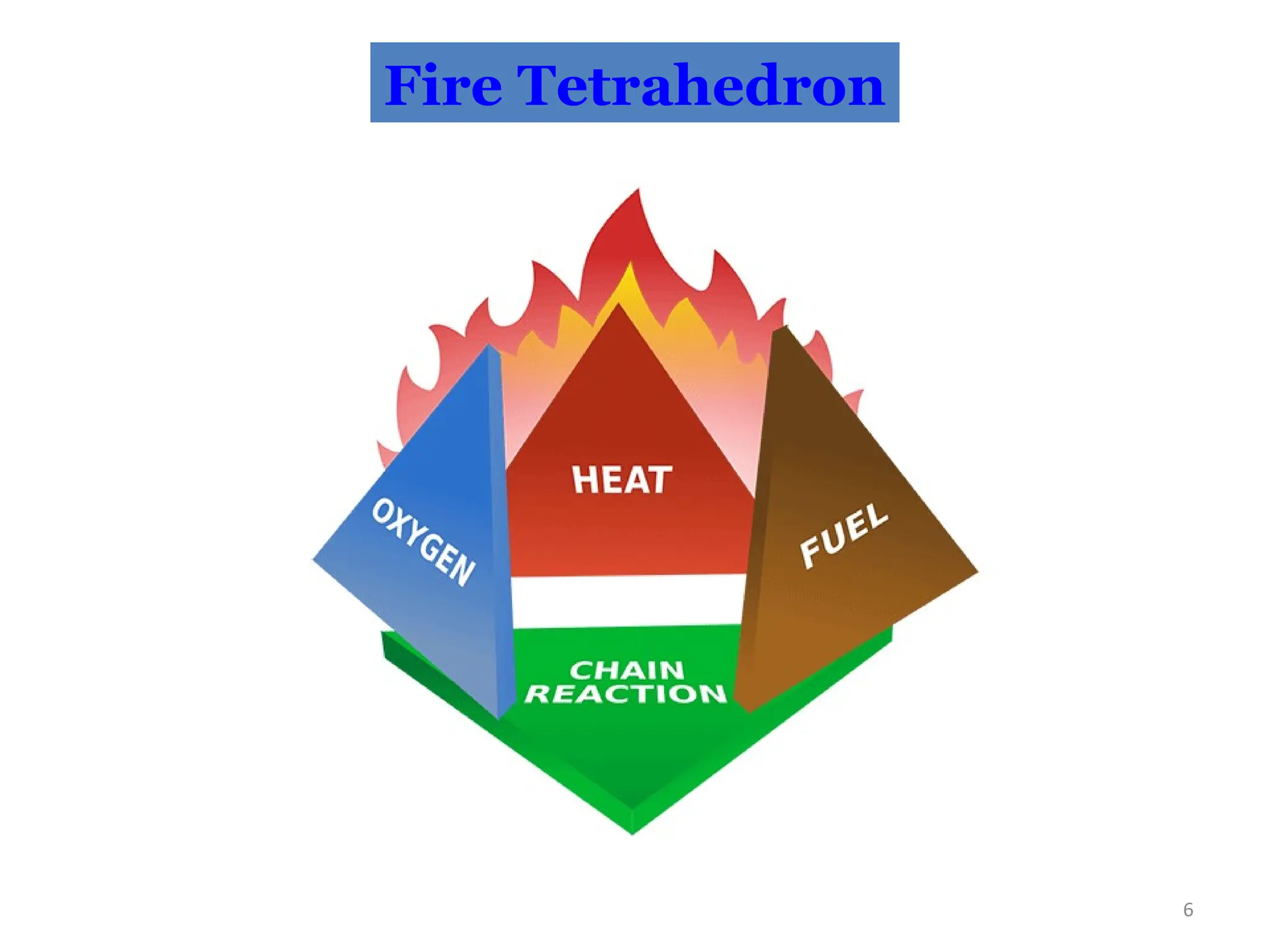
Fire Tetrahedron
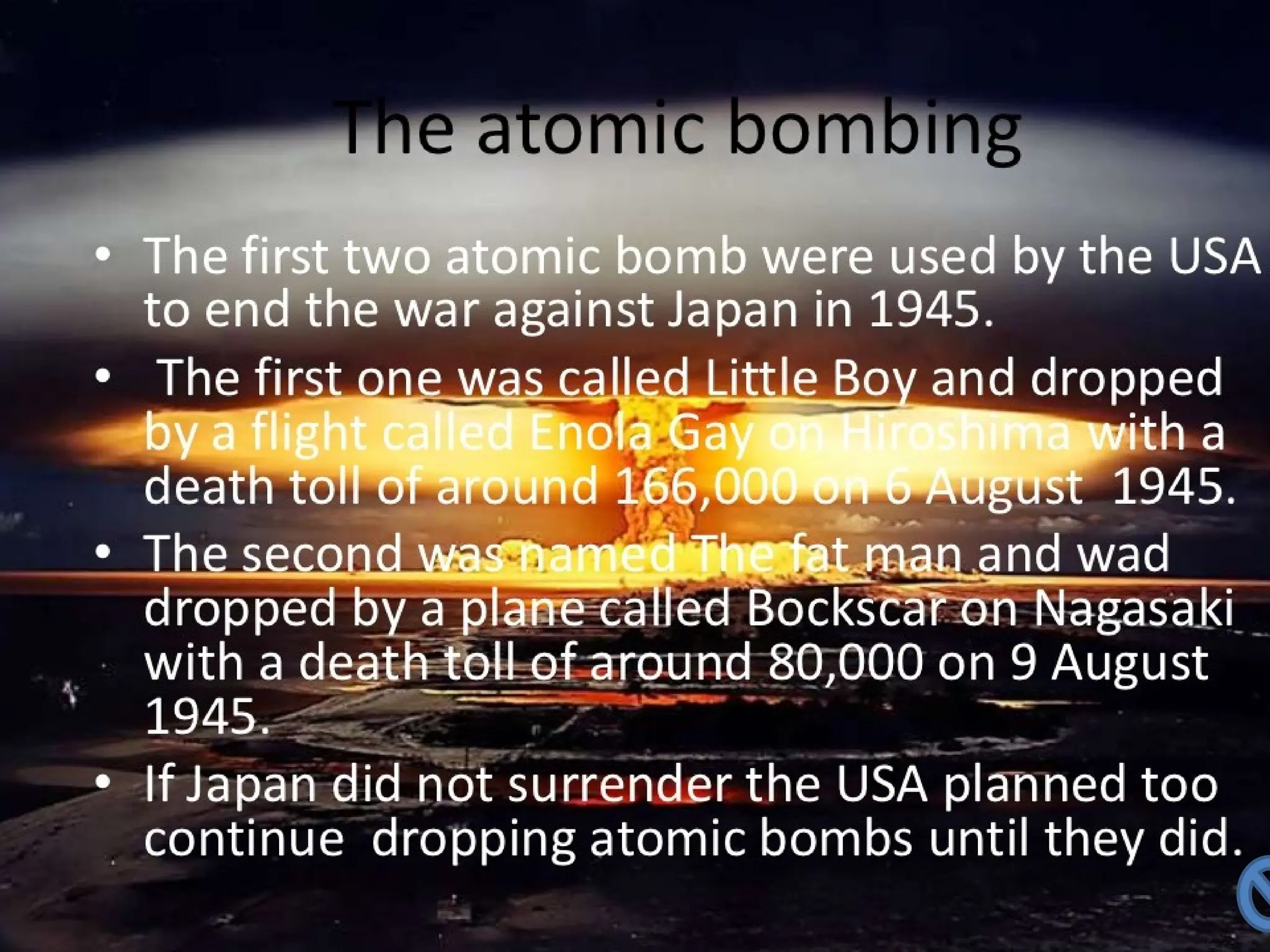
Tsutomu Yamaguchi
9
1. Starvation
Removal of un-burnt material from fire area
Principles of Fire Extinction
10
2. Smothering
Cutting off the supply of oxygen from fire area
Principles of Fire Extinction
11
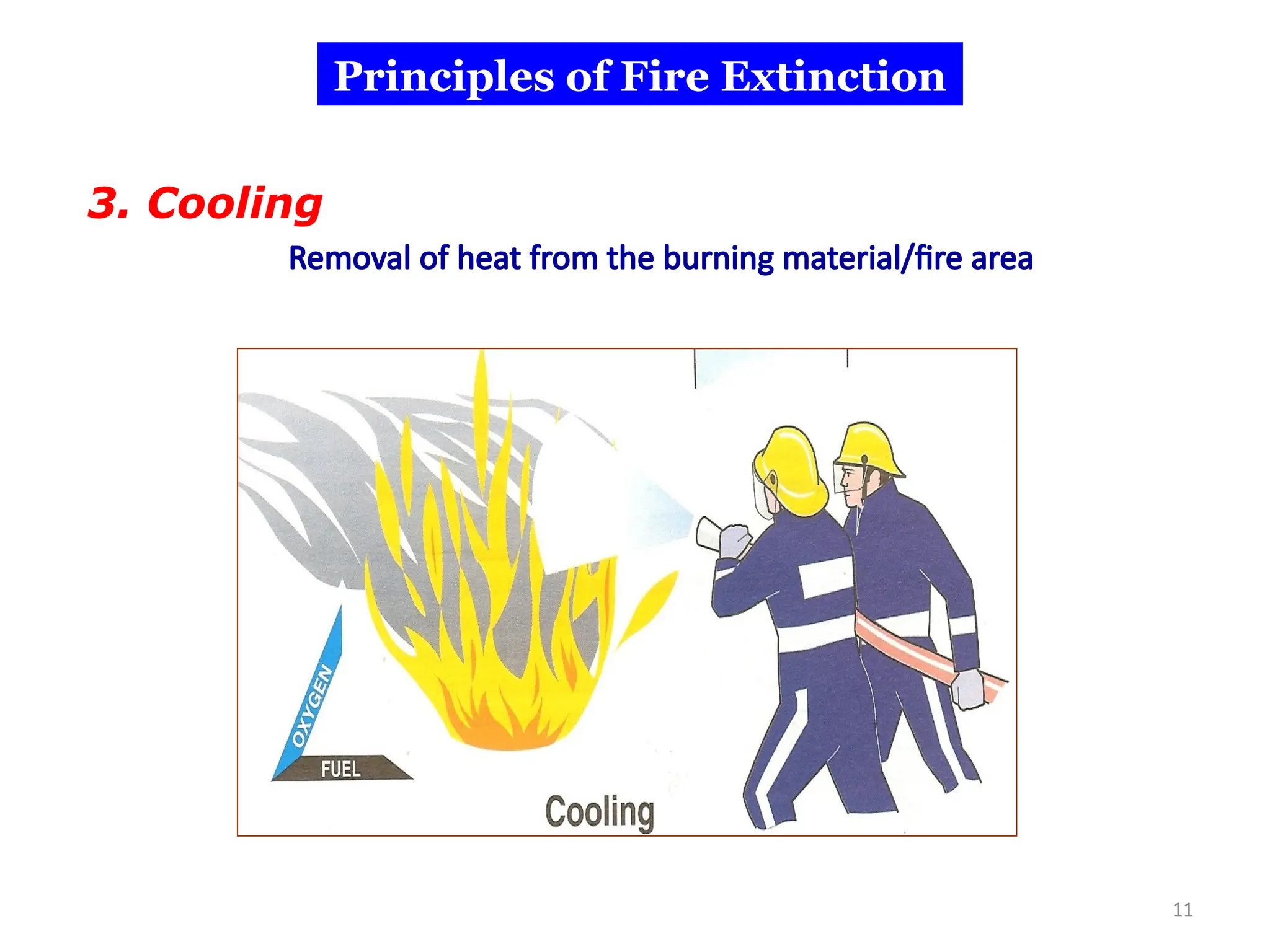
3. Cooling
Removal of heat from the burning material/fire area
Principles of Fire Extinction
12
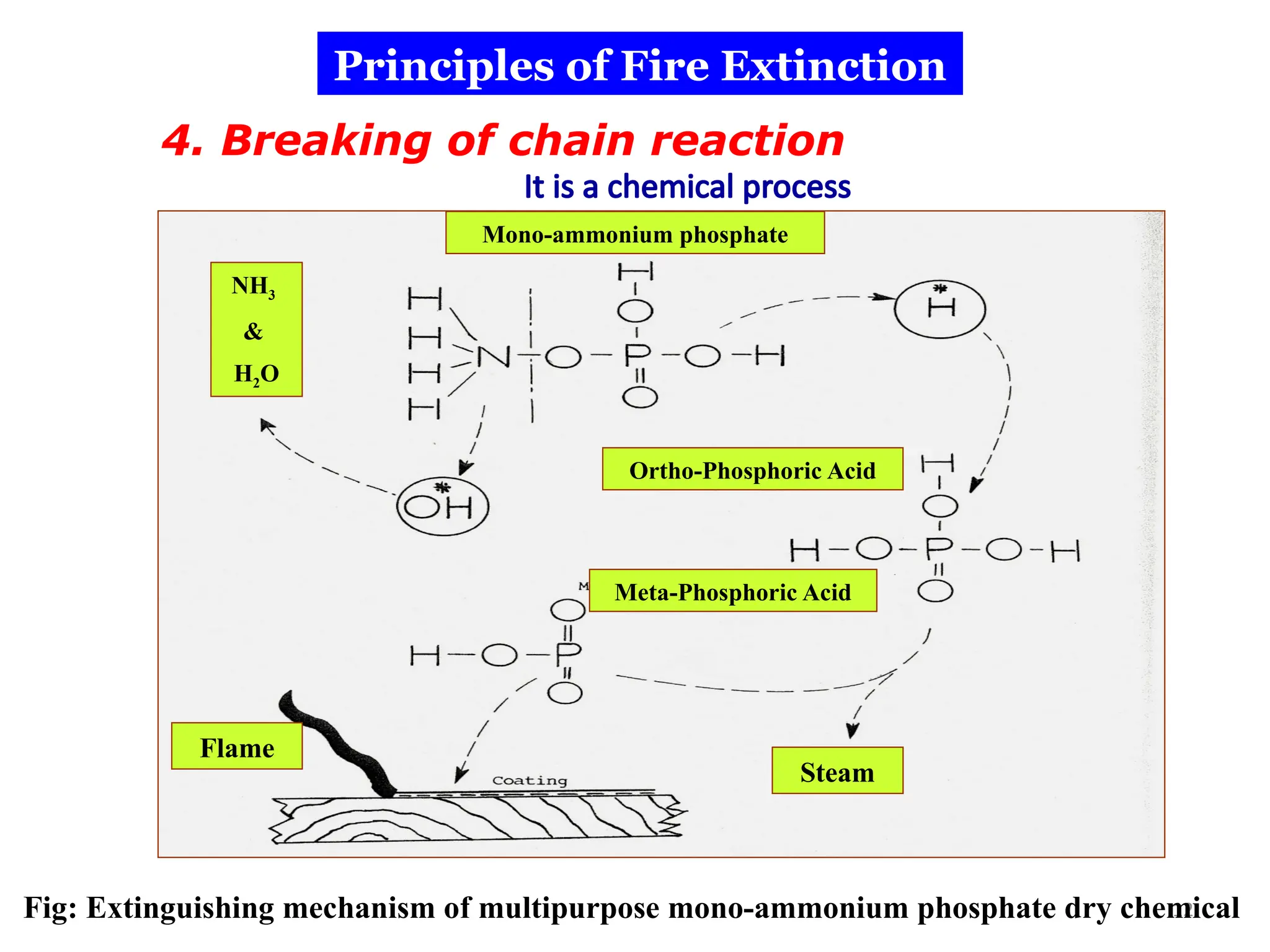
4. Breaking of chain reaction
It is a chemical process
Fig: Extinguishing mechanism of multipurpose mono-ammonium phosphate dry chemical
NH3
&
H2O
Flame
Steam
Meta-Phosphoric Acid
Ortho-Phosphoric Acid
Mono-ammonium phosphate
Principles of Fire Extinction
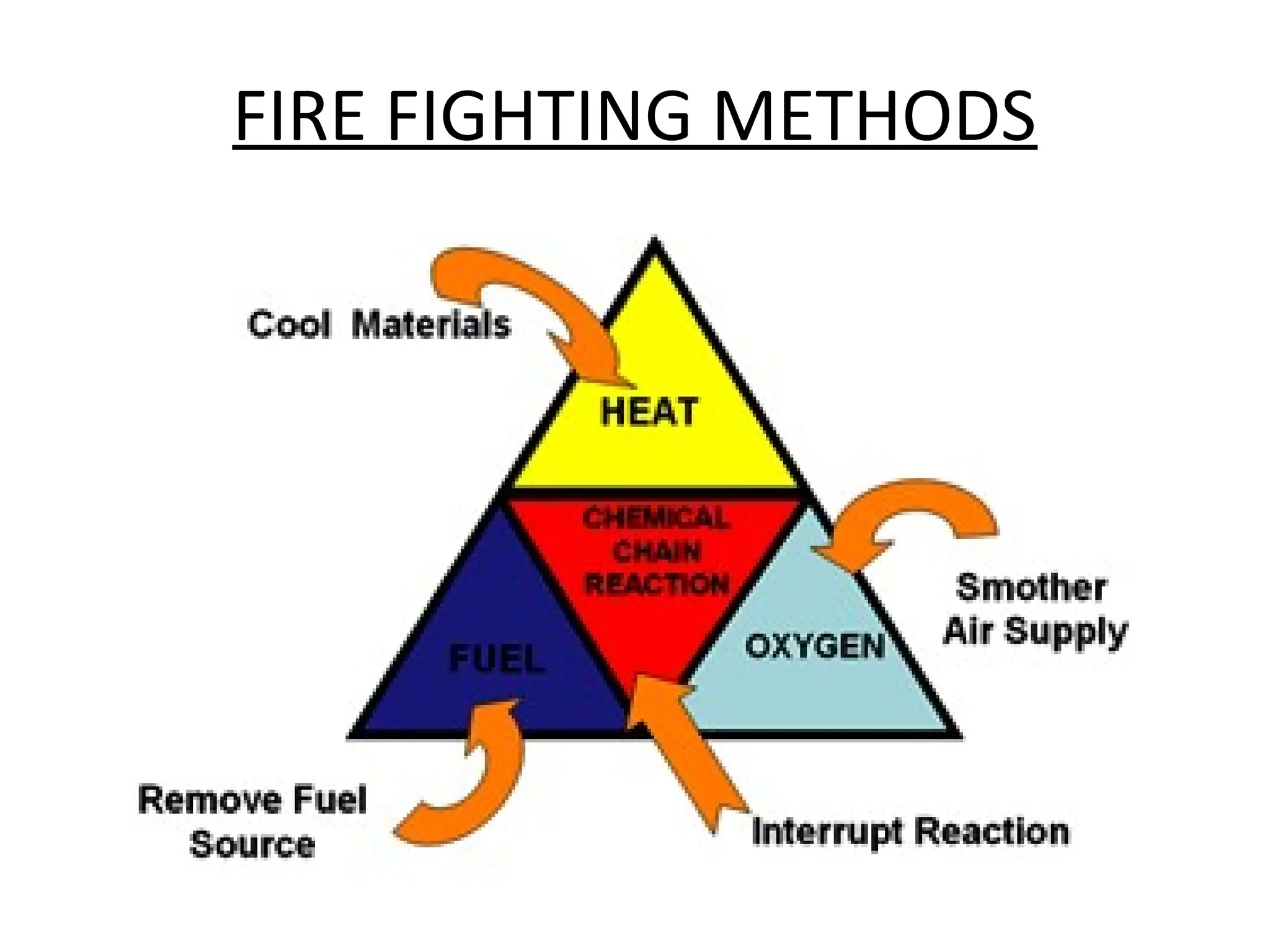
FIRE FIGHTING METHODS
15
PRINCIPLES OF FIRE EXTINCTION
• Starvation :
– Removal of unburned material from the fire area
• Smothering/Blanketing :
– Cutting off the supply of oxygen from fire area
• Cooling :
– Removal of heat from the burning material/fire
area
• Breaking of Chain Reaction :
– This is a chemical process
16
MODES OF SPREAD OF FIRE
• Conduction :
– It occurs only in solids i.e. metallic objects.
• Convection :
– It occurs both in liquids & gases due to
convection current.
• Radiation :
– It neither conduction nor convection. These
are heated rays emanating from the hot
object.
CONDUCTION
• Conduction is heat transfer within solids or
between contacting solids.
18
Conduction
Conduction is the point-to-point transmission of
heat energy.
HEAT
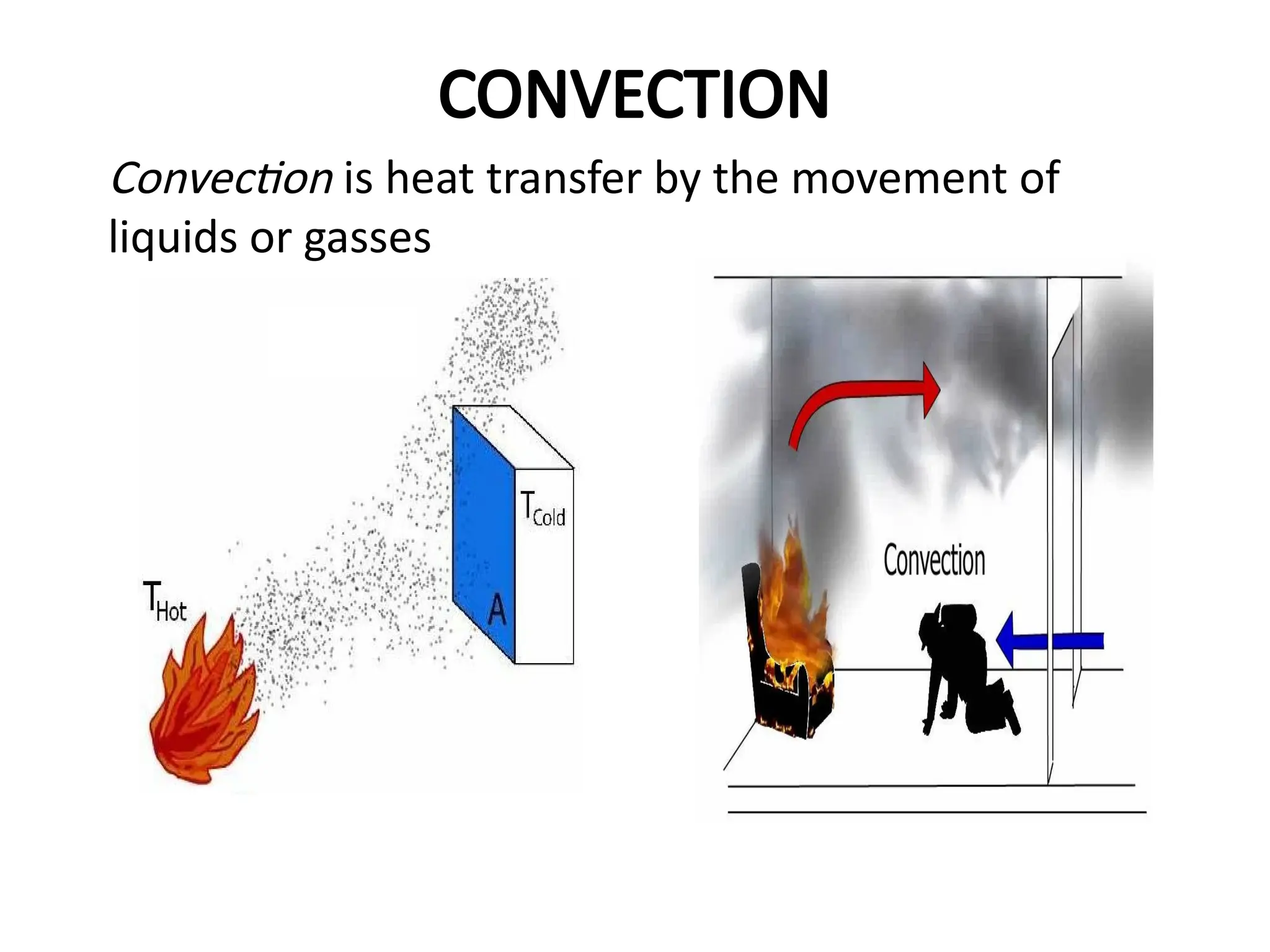
CONVECTION
Convection is heat transfer by the movement of
liquids or gasses
20
Convection
Convection is the transfer of heat energy by the
movement of heated fluids.
HEAT
RADIATION
Radiation is heat transfer by electromagnetic waves
22
Radiation
Radiation is the transmission of heat energy
through electromagnetic wave.
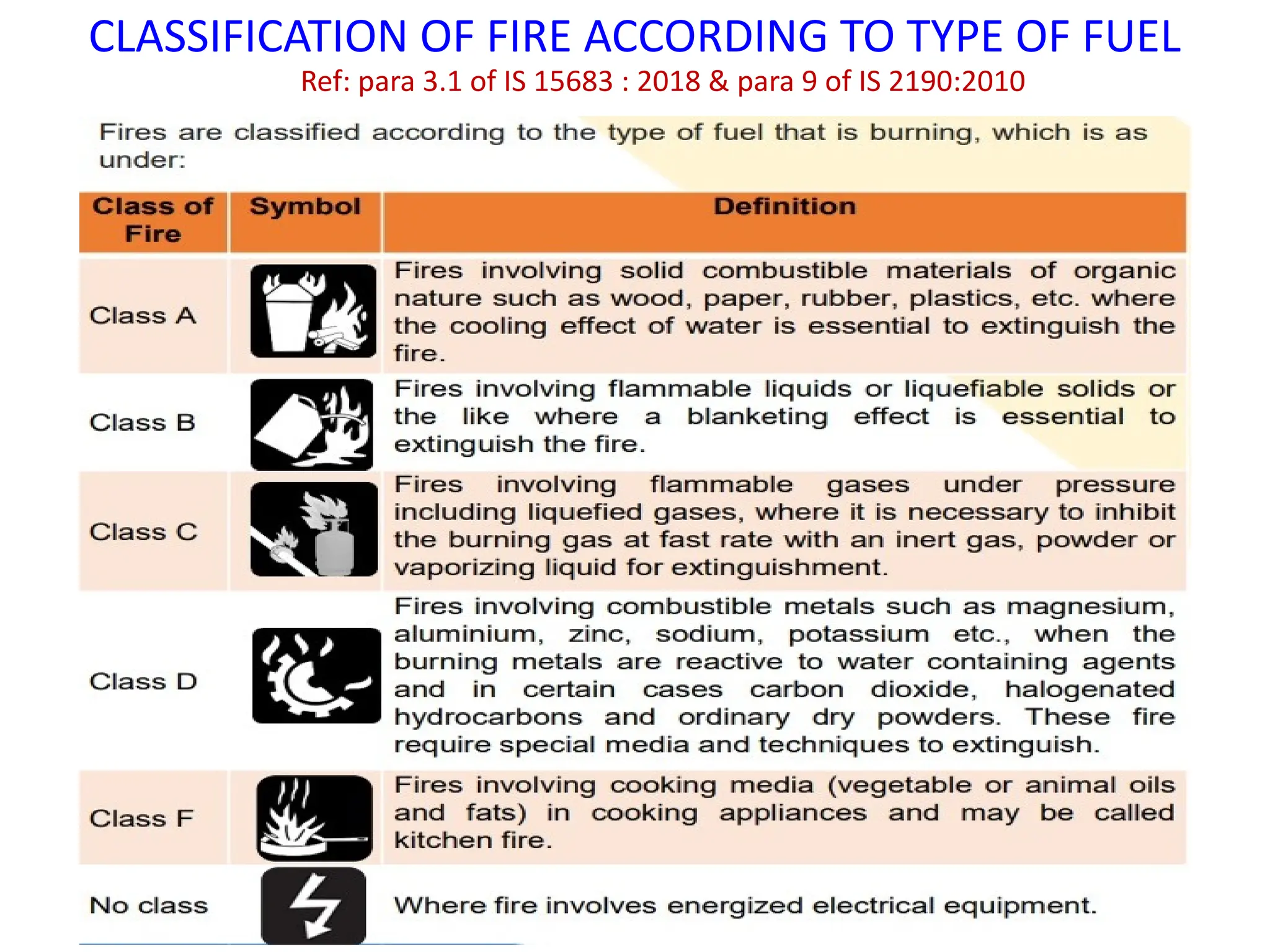
CLASSIFICATION OF FIRE ACCORDING TO TYPE OF FUEL
Ref: para 3.1 of IS 15683 : 2018 & para 9 of IS 2190:2010
24
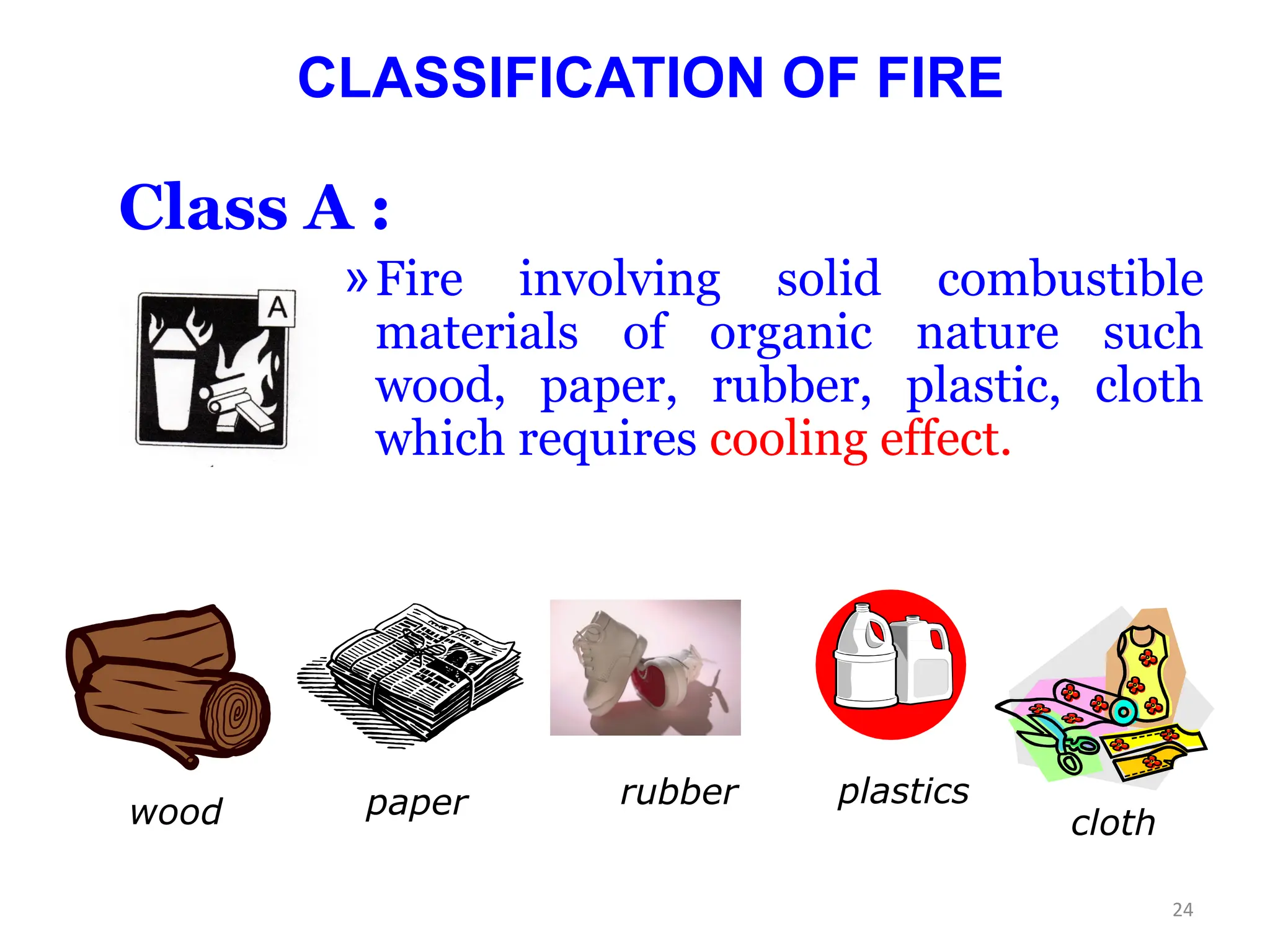
Class A :
»Fire involving solid combustible
materials of organic nature such
wood, paper, rubber, plastic, cloth
which requires cooling effect.
CLASSIFICATION OF FIRE
wood cloth
paper rubber plastics
25
Class B :
»Fire involving inflammable liquids
or liquefiable solids such as petrol,
kerosene, acids and solvents etc.
Oil Motor spirit
Paints
Acids
26
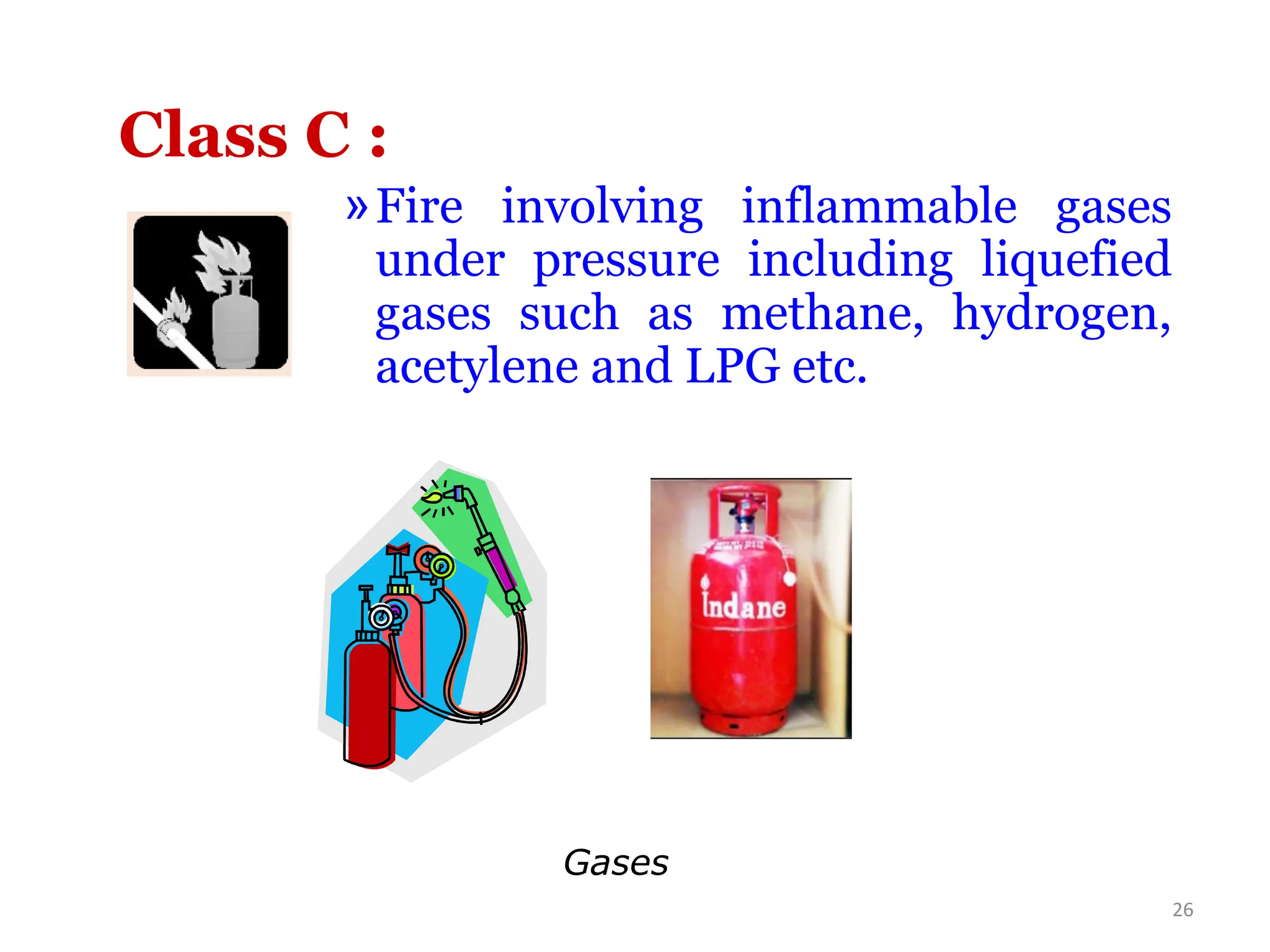
Class C :
»Fire involving inflammable gases
under pressure including liquefied
gases such as methane, hydrogen,
acetylene and LPG etc.
Gases
27
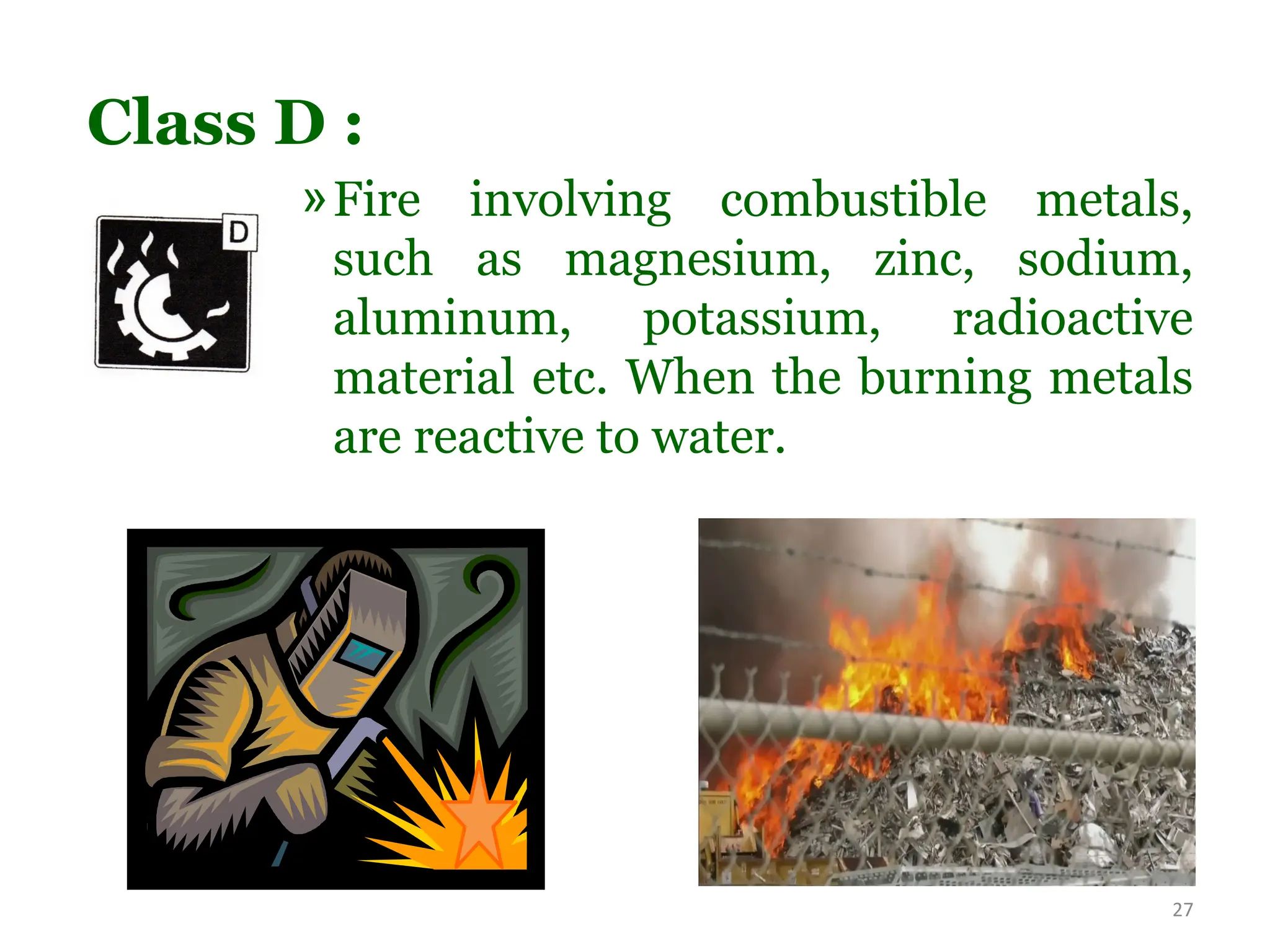
Class D :
»Fire involving combustible metals,
such as magnesium, zinc, sodium,
aluminum, potassium, radioactive
material etc. When the burning metals
are reactive to water.
C
Class F :
• Fire involving cooking media (fats,
grease and oils) in domestic
kitchens & commercial cooking
sites such as restaurants.
29
No classification – Electrical fires
Ref: para 9 of IS 2190 : 2010 and para 10.2.3 of IS 15683 : 2018
» Where fire involves energized electrical equipment.
» Where cleanliness and contamination of sensitive electrical equipment
are of importance or where the sensitivity of the control instruments or
electronic equipment and systems are likely to be affected, only Carbon
Di-oxide or Clean Agent type extinguishers should be used.
(Ref: para 10.3 of IS 2190 : 2010)
C
Energized electrical equipment
30
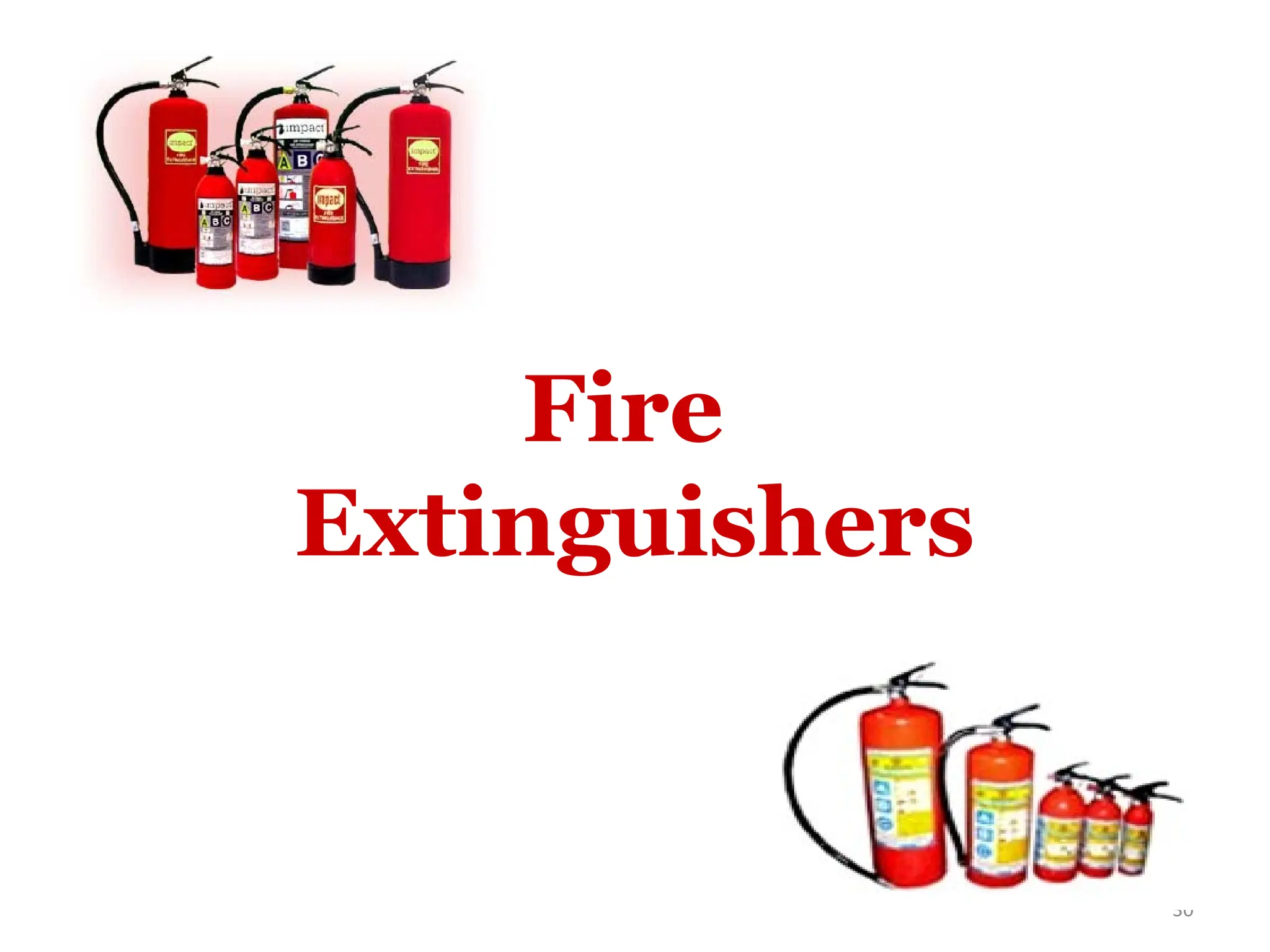
Fire
Extinguishers
Fire Extinguishers
32
Introduction
• One of the most common fire protection
appliances in use today.
• Is excellent to use on incipient fires.
• Can extinguish a small fire in much less time.
• Be knowledgeable about the different types
of fire extinguishers and their correct use.
• Known as “First aid fire fighting equipment”
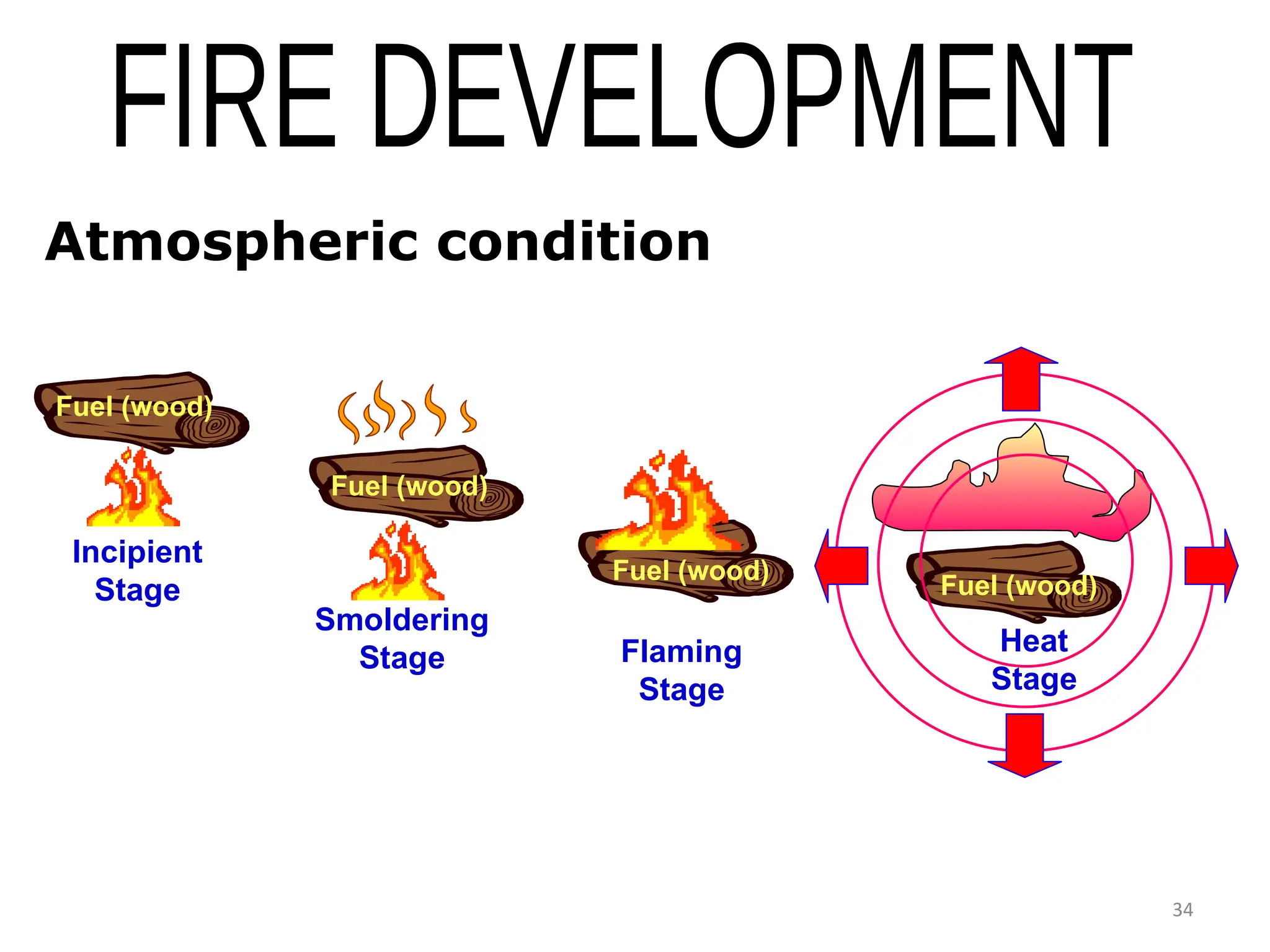
STAGES OF FIRE
^
34
Atmospheric condition
Incipient
Stage
Fuel (wood)
Fuel (wood)
Smoldering
Stage Flaming
Stage
Heat
Stage
Fuel (wood)
Fuel (wood)
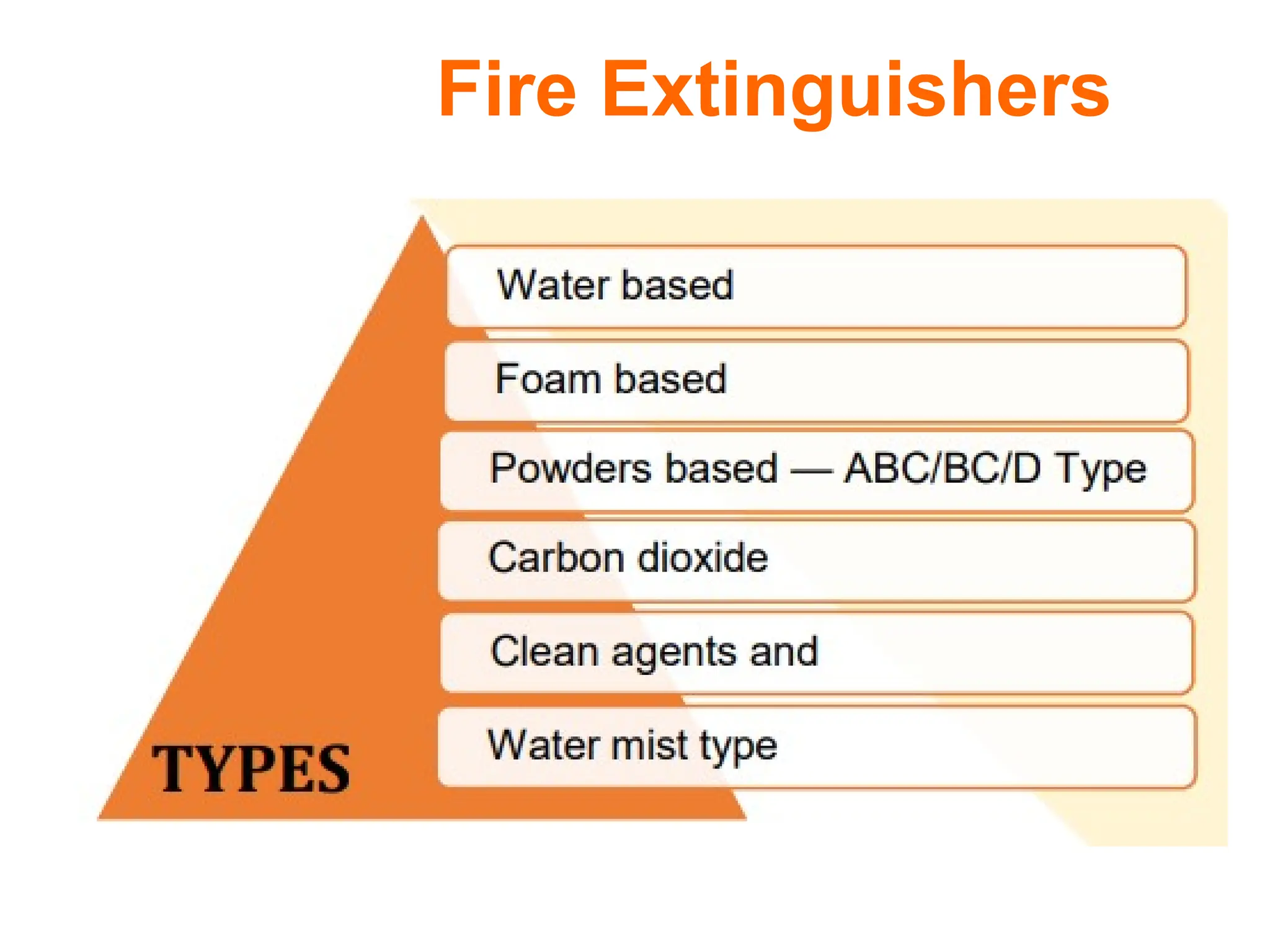
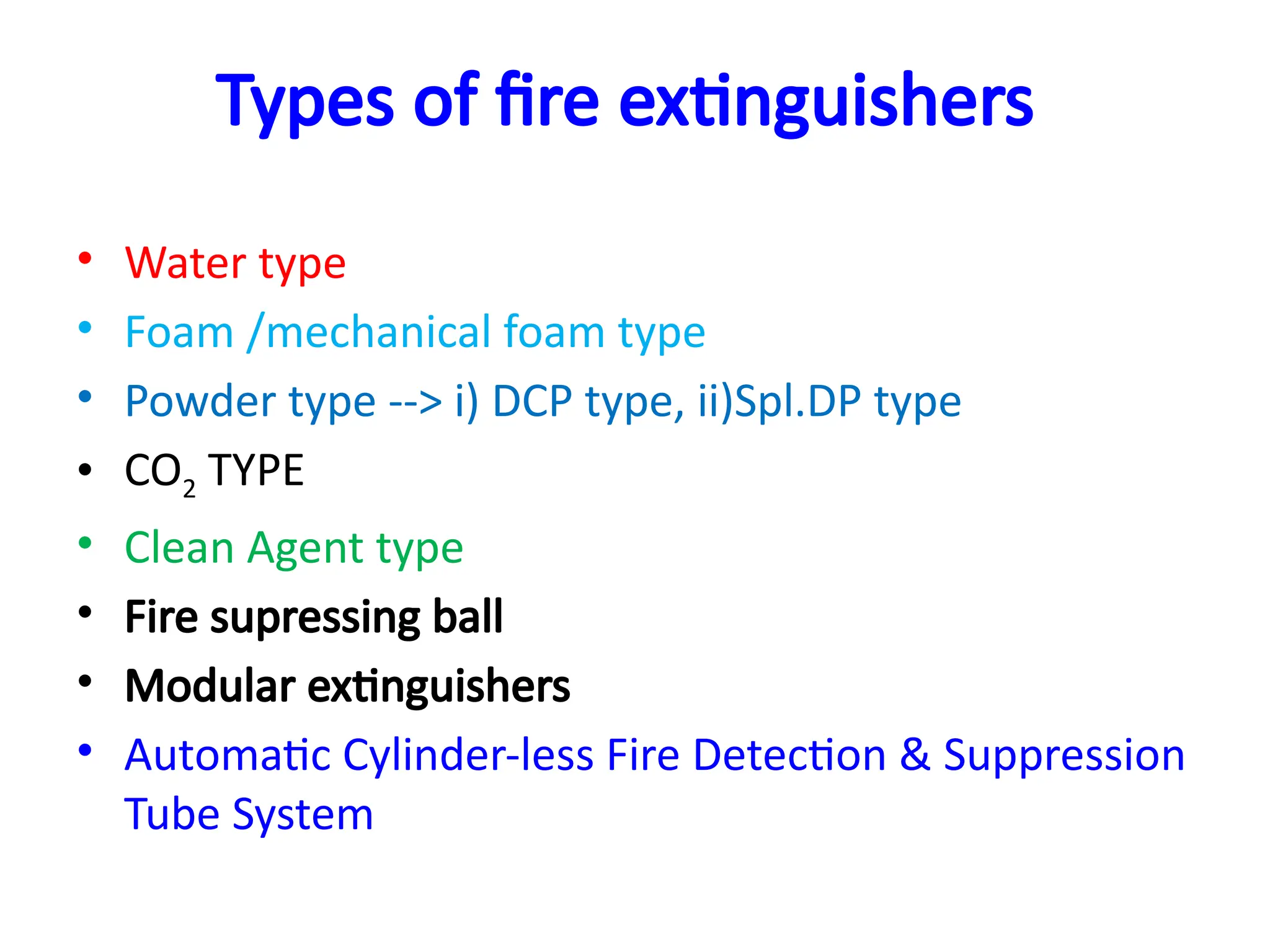
Types of fire extinguishers
• Water type
• Foam /mechanical foam type
• Powder type --> i) DCP type, ii)Spl.DP type
• CO2 TYPE
• Clean Agent type
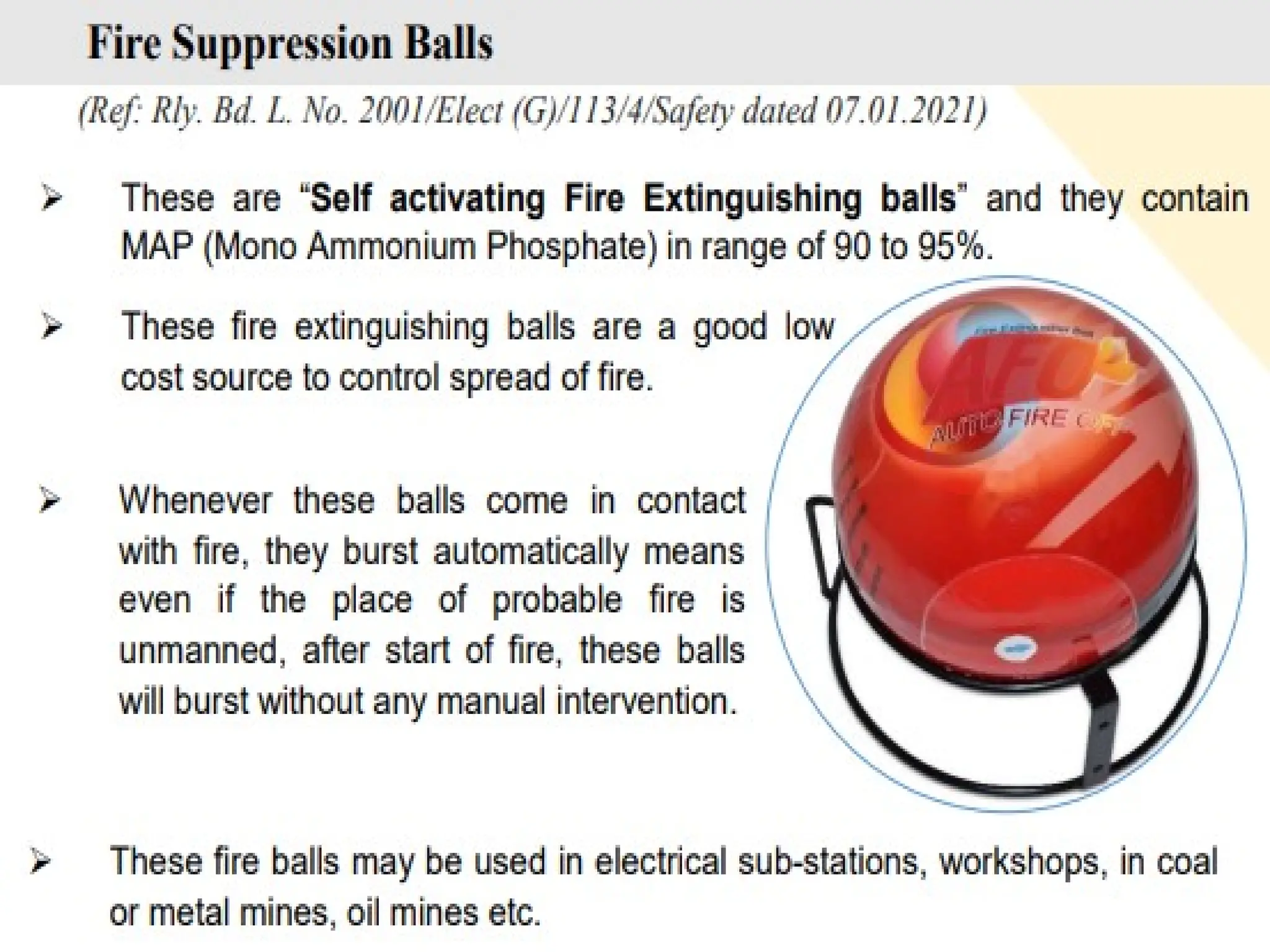
• Fire supressing ball
• Modular extinguishers
• Automatic Cylinder-less Fire Detection & Suppression
Tube System
• Effective on class A fires
• Advantage of being inexpensive, harmless,
and relatively easy to clean up
• It has favorable physical properties for fire
suppression.
• Its heat capacity (4.2 J/g.K) and high latent
heat of vaporization (2442 J/g) can absorb a
significant quantity of heat from flames and
fuels. (cooling)
• Water also expands 1700 times when it
evaporates to steam, results in the dilution of
the surrounding oxygen and fuel vapours.
38
Water
Water
• The direct effect is to cool down the
unburned product, stop the evolution
of vapour and starve the flame
gradually until complete
extinguishment.
• Cooling/Quenching.
Foam
• Applied to fuel fires as either
an aspirated (mixed &
expanded with air in a branch
pipe) or;
• Non-aspirated foam to form a
frothy blanket or seal over the
fuel,
• Preventing oxygen reaching it
(smothering)
• Foam can be used to
progressively extinguish fires
without flashback.
40
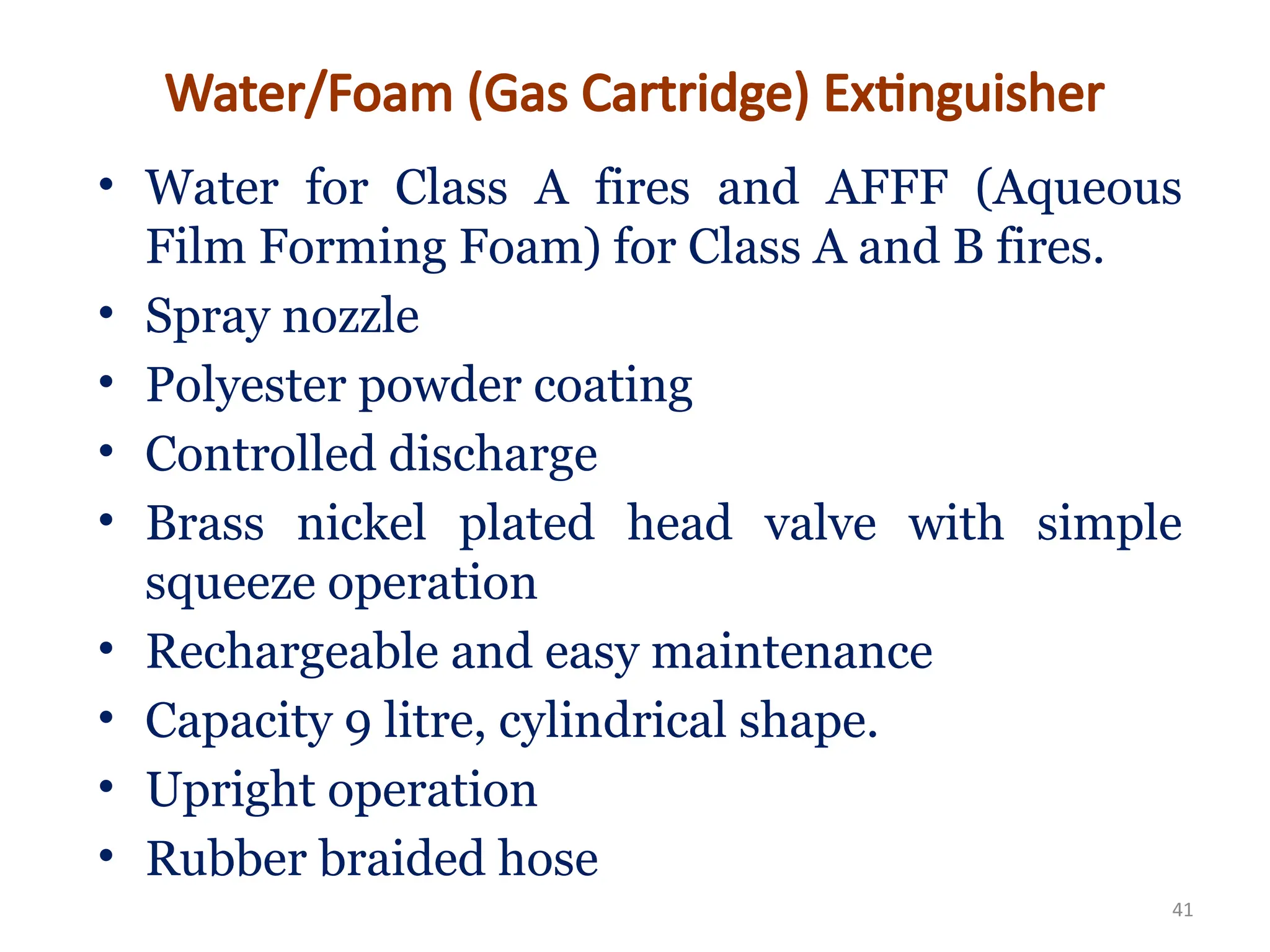
• Water for Class A fires and AFFF (Aqueous
Film Forming Foam) for Class A and B fires.
• Spray nozzle
• Polyester powder coating
• Controlled discharge
• Brass nickel plated head valve with simple
squeeze operation
• Rechargeable and easy maintenance
• Capacity 9 litre, cylindrical shape.
• Upright operation
• Rubber braided hose
41
Water/Foam (Gas Cartridge) Extinguisher
42
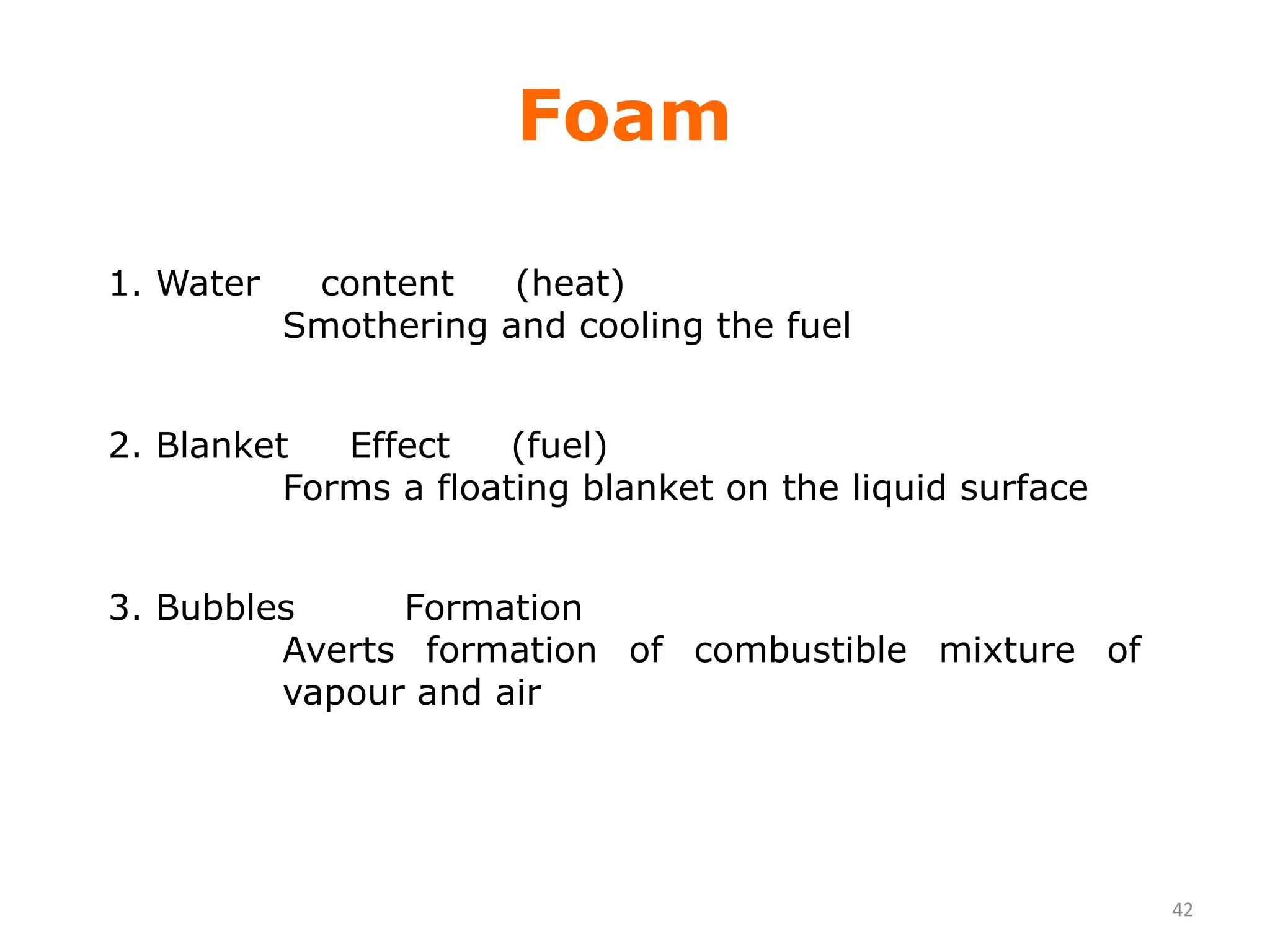
Foam
1. Water content (heat)
Smothering and cooling the fuel
2. Blanket Effect (fuel)
Forms a floating blanket on the liquid surface
3. Bubbles Formation
Averts formation of combustible mixture of
vapour and air
Water/Foam (Gas Cartridge) Extinguisher
Water Type Foam Type
Water/Foam (Gas Cartridge) Fire Extinguisher
1. Valve/extn. lever
2. Safety pin with
locking device
3. Valve handle
4. Gas cartridge
5. Discharge hose
6. Siphon tube
7. Hose holder
8. Discharge
nozzle/foam branch
pipe
45
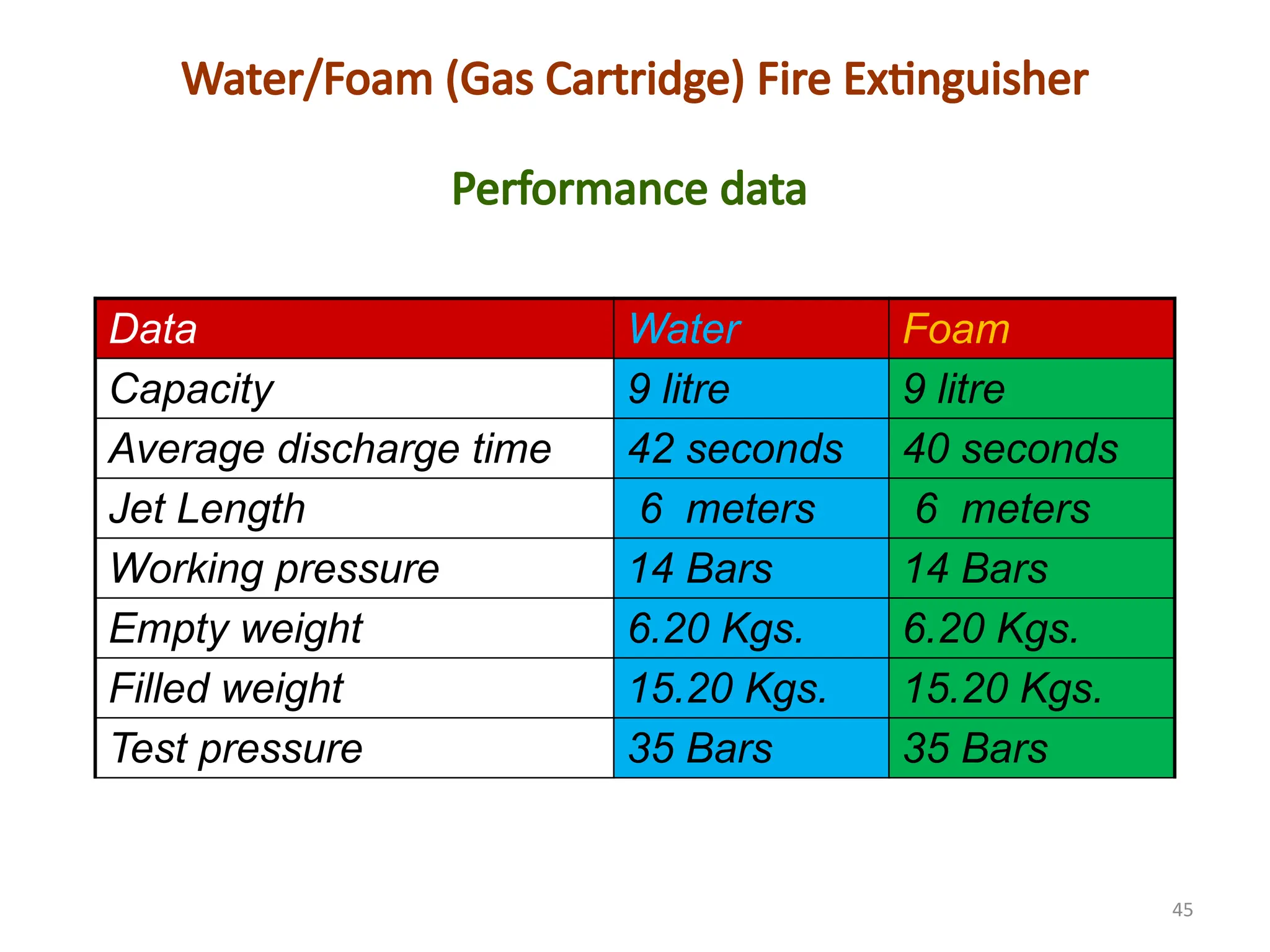
Water/Foam (Gas Cartridge) Fire Extinguisher
Performance data
Data Water Foam
Capacity 9 litre 9 litre
Average discharge time 42 seconds 40 seconds
Jet Length 6 meters 6 meters
Working pressure 14 Bars 14 Bars
Empty weight 6.20 Kgs. 6.20 Kgs.
Filled weight 15.20 Kgs. 15.20 Kgs.
Test pressure 35 Bars 35 Bars
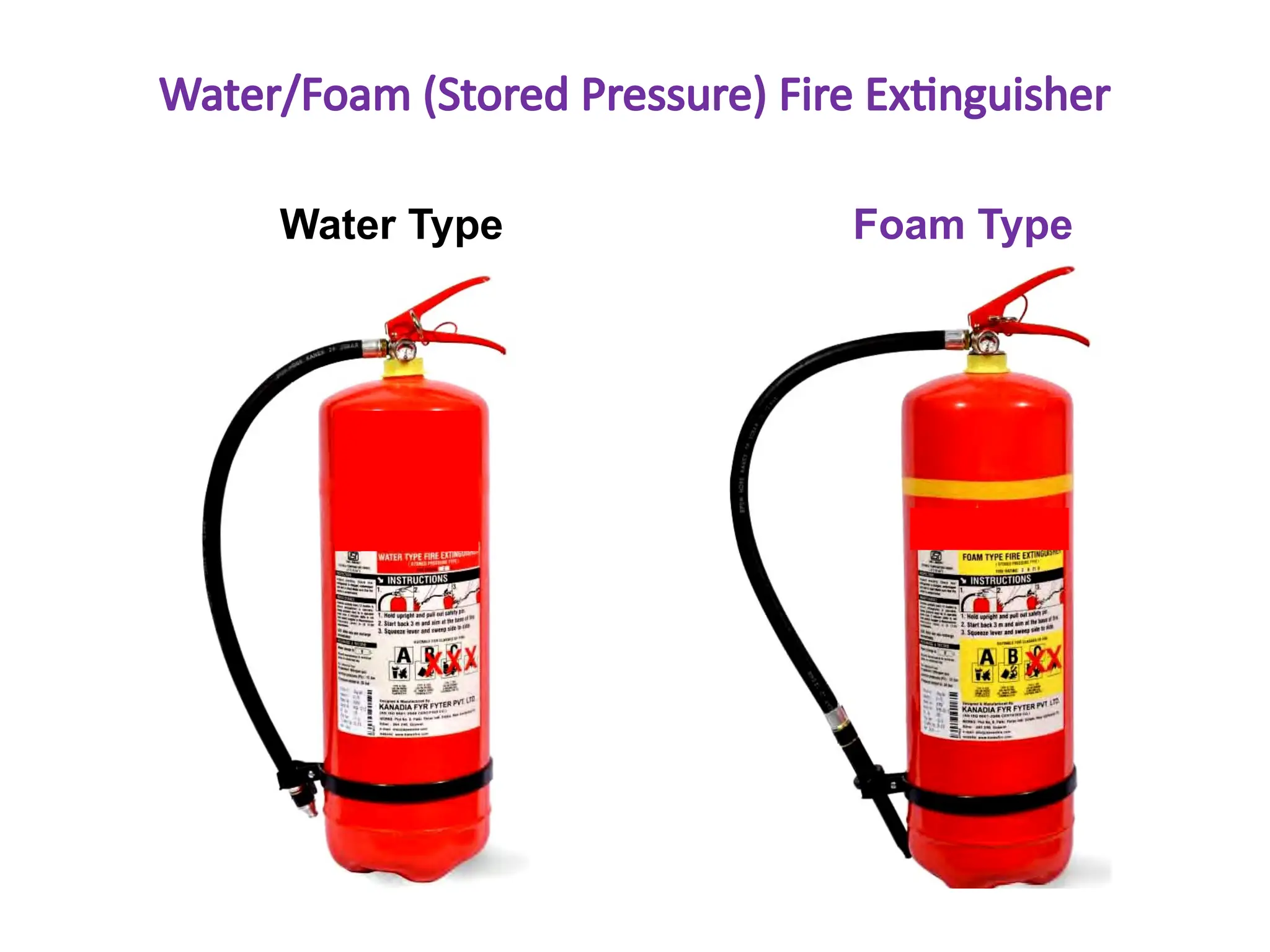
Water/Foam (Stored Pressure) Fire Extinguisher
Water Type Foam Type
47
Water/Foam (Stored Pressure) Fire Extinguisher
1. Valve/extn. lever
2. Safety pin with
locking device
3. Valve handle
4. Pressure gauge
5. Discharge hose
6. Siphon tube
7. Hose holder/belt
8. Filter
9. Discharge
nozzle/foam
branch pipe
Dry Chemical Powder
• This is a powder based agent that
extinguishes by separating the four parts of
the fire Tetrahedron.
• It prevents the chemical reactions involving
heat, fuel, and oxygen and halts the
production of fire sustaining "free-radicals",
thus extinguishing the fire.
• There are different types of Dry Chemical
and Dry Powder.
48
Dry Chemical Powder CO2 Gas Cartridge Plunger type FE
a. Mono-ammonium phosphate, also
known as "tri-class", "multipurpose" or
"ABC" dry chemical
• used on class A, B, and C fires.
• it receives its class A rating from the
agent's ability to melt and flow at
177 °C to smother the fire.
• more corrosive than other dry
chemical agents. Pale yellow in
colour
50
Dry Chemical Powder
b. Sodium Bicarbonate, "regular" or
"ordinary" used on class B and C fires
• in the heat of a fire, it releases a cloud
of carbon dioxide that smothers the
fire.
• white or blue in color
51
Dry Chemical Powder
c. Potassium Bicarbonate (Purple-K), used
on class B and C fires
• about two times as effective on class B
fires as sodium bicarbonate
• preferred dry chemical agent of the oil
and gas industry.
• colored violet to distinguish it.
52
Dry Chemical Powder
d. Potassium Bicarbonate & Urea
(Monnex/Powerex)
• used on class B and C fires.
• more effective than all other powders
due to its ability to decrepitates (where
the powder breaks up into smaller
particles) in the flame zone creating a
larger surface area for free radical
inhibition.
• grey in color.
53
Dry Chemical Powder
e. MET-L-KYL/PYROKIL is a specialty variation of
sodium bicarbonate
• used for fighting pyrophoric liquid fires
(ignite on contact with air).
• it also contains silica gel particles.
• the sodium bicarbonate interrupts the chain
reaction of the fuel and the silica soaks up
any unburned fuel, preventing contact with
air.
• it is effective on other class B fuels as well.
• blue/red in color.
54
Dry Chemical Powder
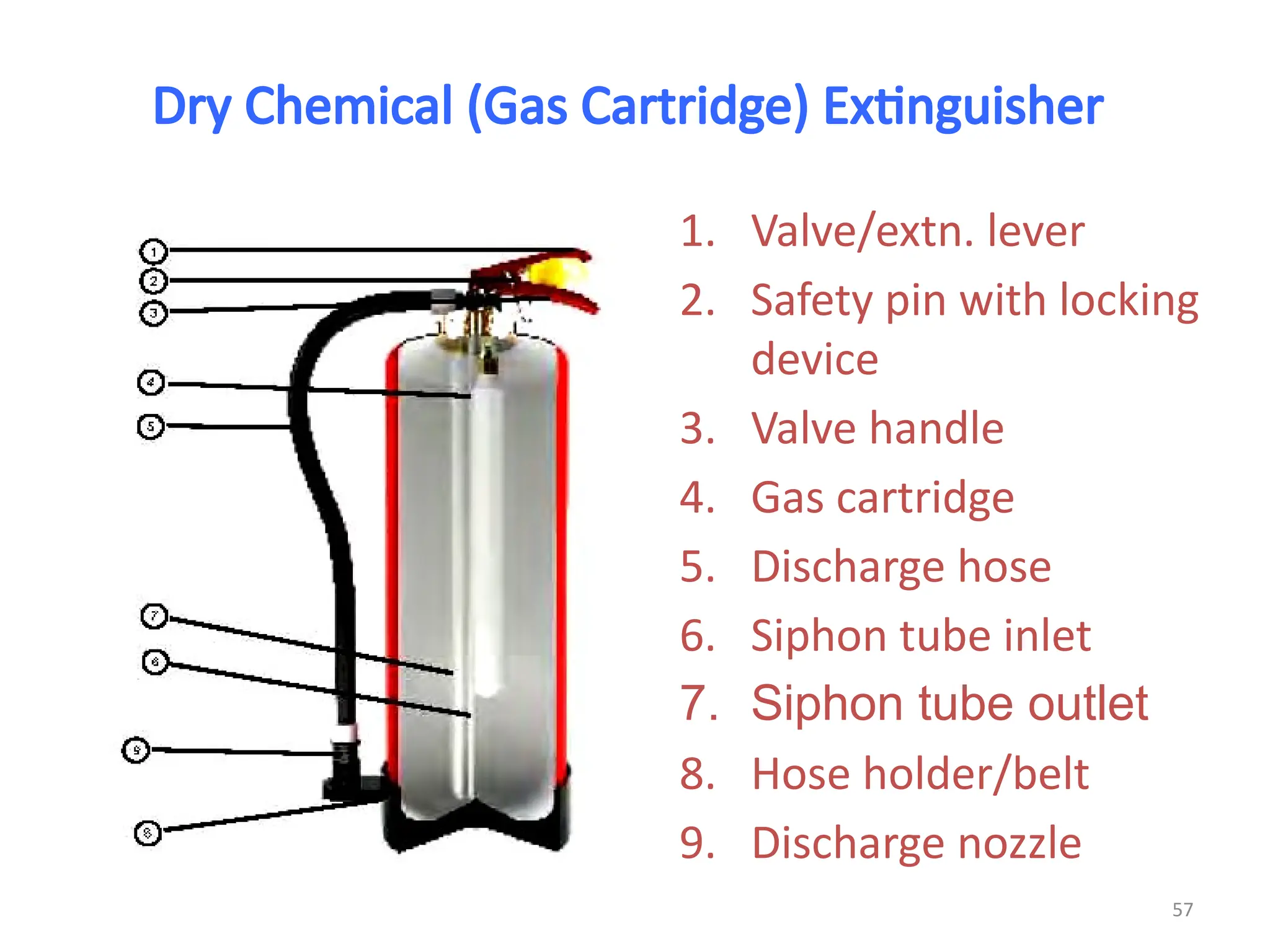
Dry Chemical (Gas Cartridge) Extinguisher
55
• Polyester powder coating
• Controlled discharge
• Brass nickel plated head valve with
simple squeeze operation
• Rechargeable and easy maintenance
• Capacity from 1 to 9 kg, cylindrical shape
• Rubber braided hose
• Upright operation
56
Dry Chemical (Gas Cartridge) Extinguisher
57
1. Valve/extn. lever
2. Safety pin with locking
device
3. Valve handle
4. Gas cartridge
5. Discharge hose
6. Siphon tube inlet
7. Siphon tube outlet
8. Hose holder/belt
9. Discharge nozzle
58
Dry Chemical (GC) Extinguisher Data
Capacity 4 Kg 6 kg 9 Kg
Ave. discharge time 18 sec 21 sec 23 sec
Jet Length 2 meters 4 metres 6 meters
Working pressure 15 Bars 15 Bars 15 Bars
Empty weight 4.6 Kgs. 4.8 6.20 Kgs.
Filled weight 8.6 Kgs. 10.8 15.20 Kgs.
Test pressure 35 Bars 35 Bars 35 Bars
Dry Chemical (Gas Cartridge) Extinguisher
Performance data
59
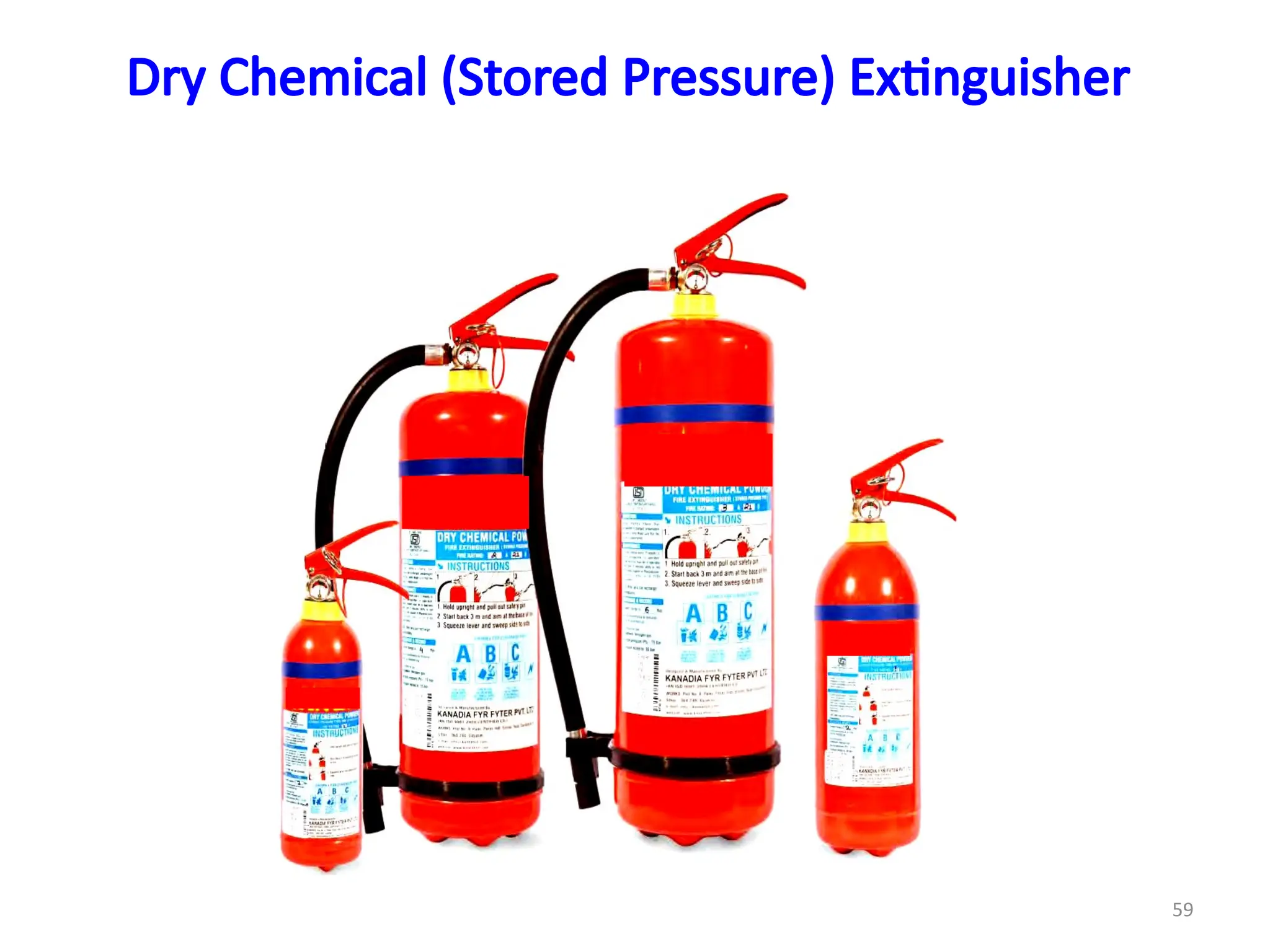
Dry Chemical (Stored Pressure) Extinguisher
60
Dry Chemical (Stored Pressure) Extinguisher
1. Valve/extn. lever
2. Safety pin with
locking device
3. Valve handle
4. Pressure gauge
5. Discharge hose
6. Siphon tube
7. Hose holder/belt
8. Discharge nozzle
61
Dry Chemical (SP) Extinguisher Data
Capacity 1 Kg 2 kg 4 Kg 6 kg 9 Kg
Ave. discharge
time
9 s 14 s 18 s 21 s 23 s
Jet Length 1 m 1 m 2 m 4 m 6 m
Working
pressure
15 Bars 15 Bars 15 Bars 15 Bars 15 Bars
Empty weight 1.1 kg 1.4 2.7 Kg. 3 kg 4.18 Kg.
Filled weight 2.1 kg 3.4 kg 6.7 Kg. 9 kg 13.18 Kg.
Test pressure 35 Bars 35 Bars 35 Bars 35 Bars 35 Bars
Performance data
Dry Chemical (Stored Pressure) Extinguisher
a. Sodium Chloride (Super-D, Met-L-X) contains
sodium chloride salt, which melts to form an
oxygen-excluding crust over the metal
• useful on most alkali metals including
sodium and potassium, and other metals
including magnesium, titanium, aluminium,
and zirconium.
b. Ternary Eutectic Chloride (TEC) contains
chlorides of barium, sodium and potassium,
which melts and forms fused skin over burning
metal and absorbs heat and cut-off oxygen to fire.
62
Dry Powder for Metal Fires
C. Graphite-based (G-Plus, G-1, Lith-X, Pyromet
or METAL.FIRE.XTNGSHR) contains dry graphite
that smothers burning metals
• developed, designed for magnesium, works
on other metals as well
• can be used on very hot burning metal fires
such as lithium
• will not stick to and extinguish flowing or
vertical lithium fires
• acts as a heat sink to dissipate heat as well
as smothering the metal fire.
63
Dry Powder for Metal Fires
d. Sodium Carbonate-based (Na-X)
• used where stainless steel piping and
equipment could be damaged by sodium
chloride based agents to control sodium,
potassium, and sodium-potassium alloy
fires.
• limited use on other metals. Smothers and
forms a crust.
64
Most class D extinguishers will have a special low velocity
nozzle or discharge wand to gently apply the agent in
large volumes to avoid disrupting any finely divided
burning materials. Agents are also available in bulk and
can be applied with a scoop or shovel
Dry Powder for Metal Fires
65
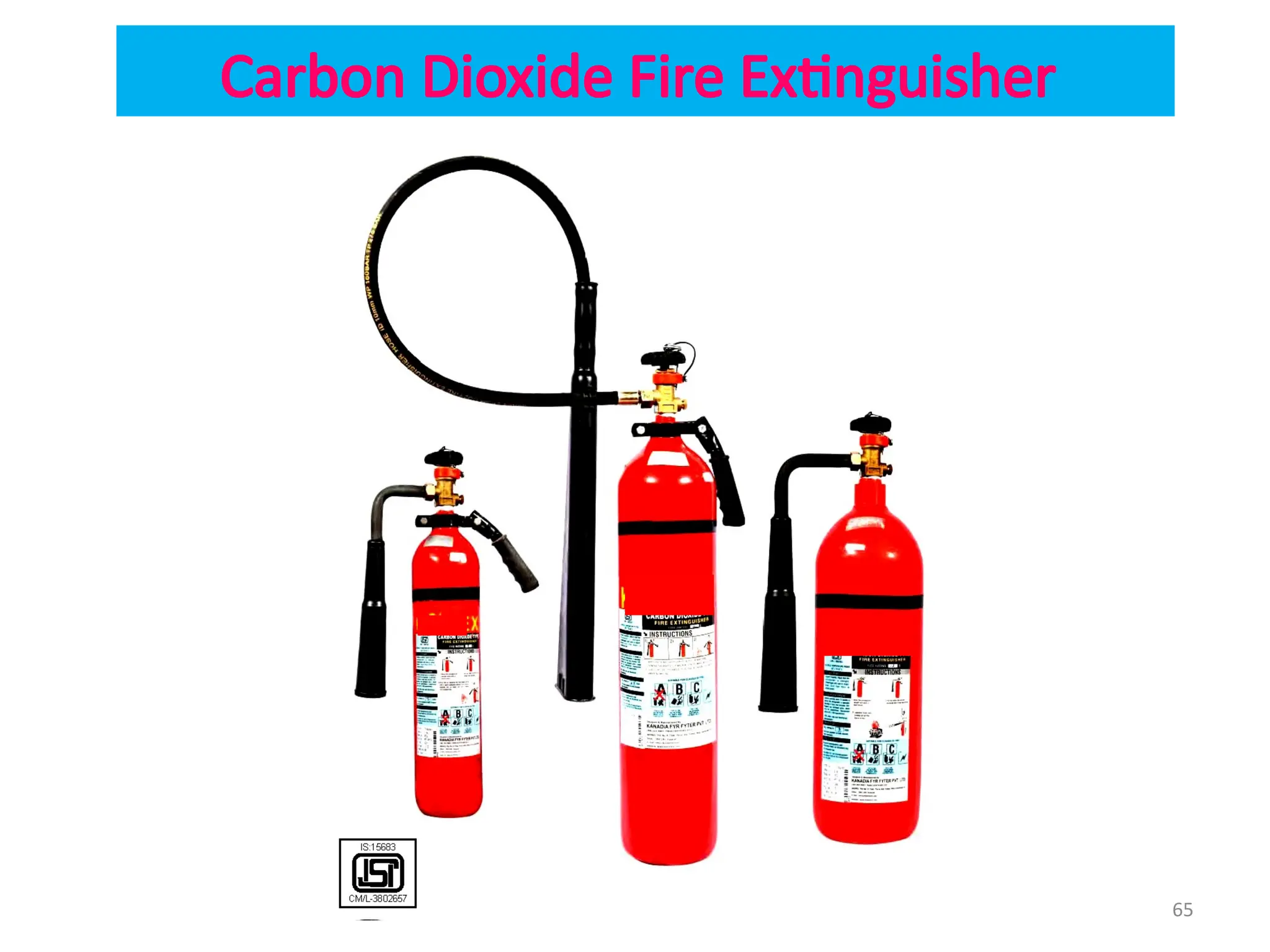
Carbon Dioxide Fire Extinguisher
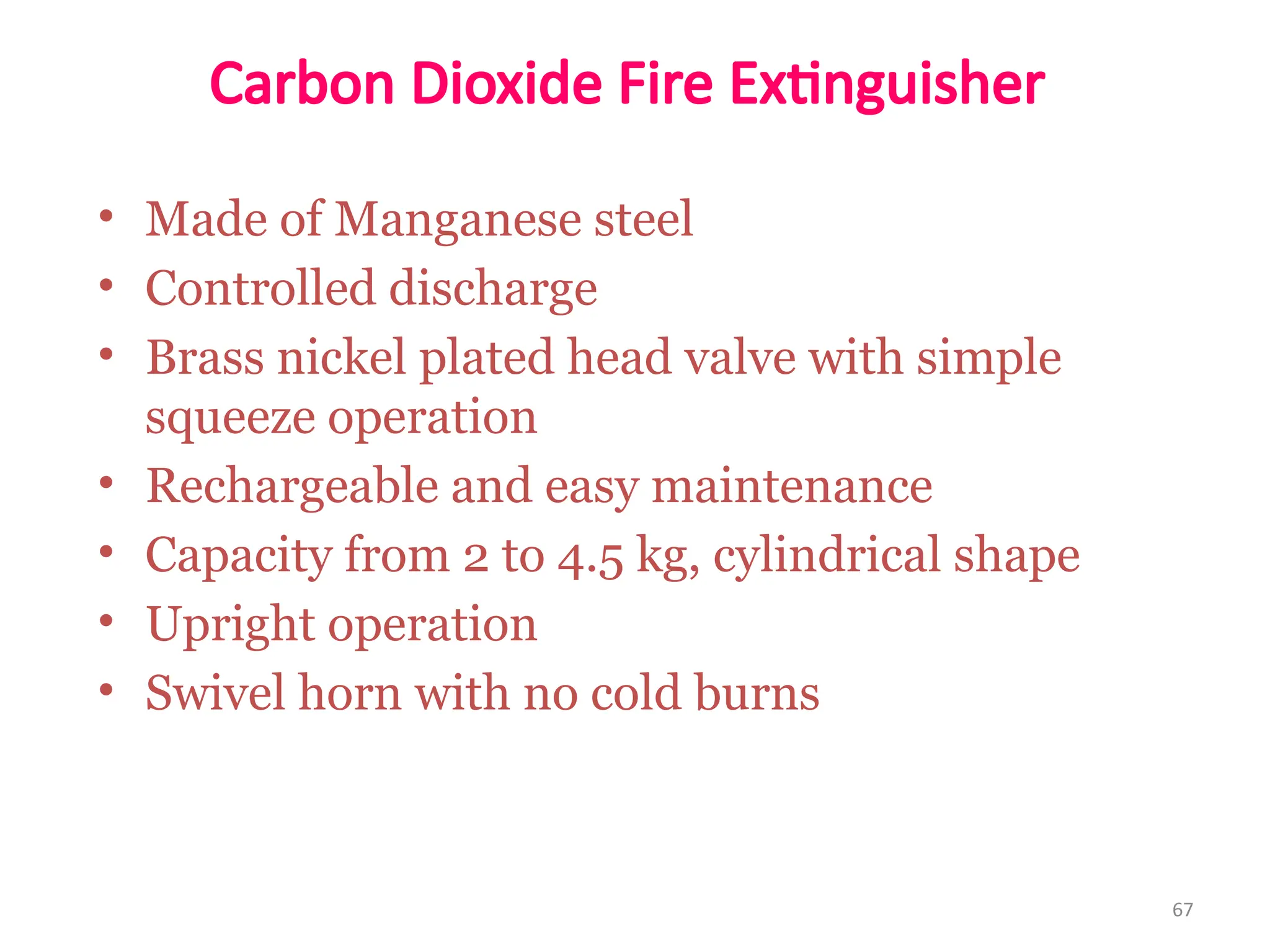
• Made of Manganese steel
• Controlled discharge
• Brass nickel plated head valve with simple
squeeze operation
• Rechargeable and easy maintenance
• Capacity from 2 to 4.5 kg, cylindrical shape
• Upright operation
• Swivel horn with no cold burns
67
Carbon Dioxide Fire Extinguisher
68
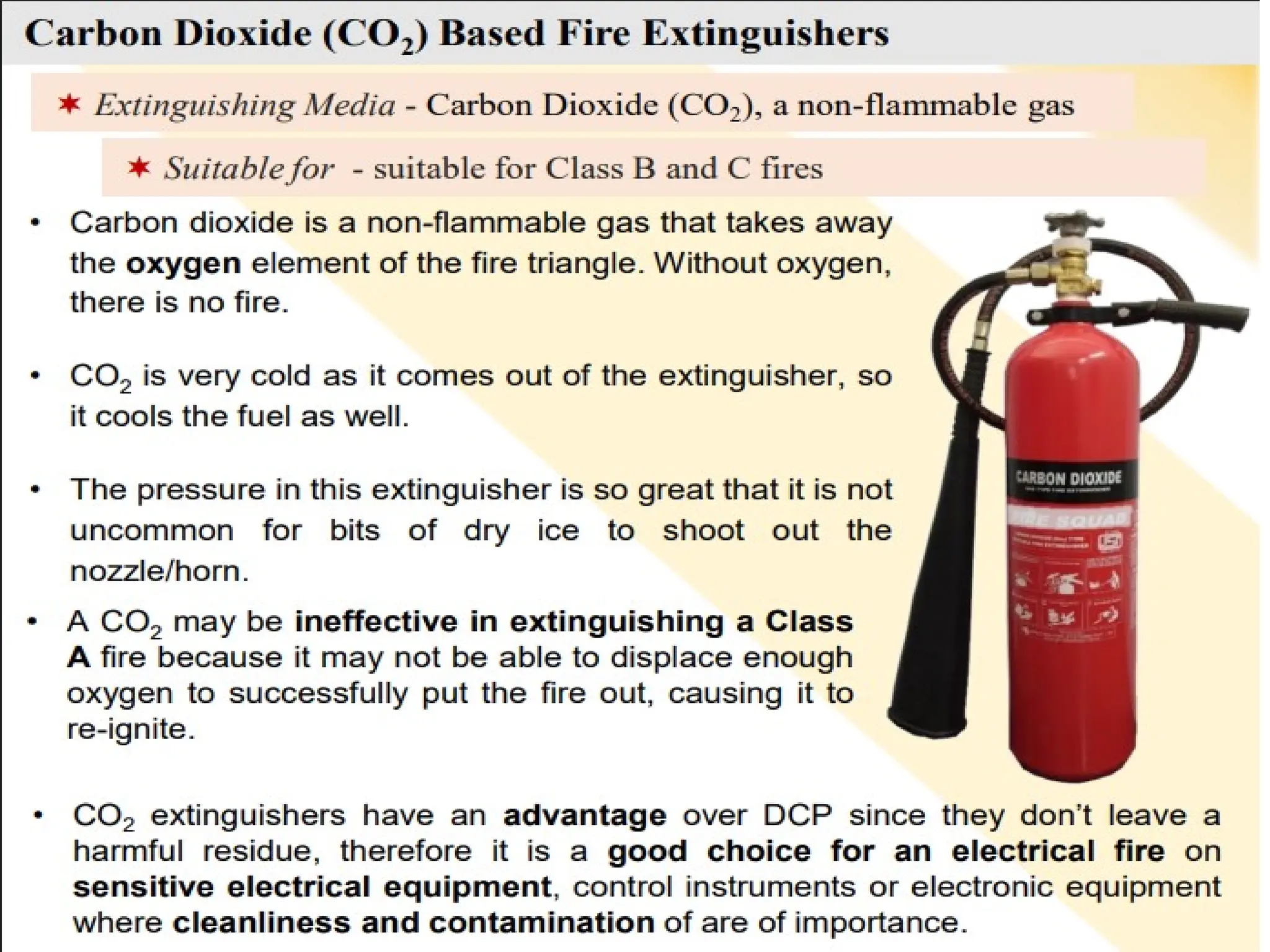
Carbon Dioxide Fire Extinguisher
1. Valve/extn. lever
2. Safety pin with
locking device
3. Valve handle
4. Discharge hose
and horn
5. Siphon tube
69
Carbon Dioxide Fire Extinguisher
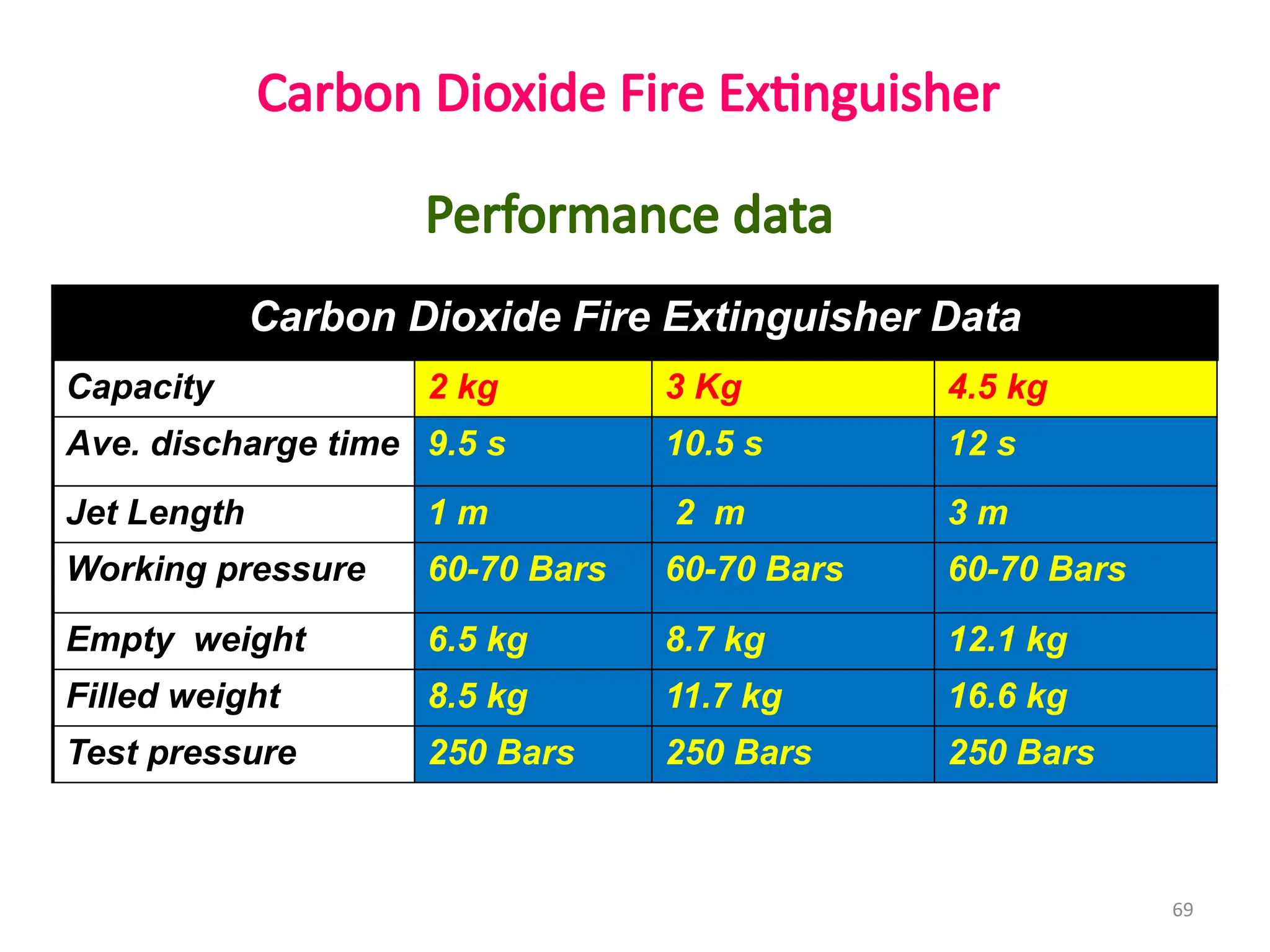
Carbon Dioxide Fire Extinguisher Data
Capacity 2 kg 3 Kg 4.5 kg
Ave. discharge time 9.5 s 10.5 s 12 s
Jet Length 1 m 2 m 3 m
Working pressure 60-70 Bars 60-70 Bars 60-70 Bars
Empty weight 6.5 kg 8.7 kg 12.1 kg
Filled weight 8.5 kg 11.7 kg 16.6 kg
Test pressure 250 Bars 250 Bars 250 Bars
Performance data
Clean Agent Fire Extinguishers
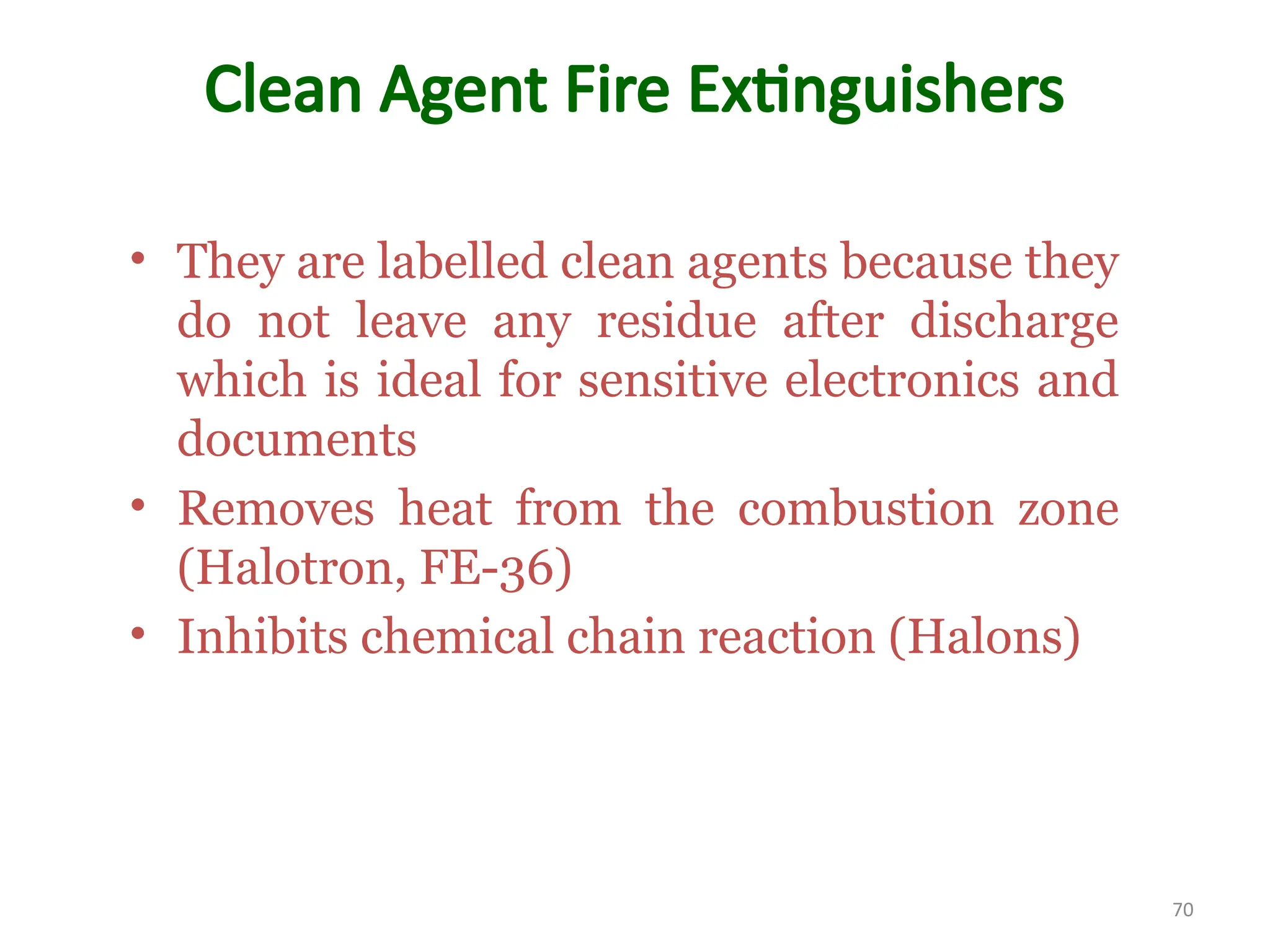
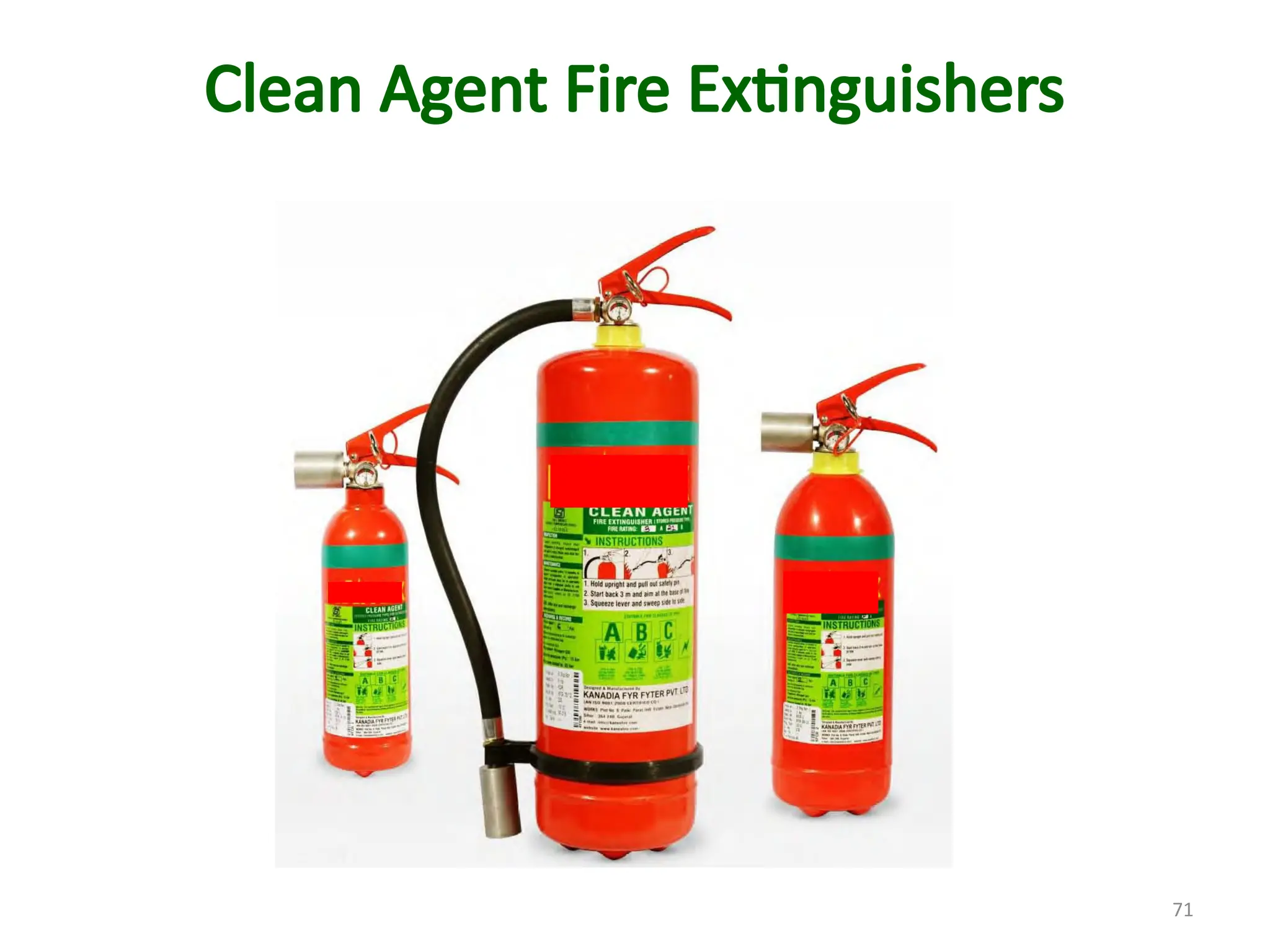
• They are labelled clean agents because they
do not leave any residue after discharge
which is ideal for sensitive electronics and
documents
• Removes heat from the combustion zone
(Halotron, FE-36)
• Inhibits chemical chain reaction (Halons)
70
Clean Agent Fire Extinguishers
71
72
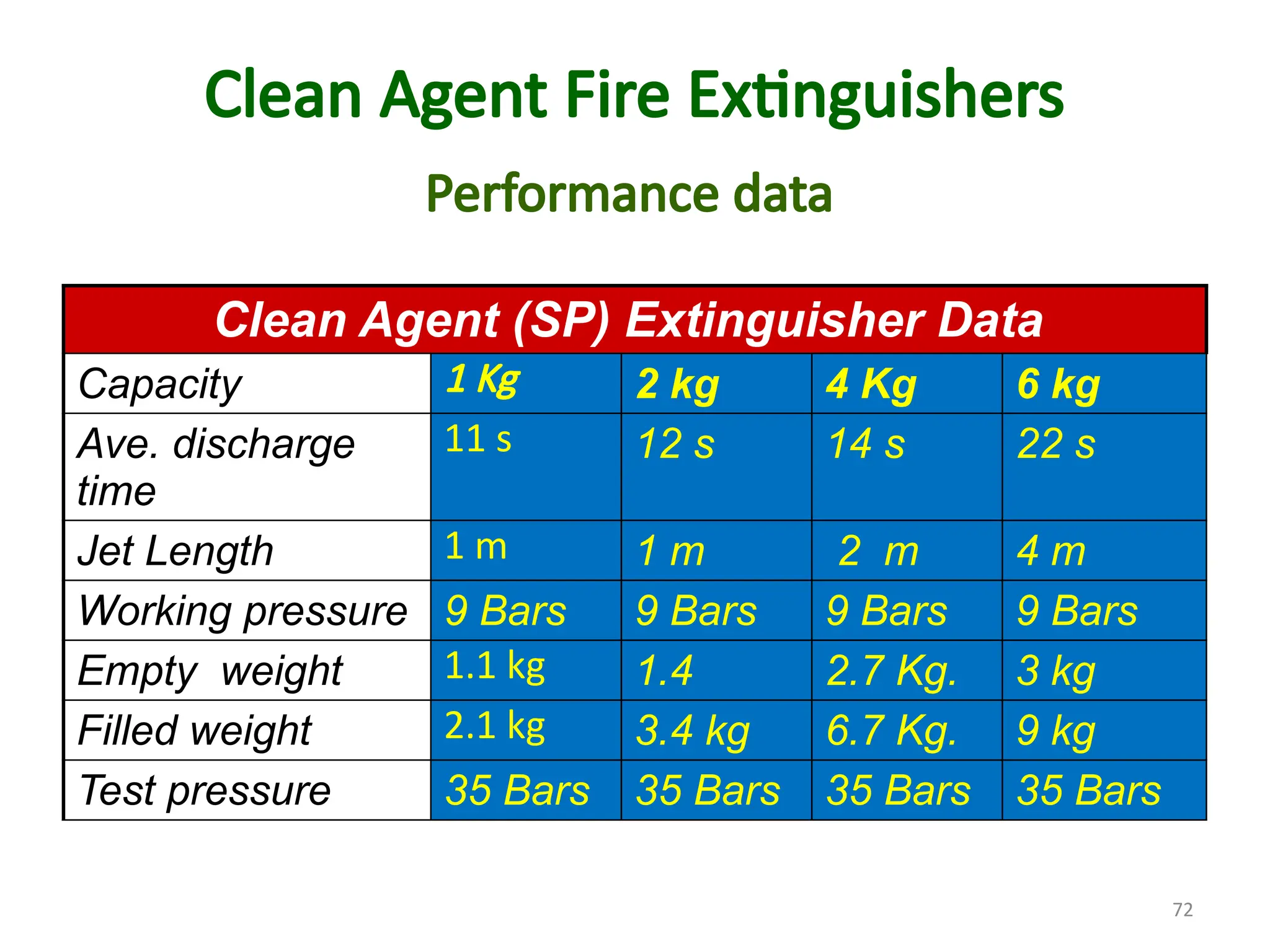
Clean Agent (SP) Extinguisher Data
Capacity 1 Kg 2 kg 4 Kg 6 kg
Ave. discharge
time
11 s 12 s 14 s 22 s
Jet Length 1 m 1 m 2 m 4 m
Working pressure 9 Bars 9 Bars 9 Bars 9 Bars
Empty weight 1.1 kg 1.4 2.7 Kg. 3 kg
Filled weight 2.1 kg 3.4 kg 6.7 Kg. 9 kg
Test pressure 35 Bars 35 Bars 35 Bars 35 Bars
Performance data
Clean Agent Fire Extinguishers
SPECIAL FIRE EXTINGUISHERS
Automatic Cylinder-less Fire Detection & Suppression Tube System
• This system consists of a heat sensitive tube made of special plastic which
is closed by a stainless steel fitting on each end.
• The tube has both storage and detection function which means that the
extinguishing agent is stored directly in the tube and no additional storage
device such as cylinder is needed.
• Melting of the tube creates a hole releasing the entire extinguishing agent
stored in the tube directly onto the source of the fire.
Modular Extinguisher
77
ABC Type Clean Agent
Modular Extinguisher
• Provides concentrated fire protection for
vital equipment
• Highly cost effective compared to fixed fire
protection system
• Portable unit
• Automated and reliable security round the
clock
• Provides security in case of fire and power
failure without power back-up
• Rechargeable and easy to service
78
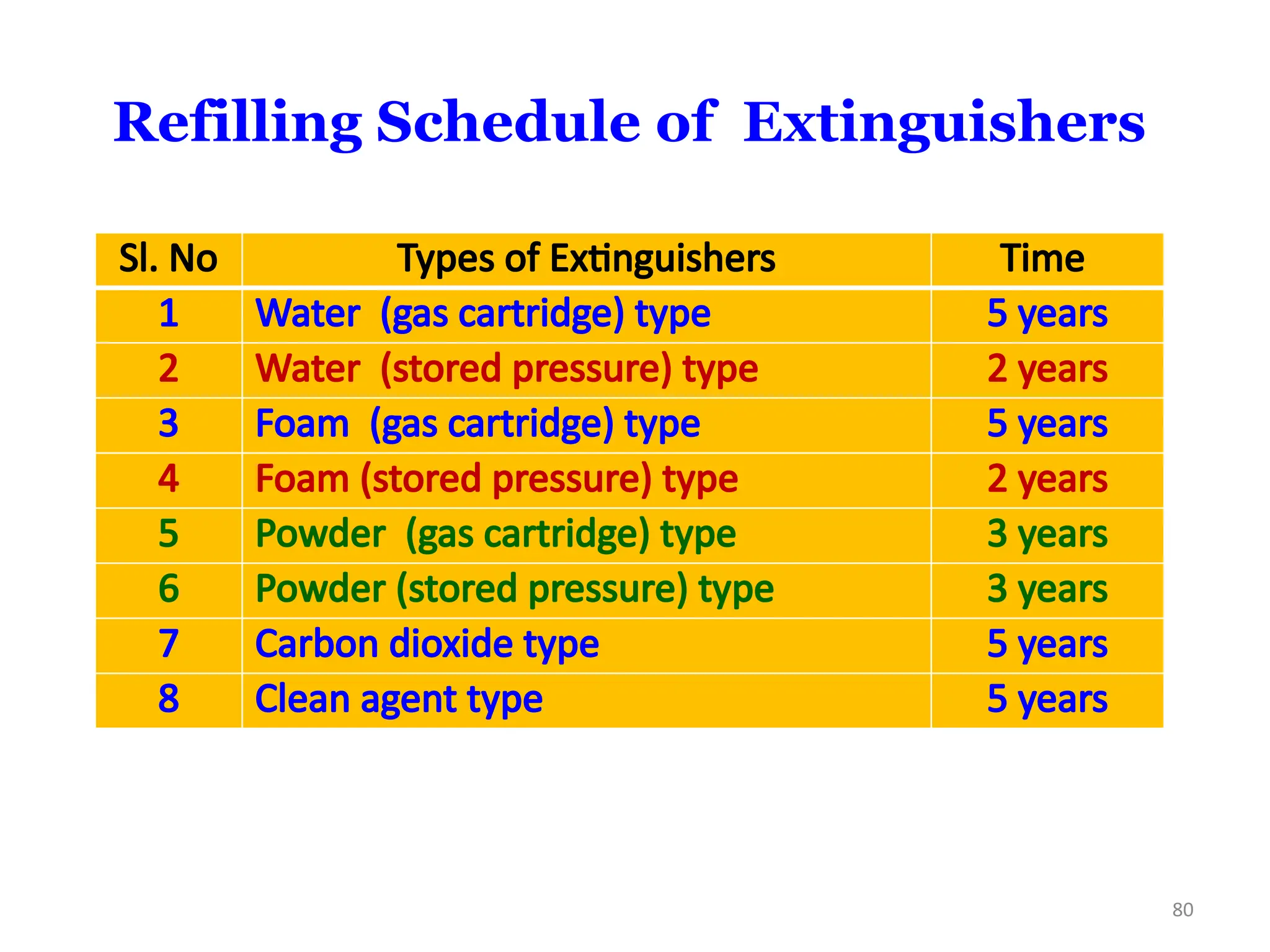
Refilling Schedule of Extinguishers
80
Sl. No Types of Extinguishers Time
1 Water (gas cartridge) type 5 years
2 Water (stored pressure) type 2 years
3 Foam (gas cartridge) type 5 years
4 Foam (stored pressure) type 2 years
5 Powder (gas cartridge) type 3 years
6 Powder (stored pressure) type 3 years
7 Carbon dioxide type 5 years
8 Clean agent type 5 years
Life of Fire Extinguishers
81
Sl. No Types of Extinguishers Life time
1 Water type 10 years
2 Foam type 10 years
3 Powder type 10 years
4 Carbon dioxide type 15 years
5 Clean agent type 10 years
82
Hydro Pressure Test
Extinguisher Hydraulic pressure test
Type Years Kg/cm2
Duration
Water 3 35 2 min
Mechanical foam 3 35 2 min
Dry chemical 3 35 2 min
Carbon Dioxide 5 250 2 min
P:PULL the pin from the
handle.
A:AIM the nozzle at the
base of the fire.
S:SQUEEZE the handle, and
don’t let go.
S: SWEEP the nozzle from side
to side
How to operate Fire Extinguishers?
88
Confined Space
Incipient Stage
Full-blown
Stage
Burn-out
Phase
Flashover
Ignition
Growth
Fully
Developed
Fire Decay
Time
PROVISION OF FIRE EXTINGUISHING EQUIPMENT
S.
No.
Description
Fire buckets
11 to 14 litres round bottom
Minimum fire Extinguishers
1 Small stations and RRI cabins 6 2
2 Central SS office - 2
3 Flag Stations - 2
4 Goods shed 6 2
5 Parcel Office 6 2
6 Electric / Diesel loco -
4
(2 in each Cab)
7 Each Brake van (Front and Rear) - 2
8 Each AC Coach / Non-AC coach - 2
9 Pantry Car - 4
10 Motor Man Cabin of EMU/DMU - 2
11 RMS Van - 2
12 Inspection Carriage - 2
13 Each Generator Car - 4
At places where mobile units are not provided but only simple firefighting
equipment’s such as hydrants, fire extinguishers and fire buckets are provided,
normally the following is the minimum quota of fire buckets, drums and fire
extinguishers to be kept at stations:
Contd...
PROVISION OF FIRE EXTINGUISHING EQUIPMENT
1. The ratio of water and sand buckets should be 1:21.
2. The fire buckets should be secured by stand with chain
and lock. The buckets should be covered to protect from
sunlight and rain.
3. Sand should be in dry condition and sand should be
replaced as and when it becomes wet. Water should be
replaced on every Monday.
4. SSE(C&W) of the base depot of the rake is responsible
for providing fire extinguisher and to ensure its timely
maintenance in all cases except at station / RRI cabin /
Central SS office / Goods shed/Parcel office where it is
the responsibility of SS/SM in charge.
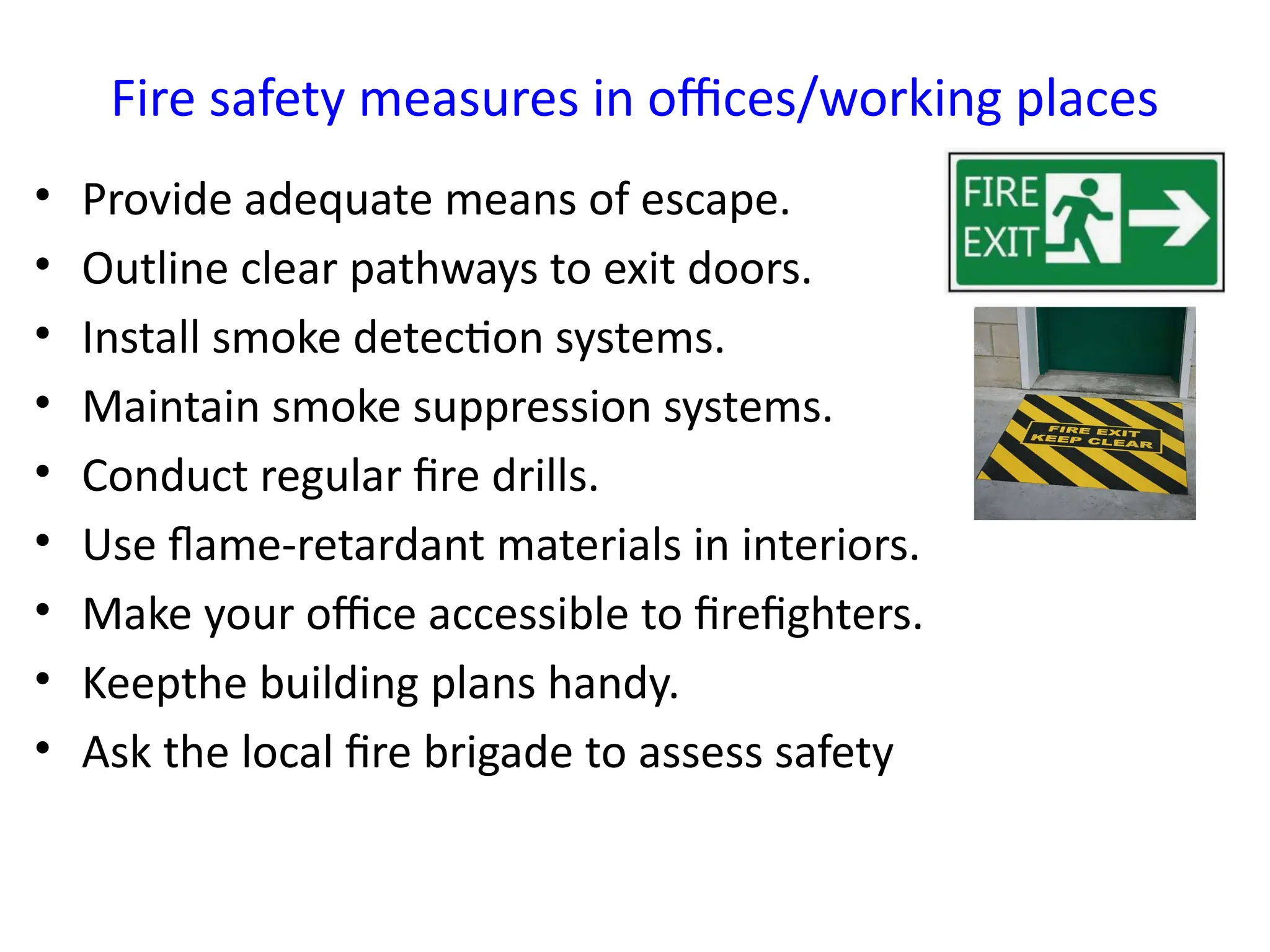
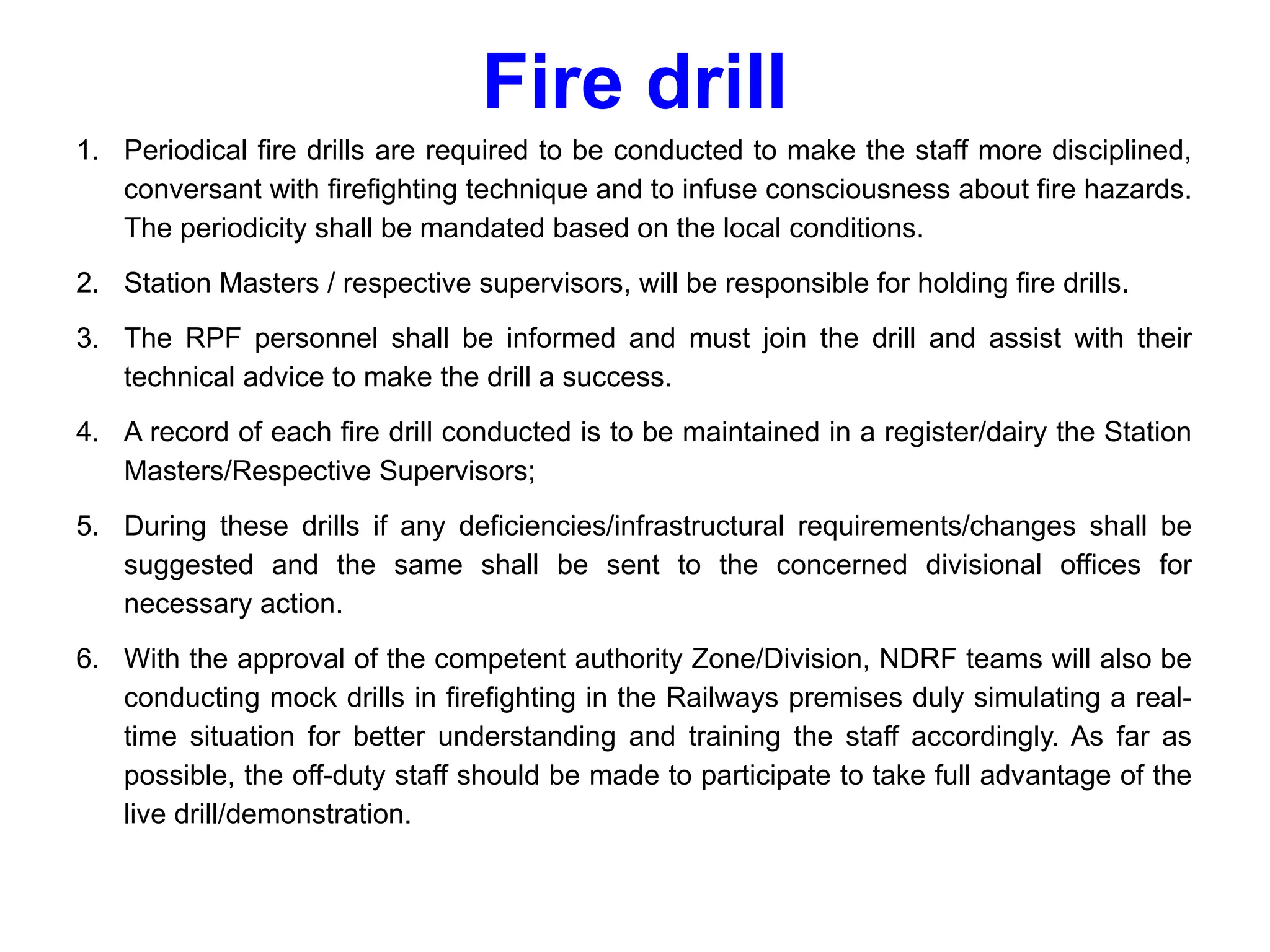
Fire safety measures in offices/working places
• Provide adequate means of escape.
• Outline clear pathways to exit doors.
• Install smoke detection systems.
• Maintain smoke suppression systems.
• Conduct regular fire drills.
• Use flame-retardant materials in interiors.
• Make your office accessible to firefighters.
• Keepthe building plans handy.
• Ask the local fire brigade to assess safety
Fire drill
1. Periodical fire drills are required to be conducted to make the staff more disciplined,
conversant with firefighting technique and to infuse consciousness about fire hazards.
The periodicity shall be mandated based on the local conditions.
2. Station Masters / respective supervisors, will be responsible for holding fire drills.
3. The RPF personnel shall be informed and must join the drill and assist with their
technical advice to make the drill a success.
4. A record of each fire drill conducted is to be maintained in a register/dairy the Station
Masters/Respective Supervisors;
5. During these drills if any deficiencies/infrastructural requirements/changes shall be
suggested and the same shall be sent to the concerned divisional offices for
necessary action.
6. With the approval of the competent authority Zone/Division, NDRF teams will also be
conducting mock drills in firefighting in the Railways premises duly simulating a real-
time situation for better understanding and training the staff accordingly. As far as
possible, the off-duty staff should be made to participate to take full advantage of the
live drill/demonstration.
MAN ON FIRE
IN CASE OF TRAIN ACCIDENTS/FIRE IN TRAIN OR ANY DISASTER:
• Passengers should not panic in case of an
accident such as collision, derailment, FIRE
etc.
• They are advised to try to come out of
affected coaches either through doors or
through emergency windows provided in
each coach.
In case of fire
• Passengers should try to stop the train by pulling
the alarm chain from the affected coach or adjacent
coach and should leave the affected coach through
vestibules (if provided) till the train comes to a halt.
• Passengers should alert their fellow
passengers also.
.
• The passengers are requested to help
the Railway staff in extinguishing the
fire.
• Fire extinguishers have been provided
in Locomotives, Coaches and
Brake van of train.
In case of fire
.
• All electrical appliances should
be switched off to avoid any
possibility of short circuiting.
In case of fire
.
• Railway administration tries to provide quick
rescue and relief arrangements like sending
medical van, accident relief train
i.e. ART&MRV, help from local
administration and local hospitals.
• Passengers who are not affected are
requested to help the affected ones till such
rescue and relief arrives.
In case of fire
.
• All the railway officials travelling
on the train either on duty/leave
or present near the site shall
make themselves available and
provide necessary assistance to
the affected passengers.
In case of fire
.
• Provide Succour and help to
other passengers at site of
accident.
In case of fire
In case of fire accident
duty of GUARD or LP/ALP and JE/SSE
• Give information to SM or SCOR or TPC – By
using field/emergency telephone, walkie-
talkie, IB telephone, Gate Telephone, by
stopping trains, by road vehicle, by engine, by
messenger.
In case of fire
• Save life
• Isolate the coach
• Put out the fire, use fire Extinguishers
• Bring down pantograph
• Put off lights, fans from the terminals
• Help the Rly. administration at site
ACTION TO BE TAKEN IN CASE OF FIRE IN RAILWAY PREMISES
1. Any Staff whether on or off duty noticing fire shall
a) Raise the fire alarm immediately as per prescribed above
b) Rescue anyone in danger and send the injured immediately to the nearest hospital and,
2. Take all possible action to extinguish the fire without any loss of time.
3. Use the available fire extinguishing appliances properly and promptly.
4. Informthe control of Railway Fire Brigade, City Fire Brigades, Civil Police, RPF Control/Post
giving them in brief the correct location of fire and also the material involved, if possible.
5. In addition to above, immediate information should also be given to concerned Railway
officials of the department whose property is involved in the fire.
6. The senior most railway official present at the site of fire, shall see that every action is being
taken to extinguish fire to prevent theft and other miscreant activities. RPF/ Police official present
at the site of fire will be responsible to guard the property during the occurrence and after. The
senior most firefighting official present at the site of fire, will ensure proper utilisation of the
Firefighting facilities.
7. As far as practicable, the documents and all moveable property adjacent to the fire should
be removed to a safer place under the direction of the responsible staff of the department
concerned. A list of the property/ documents so removed should be prepared in duplicate.
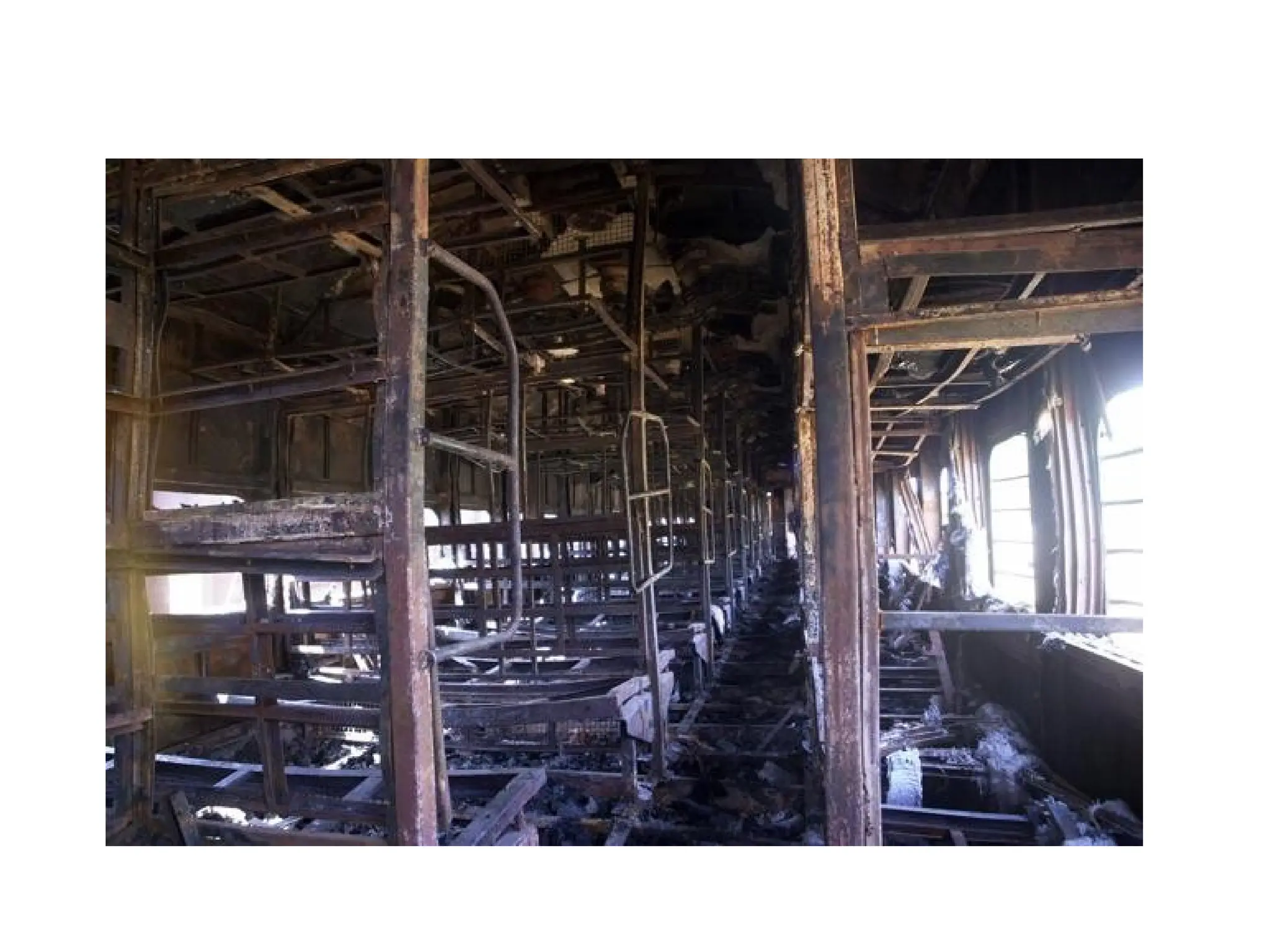
Measures to reduce fire incidences in trains
IR have always endeavored to enhance fire worthiness
of coaches by using more fire retardant furnishing materials
such as
• Compreg Board/PVC for coach flooring,
• Laminated sheets for roof, ceiling wall & partition
panelling,
• Rexene and DTPB cushioning material for seats and
berths,
• FRP windows and UIC vestibules etc.
Specifications for such furnishing materials have been
periodically upgraded to incorporate the fire retardant
parameters in line with UIC/other international norms.
All new manufacture of coaches/periodical overhauling of
existing coaches is being carried out with fire retardant
specifications of the furnishing materials.
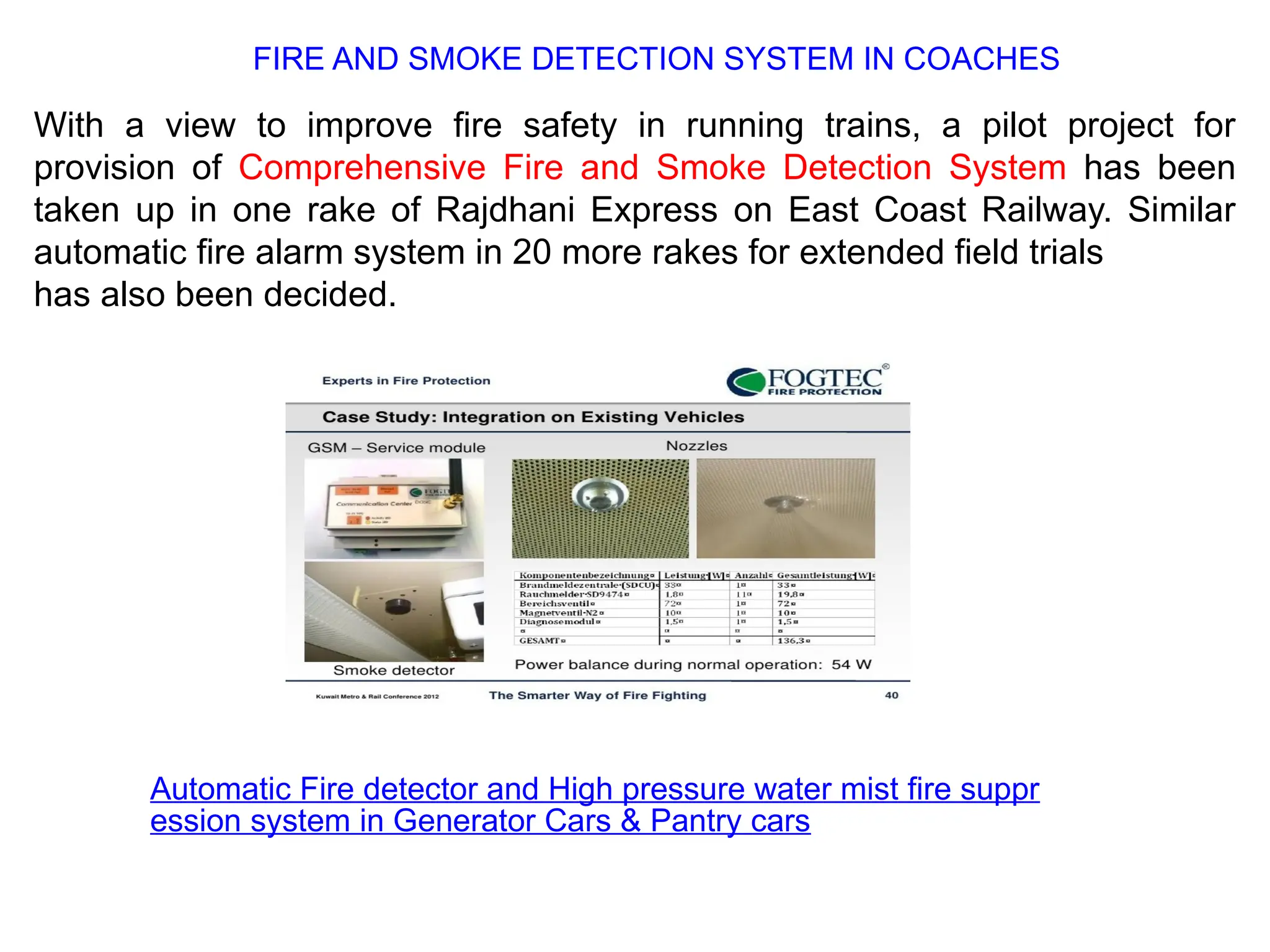
With a view to improve fire safety in running trains, a pilot project for
provision of Comprehensive Fire and Smoke Detection System has been
taken up in one rake of Rajdhani Express on East Coast Railway. Similar
automatic fire alarm system in 20 more rakes for extended field trials
has also been decided.
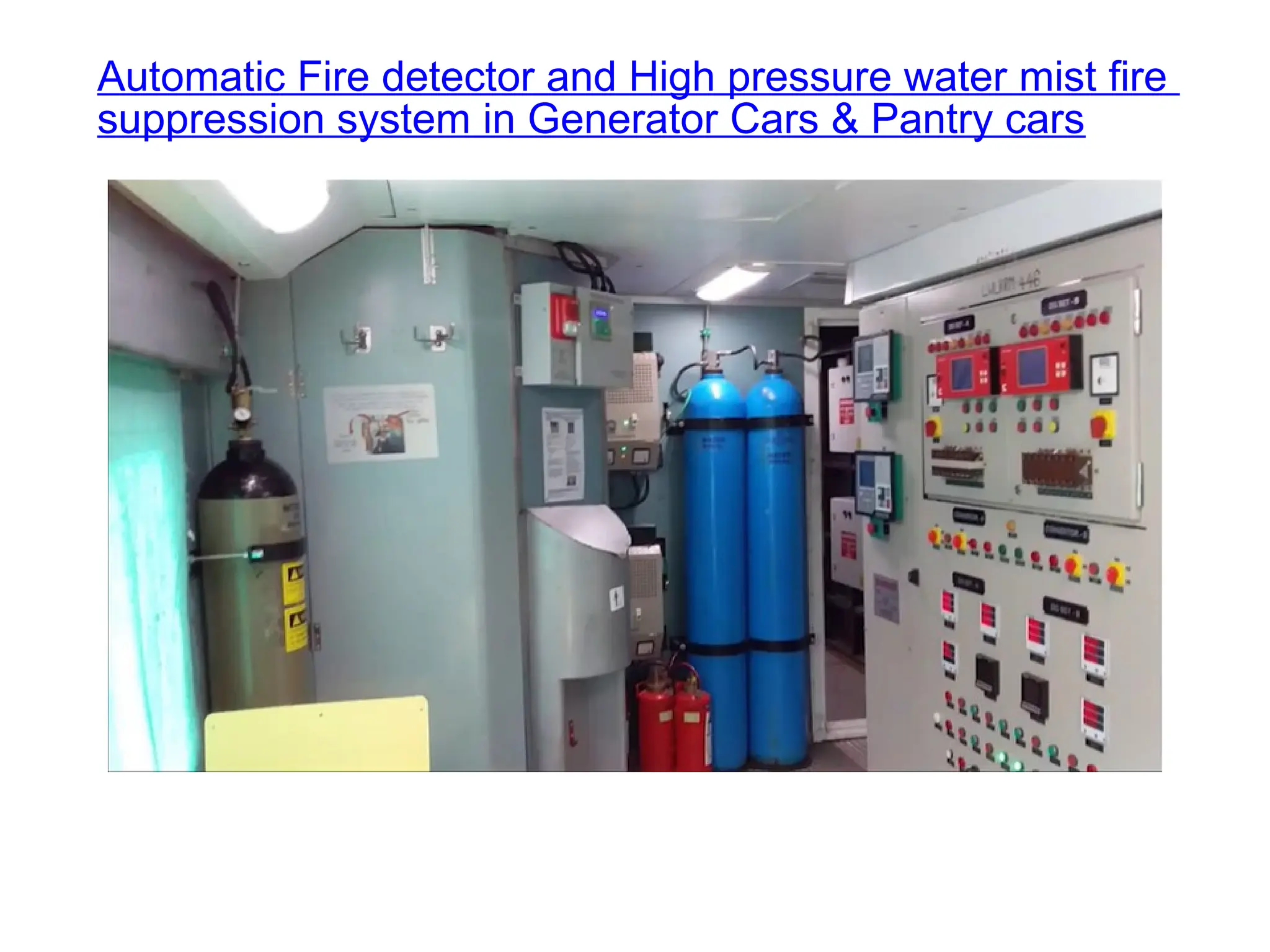
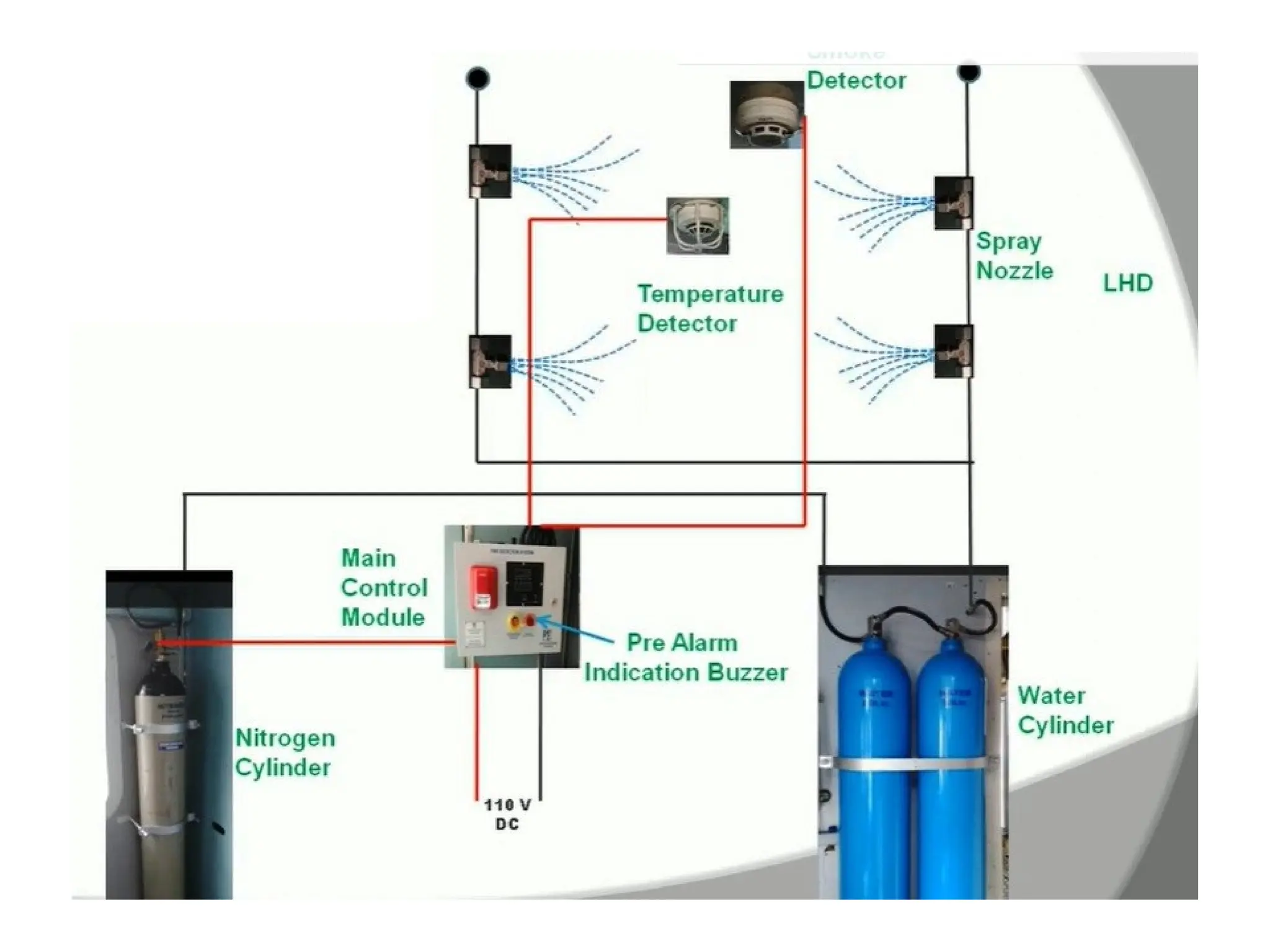
Automatic Fire detector and High pressure water mist fire suppr
ession system in Generator Cars & Pantry cars
FIRE AND SMOKE DETECTION SYSTEM IN COACHES
Automatic Fire detector and High pressure water mist fire
suppression system in Generator Cars & Pantry cars
In Generator Car In Pantry Car
Fire visual Alarming unit
Smoke cum Fire detecting sensor
IN PASSENGER COACHES
Fire audio alarming unit
Audio alarming unit with speech
Fire alarming controller
Thank you

Presentation of Fire Fighting Mechanisms

  • 1.
  • 2.
    2 Fire Definition It is achemical chain reaction which takes place with the evolution of heat and light. No smoke without fire
  • 3.
  • 4.
  • 5.
    Oxygen Heat Fuel OXYGEN SOURCEHEAT SOURCES Approx. 16% Required Normal air contains 21% of oxygen Some Fuels contains its own oxygen supply GASES To Reach Ignition Temp. Open Flame, the Sun,Hot Surface, Sparks & Arcs, Friction, Chemical Action, Elec. Energy & Gas Compression LIQUIDS SOLIDS Natural Gas, Propane, CO, Butane, Hydrogen & Acetylene. Gasoline, Kerosene, Turpentine, Alcohol, Paint, Varnish, Olive oil & Lacquer etc. Coal, Wood, Paper, Cloth, Wax, Grease, Leather, Plastic, Sugar, Grain & Hay etc. FIRE TRIANGLE Fire
  • 6.
  • 8.
  • 9.
    9 1. Starvation Removal ofun-burnt material from fire area Principles of Fire Extinction
  • 10.
    10 2. Smothering Cutting offthe supply of oxygen from fire area Principles of Fire Extinction
  • 11.
    11 3. Cooling Removal ofheat from the burning material/fire area Principles of Fire Extinction
  • 12.
    12 4. Breaking ofchain reaction It is a chemical process Fig: Extinguishing mechanism of multipurpose mono-ammonium phosphate dry chemical NH3 & H2O Flame Steam Meta-Phosphoric Acid Ortho-Phosphoric Acid Mono-ammonium phosphate Principles of Fire Extinction
  • 13.
  • 15.
    15 PRINCIPLES OF FIREEXTINCTION • Starvation : – Removal of unburned material from the fire area • Smothering/Blanketing : – Cutting off the supply of oxygen from fire area • Cooling : – Removal of heat from the burning material/fire area • Breaking of Chain Reaction : – This is a chemical process
  • 16.
    16 MODES OF SPREADOF FIRE • Conduction : – It occurs only in solids i.e. metallic objects. • Convection : – It occurs both in liquids & gases due to convection current. • Radiation : – It neither conduction nor convection. These are heated rays emanating from the hot object.
  • 17.
    CONDUCTION • Conduction isheat transfer within solids or between contacting solids.
  • 18.
    18 Conduction Conduction is thepoint-to-point transmission of heat energy. HEAT
  • 19.
    CONVECTION Convection is heattransfer by the movement of liquids or gasses
  • 20.
    20 Convection Convection is thetransfer of heat energy by the movement of heated fluids. HEAT
  • 21.
    RADIATION Radiation is heattransfer by electromagnetic waves
  • 22.
    22 Radiation Radiation is thetransmission of heat energy through electromagnetic wave.
  • 23.
    CLASSIFICATION OF FIREACCORDING TO TYPE OF FUEL Ref: para 3.1 of IS 15683 : 2018 & para 9 of IS 2190:2010
  • 24.
    24 Class A : »Fireinvolving solid combustible materials of organic nature such wood, paper, rubber, plastic, cloth which requires cooling effect. CLASSIFICATION OF FIRE wood cloth paper rubber plastics
  • 25.
    25 Class B : »Fireinvolving inflammable liquids or liquefiable solids such as petrol, kerosene, acids and solvents etc. Oil Motor spirit Paints Acids
  • 26.
    26 Class C : »Fireinvolving inflammable gases under pressure including liquefied gases such as methane, hydrogen, acetylene and LPG etc. Gases
  • 27.
    27 Class D : »Fireinvolving combustible metals, such as magnesium, zinc, sodium, aluminum, potassium, radioactive material etc. When the burning metals are reactive to water. C
  • 28.
    Class F : •Fire involving cooking media (fats, grease and oils) in domestic kitchens & commercial cooking sites such as restaurants.
  • 29.
    29 No classification –Electrical fires Ref: para 9 of IS 2190 : 2010 and para 10.2.3 of IS 15683 : 2018 » Where fire involves energized electrical equipment. » Where cleanliness and contamination of sensitive electrical equipment are of importance or where the sensitivity of the control instruments or electronic equipment and systems are likely to be affected, only Carbon Di-oxide or Clean Agent type extinguishers should be used. (Ref: para 10.3 of IS 2190 : 2010) C Energized electrical equipment
  • 30.
  • 31.
  • 32.
    32 Introduction • One ofthe most common fire protection appliances in use today. • Is excellent to use on incipient fires. • Can extinguish a small fire in much less time. • Be knowledgeable about the different types of fire extinguishers and their correct use. • Known as “First aid fire fighting equipment”
  • 33.
  • 34.
    34 Atmospheric condition Incipient Stage Fuel (wood) Fuel(wood) Smoldering Stage Flaming Stage Heat Stage Fuel (wood) Fuel (wood)
  • 37.
    Types of fireextinguishers • Water type • Foam /mechanical foam type • Powder type --> i) DCP type, ii)Spl.DP type • CO2 TYPE • Clean Agent type • Fire supressing ball • Modular extinguishers • Automatic Cylinder-less Fire Detection & Suppression Tube System
  • 38.
    • Effective onclass A fires • Advantage of being inexpensive, harmless, and relatively easy to clean up • It has favorable physical properties for fire suppression. • Its heat capacity (4.2 J/g.K) and high latent heat of vaporization (2442 J/g) can absorb a significant quantity of heat from flames and fuels. (cooling) • Water also expands 1700 times when it evaporates to steam, results in the dilution of the surrounding oxygen and fuel vapours. 38 Water
  • 39.
    Water • The directeffect is to cool down the unburned product, stop the evolution of vapour and starve the flame gradually until complete extinguishment. • Cooling/Quenching.
  • 40.
    Foam • Applied tofuel fires as either an aspirated (mixed & expanded with air in a branch pipe) or; • Non-aspirated foam to form a frothy blanket or seal over the fuel, • Preventing oxygen reaching it (smothering) • Foam can be used to progressively extinguish fires without flashback. 40
  • 41.
    • Water forClass A fires and AFFF (Aqueous Film Forming Foam) for Class A and B fires. • Spray nozzle • Polyester powder coating • Controlled discharge • Brass nickel plated head valve with simple squeeze operation • Rechargeable and easy maintenance • Capacity 9 litre, cylindrical shape. • Upright operation • Rubber braided hose 41 Water/Foam (Gas Cartridge) Extinguisher
  • 42.
    42 Foam 1. Water content(heat) Smothering and cooling the fuel 2. Blanket Effect (fuel) Forms a floating blanket on the liquid surface 3. Bubbles Formation Averts formation of combustible mixture of vapour and air
  • 43.
    Water/Foam (Gas Cartridge)Extinguisher Water Type Foam Type
  • 44.
    Water/Foam (Gas Cartridge)Fire Extinguisher 1. Valve/extn. lever 2. Safety pin with locking device 3. Valve handle 4. Gas cartridge 5. Discharge hose 6. Siphon tube 7. Hose holder 8. Discharge nozzle/foam branch pipe
  • 45.
    45 Water/Foam (Gas Cartridge)Fire Extinguisher Performance data Data Water Foam Capacity 9 litre 9 litre Average discharge time 42 seconds 40 seconds Jet Length 6 meters 6 meters Working pressure 14 Bars 14 Bars Empty weight 6.20 Kgs. 6.20 Kgs. Filled weight 15.20 Kgs. 15.20 Kgs. Test pressure 35 Bars 35 Bars
  • 46.
    Water/Foam (Stored Pressure)Fire Extinguisher Water Type Foam Type
  • 47.
    47 Water/Foam (Stored Pressure)Fire Extinguisher 1. Valve/extn. lever 2. Safety pin with locking device 3. Valve handle 4. Pressure gauge 5. Discharge hose 6. Siphon tube 7. Hose holder/belt 8. Filter 9. Discharge nozzle/foam branch pipe
  • 48.
    Dry Chemical Powder •This is a powder based agent that extinguishes by separating the four parts of the fire Tetrahedron. • It prevents the chemical reactions involving heat, fuel, and oxygen and halts the production of fire sustaining "free-radicals", thus extinguishing the fire. • There are different types of Dry Chemical and Dry Powder. 48
  • 49.
    Dry Chemical PowderCO2 Gas Cartridge Plunger type FE
  • 50.
    a. Mono-ammonium phosphate,also known as "tri-class", "multipurpose" or "ABC" dry chemical • used on class A, B, and C fires. • it receives its class A rating from the agent's ability to melt and flow at 177 °C to smother the fire. • more corrosive than other dry chemical agents. Pale yellow in colour 50 Dry Chemical Powder
  • 51.
    b. Sodium Bicarbonate,"regular" or "ordinary" used on class B and C fires • in the heat of a fire, it releases a cloud of carbon dioxide that smothers the fire. • white or blue in color 51 Dry Chemical Powder
  • 52.
    c. Potassium Bicarbonate(Purple-K), used on class B and C fires • about two times as effective on class B fires as sodium bicarbonate • preferred dry chemical agent of the oil and gas industry. • colored violet to distinguish it. 52 Dry Chemical Powder
  • 53.
    d. Potassium Bicarbonate& Urea (Monnex/Powerex) • used on class B and C fires. • more effective than all other powders due to its ability to decrepitates (where the powder breaks up into smaller particles) in the flame zone creating a larger surface area for free radical inhibition. • grey in color. 53 Dry Chemical Powder
  • 54.
    e. MET-L-KYL/PYROKIL isa specialty variation of sodium bicarbonate • used for fighting pyrophoric liquid fires (ignite on contact with air). • it also contains silica gel particles. • the sodium bicarbonate interrupts the chain reaction of the fuel and the silica soaks up any unburned fuel, preventing contact with air. • it is effective on other class B fuels as well. • blue/red in color. 54 Dry Chemical Powder
  • 55.
    Dry Chemical (GasCartridge) Extinguisher 55
  • 56.
    • Polyester powdercoating • Controlled discharge • Brass nickel plated head valve with simple squeeze operation • Rechargeable and easy maintenance • Capacity from 1 to 9 kg, cylindrical shape • Rubber braided hose • Upright operation 56 Dry Chemical (Gas Cartridge) Extinguisher
  • 57.
    Dry Chemical (GasCartridge) Extinguisher 57 1. Valve/extn. lever 2. Safety pin with locking device 3. Valve handle 4. Gas cartridge 5. Discharge hose 6. Siphon tube inlet 7. Siphon tube outlet 8. Hose holder/belt 9. Discharge nozzle
  • 58.
    58 Dry Chemical (GC)Extinguisher Data Capacity 4 Kg 6 kg 9 Kg Ave. discharge time 18 sec 21 sec 23 sec Jet Length 2 meters 4 metres 6 meters Working pressure 15 Bars 15 Bars 15 Bars Empty weight 4.6 Kgs. 4.8 6.20 Kgs. Filled weight 8.6 Kgs. 10.8 15.20 Kgs. Test pressure 35 Bars 35 Bars 35 Bars Dry Chemical (Gas Cartridge) Extinguisher Performance data
  • 59.
    59 Dry Chemical (StoredPressure) Extinguisher
  • 60.
    60 Dry Chemical (StoredPressure) Extinguisher 1. Valve/extn. lever 2. Safety pin with locking device 3. Valve handle 4. Pressure gauge 5. Discharge hose 6. Siphon tube 7. Hose holder/belt 8. Discharge nozzle
  • 61.
    61 Dry Chemical (SP)Extinguisher Data Capacity 1 Kg 2 kg 4 Kg 6 kg 9 Kg Ave. discharge time 9 s 14 s 18 s 21 s 23 s Jet Length 1 m 1 m 2 m 4 m 6 m Working pressure 15 Bars 15 Bars 15 Bars 15 Bars 15 Bars Empty weight 1.1 kg 1.4 2.7 Kg. 3 kg 4.18 Kg. Filled weight 2.1 kg 3.4 kg 6.7 Kg. 9 kg 13.18 Kg. Test pressure 35 Bars 35 Bars 35 Bars 35 Bars 35 Bars Performance data Dry Chemical (Stored Pressure) Extinguisher
  • 62.
    a. Sodium Chloride(Super-D, Met-L-X) contains sodium chloride salt, which melts to form an oxygen-excluding crust over the metal • useful on most alkali metals including sodium and potassium, and other metals including magnesium, titanium, aluminium, and zirconium. b. Ternary Eutectic Chloride (TEC) contains chlorides of barium, sodium and potassium, which melts and forms fused skin over burning metal and absorbs heat and cut-off oxygen to fire. 62 Dry Powder for Metal Fires
  • 63.
    C. Graphite-based (G-Plus,G-1, Lith-X, Pyromet or METAL.FIRE.XTNGSHR) contains dry graphite that smothers burning metals • developed, designed for magnesium, works on other metals as well • can be used on very hot burning metal fires such as lithium • will not stick to and extinguish flowing or vertical lithium fires • acts as a heat sink to dissipate heat as well as smothering the metal fire. 63 Dry Powder for Metal Fires
  • 64.
    d. Sodium Carbonate-based(Na-X) • used where stainless steel piping and equipment could be damaged by sodium chloride based agents to control sodium, potassium, and sodium-potassium alloy fires. • limited use on other metals. Smothers and forms a crust. 64 Most class D extinguishers will have a special low velocity nozzle or discharge wand to gently apply the agent in large volumes to avoid disrupting any finely divided burning materials. Agents are also available in bulk and can be applied with a scoop or shovel Dry Powder for Metal Fires
  • 65.
  • 67.
    • Made ofManganese steel • Controlled discharge • Brass nickel plated head valve with simple squeeze operation • Rechargeable and easy maintenance • Capacity from 2 to 4.5 kg, cylindrical shape • Upright operation • Swivel horn with no cold burns 67 Carbon Dioxide Fire Extinguisher
  • 68.
    68 Carbon Dioxide FireExtinguisher 1. Valve/extn. lever 2. Safety pin with locking device 3. Valve handle 4. Discharge hose and horn 5. Siphon tube
  • 69.
    69 Carbon Dioxide FireExtinguisher Carbon Dioxide Fire Extinguisher Data Capacity 2 kg 3 Kg 4.5 kg Ave. discharge time 9.5 s 10.5 s 12 s Jet Length 1 m 2 m 3 m Working pressure 60-70 Bars 60-70 Bars 60-70 Bars Empty weight 6.5 kg 8.7 kg 12.1 kg Filled weight 8.5 kg 11.7 kg 16.6 kg Test pressure 250 Bars 250 Bars 250 Bars Performance data
  • 70.
    Clean Agent FireExtinguishers • They are labelled clean agents because they do not leave any residue after discharge which is ideal for sensitive electronics and documents • Removes heat from the combustion zone (Halotron, FE-36) • Inhibits chemical chain reaction (Halons) 70
  • 71.
    Clean Agent FireExtinguishers 71
  • 72.
    72 Clean Agent (SP)Extinguisher Data Capacity 1 Kg 2 kg 4 Kg 6 kg Ave. discharge time 11 s 12 s 14 s 22 s Jet Length 1 m 1 m 2 m 4 m Working pressure 9 Bars 9 Bars 9 Bars 9 Bars Empty weight 1.1 kg 1.4 2.7 Kg. 3 kg Filled weight 2.1 kg 3.4 kg 6.7 Kg. 9 kg Test pressure 35 Bars 35 Bars 35 Bars 35 Bars Performance data Clean Agent Fire Extinguishers
  • 74.
  • 75.
    Automatic Cylinder-less FireDetection & Suppression Tube System • This system consists of a heat sensitive tube made of special plastic which is closed by a stainless steel fitting on each end. • The tube has both storage and detection function which means that the extinguishing agent is stored directly in the tube and no additional storage device such as cylinder is needed. • Melting of the tube creates a hole releasing the entire extinguishing agent stored in the tube directly onto the source of the fire.
  • 77.
  • 78.
    Modular Extinguisher • Providesconcentrated fire protection for vital equipment • Highly cost effective compared to fixed fire protection system • Portable unit • Automated and reliable security round the clock • Provides security in case of fire and power failure without power back-up • Rechargeable and easy to service 78
  • 80.
    Refilling Schedule ofExtinguishers 80 Sl. No Types of Extinguishers Time 1 Water (gas cartridge) type 5 years 2 Water (stored pressure) type 2 years 3 Foam (gas cartridge) type 5 years 4 Foam (stored pressure) type 2 years 5 Powder (gas cartridge) type 3 years 6 Powder (stored pressure) type 3 years 7 Carbon dioxide type 5 years 8 Clean agent type 5 years
  • 81.
    Life of FireExtinguishers 81 Sl. No Types of Extinguishers Life time 1 Water type 10 years 2 Foam type 10 years 3 Powder type 10 years 4 Carbon dioxide type 15 years 5 Clean agent type 10 years
  • 82.
    82 Hydro Pressure Test ExtinguisherHydraulic pressure test Type Years Kg/cm2 Duration Water 3 35 2 min Mechanical foam 3 35 2 min Dry chemical 3 35 2 min Carbon Dioxide 5 250 2 min
  • 86.
    P:PULL the pinfrom the handle. A:AIM the nozzle at the base of the fire. S:SQUEEZE the handle, and don’t let go. S: SWEEP the nozzle from side to side How to operate Fire Extinguishers?
  • 88.
  • 89.
    PROVISION OF FIREEXTINGUISHING EQUIPMENT S. No. Description Fire buckets 11 to 14 litres round bottom Minimum fire Extinguishers 1 Small stations and RRI cabins 6 2 2 Central SS office - 2 3 Flag Stations - 2 4 Goods shed 6 2 5 Parcel Office 6 2 6 Electric / Diesel loco - 4 (2 in each Cab) 7 Each Brake van (Front and Rear) - 2 8 Each AC Coach / Non-AC coach - 2 9 Pantry Car - 4 10 Motor Man Cabin of EMU/DMU - 2 11 RMS Van - 2 12 Inspection Carriage - 2 13 Each Generator Car - 4 At places where mobile units are not provided but only simple firefighting equipment’s such as hydrants, fire extinguishers and fire buckets are provided, normally the following is the minimum quota of fire buckets, drums and fire extinguishers to be kept at stations: Contd...
  • 90.
    PROVISION OF FIREEXTINGUISHING EQUIPMENT 1. The ratio of water and sand buckets should be 1:21. 2. The fire buckets should be secured by stand with chain and lock. The buckets should be covered to protect from sunlight and rain. 3. Sand should be in dry condition and sand should be replaced as and when it becomes wet. Water should be replaced on every Monday. 4. SSE(C&W) of the base depot of the rake is responsible for providing fire extinguisher and to ensure its timely maintenance in all cases except at station / RRI cabin / Central SS office / Goods shed/Parcel office where it is the responsibility of SS/SM in charge.
  • 91.
    Fire safety measuresin offices/working places • Provide adequate means of escape. • Outline clear pathways to exit doors. • Install smoke detection systems. • Maintain smoke suppression systems. • Conduct regular fire drills. • Use flame-retardant materials in interiors. • Make your office accessible to firefighters. • Keepthe building plans handy. • Ask the local fire brigade to assess safety
  • 92.
    Fire drill 1. Periodicalfire drills are required to be conducted to make the staff more disciplined, conversant with firefighting technique and to infuse consciousness about fire hazards. The periodicity shall be mandated based on the local conditions. 2. Station Masters / respective supervisors, will be responsible for holding fire drills. 3. The RPF personnel shall be informed and must join the drill and assist with their technical advice to make the drill a success. 4. A record of each fire drill conducted is to be maintained in a register/dairy the Station Masters/Respective Supervisors; 5. During these drills if any deficiencies/infrastructural requirements/changes shall be suggested and the same shall be sent to the concerned divisional offices for necessary action. 6. With the approval of the competent authority Zone/Division, NDRF teams will also be conducting mock drills in firefighting in the Railways premises duly simulating a real- time situation for better understanding and training the staff accordingly. As far as possible, the off-duty staff should be made to participate to take full advantage of the live drill/demonstration.
  • 95.
  • 101.
    IN CASE OFTRAIN ACCIDENTS/FIRE IN TRAIN OR ANY DISASTER: • Passengers should not panic in case of an accident such as collision, derailment, FIRE etc. • They are advised to try to come out of affected coaches either through doors or through emergency windows provided in each coach.
  • 102.
    In case offire • Passengers should try to stop the train by pulling the alarm chain from the affected coach or adjacent coach and should leave the affected coach through vestibules (if provided) till the train comes to a halt. • Passengers should alert their fellow passengers also.
  • 103.
    . • The passengersare requested to help the Railway staff in extinguishing the fire. • Fire extinguishers have been provided in Locomotives, Coaches and Brake van of train. In case of fire
  • 104.
    . • All electricalappliances should be switched off to avoid any possibility of short circuiting. In case of fire
  • 105.
    . • Railway administrationtries to provide quick rescue and relief arrangements like sending medical van, accident relief train i.e. ART&MRV, help from local administration and local hospitals. • Passengers who are not affected are requested to help the affected ones till such rescue and relief arrives. In case of fire
  • 106.
    . • All therailway officials travelling on the train either on duty/leave or present near the site shall make themselves available and provide necessary assistance to the affected passengers. In case of fire
  • 107.
    . • Provide Succourand help to other passengers at site of accident. In case of fire
  • 108.
    In case offire accident duty of GUARD or LP/ALP and JE/SSE • Give information to SM or SCOR or TPC – By using field/emergency telephone, walkie- talkie, IB telephone, Gate Telephone, by stopping trains, by road vehicle, by engine, by messenger.
  • 109.
    In case offire • Save life • Isolate the coach • Put out the fire, use fire Extinguishers • Bring down pantograph • Put off lights, fans from the terminals • Help the Rly. administration at site
  • 110.
    ACTION TO BETAKEN IN CASE OF FIRE IN RAILWAY PREMISES 1. Any Staff whether on or off duty noticing fire shall a) Raise the fire alarm immediately as per prescribed above b) Rescue anyone in danger and send the injured immediately to the nearest hospital and, 2. Take all possible action to extinguish the fire without any loss of time. 3. Use the available fire extinguishing appliances properly and promptly. 4. Informthe control of Railway Fire Brigade, City Fire Brigades, Civil Police, RPF Control/Post giving them in brief the correct location of fire and also the material involved, if possible. 5. In addition to above, immediate information should also be given to concerned Railway officials of the department whose property is involved in the fire. 6. The senior most railway official present at the site of fire, shall see that every action is being taken to extinguish fire to prevent theft and other miscreant activities. RPF/ Police official present at the site of fire will be responsible to guard the property during the occurrence and after. The senior most firefighting official present at the site of fire, will ensure proper utilisation of the Firefighting facilities. 7. As far as practicable, the documents and all moveable property adjacent to the fire should be removed to a safer place under the direction of the responsible staff of the department concerned. A list of the property/ documents so removed should be prepared in duplicate.
  • 111.
    Measures to reducefire incidences in trains IR have always endeavored to enhance fire worthiness of coaches by using more fire retardant furnishing materials such as • Compreg Board/PVC for coach flooring, • Laminated sheets for roof, ceiling wall & partition panelling, • Rexene and DTPB cushioning material for seats and berths, • FRP windows and UIC vestibules etc. Specifications for such furnishing materials have been periodically upgraded to incorporate the fire retardant parameters in line with UIC/other international norms. All new manufacture of coaches/periodical overhauling of existing coaches is being carried out with fire retardant specifications of the furnishing materials.
  • 112.
    With a viewto improve fire safety in running trains, a pilot project for provision of Comprehensive Fire and Smoke Detection System has been taken up in one rake of Rajdhani Express on East Coast Railway. Similar automatic fire alarm system in 20 more rakes for extended field trials has also been decided. Automatic Fire detector and High pressure water mist fire suppr ession system in Generator Cars & Pantry cars FIRE AND SMOKE DETECTION SYSTEM IN COACHES
  • 113.
    Automatic Fire detectorand High pressure water mist fire suppression system in Generator Cars & Pantry cars
  • 115.
    In Generator CarIn Pantry Car
  • 116.
    Fire visual Alarmingunit Smoke cum Fire detecting sensor IN PASSENGER COACHES Fire audio alarming unit Audio alarming unit with speech Fire alarming controller
  • 118.