A
SEMINAR ON
UNDER WATER WINDMILL
Presented by:
Sandeep.L
USN:4SM09ME043
Mechanical Engineering
INTRODUCTION
 What is it ???
 An Underwater windmill like a device that extracts
power from the tides.
Renewable energy technologies are
becoming an increasingly favourable alternative to
conventional energy sources to assuage fossil fuel related
issues. Tidal energy offers a vast and reliable energy
source. This technology is similar to wind energy
technology, with the rotor blades driven not by wind
power but by tidal currents. The gravitational pull of the
moon produces a swift tidal current, which spins the long
blades of the turbine . Which in turn produces electricity
via different parts of underwater windmill . This Energy
derived from the moon that now helps to power a small
arctic village.
NAME JUSTIFICATION
 Why it is called as “underwater windmill” ?
 "Basically it's like putting a windmill in the
water," said Bjorn Bekken, a project manager for
Hammerfest Strom.
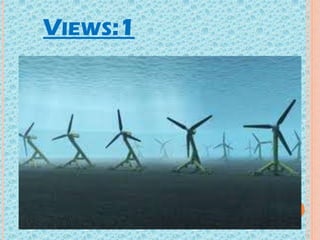
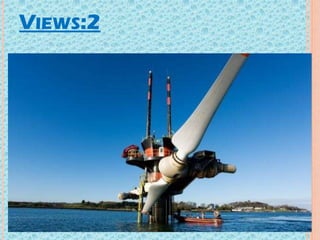
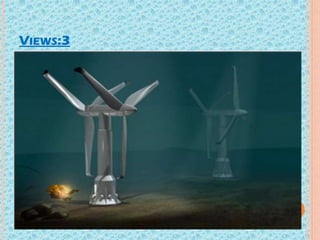
 Or as it’s looking like a wind mill & are installed
on the ocean floor and large river bed , that
means these are under the water.
VIEWS:1
VIEWS:2
VIEWS:3
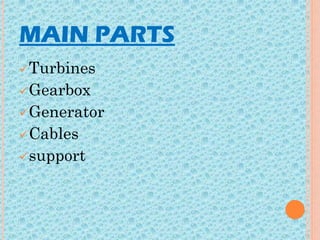
MAIN PARTS
Turbines
Gearbox
Generator
Cables
support
PRINCIPLE OF OPERATION
 In simple a underwater windmill consists of a number of
blades mounted on a hub (together known as the rotor), a
gearbox, and a generator.
 The hydrodynamic effect of the flowing water past the
blades causes the rotor to rotate, thus turning the
generator to which the rotor is connected via a gearbox.
 The gearbox is used to convert the rotational speed of the
rotor shaft to the desired output speed of the generator
shaft.
 The electricity generated is transmitted to land through
cables.
RELATED WORK
 The first tidal power station was the Rance tidal power
plant built over a period of 6 years from 1960 to 1966
at La Rance, France. It has 240 MW installed capacity.
 254 MW Sihwa Lake Tidal Power Plant in South
Korea is the largest tidal power installation in the
world. Construction was completed in 2011.
 The first in-stream tidal current generator in North
America (Race Rocks Tidal Power Demonstration
Project) was installed at Race Rocks on southern
Vancouver Island in September 2006. The next phase
in the development of this tidal current generator will
be in Nova Scotia (Bay of Fundy).
IMPLIMENTATION
 The company Atlantis Resources is to
install a 50MW tidal farm in the Gulf of
Kutch on India's west coast, with
construction starting early in 2012.The
facility could be expanded to deliver more
than 200MW.
 Projections indicate that the cost of the
initial 50MW farm - to consist of 501MW
turbines - will come in at about $150m.
 The current timescale has the project's
final engineering plans completed by the
end of this Year 2013.
FUTURE WORK
 The contract for an 812 MW tidal barrage near
Ganghwa Island (South Korea) north-west of
Incheon has been signed by Daewoo. Completion is
planned for 2015.
 A 1,320 MW barrage built around islands west of
Incheon is proposed by the South Korean
government, with projected construction start in
2017.
 In New York City, 30 tidal turbines will be installed
by Verdant Power in the East River by 2015 with a
capacity of 1.05MW. The contract for an 812 MW tidal
barrage near Ganghwa Island (South Korea) north-
west of Incheon has been signed by Daewoo.
Completion is planned for 2015.
 A 1,320 MW barrage built around islands west of
Incheon is proposed by the South Korean
government, with projected construction start in
2017.
ADVANTAGES:
The advantages of under water windmill is
much more than the disadvantages:-
 Uses Tidal energy ,which is a clean and
renewable source of energy
 Have lesser impact on the environment
 Low running cost
 Long lifetime with little maintenance
 Reduces the dependence upon fossil fuels
DISADVANTAGES:
 The initial cost is too high
 Very difficult to install
 The blade must be coated to avoid
corrosion
 Special type material must have to be
used for blade
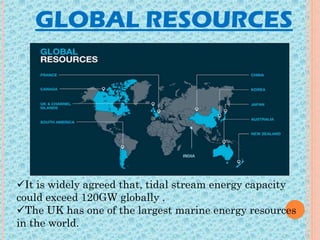
GLOBAL RESOURCES
It is widely agreed that, tidal stream energy capacity
could exceed 120GW globally .
The UK has one of the largest marine energy resources
in the world.
CONCLUSION
 Tides play a very important role in the formation of global climate as
well as the ecosystems for ocean habitants. At the same time, tides are
a substantial potential source of clean renewable energy for future
human generations. Depleting oil reserves, the emission of greenhouse
gases by burning coal, oil and other fossil fuels, as well as the
accumulation of nuclear waste from nuclear reactors will inevitably
force people to replace most of our traditional energy sources with
renewable energy in the future . Tidal energy is one of the best
candidates for this approaching revolution. Development of new,
efficient, low-cost and environmentally friendly hydraulic energy
converters suited to free-flow waters. This type of machine, moreover
,can be used not only for multi-megawatt tidal power farms but also for
mini-power stations with turbines generating a few kilowatts. Such
power stations can provide clean energy to small communities or even
individual households located near continental shorelines, straits or on
remote islands with strong tidal currents.
REFERENCES
 http://www.marineturbines.com/
 http://www.renewable-solarenergy.com/tidal-
energy-power.html
 International Energy Agency, World Energy
Outlook 2007.
 Prandle, D., Simple theory for designing tidal
power schemes, Advances in Water Resources,
1984.
 Sheth, S. and M. Shahidehpour, Tidal Energy in
Electric Power Systems, in Power Engineering
Society General Meeting, 2005.
 http://www.tidalenergyltd.com/technology.htm
Under water wind mills

Under water wind mills

  • 1.
    A SEMINAR ON UNDER WATERWINDMILL Presented by: Sandeep.L USN:4SM09ME043 Mechanical Engineering
  • 2.
    INTRODUCTION  What isit ???  An Underwater windmill like a device that extracts power from the tides. Renewable energy technologies are becoming an increasingly favourable alternative to conventional energy sources to assuage fossil fuel related issues. Tidal energy offers a vast and reliable energy source. This technology is similar to wind energy technology, with the rotor blades driven not by wind power but by tidal currents. The gravitational pull of the moon produces a swift tidal current, which spins the long blades of the turbine . Which in turn produces electricity via different parts of underwater windmill . This Energy derived from the moon that now helps to power a small arctic village.
  • 3.
    NAME JUSTIFICATION  Whyit is called as “underwater windmill” ?  "Basically it's like putting a windmill in the water," said Bjorn Bekken, a project manager for Hammerfest Strom.  Or as it’s looking like a wind mill & are installed on the ocean floor and large river bed , that means these are under the water.
  • 4.
  • 5.
  • 6.
  • 7.
  • 8.
    PRINCIPLE OF OPERATION In simple a underwater windmill consists of a number of blades mounted on a hub (together known as the rotor), a gearbox, and a generator.  The hydrodynamic effect of the flowing water past the blades causes the rotor to rotate, thus turning the generator to which the rotor is connected via a gearbox.  The gearbox is used to convert the rotational speed of the rotor shaft to the desired output speed of the generator shaft.  The electricity generated is transmitted to land through cables.
  • 9.
    RELATED WORK  Thefirst tidal power station was the Rance tidal power plant built over a period of 6 years from 1960 to 1966 at La Rance, France. It has 240 MW installed capacity.  254 MW Sihwa Lake Tidal Power Plant in South Korea is the largest tidal power installation in the world. Construction was completed in 2011.  The first in-stream tidal current generator in North America (Race Rocks Tidal Power Demonstration Project) was installed at Race Rocks on southern Vancouver Island in September 2006. The next phase in the development of this tidal current generator will be in Nova Scotia (Bay of Fundy).
  • 10.
    IMPLIMENTATION  The companyAtlantis Resources is to install a 50MW tidal farm in the Gulf of Kutch on India's west coast, with construction starting early in 2012.The facility could be expanded to deliver more than 200MW.  Projections indicate that the cost of the initial 50MW farm - to consist of 501MW turbines - will come in at about $150m.  The current timescale has the project's final engineering plans completed by the end of this Year 2013.
  • 11.
    FUTURE WORK  Thecontract for an 812 MW tidal barrage near Ganghwa Island (South Korea) north-west of Incheon has been signed by Daewoo. Completion is planned for 2015.  A 1,320 MW barrage built around islands west of Incheon is proposed by the South Korean government, with projected construction start in 2017.  In New York City, 30 tidal turbines will be installed by Verdant Power in the East River by 2015 with a capacity of 1.05MW. The contract for an 812 MW tidal barrage near Ganghwa Island (South Korea) north- west of Incheon has been signed by Daewoo. Completion is planned for 2015.  A 1,320 MW barrage built around islands west of Incheon is proposed by the South Korean government, with projected construction start in 2017.
  • 12.
    ADVANTAGES: The advantages ofunder water windmill is much more than the disadvantages:-  Uses Tidal energy ,which is a clean and renewable source of energy  Have lesser impact on the environment  Low running cost  Long lifetime with little maintenance  Reduces the dependence upon fossil fuels
  • 13.
    DISADVANTAGES:  The initialcost is too high  Very difficult to install  The blade must be coated to avoid corrosion  Special type material must have to be used for blade
  • 14.
    GLOBAL RESOURCES It iswidely agreed that, tidal stream energy capacity could exceed 120GW globally . The UK has one of the largest marine energy resources in the world.
  • 15.
    CONCLUSION  Tides playa very important role in the formation of global climate as well as the ecosystems for ocean habitants. At the same time, tides are a substantial potential source of clean renewable energy for future human generations. Depleting oil reserves, the emission of greenhouse gases by burning coal, oil and other fossil fuels, as well as the accumulation of nuclear waste from nuclear reactors will inevitably force people to replace most of our traditional energy sources with renewable energy in the future . Tidal energy is one of the best candidates for this approaching revolution. Development of new, efficient, low-cost and environmentally friendly hydraulic energy converters suited to free-flow waters. This type of machine, moreover ,can be used not only for multi-megawatt tidal power farms but also for mini-power stations with turbines generating a few kilowatts. Such power stations can provide clean energy to small communities or even individual households located near continental shorelines, straits or on remote islands with strong tidal currents.
  • 16.
    REFERENCES  http://www.marineturbines.com/  http://www.renewable-solarenergy.com/tidal- energy-power.html International Energy Agency, World Energy Outlook 2007.  Prandle, D., Simple theory for designing tidal power schemes, Advances in Water Resources, 1984.  Sheth, S. and M. Shahidehpour, Tidal Energy in Electric Power Systems, in Power Engineering Society General Meeting, 2005.  http://www.tidalenergyltd.com/technology.htm