1
Financial Viability
@WisnuDewobroto
2
3
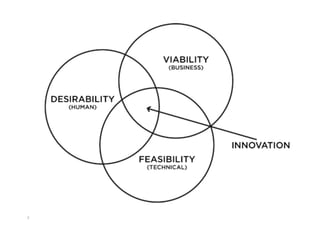
Business Model Innovation is powerful to drive growth!
Assessing financial viability early – What’s this?
• Early assessment tool /process to
test the financial viability of a
business model
• Key outputs include pricing and
volume: what do I have to do to
cover costs and achieve
breakeven (profitability)?
• The introduction of “risk” as a
financial concept: Do the returns
compensate for the risks I am
taking as an entrepreneur?
• Provides early indication whether
outside investment might be
needed to get to breakeven
‘Sometimes there
is a gap in the
market because
there’s no market
in the gap’
—Irene Bejenke-Walsh
MessageLab
Why?
To really be feasible, a business model must make sense 

• not just strategically 

(where you have a compelling and competitive product
offering and route to market),
• but also financially 

(so that you will earn more than you invest!)
• This also makes sense for a social/non-profit enterprise –
you still need to break even!
Two paths...
Financial viability has different parameters depending on
whether you intend to enter:
1. A market for products
2. A market for technology
Your choice of market might even depend on the respective
financial viability of each option.
1. Market for Products
Is there a ‘market in the gap’?
This section was co-authored by 

Irene Bejenke Walsh, MessageLab
1. Product Market
If you aim to pursue a route to the Market for Products 

(See ‘Clarysse model’ in Teece analysis slides in Business
Model tool)
1. Value Proposition based on Product Offer 

(or standardised service)
•Specific product / market niche
•Control over the value chain
•Diverse founding team with experience in industry
•Funding from founders’ own capital, debt or possibly an
Angel, followed by early revenues
-> Revenue Growth by selling standardised products to
customer segments
Key questions to address
• Do the returns on
investment compensate
for the financial risks
involved?
• Can I make a product/
deliver a service which is
competitive on a
breakeven basis ?
entrepreneur
business
• Is the addressable market
big enough to make
commercial sense? 

(See Entrepreneurial
Market Research in IE&D
Toolbox)
market • How long before the
business is self-financing
and hence…..
• …will I need outside
finance ?
finance
Copyright of Bart Clarysse and Sabrina Kiefer

The Smart Entrepreneur
TheComponents of a “Market in the Gap” Analysis
• Addressable market: this needs to be
big enough, offer enough potential
customers/revenues to make the
company scalable 

(See also “Entrepreneurial Market
Research” in IE&D Toolbox)
• A viable business model would satisfy
all 3 components opposite
• “Return on investment” is used here
as a conceptual term for a number of
key financial issues entrepreneurs
have to consider in the start-up phase,
e.g. cash and time they are investing
themselves, and how they want to be
compensated for their investment.
Breakeven Analysis
This is a rough test to work out how much we need to charge for our product or
service (i.e. the lowest price) in order to at least cover our costs, i.e. get to
breakeven.
•Once we have determined a breakeven price for our product or service, making a few basic
volume and cost assumptions, we can answer the question: is our ‘breakeven price’
competitive in the market?
•If my breakeven price is already higher than that of the nearest existing competitor(s), we are
facing a competitive and financial challenge with different potential outcomes (or a negative
business case). The idea is that the business model has to stand up at a minimum to this
simplified P&L model to assess financial viability.
•This is an interactive process, e.g. a negative business case result may cause us to review our
assumptions and thus produce a new/ lower breakeven price.
•Depending on our funding, we may be able to tolerate a negative business case in Year 1
provided we are confident that the cost base will improve in the near term (also known as ‘cost
leverage’) – this is then an issue for a more detailed financial modelling exercise to determine
when breakeven occurs and how viable this is for us.
Cost analysis
Fixed Variable
Explanation Costs that are the same
regardless of how many
items/ services you sell –
sometimes described as
the costs you need to
incur before you are able
to sell
Recurring costs that you
need to pay with each unit
you sell – naturally for some
cost items (eg raw
materials), the per unit cost
will depend on volume
Example Development costs,
property costs,
marketing, IT costs,
finance costs (though this
depends on how the
business is financed -
debt or founders’ equity)
Cost of raw materials,
distribution costs, product-
based labour/ staff costs,
royalties
Quantifying your risk & investment
• Calculating risk and investment as an
entrepreneur are essentially subjective
exercises.
• Two parameters to consider at this early stage
are money and time invested and how you
want to be compensated for these.
• Money: how much cash have I invested in the
business, when do I want/need the money back
and at what return? If I have re-mortgaged my
house and invested £50K, personal finances
might be tight and I will need a certain level of
return to pay for the cost of finance.
• Time: How long will it take to get to breakeven
point? How long can I go without a salary? If I
have invested in “sweat equity”, i.e. unpaid time,
how much is it worth and how much do I need/
want to earn?
Note: typically, third-party investors
require at least a 25% rate of return
to invest in a start up business, this
means that a business has to return 3x
the original investment over 5 years.
The concept of return on investment
• All businesses involve risk and some businesses are
riskier than others.
• Higher risks are acceptable provided they bring the
prospect of higher financial returns.
• At one level, a founder is an investor: someone
who invests his or her own time and/or money in a
new business idea or venture.
• A venture is only viable , if it compensates the
founder for the risks incurred, i.e…
• …if the founder’s return on investment exceeds the
risks involved.
• For these purposes, the return in a venture and
payback over time could be expressed as the
equivalent annual interest rate you would receive
on the same amount of money invested over the life
of the venture
Question: would you
expect to get back more
money from a £100
investment in a business
start-up or a £100
deposit in a domestic
bank account?
Now ask yourself why ?
2. Market for Technology
Technology business model – financial viability
1. Look at acquisition prices of comparable companies
2. Assess the stage of development those companies had
reached when they were acquired
3. Assess what market conditions were like at the time
4. Estimate the potential value of your business at similar
stages and market conditions
5. Evaluate the return on the effort and investment needed
Look at comparables – Steps 1 and 2
1. Look at comparable companies (similar industry/market)
where early investors exited via a trade sale pre-revenue
• What was the acquisition price?
2. At what stage of development was the comparable company
when it achieved that price? e.g.:
• Med/biotech: It had passed a stage 2 trial, or it had undergone full clinical trials
• Engineering: It had achieved a certain stage of advanced prototype or pilot tests; it
had built a certain amount of infrastructure
• Digital: it had a certain size of user base, a proven user growth trend, etc.
• And generally: employee headcount, size of technical team, size of general
operations, number of years the company has existed, etc.
Typically, at a more advanced stage of development >>
greater acquisition price
2. Stage of development - value
You might try to extrapolate a value per asset ‘unit’ at those
comparable companies, based on acquisition value E.g.
• Value per registered free user/paying customer (website)
• Value per unit of infrastructure built (engineering)
• Value of successful trial (medical), etc.
In other words, find a basis for comparison with your business
Look at Comparables - 3. Market conditions
3. What were financial market conditions like (esp. for
private equity deals) at the time the comparable companies
were acquired?
• Greater risk appetite among investors >> greater price
• Depressed financial market >> lower price

• How much competition was there on the market?
• Was it a trendy sector? Investors trying to play catch-up to get into
the market >> price rises
• Were there a lot of competing companies seeking acquisition?
>>price may fall
In short, what factors (stage of development and market)
drove exit valuation at comparable companies?
Comparables and you – step 4
4. Estimate the potential value of your business at similar
stages and market conditions
• How long might it take you to achieve a comparable stage of
development to previously acquired companies, or
comparable milestones?
• What could your ‘value per unit’ be at that stage?
• Consider possible business value in a buoyant or
depressed market .
The above will be speculative, but can offer a starting point
for considering a future value range (depending on
conditions).
5. Is the business model worth the investment?
What kind of investment (£) would be needed for the co. to
reach a ‘sellable’ stage? How much work?
• Develop Management team, Tech team, general staff
• Infrastructure
• Achieving regulatory compliance
• etc.
Given the cost, time and risk, would the final payoff (sale)
reward you sufficiently?
• For the entrepreneur this may be subjective
• For a financial investor less so – typically seek a 50-60% annual return
or 10 times initial investment
• e.g. Imperial Innovations aims for exit sales of at least £100 million,
besides a high return on initial investment
Further Reading
Clarysse, B. and Kiefer, S., 2011. The Smart Entrepreneur.
London: Elliot & Thompson, Ch. 7, 9 & 12.

Financial viability

  • 1.
  • 2.
  • 3.
    3 Business Model Innovationis powerful to drive growth!
  • 4.
    Assessing financial viabilityearly – What’s this? • Early assessment tool /process to test the financial viability of a business model • Key outputs include pricing and volume: what do I have to do to cover costs and achieve breakeven (profitability)? • The introduction of “risk” as a financial concept: Do the returns compensate for the risks I am taking as an entrepreneur? • Provides early indication whether outside investment might be needed to get to breakeven ‘Sometimes there is a gap in the market because there’s no market in the gap’ —Irene Bejenke-Walsh MessageLab
  • 5.
    Why? To really befeasible, a business model must make sense 
 • not just strategically 
 (where you have a compelling and competitive product offering and route to market), • but also financially 
 (so that you will earn more than you invest!) • This also makes sense for a social/non-profit enterprise – you still need to break even!
  • 6.
    Two paths... Financial viabilityhas different parameters depending on whether you intend to enter: 1. A market for products 2. A market for technology Your choice of market might even depend on the respective financial viability of each option.
  • 7.
    1. Market forProducts Is there a ‘market in the gap’? This section was co-authored by 
 Irene Bejenke Walsh, MessageLab
  • 8.
    1. Product Market Ifyou aim to pursue a route to the Market for Products 
 (See ‘Clarysse model’ in Teece analysis slides in Business Model tool) 1. Value Proposition based on Product Offer 
 (or standardised service) •Specific product / market niche •Control over the value chain •Diverse founding team with experience in industry •Funding from founders’ own capital, debt or possibly an Angel, followed by early revenues -> Revenue Growth by selling standardised products to customer segments
  • 9.
    Key questions toaddress • Do the returns on investment compensate for the financial risks involved? • Can I make a product/ deliver a service which is competitive on a breakeven basis ? entrepreneur business • Is the addressable market big enough to make commercial sense? 
 (See Entrepreneurial Market Research in IE&D Toolbox) market • How long before the business is self-financing and hence….. • …will I need outside finance ? finance Copyright of Bart Clarysse and Sabrina Kiefer
 The Smart Entrepreneur
  • 10.
    TheComponents of a“Market in the Gap” Analysis • Addressable market: this needs to be big enough, offer enough potential customers/revenues to make the company scalable 
 (See also “Entrepreneurial Market Research” in IE&D Toolbox) • A viable business model would satisfy all 3 components opposite • “Return on investment” is used here as a conceptual term for a number of key financial issues entrepreneurs have to consider in the start-up phase, e.g. cash and time they are investing themselves, and how they want to be compensated for their investment.
  • 11.
    Breakeven Analysis This isa rough test to work out how much we need to charge for our product or service (i.e. the lowest price) in order to at least cover our costs, i.e. get to breakeven. •Once we have determined a breakeven price for our product or service, making a few basic volume and cost assumptions, we can answer the question: is our ‘breakeven price’ competitive in the market? •If my breakeven price is already higher than that of the nearest existing competitor(s), we are facing a competitive and financial challenge with different potential outcomes (or a negative business case). The idea is that the business model has to stand up at a minimum to this simplified P&L model to assess financial viability. •This is an interactive process, e.g. a negative business case result may cause us to review our assumptions and thus produce a new/ lower breakeven price. •Depending on our funding, we may be able to tolerate a negative business case in Year 1 provided we are confident that the cost base will improve in the near term (also known as ‘cost leverage’) – this is then an issue for a more detailed financial modelling exercise to determine when breakeven occurs and how viable this is for us.
  • 12.
    Cost analysis Fixed Variable ExplanationCosts that are the same regardless of how many items/ services you sell – sometimes described as the costs you need to incur before you are able to sell Recurring costs that you need to pay with each unit you sell – naturally for some cost items (eg raw materials), the per unit cost will depend on volume Example Development costs, property costs, marketing, IT costs, finance costs (though this depends on how the business is financed - debt or founders’ equity) Cost of raw materials, distribution costs, product- based labour/ staff costs, royalties
  • 13.
    Quantifying your risk& investment • Calculating risk and investment as an entrepreneur are essentially subjective exercises. • Two parameters to consider at this early stage are money and time invested and how you want to be compensated for these. • Money: how much cash have I invested in the business, when do I want/need the money back and at what return? If I have re-mortgaged my house and invested £50K, personal finances might be tight and I will need a certain level of return to pay for the cost of finance. • Time: How long will it take to get to breakeven point? How long can I go without a salary? If I have invested in “sweat equity”, i.e. unpaid time, how much is it worth and how much do I need/ want to earn? Note: typically, third-party investors require at least a 25% rate of return to invest in a start up business, this means that a business has to return 3x the original investment over 5 years.
  • 14.
    The concept ofreturn on investment • All businesses involve risk and some businesses are riskier than others. • Higher risks are acceptable provided they bring the prospect of higher financial returns. • At one level, a founder is an investor: someone who invests his or her own time and/or money in a new business idea or venture. • A venture is only viable , if it compensates the founder for the risks incurred, i.e… • …if the founder’s return on investment exceeds the risks involved. • For these purposes, the return in a venture and payback over time could be expressed as the equivalent annual interest rate you would receive on the same amount of money invested over the life of the venture Question: would you expect to get back more money from a £100 investment in a business start-up or a £100 deposit in a domestic bank account? Now ask yourself why ?
  • 15.
    2. Market forTechnology
  • 16.
    Technology business model– financial viability 1. Look at acquisition prices of comparable companies 2. Assess the stage of development those companies had reached when they were acquired 3. Assess what market conditions were like at the time 4. Estimate the potential value of your business at similar stages and market conditions 5. Evaluate the return on the effort and investment needed
  • 17.
    Look at comparables– Steps 1 and 2 1. Look at comparable companies (similar industry/market) where early investors exited via a trade sale pre-revenue • What was the acquisition price? 2. At what stage of development was the comparable company when it achieved that price? e.g.: • Med/biotech: It had passed a stage 2 trial, or it had undergone full clinical trials • Engineering: It had achieved a certain stage of advanced prototype or pilot tests; it had built a certain amount of infrastructure • Digital: it had a certain size of user base, a proven user growth trend, etc. • And generally: employee headcount, size of technical team, size of general operations, number of years the company has existed, etc. Typically, at a more advanced stage of development >> greater acquisition price
  • 18.
    2. Stage ofdevelopment - value You might try to extrapolate a value per asset ‘unit’ at those comparable companies, based on acquisition value E.g. • Value per registered free user/paying customer (website) • Value per unit of infrastructure built (engineering) • Value of successful trial (medical), etc. In other words, find a basis for comparison with your business
  • 19.
    Look at Comparables- 3. Market conditions 3. What were financial market conditions like (esp. for private equity deals) at the time the comparable companies were acquired? • Greater risk appetite among investors >> greater price • Depressed financial market >> lower price
 • How much competition was there on the market? • Was it a trendy sector? Investors trying to play catch-up to get into the market >> price rises • Were there a lot of competing companies seeking acquisition? >>price may fall In short, what factors (stage of development and market) drove exit valuation at comparable companies?
  • 20.
    Comparables and you– step 4 4. Estimate the potential value of your business at similar stages and market conditions • How long might it take you to achieve a comparable stage of development to previously acquired companies, or comparable milestones? • What could your ‘value per unit’ be at that stage? • Consider possible business value in a buoyant or depressed market . The above will be speculative, but can offer a starting point for considering a future value range (depending on conditions).
  • 21.
    5. Is thebusiness model worth the investment? What kind of investment (£) would be needed for the co. to reach a ‘sellable’ stage? How much work? • Develop Management team, Tech team, general staff • Infrastructure • Achieving regulatory compliance • etc. Given the cost, time and risk, would the final payoff (sale) reward you sufficiently? • For the entrepreneur this may be subjective • For a financial investor less so – typically seek a 50-60% annual return or 10 times initial investment • e.g. Imperial Innovations aims for exit sales of at least £100 million, besides a high return on initial investment
  • 22.
    Further Reading Clarysse, B.and Kiefer, S., 2011. The Smart Entrepreneur. London: Elliot & Thompson, Ch. 7, 9 & 12.