Academic excellence for business and the professions 
BOOTSTRAP SEMINARS 2014 
Making sense of the numbers
Introduction 
• Why Financial planning is important 
• Building Forecasts 
• Gross Profit & Breakeven 
• Managing cash in a start up 
• Financial Control 
• How much funding should you raise and when should 
you raise it 
• Making best use of a £3K investment/competition prize 
• R&D Tax Credits 
• How to set up a company
Why it’s important 
• Ensure the business is likely to be viable 
• Support your investment case. 
• Most important ensure Cash managed – Cash is king. 
• By planning know in advance if cash flow problem – its 
too late when bank account empty. Must be able to pay 
bills as they fall due. Raising finance takes 3-6 months 
minimum. 
• Usually have a limited amount of cash to spend – ensure 
allocated to desired activities eg marketing, development 
etc 
• Growing business can very often have cash flow 
problems
BUILDING A BUDGET 
FORECAST
Some terminology 
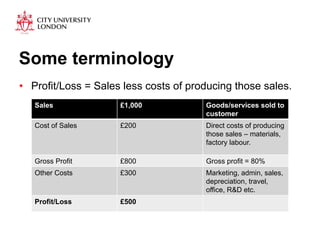
• Profit/Loss = Sales less costs of producing those sales. 
Sales £1,000 Goods/services sold to 
customer 
Cost of Sales £200 Direct costs of producing 
those sales – materials, 
factory labour. 
Gross Profit £800 Gross profit = 80% 
Other Costs £300 Marketing, admin, sales, 
depreciation, travel, 
office, R&D etc. 
Profit/Loss £500
Cash and Profit 
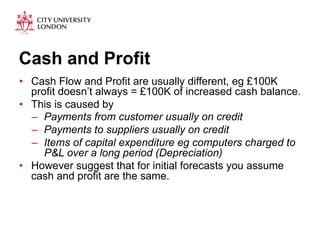
• Cash Flow and Profit are usually different, eg £100K 
profit doesn’t always = £100K of increased cash balance. 
• This is caused by 
– Payments from customer usually on credit 
– Payments to suppliers usually on credit 
– Items of capital expenditure eg computers charged to 
P&L over a long period (Depreciation) 
• However suggest that for initial forecasts you assume 
cash and profit are the same.
How to build a forecast 
• Investors typically want a 3-5 yr forecast but 
concentrate on year 1 
• Start with setting up template (See Spreadsheet) 
• What are the projected sales (Revenue Model) – number 
of units, price, when etc – is the business seasonal? 
• When will the cash be received – cash sales , credit 
sales typically paid 30-60 days after supply 
• Set up costs – hardware/software development, factory 
fit out , website development etc.
How to build a forecast 
• Cost of sales – what does it cost to make/buy in the 
units. 
• What are the overheads – staff, rent, marketing etc 
• Having identified Income + expenditure set out in a 
spreadsheet by month 
• Show net cash flow for mth + cash flow at month end 
• Remember a forecast is a best estimate!
Where does the info come from? 
• Personal knowledge 
• Competitors eg what do competitors charge 
• Competitor accounts 
• Industry statistics 
• Suppliers ask them what they will charge to supply when do 
volume discounts kick in. 
• Property – ask an estate agent 
• Work with someone who has industry knowledge 
• How are going to acquire customers – salesman ,advertising, 
what is the cost of acquiring customers likely to be. Resulting 
forecast is a best estimate 
• State assumptions - particularly Sales, cost of sales, 
marketing plan
Building a sales forecast 
• Forecast unit sales and average selling price per month 
• Use results of your market research 
• Use past data if you have it – either for your business or 
similar business 
• Is business seasonal? A lot of internet businesses are 
seasonal. Eg Christmas, games see drop-off in August 
• If you have a new technology it can be very difficult to 
predict sales levels and timing of take-up.
What costs do we typically incur? 
Most companies 
• Office costs - rent, rates Electricity, gas, cleaning, 
security, coffee, postage etc (Consider serviced office 
when starting up eg The Hangout) 
• Marketing 
• Professional Fees eg Accountancy, Tax, Payroll, Legal 
• Insurance - Employers Liability legally required 
Employee salaries 
• Capital Expenditure - computers , office furniture
What costs do we typically incur? 
Manufacturing business 
• Capital Expenditure - Plant and machinery 
• Production salaries 
• Raw Materials including packaging 
• Distribution 
• Factory building - Lease or Buy - keep it flexible, may not 
be possible if high set up costs
What costs do we typically incur? 
Web Business 
• Web site design and maintenance - in house or 
outsource 
• Hosting 
• Domain registration 
• Office Space 
• Employees 
• Fulfilment costs – postage, storage
What costs do we typically incur? 
Software/ other intellectual Property 
• Development Staff - Biggest cost 
• Patent fees/Royalties and legal costs 
• Computer hardware/software
GROSS PROFIT & 
BREAK-EVEN
Gross Profit and Break Even 
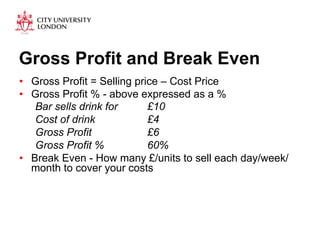
• Gross Profit = Selling price – Cost Price 
• Gross Profit % - above expressed as a % 
Bar sells drink for £10 
Cost of drink £4 
Gross Profit £6 
Gross Profit % 60% 
• Break Even - How many £/units to sell each day/week/ 
month to cover your costs
Why is this important? 
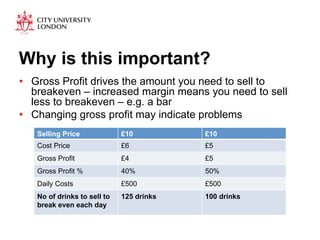
• Gross Profit drives the amount you need to sell to 
breakeven – increased margin means you need to sell 
less to breakeven – e.g. a bar 
• Changing gross profit may indicate problems 
Selling Price £10 £10 
Cost Price £6 £5 
Gross Profit £4 £5 
Gross Profit % 40% 50% 
Daily Costs £500 £500 
No of drinks to sell to 
break even each day 
125 drinks 100 drinks
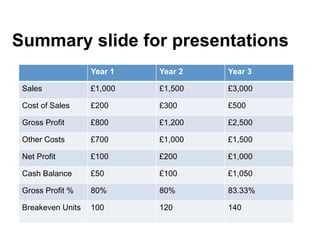
Summary slide for presentations 
Year 1 Year 2 Year 3 
Sales £1,000 £1,500 £3,000 
Cost of Sales £200 £300 £500 
Gross Profit £800 £1,200 £2,500 
Other Costs £700 £1,000 £1,500 
Net Profit £100 £200 £1,000 
Cash Balance £50 £100 £1,050 
Gross Profit % 80% 80% 83.33% 
Breakeven Units 100 120 140
MANAGING CASH FLOW 
IN A START-UP
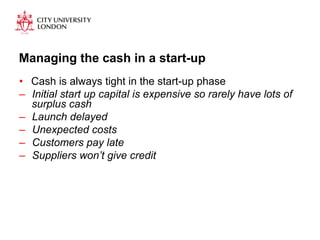
Managing the cash in a start-up 
• Cash is always tight in the start-up phase 
– Initial start up capital is expensive so rarely have lots of 
surplus cash 
– Launch delayed 
– Unexpected costs 
– Customers pay late 
– Suppliers won’t give credit
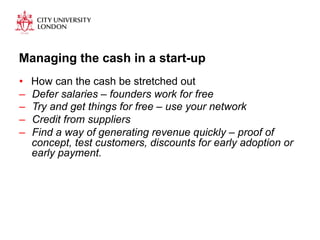
Managing the cash in a start-up 
• How can the cash be stretched out 
– Defer salaries – founders work for free 
– Try and get things for free – use your network 
– Credit from suppliers 
– Find a way of generating revenue quickly – proof of 
concept, test customers, discounts for early adoption or 
early payment.
FINANCIAL CONTROL
What is Financial Control 
• Measurement of actual v plan P+L and cash, balance sheet, KPIs, 
keeping track of product costs. 
• Ratio analysis 
• How are doing against our plan 
• Thinking ahead revising our budgets
Importance of Financial Control 
• Allows us to indentify how we are doing – good and bad from a 
financial point of view and it may point to problems in specific areas 
of the business – eg lack of sales, poor margins may mean 
problems in purchasing, marketing dept spending in excess of 
budget 
• Allows you to take corrective action in plenty of time – its too late to 
worry about a lack of cash when the bank account empty – avoid 
surprises. 
• Plan for growth ahead of time if sales are growing quicker than 
anticipated 
• Board should review mgt accounts at regular board meetings.
What do we do 
• Mthly mgt accounts – compare actual v budget analyse the 
variances 
• Mgt a/c may be as simple as a review of bank statement 
• Understand product costs 
• Reforecast – budget typically fixed for 12 mths but each mth/qtr 
reforecast 
• Calculation of ratios/key performance indicators – benchmark
HOW TO MAKE BEST 
USE OF A £3K 
INVESTMENT
How much cash to raise? 
• Your forecast will indicate how much cash you estimate 
you will need to reach profitability. 
• Raising finance is expensive – how much of the 
company do you have to sell to raise the money ? 
• If your forecast indicates that you need £2M to reach 
profitability it is very unlikely that you will be able to raise 
this in one financing round 
• Company Valuations and attractiveness to potential 
investors are related to the risk of the investment.
How much cash to raise? 
• In early stage companies some of the key risks are 
- Will the technology/product/service work 
- How much will the product cost to develop/service launch 
- Can the business overcome some regulatory issues eg planning 
permission 
- Will anyone buy the product/service 
- What will the sales price be 
Aim to raise sufficient funds (plus a contingency) at 
each round to eliminate risks with the result you 
achieve a better valuation and a greater chance of 
raising the next round. Ensure this is reflected in your 
forecast.
How to make best use of £3K 
• Use it to mitigate some of the risks 
– Build a proof of concept 
– Find early customer(s) 
– Carry out detailed market research 
– Sort out regulatory issues eg get necessary licences 
– If specific risks with the technology attempt to resolve 
them
R&D TAX CREDITS
R&D Tax Credits 
• Tax refund from HMRC for R&D Costs 
• You do not need to have previously paid tax 
• Get refund of approx 24% of Salary, Employers national 
insurance and consumables used in the R&D process eg cost 
of building a prototype. 
• Contractor cost refund is approx 16% 
• Claimed when you file your annual tax return. Supporting 
narrative is required 
• Refund is usually paid within 4-10 weeks of submitting the 
claim 
• Suggest you use a firm of accountants that understands R&D 
tax credits – not of all of them do.
SETTING UP A LIMITED 
COMPANY
Company 
• Key Advantages 
– Shareholders and directors have limited liability - (worst 
is loose investment) 
– Separate legal entity from directors/ shareholders so 
directors not personally liable for debts – (except in 
cases of negligence/fraud/Wrongful trading) 
– Raise finance by issuing shares 
• (Wrongful trading – if directors knowingly make a 
financial commitment that they know the company cant 
pay for they can be personally liable)
Types of Company 
• XYZ Limited (Private Limited Company) 
– Most common for small/medium business not listed on 
stock exchange. 
– This is what you will use 
• XYZ PLC (Public Limited Company) 
– Companies listed on a stock exchange 
– More onerous reporting/shareholder protection than 
Limited Company
How to incorporate a Company 
• Companies House 
– Cardiff based government agency that is the Registrar of 
Companies. 
– Companies file specific details that are available on the 
public record. 
– www.companieshouse.gov.uk
How to incorporate a Company 
• To incorporate a company 
– Use a lawyer or Company formation agent 
– Or do it yourself on Companies House Website – cost 
£15 
– It is a straight forward process 
– Directors/shareholders/Articles can all be changed later 
by filing appropriate forms so don't worry if you get initial 
details wrong
DIY Incorporation 
Website Address 
http://www.companieshouse.gov.uk/infoAndGuide/ 
companyRegistration.shtml 
You will need 
– Company name and registered office address ( Company name 
must be unique check first not used at Co House Webcheck 
– NB worth checking if web domain for proposed name is available 
– Director and Secretary – name, address, date of birth (need at least 
1 director, no longer requirement for secretary) 
– Shareholder name, address, no of shares, amount paying per share 
– £15 Payment
Articles of Association 
• Company rule book 
• must be filed at Companies House 
• Standard Articles are available – suggest you use these 
for initial incorporation 
• It is likely that investors will require special terms 
• Approved by shareholders
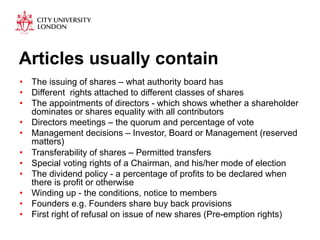
Articles usually contain 
• The issuing of shares – what authority board has 
• Different rights attached to different classes of shares 
• The appointments of directors - which shows whether a shareholder 
dominates or shares equality with all contributors 
• Directors meetings – the quorum and percentage of vote 
• Management decisions – Investor, Board or Management (reserved 
matters) 
• Transferability of shares – Permitted transfers 
• Special voting rights of a Chairman, and his/her mode of election 
• The dividend policy - a percentage of profits to be declared when 
there is profit or otherwise 
• Winding up - the conditions, notice to members 
• Founders e.g. Founders share buy back provisions 
• First right of refusal on issue of new shares (Pre-emption rights)
Academic excellence for business and the professions 
THANK YOU 
Q&A

Bootstrap Business Seminars: Making Sense of the Numbers

  • 1.
    Academic excellence forbusiness and the professions BOOTSTRAP SEMINARS 2014 Making sense of the numbers
  • 2.
    Introduction • WhyFinancial planning is important • Building Forecasts • Gross Profit & Breakeven • Managing cash in a start up • Financial Control • How much funding should you raise and when should you raise it • Making best use of a £3K investment/competition prize • R&D Tax Credits • How to set up a company
  • 3.
    Why it’s important • Ensure the business is likely to be viable • Support your investment case. • Most important ensure Cash managed – Cash is king. • By planning know in advance if cash flow problem – its too late when bank account empty. Must be able to pay bills as they fall due. Raising finance takes 3-6 months minimum. • Usually have a limited amount of cash to spend – ensure allocated to desired activities eg marketing, development etc • Growing business can very often have cash flow problems
  • 4.
  • 5.
    Some terminology •Profit/Loss = Sales less costs of producing those sales. Sales £1,000 Goods/services sold to customer Cost of Sales £200 Direct costs of producing those sales – materials, factory labour. Gross Profit £800 Gross profit = 80% Other Costs £300 Marketing, admin, sales, depreciation, travel, office, R&D etc. Profit/Loss £500
  • 6.
    Cash and Profit • Cash Flow and Profit are usually different, eg £100K profit doesn’t always = £100K of increased cash balance. • This is caused by – Payments from customer usually on credit – Payments to suppliers usually on credit – Items of capital expenditure eg computers charged to P&L over a long period (Depreciation) • However suggest that for initial forecasts you assume cash and profit are the same.
  • 7.
    How to builda forecast • Investors typically want a 3-5 yr forecast but concentrate on year 1 • Start with setting up template (See Spreadsheet) • What are the projected sales (Revenue Model) – number of units, price, when etc – is the business seasonal? • When will the cash be received – cash sales , credit sales typically paid 30-60 days after supply • Set up costs – hardware/software development, factory fit out , website development etc.
  • 8.
    How to builda forecast • Cost of sales – what does it cost to make/buy in the units. • What are the overheads – staff, rent, marketing etc • Having identified Income + expenditure set out in a spreadsheet by month • Show net cash flow for mth + cash flow at month end • Remember a forecast is a best estimate!
  • 9.
    Where does theinfo come from? • Personal knowledge • Competitors eg what do competitors charge • Competitor accounts • Industry statistics • Suppliers ask them what they will charge to supply when do volume discounts kick in. • Property – ask an estate agent • Work with someone who has industry knowledge • How are going to acquire customers – salesman ,advertising, what is the cost of acquiring customers likely to be. Resulting forecast is a best estimate • State assumptions - particularly Sales, cost of sales, marketing plan
  • 10.
    Building a salesforecast • Forecast unit sales and average selling price per month • Use results of your market research • Use past data if you have it – either for your business or similar business • Is business seasonal? A lot of internet businesses are seasonal. Eg Christmas, games see drop-off in August • If you have a new technology it can be very difficult to predict sales levels and timing of take-up.
  • 11.
    What costs dowe typically incur? Most companies • Office costs - rent, rates Electricity, gas, cleaning, security, coffee, postage etc (Consider serviced office when starting up eg The Hangout) • Marketing • Professional Fees eg Accountancy, Tax, Payroll, Legal • Insurance - Employers Liability legally required Employee salaries • Capital Expenditure - computers , office furniture
  • 12.
    What costs dowe typically incur? Manufacturing business • Capital Expenditure - Plant and machinery • Production salaries • Raw Materials including packaging • Distribution • Factory building - Lease or Buy - keep it flexible, may not be possible if high set up costs
  • 13.
    What costs dowe typically incur? Web Business • Web site design and maintenance - in house or outsource • Hosting • Domain registration • Office Space • Employees • Fulfilment costs – postage, storage
  • 14.
    What costs dowe typically incur? Software/ other intellectual Property • Development Staff - Biggest cost • Patent fees/Royalties and legal costs • Computer hardware/software
  • 15.
    GROSS PROFIT & BREAK-EVEN
  • 16.
    Gross Profit andBreak Even • Gross Profit = Selling price – Cost Price • Gross Profit % - above expressed as a % Bar sells drink for £10 Cost of drink £4 Gross Profit £6 Gross Profit % 60% • Break Even - How many £/units to sell each day/week/ month to cover your costs
  • 17.
    Why is thisimportant? • Gross Profit drives the amount you need to sell to breakeven – increased margin means you need to sell less to breakeven – e.g. a bar • Changing gross profit may indicate problems Selling Price £10 £10 Cost Price £6 £5 Gross Profit £4 £5 Gross Profit % 40% 50% Daily Costs £500 £500 No of drinks to sell to break even each day 125 drinks 100 drinks
  • 18.
    Summary slide forpresentations Year 1 Year 2 Year 3 Sales £1,000 £1,500 £3,000 Cost of Sales £200 £300 £500 Gross Profit £800 £1,200 £2,500 Other Costs £700 £1,000 £1,500 Net Profit £100 £200 £1,000 Cash Balance £50 £100 £1,050 Gross Profit % 80% 80% 83.33% Breakeven Units 100 120 140
  • 19.
    MANAGING CASH FLOW IN A START-UP
  • 20.
    Managing the cashin a start-up • Cash is always tight in the start-up phase – Initial start up capital is expensive so rarely have lots of surplus cash – Launch delayed – Unexpected costs – Customers pay late – Suppliers won’t give credit
  • 21.
    Managing the cashin a start-up • How can the cash be stretched out – Defer salaries – founders work for free – Try and get things for free – use your network – Credit from suppliers – Find a way of generating revenue quickly – proof of concept, test customers, discounts for early adoption or early payment.
  • 22.
  • 23.
    What is FinancialControl • Measurement of actual v plan P+L and cash, balance sheet, KPIs, keeping track of product costs. • Ratio analysis • How are doing against our plan • Thinking ahead revising our budgets
  • 24.
    Importance of FinancialControl • Allows us to indentify how we are doing – good and bad from a financial point of view and it may point to problems in specific areas of the business – eg lack of sales, poor margins may mean problems in purchasing, marketing dept spending in excess of budget • Allows you to take corrective action in plenty of time – its too late to worry about a lack of cash when the bank account empty – avoid surprises. • Plan for growth ahead of time if sales are growing quicker than anticipated • Board should review mgt accounts at regular board meetings.
  • 25.
    What do wedo • Mthly mgt accounts – compare actual v budget analyse the variances • Mgt a/c may be as simple as a review of bank statement • Understand product costs • Reforecast – budget typically fixed for 12 mths but each mth/qtr reforecast • Calculation of ratios/key performance indicators – benchmark
  • 26.
    HOW TO MAKEBEST USE OF A £3K INVESTMENT
  • 27.
    How much cashto raise? • Your forecast will indicate how much cash you estimate you will need to reach profitability. • Raising finance is expensive – how much of the company do you have to sell to raise the money ? • If your forecast indicates that you need £2M to reach profitability it is very unlikely that you will be able to raise this in one financing round • Company Valuations and attractiveness to potential investors are related to the risk of the investment.
  • 28.
    How much cashto raise? • In early stage companies some of the key risks are - Will the technology/product/service work - How much will the product cost to develop/service launch - Can the business overcome some regulatory issues eg planning permission - Will anyone buy the product/service - What will the sales price be Aim to raise sufficient funds (plus a contingency) at each round to eliminate risks with the result you achieve a better valuation and a greater chance of raising the next round. Ensure this is reflected in your forecast.
  • 29.
    How to makebest use of £3K • Use it to mitigate some of the risks – Build a proof of concept – Find early customer(s) – Carry out detailed market research – Sort out regulatory issues eg get necessary licences – If specific risks with the technology attempt to resolve them
  • 30.
  • 31.
    R&D Tax Credits • Tax refund from HMRC for R&D Costs • You do not need to have previously paid tax • Get refund of approx 24% of Salary, Employers national insurance and consumables used in the R&D process eg cost of building a prototype. • Contractor cost refund is approx 16% • Claimed when you file your annual tax return. Supporting narrative is required • Refund is usually paid within 4-10 weeks of submitting the claim • Suggest you use a firm of accountants that understands R&D tax credits – not of all of them do.
  • 32.
    SETTING UP ALIMITED COMPANY
  • 33.
    Company • KeyAdvantages – Shareholders and directors have limited liability - (worst is loose investment) – Separate legal entity from directors/ shareholders so directors not personally liable for debts – (except in cases of negligence/fraud/Wrongful trading) – Raise finance by issuing shares • (Wrongful trading – if directors knowingly make a financial commitment that they know the company cant pay for they can be personally liable)
  • 34.
    Types of Company • XYZ Limited (Private Limited Company) – Most common for small/medium business not listed on stock exchange. – This is what you will use • XYZ PLC (Public Limited Company) – Companies listed on a stock exchange – More onerous reporting/shareholder protection than Limited Company
  • 35.
    How to incorporatea Company • Companies House – Cardiff based government agency that is the Registrar of Companies. – Companies file specific details that are available on the public record. – www.companieshouse.gov.uk
  • 36.
    How to incorporatea Company • To incorporate a company – Use a lawyer or Company formation agent – Or do it yourself on Companies House Website – cost £15 – It is a straight forward process – Directors/shareholders/Articles can all be changed later by filing appropriate forms so don't worry if you get initial details wrong
  • 37.
    DIY Incorporation WebsiteAddress http://www.companieshouse.gov.uk/infoAndGuide/ companyRegistration.shtml You will need – Company name and registered office address ( Company name must be unique check first not used at Co House Webcheck – NB worth checking if web domain for proposed name is available – Director and Secretary – name, address, date of birth (need at least 1 director, no longer requirement for secretary) – Shareholder name, address, no of shares, amount paying per share – £15 Payment
  • 38.
    Articles of Association • Company rule book • must be filed at Companies House • Standard Articles are available – suggest you use these for initial incorporation • It is likely that investors will require special terms • Approved by shareholders
  • 39.
    Articles usually contain • The issuing of shares – what authority board has • Different rights attached to different classes of shares • The appointments of directors - which shows whether a shareholder dominates or shares equality with all contributors • Directors meetings – the quorum and percentage of vote • Management decisions – Investor, Board or Management (reserved matters) • Transferability of shares – Permitted transfers • Special voting rights of a Chairman, and his/her mode of election • The dividend policy - a percentage of profits to be declared when there is profit or otherwise • Winding up - the conditions, notice to members • Founders e.g. Founders share buy back provisions • First right of refusal on issue of new shares (Pre-emption rights)
  • 40.
    Academic excellence forbusiness and the professions THANK YOU Q&A