Start-Up Valuations
By Jeff Faust, CVA
Director of Valuation Services
October 27
2015
Copyright @ 2014 Abbott, Stringham & Lynch. All rights reserved.
2
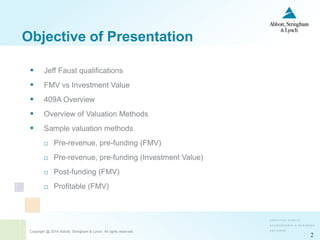
 Jeff Faust qualifications
 FMV vs Investment Value
 409A Overview
 Overview of Valuation Methods
 Sample valuation methods
 Pre-revenue, pre-funding (FMV)
 Pre-revenue, pre-funding (Investment Value)
 Post-funding (FMV)
 Profitable (FMV)
Objective of Presentation
Copyright @ 2014 Abbott, Stringham & Lynch. All rights reserved.
3
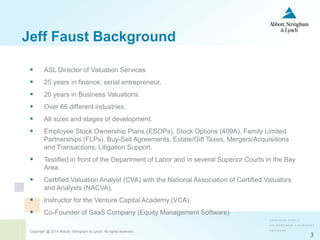
 ASL Director of Valuation Services
 25 years in finance, serial entrepreneur.
 20 years in Business Valuations.
 Over 65 different industries.
 All sizes and stages of development.
 Employee Stock Ownership Plans (ESOPs), Stock Options (409A), Family Limited
Partnerships (FLPs), Buy-Sell Agreements, Estate/Gift Taxes, Mergers/Acquisitions
and Transactions, Litigation Support.
 Testified in front of the Department of Labor and in several Superior Courts in the Bay
Area.
 Certified Valuation Analyst (CVA) with the National Association of Certified Valuators
and Analysts (NACVA).
 Instructor for the Venture Capital Academy (VCA).
 Co-Founder of SaaS Company (Equity Management Software)
Jeff Faust Background
Copyright @ 2014 Abbott, Stringham & Lynch. All rights reserved.
4
Valuation Workshop
 FMV vs Investment Value
Copyright @ 2014 Abbott, Stringham & Lynch. All rights reserved.
5
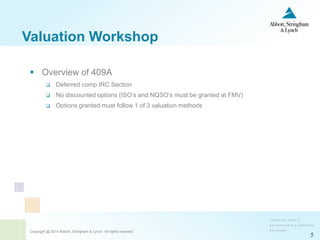
Valuation Workshop
 Overview of 409A
 Deferred comp IRC Section
 No discounted options (ISO’s and NQSO’s must be granted at FMV)
 Options granted must follow 1 of 3 valuation methods
Copyright @ 2014 Abbott, Stringham & Lynch. All rights reserved.
6
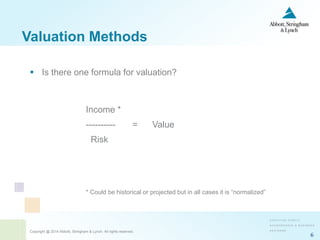
Valuation Methods
 Is there one formula for valuation?
Income *
---------- = Value
Risk
* Could be historical or projected but in all cases it is “normalized”
Copyright @ 2014 Abbott, Stringham & Lynch. All rights reserved.
7
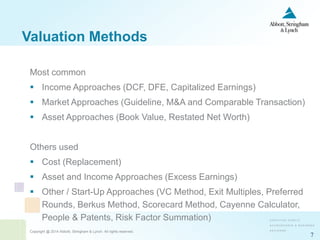
Valuation Methods
Most common
 Income Approaches (DCF, DFE, Capitalized Earnings)
 Market Approaches (Guideline, M&A and Comparable Transaction)
 Asset Approaches (Book Value, Restated Net Worth)
Others used
 Cost (Replacement)
 Asset and Income Approaches (Excess Earnings)
 Other / Start-Up Approaches (VC Method, Exit Multiples, Preferred
Rounds, Berkus Method, Scorecard Method, Cayenne Calculator,
People & Patents, Risk Factor Summation)
Copyright @ 2014 Abbott, Stringham & Lynch. All rights reserved.
8
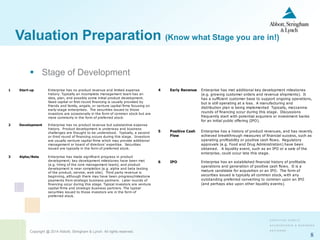
Valuation Preparation (Know what Stage you are in!)
 Stage of Development
Stage
Abbreviated
Description Description
1 Start-up Enterprise has no product revenue and limited expense
history. Typically an incomplete management team has an
idea, plan, and possibly some initial product development.
Seed capital or first-round financing is usually provided by
friends and family, angels, or venture capital firms focusing on
early-stage enterprises. The securities issued to those
investors are occasionally in the form of common stock but are
more commonly in the form of preferred stock.
2 Development Enterprise has no product revenue but substantive expense
history. Product development is underway and business
challenges are thought to be understood. Typically, a second
or third round of financing occurs during this stage. Investors
are usually venture capital firms which may provide additional
management or board of directors’ expertise. Securities
issued are typically in the form of preferred stock.
3 Alpha/Beta Enterprise has made significant progress in product
development; key development milestones have been met
(e.g. hiring of the core management team); and product
development is near completion (e.g. alpha and beta testing
of the product, service, web site). Third party revenue is
beginning, although there may have been progress/milestone
payments from strategic business partners. Later rounds of
financing occur during this stage. Typical investors are venture
capital firms and strategic business partners. The typical
securities issued to those investors are in the form of
preferred stock.
4 Early Revenue Enterprise has met additional key development milestones
(e.g. growing customer orders and revenue shipments). It
has a sufficient customer base to support ongoing operations,
but is still operating at a loss. A manufacturing and
distribution plan is being implemented Typically, mezzanine
rounds of financing occur during this stage. Discussions
frequently start with potential acquirers or investment banks
for an initial public offering (IPO).
2 Development Enterprise has no product revenue but substantive expense
history. Product development is underway and business
challenges are thought to be understood. Typically, a second
or third round of financing occurs during this stage. Investors
are usually venture capital firms which may provide additional
management or board of directors’ expertise. Securities
issued are typically in the form of preferred stock.
3 Alpha/Beta Enterprise has made significant progress in product
development; key development milestones have been met
(e.g. hiring of the core management team); and product
development is near completion (e.g. alpha and beta testing
of the product, service, web site). Third party revenue is
beginning, although there may have been progress/milestone
payments from strategic business partners. Later rounds of
financing occur during this stage. Typical investors are venture
capital firms and strategic business partners. The typical
securities issued to those investors are in the form of
preferred stock.
4 Early Revenue Enterprise has met additional key development milestones
(e.g. growing customer orders and revenue shipments). It
has a sufficient customer base to support ongoing operations,
but is still operating at a loss. A manufacturing and
distribution plan is being implemented Typically, mezzanine
rounds of financing occur during this stage. Discussions
frequently start with potential acquirers or investment banks
for an initial public offering (IPO).
5 Positive Cash
Flow
Enterprise has a history of product revenues, and has recently
achieved breakthrough measures of financial success, such as
operating profitability or positive cash flows. Regulatory
approvals (e.g. Food and Drug Administration) have been
obtained. A liquidity event, such as an IPO or a sale of the
enterprise, could occur late this stage.
6 IPO Enterprise has an established financial history of profitable
operations and generation of positive cash flows. It is a
mature candidate for acquisition or an IPO. The form of
securities issued is typically all common stock, with any
outstanding preferred converting to common upon an IPO
(and perhaps also upon other liquidity events).
Copyright @ 2014 Abbott, Stringham & Lynch. All rights reserved.
9
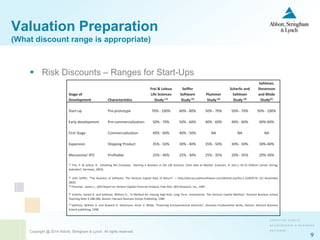
 Risk Discounts – Ranges for Start-Ups
Stage of
Development Characteristics
Frei & Leleux
Life Sciences
Study (1)
Seiffer
Software
Study (2)
Plummer
Study (3)
Scherlis and
Sahlman
Study (4)
Sahlman,
Stevenson
and Bhide
Study(5)
Start-up Pre-prototype 70% - 100% 60% - 80% 50% - 70% 50% - 70% 50% - 100%
Early development Pre-commercialization 50% - 70% 50% - 60% 40% - 60% 40% - 60% 40%-60%
First Stage Commercialization 40% - 60% 40% - 50% NA NA NA
Expansion Shipping Product 35% - 50% 30% - 40% 35% - 50% 30% - 50% 30%-40%
Mezzanine/ IPO Profitable 25% - 40% 25% - 30% 25% - 35% 20% - 35% 20%-30%
(1) Frei, P. & Leleux, B. Valuating the Company. Starting a Business in the Life Sciences- from Idea to Market. (Luessen, H. (ed.).) 42-55 (Edition Cantor Verlag,
Aulendorf, Germany, 2003).
(2) John Seiffer, "The Business of Software: The Venture Capital Rate of Return". < http://discuss.joelonsoftware.com/default.asp?biz.5.254929.9> (21 November
2005)
(3) Plummer, James L., QED Report on Venture Capital Financial Analysis, Palo Alto: QED Research, Inc., 1987
(4) Scherlis, Daniel R. and Sahlman, William A., "A Method for Valuing High-Risk, Long Term, Investments: The Venture Capital Method," Harvard Business School
Teaching Note 9-288-006, Boston: Harvard Business School Publishing, 1989
(5) Sahlman, William A. and Howard H. Stevenson, Amar V. Bhide, “Financing Entrepreneurial Ventures”, Business Fundamental Series, Boston: Harvard Business
School publishing, 1998.
Valuation Preparation
(What discount range is appropriate)
Copyright @ 2014 Abbott, Stringham & Lynch. All rights reserved.
10
Sample Valuation Methods
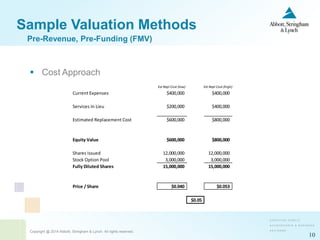
 Cost Approach
Est Repl Cost (low) Est Repl Cost (high)
Current Expenses $400,000 $400,000
Services In Lieu $200,000 $400,000
Estimated Replacement Cost $600,000 $800,000
Equity Value $600,000 $800,000
Shares Issued 12,000,000 12,000,000
Stock Option Pool 3,000,000 3,000,000
Fully Diluted Shares 15,000,000 15,000,000
Price / Share $0.040 $0.053
$0.05
Pre-Revenue, Pre-Funding (FMV)
Copyright @ 2014 Abbott, Stringham & Lynch. All rights reserved.
11
Sample Valuation Methods
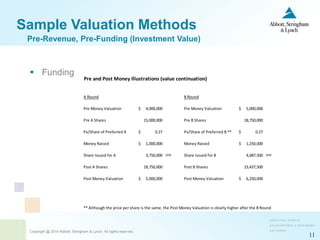
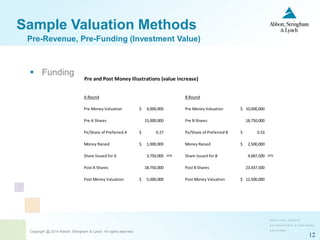
 Funding
Pre-Revenue, Pre-Funding (Investment Value)
Pre and Post Money Illustrations (value continuation)
A Round B Round
Pre Money Valuation 4,000,000$ Pre Money Valuation 5,000,000$
Pre A Shares 15,000,000 Pre B Shares 18,750,000
Px/Share of Preferred A 0.27$ Px/Share of Preferred B ** 0.27$
Money Raised 1,000,000$ Money Raised 1,250,000$
Share Issued for A 3,750,000 20% Share Issued for B 4,687,500 20%
Post A Shares 18,750,000 Post B Shares 23,437,500
Post Money Valuation 5,000,000$ Post Money Valuation 6,250,000$
** Although the price per share is the same, the Post Money Valuation is clearly higher after the B Round
Copyright @ 2014 Abbott, Stringham & Lynch. All rights reserved.
12
Sample Valuation Methods
 Funding
Pre-Revenue, Pre-Funding (Investment Value)
Pre and Post Money Illustrations (value increase)
A Round B Round
Pre Money Valuation 4,000,000$ Pre Money Valuation 10,000,000$
Pre A Shares 15,000,000 Pre B Shares 18,750,000
Px/Share of Preferred A 0.27$ Px/Share of Preferred B 0.53$
Money Raised 1,000,000$ Money Raised 2,500,000$
Share Issued for A 3,750,000 20% Share Issued for B 4,687,500 20%
Post A Shares 18,750,000 Post B Shares 23,437,500
Post Money Valuation 5,000,000$ Post Money Valuation 12,500,000$
Copyright @ 2014 Abbott, Stringham & Lynch. All rights reserved.
13
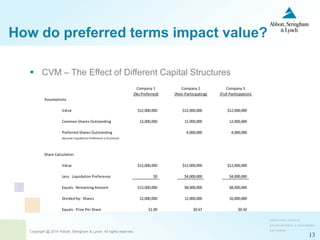
How do preferred terms impact value?
 CVM – The Effect of Different Capital Structures
Company 1 Company 2 Company 3
(No Preferred) (Non-Participating) (Full Participation)
Assumptions
Value $12,000,000 $12,000,000 $12,000,000
Common Shares Outstanding 12,000,000 12,000,000 12,000,000
Preferred Shares Outstanding 4,000,000 4,000,000
(Assume Liquidation Preference is $1/share)
Share Calculation
Value $12,000,000 $12,000,000 $12,000,000
Less: Liquidation Preference $0 $4,000,000 $4,000,000
Equals: Remaining Amount $12,000,000 $8,000,000 $8,000,000
Divided by: Shares 12,000,000 12,000,000 16,000,000
Equals: Price Per Share $1.00 $0.67 $0.50
Copyright @ 2014 Abbott, Stringham & Lynch. All rights reserved.
14
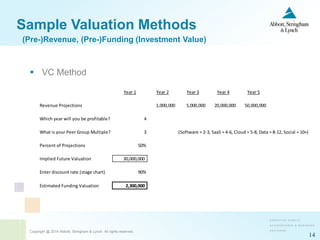
 VC Method
(Pre-)Revenue, (Pre-)Funding (Investment Value)
Sample Valuation Methods
Year 1 Year 2 Year 3 Year 4 Year 5
Revenue Projections 1,000,000 5,000,000 20,000,000 50,000,000
Which year will you be profitable? 4
What is your Peer Group Multiple? 3 (Software = 2-3, SaaS = 4-6, Cloud = 5-8, Data = 8-12, Social = 10+)
Percent of Projections 50%
Implied Future Valuation 30,000,000
Enter discount rate (stage chart) 90%
Estimated Funding Valuation 2,300,000
Copyright @ 2014 Abbott, Stringham & Lynch. All rights reserved.
15
Sample Valuation Methods
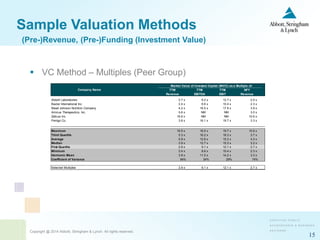
 VC Method – Multiples (Peer Group) ($US in millions)
Market Value of Invested Capital (MVIC) as a Multiple of:
TTM TTM TTM NFY
Revenue EBITDA EBIT Revenue
2.7 x 9.2 x 12.7 x 2.5 x
2.4 x 8.6 x 10.4 x 2.3 x
4.2 x 16.5 x 17.9 x 3.8 x
5.6 x NM NM 3.0 x
16.9 x NM NM 10.6 x
3.6 x 16.1 x 19.7 x 3.3 x
Maximum 16.9 x 16.5 x 19.7 x 10.6 x
Third Quartile 5.3 x 16.2 x 18.3 x 3.7 x
Average 5.9 x 12.6 x 15.2 x 4.3 x
Median 3.9 x 12.7 x 15.3 x 3.2 x
First Quartile 2.9 x 9.1 x 12.1 x 2.7 x
Minimum 2.4 x 8.6 x 10.4 x 2.3 x
Harmonic Mean 3.9 x 11.5 x 14.2 x 3.3 x
Coefficient of Variance 94% 34% 29% 74%
Selected Multiples 2.9 x 9.1 x 12.1 x 2.7 x
Sample Company's Financials 5.200$ (9.562)$ (10.562)$ 15.265$
Indicated MVIC Value Range 15.080 (87.014) (127.800) 41.216
Weighting 0% 0% 0% 100%
Implied Market Value of Invested Capital 41.200$
Less: Debt 10.500
Total Equity Value (Non-controlling, Marketable) 30.700$
Less: Discount for Lack of Marketability 35.0% 10.745
Total Equity Value (Non-controlling, Non-marketable) 19.955$
Perrigo Co.
Zalicus Inc.
Company Name
Abbott Laboratories
Baxter International Inc.
Mead Johnson Nutrition Company
Amicus Therapeutics, Inc.
(Pre-)Revenue, (Pre-)Funding (Investment Value)
Copyright @ 2014 Abbott, Stringham & Lynch. All rights reserved.
16
Sample Valuation Methods
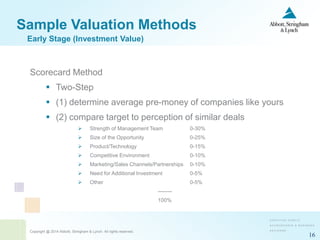
Scorecard Method
 Two-Step
 (1) determine average pre-money of companies like yours
 (2) compare target to perception of similar deals
 Strength of Management Team 0-30%
 Size of the Opportunity 0-25%
 Product/Technology 0-15%
 Competitive Environment 0-10%
 Marketing/Sales Channels/Partnerships 0-10%
 Need for Additional Investment 0-5%
 Other 0-5%
--------
100%
Early Stage (Investment Value)
Copyright @ 2014 Abbott, Stringham & Lynch. All rights reserved.
17
Sample Valuation Methods
Scorecard Method
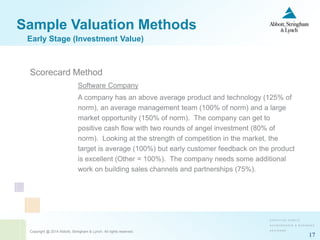
Software Company
A company has an above average product and technology (125% of
norm), an average management team (100% of norm) and a large
market opportunity (150% of norm). The company can get to
positive cash flow with two rounds of angel investment (80% of
norm). Looking at the strength of competition in the market, the
target is average (100%) but early customer feedback on the product
is excellent (Other = 100%). The company needs some additional
work on building sales channels and partnerships (75%).
Early Stage (Investment Value)
Copyright @ 2014 Abbott, Stringham & Lynch. All rights reserved.
18
Sample Valuation Methods
Scorecard Method
Early Stage (Investment Value)
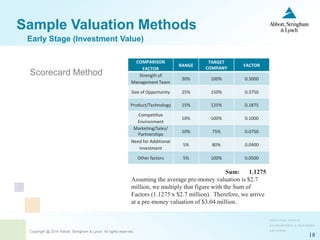
COMPARISON
FACTOR
RANGE
TARGET
COMPANY
FACTOR
Strength of
Management Team
30% 100% 0.3000
Size of Opportunity 25% 150% 0.3750
Product/Technology 15% 125% 0.1875
Competitive
Environment
10% 100% 0.1000
Marketing/Sales/
Partnerships
10% 75% 0.0750
Need for Additional
Investment
5% 80% 0.0400
Other factors 5% 100% 0.0500
Sum: 1.1275
Assuming the average pre-money valuation is $2.7
million, we multiply that figure with the Sum of
Factors (1.1275 x $2.7 million). Therefore, we arrive
at a pre-money valuation of $3.04 million.
Copyright @ 2014 Abbott, Stringham & Lynch. All rights reserved.
19
Sample Valuation Methods
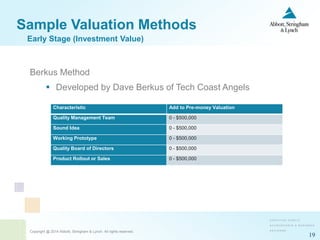
Berkus Method
 Developed by Dave Berkus of Tech Coast Angels
Early Stage (Investment Value)
Characteristic Add to Pre-money Valuation
Quality Management Team 0 - $500,000
Sound Idea 0 - $500,000
Working Prototype 0 - $500,000
Quality Board of Directors 0 - $500,000
Product Rollout or Sales 0 - $500,000
Copyright @ 2014 Abbott, Stringham & Lynch. All rights reserved.
20
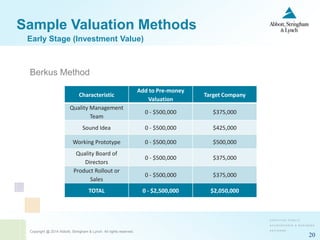
Sample Valuation Methods
Berkus Method
Early Stage (Investment Value)
Characteristic
Add to Pre-money
Valuation
Target Company
Quality Management
Team
0 - $500,000 $375,000
Sound Idea 0 - $500,000 $425,000
Working Prototype 0 - $500,000 $500,000
Quality Board of
Directors
0 - $500,000 $375,000
Product Rollout or
Sales
0 - $500,000 $375,000
TOTAL 0 - $2,500,000 $2,050,000
Copyright @ 2014 Abbott, Stringham & Lynch. All rights reserved.
21
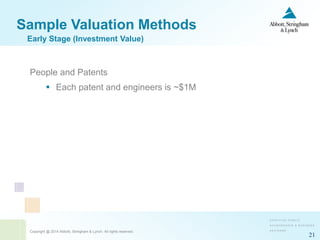
Sample Valuation Methods
People and Patents
 Each patent and engineers is ~$1M
Early Stage (Investment Value)
Copyright @ 2014 Abbott, Stringham & Lynch. All rights reserved.
22
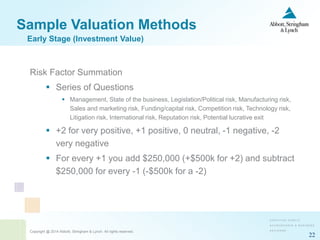
Sample Valuation Methods
Risk Factor Summation
 Series of Questions
 Management, State of the business, Legislation/Political risk, Manufacturing risk,
Sales and marketing risk, Funding/capital risk, Competition risk, Technology risk,
Litigation risk, International risk, Reputation risk, Potential lucrative exit
 +2 for very positive, +1 positive, 0 neutral, -1 negative, -2
very negative
 For every +1 you add $250,000 (+$500k for +2) and subtract
$250,000 for every -1 (-$500k for a -2)
Early Stage (Investment Value)
Copyright @ 2014 Abbott, Stringham & Lynch. All rights reserved.
23
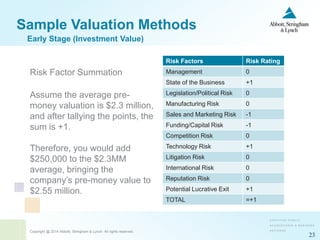
Sample Valuation Methods
Risk Factor Summation
Assume the average pre-
money valuation is $2.3 million,
and after tallying the points, the
sum is +1.
Therefore, you would add
$250,000 to the $2.3MM
average, bringing the
company’s pre-money value to
$2.55 million.
Early Stage (Investment Value)
Risk Factors Risk Rating
Management 0
State of the Business +1
Legislation/Political Risk 0
Manufacturing Risk 0
Sales and Marketing Risk -1
Funding/Capital Risk -1
Competition Risk 0
Technology Risk +1
Litigation Risk 0
International Risk 0
Reputation Risk 0
Potential Lucrative Exit +1
TOTAL =+1
Copyright @ 2014 Abbott, Stringham & Lynch. All rights reserved.
24
Sample Valuation Methods
Cayenne Calculator
 www.caycon.com/valuation.php
 Series of questions
Any Stage (Investment Value)
Copyright @ 2014 Abbott, Stringham & Lynch. All rights reserved.
25
Sample Valuation Methods
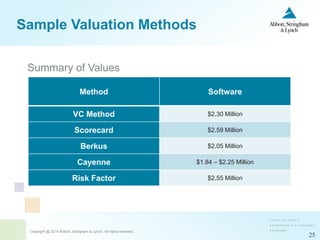
Summary of Values
Method Software
VC Method $2.30 Million
Scorecard $2.59 Million
Berkus $2.05 Million
Cayenne $1.84 – $2.25 Million
Risk Factor $2.55 Million
Copyright @ 2014 Abbott, Stringham & Lynch. All rights reserved.
26
Sample Valuation Methods
 Discounted Cash Flow (DCF) – [exit multiples]
Projected Financials
FYE FYE FYE FYE FYE
12/31/12 12/31/13 12/31/14 12/31/15 12/31/16
Projected Earnings (9.238)$ (5.235)$ 1.528$ 6.859$ 10.537$
Terminal Value Calculation
Revenue Multiple 12/31/16 165.526$ 2.7
Terminal Value 430.37$
Present Value Period 1.00 2.00 3.00 4.00 5.00 5.50
Present Value Factor (3)
60.0% Discount Rate 0.624 0.390 0.244 0.152 0.095 0.075
Present Value of Debt-free Cash Flow (5.782)$ (2.042)$ 0.373$ 1.045$ 1.004$ 32.406$
Sum of Present Value of Debt-free Cash Flow in Projection Period (5.403)$
Plus: Present Value of Terminal Value 32.406
Total Equity Value (Controlling, Marketable) 27.003$
Less: Discount for Lack of Control 0.0% -
Total Equity Value (Non-controlling, Marketable) 27.003$
Less: Discount for Lack of Marketability 35.0% 9.451
Total Equity Value (Non-controlling, Non-marketable) 17.552$
Terminal
Year
Post-Funding (FMV)
Copyright @ 2014 Abbott, Stringham & Lynch. All rights reserved.
27
Sample Valuation Methods
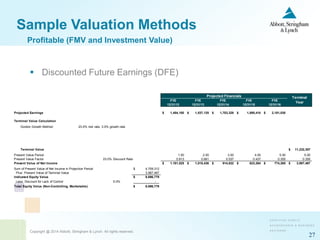
 Discounted Future Earnings (DFE)
Profitable (FMV and Investment Value)
Projected Financials
FYE FYE FYE FYE FYE
12/31/12 12/31/13 12/31/14 12/31/15 12/31/16
Projected Earnings 1,454,100$ 1,537,125$ 1,703,328$ 1,885,410$ 2,181,030$
Terminal Value Calculation
Gordon Growth Method 23.0% risk rate, 3.0% growth rate
Terminal Value 11,232,307$
Present Value Period 1.00 2.00 3.00 4.00 5.00 5.00
Present Value Factor 23.0% Discount Rate 0.813 0.661 0.537 0.437 0.355 0.355
Present Value of Net Income 1,181,525$ 1,015,436$ 914,822$ 823,264$ 774,265$ 3,987,467$
Sum of Present Value of Net Income in Projection Period 4,709,312$
Plus: Present Value of Terminal Value 3,987,467
Indicated Equity Value 8,696,779$
Less: Discount for Lack of Control 0.0% -
Total Equity Value (Non-Controlling, Marketable) 8,696,779$
Less: Discount for Lack of Marketability 35.0% 3,043,872
Total Equity Value (Non-Controlling, Non-marketable) 5,652,906$
Terminal
Year
Copyright @ 2014 Abbott, Stringham & Lynch. All rights reserved.
28
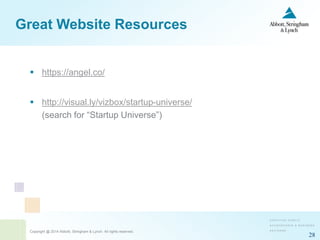
Great Website Resources
 https://angel.co/
 http://visual.ly/vizbox/startup-universe/
(search for “Startup Universe”)
Copyright @ 2014 Abbott, Stringham & Lynch. All rights reserved.
29
Q & A
 Any questions?
Copyright @ 2014 Abbott, Stringham & Lynch. All rights reserved.
30
Jeff Faust, CVA
jfaust@aslcpa.com
(408) 377-8700 x232
Contact Information
Abbott Stringham & Lynch
1550 Leigh Avenue
San Jose, CA 95125
(408) 377-8700

Valuations w/ Jeff Faust

  • 1.
    Start-Up Valuations By JeffFaust, CVA Director of Valuation Services October 27 2015
  • 2.
    Copyright @ 2014Abbott, Stringham & Lynch. All rights reserved. 2  Jeff Faust qualifications  FMV vs Investment Value  409A Overview  Overview of Valuation Methods  Sample valuation methods  Pre-revenue, pre-funding (FMV)  Pre-revenue, pre-funding (Investment Value)  Post-funding (FMV)  Profitable (FMV) Objective of Presentation
  • 3.
    Copyright @ 2014Abbott, Stringham & Lynch. All rights reserved. 3  ASL Director of Valuation Services  25 years in finance, serial entrepreneur.  20 years in Business Valuations.  Over 65 different industries.  All sizes and stages of development.  Employee Stock Ownership Plans (ESOPs), Stock Options (409A), Family Limited Partnerships (FLPs), Buy-Sell Agreements, Estate/Gift Taxes, Mergers/Acquisitions and Transactions, Litigation Support.  Testified in front of the Department of Labor and in several Superior Courts in the Bay Area.  Certified Valuation Analyst (CVA) with the National Association of Certified Valuators and Analysts (NACVA).  Instructor for the Venture Capital Academy (VCA).  Co-Founder of SaaS Company (Equity Management Software) Jeff Faust Background
  • 4.
    Copyright @ 2014Abbott, Stringham & Lynch. All rights reserved. 4 Valuation Workshop  FMV vs Investment Value
  • 5.
    Copyright @ 2014Abbott, Stringham & Lynch. All rights reserved. 5 Valuation Workshop  Overview of 409A  Deferred comp IRC Section  No discounted options (ISO’s and NQSO’s must be granted at FMV)  Options granted must follow 1 of 3 valuation methods
  • 6.
    Copyright @ 2014Abbott, Stringham & Lynch. All rights reserved. 6 Valuation Methods  Is there one formula for valuation? Income * ---------- = Value Risk * Could be historical or projected but in all cases it is “normalized”
  • 7.
    Copyright @ 2014Abbott, Stringham & Lynch. All rights reserved. 7 Valuation Methods Most common  Income Approaches (DCF, DFE, Capitalized Earnings)  Market Approaches (Guideline, M&A and Comparable Transaction)  Asset Approaches (Book Value, Restated Net Worth) Others used  Cost (Replacement)  Asset and Income Approaches (Excess Earnings)  Other / Start-Up Approaches (VC Method, Exit Multiples, Preferred Rounds, Berkus Method, Scorecard Method, Cayenne Calculator, People & Patents, Risk Factor Summation)
  • 8.
    Copyright @ 2014Abbott, Stringham & Lynch. All rights reserved. 8 Valuation Preparation (Know what Stage you are in!)  Stage of Development Stage Abbreviated Description Description 1 Start-up Enterprise has no product revenue and limited expense history. Typically an incomplete management team has an idea, plan, and possibly some initial product development. Seed capital or first-round financing is usually provided by friends and family, angels, or venture capital firms focusing on early-stage enterprises. The securities issued to those investors are occasionally in the form of common stock but are more commonly in the form of preferred stock. 2 Development Enterprise has no product revenue but substantive expense history. Product development is underway and business challenges are thought to be understood. Typically, a second or third round of financing occurs during this stage. Investors are usually venture capital firms which may provide additional management or board of directors’ expertise. Securities issued are typically in the form of preferred stock. 3 Alpha/Beta Enterprise has made significant progress in product development; key development milestones have been met (e.g. hiring of the core management team); and product development is near completion (e.g. alpha and beta testing of the product, service, web site). Third party revenue is beginning, although there may have been progress/milestone payments from strategic business partners. Later rounds of financing occur during this stage. Typical investors are venture capital firms and strategic business partners. The typical securities issued to those investors are in the form of preferred stock. 4 Early Revenue Enterprise has met additional key development milestones (e.g. growing customer orders and revenue shipments). It has a sufficient customer base to support ongoing operations, but is still operating at a loss. A manufacturing and distribution plan is being implemented Typically, mezzanine rounds of financing occur during this stage. Discussions frequently start with potential acquirers or investment banks for an initial public offering (IPO). 2 Development Enterprise has no product revenue but substantive expense history. Product development is underway and business challenges are thought to be understood. Typically, a second or third round of financing occurs during this stage. Investors are usually venture capital firms which may provide additional management or board of directors’ expertise. Securities issued are typically in the form of preferred stock. 3 Alpha/Beta Enterprise has made significant progress in product development; key development milestones have been met (e.g. hiring of the core management team); and product development is near completion (e.g. alpha and beta testing of the product, service, web site). Third party revenue is beginning, although there may have been progress/milestone payments from strategic business partners. Later rounds of financing occur during this stage. Typical investors are venture capital firms and strategic business partners. The typical securities issued to those investors are in the form of preferred stock. 4 Early Revenue Enterprise has met additional key development milestones (e.g. growing customer orders and revenue shipments). It has a sufficient customer base to support ongoing operations, but is still operating at a loss. A manufacturing and distribution plan is being implemented Typically, mezzanine rounds of financing occur during this stage. Discussions frequently start with potential acquirers or investment banks for an initial public offering (IPO). 5 Positive Cash Flow Enterprise has a history of product revenues, and has recently achieved breakthrough measures of financial success, such as operating profitability or positive cash flows. Regulatory approvals (e.g. Food and Drug Administration) have been obtained. A liquidity event, such as an IPO or a sale of the enterprise, could occur late this stage. 6 IPO Enterprise has an established financial history of profitable operations and generation of positive cash flows. It is a mature candidate for acquisition or an IPO. The form of securities issued is typically all common stock, with any outstanding preferred converting to common upon an IPO (and perhaps also upon other liquidity events).
  • 9.
    Copyright @ 2014Abbott, Stringham & Lynch. All rights reserved. 9  Risk Discounts – Ranges for Start-Ups Stage of Development Characteristics Frei & Leleux Life Sciences Study (1) Seiffer Software Study (2) Plummer Study (3) Scherlis and Sahlman Study (4) Sahlman, Stevenson and Bhide Study(5) Start-up Pre-prototype 70% - 100% 60% - 80% 50% - 70% 50% - 70% 50% - 100% Early development Pre-commercialization 50% - 70% 50% - 60% 40% - 60% 40% - 60% 40%-60% First Stage Commercialization 40% - 60% 40% - 50% NA NA NA Expansion Shipping Product 35% - 50% 30% - 40% 35% - 50% 30% - 50% 30%-40% Mezzanine/ IPO Profitable 25% - 40% 25% - 30% 25% - 35% 20% - 35% 20%-30% (1) Frei, P. & Leleux, B. Valuating the Company. Starting a Business in the Life Sciences- from Idea to Market. (Luessen, H. (ed.).) 42-55 (Edition Cantor Verlag, Aulendorf, Germany, 2003). (2) John Seiffer, "The Business of Software: The Venture Capital Rate of Return". < http://discuss.joelonsoftware.com/default.asp?biz.5.254929.9> (21 November 2005) (3) Plummer, James L., QED Report on Venture Capital Financial Analysis, Palo Alto: QED Research, Inc., 1987 (4) Scherlis, Daniel R. and Sahlman, William A., "A Method for Valuing High-Risk, Long Term, Investments: The Venture Capital Method," Harvard Business School Teaching Note 9-288-006, Boston: Harvard Business School Publishing, 1989 (5) Sahlman, William A. and Howard H. Stevenson, Amar V. Bhide, “Financing Entrepreneurial Ventures”, Business Fundamental Series, Boston: Harvard Business School publishing, 1998. Valuation Preparation (What discount range is appropriate)
  • 10.
    Copyright @ 2014Abbott, Stringham & Lynch. All rights reserved. 10 Sample Valuation Methods  Cost Approach Est Repl Cost (low) Est Repl Cost (high) Current Expenses $400,000 $400,000 Services In Lieu $200,000 $400,000 Estimated Replacement Cost $600,000 $800,000 Equity Value $600,000 $800,000 Shares Issued 12,000,000 12,000,000 Stock Option Pool 3,000,000 3,000,000 Fully Diluted Shares 15,000,000 15,000,000 Price / Share $0.040 $0.053 $0.05 Pre-Revenue, Pre-Funding (FMV)
  • 11.
    Copyright @ 2014Abbott, Stringham & Lynch. All rights reserved. 11 Sample Valuation Methods  Funding Pre-Revenue, Pre-Funding (Investment Value) Pre and Post Money Illustrations (value continuation) A Round B Round Pre Money Valuation 4,000,000$ Pre Money Valuation 5,000,000$ Pre A Shares 15,000,000 Pre B Shares 18,750,000 Px/Share of Preferred A 0.27$ Px/Share of Preferred B ** 0.27$ Money Raised 1,000,000$ Money Raised 1,250,000$ Share Issued for A 3,750,000 20% Share Issued for B 4,687,500 20% Post A Shares 18,750,000 Post B Shares 23,437,500 Post Money Valuation 5,000,000$ Post Money Valuation 6,250,000$ ** Although the price per share is the same, the Post Money Valuation is clearly higher after the B Round
  • 12.
    Copyright @ 2014Abbott, Stringham & Lynch. All rights reserved. 12 Sample Valuation Methods  Funding Pre-Revenue, Pre-Funding (Investment Value) Pre and Post Money Illustrations (value increase) A Round B Round Pre Money Valuation 4,000,000$ Pre Money Valuation 10,000,000$ Pre A Shares 15,000,000 Pre B Shares 18,750,000 Px/Share of Preferred A 0.27$ Px/Share of Preferred B 0.53$ Money Raised 1,000,000$ Money Raised 2,500,000$ Share Issued for A 3,750,000 20% Share Issued for B 4,687,500 20% Post A Shares 18,750,000 Post B Shares 23,437,500 Post Money Valuation 5,000,000$ Post Money Valuation 12,500,000$
  • 13.
    Copyright @ 2014Abbott, Stringham & Lynch. All rights reserved. 13 How do preferred terms impact value?  CVM – The Effect of Different Capital Structures Company 1 Company 2 Company 3 (No Preferred) (Non-Participating) (Full Participation) Assumptions Value $12,000,000 $12,000,000 $12,000,000 Common Shares Outstanding 12,000,000 12,000,000 12,000,000 Preferred Shares Outstanding 4,000,000 4,000,000 (Assume Liquidation Preference is $1/share) Share Calculation Value $12,000,000 $12,000,000 $12,000,000 Less: Liquidation Preference $0 $4,000,000 $4,000,000 Equals: Remaining Amount $12,000,000 $8,000,000 $8,000,000 Divided by: Shares 12,000,000 12,000,000 16,000,000 Equals: Price Per Share $1.00 $0.67 $0.50
  • 14.
    Copyright @ 2014Abbott, Stringham & Lynch. All rights reserved. 14  VC Method (Pre-)Revenue, (Pre-)Funding (Investment Value) Sample Valuation Methods Year 1 Year 2 Year 3 Year 4 Year 5 Revenue Projections 1,000,000 5,000,000 20,000,000 50,000,000 Which year will you be profitable? 4 What is your Peer Group Multiple? 3 (Software = 2-3, SaaS = 4-6, Cloud = 5-8, Data = 8-12, Social = 10+) Percent of Projections 50% Implied Future Valuation 30,000,000 Enter discount rate (stage chart) 90% Estimated Funding Valuation 2,300,000
  • 15.
    Copyright @ 2014Abbott, Stringham & Lynch. All rights reserved. 15 Sample Valuation Methods  VC Method – Multiples (Peer Group) ($US in millions) Market Value of Invested Capital (MVIC) as a Multiple of: TTM TTM TTM NFY Revenue EBITDA EBIT Revenue 2.7 x 9.2 x 12.7 x 2.5 x 2.4 x 8.6 x 10.4 x 2.3 x 4.2 x 16.5 x 17.9 x 3.8 x 5.6 x NM NM 3.0 x 16.9 x NM NM 10.6 x 3.6 x 16.1 x 19.7 x 3.3 x Maximum 16.9 x 16.5 x 19.7 x 10.6 x Third Quartile 5.3 x 16.2 x 18.3 x 3.7 x Average 5.9 x 12.6 x 15.2 x 4.3 x Median 3.9 x 12.7 x 15.3 x 3.2 x First Quartile 2.9 x 9.1 x 12.1 x 2.7 x Minimum 2.4 x 8.6 x 10.4 x 2.3 x Harmonic Mean 3.9 x 11.5 x 14.2 x 3.3 x Coefficient of Variance 94% 34% 29% 74% Selected Multiples 2.9 x 9.1 x 12.1 x 2.7 x Sample Company's Financials 5.200$ (9.562)$ (10.562)$ 15.265$ Indicated MVIC Value Range 15.080 (87.014) (127.800) 41.216 Weighting 0% 0% 0% 100% Implied Market Value of Invested Capital 41.200$ Less: Debt 10.500 Total Equity Value (Non-controlling, Marketable) 30.700$ Less: Discount for Lack of Marketability 35.0% 10.745 Total Equity Value (Non-controlling, Non-marketable) 19.955$ Perrigo Co. Zalicus Inc. Company Name Abbott Laboratories Baxter International Inc. Mead Johnson Nutrition Company Amicus Therapeutics, Inc. (Pre-)Revenue, (Pre-)Funding (Investment Value)
  • 16.
    Copyright @ 2014Abbott, Stringham & Lynch. All rights reserved. 16 Sample Valuation Methods Scorecard Method  Two-Step  (1) determine average pre-money of companies like yours  (2) compare target to perception of similar deals  Strength of Management Team 0-30%  Size of the Opportunity 0-25%  Product/Technology 0-15%  Competitive Environment 0-10%  Marketing/Sales Channels/Partnerships 0-10%  Need for Additional Investment 0-5%  Other 0-5% -------- 100% Early Stage (Investment Value)
  • 17.
    Copyright @ 2014Abbott, Stringham & Lynch. All rights reserved. 17 Sample Valuation Methods Scorecard Method Software Company A company has an above average product and technology (125% of norm), an average management team (100% of norm) and a large market opportunity (150% of norm). The company can get to positive cash flow with two rounds of angel investment (80% of norm). Looking at the strength of competition in the market, the target is average (100%) but early customer feedback on the product is excellent (Other = 100%). The company needs some additional work on building sales channels and partnerships (75%). Early Stage (Investment Value)
  • 18.
    Copyright @ 2014Abbott, Stringham & Lynch. All rights reserved. 18 Sample Valuation Methods Scorecard Method Early Stage (Investment Value) COMPARISON FACTOR RANGE TARGET COMPANY FACTOR Strength of Management Team 30% 100% 0.3000 Size of Opportunity 25% 150% 0.3750 Product/Technology 15% 125% 0.1875 Competitive Environment 10% 100% 0.1000 Marketing/Sales/ Partnerships 10% 75% 0.0750 Need for Additional Investment 5% 80% 0.0400 Other factors 5% 100% 0.0500 Sum: 1.1275 Assuming the average pre-money valuation is $2.7 million, we multiply that figure with the Sum of Factors (1.1275 x $2.7 million). Therefore, we arrive at a pre-money valuation of $3.04 million.
  • 19.
    Copyright @ 2014Abbott, Stringham & Lynch. All rights reserved. 19 Sample Valuation Methods Berkus Method  Developed by Dave Berkus of Tech Coast Angels Early Stage (Investment Value) Characteristic Add to Pre-money Valuation Quality Management Team 0 - $500,000 Sound Idea 0 - $500,000 Working Prototype 0 - $500,000 Quality Board of Directors 0 - $500,000 Product Rollout or Sales 0 - $500,000
  • 20.
    Copyright @ 2014Abbott, Stringham & Lynch. All rights reserved. 20 Sample Valuation Methods Berkus Method Early Stage (Investment Value) Characteristic Add to Pre-money Valuation Target Company Quality Management Team 0 - $500,000 $375,000 Sound Idea 0 - $500,000 $425,000 Working Prototype 0 - $500,000 $500,000 Quality Board of Directors 0 - $500,000 $375,000 Product Rollout or Sales 0 - $500,000 $375,000 TOTAL 0 - $2,500,000 $2,050,000
  • 21.
    Copyright @ 2014Abbott, Stringham & Lynch. All rights reserved. 21 Sample Valuation Methods People and Patents  Each patent and engineers is ~$1M Early Stage (Investment Value)
  • 22.
    Copyright @ 2014Abbott, Stringham & Lynch. All rights reserved. 22 Sample Valuation Methods Risk Factor Summation  Series of Questions  Management, State of the business, Legislation/Political risk, Manufacturing risk, Sales and marketing risk, Funding/capital risk, Competition risk, Technology risk, Litigation risk, International risk, Reputation risk, Potential lucrative exit  +2 for very positive, +1 positive, 0 neutral, -1 negative, -2 very negative  For every +1 you add $250,000 (+$500k for +2) and subtract $250,000 for every -1 (-$500k for a -2) Early Stage (Investment Value)
  • 23.
    Copyright @ 2014Abbott, Stringham & Lynch. All rights reserved. 23 Sample Valuation Methods Risk Factor Summation Assume the average pre- money valuation is $2.3 million, and after tallying the points, the sum is +1. Therefore, you would add $250,000 to the $2.3MM average, bringing the company’s pre-money value to $2.55 million. Early Stage (Investment Value) Risk Factors Risk Rating Management 0 State of the Business +1 Legislation/Political Risk 0 Manufacturing Risk 0 Sales and Marketing Risk -1 Funding/Capital Risk -1 Competition Risk 0 Technology Risk +1 Litigation Risk 0 International Risk 0 Reputation Risk 0 Potential Lucrative Exit +1 TOTAL =+1
  • 24.
    Copyright @ 2014Abbott, Stringham & Lynch. All rights reserved. 24 Sample Valuation Methods Cayenne Calculator  www.caycon.com/valuation.php  Series of questions Any Stage (Investment Value)
  • 25.
    Copyright @ 2014Abbott, Stringham & Lynch. All rights reserved. 25 Sample Valuation Methods Summary of Values Method Software VC Method $2.30 Million Scorecard $2.59 Million Berkus $2.05 Million Cayenne $1.84 – $2.25 Million Risk Factor $2.55 Million
  • 26.
    Copyright @ 2014Abbott, Stringham & Lynch. All rights reserved. 26 Sample Valuation Methods  Discounted Cash Flow (DCF) – [exit multiples] Projected Financials FYE FYE FYE FYE FYE 12/31/12 12/31/13 12/31/14 12/31/15 12/31/16 Projected Earnings (9.238)$ (5.235)$ 1.528$ 6.859$ 10.537$ Terminal Value Calculation Revenue Multiple 12/31/16 165.526$ 2.7 Terminal Value 430.37$ Present Value Period 1.00 2.00 3.00 4.00 5.00 5.50 Present Value Factor (3) 60.0% Discount Rate 0.624 0.390 0.244 0.152 0.095 0.075 Present Value of Debt-free Cash Flow (5.782)$ (2.042)$ 0.373$ 1.045$ 1.004$ 32.406$ Sum of Present Value of Debt-free Cash Flow in Projection Period (5.403)$ Plus: Present Value of Terminal Value 32.406 Total Equity Value (Controlling, Marketable) 27.003$ Less: Discount for Lack of Control 0.0% - Total Equity Value (Non-controlling, Marketable) 27.003$ Less: Discount for Lack of Marketability 35.0% 9.451 Total Equity Value (Non-controlling, Non-marketable) 17.552$ Terminal Year Post-Funding (FMV)
  • 27.
    Copyright @ 2014Abbott, Stringham & Lynch. All rights reserved. 27 Sample Valuation Methods  Discounted Future Earnings (DFE) Profitable (FMV and Investment Value) Projected Financials FYE FYE FYE FYE FYE 12/31/12 12/31/13 12/31/14 12/31/15 12/31/16 Projected Earnings 1,454,100$ 1,537,125$ 1,703,328$ 1,885,410$ 2,181,030$ Terminal Value Calculation Gordon Growth Method 23.0% risk rate, 3.0% growth rate Terminal Value 11,232,307$ Present Value Period 1.00 2.00 3.00 4.00 5.00 5.00 Present Value Factor 23.0% Discount Rate 0.813 0.661 0.537 0.437 0.355 0.355 Present Value of Net Income 1,181,525$ 1,015,436$ 914,822$ 823,264$ 774,265$ 3,987,467$ Sum of Present Value of Net Income in Projection Period 4,709,312$ Plus: Present Value of Terminal Value 3,987,467 Indicated Equity Value 8,696,779$ Less: Discount for Lack of Control 0.0% - Total Equity Value (Non-Controlling, Marketable) 8,696,779$ Less: Discount for Lack of Marketability 35.0% 3,043,872 Total Equity Value (Non-Controlling, Non-marketable) 5,652,906$ Terminal Year
  • 28.
    Copyright @ 2014Abbott, Stringham & Lynch. All rights reserved. 28 Great Website Resources  https://angel.co/  http://visual.ly/vizbox/startup-universe/ (search for “Startup Universe”)
  • 29.
    Copyright @ 2014Abbott, Stringham & Lynch. All rights reserved. 29 Q & A  Any questions?
  • 30.
    Copyright @ 2014Abbott, Stringham & Lynch. All rights reserved. 30 Jeff Faust, CVA jfaust@aslcpa.com (408) 377-8700 x232 Contact Information Abbott Stringham & Lynch 1550 Leigh Avenue San Jose, CA 95125 (408) 377-8700