Community Infrastructure Levy
 and Development Appraisals
       Presentation to
  Squires, Sanders (UK) LLP
     by Vail Williams LLP

Chris Cave, Partner, Development Consultancy
James Lacey, Partner, Planning Consultancy

Thursday 19 January 2012
Vail Williams LLP
                                 Who are we?

• Chris Cave – Partner: Responsible for Birmingham office
  and the firm’s Development Consultancy team - based in
  Birmingham.
    30 years experience of retail, office, industrial, leisure
  and residential developments.

• James Lacey – Partner: Leads Planning team – based in
  Reading
  12 years of representing commercial and residential
  developers and corporate and private landowners
Planning and Development –
                   What we will cover

• The new Community Infrastructure Levy (CIL) and
  comparison with S106 costs and its implications on the
  development process.
• How the CIL is being introduced and the process?
• Development appraisals what are they and how are they
  used?
• What are the basics?
• Where is the market today and how does Development
  Consultancy and the appraisal system play its part?
• Example of the difference between CIL and S106 and the
  implications on development viability.
Planning - CIL


  •   “CIL” – Background
  •   The process
  •   Emerging figures
  •   Current consultations
Community Infrastructure Levy (‘CIL’)
                                    Background
   “CIL” came into force in April 2010. Allows LA’s in England &
   Wales to:

3. Raise an estimated additional £1 billion a year of funding for
   local infrastructure by 2016 (source: ‘CIL’ an overview 2011,
   CLG)

5. Deliver funding for a wide range of infrastructure projects (in
   addition to affordable housing or, SPA contributions)

7. Funds: safer road schemes, flood defences, schools, hospitals
   and other health and social care facilities, play areas, parks,
   green spaces, district heating systems, police stations, leisure
   centres and other community safety facilities.
The Process

• MUST HAVE UP TO DATE CORE STRATEGY thereafter they
  can prepare a charging schedule rate(s) per sq.m.

• Consultation on the charging schedule – lack of engagement

• Rates must be supported by evidence which relates to the
  viability of new development – lack of input into the two
  examinations to date

• Examination to ensure the rates support rather than harm new
  development. Binding report – Newark & Sherwood and
  Shropshire only two.
The aim


‘Creates a fairer and transparent system to ensure proportionate
levels of contributions are paid on developments of 100 sq.m. or
more.’ (CLG guidance) (net gain)
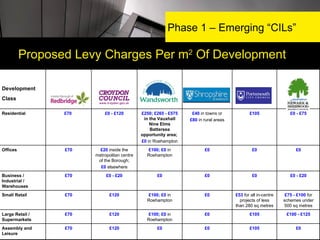
Phase 1 – Emerging “CILs”

          Proposed Levy Charges Per m2 Of Development

Development
Class

Residential      £70       £0 - £120         £250; £265 - £575    £40 in towns or            £105                £0 - £75
                                              in the Vauxhall    £80 in rural areas
                                                 Nine Elms
                                                 Battersea
                                             opportunity area;
                                             £0 in Roehampton
Offices          £70     £20 inside the         £100; £0 in             £0                     £0                   £0
                       metropolitan centre     Roehampton
                        of the Borough;
                         £0 elsewhere
Business /       £70        £0 - £20                £0                  £0                     £0                £0 - £20
Industrial /
Warehouses
Small Retail     £70          £120              £100; £0 in             £0            £53 for all in-centre    £75 - £100 for
                                               Roehampton                               projects of less      schemes under
                                                                                      than 280 sq metres       500 sq metres
Large Retail /   £70          £120              £100; £0 in             £0                   £105              £100 - £125
Supermarkets                                   Roehampton
Assembly and     £70          £120                  £0                  £0                   £105                   £0
Leisure
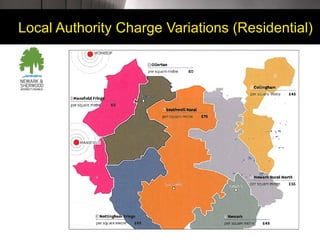
Local Authority Charge Variations (Residential)
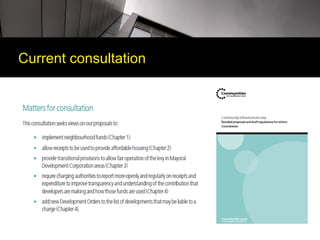
Current consultation
So what does this mean for the developer?


 • The responsibility to pay the levy runs with the ownership
   of the land. Developers / landowners need to be made
   aware of the ‘CIL’ contributions which are emerging.

 • The “CIL” would be payable upon the commencement of
   development and would exclude SPA , affordable housing
   etc which are in addition.
Development Appraisals –
         Who are they for? What are they?


• Land Owners – Usually a residual appraisal to produce a site
  value.
• Developers – a means of targeting and tracking profit and
  negotiating S106 and CIL contributions. Means of presenting
  and tracking development viability and non viability.
The Basics - what’s needed?

• Scheme – what is it, floor areas, etc?

• Values – research into yields rents capital values

• Costs -
               - Planning
               - S106/S278 (CIL)
               - Build Costs and Professional Fees
               - Marketing Promotion
               - Voids/Disposal Assumptions
               - Finance
What else?

•   Local Authority Planning Application Fee's
•   Flood Risk Assessment
•   Topographical Surveys
•   Geotechnical Surveys
•   Sustainability
•   Highways
•   Bats, Newts, Badgers, etc
Rubbish In/Rubbish Out

• The valuer should not assume the answer is correct
• A development appraisal is simply a valuation format,
  so:
    1. Validate the assumptions
    2. Check the cash flow – are costs and income occurring
       at the right time?
    3. Does the resultant residual match knowledge of site
       values in a particular location? If not, why not?
    4. Will the market actually support the development
Where is the development market today, is
there one?
• Development Finance - the elephant in the room
• Tenant Demand - another elephant
• Offices - at rents less than £20 per sq ft there is no site value - that’s
  most of the UK, but London, Thames Valley are viable.
• Industrial - viable but land values are probably less than half of 2007.
• Retail - food never stopped - town centres and out of town down to
  location.
• Residential -
    • Recovering, major house buyers are active but concentrating on
       housing not apartments private developers are struggling for cash
    • Affordable housing no government grants for RSL’s has reduced
       land values by up to a third.
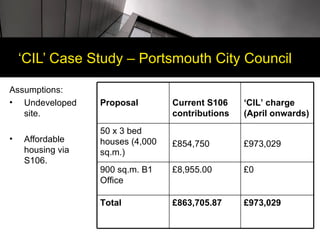
‘CIL’ Case Study – Portsmouth City Council

Assumptions:
• Undeveloped     Proposal        Current S106    ‘CIL’ charge
   site.                          contributions   (April onwards)
                  50 x 3 bed
•   Affordable    houses (4,000   £854,750        £973,029
    housing via   sq.m.)
    S106.
                  900 sq.m. B1    £8,955.00       £0
                  Office

                  Total           £863,705.87     £973,029
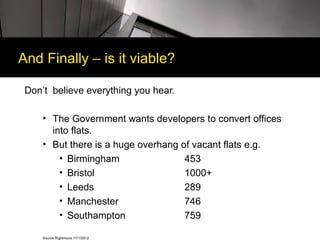
And Finally – is it viable?

 Don’t believe everything you hear.

     • The Government wants developers to convert offices
       into flats.
     • But there is a huge overhang of vacant flats e.g.
         • Birmingham                453
         • Bristol                   1000+
         • Leeds                     289
         • Manchester                746
         • Southampton               759

     Source Rightmove 17/1/2012
Making commercial sense of property

                vailwilliams.com
Chris Cave - Partner, Development Consultancy   James Lacey - Partner, Planning Consultancy
Telephone: +44 (0)121 654 1065                  Telephone: +44 (0)1483 446826
           Mobile: +44 (0)7887 626354           Mobile: +44 (0)7909 966836
      Email: ccave@vailwilliams.com             Email: jlacey@vailwilliams.com

Cil birmingham presentation - 19 jan 2012 (2)

  • 1.
    Community Infrastructure Levy and Development Appraisals Presentation to Squires, Sanders (UK) LLP by Vail Williams LLP Chris Cave, Partner, Development Consultancy James Lacey, Partner, Planning Consultancy Thursday 19 January 2012
  • 2.
    Vail Williams LLP Who are we? • Chris Cave – Partner: Responsible for Birmingham office and the firm’s Development Consultancy team - based in Birmingham. 30 years experience of retail, office, industrial, leisure and residential developments. • James Lacey – Partner: Leads Planning team – based in Reading 12 years of representing commercial and residential developers and corporate and private landowners
  • 3.
    Planning and Development– What we will cover • The new Community Infrastructure Levy (CIL) and comparison with S106 costs and its implications on the development process. • How the CIL is being introduced and the process? • Development appraisals what are they and how are they used? • What are the basics? • Where is the market today and how does Development Consultancy and the appraisal system play its part? • Example of the difference between CIL and S106 and the implications on development viability.
  • 4.
    Planning - CIL • “CIL” – Background • The process • Emerging figures • Current consultations
  • 5.
    Community Infrastructure Levy(‘CIL’) Background “CIL” came into force in April 2010. Allows LA’s in England & Wales to: 3. Raise an estimated additional £1 billion a year of funding for local infrastructure by 2016 (source: ‘CIL’ an overview 2011, CLG) 5. Deliver funding for a wide range of infrastructure projects (in addition to affordable housing or, SPA contributions) 7. Funds: safer road schemes, flood defences, schools, hospitals and other health and social care facilities, play areas, parks, green spaces, district heating systems, police stations, leisure centres and other community safety facilities.
  • 6.
    The Process • MUSTHAVE UP TO DATE CORE STRATEGY thereafter they can prepare a charging schedule rate(s) per sq.m. • Consultation on the charging schedule – lack of engagement • Rates must be supported by evidence which relates to the viability of new development – lack of input into the two examinations to date • Examination to ensure the rates support rather than harm new development. Binding report – Newark & Sherwood and Shropshire only two.
  • 7.
    The aim ‘Creates afairer and transparent system to ensure proportionate levels of contributions are paid on developments of 100 sq.m. or more.’ (CLG guidance) (net gain)
  • 8.
    Phase 1 –Emerging “CILs” Proposed Levy Charges Per m2 Of Development Development Class Residential £70 £0 - £120 £250; £265 - £575 £40 in towns or £105 £0 - £75 in the Vauxhall £80 in rural areas Nine Elms Battersea opportunity area; £0 in Roehampton Offices £70 £20 inside the £100; £0 in £0 £0 £0 metropolitan centre Roehampton of the Borough; £0 elsewhere Business / £70 £0 - £20 £0 £0 £0 £0 - £20 Industrial / Warehouses Small Retail £70 £120 £100; £0 in £0 £53 for all in-centre £75 - £100 for Roehampton projects of less schemes under than 280 sq metres 500 sq metres Large Retail / £70 £120 £100; £0 in £0 £105 £100 - £125 Supermarkets Roehampton Assembly and £70 £120 £0 £0 £105 £0 Leisure
  • 9.
    Local Authority ChargeVariations (Residential)
  • 10.
  • 11.
    So what doesthis mean for the developer? • The responsibility to pay the levy runs with the ownership of the land. Developers / landowners need to be made aware of the ‘CIL’ contributions which are emerging. • The “CIL” would be payable upon the commencement of development and would exclude SPA , affordable housing etc which are in addition.
  • 12.
    Development Appraisals – Who are they for? What are they? • Land Owners – Usually a residual appraisal to produce a site value. • Developers – a means of targeting and tracking profit and negotiating S106 and CIL contributions. Means of presenting and tracking development viability and non viability.
  • 13.
    The Basics -what’s needed? • Scheme – what is it, floor areas, etc? • Values – research into yields rents capital values • Costs - - Planning - S106/S278 (CIL) - Build Costs and Professional Fees - Marketing Promotion - Voids/Disposal Assumptions - Finance
  • 14.
    What else? • Local Authority Planning Application Fee's • Flood Risk Assessment • Topographical Surveys • Geotechnical Surveys • Sustainability • Highways • Bats, Newts, Badgers, etc
  • 15.
    Rubbish In/Rubbish Out •The valuer should not assume the answer is correct • A development appraisal is simply a valuation format, so: 1. Validate the assumptions 2. Check the cash flow – are costs and income occurring at the right time? 3. Does the resultant residual match knowledge of site values in a particular location? If not, why not? 4. Will the market actually support the development
  • 16.
    Where is thedevelopment market today, is there one? • Development Finance - the elephant in the room • Tenant Demand - another elephant • Offices - at rents less than £20 per sq ft there is no site value - that’s most of the UK, but London, Thames Valley are viable. • Industrial - viable but land values are probably less than half of 2007. • Retail - food never stopped - town centres and out of town down to location. • Residential - • Recovering, major house buyers are active but concentrating on housing not apartments private developers are struggling for cash • Affordable housing no government grants for RSL’s has reduced land values by up to a third.
  • 17.
    ‘CIL’ Case Study– Portsmouth City Council Assumptions: • Undeveloped Proposal Current S106 ‘CIL’ charge site. contributions (April onwards) 50 x 3 bed • Affordable houses (4,000 £854,750 £973,029 housing via sq.m.) S106. 900 sq.m. B1 £8,955.00 £0 Office Total £863,705.87 £973,029
  • 18.
    And Finally –is it viable? Don’t believe everything you hear. • The Government wants developers to convert offices into flats. • But there is a huge overhang of vacant flats e.g. • Birmingham 453 • Bristol 1000+ • Leeds 289 • Manchester 746 • Southampton 759 Source Rightmove 17/1/2012
  • 19.
    Making commercial senseof property vailwilliams.com Chris Cave - Partner, Development Consultancy James Lacey - Partner, Planning Consultancy Telephone: +44 (0)121 654 1065 Telephone: +44 (0)1483 446826 Mobile: +44 (0)7887 626354 Mobile: +44 (0)7909 966836 Email: ccave@vailwilliams.com Email: jlacey@vailwilliams.com

Editor's Notes

  • #5 Andrew refer to VW and attendees today. Q&A within latter part of the session.
  • #6 Just another contribution Ask us re status of CIL for specific authorities Relationship The Community Infrastructure Levy (the levy) came into force in April 2010 . It allows local authorities in England and Wales to raise funds from developers undertaking new building projects in their area. Charging Authorities will prepare and publish charging schedules for their areas. The aim of the levy is to create a fairer system, with all but the smallest building projects making a contribution towards additional infrastructure that is needed as a result of their development. The government believe this will give you the developer more certainty as to what contribute are expected, thus speeding up the development process , it is thought that the application of the money raised will be more transparent.
  • #9 Redbridge - The draft charging schedule was submitted for independent examination on 22 June. This process is due to be concluded by the autumn and, if the charging schedule is approved, the Council hopes to implement CIL by the end of the year. Croydon - The CIL is out for consultation. A further round of consultation is due next year ahead of the examination in public. Wandsworth - Consultation on the draft charging schedule ended on 22 July. The Council hopes that the examination of the schedule could take place this year. Newark & Sherwood - The CIL examination began late last month. If it is approved, the Council expects to adopt the CIL in the autumn. Shropshire - The CIL examination started six weeks ago. Portsmouth - The first consultation was in April. The charging schedule submitted to the examiner later. NOTE : London Boroughs are due to be subject to an extra CIL rate to help fund Crossrail. The planned rate varies per Borough. For example, in Redbridge it is set to be £35 per square metre and in Wandsworth £50 per square metre. Source: Planning Magazine – 12 August 2011