




An Presentation ON
TECHNIQUES OF PROJECT APPRAISAL
Submitted To:-
Dr A.K. GAURAHA
Dept. of
Agril.Economics
Submitted By:-
Mohamed Arshad
Ayub
Dept. of
Agril.ECONOMICS
M.SC. Ag. (PREVIOUS)
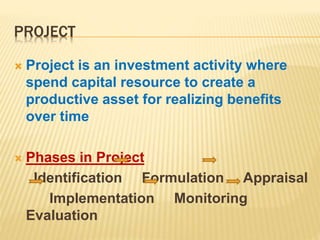
PROJECT
 Project is an investment activity where
spend capital resource to create a
productive asset for realizing benefits
over time
 Phases in Project
Identification Formulation Appraisal
Implementation Monitoring
Evaluation
APPRAISAL
 Appraisal involves a careful checking of
the basic data, assumptions and
methodology used in project preparation.
 Project appraisal is the process of
assessing and questioning proposals
before resources are committed.
KEY ISSUES IN APPRAISING PROJECTS
 Need, targeting and objectives
 Context and connections
 Consultation
 Options
 Inputs
 Value for money
 Implementation
 Risk and uncertainty
 Forward strategies
 Sustainability
FEASIBILITY STUDY
 A Feasibility study may be undertaken during
appraisal to establish the technical, economic
and financial viability, environmental
compliance and social acceptability of a
project.
 Aim of a feasibility study:
Development objectives
Policy framework and detailed project
objectives
Technical soundness of the project
The economic and financial viability of the
project proposal
The status of demand for the project
beneficiaries
Considerations of customs and traditions
of project benefactors and issues of
compatibility
Other important policy and cross cutting
issues (gender, environment,)
 Administrative feasibility of the project
VARIOUS ASPECTS/ANALYSIS OF APPRAISAL
 Technical analysis
 Economic Analysis
 Financial Analysis
 Environmental Analysis, and
 Social Analysis
Economic Analysis
 It is a systematic process for examining
alternative uses of resources, focusing on
assessment of needs, objectives, options,
costs, benefits, risks, funding,
affordability and other factors relevant to
decisions.
 The main types of economic appraisal
are:
Cost-benefit analysis
Cost-effectiveness analysis
Multi-criteria analysis
Financial Analysis
 Financial analysis involves assessment
of financial impact, judgment of
efficient resource use, assessment of
incentives, provision of a sound
financing plan, coordination of financial
contribution and assessment of
financial management competence.
 The main objective of financial
analysis is to determine the
requirements of funds/timing and the
expected returns on.
TECHNIQUES OF PROJECT APPRAISAL
 The can be discussed under two heads
viz
(i) Undiscounted
(a) Pay back period,
(b) Rank by inspection,
(c) Proceeds per unit of outlay, and
(d) Average annual proceeds per unit of
outlay.
(II) DISCOUNTED.
 Discounting techniques take into account
the time-value of money.
 NPV(net present value)
 It is present worth of cash flow stream.
 The net present value at interest rate i is
denoted NPV(i)
NPV= ∑ P/(1+i) ᶤ
 If an investor can lend and borrow money
at rate i1, a project will be profitable if and
only if
NPV(i1) > 0
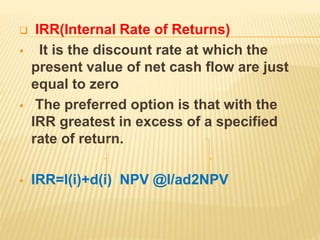
 IRR(Internal Rate of Returns)
 It is the discount rate at which the
present value of net cash flow are just
equal to zero
 The preferred option is that with the
IRR greatest in excess of a specified
rate of return.
 IRR=l(i)+d(i) NPV @l/ad2NPV
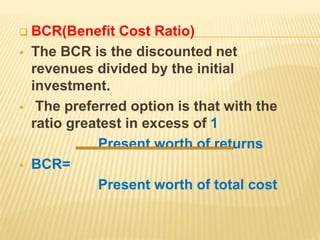
 BCR(Benefit Cost Ratio)
 The BCR is the discounted net
revenues divided by the initial
investment.
 The preferred option is that with the
ratio greatest in excess of 1
Present worth of returns
 BCR=
Present worth of total cost
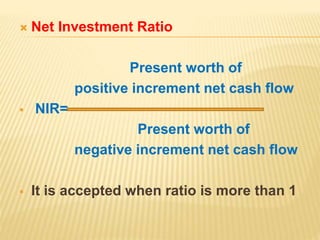
 Net Investment Ratio
Present worth of
positive increment net cash flow
 NIR=
Present worth of
negative increment net cash flow
 It is accepted when ratio is more than 1
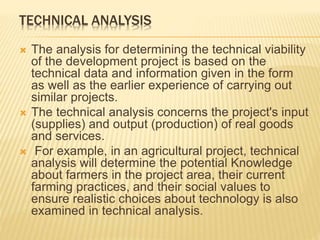
TECHNICAL ANALYSIS
 The analysis for determining the technical viability
of the development project is based on the
technical data and information given in the form
as well as the earlier experience of carrying out
similar projects.
 The technical analysis concerns the project's input
(supplies) and output (production) of real goods
and services.
 For example, in an agricultural project, technical
analysis will determine the potential Knowledge
about farmers in the project area, their current
farming practices, and their social values to
ensure realistic choices about technology is also
examined in technical analysis.
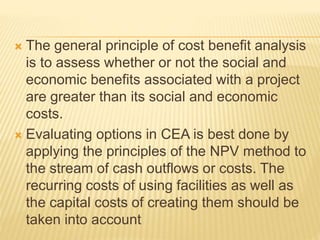
 The general principle of cost benefit analysis
is to assess whether or not the social and
economic benefits associated with a project
are greater than its social and economic
costs.
 Evaluating options in CEA is best done by
applying the principles of the NPV method to
the stream of cash outflows or costs. The
recurring costs of using facilities as well as
the capital costs of creating them should be
taken into account
 Multi-criteria analysis (MCA) establishes
preferences between project options by
reference to an explicit set of criteria and
objectives. These would normally reflect
policy/programme objectives and project
objectives and other considerations as
appropriate, such as value for money, costs,
social, environmental, equality, etc.
FINANCIAL ANALYSIS
 Financial analysis involves assessment of financial
impact, judgment of efficient resource use,
assessment of incentives, provision of a sound
financing plan, coordination of financial contribution
and assessment of financial management
competence.
 The main objective of financial analysis is to
determine the requirements of funds/timing and the
expected returns on.
 Under this analysis, judgment is framed about the
project's financial efficiency, incentives, credit-
worthiness and liquidity.
 In financial analysis, cost and benefits are
calculated using current market prices.
Interest payments on borrowed capital and
repayment of loans are not included. Taxes in
the form of excise duties, customs duties,
sales taxes are considered cost, while
subsidies and loan receipts are considered
benefits and are fully accounted for in the
analysis.
 The BCR is the discounted net revenues
divided by the initial investment. The
preferred option is that with the ratio greatest
in excess of 1. In any event, a project with a
benefit cost ratio of less than one should
generally not proceed. The advantage of this

project appraisal

  • 1.
    An Presentation ON TECHNIQUESOF PROJECT APPRAISAL Submitted To:- Dr A.K. GAURAHA Dept. of Agril.Economics Submitted By:- Mohamed Arshad Ayub Dept. of Agril.ECONOMICS M.SC. Ag. (PREVIOUS)
  • 2.
    PROJECT  Project isan investment activity where spend capital resource to create a productive asset for realizing benefits over time  Phases in Project Identification Formulation Appraisal Implementation Monitoring Evaluation
  • 3.
    APPRAISAL  Appraisal involvesa careful checking of the basic data, assumptions and methodology used in project preparation.  Project appraisal is the process of assessing and questioning proposals before resources are committed.
  • 4.
    KEY ISSUES INAPPRAISING PROJECTS  Need, targeting and objectives  Context and connections  Consultation  Options  Inputs  Value for money  Implementation  Risk and uncertainty  Forward strategies  Sustainability
  • 5.
    FEASIBILITY STUDY  AFeasibility study may be undertaken during appraisal to establish the technical, economic and financial viability, environmental compliance and social acceptability of a project.  Aim of a feasibility study: Development objectives Policy framework and detailed project objectives Technical soundness of the project
  • 6.
    The economic andfinancial viability of the project proposal The status of demand for the project beneficiaries Considerations of customs and traditions of project benefactors and issues of compatibility Other important policy and cross cutting issues (gender, environment,)  Administrative feasibility of the project
  • 7.
    VARIOUS ASPECTS/ANALYSIS OFAPPRAISAL  Technical analysis  Economic Analysis  Financial Analysis  Environmental Analysis, and  Social Analysis
  • 8.
    Economic Analysis  Itis a systematic process for examining alternative uses of resources, focusing on assessment of needs, objectives, options, costs, benefits, risks, funding, affordability and other factors relevant to decisions.  The main types of economic appraisal are: Cost-benefit analysis Cost-effectiveness analysis Multi-criteria analysis
  • 9.
    Financial Analysis  Financialanalysis involves assessment of financial impact, judgment of efficient resource use, assessment of incentives, provision of a sound financing plan, coordination of financial contribution and assessment of financial management competence.  The main objective of financial analysis is to determine the requirements of funds/timing and the expected returns on.
  • 10.
    TECHNIQUES OF PROJECTAPPRAISAL  The can be discussed under two heads viz (i) Undiscounted (a) Pay back period, (b) Rank by inspection, (c) Proceeds per unit of outlay, and (d) Average annual proceeds per unit of outlay.
  • 11.
    (II) DISCOUNTED.  Discountingtechniques take into account the time-value of money.  NPV(net present value)  It is present worth of cash flow stream.  The net present value at interest rate i is denoted NPV(i) NPV= ∑ P/(1+i) ᶤ  If an investor can lend and borrow money at rate i1, a project will be profitable if and only if NPV(i1) > 0
  • 12.
     IRR(Internal Rateof Returns)  It is the discount rate at which the present value of net cash flow are just equal to zero  The preferred option is that with the IRR greatest in excess of a specified rate of return.  IRR=l(i)+d(i) NPV @l/ad2NPV
  • 13.
     BCR(Benefit CostRatio)  The BCR is the discounted net revenues divided by the initial investment.  The preferred option is that with the ratio greatest in excess of 1 Present worth of returns  BCR= Present worth of total cost
  • 14.
     Net InvestmentRatio Present worth of positive increment net cash flow  NIR= Present worth of negative increment net cash flow  It is accepted when ratio is more than 1
  • 16.
    TECHNICAL ANALYSIS  Theanalysis for determining the technical viability of the development project is based on the technical data and information given in the form as well as the earlier experience of carrying out similar projects.  The technical analysis concerns the project's input (supplies) and output (production) of real goods and services.  For example, in an agricultural project, technical analysis will determine the potential Knowledge about farmers in the project area, their current farming practices, and their social values to ensure realistic choices about technology is also examined in technical analysis.
  • 17.
     The generalprinciple of cost benefit analysis is to assess whether or not the social and economic benefits associated with a project are greater than its social and economic costs.  Evaluating options in CEA is best done by applying the principles of the NPV method to the stream of cash outflows or costs. The recurring costs of using facilities as well as the capital costs of creating them should be taken into account
  • 18.
     Multi-criteria analysis(MCA) establishes preferences between project options by reference to an explicit set of criteria and objectives. These would normally reflect policy/programme objectives and project objectives and other considerations as appropriate, such as value for money, costs, social, environmental, equality, etc.
  • 19.
    FINANCIAL ANALYSIS  Financialanalysis involves assessment of financial impact, judgment of efficient resource use, assessment of incentives, provision of a sound financing plan, coordination of financial contribution and assessment of financial management competence.  The main objective of financial analysis is to determine the requirements of funds/timing and the expected returns on.  Under this analysis, judgment is framed about the project's financial efficiency, incentives, credit- worthiness and liquidity.
  • 20.
     In financialanalysis, cost and benefits are calculated using current market prices. Interest payments on borrowed capital and repayment of loans are not included. Taxes in the form of excise duties, customs duties, sales taxes are considered cost, while subsidies and loan receipts are considered benefits and are fully accounted for in the analysis.  The BCR is the discounted net revenues divided by the initial investment. The preferred option is that with the ratio greatest in excess of 1. In any event, a project with a benefit cost ratio of less than one should generally not proceed. The advantage of this