MANAGEMENT ACCOUNTING
RATIO ANALYSIS
BY:
SMT.UMA MINAJIGI REUR
HEAD, DEPT. OF COMMERCE & MANAGEMENT
SMT. V G DEGREE COLLEGE FOR WOMEN, KALABURAGI
MANAGEMENT
ACCOUNTING
B.COM SIXTH SEMESTER
&
BBA FOURTH SEMESTER
6.3: PRINCIPLES OF MANAGEMENT ACCOUNTING
B.COM SIXTH SEMESTER
6.3: PRINCIPLES OF MANAGEMENT ACCOUNTING
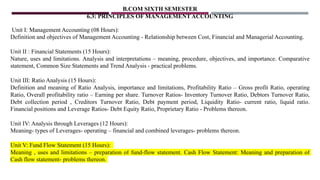
Unit I: Management Accounting (08 Hours):
Definition and objectives of Management Accounting - Relationship between Cost, Financial and Managerial Accounting.
Unit II : Financial Statements (15 Hours):
Nature, uses and limitations. Analysis and interpretations – meaning, procedure, objectives, and importance. Comparative
statement, Common Size Statements and Trend Analysis - practical problems.
Unit III: Ratio Analysis (15 Hours):
Definition and meaning of Ratio Analysis, importance and limitations, Profitability Ratio – Gross profit Ratio, operating
Ratio, Overall profitability ratio – Earning per share. Turnover Ratios- Inventory Turnover Ratio, Debtors Turnover Ratio,
Debt collection period , Creditors Turnover Ratio, Debt payment period, Liquidity Ratio- current ratio, liquid ratio.
Financial positions and Leverage Ratios- Debt Equity Ratio, Proprietary Ratio - Problems thereon.
Unit IV: Analysis through Leverages (12 Hours):
Meaning- types of Leverages- operating – financial and combined leverages- problems thereon.
Unit V: Fund Flow Statement (15 Hours):
Meaning , uses and limitations – preparation of fund-flow statement. Cash Flow Statement: Meaning and preparation of
Cash flow statement- problems thereon.
Management Accounting
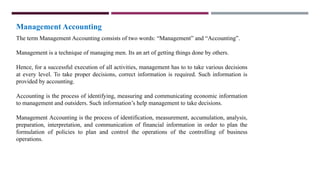
The term Management Accounting consists of two words: “Management” and “Accounting”.
Management is a technique of managing men. Its an art of getting things done by others.
Hence, for a successful execution of all activities, management has to to take various decisions
at every level. To take proper decisions, correct information is required. Such information is
provided by accounting.
Accounting is the process of identifying, measuring and communicating economic information
to management and outsiders. Such information’s help management to take decisions.
Management Accounting is the process of identification, measurement, accumulation, analysis,
preparation, interpretation, and communication of financial information in order to plan the
formulation of policies to plan and control the operations of the controlling of business
operations.
Definition:
J.S. Batty defines, “Management accounting is the term used
to describe the accounting methods, systems and techniques
which coupled with special knowledge and ability to assist
management in its task of maximising profit and minimising
losses.”
Management Accounting is a system for gathering data and
other financial information primarily for the internal needs of
management. It is designed to assist internal management in
the efficient formulation, execution and appraisal of business
plans.
Meaning of Funds Flow Statement:
It is a statement which discloses the analytical information about the different
sources of a fund and the application of the same in an accounting cycle.
It deals with the transactions which change either the amount of current assets and
current liabilities (in the form of decrease or increase in working capital) or fixed assets,
long-term loans including ownership fund.
It gives a clear picture about the movement of funds between the opening and closing
dates of the Balance Sheet. It is also called the Statement of Sources and Applications of
Funds, Movement of Funds Statement; Where Got-Where Gone Statement: Inflow and
Outflow of Fund Statement etc.
No doubt, Funds Flow Statement is an important indicator of financial analysis and
control. It is valuable and also helps to determine how the funds are financed. The
financial analyst can evaluate the future flows of a firm on the basis of past data.
Funds Flow Statement
Funds Flow Statement statement supplies an efficient method for
the financial manager in order to assess the
(a)growth of the firm,
(b)its resulting financial needs, and
(c)to determine the best way to finance those needs.
In particular, funds flow statements are very useful in planning
intermediate and long-term financing.
Sources of Funds:
Transactions which result in an increase in the amount of fund or
working capital are called sources of fund.
The following are the sources of funds:
1. Funds from operations, operating profit or trading profit.
2. Non operating incomes.
3. Refund of Income Tax (received).
4. Issue of Shares for cash or for any other current asset.
5. Issue of debentures for cash or for any other current asset.
6. Long term and medium term loans borrowed.
7. Long term or medium term deposits accepted.
8. Sale of long term investments for cash or for any other current asset.
9. Sale of fixed assets for cash or for any other current asset.
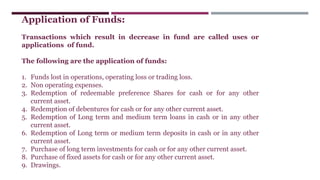
Application of Funds:
Transactions which result in decrease in fund are called uses or
applications of fund.
The following are the application of funds:
1. Funds lost in operations, operating loss or trading loss.
2. Non operating expenses.
3. Redemption of redeemable preference Shares for cash or for any other
current asset.
4. Redemption of debentures for cash or for any other current asset.
5. Redemption of Long term and medium term loans in cash or in any other
current asset.
6. Redemption of Long term or medium term deposits in cash or in any other
current asset.
7. Purchase of long term investments for cash or for any other current asset.
8. Purchase of fixed assets for cash or for any other current asset.
9. Drawings.
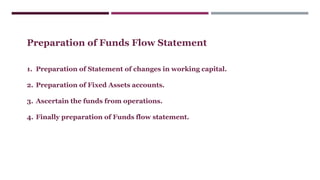
Preparation of Funds Flow Statement
1. Preparation of Statement of changes in working capital.
2. Preparation of Fixed Assets accounts.
3. Ascertain the funds from operations.
4. Finally preparation of Funds flow statement.
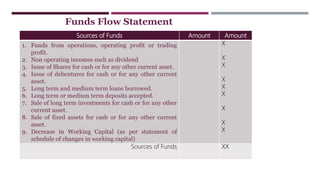
Funds Flow Statement
Sources of Funds Amount Amount
1. Funds from operations, operating profit or trading
profit.
2. Non operating incomes such as dividend
3. Issue of Shares for cash or for any other current asset.
4. Issue of debentures for cash or for any other current
asset.
5. Long term and medium term loans borrowed.
6. Long term or medium term deposits accepted.
7. Sale of long term investments for cash or for any other
current asset.
8. Sale of fixed assets for cash or for any other current
asset.
9. Decrease in Working Capital (as per statement of
schedule of changes in working capital)
X
X
X
X
X
X
X
X
X
Sources of Funds XX
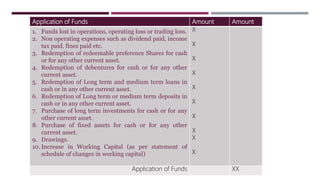
Application of Funds Amount Amount
1. Funds lost in operations, operating loss or trading loss.
2. Non operating expenses such as dividend paid, income
tax paid, fines paid etc.
3. Redemption of redeemable preference Shares for cash
or for any other current asset.
4. Redemption of debentures for cash or for any other
current asset.
5. Redemption of Long term and medium term loans in
cash or in any other current asset.
6. Redemption of Long term or medium term deposits in
cash or in any other current asset.
7. Purchase of long term investments for cash or for any
other current asset.
8. Purchase of fixed assets for cash or for any other
current asset.
9. Drawings.
10. Increase in Working Capital (as per statement of
schedule of changes in working capital)
X
X
X
X
X
X
X
X
X
X
Application of Funds XX
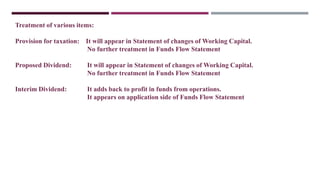
Treatment of various items:
Provision for taxation: It will appear in Statement of changes of Working Capital.
No further treatment in Funds Flow Statement
Proposed Dividend: It will appear in Statement of changes of Working Capital.
No further treatment in Funds Flow Statement
Interim Dividend: It adds back to profit in funds from operations.
It appears on application side of Funds Flow Statement
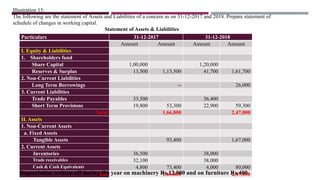
Illustration 15:
The following are the statement of Assets and Liabilities of a concern as on 31-12-2017 and 2018. Prepare statement of
schedule of changes in working capital.
Statement of Assets & Liabilities
Particulars 31-12-2017 31-12-2018
Amount Amount Amount Amount
I. Equity & Liabilities
1. Shareholders fund
Share Capital 1,00,000 1,20,000
Reserves & Surplus 13,500 1,13,500 41,700 1,61,700
2. Non-Current Liabilities
Long Term Borrowings -- 26,000
3. Current Liabilities
Trade Payables 33,500 36,400
Short Term Provisions 19,800 53,300 22,900 59,300
Total 1,66,800 2,47,000
II. Assets
1. Non-Current Assets
a. Fixed Assets
Tangible Assets 93,400 1,67,000
2. Current Assets
Inventories 36,500 38,000
Trade receivables 32,100 38,000
Cash & Cash Equivalents 4,800 73,400 4,000 80,000
Total 1,66,800 2,47,000
Depreciation written off during the year on machinery Rs.12,000 and on furniture Rs.400.
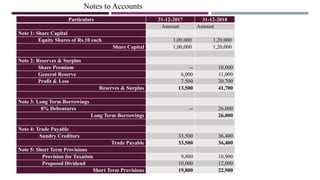
Notes to Accounts
Particulars 31-12-2017 31-12-2018
Amount Amount
Note 1: Share Capital
Equity Shares of Rs.10 each 1,00,000 1,20,000
Share Capital 1,00,000 1,20,000
Note 2: Reserves & Surplus
Share Premium -- 10,000
General Reserve 6,000 11,000
Profit & Loss 7,500 20,700
Reserves & Surplus 13,500 41,700
Note 3: Long Term Borrowings
8% Debentures -- 26,000
Long Term Borrowings 26,000
Note 4: Trade Payable
Sundry Creditors 33,500 36,400
Trade Payable 33,500 36,400
Note 5: Short Term Provisions
Provision for Taxation 9,800 10,900
Proposed Dividend 10,000 12,000
Short Term Provisions 19,800 22,900
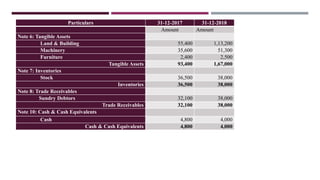
Particulars 31-12-2017 31-12-2018
Amount Amount
Note 6: Tangible Assets
Land & Building 55,400 1,13,200
Machinery 35,600 51,300
Furniture 2,400 2,500
Tangible Assets 93,400 1,67,000
Note 7: Inventories
Stock 36,500 38,000
Inventories 36,500 38,000
Note 8: Trade Receivables
Sundry Debtors 32,100 38,000
Trade Receivables 32,100 38,000
Note 10: Cash & Cash Equivalents
Cash 4,800 4,000
Cash & Cash Equivalents 4,800 4,000
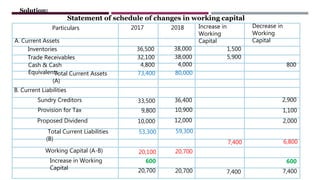
Solution:
Statement of schedule of changes in working capital
Particulars 2017 2018 Increase in
Working
Capital
Decrease in
Working
Capital
A. Current Assets
Inventories
Trade Receivables
Cash & Cash
Equivalents
B. Current Liabilities
Sundry Creditors
Provision for Tax
Working Capital (A-B)
Increase in Working
Capital
36,500
32,100
4,800
73,400
38,000
38,000
4,000
80,000
1,500
5,900
33,500
9,800
53,300
36,400
10,900
59,300
7,400
2,900
1,100
800
20,100
600
20,700
20,700
20,700 7,400 7,400
6,800
600
Total Current Assets
(A)
Proposed Dividend 10,000 12,000 2,000
Total Current Liabilities
(B)
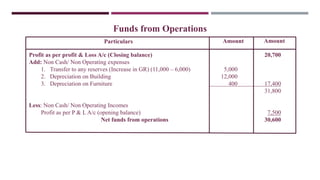
Funds from Operations
Profit as per profit & Loss A/c (Closing balance) 20,700
Add: Non Cash/ Non Operating expenses
1. Transfer to any reserves (Increase in GR) (11,000 – 6,000) 5,000
2. Depreciation on Building 12,000
3. Depreciation on Furniture 400 17,400
31,800
Less: Non Cash/ Non Operating Incomes
Profit as per P & L A/c (opening balance) 7,500
Net funds from operations 30,600
Particulars Amount
Amount
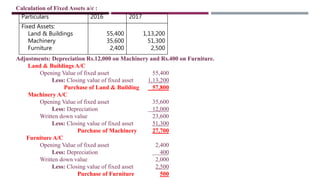
Calculation of Fixed Assets a/c :
Adjustments: Depreciation Rs.12,000 on Machinery and Rs.400 on Furniture.
Land & Buildings A/C
Opening Value of fixed asset 55,400
Less: Closing value of fixed asset 1,13,200
Purchase of Land & Building 57,800
Machinery A/C
Opening Value of fixed asset 35,600
Less: Depreciation 12,000
Written down value 23,600
Less: Closing value of fixed asset 51,300
Purchase of Machinery 27,700
Furniture A/C
Opening Value of fixed asset 2,400
Less: Depreciation 400
Written down value 2,000
Less: Closing value of fixed asset 2,500
Purchase of Furniture 500
Particulars 2016 2017
Fixed Assets:
Land & Buildings
Machinery
Furniture
55,400
35,600
2,400
1,13,200
51,300
2,500
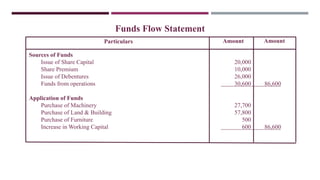
Funds Flow Statement
Sources of Funds
Issue of Share Capital 20,000
Share Premium 10,000
Issue of Debentures 26,000
Funds from operations 30,600 86,600
Application of Funds
Purchase of Machinery 27,700
Purchase of Land & Building 57,800
Purchase of Furniture 500
Increase in Working Capital 600 86,600
Particulars Amount
Amount
THANK YOU

FFA - Funds Flow Statement

  • 1.
    MANAGEMENT ACCOUNTING RATIO ANALYSIS BY: SMT.UMAMINAJIGI REUR HEAD, DEPT. OF COMMERCE & MANAGEMENT SMT. V G DEGREE COLLEGE FOR WOMEN, KALABURAGI
  • 2.
    MANAGEMENT ACCOUNTING B.COM SIXTH SEMESTER & BBAFOURTH SEMESTER 6.3: PRINCIPLES OF MANAGEMENT ACCOUNTING
  • 3.
    B.COM SIXTH SEMESTER 6.3:PRINCIPLES OF MANAGEMENT ACCOUNTING Unit I: Management Accounting (08 Hours): Definition and objectives of Management Accounting - Relationship between Cost, Financial and Managerial Accounting. Unit II : Financial Statements (15 Hours): Nature, uses and limitations. Analysis and interpretations – meaning, procedure, objectives, and importance. Comparative statement, Common Size Statements and Trend Analysis - practical problems. Unit III: Ratio Analysis (15 Hours): Definition and meaning of Ratio Analysis, importance and limitations, Profitability Ratio – Gross profit Ratio, operating Ratio, Overall profitability ratio – Earning per share. Turnover Ratios- Inventory Turnover Ratio, Debtors Turnover Ratio, Debt collection period , Creditors Turnover Ratio, Debt payment period, Liquidity Ratio- current ratio, liquid ratio. Financial positions and Leverage Ratios- Debt Equity Ratio, Proprietary Ratio - Problems thereon. Unit IV: Analysis through Leverages (12 Hours): Meaning- types of Leverages- operating – financial and combined leverages- problems thereon. Unit V: Fund Flow Statement (15 Hours): Meaning , uses and limitations – preparation of fund-flow statement. Cash Flow Statement: Meaning and preparation of Cash flow statement- problems thereon.
  • 4.
    Management Accounting The termManagement Accounting consists of two words: “Management” and “Accounting”. Management is a technique of managing men. Its an art of getting things done by others. Hence, for a successful execution of all activities, management has to to take various decisions at every level. To take proper decisions, correct information is required. Such information is provided by accounting. Accounting is the process of identifying, measuring and communicating economic information to management and outsiders. Such information’s help management to take decisions. Management Accounting is the process of identification, measurement, accumulation, analysis, preparation, interpretation, and communication of financial information in order to plan the formulation of policies to plan and control the operations of the controlling of business operations.
  • 5.
    Definition: J.S. Batty defines,“Management accounting is the term used to describe the accounting methods, systems and techniques which coupled with special knowledge and ability to assist management in its task of maximising profit and minimising losses.” Management Accounting is a system for gathering data and other financial information primarily for the internal needs of management. It is designed to assist internal management in the efficient formulation, execution and appraisal of business plans.
  • 6.
    Meaning of FundsFlow Statement: It is a statement which discloses the analytical information about the different sources of a fund and the application of the same in an accounting cycle. It deals with the transactions which change either the amount of current assets and current liabilities (in the form of decrease or increase in working capital) or fixed assets, long-term loans including ownership fund. It gives a clear picture about the movement of funds between the opening and closing dates of the Balance Sheet. It is also called the Statement of Sources and Applications of Funds, Movement of Funds Statement; Where Got-Where Gone Statement: Inflow and Outflow of Fund Statement etc. No doubt, Funds Flow Statement is an important indicator of financial analysis and control. It is valuable and also helps to determine how the funds are financed. The financial analyst can evaluate the future flows of a firm on the basis of past data. Funds Flow Statement
  • 7.
    Funds Flow Statementstatement supplies an efficient method for the financial manager in order to assess the (a)growth of the firm, (b)its resulting financial needs, and (c)to determine the best way to finance those needs. In particular, funds flow statements are very useful in planning intermediate and long-term financing.
  • 8.
    Sources of Funds: Transactionswhich result in an increase in the amount of fund or working capital are called sources of fund. The following are the sources of funds: 1. Funds from operations, operating profit or trading profit. 2. Non operating incomes. 3. Refund of Income Tax (received). 4. Issue of Shares for cash or for any other current asset. 5. Issue of debentures for cash or for any other current asset. 6. Long term and medium term loans borrowed. 7. Long term or medium term deposits accepted. 8. Sale of long term investments for cash or for any other current asset. 9. Sale of fixed assets for cash or for any other current asset.
  • 9.
    Application of Funds: Transactionswhich result in decrease in fund are called uses or applications of fund. The following are the application of funds: 1. Funds lost in operations, operating loss or trading loss. 2. Non operating expenses. 3. Redemption of redeemable preference Shares for cash or for any other current asset. 4. Redemption of debentures for cash or for any other current asset. 5. Redemption of Long term and medium term loans in cash or in any other current asset. 6. Redemption of Long term or medium term deposits in cash or in any other current asset. 7. Purchase of long term investments for cash or for any other current asset. 8. Purchase of fixed assets for cash or for any other current asset. 9. Drawings.
  • 10.
    Preparation of FundsFlow Statement 1. Preparation of Statement of changes in working capital. 2. Preparation of Fixed Assets accounts. 3. Ascertain the funds from operations. 4. Finally preparation of Funds flow statement.
  • 11.
    Funds Flow Statement Sourcesof Funds Amount Amount 1. Funds from operations, operating profit or trading profit. 2. Non operating incomes such as dividend 3. Issue of Shares for cash or for any other current asset. 4. Issue of debentures for cash or for any other current asset. 5. Long term and medium term loans borrowed. 6. Long term or medium term deposits accepted. 7. Sale of long term investments for cash or for any other current asset. 8. Sale of fixed assets for cash or for any other current asset. 9. Decrease in Working Capital (as per statement of schedule of changes in working capital) X X X X X X X X X Sources of Funds XX
  • 12.
    Application of FundsAmount Amount 1. Funds lost in operations, operating loss or trading loss. 2. Non operating expenses such as dividend paid, income tax paid, fines paid etc. 3. Redemption of redeemable preference Shares for cash or for any other current asset. 4. Redemption of debentures for cash or for any other current asset. 5. Redemption of Long term and medium term loans in cash or in any other current asset. 6. Redemption of Long term or medium term deposits in cash or in any other current asset. 7. Purchase of long term investments for cash or for any other current asset. 8. Purchase of fixed assets for cash or for any other current asset. 9. Drawings. 10. Increase in Working Capital (as per statement of schedule of changes in working capital) X X X X X X X X X X Application of Funds XX
  • 13.
    Treatment of variousitems: Provision for taxation: It will appear in Statement of changes of Working Capital. No further treatment in Funds Flow Statement Proposed Dividend: It will appear in Statement of changes of Working Capital. No further treatment in Funds Flow Statement Interim Dividend: It adds back to profit in funds from operations. It appears on application side of Funds Flow Statement
  • 14.
    Illustration 15: The followingare the statement of Assets and Liabilities of a concern as on 31-12-2017 and 2018. Prepare statement of schedule of changes in working capital. Statement of Assets & Liabilities Particulars 31-12-2017 31-12-2018 Amount Amount Amount Amount I. Equity & Liabilities 1. Shareholders fund Share Capital 1,00,000 1,20,000 Reserves & Surplus 13,500 1,13,500 41,700 1,61,700 2. Non-Current Liabilities Long Term Borrowings -- 26,000 3. Current Liabilities Trade Payables 33,500 36,400 Short Term Provisions 19,800 53,300 22,900 59,300 Total 1,66,800 2,47,000 II. Assets 1. Non-Current Assets a. Fixed Assets Tangible Assets 93,400 1,67,000 2. Current Assets Inventories 36,500 38,000 Trade receivables 32,100 38,000 Cash & Cash Equivalents 4,800 73,400 4,000 80,000 Total 1,66,800 2,47,000 Depreciation written off during the year on machinery Rs.12,000 and on furniture Rs.400.
  • 15.
    Notes to Accounts Particulars31-12-2017 31-12-2018 Amount Amount Note 1: Share Capital Equity Shares of Rs.10 each 1,00,000 1,20,000 Share Capital 1,00,000 1,20,000 Note 2: Reserves & Surplus Share Premium -- 10,000 General Reserve 6,000 11,000 Profit & Loss 7,500 20,700 Reserves & Surplus 13,500 41,700 Note 3: Long Term Borrowings 8% Debentures -- 26,000 Long Term Borrowings 26,000 Note 4: Trade Payable Sundry Creditors 33,500 36,400 Trade Payable 33,500 36,400 Note 5: Short Term Provisions Provision for Taxation 9,800 10,900 Proposed Dividend 10,000 12,000 Short Term Provisions 19,800 22,900
  • 16.
    Particulars 31-12-2017 31-12-2018 AmountAmount Note 6: Tangible Assets Land & Building 55,400 1,13,200 Machinery 35,600 51,300 Furniture 2,400 2,500 Tangible Assets 93,400 1,67,000 Note 7: Inventories Stock 36,500 38,000 Inventories 36,500 38,000 Note 8: Trade Receivables Sundry Debtors 32,100 38,000 Trade Receivables 32,100 38,000 Note 10: Cash & Cash Equivalents Cash 4,800 4,000 Cash & Cash Equivalents 4,800 4,000
  • 17.
    Solution: Statement of scheduleof changes in working capital Particulars 2017 2018 Increase in Working Capital Decrease in Working Capital A. Current Assets Inventories Trade Receivables Cash & Cash Equivalents B. Current Liabilities Sundry Creditors Provision for Tax Working Capital (A-B) Increase in Working Capital 36,500 32,100 4,800 73,400 38,000 38,000 4,000 80,000 1,500 5,900 33,500 9,800 53,300 36,400 10,900 59,300 7,400 2,900 1,100 800 20,100 600 20,700 20,700 20,700 7,400 7,400 6,800 600 Total Current Assets (A) Proposed Dividend 10,000 12,000 2,000 Total Current Liabilities (B)
  • 18.
    Funds from Operations Profitas per profit & Loss A/c (Closing balance) 20,700 Add: Non Cash/ Non Operating expenses 1. Transfer to any reserves (Increase in GR) (11,000 – 6,000) 5,000 2. Depreciation on Building 12,000 3. Depreciation on Furniture 400 17,400 31,800 Less: Non Cash/ Non Operating Incomes Profit as per P & L A/c (opening balance) 7,500 Net funds from operations 30,600 Particulars Amount Amount
  • 19.
    Calculation of FixedAssets a/c : Adjustments: Depreciation Rs.12,000 on Machinery and Rs.400 on Furniture. Land & Buildings A/C Opening Value of fixed asset 55,400 Less: Closing value of fixed asset 1,13,200 Purchase of Land & Building 57,800 Machinery A/C Opening Value of fixed asset 35,600 Less: Depreciation 12,000 Written down value 23,600 Less: Closing value of fixed asset 51,300 Purchase of Machinery 27,700 Furniture A/C Opening Value of fixed asset 2,400 Less: Depreciation 400 Written down value 2,000 Less: Closing value of fixed asset 2,500 Purchase of Furniture 500 Particulars 2016 2017 Fixed Assets: Land & Buildings Machinery Furniture 55,400 35,600 2,400 1,13,200 51,300 2,500
  • 20.
    Funds Flow Statement Sourcesof Funds Issue of Share Capital 20,000 Share Premium 10,000 Issue of Debentures 26,000 Funds from operations 30,600 86,600 Application of Funds Purchase of Machinery 27,700 Purchase of Land & Building 57,800 Purchase of Furniture 500 Increase in Working Capital 600 86,600 Particulars Amount Amount
  • 21.