
MANAGEMENT ACCOUNTING
RATIO ANALYSIS
BY:
SMT.UMA MINAJIGI REUR
HEAD, DEPT. OF COMMERCE & MANAGEMENT
SMT. V G DEGREE COLLEGE FOR WOMEN, KALABURAGI
MANAGEMENT ACCOUNTING
RATIO ANALYSIS
LIQUIDITY RATIOS - 2
An analysis of financial statements with the help of ratio is called Ratio
Analysis.
Ratio refers to Numerical or Quantitative relationship between two items.
What are Financial Ratios?
Financial ratios are created with the use of numerical values taken from financial
statements to gain meaningful information about a company. The numbers found
on a company’s financial statements – balance sheet, income statement, and cash
flow statement – are used to perform quantitative analysis and assess a
company’s liquidity, leverage, growth, margins, profitability, rates of return,
valuation, and more.
Ratio analysis is a process used for the calculation of financial ratios or in
other words, for the purpose of evaluating the financial wellbeing of a
company. The values used for the calculation of financial ratios of a company
are extracted from the financial statements of that same company.
Ratio analysis can be defined as the process of ascertaining the financial ratios
that are used for indicating the ongoing financial performance of a company
using few types of ratios such as liquidity, profitability, activity, debt, market,
solvency, efficiency, and coverage ratios and few examples of such ratios are
return on equity, current ratio, quick ratio, dividend payout ratio, debt-equity
ratio, and so on.
Classification of Accounting Ratio
Types of ratios are given below:
1. Liquidity Ratios
2. Leverage Ratio
3. Turnover Ratio
4. Profitability Ratio
1. Liquidity Ratios
This type of ratio helps in measuring the ability of a company to take care of its
short-term debt obligations. A higher liquidity ratio represents that the company is
highly rich in cash.
The types of liquidity ratios are: –
1. Current Ratio or Working Capital Ratio
2. Quick Ratio or Liquidity Ratio or Acid Test Ratio
3. Absolute Liquid Ratio or Cash Ratio
4. Stock to Working Capital Ratio
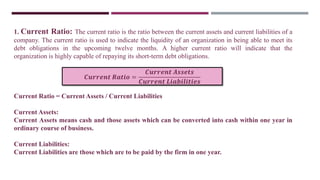
1. Current Ratio: The current ratio is the ratio between the current assets and current liabilities of a
company. The current ratio is used to indicate the liquidity of an organization in being able to meet its
debt obligations in the upcoming twelve months. A higher current ratio will indicate that the
organization is highly capable of repaying its short-term debt obligations.
Current Ratio = Current Assets / Current Liabilities
Current Assets:
Current Assets means cash and those assets which can be converted into cash within one year in
ordinary course of business.
Current Liabilities:
Current Liabilities are those which are to be paid by the firm in one year.
𝑪𝒖𝒓𝒓𝒆𝒏𝒕 𝑹𝒂𝒕𝒊𝒐 =
𝑪𝒖𝒓𝒓𝒆𝒏𝒕 𝑨𝒔𝒔𝒆𝒕𝒔
𝑪𝒖𝒓𝒓𝒆𝒏𝒕 𝑳𝒊𝒂𝒃𝒊𝒍𝒊𝒕𝒊𝒆𝒔
Current Ratio:
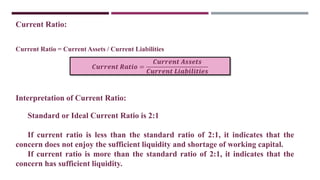
Current Ratio = Current Assets / Current Liabilities
Interpretation of Current Ratio:
Standard or Ideal Current Ratio is 2:1
If current ratio is less than the standard ratio of 2:1, it indicates that the
concern does not enjoy the sufficient liquidity and shortage of working capital.
If current ratio is more than the standard ratio of 2:1, it indicates that the
concern has sufficient liquidity.
𝑪𝒖𝒓𝒓𝒆𝒏𝒕 𝑹𝒂𝒕𝒊𝒐 =
𝑪𝒖𝒓𝒓𝒆𝒏𝒕 𝑨𝒔𝒔𝒆𝒕𝒔
𝑪𝒖𝒓𝒓𝒆𝒏𝒕 𝑳𝒊𝒂𝒃𝒊𝒍𝒊𝒕𝒊𝒆𝒔
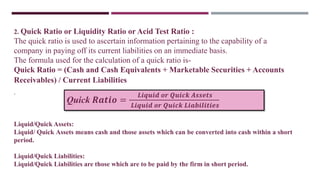
2. Quick Ratio or Liquidity Ratio or Acid Test Ratio :
The quick ratio is used to ascertain information pertaining to the capability of a
company in paying off its current liabilities on an immediate basis.
The formula used for the calculation of a quick ratio is-
Quick Ratio = (Cash and Cash Equivalents + Marketable Securities + Accounts
Receivables) / Current Liabilities
.
Liquid/Quick Assets:
Liquid/ Quick Assets means cash and those assets which can be converted into cash within a short
period.
Liquid/Quick Liabilities:
Liquid/Quick Liabilities are those which are to be paid by the firm in short period.
Quick 𝑹𝒂𝒕𝒊𝒐 =
𝑳𝒊𝒒𝒖𝒊𝒅 𝒐𝒓 𝑸𝒖𝒊𝒄𝒌 𝑨𝒔𝒔𝒆𝒕𝒔
𝑳𝒊𝒒𝒖𝒊𝒅 𝒐𝒓 𝑸𝒖𝒊𝒄𝒌 𝑳𝒊𝒂𝒃𝒊𝒍𝒊𝒕𝒊𝒆𝒔
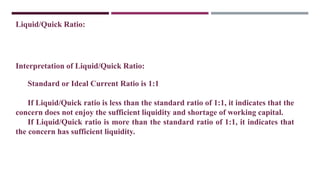
Liquid/Quick Ratio:
Interpretation of Liquid/Quick Ratio:
Standard or Ideal Current Ratio is 1:1
If Liquid/Quick ratio is less than the standard ratio of 1:1, it indicates that the
concern does not enjoy the sufficient liquidity and shortage of working capital.
If Liquid/Quick ratio is more than the standard ratio of 1:1, it indicates that
the concern has sufficient liquidity.
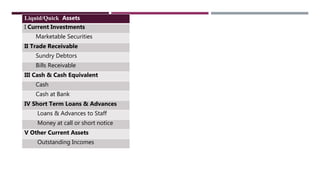
Liquid/Quick Assets
I Current Investments
Marketable Securities
II Trade Receivable
Sundry Debtors
Bills Receivable
III Cash & Cash Equivalent
Cash
Cash at Bank
IV Short Term Loans & Advances
Loans & Advances to Staff
Money at call or short notice
V Other Current Assets
Outstanding Incomes
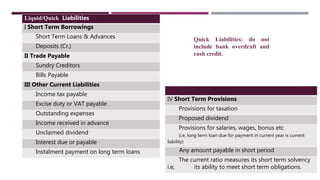
Liquid/Quick Liabilities
I Short Term Borrowings
Short Term Loans & Advances
Deposits (Cr.)
II Trade Payable
Sundry Creditors
Bills Payable
III Other Current Liabilities
Income tax payable
Excise duty or VAT payable
Outstanding expenses
Income received in advance
Unclaimed dividend
Interest due or payable
Instalment payment on long term loans
IV Short Term Provisions
Provisions for taxation
Proposed dividend
Provisions for salaries, wages, bonus etc
(i.e, long term loan due for payment in current year is current
liability)
Any amount payable in short period
The current ratio measures its short term solvency
i.e, its ability to meet short term obligations.
Quick Liabilities: do not
include bank overdraft and
cash credit.
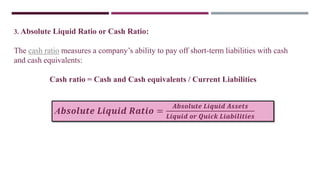
3. Absolute Liquid Ratio or Cash Ratio:
The cash ratio measures a company’s ability to pay off short-term liabilities with cash
and cash equivalents:
Cash ratio = Cash and Cash equivalents / Current Liabilities
A𝒃𝒔𝒐𝒍𝒖𝒕𝒆 𝑳𝒊𝒒𝒖𝒊𝒅 𝑹𝒂𝒕𝒊𝒐 =
𝑨𝒃𝒔𝒐𝒍𝒖𝒕𝒆 𝑳𝒊𝒒𝒖𝒊𝒅 𝑨𝒔𝒔𝒆𝒕𝒔
𝑳𝒊𝒒𝒖𝒊𝒅 𝒐𝒓 𝑸𝒖𝒊𝒄𝒌 𝑳𝒊𝒂𝒃𝒊𝒍𝒊𝒕𝒊𝒆𝒔
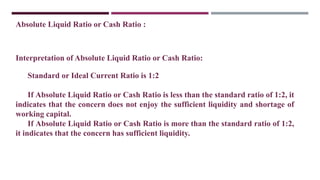
Absolute Liquid Ratio or Cash Ratio :
Interpretation of Absolute Liquid Ratio or Cash Ratio:
Standard or Ideal Current Ratio is 1:2
If Absolute Liquid Ratio or Cash Ratio is less than the standard ratio of 1:2, it
indicates that the concern does not enjoy the sufficient liquidity and shortage of
working capital.
If Absolute Liquid Ratio or Cash Ratio is more than the standard ratio of 1:2,
it indicates that the concern has sufficient liquidity.
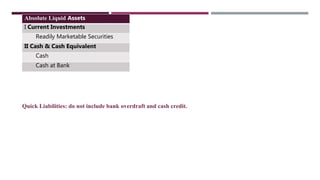
Absolute Liquid Assets
I Current Investments
Readily Marketable Securities
II Cash & Cash Equivalent
Cash
Cash at Bank
Quick Liabilities: do not include bank overdraft and cash credit.
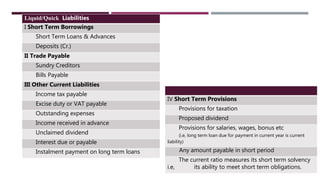
Liquid/Quick Liabilities
I Short Term Borrowings
Short Term Loans & Advances
Deposits (Cr.)
II Trade Payable
Sundry Creditors
Bills Payable
III Other Current Liabilities
Income tax payable
Excise duty or VAT payable
Outstanding expenses
Income received in advance
Unclaimed dividend
Interest due or payable
Instalment payment on long term loans
IV Short Term Provisions
Provisions for taxation
Proposed dividend
Provisions for salaries, wages, bonus etc
(i.e, long term loan due for payment in current year is current
liability)
Any amount payable in short period
The current ratio measures its short term solvency
i.e, its ability to meet short term obligations.
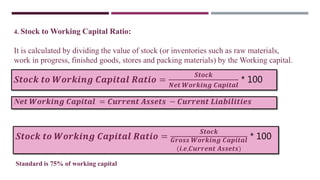
4. Stock to Working Capital Ratio:
It is calculated by dividing the value of stock (or inventories such as raw materials,
work in progress, finished goods, stores and packing materials) by the Working capital.
S𝒕𝒐𝒄𝒌 𝒕𝒐 𝑾𝒐𝒓𝒌𝒊𝒏𝒈 𝑪𝒂𝒑𝒊𝒕𝒂𝒍 𝑹𝒂𝒕𝒊𝒐 =
𝑺𝒕𝒐𝒄𝒌
𝑵𝒆𝒕 𝑾𝒐𝒓𝒌𝒊𝒏𝒈 𝑪𝒂𝒑𝒊𝒕𝒂𝒍
* 100
N𝒆𝒕 𝑾𝒐𝒓𝒌𝒊𝒏𝒈 𝑪𝒂𝒑𝒊𝒕𝒂𝒍 = 𝑪𝒖𝒓𝒓𝒆𝒏𝒕 𝑨𝒔𝒔𝒆𝒕𝒔 − 𝑪𝒖𝒓𝒓𝒆𝒏𝒕 𝑳𝒊𝒂𝒃𝒊𝒍𝒊𝒕𝒊𝒆𝒔
S𝒕𝒐𝒄𝒌 𝒕𝒐 𝑾𝒐𝒓𝒌𝒊𝒏𝒈 𝑪𝒂𝒑𝒊𝒕𝒂𝒍 𝑹𝒂𝒕𝒊𝒐 =
𝑺𝒕𝒐𝒄𝒌
𝑮𝒓𝒐𝒔𝒔 𝑾𝒐𝒓𝒌𝒊𝒏𝒈 𝑪𝒂𝒑𝒊𝒕𝒂𝒍
(𝒊.𝒆,𝑪𝒖𝒓𝒓𝒆𝒏𝒕 𝑨𝒔𝒔𝒆𝒕𝒔)
* 100
Standard is 75% of working capital
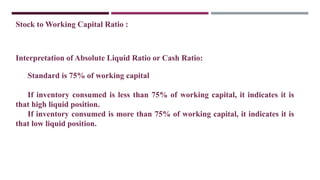
Stock to Working Capital Ratio :
Interpretation of Absolute Liquid Ratio or Cash Ratio:
Standard is 75% of working capital
If inventory consumed is less than 75% of working capital, it indicates it is
that high liquid position.
If inventory consumed is more than 75% of working capital, it indicates it is
that low liquid position.
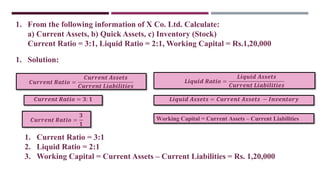
1. From the following information of X Co. Ltd. Calculate:
a) Current Assets, b) Quick Assets, c) Inventory (Stock)
Current Ratio = 3:1, Liquid Ratio = 2:1, Working Capital = Rs.1,20,000
𝑪𝒖𝒓𝒓𝒆𝒏𝒕 𝑹𝒂𝒕𝒊𝒐 =
𝑪𝒖𝒓𝒓𝒆𝒏𝒕 𝑨𝒔𝒔𝒆𝒕𝒔
𝑪𝒖𝒓𝒓𝒆𝒏𝒕 𝑳𝒊𝒂𝒃𝒊𝒍𝒊𝒕𝒊𝒆𝒔
1. Solution:
𝑪𝒖𝒓𝒓𝒆𝒏𝒕 𝑹𝒂𝒕𝒊𝒐 = 𝟑: 𝟏
𝑪𝒖𝒓𝒓𝒆𝒏𝒕 𝑹𝒂𝒕𝒊𝒐 =
𝟑
𝟏
1. Current Ratio = 3:1
2. Liquid Ratio = 2:1
3. Working Capital = Current Assets – Current Liabilities = Rs. 1,20,000
𝑳𝒊𝒒𝒖𝒊𝒅 𝑹𝒂𝒕𝒊𝒐 =
𝑳𝒊𝒒𝒖𝒊𝒅 𝑨𝒔𝒔𝒆𝒕𝒔
𝑪𝒖𝒓𝒓𝒆𝒏𝒕 𝑳𝒊𝒂𝒃𝒊𝒍𝒊𝒕𝒊𝒆𝒔
𝑳𝒊𝒒𝒖𝒊𝒅 𝑨𝒔𝒔𝒆𝒕𝒔 = 𝑪𝒖𝒓𝒓𝒆𝒏𝒕 𝑨𝒔𝒔𝒆𝒕𝒔 − 𝑰𝒏𝒗𝒆𝒏𝒕𝒐𝒓𝒚
Working Capital = Current Assets – Current Liabilities
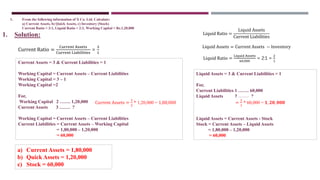
1. From the following information of X Co. Ltd. Calculate:
a) Current Assets, b) Quick Assets, c) Inventory (Stock)
Current Ratio = 3:1, Liquid Ratio = 2:1, Working Capital = Rs.1,20,000
Current Ratio =
Current Assets
Current Liabilities
=
3
1
1. Solution:
Current Assets = 3 & Current Liabilities = 1
Working Capital = Current Assets – Current Liabilities
Working Capital = 3 – 1
Working Capital =2
For,
Working Capital 2 ……. 1,20,000
Current Assets 3 ……. ?
Working Capital = Current Assets – Current Liabilities
Current Liabilities = Current Assets – Working Capital
= 1,80,000 – 1,20,000
= 60,000
Liquid Ratio =
Liquid Assets
Current Liabilities
Liquid Assets = Current Assets − Inventory
Current Assets =
3
2
* 1,20,000 = 1,80,000
Liquid Ratio =
Liquid Assets
60,000
= 2:1 =
2
1
Liquid Assets = 3 & Current Liabilities = 1
For,
Current Liabilities 1 ……. 60,000
Liquid Assets 2 ……. ?
Liquid Assets = Current Assets - Stock
Stock = Current Assets – Liquid Assets
= 1,80,000 – 1,20,000
= 60,000
=
2
1
* 60,000 = 𝟏, 𝟐𝟎, 𝟎𝟎𝟎
a) Current Assets = 1,80,000
b) Quick Assets = 1,20,000
c) Stock = 60,000
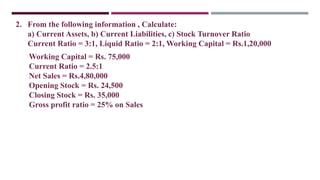
2. From the following information , Calculate:
a) Current Assets, b) Current Liabilities, c) Stock Turnover Ratio
Current Ratio = 3:1, Liquid Ratio = 2:1, Working Capital = Rs.1,20,000
Working Capital = Rs. 75,000
Current Ratio = 2.5:1
Net Sales = Rs.4,80,000
Opening Stock = Rs. 24,500
Closing Stock = Rs. 35,000
Gross profit ratio = 25% on Sales
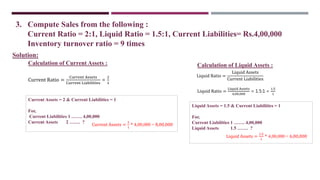
3. Compute Sales from the following :
Current Ratio = 2:1, Liquid Ratio = 1.5:1, Current Liabilities= Rs.4,00,000
Inventory turnover ratio = 9 times
Current Ratio =
Current Assets
Current Liabilities
=
2
1
Current Assets = 2 & Current Liabilities = 1
For,
Current Liabilities 1 ……. 4,00,000
Current Assets 2 ……. ?
Solution:
Current Assets =
2
1
* 4,00,000 = 8,00,000
Liquid Ratio =
Liquid Assets
Current Liabilities
Liquid Ratio =
Liquid Assets
4,00,000
= 1.5:1 =
1.5
1
Liquid Assets = 1.5 & Current Liabilities = 1
For,
Current Liabilities 1 ……. 4,00,000
Liquid Assets 1.5 ……. ?
Liquid Assets =
1.5
1
* 4,00,000 = 6,00,000
Calculation of Current Assets : Calculation of Liquid Assets :
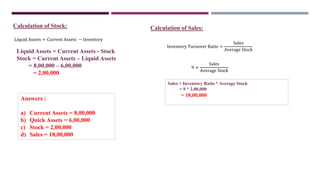
Inventory Turnover Ratio =
Sales
Average Stock
Sales = Inventory Ratio * Average Stock
= 9 * 2,00,000
= 18,00,000
Calculation of Stock: Calculation of Sales:
Liquid Assets = Current Assets − Inventory
Liquid Assets = Current Assets - Stock
Stock = Current Assets – Liquid Assets
= 8,00,000 – 6,00,000
= 2,00,000
9 =
Sales
Average Stock
Answers :
a) Current Assets = 8,00,000
b) Quick Assets = 6,00,000
c) Stock = 2,00,000
d) Sales = 18,00,000
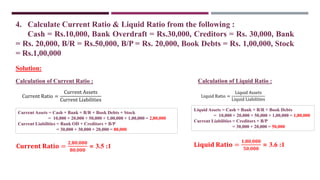
4. Calculate Current Ratio & Liquid Ratio from the following :
Cash = Rs.10,000, Bank Overdraft = Rs.30,000, Creditors = Rs. 30,000, Bank
= Rs. 20,000, B/R = Rs.50,000, B/P = Rs. 20,000, Book Debts = Rs. 1,00,000, Stock
= Rs.1,00,000
Current Ratio =
Current Assets
Current Liabilities
Current Assets = Cash + Bank + B/R + Book Debts + Stock
= 10,000 + 20,000 + 50,000 + 1,00,000 + 1,00,000 = 2,80,000
Current Liabilities = Bank OD + Creditors + B/P
= 30,000 + 30,000 + 20,000 = 80,000
Solution:
Liquid Ratio =
Liquid Assets
Liquid Liabilities
Liquid Assets = Cash + Bank + B/R + Book Debts
= 10,000 + 20,000 + 50,000 + 1,00,000 = 1,80,000
Current Liabilities = Creditors + B/P
= 30,000 + 20,000 = 50,000
Calculation of Current Ratio : Calculation of Liquid Ratio :
𝐂𝐮𝐫𝐫𝐞𝐧𝐭 𝐑𝐚𝐭𝐢𝐨 =
𝟐,𝟖𝟎,𝟎𝟎𝟎
𝟖𝟎,𝟎𝟎𝟎
= 3.5 :1 𝐋𝐢𝐪𝐮𝐢𝐝 𝐑𝐚𝐭𝐢𝐨 =
𝟏,𝟖𝟎,𝟎𝟎𝟎
𝟓𝟎,𝟎𝟎𝟎
= 3.6 :1
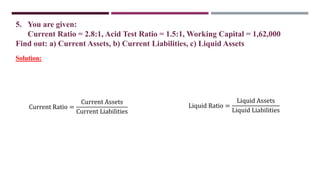
5. You are given:
Current Ratio = 2.8:1, Acid Test Ratio = 1.5:1, Working Capital = 1,62,000
Find out: a) Current Assets, b) Current Liabilities, c) Liquid Assets
Current Ratio =
Current Assets
Current Liabilities
Solution:
Liquid Ratio =
Liquid Assets
Liquid Liabilities
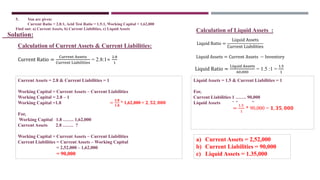
Current Ratio =
Current Assets
Current Liabilities
= 2.8:1=
2.8
1
Solution:
Current Assets = 2.8 & Current Liabilities = 1
Working Capital = Current Assets – Current Liabilities
Working Capital = 2.8 – 1
Working Capital =1.8
For,
Working Capital 1.8 ……. 1,62,000
Current Assets 2.8 ……. ?
Working Capital = Current Assets – Current Liabilities
Current Liabilities = Current Assets – Working Capital
= 2,52,000 – 1,62,000
= 90,000
Liquid Ratio =
Liquid Assets
Current Liabilities
Liquid Assets = Current Assets − Inventory
=
𝟐.𝟖
𝟏.𝟖
* 1,62,000 = 𝟐, 𝟓𝟐, 𝟎𝟎𝟎
Liquid Ratio =
Liquid Assets
60,000
= 1.5 :1 =
1.5
1
Liquid Assets = 1.5 & Current Liabilities = 1
For,
Current Liabilities 1 ……. 90,000
Liquid Assets 1.5 ……. ?
=
1.5
1
* 90,000 = 𝟏, 𝟑𝟓, 𝟎𝟎𝟎
a) Current Assets = 2,52,000
b) Current Liabilities = 90,000
c) Liquid Assets = 1.35,000
5. You are given:
Current Ratio = 2.8:1, Acid Test Ratio = 1.5:1, Working Capital = 1,62,000
Find out: a) Current Assets, b) Current Liabilities, c) Liquid Assets
Calculation of Current Assets & Current Liabilities:
Calculation of Liquid Assets :
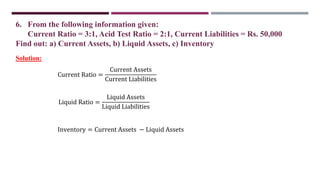
6. From the following information given:
Current Ratio = 3:1, Acid Test Ratio = 2:1, Current Liabilities = Rs. 50,000
Find out: a) Current Assets, b) Liquid Assets, c) Inventory
Current Ratio =
Current Assets
Current Liabilities
Solution:
Liquid Ratio =
Liquid Assets
Liquid Liabilities
Inventory = Current Assets − Liquid Assets
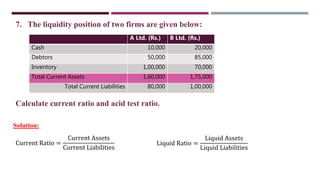
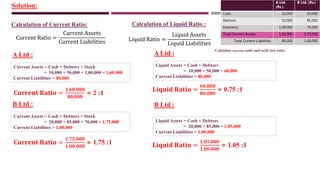
7. The liquidity position of two firms are given below:
Current Ratio =
Current Assets
Current Liabilities
Solution:
Liquid Ratio =
Liquid Assets
Liquid Liabilities
A Ltd. (Rs.) B Ltd. (Rs.)
Cash 10,000 20,000
Debtors 50,000 85,000
Inventory 1,00,000 70,000
Total Current Assets 1,60,000 1,75,000
Total Current Liabilities 80,000 1,00,000
Calculate current ratio and acid test ratio.
Current Ratio =
Current Assets
Current Liabilities
Solution:
A Ltd.
(Rs.)
B Ltd. (Rs.)
Cash 10,000 20,000
Debtors 50,000 85,000
Inventory 1,00,000 70,000
Total Current Assets 1,60,000 1,75,000
Total Current Liabilities 80,000 1,00,000
Calculate current ratio and acid test ratio.
Calculation of Current Ratio:
Current Assets = Cash + Debtors + Stock
= 10,000 + 50,000 + 1,00,000 = 1,60,000
Current Liabilities = 80,000
Liquid Ratio =
Liquid Assets
Liquid Liabilities
Liquid Assets = Cash + Debtors
= 10,000 + 50,000 = 60,000
Current Liabilities = 80,000
Calculation of Liquid Ratio :
𝐂𝐮𝐫𝐫𝐞𝐧𝐭 𝐑𝐚𝐭𝐢𝐨 =
𝟏,𝟔𝟎,𝟎𝟎𝟎
𝟖𝟎,𝟎𝟎𝟎
= 2 :1
𝐋𝐢𝐪𝐮𝐢𝐝 𝐑𝐚𝐭𝐢𝐨 =
𝟔𝟎,𝟎𝟎𝟎
𝟖𝟎,𝟎𝟎𝟎
= 0.75 :1
A Ltd :
Current Assets = Cash + Debtors + Stock
= 20,000 + 85,000 + 70,000 = 1,75,000
Current Liabilities = 1,00,000
𝐂𝐮𝐫𝐫𝐞𝐧𝐭 𝐑𝐚𝐭𝐢𝐨 =
𝟏,𝟕𝟓,𝟎𝟎𝟎
𝟏,𝟎𝟎,𝟎𝟎𝟎
= 1.75 :1
B Ltd :
A Ltd :
B Ltd :
Liquid Assets = Cash + Debtors
= 20,000 + 85,000 = 1,05,000
Current Liabilities = 1,00,000
𝐋𝐢𝐪𝐮𝐢𝐝 𝐑𝐚𝐭𝐢𝐨 =
𝟏,𝟎𝟓,𝟎𝟎𝟎
𝟏,𝟎𝟎,𝟎𝟎𝟎
= 1.05 :1
THANK YOU

Ratio analysis - Liquidity Ratios

  • 1.
    MANAGEMENT ACCOUNTING RATIO ANALYSIS BY: SMT.UMAMINAJIGI REUR HEAD, DEPT. OF COMMERCE & MANAGEMENT SMT. V G DEGREE COLLEGE FOR WOMEN, KALABURAGI
  • 2.
  • 3.
    An analysis offinancial statements with the help of ratio is called Ratio Analysis. Ratio refers to Numerical or Quantitative relationship between two items. What are Financial Ratios? Financial ratios are created with the use of numerical values taken from financial statements to gain meaningful information about a company. The numbers found on a company’s financial statements – balance sheet, income statement, and cash flow statement – are used to perform quantitative analysis and assess a company’s liquidity, leverage, growth, margins, profitability, rates of return, valuation, and more.
  • 4.
    Ratio analysis isa process used for the calculation of financial ratios or in other words, for the purpose of evaluating the financial wellbeing of a company. The values used for the calculation of financial ratios of a company are extracted from the financial statements of that same company. Ratio analysis can be defined as the process of ascertaining the financial ratios that are used for indicating the ongoing financial performance of a company using few types of ratios such as liquidity, profitability, activity, debt, market, solvency, efficiency, and coverage ratios and few examples of such ratios are return on equity, current ratio, quick ratio, dividend payout ratio, debt-equity ratio, and so on.
  • 5.
    Classification of AccountingRatio Types of ratios are given below: 1. Liquidity Ratios 2. Leverage Ratio 3. Turnover Ratio 4. Profitability Ratio
  • 6.
    1. Liquidity Ratios Thistype of ratio helps in measuring the ability of a company to take care of its short-term debt obligations. A higher liquidity ratio represents that the company is highly rich in cash. The types of liquidity ratios are: – 1. Current Ratio or Working Capital Ratio 2. Quick Ratio or Liquidity Ratio or Acid Test Ratio 3. Absolute Liquid Ratio or Cash Ratio 4. Stock to Working Capital Ratio
  • 7.
    1. Current Ratio:The current ratio is the ratio between the current assets and current liabilities of a company. The current ratio is used to indicate the liquidity of an organization in being able to meet its debt obligations in the upcoming twelve months. A higher current ratio will indicate that the organization is highly capable of repaying its short-term debt obligations. Current Ratio = Current Assets / Current Liabilities Current Assets: Current Assets means cash and those assets which can be converted into cash within one year in ordinary course of business. Current Liabilities: Current Liabilities are those which are to be paid by the firm in one year. 𝑪𝒖𝒓𝒓𝒆𝒏𝒕 𝑹𝒂𝒕𝒊𝒐 = 𝑪𝒖𝒓𝒓𝒆𝒏𝒕 𝑨𝒔𝒔𝒆𝒕𝒔 𝑪𝒖𝒓𝒓𝒆𝒏𝒕 𝑳𝒊𝒂𝒃𝒊𝒍𝒊𝒕𝒊𝒆𝒔
  • 8.
    Current Ratio: Current Ratio= Current Assets / Current Liabilities Interpretation of Current Ratio: Standard or Ideal Current Ratio is 2:1 If current ratio is less than the standard ratio of 2:1, it indicates that the concern does not enjoy the sufficient liquidity and shortage of working capital. If current ratio is more than the standard ratio of 2:1, it indicates that the concern has sufficient liquidity. 𝑪𝒖𝒓𝒓𝒆𝒏𝒕 𝑹𝒂𝒕𝒊𝒐 = 𝑪𝒖𝒓𝒓𝒆𝒏𝒕 𝑨𝒔𝒔𝒆𝒕𝒔 𝑪𝒖𝒓𝒓𝒆𝒏𝒕 𝑳𝒊𝒂𝒃𝒊𝒍𝒊𝒕𝒊𝒆𝒔
  • 9.
    2. Quick Ratioor Liquidity Ratio or Acid Test Ratio : The quick ratio is used to ascertain information pertaining to the capability of a company in paying off its current liabilities on an immediate basis. The formula used for the calculation of a quick ratio is- Quick Ratio = (Cash and Cash Equivalents + Marketable Securities + Accounts Receivables) / Current Liabilities . Liquid/Quick Assets: Liquid/ Quick Assets means cash and those assets which can be converted into cash within a short period. Liquid/Quick Liabilities: Liquid/Quick Liabilities are those which are to be paid by the firm in short period. Quick 𝑹𝒂𝒕𝒊𝒐 = 𝑳𝒊𝒒𝒖𝒊𝒅 𝒐𝒓 𝑸𝒖𝒊𝒄𝒌 𝑨𝒔𝒔𝒆𝒕𝒔 𝑳𝒊𝒒𝒖𝒊𝒅 𝒐𝒓 𝑸𝒖𝒊𝒄𝒌 𝑳𝒊𝒂𝒃𝒊𝒍𝒊𝒕𝒊𝒆𝒔
  • 10.
    Liquid/Quick Ratio: Interpretation ofLiquid/Quick Ratio: Standard or Ideal Current Ratio is 1:1 If Liquid/Quick ratio is less than the standard ratio of 1:1, it indicates that the concern does not enjoy the sufficient liquidity and shortage of working capital. If Liquid/Quick ratio is more than the standard ratio of 1:1, it indicates that the concern has sufficient liquidity.
  • 11.
    Liquid/Quick Assets I CurrentInvestments Marketable Securities II Trade Receivable Sundry Debtors Bills Receivable III Cash & Cash Equivalent Cash Cash at Bank IV Short Term Loans & Advances Loans & Advances to Staff Money at call or short notice V Other Current Assets Outstanding Incomes
  • 12.
    Liquid/Quick Liabilities I ShortTerm Borrowings Short Term Loans & Advances Deposits (Cr.) II Trade Payable Sundry Creditors Bills Payable III Other Current Liabilities Income tax payable Excise duty or VAT payable Outstanding expenses Income received in advance Unclaimed dividend Interest due or payable Instalment payment on long term loans IV Short Term Provisions Provisions for taxation Proposed dividend Provisions for salaries, wages, bonus etc (i.e, long term loan due for payment in current year is current liability) Any amount payable in short period The current ratio measures its short term solvency i.e, its ability to meet short term obligations. Quick Liabilities: do not include bank overdraft and cash credit.
  • 13.
    3. Absolute LiquidRatio or Cash Ratio: The cash ratio measures a company’s ability to pay off short-term liabilities with cash and cash equivalents: Cash ratio = Cash and Cash equivalents / Current Liabilities A𝒃𝒔𝒐𝒍𝒖𝒕𝒆 𝑳𝒊𝒒𝒖𝒊𝒅 𝑹𝒂𝒕𝒊𝒐 = 𝑨𝒃𝒔𝒐𝒍𝒖𝒕𝒆 𝑳𝒊𝒒𝒖𝒊𝒅 𝑨𝒔𝒔𝒆𝒕𝒔 𝑳𝒊𝒒𝒖𝒊𝒅 𝒐𝒓 𝑸𝒖𝒊𝒄𝒌 𝑳𝒊𝒂𝒃𝒊𝒍𝒊𝒕𝒊𝒆𝒔
  • 14.
    Absolute Liquid Ratioor Cash Ratio : Interpretation of Absolute Liquid Ratio or Cash Ratio: Standard or Ideal Current Ratio is 1:2 If Absolute Liquid Ratio or Cash Ratio is less than the standard ratio of 1:2, it indicates that the concern does not enjoy the sufficient liquidity and shortage of working capital. If Absolute Liquid Ratio or Cash Ratio is more than the standard ratio of 1:2, it indicates that the concern has sufficient liquidity.
  • 15.
    Absolute Liquid Assets ICurrent Investments Readily Marketable Securities II Cash & Cash Equivalent Cash Cash at Bank Quick Liabilities: do not include bank overdraft and cash credit.
  • 16.
    Liquid/Quick Liabilities I ShortTerm Borrowings Short Term Loans & Advances Deposits (Cr.) II Trade Payable Sundry Creditors Bills Payable III Other Current Liabilities Income tax payable Excise duty or VAT payable Outstanding expenses Income received in advance Unclaimed dividend Interest due or payable Instalment payment on long term loans IV Short Term Provisions Provisions for taxation Proposed dividend Provisions for salaries, wages, bonus etc (i.e, long term loan due for payment in current year is current liability) Any amount payable in short period The current ratio measures its short term solvency i.e, its ability to meet short term obligations.
  • 17.
    4. Stock toWorking Capital Ratio: It is calculated by dividing the value of stock (or inventories such as raw materials, work in progress, finished goods, stores and packing materials) by the Working capital. S𝒕𝒐𝒄𝒌 𝒕𝒐 𝑾𝒐𝒓𝒌𝒊𝒏𝒈 𝑪𝒂𝒑𝒊𝒕𝒂𝒍 𝑹𝒂𝒕𝒊𝒐 = 𝑺𝒕𝒐𝒄𝒌 𝑵𝒆𝒕 𝑾𝒐𝒓𝒌𝒊𝒏𝒈 𝑪𝒂𝒑𝒊𝒕𝒂𝒍 * 100 N𝒆𝒕 𝑾𝒐𝒓𝒌𝒊𝒏𝒈 𝑪𝒂𝒑𝒊𝒕𝒂𝒍 = 𝑪𝒖𝒓𝒓𝒆𝒏𝒕 𝑨𝒔𝒔𝒆𝒕𝒔 − 𝑪𝒖𝒓𝒓𝒆𝒏𝒕 𝑳𝒊𝒂𝒃𝒊𝒍𝒊𝒕𝒊𝒆𝒔 S𝒕𝒐𝒄𝒌 𝒕𝒐 𝑾𝒐𝒓𝒌𝒊𝒏𝒈 𝑪𝒂𝒑𝒊𝒕𝒂𝒍 𝑹𝒂𝒕𝒊𝒐 = 𝑺𝒕𝒐𝒄𝒌 𝑮𝒓𝒐𝒔𝒔 𝑾𝒐𝒓𝒌𝒊𝒏𝒈 𝑪𝒂𝒑𝒊𝒕𝒂𝒍 (𝒊.𝒆,𝑪𝒖𝒓𝒓𝒆𝒏𝒕 𝑨𝒔𝒔𝒆𝒕𝒔) * 100 Standard is 75% of working capital
  • 18.
    Stock to WorkingCapital Ratio : Interpretation of Absolute Liquid Ratio or Cash Ratio: Standard is 75% of working capital If inventory consumed is less than 75% of working capital, it indicates it is that high liquid position. If inventory consumed is more than 75% of working capital, it indicates it is that low liquid position.
  • 19.
    1. From thefollowing information of X Co. Ltd. Calculate: a) Current Assets, b) Quick Assets, c) Inventory (Stock) Current Ratio = 3:1, Liquid Ratio = 2:1, Working Capital = Rs.1,20,000 𝑪𝒖𝒓𝒓𝒆𝒏𝒕 𝑹𝒂𝒕𝒊𝒐 = 𝑪𝒖𝒓𝒓𝒆𝒏𝒕 𝑨𝒔𝒔𝒆𝒕𝒔 𝑪𝒖𝒓𝒓𝒆𝒏𝒕 𝑳𝒊𝒂𝒃𝒊𝒍𝒊𝒕𝒊𝒆𝒔 1. Solution: 𝑪𝒖𝒓𝒓𝒆𝒏𝒕 𝑹𝒂𝒕𝒊𝒐 = 𝟑: 𝟏 𝑪𝒖𝒓𝒓𝒆𝒏𝒕 𝑹𝒂𝒕𝒊𝒐 = 𝟑 𝟏 1. Current Ratio = 3:1 2. Liquid Ratio = 2:1 3. Working Capital = Current Assets – Current Liabilities = Rs. 1,20,000 𝑳𝒊𝒒𝒖𝒊𝒅 𝑹𝒂𝒕𝒊𝒐 = 𝑳𝒊𝒒𝒖𝒊𝒅 𝑨𝒔𝒔𝒆𝒕𝒔 𝑪𝒖𝒓𝒓𝒆𝒏𝒕 𝑳𝒊𝒂𝒃𝒊𝒍𝒊𝒕𝒊𝒆𝒔 𝑳𝒊𝒒𝒖𝒊𝒅 𝑨𝒔𝒔𝒆𝒕𝒔 = 𝑪𝒖𝒓𝒓𝒆𝒏𝒕 𝑨𝒔𝒔𝒆𝒕𝒔 − 𝑰𝒏𝒗𝒆𝒏𝒕𝒐𝒓𝒚 Working Capital = Current Assets – Current Liabilities
  • 20.
    1. From thefollowing information of X Co. Ltd. Calculate: a) Current Assets, b) Quick Assets, c) Inventory (Stock) Current Ratio = 3:1, Liquid Ratio = 2:1, Working Capital = Rs.1,20,000 Current Ratio = Current Assets Current Liabilities = 3 1 1. Solution: Current Assets = 3 & Current Liabilities = 1 Working Capital = Current Assets – Current Liabilities Working Capital = 3 – 1 Working Capital =2 For, Working Capital 2 ……. 1,20,000 Current Assets 3 ……. ? Working Capital = Current Assets – Current Liabilities Current Liabilities = Current Assets – Working Capital = 1,80,000 – 1,20,000 = 60,000 Liquid Ratio = Liquid Assets Current Liabilities Liquid Assets = Current Assets − Inventory Current Assets = 3 2 * 1,20,000 = 1,80,000 Liquid Ratio = Liquid Assets 60,000 = 2:1 = 2 1 Liquid Assets = 3 & Current Liabilities = 1 For, Current Liabilities 1 ……. 60,000 Liquid Assets 2 ……. ? Liquid Assets = Current Assets - Stock Stock = Current Assets – Liquid Assets = 1,80,000 – 1,20,000 = 60,000 = 2 1 * 60,000 = 𝟏, 𝟐𝟎, 𝟎𝟎𝟎 a) Current Assets = 1,80,000 b) Quick Assets = 1,20,000 c) Stock = 60,000
  • 21.
    2. From thefollowing information , Calculate: a) Current Assets, b) Current Liabilities, c) Stock Turnover Ratio Current Ratio = 3:1, Liquid Ratio = 2:1, Working Capital = Rs.1,20,000 Working Capital = Rs. 75,000 Current Ratio = 2.5:1 Net Sales = Rs.4,80,000 Opening Stock = Rs. 24,500 Closing Stock = Rs. 35,000 Gross profit ratio = 25% on Sales
  • 22.
    3. Compute Salesfrom the following : Current Ratio = 2:1, Liquid Ratio = 1.5:1, Current Liabilities= Rs.4,00,000 Inventory turnover ratio = 9 times Current Ratio = Current Assets Current Liabilities = 2 1 Current Assets = 2 & Current Liabilities = 1 For, Current Liabilities 1 ……. 4,00,000 Current Assets 2 ……. ? Solution: Current Assets = 2 1 * 4,00,000 = 8,00,000 Liquid Ratio = Liquid Assets Current Liabilities Liquid Ratio = Liquid Assets 4,00,000 = 1.5:1 = 1.5 1 Liquid Assets = 1.5 & Current Liabilities = 1 For, Current Liabilities 1 ……. 4,00,000 Liquid Assets 1.5 ……. ? Liquid Assets = 1.5 1 * 4,00,000 = 6,00,000 Calculation of Current Assets : Calculation of Liquid Assets :
  • 23.
    Inventory Turnover Ratio= Sales Average Stock Sales = Inventory Ratio * Average Stock = 9 * 2,00,000 = 18,00,000 Calculation of Stock: Calculation of Sales: Liquid Assets = Current Assets − Inventory Liquid Assets = Current Assets - Stock Stock = Current Assets – Liquid Assets = 8,00,000 – 6,00,000 = 2,00,000 9 = Sales Average Stock Answers : a) Current Assets = 8,00,000 b) Quick Assets = 6,00,000 c) Stock = 2,00,000 d) Sales = 18,00,000
  • 24.
    4. Calculate CurrentRatio & Liquid Ratio from the following : Cash = Rs.10,000, Bank Overdraft = Rs.30,000, Creditors = Rs. 30,000, Bank = Rs. 20,000, B/R = Rs.50,000, B/P = Rs. 20,000, Book Debts = Rs. 1,00,000, Stock = Rs.1,00,000 Current Ratio = Current Assets Current Liabilities Current Assets = Cash + Bank + B/R + Book Debts + Stock = 10,000 + 20,000 + 50,000 + 1,00,000 + 1,00,000 = 2,80,000 Current Liabilities = Bank OD + Creditors + B/P = 30,000 + 30,000 + 20,000 = 80,000 Solution: Liquid Ratio = Liquid Assets Liquid Liabilities Liquid Assets = Cash + Bank + B/R + Book Debts = 10,000 + 20,000 + 50,000 + 1,00,000 = 1,80,000 Current Liabilities = Creditors + B/P = 30,000 + 20,000 = 50,000 Calculation of Current Ratio : Calculation of Liquid Ratio : 𝐂𝐮𝐫𝐫𝐞𝐧𝐭 𝐑𝐚𝐭𝐢𝐨 = 𝟐,𝟖𝟎,𝟎𝟎𝟎 𝟖𝟎,𝟎𝟎𝟎 = 3.5 :1 𝐋𝐢𝐪𝐮𝐢𝐝 𝐑𝐚𝐭𝐢𝐨 = 𝟏,𝟖𝟎,𝟎𝟎𝟎 𝟓𝟎,𝟎𝟎𝟎 = 3.6 :1
  • 25.
    5. You aregiven: Current Ratio = 2.8:1, Acid Test Ratio = 1.5:1, Working Capital = 1,62,000 Find out: a) Current Assets, b) Current Liabilities, c) Liquid Assets Current Ratio = Current Assets Current Liabilities Solution: Liquid Ratio = Liquid Assets Liquid Liabilities
  • 26.
    Current Ratio = CurrentAssets Current Liabilities = 2.8:1= 2.8 1 Solution: Current Assets = 2.8 & Current Liabilities = 1 Working Capital = Current Assets – Current Liabilities Working Capital = 2.8 – 1 Working Capital =1.8 For, Working Capital 1.8 ……. 1,62,000 Current Assets 2.8 ……. ? Working Capital = Current Assets – Current Liabilities Current Liabilities = Current Assets – Working Capital = 2,52,000 – 1,62,000 = 90,000 Liquid Ratio = Liquid Assets Current Liabilities Liquid Assets = Current Assets − Inventory = 𝟐.𝟖 𝟏.𝟖 * 1,62,000 = 𝟐, 𝟓𝟐, 𝟎𝟎𝟎 Liquid Ratio = Liquid Assets 60,000 = 1.5 :1 = 1.5 1 Liquid Assets = 1.5 & Current Liabilities = 1 For, Current Liabilities 1 ……. 90,000 Liquid Assets 1.5 ……. ? = 1.5 1 * 90,000 = 𝟏, 𝟑𝟓, 𝟎𝟎𝟎 a) Current Assets = 2,52,000 b) Current Liabilities = 90,000 c) Liquid Assets = 1.35,000 5. You are given: Current Ratio = 2.8:1, Acid Test Ratio = 1.5:1, Working Capital = 1,62,000 Find out: a) Current Assets, b) Current Liabilities, c) Liquid Assets Calculation of Current Assets & Current Liabilities: Calculation of Liquid Assets :
  • 27.
    6. From thefollowing information given: Current Ratio = 3:1, Acid Test Ratio = 2:1, Current Liabilities = Rs. 50,000 Find out: a) Current Assets, b) Liquid Assets, c) Inventory Current Ratio = Current Assets Current Liabilities Solution: Liquid Ratio = Liquid Assets Liquid Liabilities Inventory = Current Assets − Liquid Assets
  • 28.
    7. The liquidityposition of two firms are given below: Current Ratio = Current Assets Current Liabilities Solution: Liquid Ratio = Liquid Assets Liquid Liabilities A Ltd. (Rs.) B Ltd. (Rs.) Cash 10,000 20,000 Debtors 50,000 85,000 Inventory 1,00,000 70,000 Total Current Assets 1,60,000 1,75,000 Total Current Liabilities 80,000 1,00,000 Calculate current ratio and acid test ratio.
  • 29.
    Current Ratio = CurrentAssets Current Liabilities Solution: A Ltd. (Rs.) B Ltd. (Rs.) Cash 10,000 20,000 Debtors 50,000 85,000 Inventory 1,00,000 70,000 Total Current Assets 1,60,000 1,75,000 Total Current Liabilities 80,000 1,00,000 Calculate current ratio and acid test ratio. Calculation of Current Ratio: Current Assets = Cash + Debtors + Stock = 10,000 + 50,000 + 1,00,000 = 1,60,000 Current Liabilities = 80,000 Liquid Ratio = Liquid Assets Liquid Liabilities Liquid Assets = Cash + Debtors = 10,000 + 50,000 = 60,000 Current Liabilities = 80,000 Calculation of Liquid Ratio : 𝐂𝐮𝐫𝐫𝐞𝐧𝐭 𝐑𝐚𝐭𝐢𝐨 = 𝟏,𝟔𝟎,𝟎𝟎𝟎 𝟖𝟎,𝟎𝟎𝟎 = 2 :1 𝐋𝐢𝐪𝐮𝐢𝐝 𝐑𝐚𝐭𝐢𝐨 = 𝟔𝟎,𝟎𝟎𝟎 𝟖𝟎,𝟎𝟎𝟎 = 0.75 :1 A Ltd : Current Assets = Cash + Debtors + Stock = 20,000 + 85,000 + 70,000 = 1,75,000 Current Liabilities = 1,00,000 𝐂𝐮𝐫𝐫𝐞𝐧𝐭 𝐑𝐚𝐭𝐢𝐨 = 𝟏,𝟕𝟓,𝟎𝟎𝟎 𝟏,𝟎𝟎,𝟎𝟎𝟎 = 1.75 :1 B Ltd : A Ltd : B Ltd : Liquid Assets = Cash + Debtors = 20,000 + 85,000 = 1,05,000 Current Liabilities = 1,00,000 𝐋𝐢𝐪𝐮𝐢𝐝 𝐑𝐚𝐭𝐢𝐨 = 𝟏,𝟎𝟓,𝟎𝟎𝟎 𝟏,𝟎𝟎,𝟎𝟎𝟎 = 1.05 :1
  • 30.