Financial Management
Definition of Financial Management
– Managerial activities which deals with planning and
controlling of firms and financial sources.
– Financial management is an area of financial
decision making, harmonsing individual motives
and enterprise goals.
- Weston Brigham
Scope of financial management
 The scope and functions of financial
management is classified in two categories.
- Traditional approach
- Modern approach
Traditional approach
 According to this approach, the scope of the finance
function is restricted to “procurement of funds by
corporate enterprise to meet their financial needs.
 The term ‘procurement’ refers to raising of funds
externally as well as the inter related aspects of raising
funds.
Traditional approach
 The inter related aspects are the institutional
arrangement for finance, financial instruments through
which funds are raised and legal and accounting
aspects between the firm and its sources of funds.
 In traditional approach the resources could be
raised from the combination of the available
sources.
Limitations of traditional approach
 This approach is confirmed to ‘procurement of
funds’ only.
 It fails to consider an important aspects i.e.
allocation of funds.
 It deals with only outside I.e. investors,
investment bankers.
Limitations of traditional approach
 The internal decision making is completely
ignored in this approach.
 The traditional approach fails to consider the
problems involved in working capital
management.
 The traditional approach neglected the issues
relating to the allocation and management of
funds and failed to make financial decisions.
Modern approach
 The modern approach is an analytical way of
looking into financial problems of the firm.
 According to this approach, the finance
function covers both acquisition of funds as
well as the allocation of funds to various uses.
 Financial management is concerned with the
issues involved in raising of funds and efficient
and wise allocation of funds.
Main Contents of Modern approach
 How large should an enterprise be and how far
it should grow?
 In what form should it hold its assets?
 How should the funds required be raised?
- Financial management is concerned with
finding answer to the above problems.
Functions of Finance
 There are three finance functions
 Investment decision
 Financing decision
 Dividend decision
Investment Decision
 Investment decision relates to selections of
asset in which funds will be invested by a firm.
 The asset that can be acquired by a firm may
be long term asset and short term asset.
Investment Decision
 Decision with regard to long term assets is
called capital budgeting.
 Decision with regard to short term or current
assets is called working capital management.
Capital Budgeting
 Capital budgeting relates to selection of an
asset or investment proposal which would yield
benefit in future. It involves three elements.
 The measurement of the worth of the proposal
Capital Budgeting
 Evaluation of the investment proposal in terms
of risk associated with it and
 Evaluation of the worth of the investment
proposal against certain norms or standard. The
standard is broadly known as cost of capital
Financing Decision
 Determination of the proportion of equity and
dept is the main issue in financing decision.
 Once the best combination of debt and equity is
determined, the next step is raising appropriate
amount through available sources.
Working Capital Management
 Working capital management or current asset
management is an important part of investment
decision.
 Proper management of working capital ensures
firm’s liquidity and solvency.
 A conflict exists between profitability and liquidity
while managing current asset.
Working Capital Management
 If a firm does not invest sufficient funds in
current assets it may become illiquid and may
not meet its current obligations.
 The financial manager should develop proper
techniques of managing current assets so that
neither insufficient nor unnecessary funds are
invested in current assets.
 If the current asset are large, the firm would
lose its profitability and liquidity.
Management of Working Capital
 The management of working capital has two
aspects.
- Efficient management of individual current
asset such as cash, receivable and inventory.
- Overview of working capital management and
Financing Decision
 Financing decision is concerned with the
financing mix or capital structure.
 The mix of debt and equity is known as capital
structure.
Dividend Decision
 A firm distribute all profits or retain them or
distribute a portion and retain the balance with
it.
 Which course should be allowed? The decision
depends upon the preference of the
shareholders and investment opportunities
available to the firm.
Dividend Decision
 Dividend decision has a strong influence on the
market prize of the share.
 So the dividend policy is to be determined in
terms of its impact on shareholder’s value.
 The optimum dividend policy is one which
maximizes the value of shares and wealth of
the shareholders.
Dividend Decision
 The financial manager should determine the
optimum pay out ratio I.e. the proportions of net
profit to be paid out to the shareholders.
 The above three decisions are inter related. To
have an optimum financial decision the three
should be taken jointly.
Objectives of financial management
 The term ‘objective’ refers to a goal or decision
for taking financial decisions.
 Profit maximisation
 Wealth maximisation
Profit maximisation
 The term profit maximisation is deep rooted in
the economic theory.
 It is need that when firms pursue the policy of
maximising profits.
 Society’s resources are efficiently utilised.
Profit maximisation
 The firm should undertake those actions that
would profits and drop those actions that would
decrease profit.
 The financial decisions should be oriented to the
maximisation of profits.
 Profit provides the yardstick for measuring
performance of firms.
Profit maximisation
 It makes allocation of resources to profitable
and desirable areas.
 It also ensures maximum social welfare.
Wealth maximisation
 Wealth maximisation or net present value
maximisation provides an appropriate and
operationally feasible decision criterion for
financial management decisions.
Sources of Finance
 Capital required for a business can be classified
under two main categories, viz.,
- Fixed Capital, and
- Working Capital.
- every business needs funds for two purposes.
- for its establishment and to carry out its day-to-
day operations.
Sources of Finance
 Long term funds are required to create production
facilities through purchase of fixed assets such as
- plant,
- machinery,
- land,
- building,
- furniture, etc.
Sources of Finance
- Investment in these asset represent that part of
firm’s capital which is blocked on permanent or
fixed basis and is called fixed capital.
 Funds are also needed for short-term purposes
for the purchase of raw materials, payment of
wages and other day to day expenses, etc. These
funds are known as working capital.
Sources of Finance/Funds
 In our present day economy, finance is defined
as the provision of money at the time when it is
required.
 Every enterprise, whether big or medium or
small, needs finance to carry on its operations
and to achieve its targets.
Sources of Finance/Funds
 In fact finance is so indispensable today that is
rightly said that it is the life blood of enterprise.
 With out adequate finance, no enterprise can
possibly accomplish its objectives.
 In every concern there are two methods of raising
finance, viz.,
- Raising of owned capital,
- Rising of borrowed capital
Sources of Finance/Funds
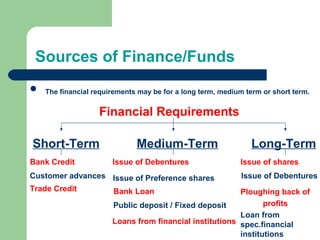
 The financial requirements may be for a long term, medium term or short term.
Financial Requirements
Short-Term Medium-Term Long-Term
Bank Credit
Customer advances
Trade Credit
Issue of Debentures
Issue of Preference shares
Bank Loan
Public deposit / Fixed deposit
Loans from financial institutions
Issue of shares
Issue of Debentures
Ploughing back of
profits
Loan from
spec.financial
institutions
Issue of shares
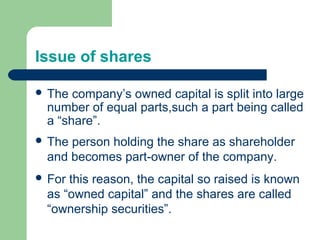
 The company’s owned capital is split into large
number of equal parts,such a part being called
a “share”.
 The person holding the share as shareholder
and becomes part-owner of the company.
 For this reason, the capital so raised is known
as “owned capital” and the shares are called
“ownership securities”.
Issue of shares
 The share capital of the company is ideal for
meeting the long term requirements.
 It need not be paid back to the shareholders
within the life time of the company.
 The only exception is the sum raised by the
issue of redeemable preference shares.
Types of shares
 A public company can issue two types of
share.
 Equity share
 Preference share
Equity share
 Equity share has number of special features
 The dividend on these shares are paid after the
dividend on preference share has been paid.
 The rate of dividend depends upon the amount
of profits available and the intention of
directors.
Equity share
 The Equity shareholders have the chance of
earning good dividends in times of prosperity
and run the risk of earning nothing in times of
adversity.
 The equity shareholders have a residual claim
on the company’s asset in case of liquidation.
 The company is controlled by the equity
shareholders and they are entitled to vote in
the meetings of the company.
Preference shares
 Preference shares are those which carry
preferential right over other class of shares
with regard to payment of dividend and
repayment of capital.
 The rate of dividend on preference share is a
fixed one.

Financialmanagement

  • 1.
  • 2.
    Definition of FinancialManagement – Managerial activities which deals with planning and controlling of firms and financial sources. – Financial management is an area of financial decision making, harmonsing individual motives and enterprise goals. - Weston Brigham
  • 3.
    Scope of financialmanagement  The scope and functions of financial management is classified in two categories. - Traditional approach - Modern approach
  • 4.
    Traditional approach  Accordingto this approach, the scope of the finance function is restricted to “procurement of funds by corporate enterprise to meet their financial needs.  The term ‘procurement’ refers to raising of funds externally as well as the inter related aspects of raising funds.
  • 5.
    Traditional approach  Theinter related aspects are the institutional arrangement for finance, financial instruments through which funds are raised and legal and accounting aspects between the firm and its sources of funds.  In traditional approach the resources could be raised from the combination of the available sources.
  • 6.
    Limitations of traditionalapproach  This approach is confirmed to ‘procurement of funds’ only.  It fails to consider an important aspects i.e. allocation of funds.  It deals with only outside I.e. investors, investment bankers.
  • 7.
    Limitations of traditionalapproach  The internal decision making is completely ignored in this approach.  The traditional approach fails to consider the problems involved in working capital management.  The traditional approach neglected the issues relating to the allocation and management of funds and failed to make financial decisions.
  • 8.
    Modern approach  Themodern approach is an analytical way of looking into financial problems of the firm.  According to this approach, the finance function covers both acquisition of funds as well as the allocation of funds to various uses.  Financial management is concerned with the issues involved in raising of funds and efficient and wise allocation of funds.
  • 9.
    Main Contents ofModern approach  How large should an enterprise be and how far it should grow?  In what form should it hold its assets?  How should the funds required be raised? - Financial management is concerned with finding answer to the above problems.
  • 10.
    Functions of Finance There are three finance functions  Investment decision  Financing decision  Dividend decision
  • 11.
    Investment Decision  Investmentdecision relates to selections of asset in which funds will be invested by a firm.  The asset that can be acquired by a firm may be long term asset and short term asset.
  • 12.
    Investment Decision  Decisionwith regard to long term assets is called capital budgeting.  Decision with regard to short term or current assets is called working capital management.
  • 13.
    Capital Budgeting  Capitalbudgeting relates to selection of an asset or investment proposal which would yield benefit in future. It involves three elements.  The measurement of the worth of the proposal
  • 14.
    Capital Budgeting  Evaluationof the investment proposal in terms of risk associated with it and  Evaluation of the worth of the investment proposal against certain norms or standard. The standard is broadly known as cost of capital
  • 15.
    Financing Decision  Determinationof the proportion of equity and dept is the main issue in financing decision.  Once the best combination of debt and equity is determined, the next step is raising appropriate amount through available sources.
  • 16.
    Working Capital Management Working capital management or current asset management is an important part of investment decision.  Proper management of working capital ensures firm’s liquidity and solvency.  A conflict exists between profitability and liquidity while managing current asset.
  • 17.
    Working Capital Management If a firm does not invest sufficient funds in current assets it may become illiquid and may not meet its current obligations.  The financial manager should develop proper techniques of managing current assets so that neither insufficient nor unnecessary funds are invested in current assets.  If the current asset are large, the firm would lose its profitability and liquidity.
  • 18.
    Management of WorkingCapital  The management of working capital has two aspects. - Efficient management of individual current asset such as cash, receivable and inventory. - Overview of working capital management and
  • 19.
    Financing Decision  Financingdecision is concerned with the financing mix or capital structure.  The mix of debt and equity is known as capital structure.
  • 20.
    Dividend Decision  Afirm distribute all profits or retain them or distribute a portion and retain the balance with it.  Which course should be allowed? The decision depends upon the preference of the shareholders and investment opportunities available to the firm.
  • 21.
    Dividend Decision  Dividenddecision has a strong influence on the market prize of the share.  So the dividend policy is to be determined in terms of its impact on shareholder’s value.  The optimum dividend policy is one which maximizes the value of shares and wealth of the shareholders.
  • 22.
    Dividend Decision  Thefinancial manager should determine the optimum pay out ratio I.e. the proportions of net profit to be paid out to the shareholders.  The above three decisions are inter related. To have an optimum financial decision the three should be taken jointly.
  • 23.
    Objectives of financialmanagement  The term ‘objective’ refers to a goal or decision for taking financial decisions.  Profit maximisation  Wealth maximisation
  • 24.
    Profit maximisation  Theterm profit maximisation is deep rooted in the economic theory.  It is need that when firms pursue the policy of maximising profits.  Society’s resources are efficiently utilised.
  • 25.
    Profit maximisation  Thefirm should undertake those actions that would profits and drop those actions that would decrease profit.  The financial decisions should be oriented to the maximisation of profits.  Profit provides the yardstick for measuring performance of firms.
  • 26.
    Profit maximisation  Itmakes allocation of resources to profitable and desirable areas.  It also ensures maximum social welfare.
  • 27.
    Wealth maximisation  Wealthmaximisation or net present value maximisation provides an appropriate and operationally feasible decision criterion for financial management decisions.
  • 28.
    Sources of Finance Capital required for a business can be classified under two main categories, viz., - Fixed Capital, and - Working Capital. - every business needs funds for two purposes. - for its establishment and to carry out its day-to- day operations.
  • 29.
    Sources of Finance Long term funds are required to create production facilities through purchase of fixed assets such as - plant, - machinery, - land, - building, - furniture, etc.
  • 30.
    Sources of Finance -Investment in these asset represent that part of firm’s capital which is blocked on permanent or fixed basis and is called fixed capital.  Funds are also needed for short-term purposes for the purchase of raw materials, payment of wages and other day to day expenses, etc. These funds are known as working capital.
  • 31.
    Sources of Finance/Funds In our present day economy, finance is defined as the provision of money at the time when it is required.  Every enterprise, whether big or medium or small, needs finance to carry on its operations and to achieve its targets.
  • 32.
    Sources of Finance/Funds In fact finance is so indispensable today that is rightly said that it is the life blood of enterprise.  With out adequate finance, no enterprise can possibly accomplish its objectives.  In every concern there are two methods of raising finance, viz., - Raising of owned capital, - Rising of borrowed capital
  • 33.
    Sources of Finance/Funds The financial requirements may be for a long term, medium term or short term. Financial Requirements Short-Term Medium-Term Long-Term Bank Credit Customer advances Trade Credit Issue of Debentures Issue of Preference shares Bank Loan Public deposit / Fixed deposit Loans from financial institutions Issue of shares Issue of Debentures Ploughing back of profits Loan from spec.financial institutions
  • 34.
    Issue of shares The company’s owned capital is split into large number of equal parts,such a part being called a “share”.  The person holding the share as shareholder and becomes part-owner of the company.  For this reason, the capital so raised is known as “owned capital” and the shares are called “ownership securities”.
  • 35.
    Issue of shares The share capital of the company is ideal for meeting the long term requirements.  It need not be paid back to the shareholders within the life time of the company.  The only exception is the sum raised by the issue of redeemable preference shares.
  • 36.
    Types of shares A public company can issue two types of share.  Equity share  Preference share
  • 37.
    Equity share  Equityshare has number of special features  The dividend on these shares are paid after the dividend on preference share has been paid.  The rate of dividend depends upon the amount of profits available and the intention of directors.
  • 38.
    Equity share  TheEquity shareholders have the chance of earning good dividends in times of prosperity and run the risk of earning nothing in times of adversity.  The equity shareholders have a residual claim on the company’s asset in case of liquidation.  The company is controlled by the equity shareholders and they are entitled to vote in the meetings of the company.
  • 39.
    Preference shares  Preferenceshares are those which carry preferential right over other class of shares with regard to payment of dividend and repayment of capital.  The rate of dividend on preference share is a fixed one.