1
PRESENTATION ON
BLADELESS WIND ENERGY
GUIDED BY
Mr. VIKAS PATEL
Department Of
Electrical Engineering
PRESENTED BY
ASHISH KUMAR SAROJ
Roll No.-1673720017
3rd YEAR
ELECTRICAL ENGINEERING
RAJKIYA ENGINEERING COLLEGE
AMBEDKAR NAGAR
2018-19
2
DISCUSSION OUTLINE
➢ Introduction
➢ Vortex Shedding
➢ Definition of Vortex Bladeless
➢ How Vortex Bladeless works
➢ Design of Vortex Bladeless
➢ Why is it Better
➢ Conclusion
➢ Reference
3
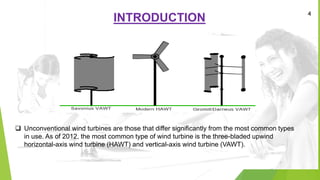
❑ Unconventional wind turbines are those that differ significantly from the most common types
in use. As of 2012, the most common type of wind turbine is the three-bladed upwind
horizontal-axis wind turbine (HAWT) and vertical-axis wind turbine (VAWT).
INTRODUCTION 4
❑ The wide variety of designs reflects
ongoing commercial, technological,
and inventive interests in harvesting
wind resources.
❑ A more efficient, cost-effective, and
environmentally friendly way to
produce energy called Vortex
Bladeless which works on the
Principle of Vortex Shedding.
5
Vortex Shedding
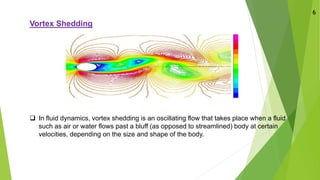
❑ In fluid dynamics, vortex shedding is an oscillating flow that takes place when a fluid
such as air or water flows past a bluff (as opposed to streamlined) body at certain
velocities, depending on the size and shape of the body.
6
What is Vortex Bladeless ?
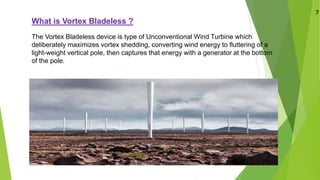
The Vortex Bladeless device is type of Unconventional Wind Turbine which
deliberately maximizes vortex shedding, converting wind energy to fluttering of a
light-weight vertical pole, then captures that energy with a generator at the bottom
of the pole.
7
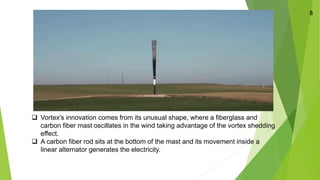
❑ Vortex's innovation comes from its unusual shape, where a fiberglass and
carbon fiber mast oscillates in the wind taking advantage of the vortex shedding
effect.
❑ A carbon fiber rod sits at the bottom of the mast and its movement inside a
linear alternator generates the electricity.
8
Working Principle
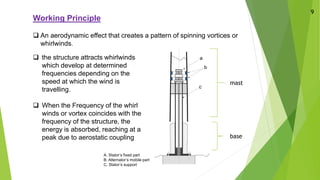
❑ An aerodynamic effect that creates a pattern of spinning vortices or
whirlwinds.
❑ the structure attracts whirlwinds
which develop at determined
frequencies depending on the
speed at which the wind is
travelling.
❑ When the Frequency of the whirl
winds or vortex coincides with the
frequency of the structure, the
energy is absorbed, reaching at a
peak due to aerostatic coupling
9
mast
base
A. Stator’s fixed part
B. Alternator’s mobile part
C. Stator’s support
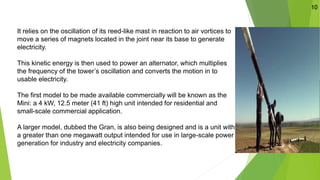
It relies on the oscillation of its reed-like mast in reaction to air vortices to
move a series of magnets located in the joint near its base to generate
electricity.
This kinetic energy is then used to power an alternator, which multiplies
the frequency of the tower’s oscillation and converts the motion in to
usable electricity.
The first model to be made available commercially will be known as the
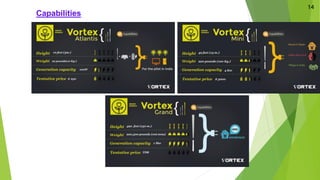
Mini: a 4 kW, 12.5 meter (41 ft) high unit intended for residential and
small-scale commercial application.
A larger model, dubbed the Gran, is also being designed and is a unit with
a greater than one megawatt output intended for use in large-scale power
generation for industry and electricity companies.
10
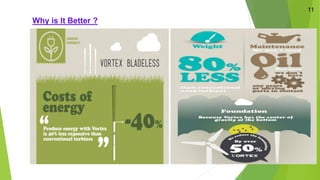
Why is It Better ?
11
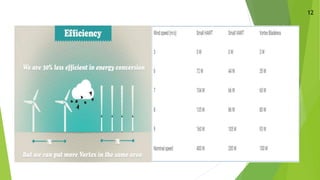
12
Capabilities
14
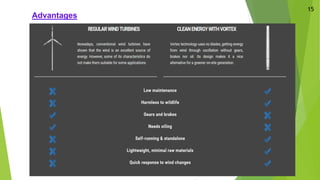
Advantages
15
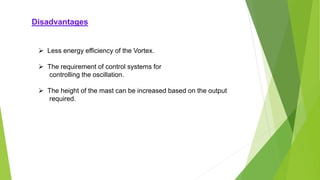
Disadvantages
➢ Less energy efficiency of the Vortex.
➢ The requirement of control systems for
controlling the oscillation.
➢ The height of the mast can be increased based on the output
required.
Meet The Team
16
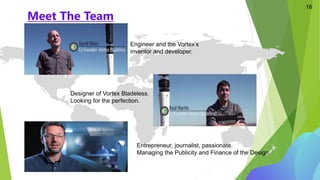
Designer of Vortex Bladeless.
Looking for the perfection.
Engineer and the Vortex’s
inventor and developer.
Entrepreneur, journalist, passionate.
Managing the Publicity and Finance of the Design.
Conclusion
➢ When it comes to clean energy, wind power is considered one of the most
reliable and sustainable alternatives.
➢ And thanks to the combination of improved technology and diminishing prices,
its adoption has increased in recent years.
➢ Innovations like these, are what is leading to a revolution in wind power, and
some very optimistic appraisals for its adoption.
➢ In 2014, the Department of Energy estimated that by 2050, wind power could
account for as such as 35% of the US' electrical production.
➢ An even more optimistic appraisal came from the Global Wind Energy Council
and Greenpeace International.
➢ Together, they released a report in 2014 that stated how wind power could
account for as much as 25 to 30% of global electricity demands by 2050.
➢ SO , If we look at the future of Vortex Bladeless I looks Dawn Bright.
17
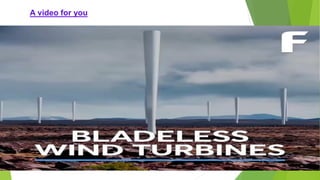
A video for you
Bibliography
[1] K. Y. Bilhah, and R.H. Scanlan, “Resonance, Tacoma Narrows bridge failure, and undergraduate
physics textbooks”, Amer. J. Phys. 59, 1991, pages 118-124.
[2] C. C. Feng, “The measurement of vortex induced effects in a flow past stationary and oscillating
circular and D-section cylinders”
MSc thesis, University British Columbia, Vancouver, 1968.
[3] D. A. Spear and T. R. Richards. “Modified power law equations for vertical wind profiles”, NASA
Lewis Research Center, 1979.
[4] A. Betz. “Das Maximum der theoretisch moglichen Ausnutzung des Windes durch Windmotoren”
Zeitschrift fur das gesamte Turbulences, 1920, pages 307–309.
[5] D. J. Yanez “An electrical power generator and an electrical generator method”, Patent W PCT/
EP2015/072802, 2015.
[6] R. Bourget, G. E. Karnataka's, M. S. Triantafyllou. “Lock-in of the vortex-induced vibrations of a
long tensioned beam in shear flow”, Journal of Fluids and Structures, 2011, vol. 27, pages. 838-847.
7. http://www.vortexbladeless.com
8. https://en.wikipedia.org/wiki/Unconventional_wind_turbines
18
Thank You…..
19

Vortex bladeless wind generator ppt

  • 1.
  • 2.
    PRESENTATION ON BLADELESS WINDENERGY GUIDED BY Mr. VIKAS PATEL Department Of Electrical Engineering PRESENTED BY ASHISH KUMAR SAROJ Roll No.-1673720017 3rd YEAR ELECTRICAL ENGINEERING RAJKIYA ENGINEERING COLLEGE AMBEDKAR NAGAR 2018-19 2
  • 3.
    DISCUSSION OUTLINE ➢ Introduction ➢Vortex Shedding ➢ Definition of Vortex Bladeless ➢ How Vortex Bladeless works ➢ Design of Vortex Bladeless ➢ Why is it Better ➢ Conclusion ➢ Reference 3
  • 4.
    ❑ Unconventional windturbines are those that differ significantly from the most common types in use. As of 2012, the most common type of wind turbine is the three-bladed upwind horizontal-axis wind turbine (HAWT) and vertical-axis wind turbine (VAWT). INTRODUCTION 4
  • 5.
    ❑ The widevariety of designs reflects ongoing commercial, technological, and inventive interests in harvesting wind resources. ❑ A more efficient, cost-effective, and environmentally friendly way to produce energy called Vortex Bladeless which works on the Principle of Vortex Shedding. 5
  • 6.
    Vortex Shedding ❑ Influid dynamics, vortex shedding is an oscillating flow that takes place when a fluid such as air or water flows past a bluff (as opposed to streamlined) body at certain velocities, depending on the size and shape of the body. 6
  • 7.
    What is VortexBladeless ? The Vortex Bladeless device is type of Unconventional Wind Turbine which deliberately maximizes vortex shedding, converting wind energy to fluttering of a light-weight vertical pole, then captures that energy with a generator at the bottom of the pole. 7
  • 8.
    ❑ Vortex's innovationcomes from its unusual shape, where a fiberglass and carbon fiber mast oscillates in the wind taking advantage of the vortex shedding effect. ❑ A carbon fiber rod sits at the bottom of the mast and its movement inside a linear alternator generates the electricity. 8
  • 9.
    Working Principle ❑ Anaerodynamic effect that creates a pattern of spinning vortices or whirlwinds. ❑ the structure attracts whirlwinds which develop at determined frequencies depending on the speed at which the wind is travelling. ❑ When the Frequency of the whirl winds or vortex coincides with the frequency of the structure, the energy is absorbed, reaching at a peak due to aerostatic coupling 9 mast base A. Stator’s fixed part B. Alternator’s mobile part C. Stator’s support
  • 10.
    It relies onthe oscillation of its reed-like mast in reaction to air vortices to move a series of magnets located in the joint near its base to generate electricity. This kinetic energy is then used to power an alternator, which multiplies the frequency of the tower’s oscillation and converts the motion in to usable electricity. The first model to be made available commercially will be known as the Mini: a 4 kW, 12.5 meter (41 ft) high unit intended for residential and small-scale commercial application. A larger model, dubbed the Gran, is also being designed and is a unit with a greater than one megawatt output intended for use in large-scale power generation for industry and electricity companies. 10
  • 11.
    Why is ItBetter ? 11
  • 12.
  • 13.
  • 14.
  • 15.
    Disadvantages ➢ Less energyefficiency of the Vortex. ➢ The requirement of control systems for controlling the oscillation. ➢ The height of the mast can be increased based on the output required.
  • 16.
    Meet The Team 16 Designerof Vortex Bladeless. Looking for the perfection. Engineer and the Vortex’s inventor and developer. Entrepreneur, journalist, passionate. Managing the Publicity and Finance of the Design.
  • 17.
    Conclusion ➢ When itcomes to clean energy, wind power is considered one of the most reliable and sustainable alternatives. ➢ And thanks to the combination of improved technology and diminishing prices, its adoption has increased in recent years. ➢ Innovations like these, are what is leading to a revolution in wind power, and some very optimistic appraisals for its adoption. ➢ In 2014, the Department of Energy estimated that by 2050, wind power could account for as such as 35% of the US' electrical production. ➢ An even more optimistic appraisal came from the Global Wind Energy Council and Greenpeace International. ➢ Together, they released a report in 2014 that stated how wind power could account for as much as 25 to 30% of global electricity demands by 2050. ➢ SO , If we look at the future of Vortex Bladeless I looks Dawn Bright. 17
  • 18.
  • 19.
    Bibliography [1] K. Y.Bilhah, and R.H. Scanlan, “Resonance, Tacoma Narrows bridge failure, and undergraduate physics textbooks”, Amer. J. Phys. 59, 1991, pages 118-124. [2] C. C. Feng, “The measurement of vortex induced effects in a flow past stationary and oscillating circular and D-section cylinders” MSc thesis, University British Columbia, Vancouver, 1968. [3] D. A. Spear and T. R. Richards. “Modified power law equations for vertical wind profiles”, NASA Lewis Research Center, 1979. [4] A. Betz. “Das Maximum der theoretisch moglichen Ausnutzung des Windes durch Windmotoren” Zeitschrift fur das gesamte Turbulences, 1920, pages 307–309. [5] D. J. Yanez “An electrical power generator and an electrical generator method”, Patent W PCT/ EP2015/072802, 2015. [6] R. Bourget, G. E. Karnataka's, M. S. Triantafyllou. “Lock-in of the vortex-induced vibrations of a long tensioned beam in shear flow”, Journal of Fluids and Structures, 2011, vol. 27, pages. 838-847. 7. http://www.vortexbladeless.com 8. https://en.wikipedia.org/wiki/Unconventional_wind_turbines 18
  • 20.