TRUSS FINAL
PROJECT
Group 3: Arman Yosal, Josia Tannos,
Maya Goldman, Savannah Brooks
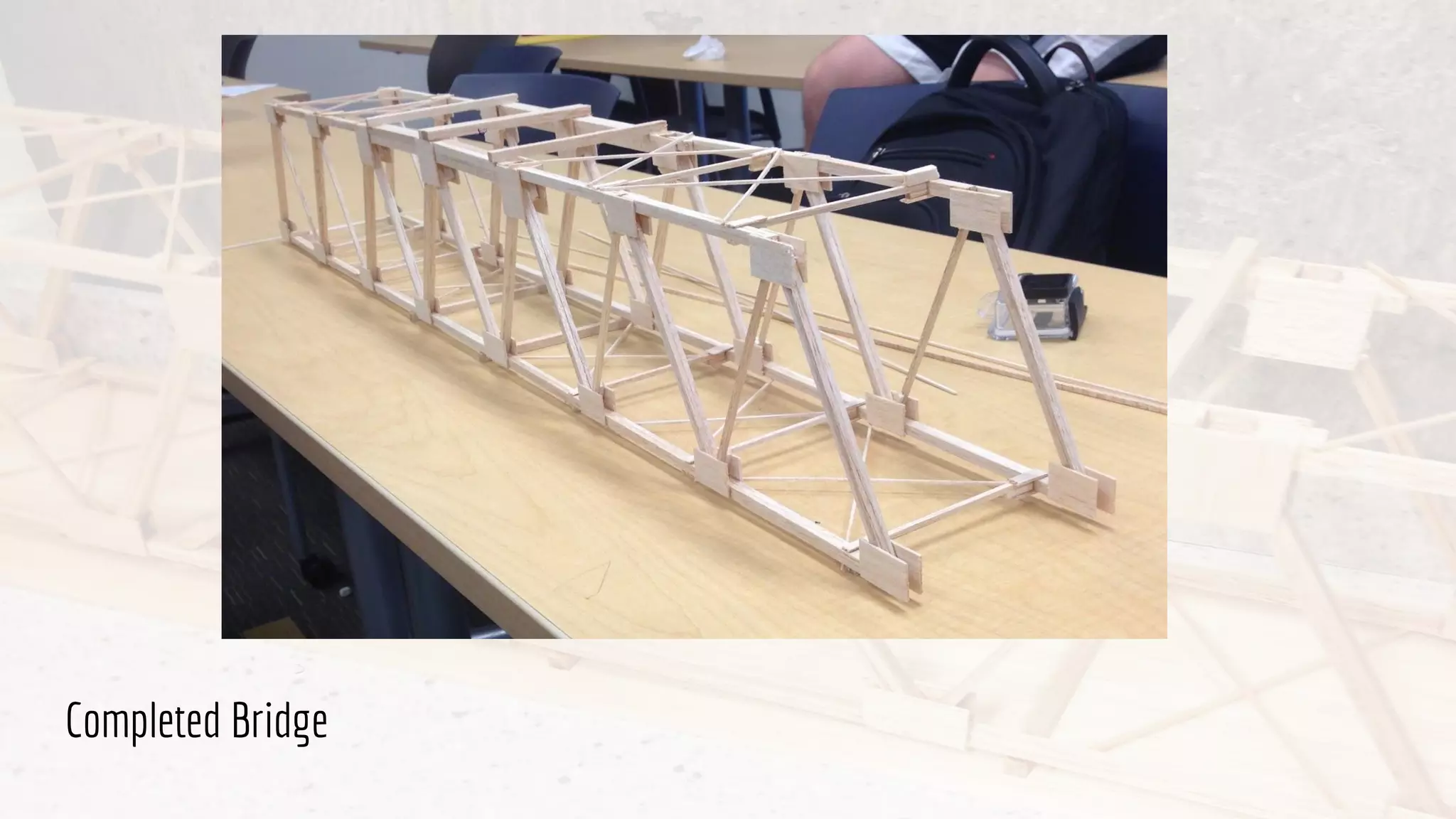
Completed Bridge
Introduction
-Concept
-Design Methods
-Construction Techniques
-Testing and Performance
-Post Test Evaluation
-Conclusion
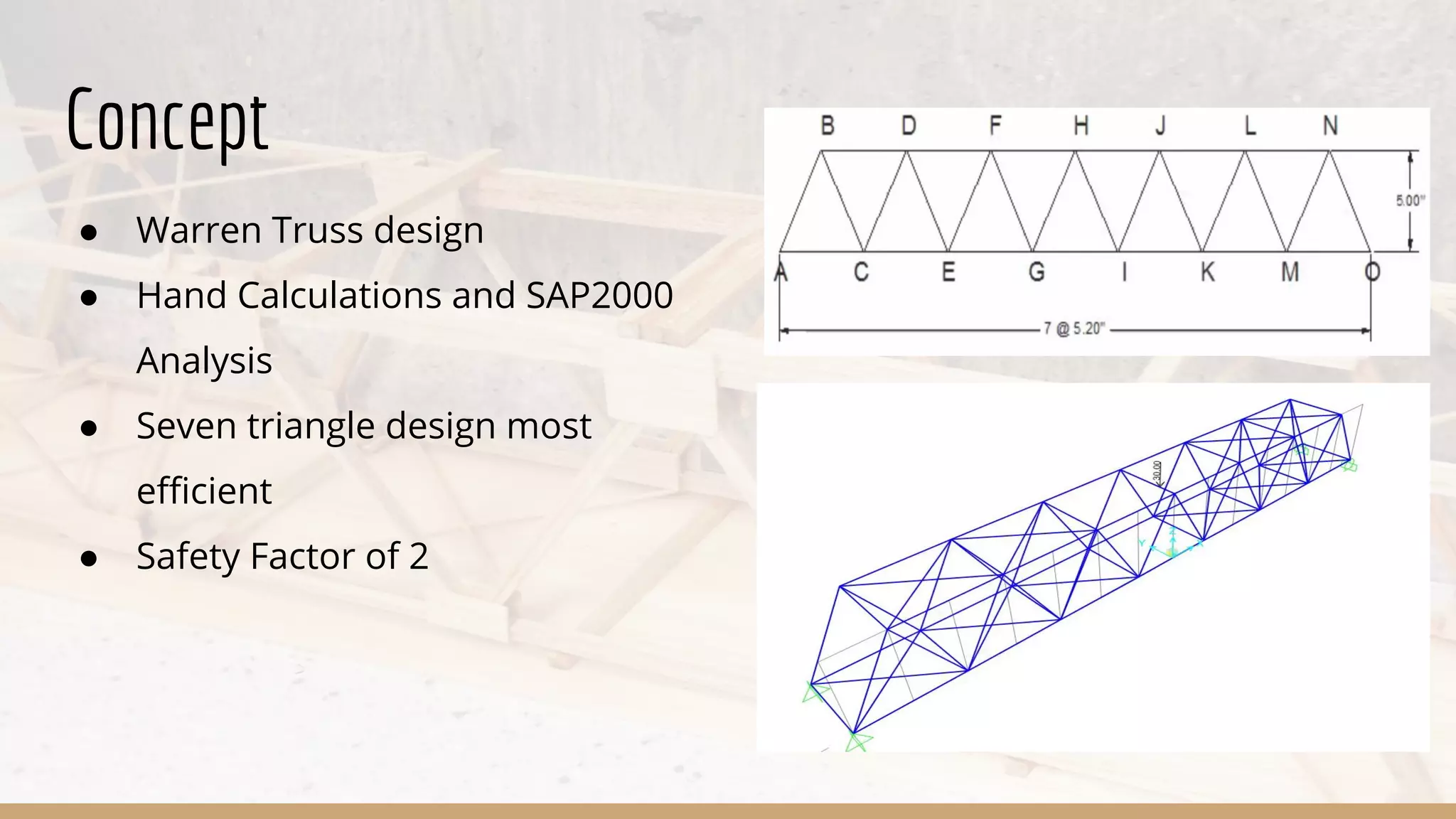
Concept
● Warren Truss design
● Hand Calculations and SAP2000
Analysis
● Seven triangle design most
efficient
● Safety Factor of 2
Design Methods
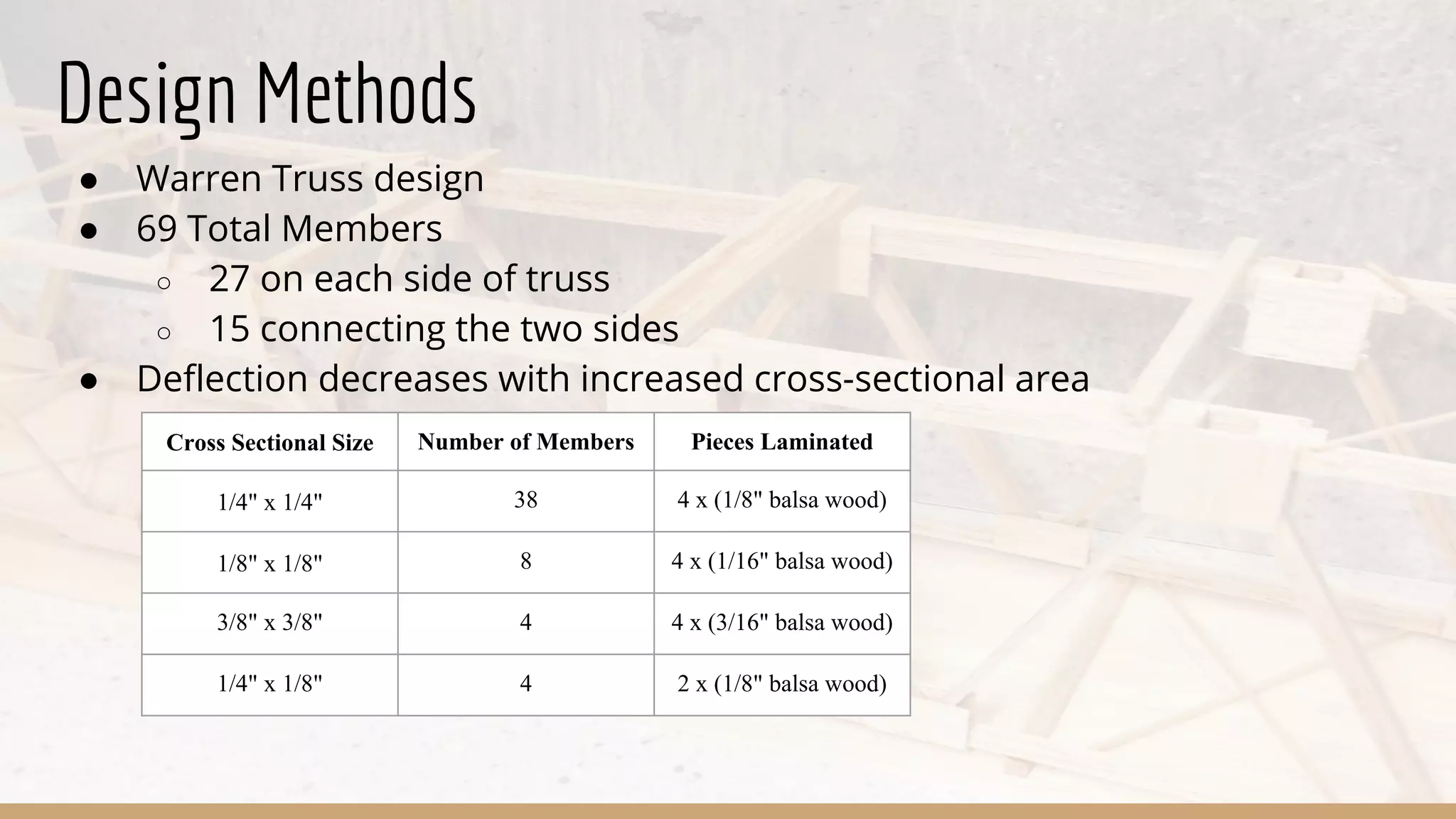
● Warren Truss design
● 69 Total Members
○ 27 on each side of truss
○ 15 connecting the two sides
● Deflection decreases with increased cross-sectional area
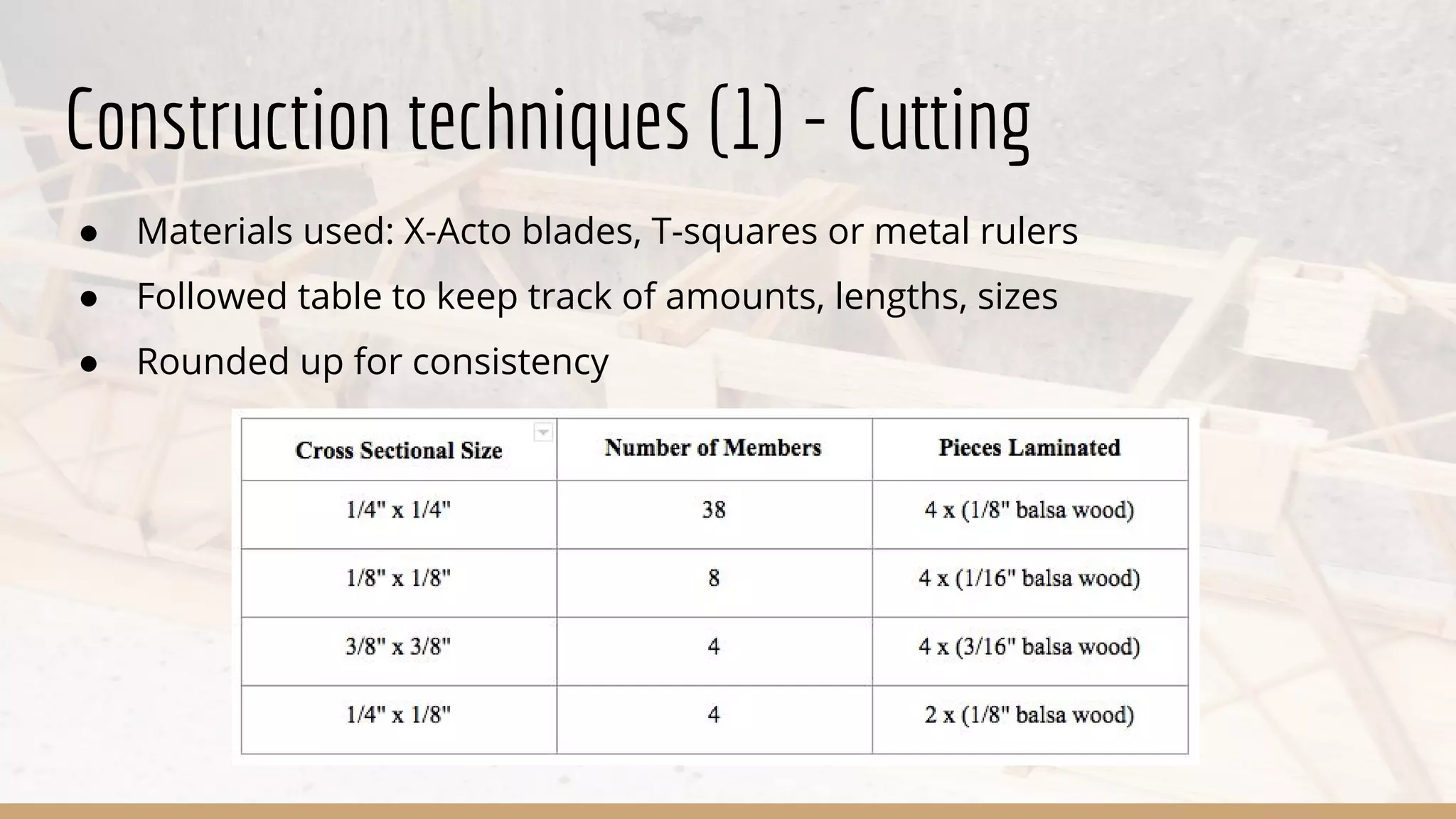
Cross Sectional Size Number of Members Pieces Laminated
1/4" x 1/4" 38 4 x (1/8" balsa wood)
1/8" x 1/8" 8 4 x (1/16" balsa wood)
3/8" x 3/8" 4 4 x (3/16" balsa wood)
1/4" x 1/8" 4 2 x (1/8" balsa wood)
Construction techniques (1) - Cutting
● Materials used: X-Acto blades, T-squares or metal rulers
● Followed table to keep track of amounts, lengths, sizes
● Rounded up for consistency
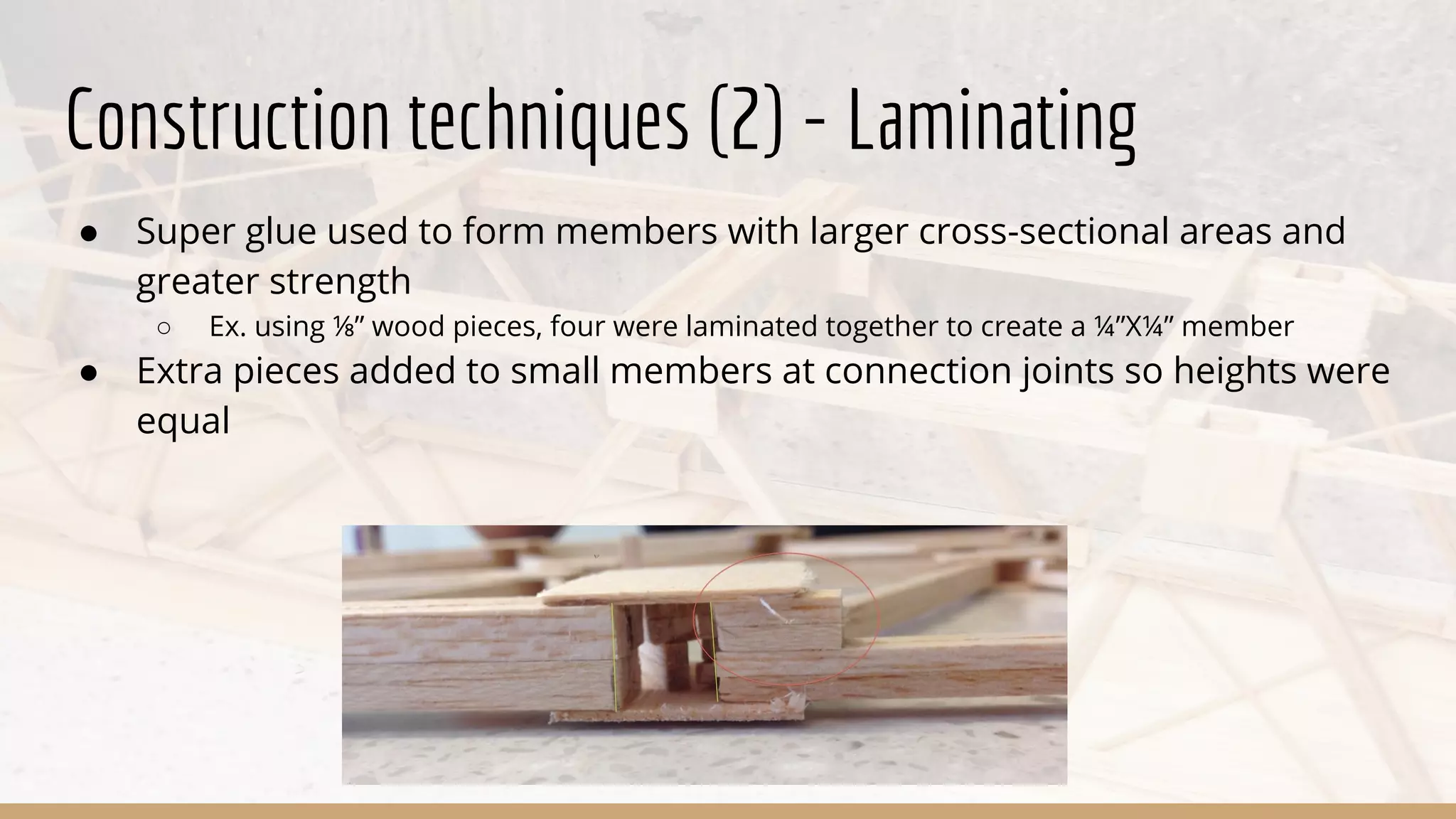
Construction techniques (2) - Laminating
● Super glue used to form members with larger cross-sectional areas and
greater strength
○ Ex. using ⅛” wood pieces, four were laminated together to create a ¼”X¼” member
● Extra pieces added to small members at connection joints so heights were
equal
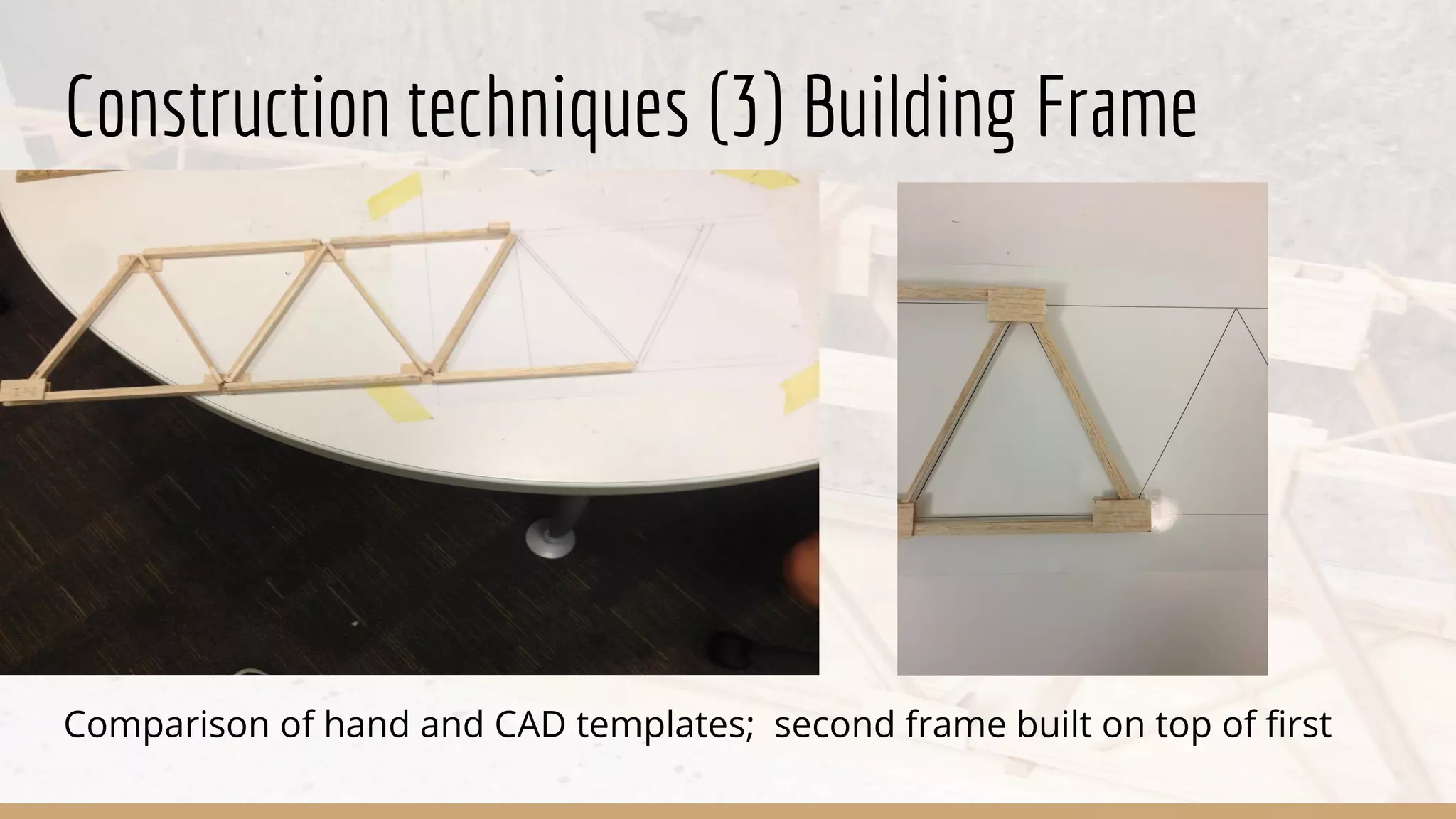
Construction techniques (3) Building Frame
Comparison of hand and CAD templates; second frame built on top of first
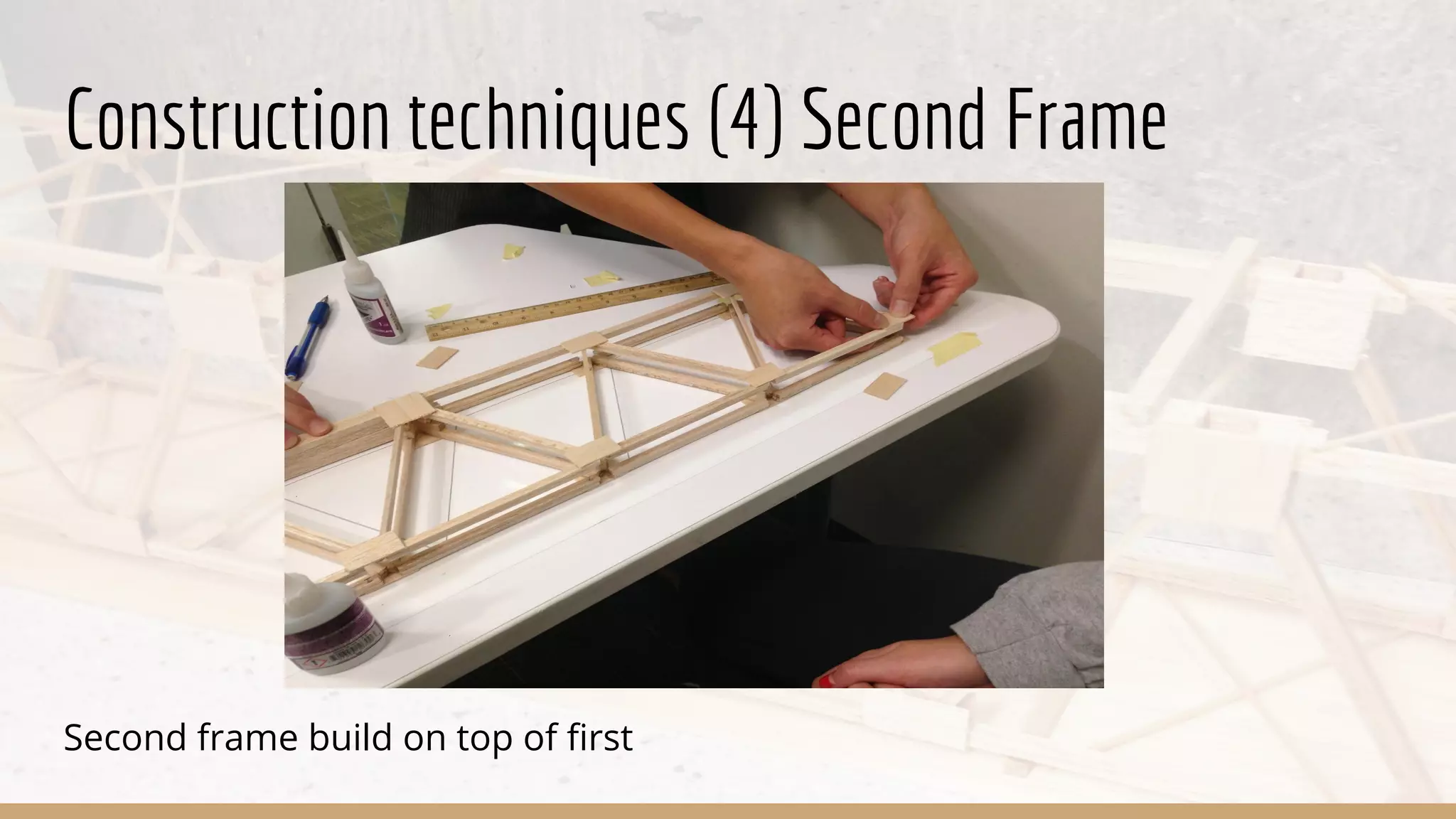
Construction techniques (4) Second Frame
Second frame build on top of first
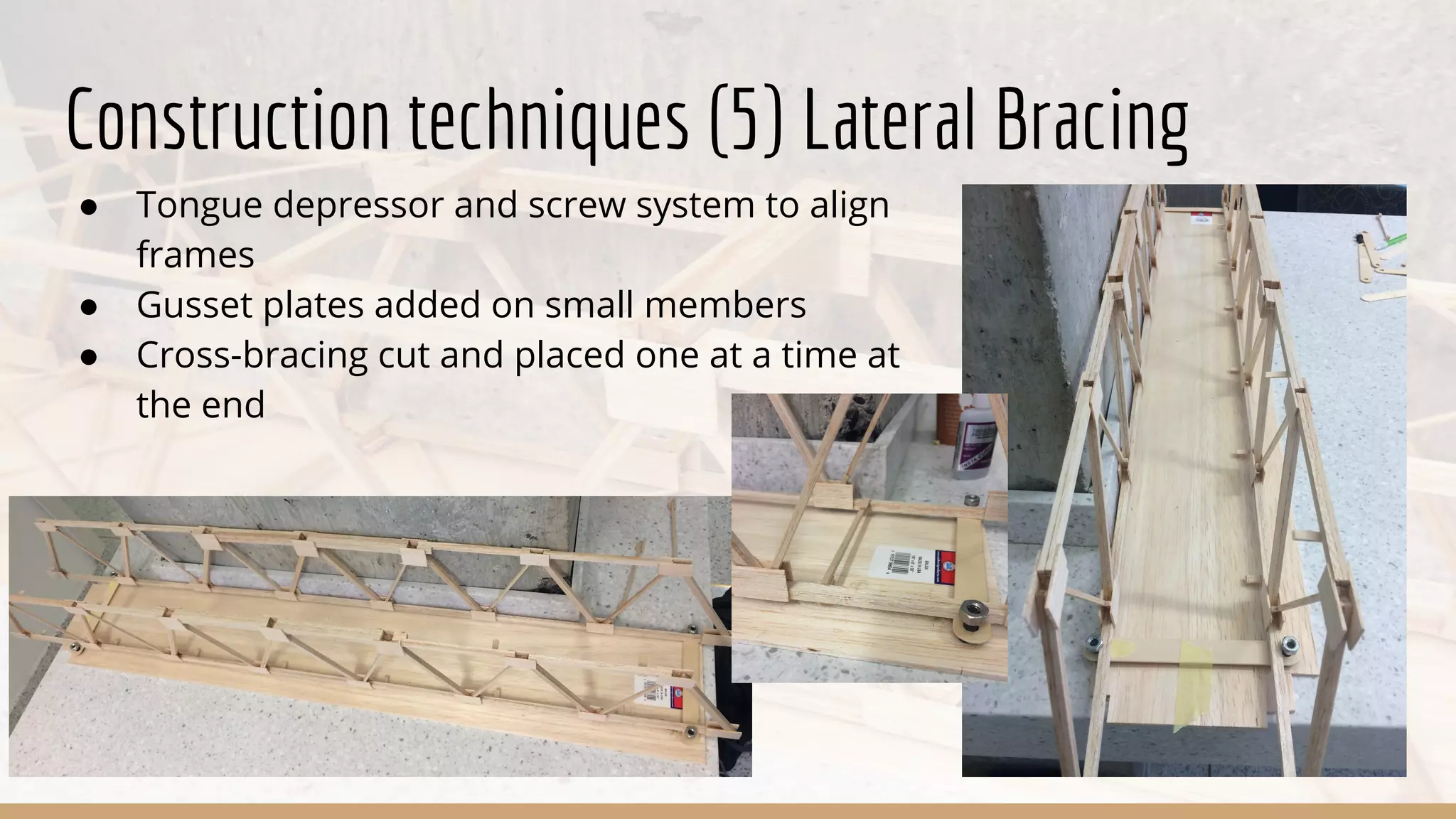
Construction techniques (5) Lateral Bracing
● Tongue depressor and screw system to align
frames
● Gusset plates added on small members
● Cross-bracing cut and placed one at a time at
the end
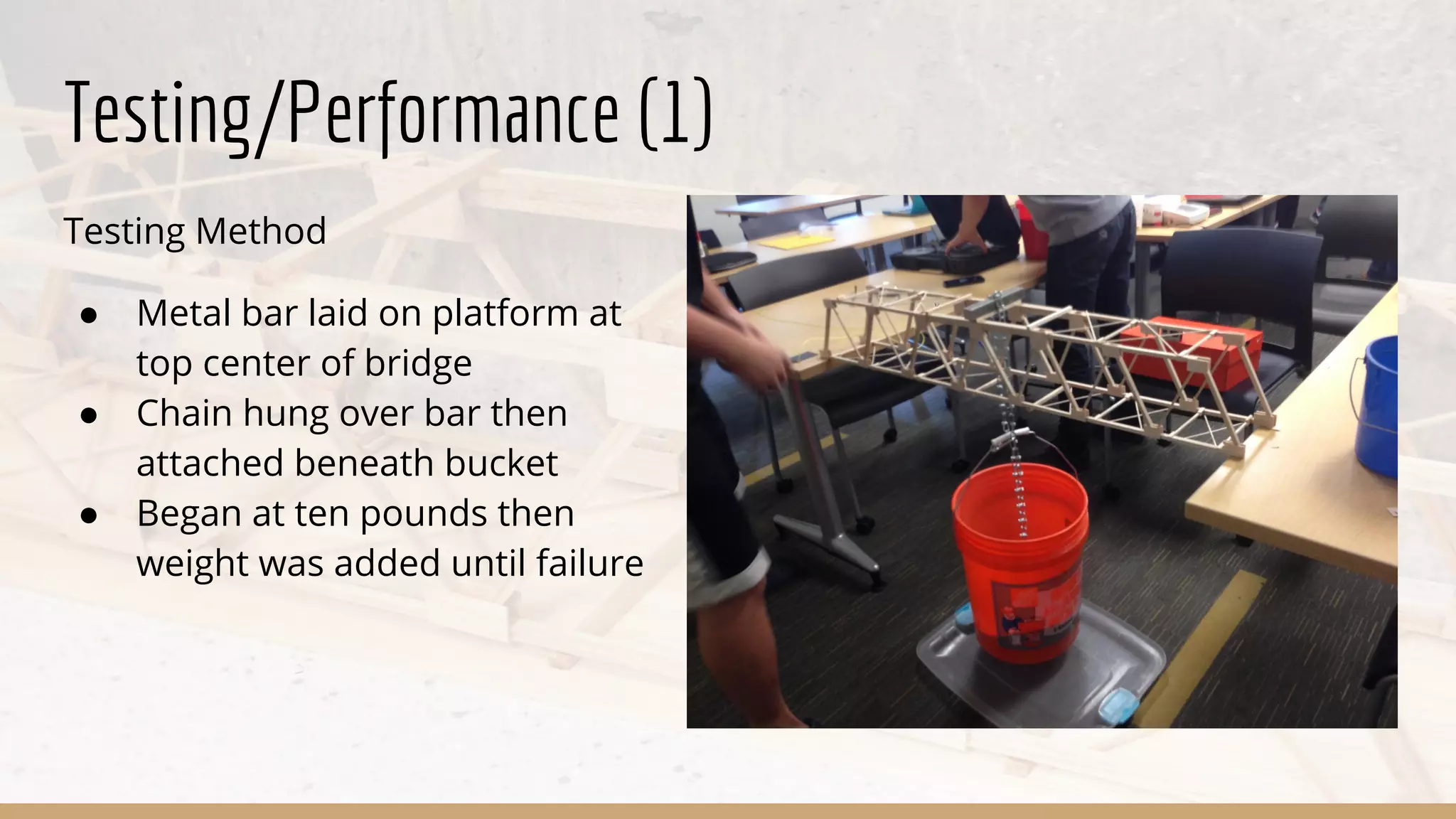
Testing/Performance (1)
Testing Method
● Metal bar laid on platform at
top center of bridge
● Chain hung over bar then
attached beneath bucket
● Began at ten pounds then
weight was added until failure
Testing/Performance (2)
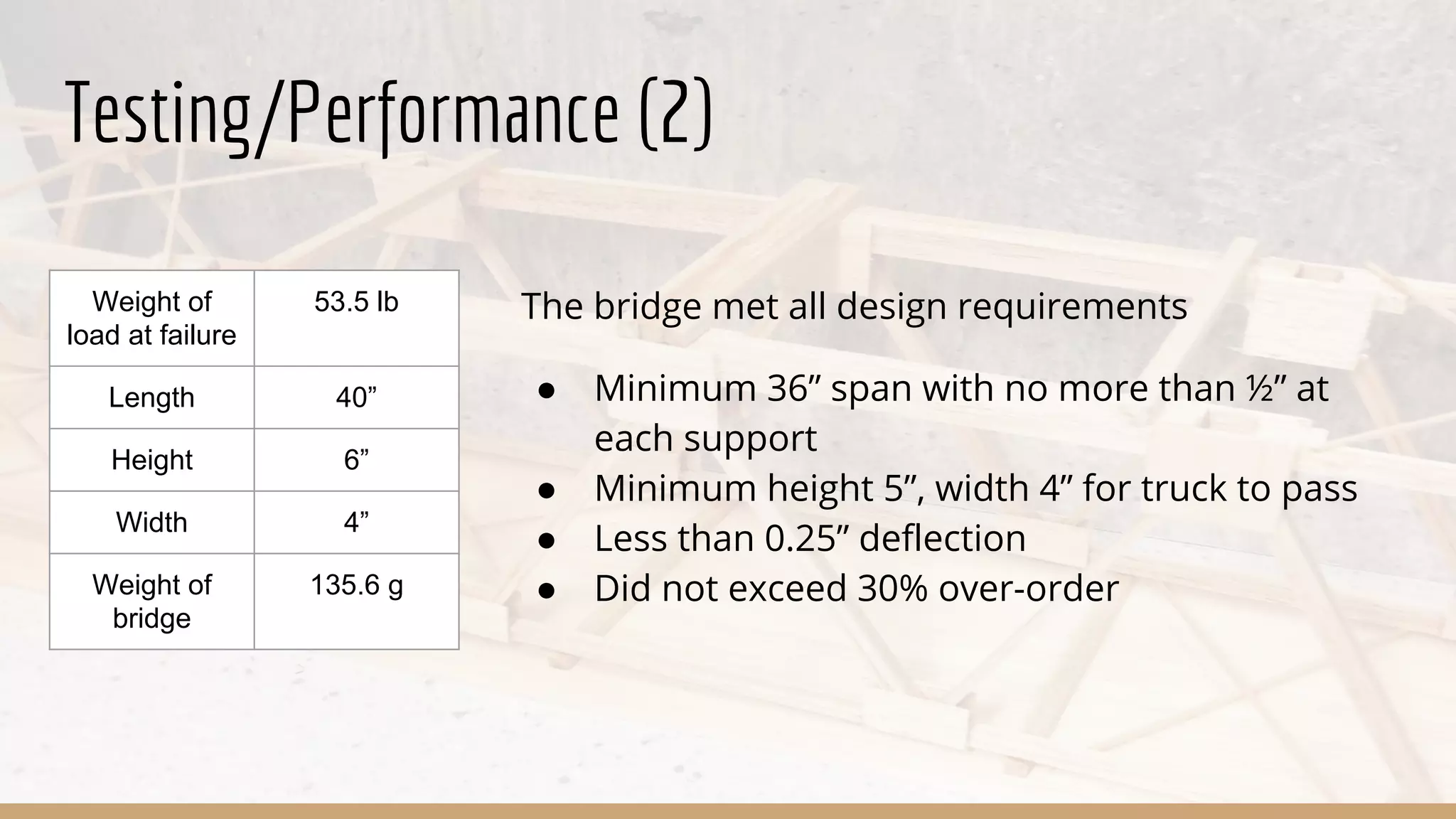
The bridge met all design requirements
● Minimum 36” span with no more than ½” at
each support
● Minimum height 5”, width 4” for truck to pass
● Less than 0.25” deflection
● Did not exceed 30% over-order
Weight of
load at failure
53.5 lb
Length 40”
Height 6”
Width 4”
Weight of
bridge
135.6 g
Testing/Performance (3)
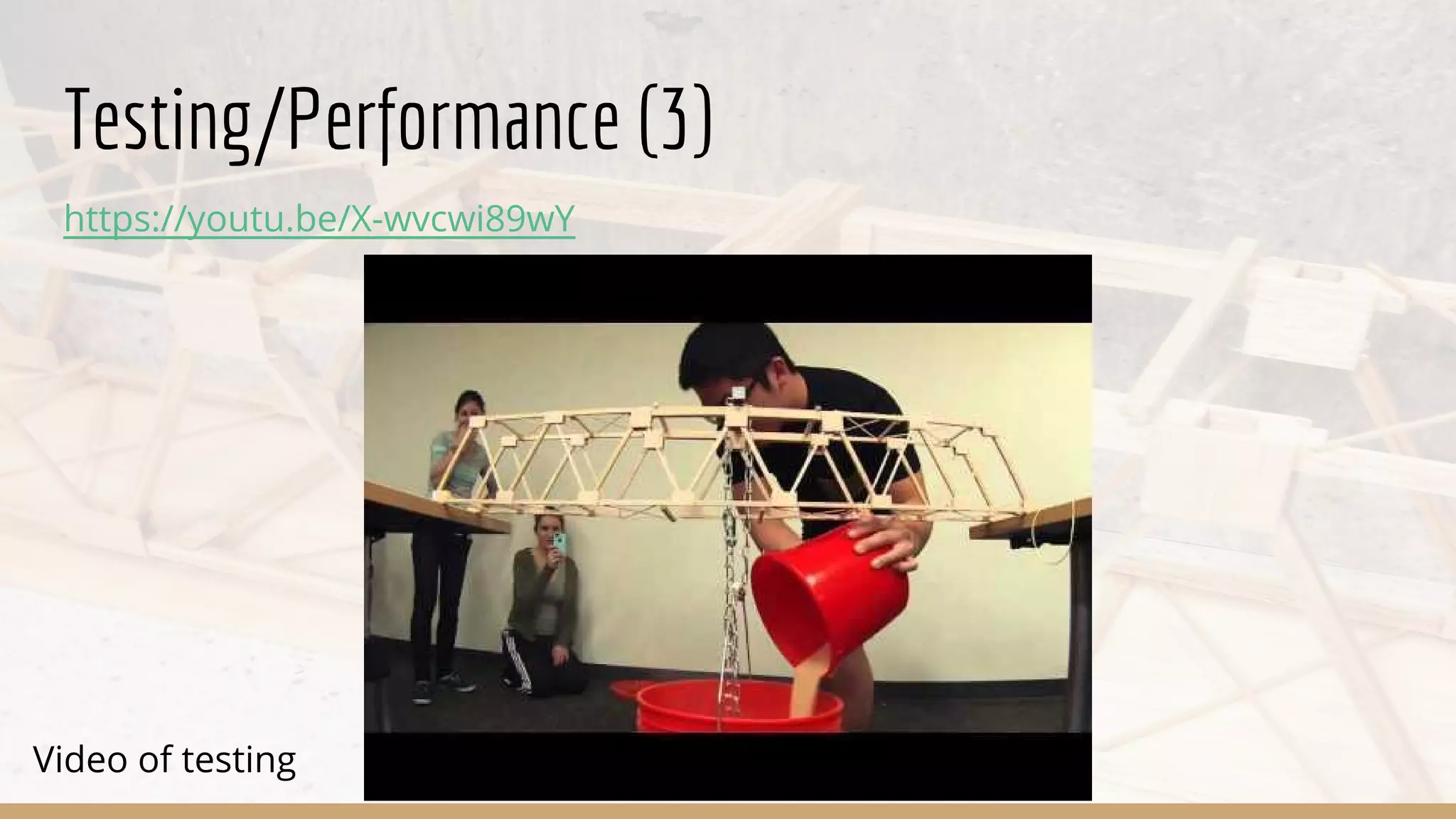
https://youtu.be/X-wvcwi89wY
Video of testing
Post Test Evaluation (1)
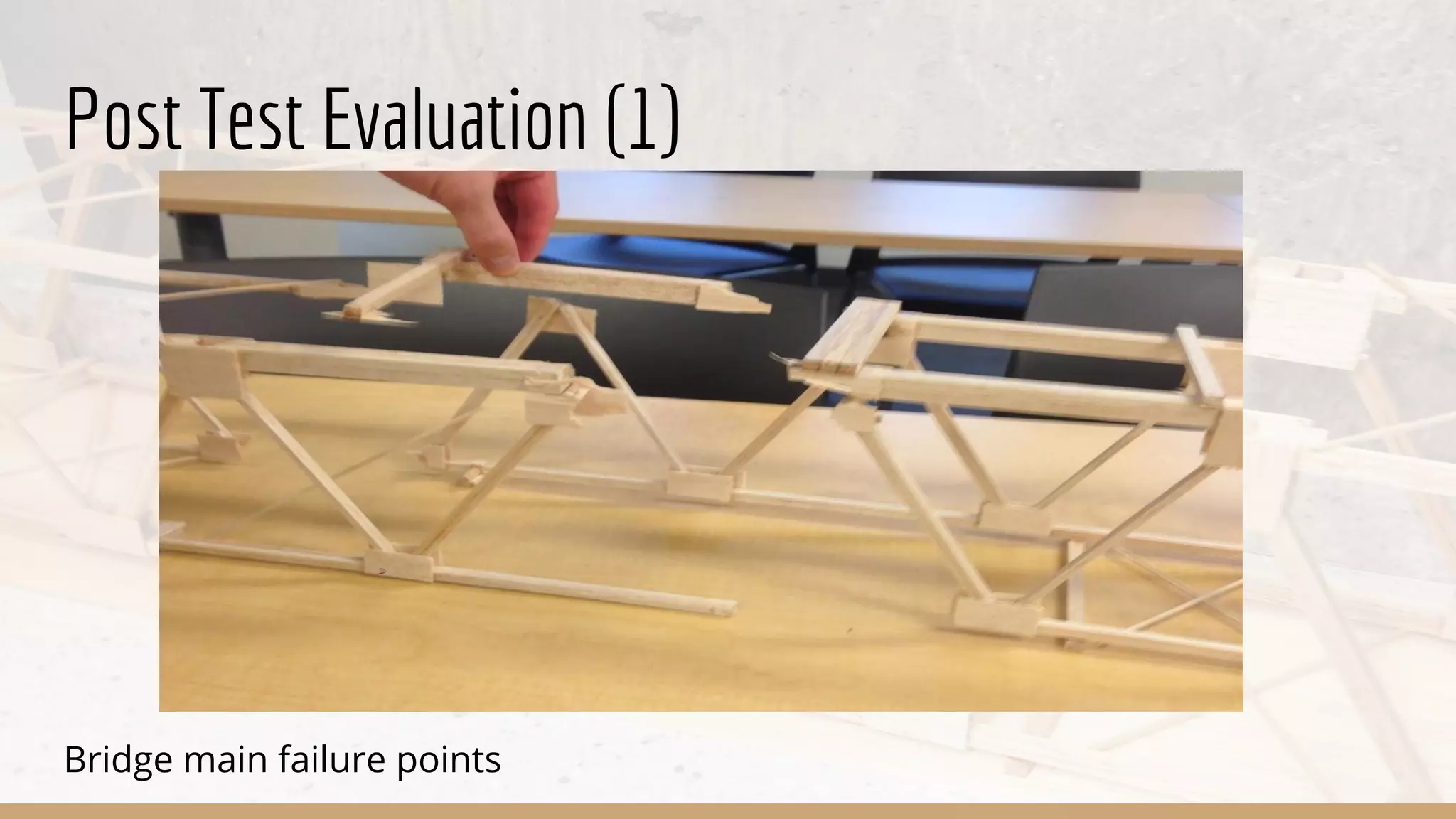
Bridge main failure points
Post Test Evaluation (2)
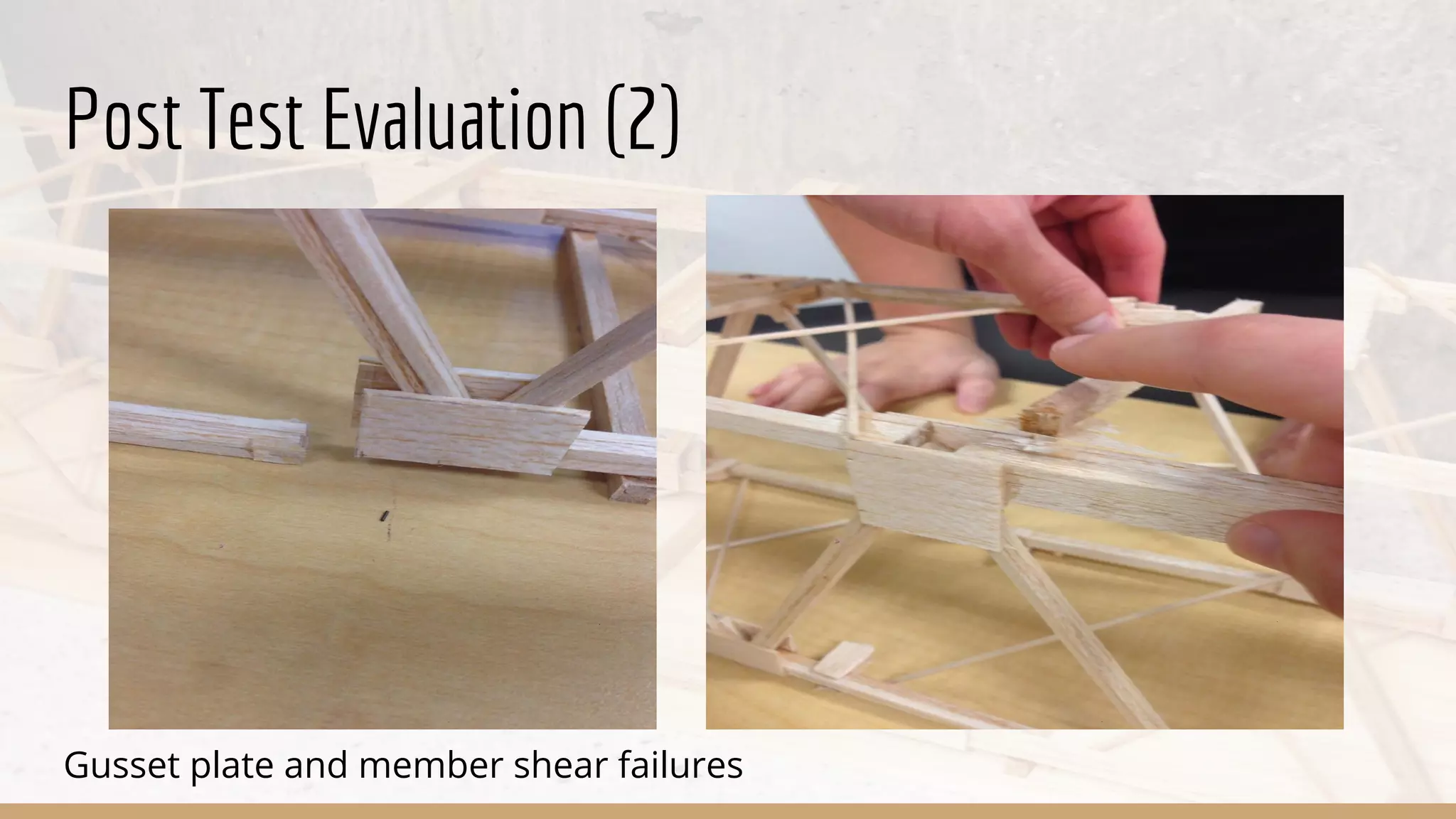
Gusset plate and member shear failures
Post Test Evaluation (3)
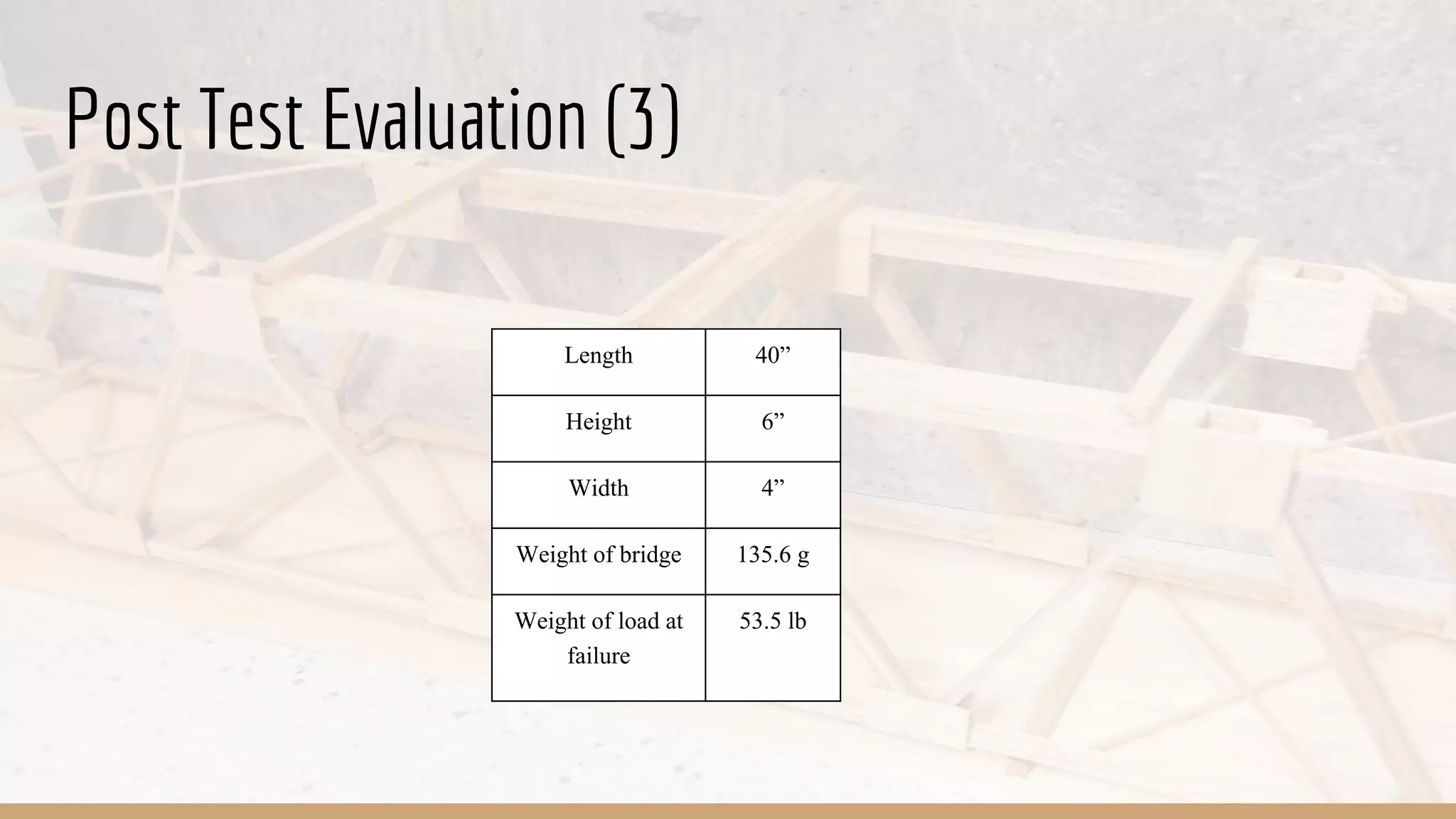
Length 40”
Height 6”
Width 4”
Weight of bridge 135.6 g
Weight of load at
failure
53.5 lb
Post Test Evaluation (4)
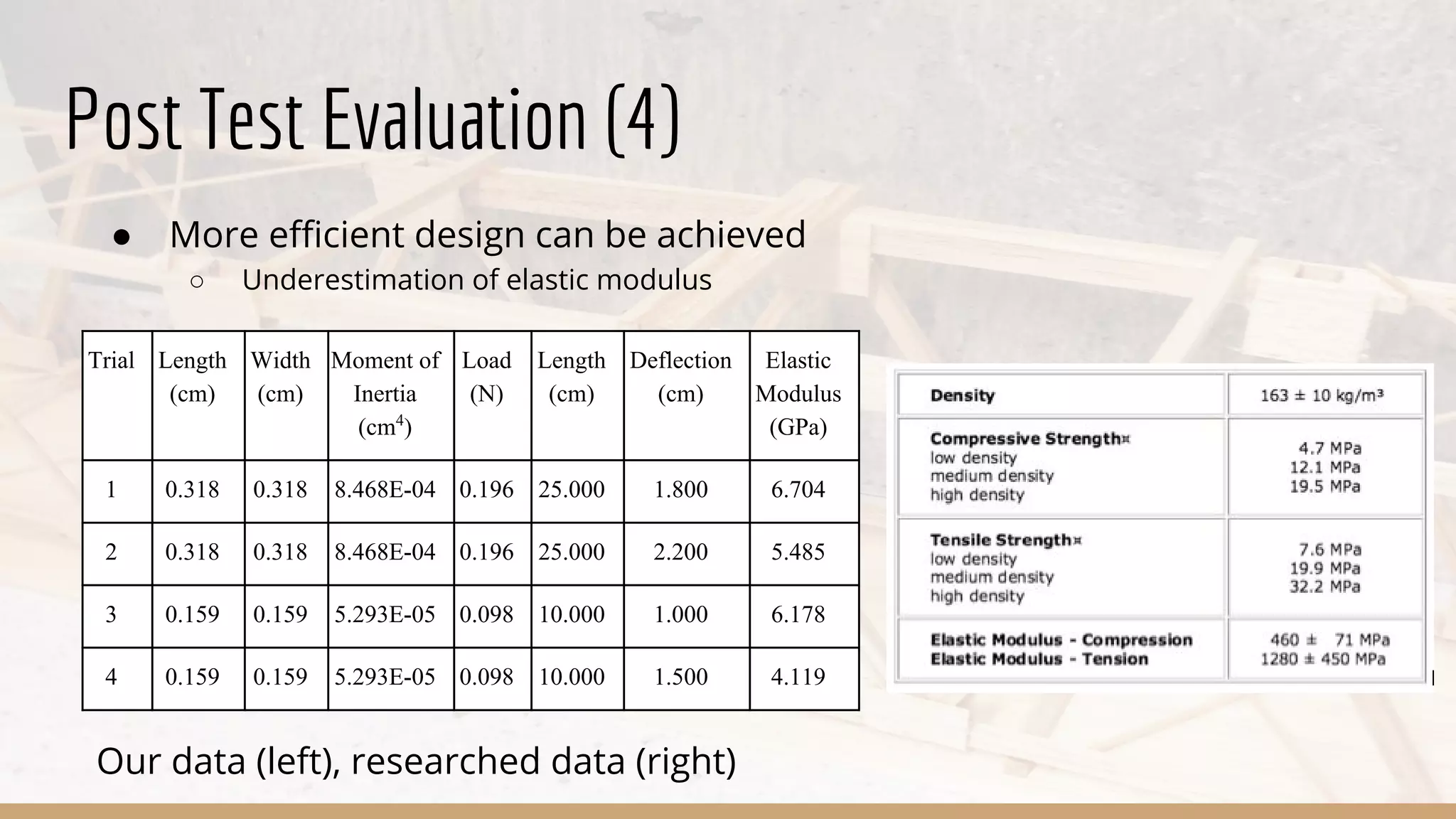
● More efficient design can be achieved
○ Underestimation of elastic modulus
Trial Length
(cm)
Width
(cm)
Moment of
Inertia
(cm4
)
Load
(N)
Length
(cm)
Deflection
(cm)
Elastic
Modulus
(GPa)
1 0.318 0.318 8.468E-04 0.196 25.000 1.800 6.704
2 0.318 0.318 8.468E-04 0.196 25.000 2.200 5.485
3 0.159 0.159 5.293E-05 0.098 10.000 1.000 6.178
4 0.159 0.159 5.293E-05 0.098 10.000 1.500 4.119
Our data (left), researched data (right)
Conclusions
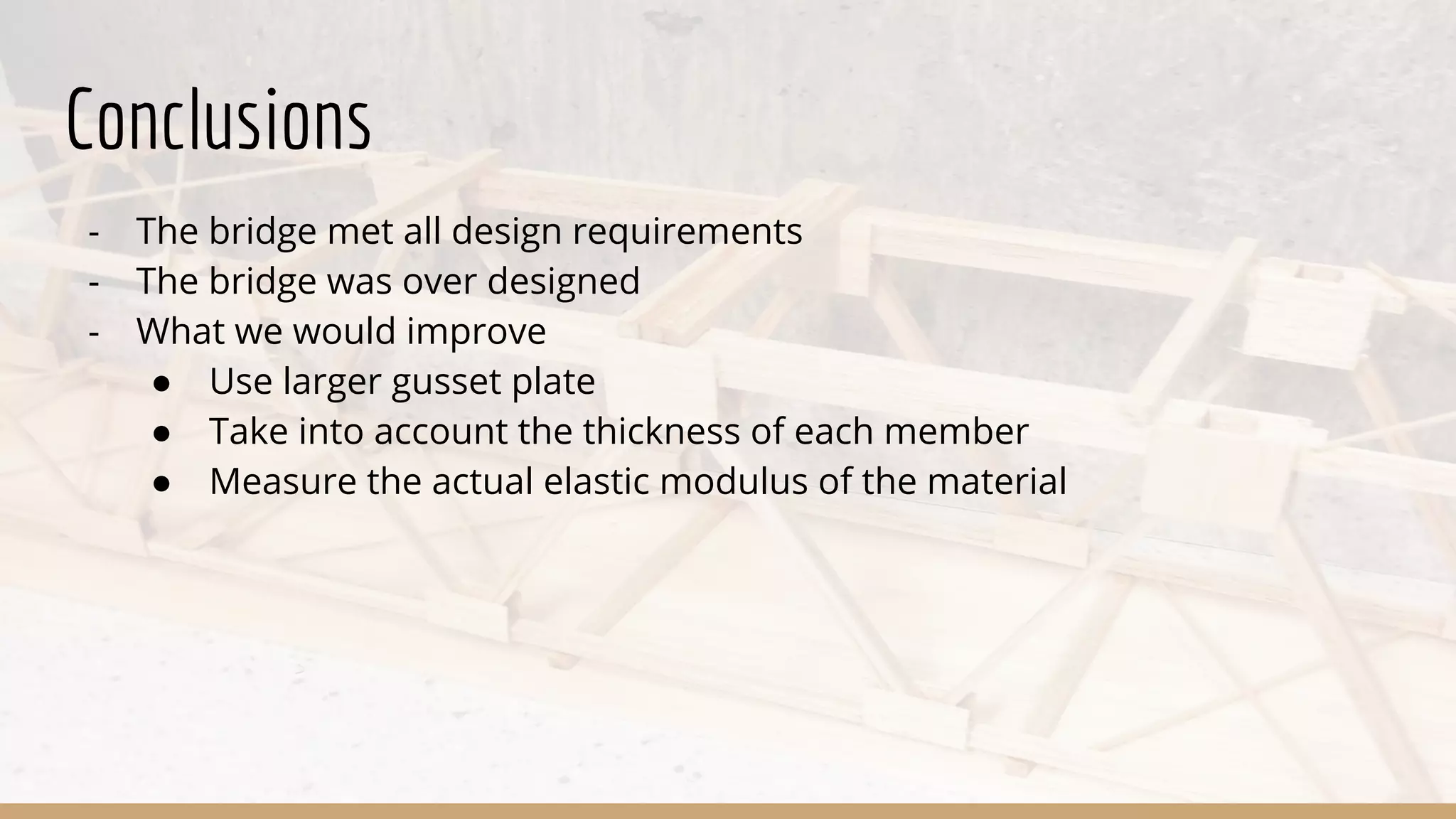
- The bridge met all design requirements
- The bridge was over designed
- What we would improve
● Use larger gusset plate
● Take into account the thickness of each member
● Measure the actual elastic modulus of the material
Questions?

Final Presentation (Balsa Wood Bridge Design)

  • 1.
    TRUSS FINAL PROJECT Group 3:Arman Yosal, Josia Tannos, Maya Goldman, Savannah Brooks
  • 2.
  • 3.
    Introduction -Concept -Design Methods -Construction Techniques -Testingand Performance -Post Test Evaluation -Conclusion
  • 4.
    Concept ● Warren Trussdesign ● Hand Calculations and SAP2000 Analysis ● Seven triangle design most efficient ● Safety Factor of 2
  • 5.
    Design Methods ● WarrenTruss design ● 69 Total Members ○ 27 on each side of truss ○ 15 connecting the two sides ● Deflection decreases with increased cross-sectional area Cross Sectional Size Number of Members Pieces Laminated 1/4" x 1/4" 38 4 x (1/8" balsa wood) 1/8" x 1/8" 8 4 x (1/16" balsa wood) 3/8" x 3/8" 4 4 x (3/16" balsa wood) 1/4" x 1/8" 4 2 x (1/8" balsa wood)
  • 6.
    Construction techniques (1)- Cutting ● Materials used: X-Acto blades, T-squares or metal rulers ● Followed table to keep track of amounts, lengths, sizes ● Rounded up for consistency
  • 7.
    Construction techniques (2)- Laminating ● Super glue used to form members with larger cross-sectional areas and greater strength ○ Ex. using ⅛” wood pieces, four were laminated together to create a ¼”X¼” member ● Extra pieces added to small members at connection joints so heights were equal
  • 8.
    Construction techniques (3)Building Frame Comparison of hand and CAD templates; second frame built on top of first
  • 9.
    Construction techniques (4)Second Frame Second frame build on top of first
  • 10.
    Construction techniques (5)Lateral Bracing ● Tongue depressor and screw system to align frames ● Gusset plates added on small members ● Cross-bracing cut and placed one at a time at the end
  • 11.
    Testing/Performance (1) Testing Method ●Metal bar laid on platform at top center of bridge ● Chain hung over bar then attached beneath bucket ● Began at ten pounds then weight was added until failure
  • 12.
    Testing/Performance (2) The bridgemet all design requirements ● Minimum 36” span with no more than ½” at each support ● Minimum height 5”, width 4” for truck to pass ● Less than 0.25” deflection ● Did not exceed 30% over-order Weight of load at failure 53.5 lb Length 40” Height 6” Width 4” Weight of bridge 135.6 g
  • 13.
  • 14.
    Post Test Evaluation(1) Bridge main failure points
  • 15.
    Post Test Evaluation(2) Gusset plate and member shear failures
  • 16.
    Post Test Evaluation(3) Length 40” Height 6” Width 4” Weight of bridge 135.6 g Weight of load at failure 53.5 lb
  • 17.
    Post Test Evaluation(4) ● More efficient design can be achieved ○ Underestimation of elastic modulus Trial Length (cm) Width (cm) Moment of Inertia (cm4 ) Load (N) Length (cm) Deflection (cm) Elastic Modulus (GPa) 1 0.318 0.318 8.468E-04 0.196 25.000 1.800 6.704 2 0.318 0.318 8.468E-04 0.196 25.000 2.200 5.485 3 0.159 0.159 5.293E-05 0.098 10.000 1.000 6.178 4 0.159 0.159 5.293E-05 0.098 10.000 1.500 4.119 Our data (left), researched data (right)
  • 18.
    Conclusions - The bridgemet all design requirements - The bridge was over designed - What we would improve ● Use larger gusset plate ● Take into account the thickness of each member ● Measure the actual elastic modulus of the material
  • 19.