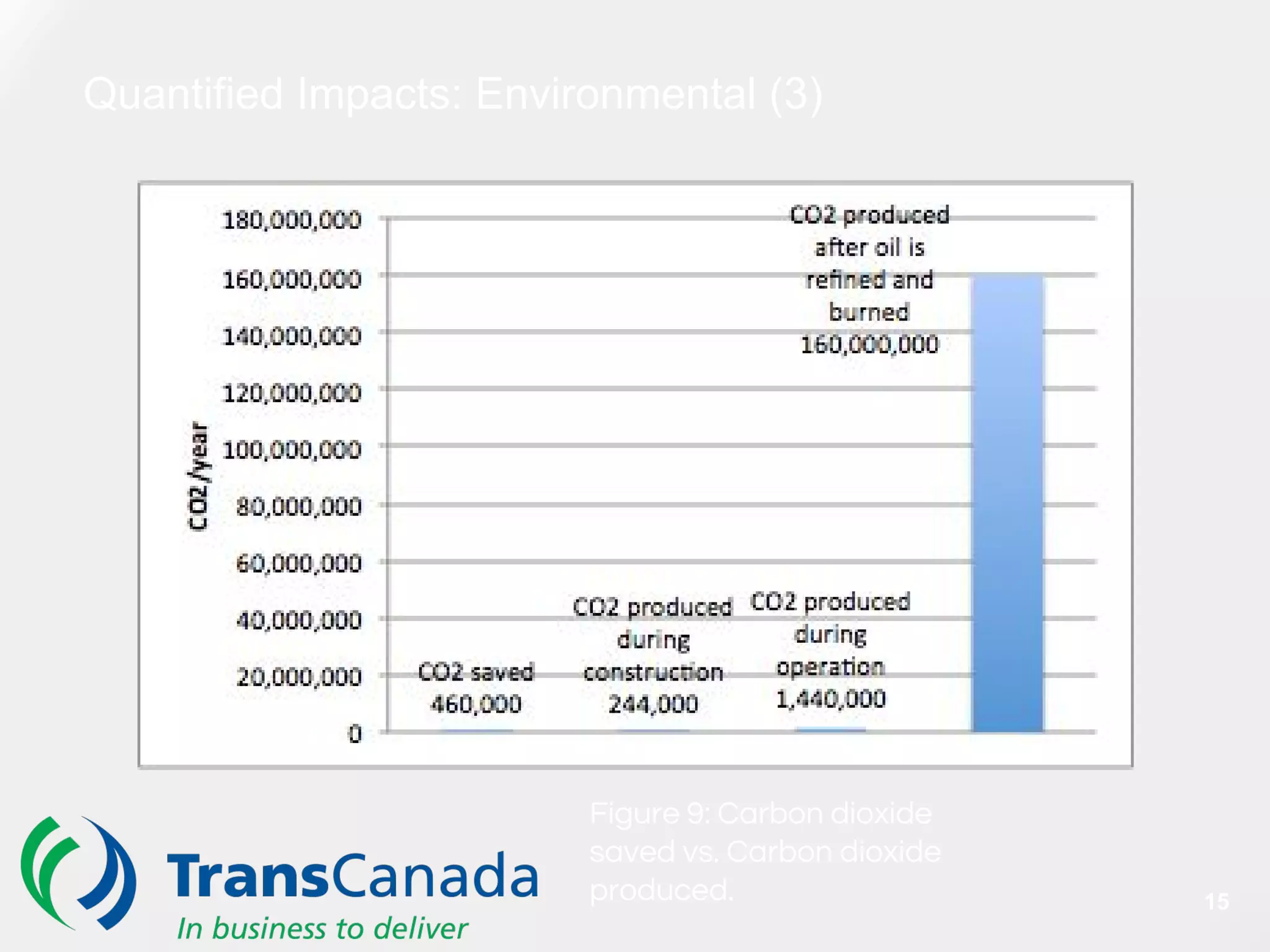
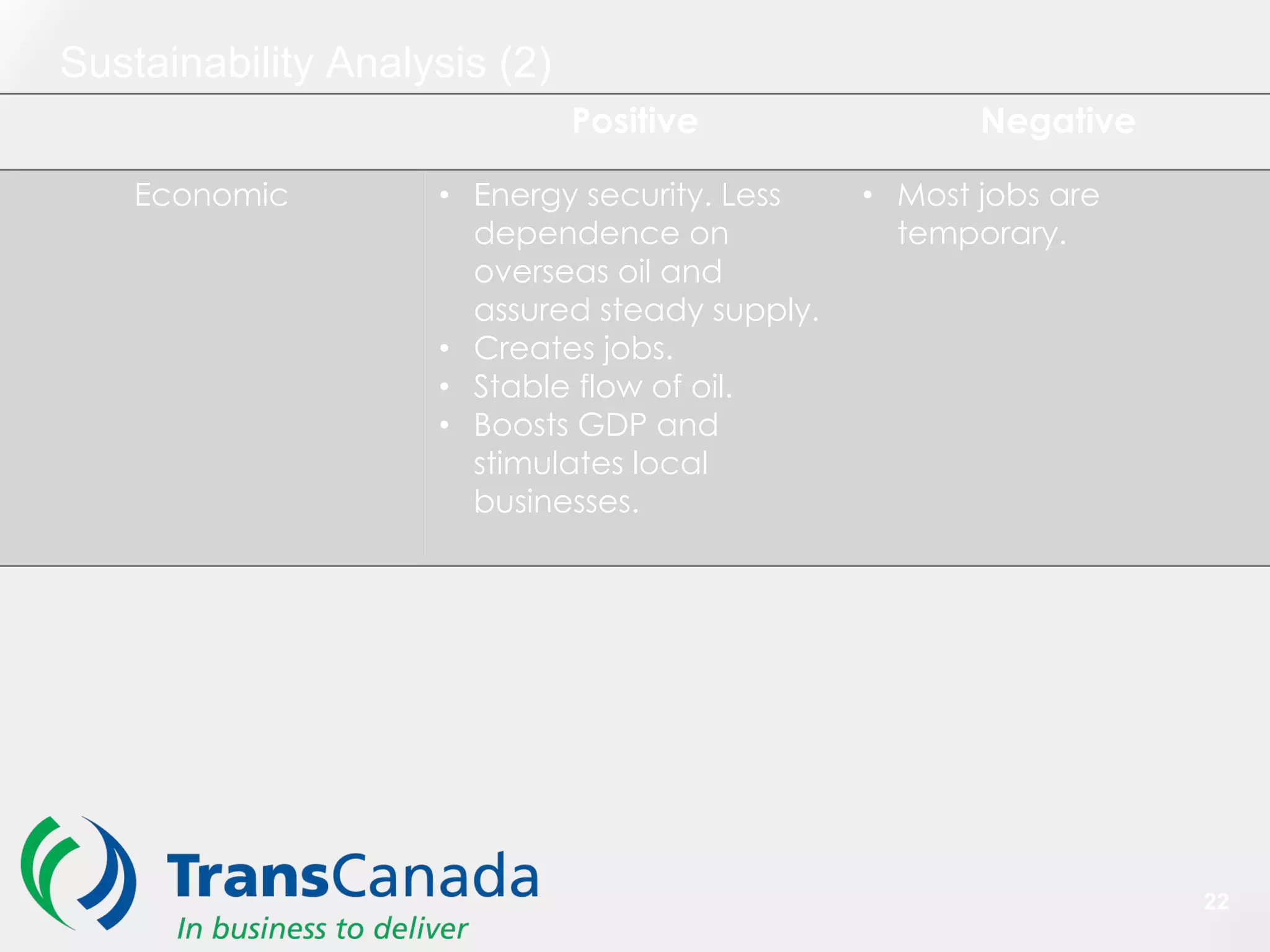
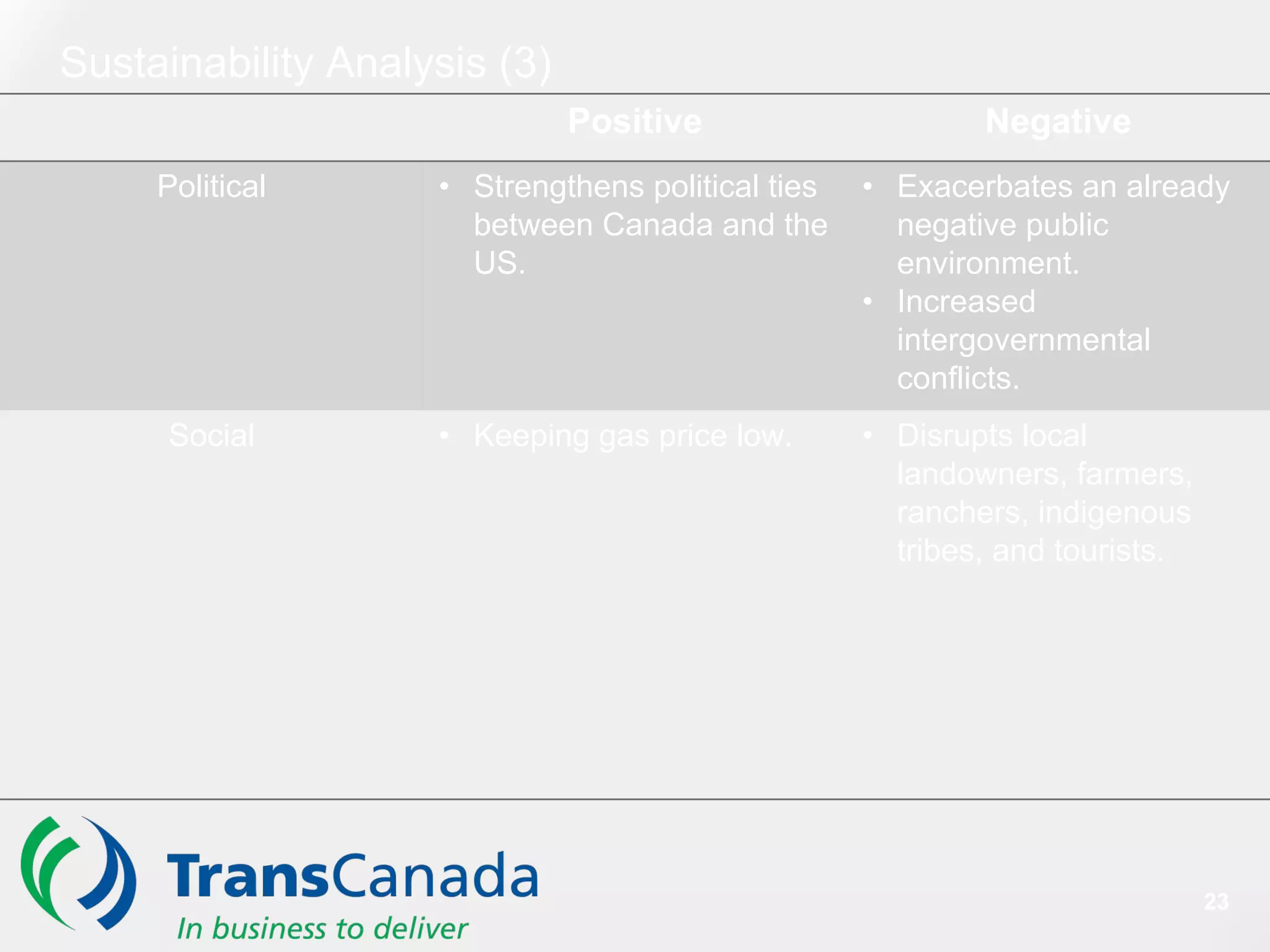
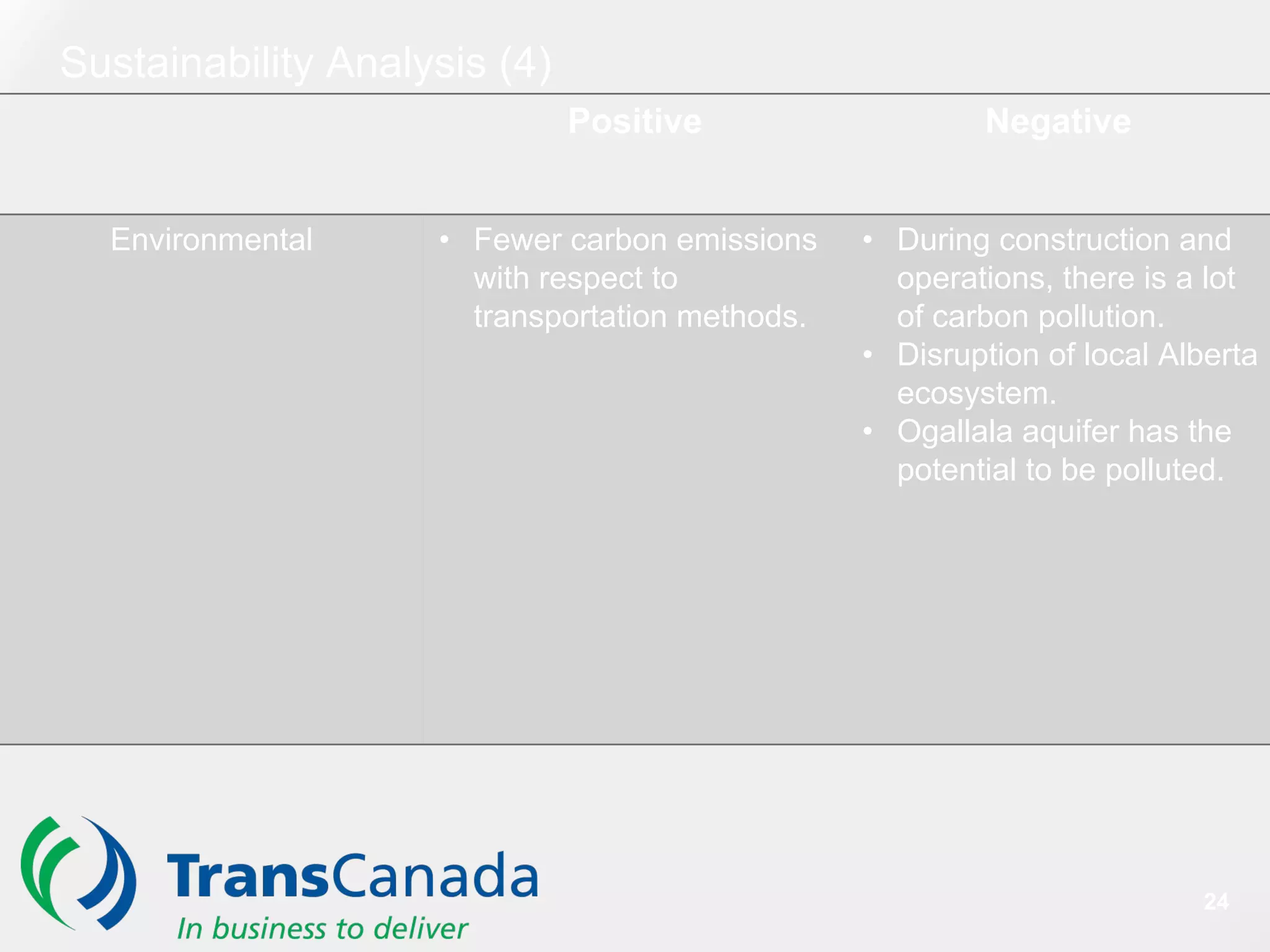
The document analyzes the proposed Keystone XL oil pipeline from Alberta, Canada to Nebraska. It would transport 830,000 barrels per day of crude oil. The pipeline is proposed to address oil demand and make the US less dependent on foreign oil imports. However, its environmental impacts were questioned as it would produce 1.44 million tons of carbon emissions annually and could potentially pollute water sources like the Ogallala Aquifer if leaks occurred. While creating short-term jobs and economic growth, it may disrupt other industries like farming and tourism and face opposition from landowners and indigenous groups along its path. The analysis finds the project is not environmentally sustainable long-term.
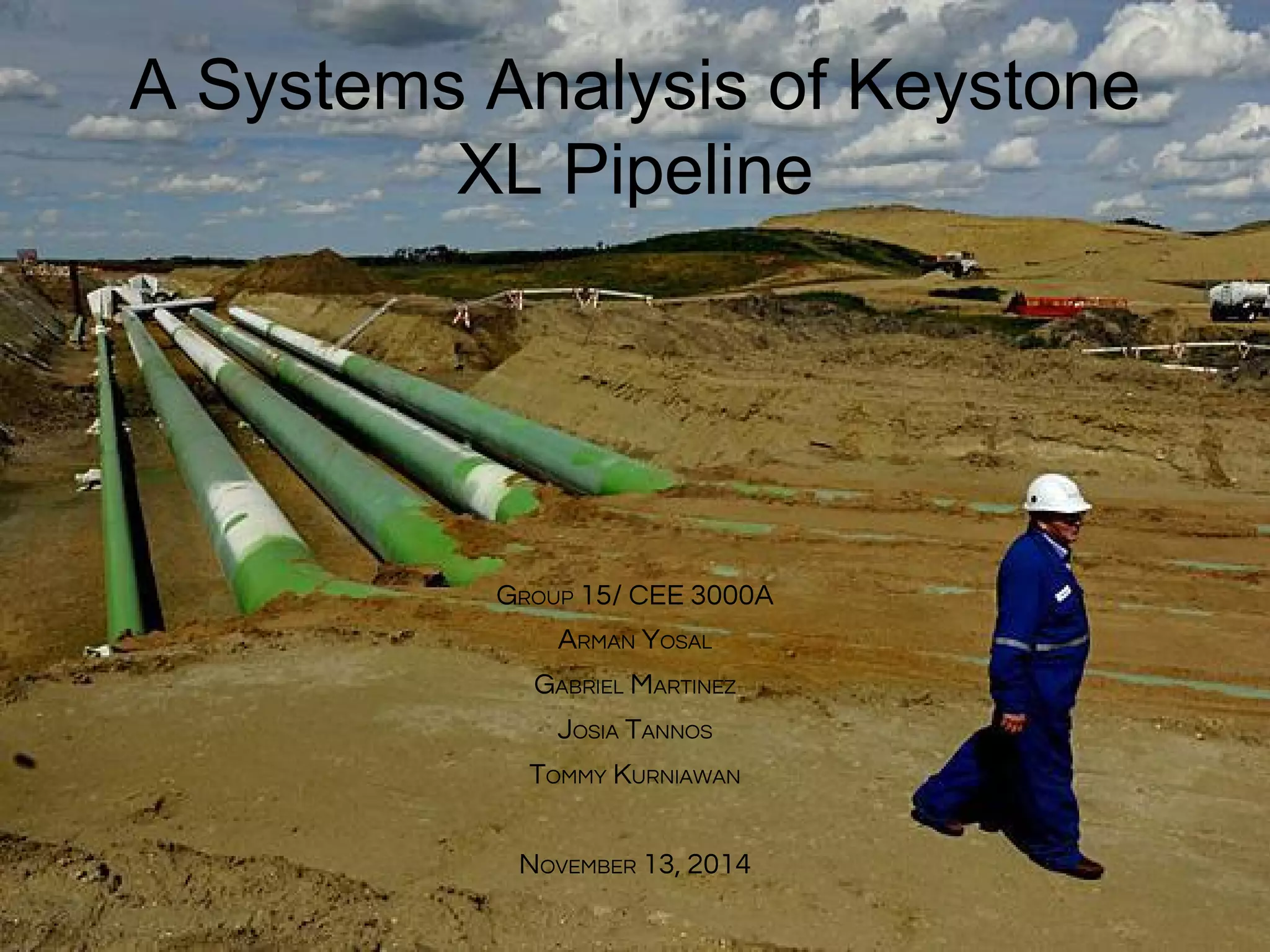
![Background and Purpose (1)
N
Figure 1: Proposed Route [1]
The Keystone Pipeline is owned by
TransCanada.
Keystone XL is the fourth phase of the
Keystone Pipeline.
Runs from Alberta, Canada to Steele
City, Nebraska.
3](https://image.slidesharecdn.com/b3c607d6-79d9-4241-b1ce-f97edbfaf611-161003160257/75/Final-Presentation-XL-Keystone-Pipeline-Project-3-2048.jpg)
![Background and Purpose (2)
Figure 2: Map with sources and
estimated loads [2]
First proposed in 2008, but was
rejected.
Reapplied for Presidential Permit in
2012 with new route.
Will transport synthetic crude oil,
diluted bitumen, and light crude oil.
Meant to tackle consumer (refineries)
demand for oil, especially heavy oil.
4](https://image.slidesharecdn.com/b3c607d6-79d9-4241-b1ce-f97edbfaf611-161003160257/75/Final-Presentation-XL-Keystone-Pipeline-Project-4-2048.jpg)
![Functional Characteristics (1)
Length: 1,897 km (1,179 mi)
Diameter: 914 mm
Capacity: 830,000 bpd
Components:
Carbon steel.
Fusion-bonded epoxy.
Cathodic protection.
Pumps and pump stations.
5
Figure 3: Assembly of the Gulf
Coast Project. [3]](https://image.slidesharecdn.com/b3c607d6-79d9-4241-b1ce-f97edbfaf611-161003160257/75/Final-Presentation-XL-Keystone-Pipeline-Project-5-2048.jpg)
![Functional Characteristics (2)
Carbon Steel
Harder and stronger than stainless steel.
Withstand impact from 65-ton excavator with 3.5-inch teeth.
Figure 4: Carbon steel
pipeline. [4]
6](https://image.slidesharecdn.com/b3c607d6-79d9-4241-b1ce-f97edbfaf611-161003160257/75/Final-Presentation-XL-Keystone-Pipeline-Project-6-2048.jpg)
![Functional Characteristics (3)
Fusion-bonded epoxy coating
Protects steel pipe from corrosion.
Steel cleaned
and heated.
FBE powder
sprayed and
melt on surface.
Figure 5: FBE process. [5]
7](https://image.slidesharecdn.com/b3c607d6-79d9-4241-b1ce-f97edbfaf611-161003160257/75/Final-Presentation-XL-Keystone-Pipeline-Project-7-2048.jpg)
![Functional Characteristics (4)
Cathodic Protection
Prevents corrosion.
Impressed current cathodic
protection.
Corrosion is passed on from the
pipeline’s metal to the similar
metal by making the pipeline’s
metal a cathode in the
electrochemical cell.
Figure 6: Cathodic protection for pipeline.
[6] 8](https://image.slidesharecdn.com/b3c607d6-79d9-4241-b1ce-f97edbfaf611-161003160257/75/Final-Presentation-XL-Keystone-Pipeline-Project-8-2048.jpg)
![Functional Characteristics (5)
Pumps and Pump Stations
41 pumps stations separated by
about 80 kilometers from each
other.
Powered by 6,500 horsepower
electric motor.
32,000 horsepower of pumping
power.
Facilitates the movement of oil
within the pipeline.
Figure 7: Pump Station. [7]
9](https://image.slidesharecdn.com/b3c607d6-79d9-4241-b1ce-f97edbfaf611-161003160257/75/Final-Presentation-XL-Keystone-Pipeline-Project-9-2048.jpg)
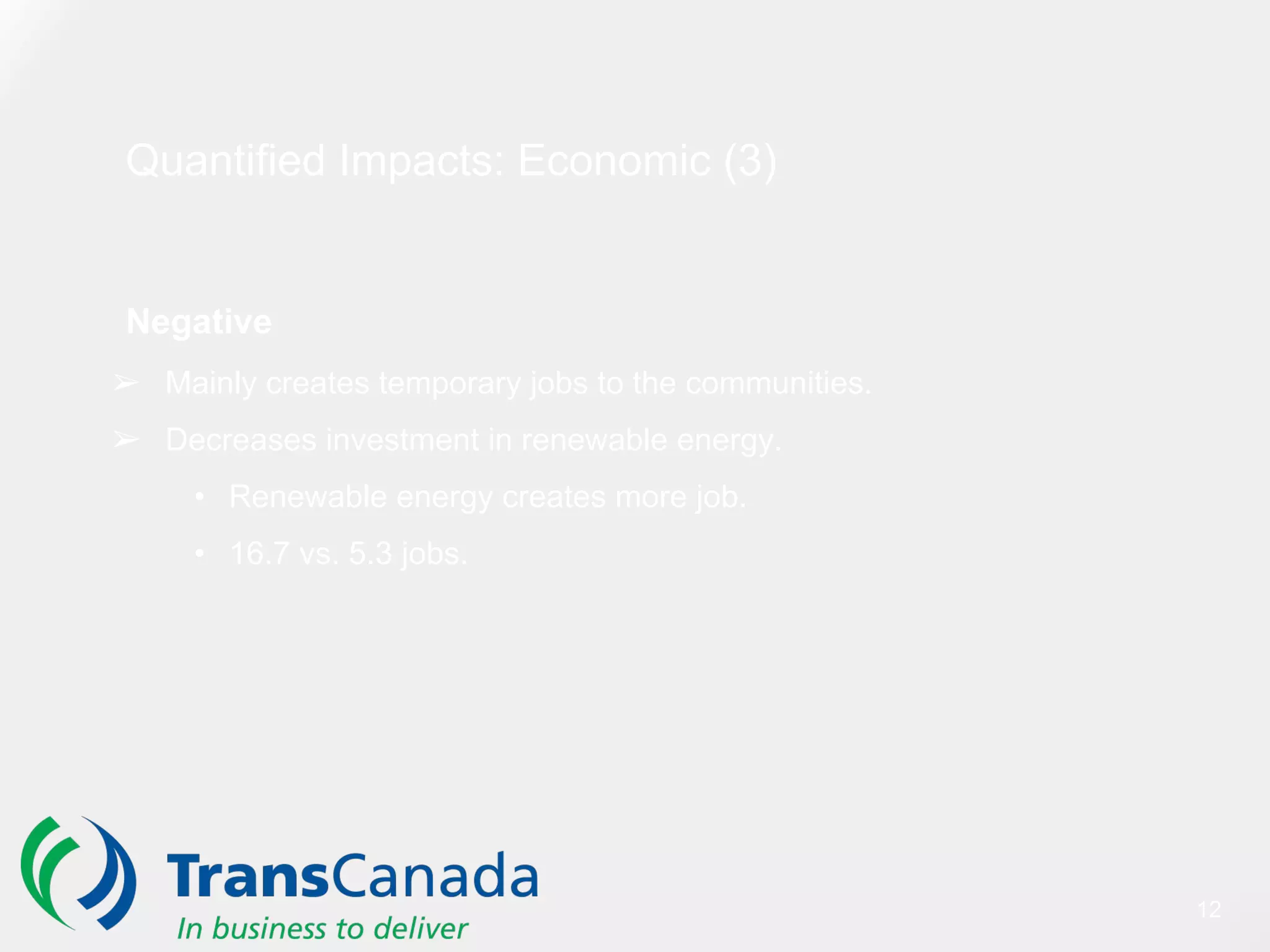
![Quantified Impacts: Economic (2)
Positive
➢ Stimulates local small businesses.
Boosts GDP of both the United
States and Canada.
➢ Creates approximately 42,100
direct and indirect jobs for local
communities (lodging, food
services, transportation,
warehousing, etc.).
Figure 8: Jobs Distribution. [8]
11](https://image.slidesharecdn.com/b3c607d6-79d9-4241-b1ce-f97edbfaf611-161003160257/75/Final-Presentation-XL-Keystone-Pipeline-Project-11-2048.jpg)


![British Petroleum [Case Study : Deepwater Horizon Oil Spill]](https://cdn.slidesharecdn.com/ss_thumbnails/bpoilspill-ppt-190514174319-thumbnail.jpg?width=640&height=640&fit=bounds)


