BREAST RECONSTRUCTION IMPLANT
OR AUTOLOGOUS TISSUE
Presenter
DR NIKHIL AMEERCHETTY,MS
ROLE OF THE GENERAL SURGEON IN BREAST
RECONSTRUCTION
ā€¢ā€œWhat will it look like when you are done?ā€
• ā€œWill I have to live without a breast?ā€
History
• Volkmann, Czerny, and Billroth local recurrence rates 52% to 85%.
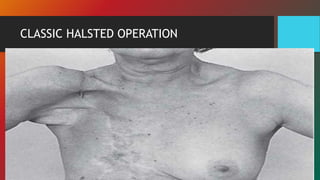
• William Halsted 6% recurrence rate.
• Halsted concept ā€œTo attempt to close the breast by any plastic method is
hazardous, and in my opinion, to be vigorously discounted.ā€
• The first attempt by Vincent Czerny in 1895 transplanted a large lipoma .
• Tansini (1896) latissimus dorsi myocutaneous flap
• In 1942, Sir Harold Gillies of England started using a tubed pedicle technique of
breast reconstruction.
• Olivari, McCraw, and Muhlbauer in 1970 reintroduced myocutaneous flap .
• In 1963, the silicone breast implant .
CLASSIC HALSTED OPERATION
TUBED ABDOMINAL PANNICULUS GRAFT
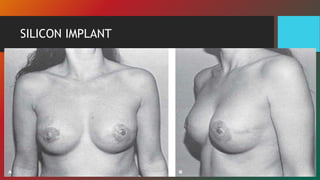
SILICON IMPLANT
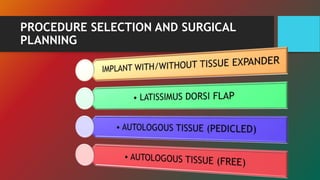
PROCEDURE SELECTION AND SURGICAL
PLANNING
PREREQISITS
• Type of mastectomy (ie.. skin-sparing technique vs. the standard modified
radical mastectomy)
• Body habitus (thin women or fat women).
• Contralateral breast size and shape.
• Donor site evaluation
• Course of overall health
THE IDEAL TOTAL MASTECTOMY
• Preserve pectoralis major muscle
• 2cm excess margin
• Incision
• Best is oblique
• Worst is transverse patey incision.
FAVORABLE AND UNFAVORABLE INCISION
IMPLANTS
• Silicone gel implants represented an historic medical breakthrough.
• Biologically inert
• Fibrous encapsulation
• Better results with under muscle placement
• Low grade infection
TISSUE EXPANSION
• Stretch the retained breast skin
• Decreasing the encapsulation seen with the permanent silicone
implant
• Best suited for a well built patient
• Avoid placing under tight. Thin. Or irradiated skin.
Technique
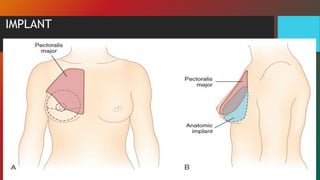
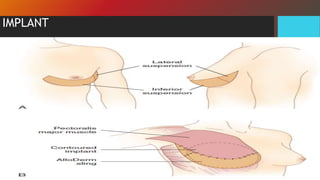
• The pectoralis muscle for superomedial aspect of the implant.
• Serratus anterior and some of the fascia of the rectus muscle inferiorly.
• Light compressive dressing& applied to the superior pole of the breast
to prevent migration for 4-6 weeks .
• Major drawback is distortion of shape over time and repeated
corrections , not suited for large defects
IMPLANT
IMPLANT
MYOCUTANEOUS FLAPS
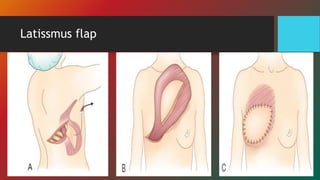
• LATISSIMUS DORSI BREAST RECONSTRUCTION
• Revolutionized the reconstruction of the radical mastectomy defect
1. Replacement of the pectoralis muscle
2. Muscle coverage of the implant
3. Replacement of missing skin
Techinique
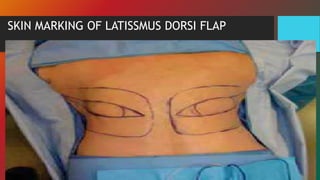
• Flap marked before the breast surgery in standing position
• Paraspinous origins of the muscle divided while preserving the
thoracodorsal neurovascular bundle.
• The flap is carefully rotated on its humeral insertion toward the
anterior chest wall
• Cornerstone is protecting thoracodorsal artery and vein during axillary
dissection
• 2-cm. layer of fat on the surface of the latissimus dorsi
muscle can provide 500 g of fat.
• Immediate reconstruction is possible and with single
stage
• Functional loss is unnoticed .
• In irradiated patients it brings a robust blood supply into a deficient
region.
• Irradiated skin is best excised
• If an implant is used. it must be covered in its entirety with muscle.
• latissimus dorsi myocutaneous flap is refractory to radiation-induced
loss due to its rich blood supply.
Latissmus flap
SKIN MARKING OF LATISSMUS DORSI FLAP
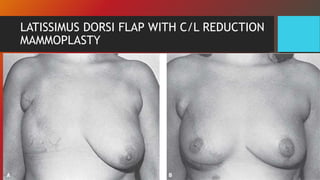
LATISSIMUS DORSI FLAP WITH C/L REDUCTION
MAMMOPLASTY
AUTOGENOUS MYOCUTANEOUS FLAPS
• Hartrampf in 1982 used the TRAM flap.
• It was the first breast reconstruction using only vascularized
autologous tissue
• In the late 1980s, the autologous extended latissimus flap was
developed
• 1990s, microvasular transfer of the TRAM to Ā·high-risk" patients
(smoking , diabetics , obesity) .
TRAM FLAP
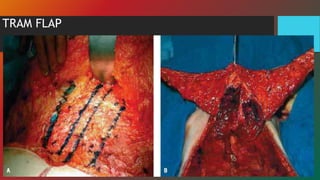
• Gold standard of breast reconstruction.
• Used mainly for difficult reconstructions (extensive skin
removal)
• Management of the donor site is needed
• If B/L flap taken closed with a onlay mesh
TECHNIQUE
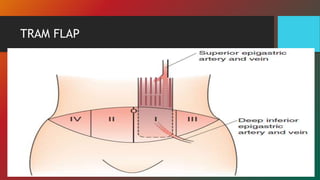
• 'TRAM flap differs from every other myocutaneous flap in that its
vascular supply is more tenuous requiring delicate handling.
• These flaps are supplied by musculcutaneous perforating branches from
the deep superior epigastric artery and vein.
• One or two pedicled flaps
• Excellent for B/L mastectomy reconstruction
TRAM FLAP
TRAM FLAP
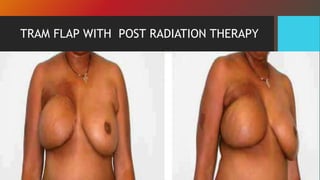
TRAM FLAP WITH POST RADIATION THERAPY
FREE TISSUE TRANSFERS
• Decreased complication rate and requires fewer revisions
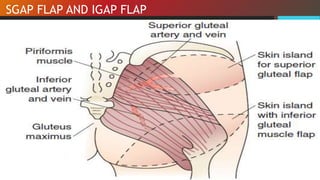
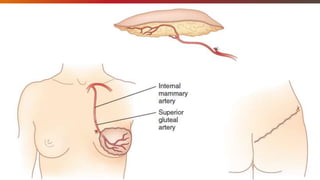
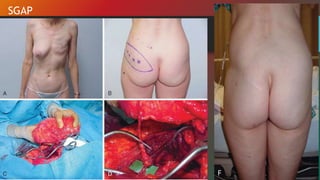
1. Superior Gluteal Artery Perforator (SGAP) flap.
2. Inferior Gluteal Artery Perforator (IGAP) flap.
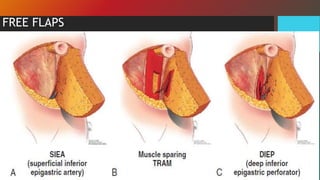
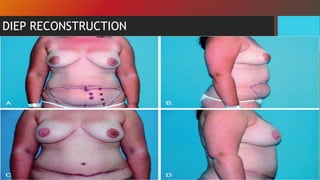
3. Deep Inferior Epipstric Artery Perforator (DIRP) flap.
4. Superficial Inferior Epigastric Artery (SIEA) flap.
• Microvascular anastomosis is performed to either the thoracodorsal or
the internal mammary vessels .
FREE FLAPS
SGAP FLAP AND IGAP FLAP
DIEP RECONSTRUCTION
SGAP
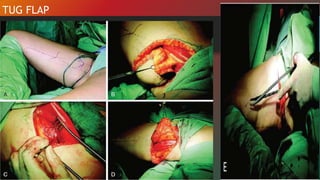
TUG FLAP
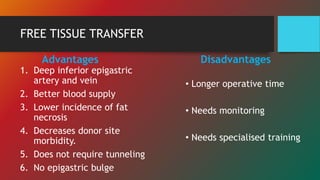
FREE TISSUE TRANSFER
Advantages
1. Deep inferior epigastric
artery and vein
2. Better blood supply
3. Lower incidence of fat
necrosis
4. Decreases donor site
morbidity.
5. Does not require tunneling
6. No epigastric bulge
Disadvantages
• Longer operative time
• Needs monitoring
• Needs specialised training
PARTIAL MASTECTOMY
• AUTOLOGOUS TISSUE TRANSFER TECHNIQUE
• PREFFERED IS LATISSIMUS DORSI FLAP
MODIFIED RADICAL MASTECTOMY
• If done with skin sparing – Implants
• If extensive skin loss - autologous tissue transfer technique
Radical mastectomy
•Autologous reconstruction
DELAYED RECONSTRUCTION
• Reasons that patient expresses for delayed reconstruction
1. Fear of additional prodedure
2. Relif from negative feelings
3. Symmetry
4. Lasting results
5. Emotional recovery
Immediate reconstruction
• Differentiation should stop between the treatment and
reconstruction
• Immediate reconstruction does not interfer with surgical
treatment
• Favoured procedure for stage I and IIa and for advanced stages
if patient choices immediate can be opted
• RECURRENCES NEVER OCCUR ON THE FLAPS
CHEMOTHERAPY IMPACT
• Chemotherapy can be started while there is still a surface wound that
has not yet epithelialized
• Avoided if frank tissue necrosis, seroma, or infection.
• In anticipated bad wounds flaps are better than implants
Mastectomy and radiation effects
• Scarring between skin and pectoralis major muscle
• Shrinkage of both skin and muscle
• Causes persistent perivascular inflammation.
OPPOSITE BREAST CONSIDERATIONS
• Reduction mammaplasty involves the removal of breast tissue as well as
excess skin.
• Mastopexy in contrast corrects breast ptosis by elevating the breast
mound (preserves breast volume )
• Augmentation mammoplasty
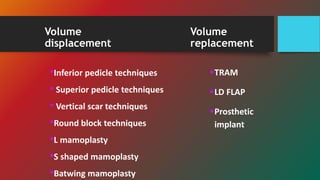
Volume
displacement
Volume
replacement
ļ‚§TRAM
ļ‚§LD FLAP
ļ‚§Prosthetic
implant
•Inferior pedicle techniques
• Superior pedicle techniques
• Vertical scar techniques
•Round block techniques
•L mamoplasty
•S shaped mamoplasty
•Batwing mamoplasty
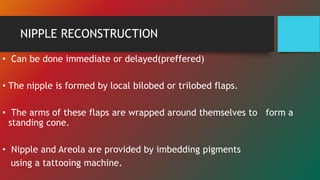
NIPPLE RECONSTRUCTION
• Can be done immediate or delayed(preffered)
• The nipple is formed by local bilobed or trilobed flaps.
• The arms of these flaps are wrapped around themselves to form a
standing cone.
• Nipple and Areola are provided by imbedding pigments
using a tattooing machine.
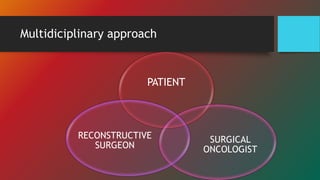
Multidiciplinary approach
PATIENT
SURGICAL
ONCOLOGIST
RECONSTRUCTIVE
SURGEON
Breast reconstruction after breast surgery

Breast reconstruction after breast surgery

  • 1.
    BREAST RECONSTRUCTION IMPLANT ORAUTOLOGOUS TISSUE Presenter DR NIKHIL AMEERCHETTY,MS
  • 2.
    ROLE OF THEGENERAL SURGEON IN BREAST RECONSTRUCTION ā€¢ā€œWhat will it look like when you are done?ā€ • ā€œWill I have to live without a breast?ā€
  • 3.
    History • Volkmann, Czerny,and Billroth local recurrence rates 52% to 85%. • William Halsted 6% recurrence rate. • Halsted concept ā€œTo attempt to close the breast by any plastic method is hazardous, and in my opinion, to be vigorously discounted.ā€ • The first attempt by Vincent Czerny in 1895 transplanted a large lipoma . • Tansini (1896) latissimus dorsi myocutaneous flap • In 1942, Sir Harold Gillies of England started using a tubed pedicle technique of breast reconstruction. • Olivari, McCraw, and Muhlbauer in 1970 reintroduced myocutaneous flap . • In 1963, the silicone breast implant .
  • 4.
  • 5.
  • 6.
  • 7.
  • 8.
    PROCEDURE SELECTION ANDSURGICAL PLANNING
  • 9.
    PREREQISITS • Type ofmastectomy (ie.. skin-sparing technique vs. the standard modified radical mastectomy) • Body habitus (thin women or fat women). • Contralateral breast size and shape. • Donor site evaluation • Course of overall health
  • 10.
    THE IDEAL TOTALMASTECTOMY • Preserve pectoralis major muscle • 2cm excess margin • Incision • Best is oblique • Worst is transverse patey incision.
  • 11.
  • 12.
    IMPLANTS • Silicone gelimplants represented an historic medical breakthrough. • Biologically inert • Fibrous encapsulation • Better results with under muscle placement • Low grade infection
  • 13.
    TISSUE EXPANSION • Stretchthe retained breast skin • Decreasing the encapsulation seen with the permanent silicone implant • Best suited for a well built patient • Avoid placing under tight. Thin. Or irradiated skin.
  • 14.
    Technique • The pectoralismuscle for superomedial aspect of the implant. • Serratus anterior and some of the fascia of the rectus muscle inferiorly. • Light compressive dressing& applied to the superior pole of the breast to prevent migration for 4-6 weeks . • Major drawback is distortion of shape over time and repeated corrections , not suited for large defects
  • 15.
  • 16.
  • 17.
    MYOCUTANEOUS FLAPS • LATISSIMUSDORSI BREAST RECONSTRUCTION • Revolutionized the reconstruction of the radical mastectomy defect 1. Replacement of the pectoralis muscle 2. Muscle coverage of the implant 3. Replacement of missing skin
  • 18.
    Techinique • Flap markedbefore the breast surgery in standing position • Paraspinous origins of the muscle divided while preserving the thoracodorsal neurovascular bundle. • The flap is carefully rotated on its humeral insertion toward the anterior chest wall • Cornerstone is protecting thoracodorsal artery and vein during axillary dissection
  • 19.
    • 2-cm. layerof fat on the surface of the latissimus dorsi muscle can provide 500 g of fat. • Immediate reconstruction is possible and with single stage • Functional loss is unnoticed .
  • 20.
    • In irradiatedpatients it brings a robust blood supply into a deficient region. • Irradiated skin is best excised • If an implant is used. it must be covered in its entirety with muscle. • latissimus dorsi myocutaneous flap is refractory to radiation-induced loss due to its rich blood supply.
  • 21.
  • 22.
    SKIN MARKING OFLATISSMUS DORSI FLAP
  • 23.
    LATISSIMUS DORSI FLAPWITH C/L REDUCTION MAMMOPLASTY
  • 25.
    AUTOGENOUS MYOCUTANEOUS FLAPS •Hartrampf in 1982 used the TRAM flap. • It was the first breast reconstruction using only vascularized autologous tissue • In the late 1980s, the autologous extended latissimus flap was developed • 1990s, microvasular transfer of the TRAM to Ā·high-risk" patients (smoking , diabetics , obesity) .
  • 26.
    TRAM FLAP • Goldstandard of breast reconstruction. • Used mainly for difficult reconstructions (extensive skin removal) • Management of the donor site is needed • If B/L flap taken closed with a onlay mesh
  • 27.
    TECHNIQUE • 'TRAM flapdiffers from every other myocutaneous flap in that its vascular supply is more tenuous requiring delicate handling. • These flaps are supplied by musculcutaneous perforating branches from the deep superior epigastric artery and vein. • One or two pedicled flaps • Excellent for B/L mastectomy reconstruction
  • 28.
  • 29.
  • 30.
    TRAM FLAP WITHPOST RADIATION THERAPY
  • 31.
    FREE TISSUE TRANSFERS •Decreased complication rate and requires fewer revisions 1. Superior Gluteal Artery Perforator (SGAP) flap. 2. Inferior Gluteal Artery Perforator (IGAP) flap. 3. Deep Inferior Epipstric Artery Perforator (DIRP) flap. 4. Superficial Inferior Epigastric Artery (SIEA) flap. • Microvascular anastomosis is performed to either the thoracodorsal or the internal mammary vessels .
  • 32.
  • 33.
    SGAP FLAP ANDIGAP FLAP
  • 35.
  • 36.
  • 37.
  • 38.
    FREE TISSUE TRANSFER Advantages 1.Deep inferior epigastric artery and vein 2. Better blood supply 3. Lower incidence of fat necrosis 4. Decreases donor site morbidity. 5. Does not require tunneling 6. No epigastric bulge Disadvantages • Longer operative time • Needs monitoring • Needs specialised training
  • 39.
    PARTIAL MASTECTOMY • AUTOLOGOUSTISSUE TRANSFER TECHNIQUE • PREFFERED IS LATISSIMUS DORSI FLAP
  • 40.
    MODIFIED RADICAL MASTECTOMY •If done with skin sparing – Implants • If extensive skin loss - autologous tissue transfer technique
  • 41.
  • 42.
    DELAYED RECONSTRUCTION • Reasonsthat patient expresses for delayed reconstruction 1. Fear of additional prodedure 2. Relif from negative feelings 3. Symmetry 4. Lasting results 5. Emotional recovery
  • 43.
    Immediate reconstruction • Differentiationshould stop between the treatment and reconstruction • Immediate reconstruction does not interfer with surgical treatment • Favoured procedure for stage I and IIa and for advanced stages if patient choices immediate can be opted • RECURRENCES NEVER OCCUR ON THE FLAPS
  • 44.
    CHEMOTHERAPY IMPACT • Chemotherapycan be started while there is still a surface wound that has not yet epithelialized • Avoided if frank tissue necrosis, seroma, or infection. • In anticipated bad wounds flaps are better than implants
  • 45.
    Mastectomy and radiationeffects • Scarring between skin and pectoralis major muscle • Shrinkage of both skin and muscle • Causes persistent perivascular inflammation.
  • 46.
    OPPOSITE BREAST CONSIDERATIONS •Reduction mammaplasty involves the removal of breast tissue as well as excess skin. • Mastopexy in contrast corrects breast ptosis by elevating the breast mound (preserves breast volume ) • Augmentation mammoplasty
  • 47.
    Volume displacement Volume replacement ļ‚§TRAM ļ‚§LD FLAP ļ‚§Prosthetic implant •Inferior pedicletechniques • Superior pedicle techniques • Vertical scar techniques •Round block techniques •L mamoplasty •S shaped mamoplasty •Batwing mamoplasty
  • 48.
    NIPPLE RECONSTRUCTION • Canbe done immediate or delayed(preffered) • The nipple is formed by local bilobed or trilobed flaps. • The arms of these flaps are wrapped around themselves to form a standing cone. • Nipple and Areola are provided by imbedding pigments using a tattooing machine.
  • 49.

Editor's Notes

  • #13Ā Choosing the vohune of the implant can be diflicult. In such cases. the use of a postoperatively adjustable implant can simplify this task.
  • #18Ā Lats muscle covering the implant protects it for a max of 5 yrs This method is falling out for the fact that shape and softness of the implant associated
  • #20Ā and the skin paddle can carry an additlonal300 to 500 g of fat. '1his total of 800 to 1000 g is, in most cases, enough to replace the entire volume of breast tissue.
  • #26Ā who were considered unacceptable candidates for pedicled TRAM flap reconstructions.
  • #47Ā Reduction for prople who do not want surgery