Breast  Reconstruction: Decision Making  Surgical Planning Michael J. Miller, M.D. Professor of Surgery Director, Division of Plastic Surgery The Ohio State University
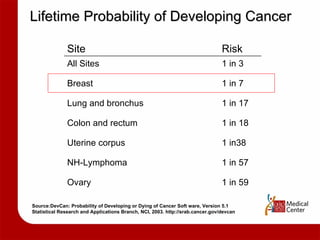
Lifetime Probability of Developing Cancer Source:DevCan: Probability of Developing or Dying of Cancer Soft ware, Version 5.1 Statistical Research and Applications Branch, NCI, 2003. http://srab.cancer.gov/devcan 1 in 59 Ovary 1 in 57 NH-Lymphoma 1 in38 Uterine corpus 1 in 18 Colon and rectum 1 in 17 Lung and bronchus 1 in 7 Breast 1 in 3 All Sites Risk Site
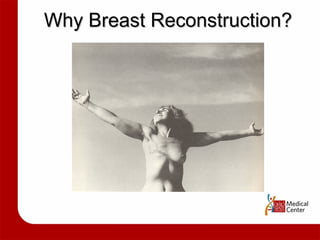
Why Breast Reconstruction?
Mastectomy/ No Reconstruction Advantages   no further surgery needed shorter surgery time/hospital stay symmetry restored with prosthesis may consider reconstruction in future Disadvantages scar on chest wall asymmetry in clothing external prosthetic can: dislodge be uncomfortable be impractical for athletic activities
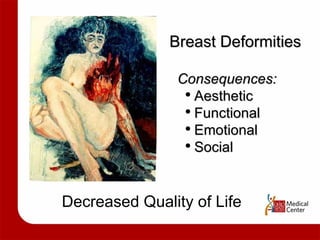
Breast Deformities Consequences: Aesthetic Functional Emotional Social Decreased Quality of Life
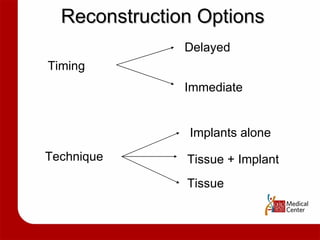
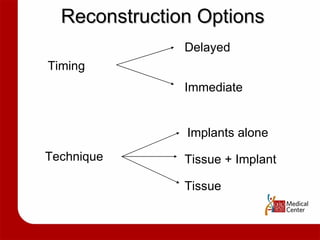
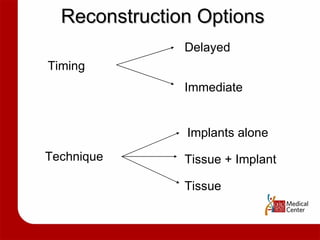
Reconstruction Options Immediate Delayed Timing Technique Tissue Tissue + Implant Implants alone
Delayed Reconstruction Advantages shorter hospital stay/ shorter recovery adjuvant therapy causes no complications to reconstruction allows patient time to consider reconstructive options Disadvantages soft tissue scar on chest wall requires additional surgery and recovery time difficult to reconstruct after scarring occurs
 
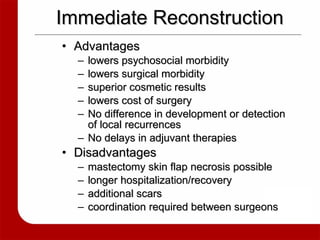
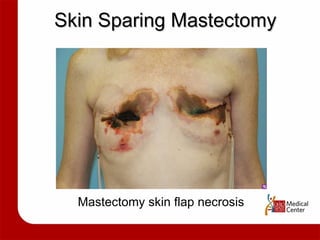
Immediate Reconstruction Advantages lowers psychosocial morbidity lowers surgical morbidity superior cosmetic results lowers cost of surgery No difference in development or detection of local recurrences No delays in adjuvant therapies Disadvantages mastectomy skin flap necrosis possible longer hospitalization/recovery additional scars  coordination required between surgeons
Reconstruction Options Immediate Delayed Timing Technique Tissue Tissue + Implant Implants alone
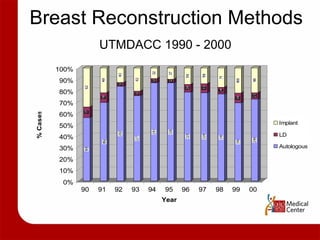
Breast Reconstruction Methods UTMDACC 1990 - 2000
Implant Reconstruction Two-Stage Stage One: Tissue expansion Stage Two: Permanent implant placement One Stage Permanent implant placement Use of dermal matrix implants
Implant Reconstruction Tissue Expanders/Implants Advantages No additional scarring Shorter procedure/recovery Satisfactory shape in clothing Disadvantages Foreign body causing risk of infection Risk of rupture necessitating removal Risk of capsule formation and firmness Asymmetry Implant not permanent
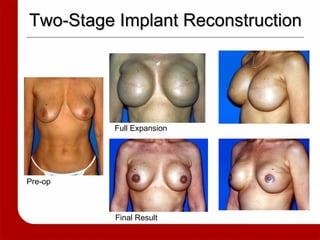
Two-Stage Implant Reconstruction Pre-op Full Expansion Final Result
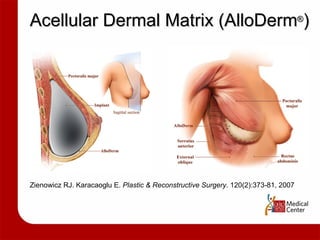
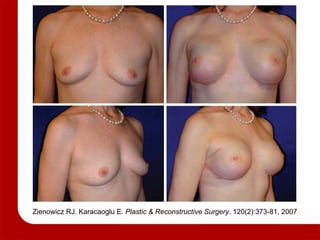
Acellular Dermal Matrix (AlloDerm ® ) Zienowicz RJ. Karacaoglu E.  Plastic & Reconstructive Surgery . 120(2):373-81, 2007
Zienowicz RJ. Karacaoglu E.  Plastic & Reconstructive Surgery . 120(2):373-81, 2007
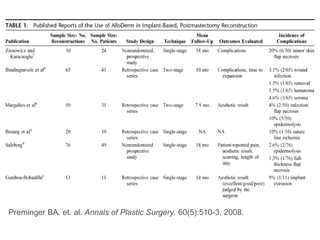
Preminger BA. et. al.  Annals of Plastic Surgery.  60(5):510-3, 2008.
“ Well, this is a fine mess …”
Q. 1  “How in the world did we get here?” “ Well, this is a fine mess …”
Q. 1  “How in the world did we get here?” Q. 2  “How do we avoid ever being back here again?” “ Well, this is a fine mess …”
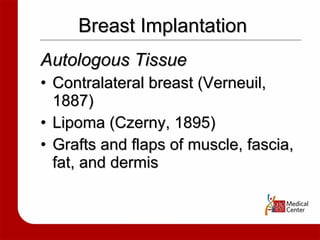
Breast Implantation Autologous Tissue Contralateral breast (Verneuil, 1887) Lipoma (Czerny, 1895)  Grafts and flaps of muscle, fascia, fat, and dermis
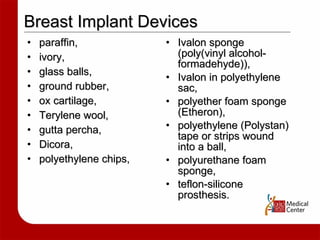
paraffin,  ivory,  glass balls,  ground rubber,  ox cartilage,  Terylene wool,  gutta percha,  Dicora,  polyethylene chips,  Ivalon sponge (poly(vinyl alcohol-formadehyde)), Ivalon in polyethylene sac, polyether foam sponge (Etheron),  polyethylene (Polystan) tape or strips wound into a ball,  polyurethane foam sponge,  teflon-silicone prosthesis.  Breast Implant Devices
Breast Implantation Paraffin, Vaseline, “Organogen,” “Bioplaxm” Silicone oil  +  some combination of:  ricinoleic acid, animal fatty acid, vegetable fatty acids, mineral oil, vegetable (castor) oil, olive oil, croton oil, peanut oil, concentrated vitamin D, snake venom, talc, beeswax, shellac, glazier’s puddy, epoxy resin, industrial silicone fluids Example: Sakurai (> 72,000 cases)  Medical-grade silicone Direct Injections
Silicone Implant Alternatives Pain Skin discoloration, edema, ulceration, and necrosis Calcifications Granulomas Fluid migration Infection Cysts Axillary adenopathy Disfigurement Loss of the breast Liver dysfunction Pneumonitis/ARDS Pulomonary embolism Coma Death Complications
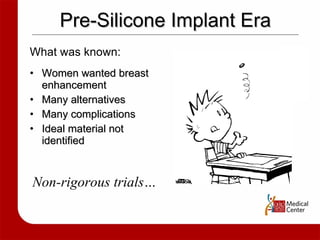
Pre-Silicone Implant Era Women wanted breast enhancement Many alternatives Many complications Ideal material not identified Non-rigorous trials… What was known:
Silicone Breast Implants 1950’s- shunts and joint replacements 1964- Cronin and Gerow  Introduced silicone gel-filled breast implant Pre-clinical studies in dogs  1962-1968 Dow Corning- only manufacturer 1968-early 1990’s- Multiple manufacturers Dow Corning, Heyer-Schulte-Mentor, Cox-Uphoff International, Aesthetech Corp., Surgitek, Inamed-McGhan, Mammatech, foreign manufacturers, …
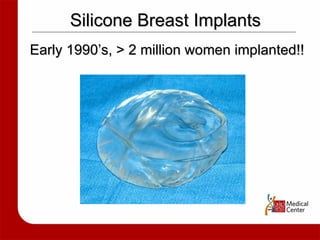
Silicone Breast Implants Early 1990’s, > 2 million women implanted!!
Prior to 1970’s:  little regulation or oversight…
FDA Device Regulation 1976- Medical Devices Amendments General and Plastic Surgery Advisory Panel Implants required general controls and performance standards only.  1982- FDA proposes reclassification as Class III device requiring stringent controls 1988- Changed to Class III status requiring pre-market approval (PMA) applications.  1992- Withdrawn from the market
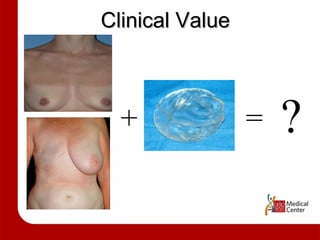
Clinical Value + = ?
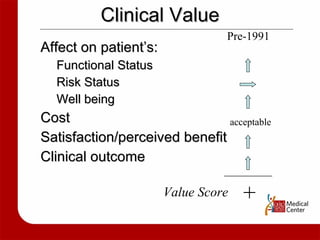
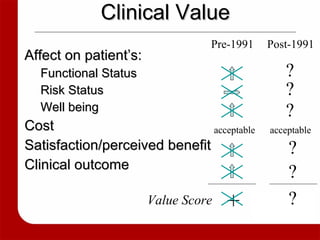
Clinical Value Determined by:  Affect on patient’s:  Functional Status  Risk Status Well being Cost Patient satisfaction and perceived benefit Clinical outcome Nelson EC. et al.  Joint Commission Journal on Quality Improvement. 22(4):243-58, 1996
Clinical Value Affect on patient’s:  Functional Status  Risk Status   Well being Cost Satisfaction/perceived benefit Clinical outcome Pre-1991 acceptable + Value Score
Clinical Value Affect on patient’s:  Functional Status  Risk Status   Well being Cost Satisfaction/perceived benefit Clinical outcome Pre-1991 acceptable Post-1991 + Value Score acceptable ? ? ? ? ? ?
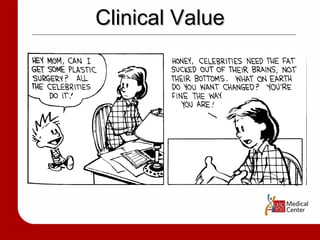
Clinical Value
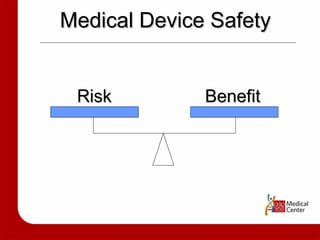
Medical Device Safety Risk Benefit
Silicon Gel Breast Implants After all is said and done… Conclusions: Local complications are well described Systemic complications are not supported Patients must be informed  2006- Silicone Gel implants return to the U.S. market
“ How in the world did we get here?” “ How do we avoid  being back here again?”
Reconstruction Options Immediate Delayed Timing Technique Tissue Tissue + Implant Implants alone
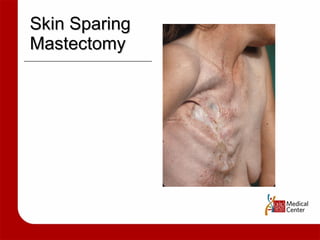
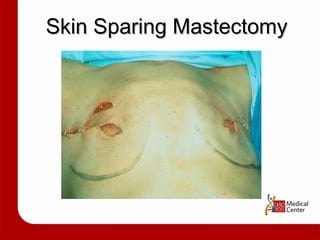
Skin Sparing Mastectomy
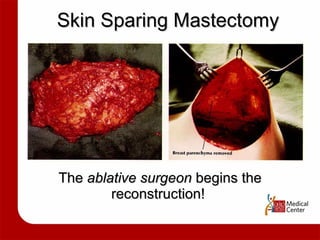
Skin Sparing Mastectomy The  ablative surgeon  begins the reconstruction!
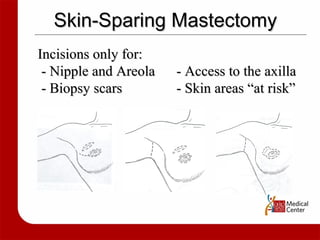
Skin-Sparing Mastectomy Incisions only for:  - Nipple and Areola   - Access to the axilla - Biopsy scars   - Skin areas “at risk”
Skin Sparing Mastectomy
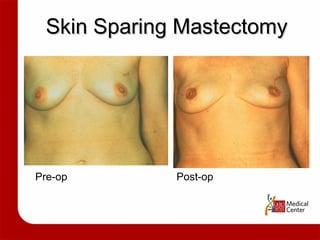
Pre-op Post-op Skin Sparing Mastectomy
Skin Sparing Mastectomy Mastectomy skin flap necrosis
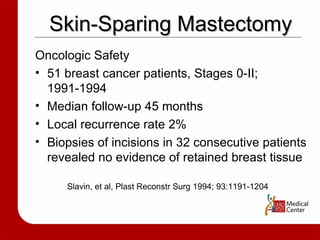
Oncologic Safety 51 breast cancer patients, Stages 0-II; 1991-1994 Median follow-up 45 months Local recurrence rate 2% Biopsies of incisions in 32 consecutive patients revealed no evidence of retained breast tissue Slavin, et al, Plast Reconstr Surg 1994; 93:1191-1204 Skin-Sparing Mastectomy
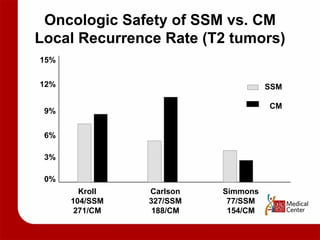
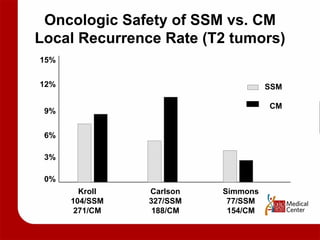
Oncologic Safety of SSM vs. CM Local Recurrence Rate (T2 tumors) Kroll 104/SSM 271/CM Carlson 327/SSM 188/CM Simmons 77/SSM 154/CM SSM CM 15% 12% 9% 6% 3% 0%
Skin Sparing Mastectomy Skin-sparing mastectomy with immediate breast reconstruction is oncologically safe and offers superior cosmetic results compared to conventional mastectomy Local recurrence rates are similar for skin-sparing and conventional mastectomies Most local recurrence are detected by physical exam within 3 years following skin-sparing mastectomy
Technically more demanding Oncological safety  Superior aesthetic results Skin Sparing Mastectomy
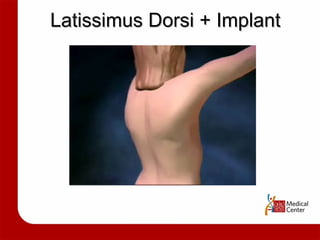
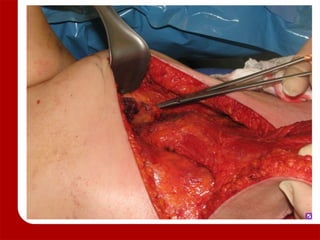
Latissimus Dorsi + Implant
 
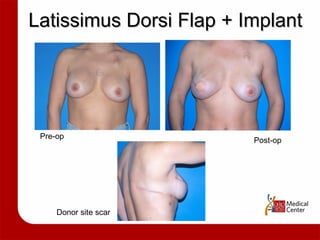
Latissimus Dorsi Flap + Implant Pre-op Post-op Donor site scar
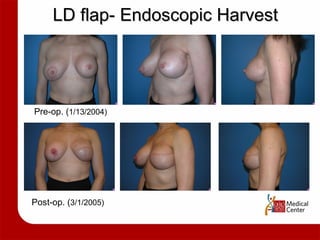
LD flap- Endoscopic Harvest Post-op. ( 3/1/2005) Pre-op. ( 1/13/2004)
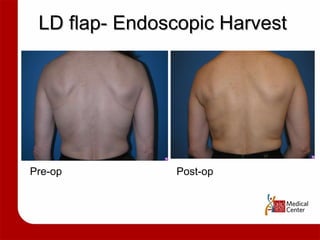
LD flap- Endoscopic Harvest Pre-op Post-op
Reconstruction Options Immediate Delayed Timing Technique Tissue Tissue + Implant Implants alone
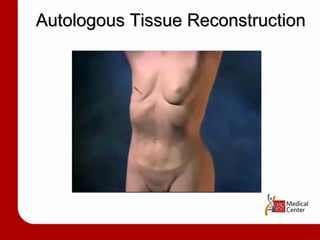
Autologous Tissue Reconstruction
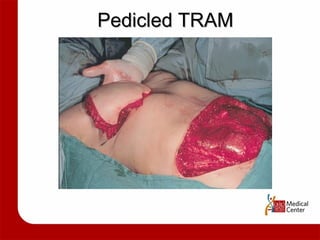
Pedicled TRAM
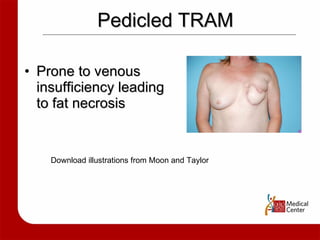
Pedicled TRAM Prone to venous insufficiency leading to fat necrosis  Download illustrations from Moon and Taylor
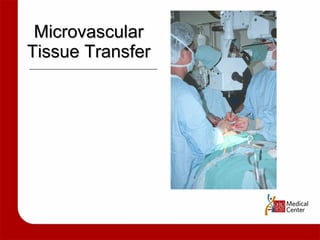
Microvascular Tissue Transfer
Microsurgical Breast Reconstruction Donor site options Free TRAM Muscle-sparing free TRAM DIEP SIEA S-GAP I-GAP Other
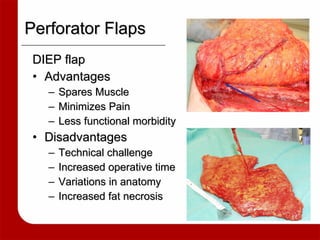
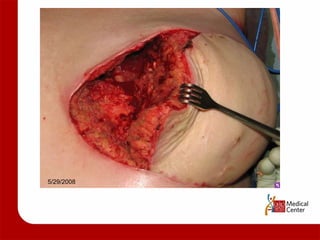
Perforator Flaps DIEP flap Advantages Spares Muscle  Minimizes Pain  Less functional morbidity  Disadvantages Technical challenge Increased operative time Variations in anatomy Increased fat necrosis
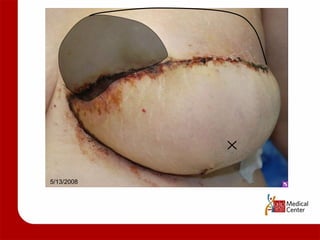
5/13/2008
5/29/2008
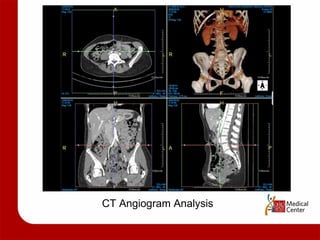
CT Angiogram Analysis
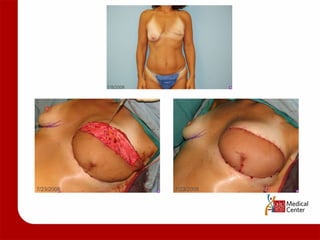
7/23/2008 7/23/2008
7/8/2008 7/23/2008 7/23/2008
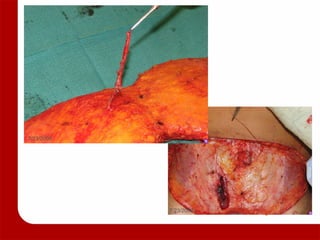
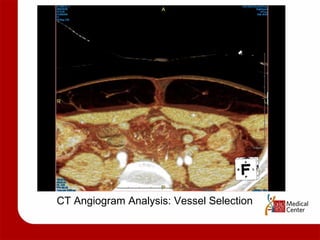
CT Angiogram Analysis: Vessel Selection
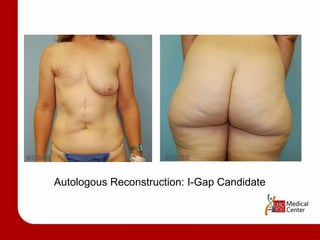
9/2/2008 9/2/2008 Autologous Reconstruction: I-Gap Candidate
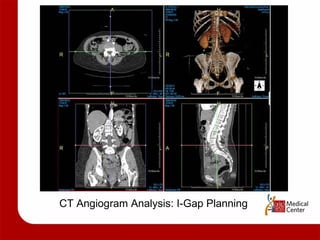
CT Angiogram Analysis: I-Gap Planning
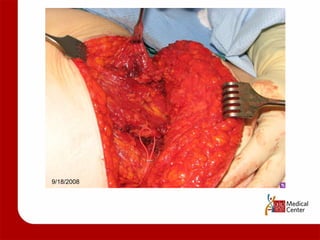
9/18/2008
Autologous Tissue Reconstruction Advantages Natural breast shape and behavior Natural consistency “ Tummy-tuck,” “buttocks lift” No foreign body Lower costs long-term Less emotional trauma
Autologous Tissue Reconstruction Disadvantages Longer surgical procedure Donor site scarring/deformity Possible Complications Longer hospitalization Longer recovery Greater initial cost
Ideal Abdominal Tissue Candidate Healthy No previous abdominal surgery Multiparous Non-smoker No plans of radiotherapy Compliant patient
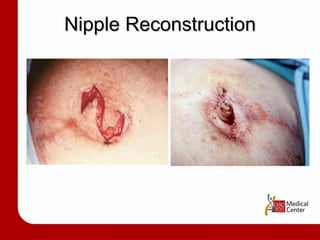
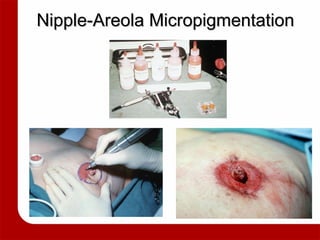
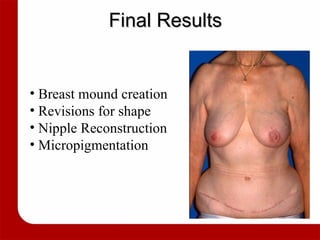
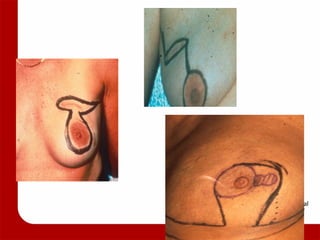
Adjunct Procedures Breast mound reshaping Contralateral modifications for symmetry Nipple reconstruction Nipple/areolar micropigmentation
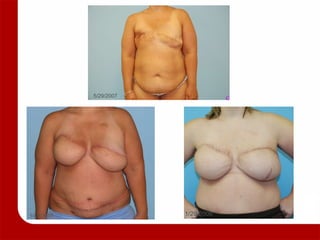
“ Breast reconstruction-  a process…  not an operation.”
5/29/2007 10/2/2007 1/29/2008
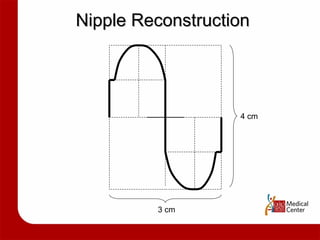
Nipple Reconstruction 3 cm 4 cm
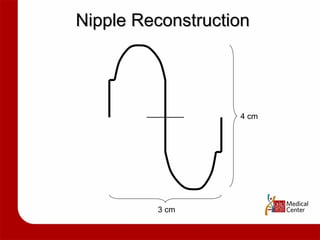
Nipple Reconstruction
Nipple-Areola Micropigmentation
Final Results Breast mound creation Revisions for shape Nipple Reconstruction Micropigmentation
Thank you! University Hospital James Cancer Hospital The Ohio State University Plastic Surgery …  to restore and make whole
 
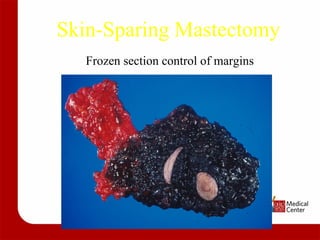
Skin-Sparing Mastectomy Frozen section control of margins
Oncologic Safety 51 breast cancer patients, Stages 0-II; 1991-1994 Median follow-up 45 months Local recurrence rate 2% Biopsies of incisions in 32 consecutive patients revealed no evidence of retained breast tissue Slavin, et al, Plast Reconstr Surg 1994; 93:1191-1204 Skin-Sparing Mastectomy
Local/Regional Recurrence*after  Skin-Sparing Mastectomy  Immediate Flap Reconstruction  (Stage ll) * Median follow-up 5.4 years **  None with stage 0 or stage I breast  cancer
Oncologic Safety of SSM vs. CM Local Recurrence Rate (T2 tumors) Kroll 104/SSM 271/CM Carlson 327/SSM 188/CM Simmons 77/SSM 154/CM SSM CM 15% 12% 9% 6% 3% 0%
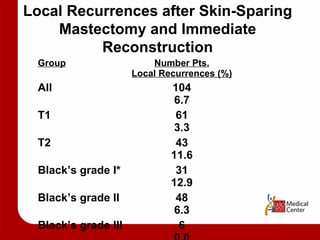
Local Recurrences after Skin-Sparing Mastectomy and Immediate Reconstruction Group Number Pts. Local Recurrences (%) All 104 6.7 T1 61 3.3 T2 43 11.6 Black’s grade I* 31 12.9 Black’s grade II 48 6.3 Black’s grade III 6 0.0 *The lower the grade, the more anaplastic the tumor Ann Surg Oncol 4:193-197,1997
Regional recurrence after skin-spring mastectomy is a function of the biology of the tumor and stage of disease
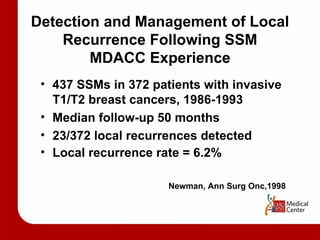
Detection and Management of Local Recurrence Following SSM MDACC Experience 437 SSMs in 372 patients with invasive T1/T2 breast cancers, 1986-1993 Median follow-up 50 months 23/372 local recurrences detected Local recurrence rate = 6.2% Newman, Ann Surg Onc,1998
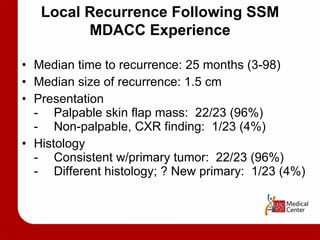
Local Recurrence Following SSM MDACC Experience Median time to recurrence: 25 months (3-98) Median size of recurrence: 1.5 cm Presentation - Palpable skin flap mass:  22/23 (96%) - Non-palpable, CXR finding:  1/23 (4%) Histology - Consistent w/primary tumor:  22/23 (96%) - Different histology; ? New primary:  1/23 (4%)
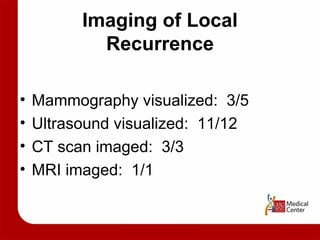
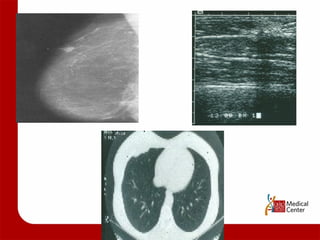
Imaging of Local Recurrence Mammography visualized:  3/5 Ultrasound visualized:  11/12 CT scan imaged:  3/3 MRI imaged:  1/1
 
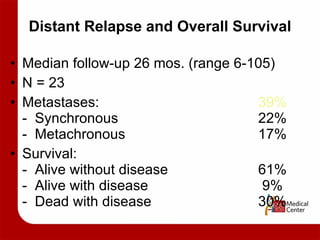
Distant Relapse and Overall Survival Median follow-up 26 mos. (range 6-105) N = 23 Metastases:  39%   -  Synchronous 22% -  Metachronous 17% Survival: -  Alive without disease 61% -  Alive with disease 9% -  Dead with disease 30%
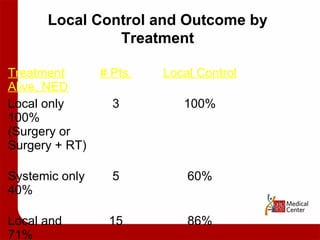
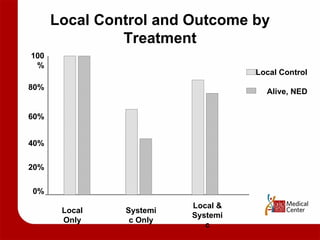
Local Control and Outcome by Treatment Treatment # Pts. Local Control  Alive, NED Local only 3 100% 100% (Surgery or Surgery + RT) Systemic only 5 60% 40% Local and  15 86% 71% Systemic
Local Control and Outcome by Treatment Local Only Systemic Only Local & Systemic Local Control Alive, NED 100% 80% 60% 40% 20% 0%
Skin Sparing Mastectomy Skin-sparing mastectomy with immediate breast reconstruction is oncologically safe and offers superior cosmetic results compared to conventional mastectomy Local recurrence rates are similar for skin-sparing and conventional mastectomies Most local recurrence are detected by physical exam within 3 years following skin-sparing mastectomy
Treatment approach depends on extent of local recurrence and presence of synchronous metastases, but resection of the reconstructed breast is  rarely  necessary Multimodality therapy usually results in excellent local control of disease and prolonged disease-free survival Skin Sparing Mastectomy
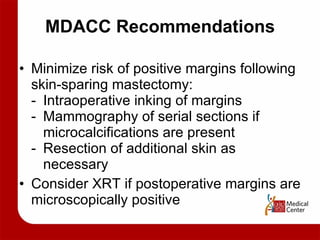
MDACC Recommendations Minimize risk of positive margins following skin-sparing mastectomy: - Intraoperative inking of margins - Mammography of serial sections if  microcalcifications are present - Resection of additional skin as  necessary Consider XRT if postoperative margins are microscopically positive
MDACC Recommendations Management of local recurrence: - Evaluate for distant metastatic disease - Breast ultrasound and mammography to  evaluate extent of recurrence - Multimodality therapy, including surgery  for resectable disease
Reservations Regarding  Skin-Sparing Mastectomy Technically more demanding:  Yes Increased surgical morbidity:  No Oncologic safety: Yes

2008 breast reconstruction (aust)

  • 1.
    Breast Reconstruction:Decision Making Surgical Planning Michael J. Miller, M.D. Professor of Surgery Director, Division of Plastic Surgery The Ohio State University
  • 2.
    Lifetime Probability ofDeveloping Cancer Source:DevCan: Probability of Developing or Dying of Cancer Soft ware, Version 5.1 Statistical Research and Applications Branch, NCI, 2003. http://srab.cancer.gov/devcan 1 in 59 Ovary 1 in 57 NH-Lymphoma 1 in38 Uterine corpus 1 in 18 Colon and rectum 1 in 17 Lung and bronchus 1 in 7 Breast 1 in 3 All Sites Risk Site
  • 3.
  • 4.
    Mastectomy/ No ReconstructionAdvantages no further surgery needed shorter surgery time/hospital stay symmetry restored with prosthesis may consider reconstruction in future Disadvantages scar on chest wall asymmetry in clothing external prosthetic can: dislodge be uncomfortable be impractical for athletic activities
  • 5.
    Breast Deformities Consequences:Aesthetic Functional Emotional Social Decreased Quality of Life
  • 6.
    Reconstruction Options ImmediateDelayed Timing Technique Tissue Tissue + Implant Implants alone
  • 7.
    Delayed Reconstruction Advantagesshorter hospital stay/ shorter recovery adjuvant therapy causes no complications to reconstruction allows patient time to consider reconstructive options Disadvantages soft tissue scar on chest wall requires additional surgery and recovery time difficult to reconstruct after scarring occurs
  • 8.
  • 9.
    Immediate Reconstruction Advantageslowers psychosocial morbidity lowers surgical morbidity superior cosmetic results lowers cost of surgery No difference in development or detection of local recurrences No delays in adjuvant therapies Disadvantages mastectomy skin flap necrosis possible longer hospitalization/recovery additional scars coordination required between surgeons
  • 10.
    Reconstruction Options ImmediateDelayed Timing Technique Tissue Tissue + Implant Implants alone
  • 11.
    Breast Reconstruction MethodsUTMDACC 1990 - 2000
  • 12.
    Implant Reconstruction Two-StageStage One: Tissue expansion Stage Two: Permanent implant placement One Stage Permanent implant placement Use of dermal matrix implants
  • 13.
    Implant Reconstruction TissueExpanders/Implants Advantages No additional scarring Shorter procedure/recovery Satisfactory shape in clothing Disadvantages Foreign body causing risk of infection Risk of rupture necessitating removal Risk of capsule formation and firmness Asymmetry Implant not permanent
  • 14.
    Two-Stage Implant ReconstructionPre-op Full Expansion Final Result
  • 15.
    Acellular Dermal Matrix(AlloDerm ® ) Zienowicz RJ. Karacaoglu E. Plastic & Reconstructive Surgery . 120(2):373-81, 2007
  • 16.
    Zienowicz RJ. KaracaogluE. Plastic & Reconstructive Surgery . 120(2):373-81, 2007
  • 17.
    Preminger BA. et.al. Annals of Plastic Surgery. 60(5):510-3, 2008.
  • 18.
    “ Well, thisis a fine mess …”
  • 19.
    Q. 1 “How in the world did we get here?” “ Well, this is a fine mess …”
  • 20.
    Q. 1 “How in the world did we get here?” Q. 2 “How do we avoid ever being back here again?” “ Well, this is a fine mess …”
  • 21.
    Breast Implantation AutologousTissue Contralateral breast (Verneuil, 1887) Lipoma (Czerny, 1895) Grafts and flaps of muscle, fascia, fat, and dermis
  • 22.
    paraffin, ivory, glass balls, ground rubber, ox cartilage, Terylene wool, gutta percha, Dicora, polyethylene chips, Ivalon sponge (poly(vinyl alcohol-formadehyde)), Ivalon in polyethylene sac, polyether foam sponge (Etheron), polyethylene (Polystan) tape or strips wound into a ball, polyurethane foam sponge, teflon-silicone prosthesis. Breast Implant Devices
  • 23.
    Breast Implantation Paraffin,Vaseline, “Organogen,” “Bioplaxm” Silicone oil + some combination of: ricinoleic acid, animal fatty acid, vegetable fatty acids, mineral oil, vegetable (castor) oil, olive oil, croton oil, peanut oil, concentrated vitamin D, snake venom, talc, beeswax, shellac, glazier’s puddy, epoxy resin, industrial silicone fluids Example: Sakurai (> 72,000 cases) Medical-grade silicone Direct Injections
  • 24.
    Silicone Implant AlternativesPain Skin discoloration, edema, ulceration, and necrosis Calcifications Granulomas Fluid migration Infection Cysts Axillary adenopathy Disfigurement Loss of the breast Liver dysfunction Pneumonitis/ARDS Pulomonary embolism Coma Death Complications
  • 25.
    Pre-Silicone Implant EraWomen wanted breast enhancement Many alternatives Many complications Ideal material not identified Non-rigorous trials… What was known:
  • 26.
    Silicone Breast Implants1950’s- shunts and joint replacements 1964- Cronin and Gerow Introduced silicone gel-filled breast implant Pre-clinical studies in dogs 1962-1968 Dow Corning- only manufacturer 1968-early 1990’s- Multiple manufacturers Dow Corning, Heyer-Schulte-Mentor, Cox-Uphoff International, Aesthetech Corp., Surgitek, Inamed-McGhan, Mammatech, foreign manufacturers, …
  • 27.
    Silicone Breast ImplantsEarly 1990’s, > 2 million women implanted!!
  • 28.
    Prior to 1970’s: little regulation or oversight…
  • 29.
    FDA Device Regulation1976- Medical Devices Amendments General and Plastic Surgery Advisory Panel Implants required general controls and performance standards only. 1982- FDA proposes reclassification as Class III device requiring stringent controls 1988- Changed to Class III status requiring pre-market approval (PMA) applications. 1992- Withdrawn from the market
  • 30.
  • 31.
    Clinical Value Determinedby: Affect on patient’s: Functional Status Risk Status Well being Cost Patient satisfaction and perceived benefit Clinical outcome Nelson EC. et al. Joint Commission Journal on Quality Improvement. 22(4):243-58, 1996
  • 32.
    Clinical Value Affecton patient’s: Functional Status Risk Status Well being Cost Satisfaction/perceived benefit Clinical outcome Pre-1991 acceptable + Value Score
  • 33.
    Clinical Value Affecton patient’s: Functional Status Risk Status Well being Cost Satisfaction/perceived benefit Clinical outcome Pre-1991 acceptable Post-1991 + Value Score acceptable ? ? ? ? ? ?
  • 34.
  • 35.
  • 36.
    Silicon Gel BreastImplants After all is said and done… Conclusions: Local complications are well described Systemic complications are not supported Patients must be informed 2006- Silicone Gel implants return to the U.S. market
  • 37.
    “ How inthe world did we get here?” “ How do we avoid being back here again?”
  • 38.
    Reconstruction Options ImmediateDelayed Timing Technique Tissue Tissue + Implant Implants alone
  • 39.
  • 40.
    Skin Sparing MastectomyThe ablative surgeon begins the reconstruction!
  • 41.
    Skin-Sparing Mastectomy Incisionsonly for: - Nipple and Areola - Access to the axilla - Biopsy scars - Skin areas “at risk”
  • 42.
  • 43.
    Pre-op Post-op SkinSparing Mastectomy
  • 44.
    Skin Sparing MastectomyMastectomy skin flap necrosis
  • 45.
    Oncologic Safety 51breast cancer patients, Stages 0-II; 1991-1994 Median follow-up 45 months Local recurrence rate 2% Biopsies of incisions in 32 consecutive patients revealed no evidence of retained breast tissue Slavin, et al, Plast Reconstr Surg 1994; 93:1191-1204 Skin-Sparing Mastectomy
  • 46.
    Oncologic Safety ofSSM vs. CM Local Recurrence Rate (T2 tumors) Kroll 104/SSM 271/CM Carlson 327/SSM 188/CM Simmons 77/SSM 154/CM SSM CM 15% 12% 9% 6% 3% 0%
  • 47.
    Skin Sparing MastectomySkin-sparing mastectomy with immediate breast reconstruction is oncologically safe and offers superior cosmetic results compared to conventional mastectomy Local recurrence rates are similar for skin-sparing and conventional mastectomies Most local recurrence are detected by physical exam within 3 years following skin-sparing mastectomy
  • 48.
    Technically more demandingOncological safety Superior aesthetic results Skin Sparing Mastectomy
  • 49.
  • 50.
  • 51.
    Latissimus Dorsi Flap+ Implant Pre-op Post-op Donor site scar
  • 52.
    LD flap- EndoscopicHarvest Post-op. ( 3/1/2005) Pre-op. ( 1/13/2004)
  • 53.
    LD flap- EndoscopicHarvest Pre-op Post-op
  • 54.
    Reconstruction Options ImmediateDelayed Timing Technique Tissue Tissue + Implant Implants alone
  • 55.
  • 56.
  • 57.
    Pedicled TRAM Proneto venous insufficiency leading to fat necrosis Download illustrations from Moon and Taylor
  • 58.
  • 59.
    Microsurgical Breast ReconstructionDonor site options Free TRAM Muscle-sparing free TRAM DIEP SIEA S-GAP I-GAP Other
  • 60.
    Perforator Flaps DIEPflap Advantages Spares Muscle Minimizes Pain Less functional morbidity Disadvantages Technical challenge Increased operative time Variations in anatomy Increased fat necrosis
  • 61.
  • 62.
  • 63.
  • 64.
  • 65.
  • 66.
    CT Angiogram Analysis:Vessel Selection
  • 67.
    9/2/2008 9/2/2008 AutologousReconstruction: I-Gap Candidate
  • 68.
    CT Angiogram Analysis:I-Gap Planning
  • 69.
  • 70.
    Autologous Tissue ReconstructionAdvantages Natural breast shape and behavior Natural consistency “ Tummy-tuck,” “buttocks lift” No foreign body Lower costs long-term Less emotional trauma
  • 71.
    Autologous Tissue ReconstructionDisadvantages Longer surgical procedure Donor site scarring/deformity Possible Complications Longer hospitalization Longer recovery Greater initial cost
  • 72.
    Ideal Abdominal TissueCandidate Healthy No previous abdominal surgery Multiparous Non-smoker No plans of radiotherapy Compliant patient
  • 73.
    Adjunct Procedures Breastmound reshaping Contralateral modifications for symmetry Nipple reconstruction Nipple/areolar micropigmentation
  • 74.
    “ Breast reconstruction- a process… not an operation.”
  • 75.
  • 76.
  • 77.
  • 78.
  • 79.
  • 80.
    Final Results Breastmound creation Revisions for shape Nipple Reconstruction Micropigmentation
  • 81.
    Thank you! UniversityHospital James Cancer Hospital The Ohio State University Plastic Surgery … to restore and make whole
  • 82.
  • 83.
    Skin-Sparing Mastectomy Frozensection control of margins
  • 84.
    Oncologic Safety 51breast cancer patients, Stages 0-II; 1991-1994 Median follow-up 45 months Local recurrence rate 2% Biopsies of incisions in 32 consecutive patients revealed no evidence of retained breast tissue Slavin, et al, Plast Reconstr Surg 1994; 93:1191-1204 Skin-Sparing Mastectomy
  • 85.
    Local/Regional Recurrence*after Skin-Sparing Mastectomy Immediate Flap Reconstruction (Stage ll) * Median follow-up 5.4 years ** None with stage 0 or stage I breast cancer
  • 86.
    Oncologic Safety ofSSM vs. CM Local Recurrence Rate (T2 tumors) Kroll 104/SSM 271/CM Carlson 327/SSM 188/CM Simmons 77/SSM 154/CM SSM CM 15% 12% 9% 6% 3% 0%
  • 87.
    Local Recurrences afterSkin-Sparing Mastectomy and Immediate Reconstruction Group Number Pts. Local Recurrences (%) All 104 6.7 T1 61 3.3 T2 43 11.6 Black’s grade I* 31 12.9 Black’s grade II 48 6.3 Black’s grade III 6 0.0 *The lower the grade, the more anaplastic the tumor Ann Surg Oncol 4:193-197,1997
  • 88.
    Regional recurrence afterskin-spring mastectomy is a function of the biology of the tumor and stage of disease
  • 89.
    Detection and Managementof Local Recurrence Following SSM MDACC Experience 437 SSMs in 372 patients with invasive T1/T2 breast cancers, 1986-1993 Median follow-up 50 months 23/372 local recurrences detected Local recurrence rate = 6.2% Newman, Ann Surg Onc,1998
  • 90.
    Local Recurrence FollowingSSM MDACC Experience Median time to recurrence: 25 months (3-98) Median size of recurrence: 1.5 cm Presentation - Palpable skin flap mass: 22/23 (96%) - Non-palpable, CXR finding: 1/23 (4%) Histology - Consistent w/primary tumor: 22/23 (96%) - Different histology; ? New primary: 1/23 (4%)
  • 91.
    Imaging of LocalRecurrence Mammography visualized: 3/5 Ultrasound visualized: 11/12 CT scan imaged: 3/3 MRI imaged: 1/1
  • 92.
  • 93.
    Distant Relapse andOverall Survival Median follow-up 26 mos. (range 6-105) N = 23 Metastases: 39% - Synchronous 22% - Metachronous 17% Survival: - Alive without disease 61% - Alive with disease 9% - Dead with disease 30%
  • 94.
    Local Control andOutcome by Treatment Treatment # Pts. Local Control Alive, NED Local only 3 100% 100% (Surgery or Surgery + RT) Systemic only 5 60% 40% Local and 15 86% 71% Systemic
  • 95.
    Local Control andOutcome by Treatment Local Only Systemic Only Local & Systemic Local Control Alive, NED 100% 80% 60% 40% 20% 0%
  • 96.
    Skin Sparing MastectomySkin-sparing mastectomy with immediate breast reconstruction is oncologically safe and offers superior cosmetic results compared to conventional mastectomy Local recurrence rates are similar for skin-sparing and conventional mastectomies Most local recurrence are detected by physical exam within 3 years following skin-sparing mastectomy
  • 97.
    Treatment approach dependson extent of local recurrence and presence of synchronous metastases, but resection of the reconstructed breast is rarely necessary Multimodality therapy usually results in excellent local control of disease and prolonged disease-free survival Skin Sparing Mastectomy
  • 98.
    MDACC Recommendations Minimizerisk of positive margins following skin-sparing mastectomy: - Intraoperative inking of margins - Mammography of serial sections if microcalcifications are present - Resection of additional skin as necessary Consider XRT if postoperative margins are microscopically positive
  • 99.
    MDACC Recommendations Managementof local recurrence: - Evaluate for distant metastatic disease - Breast ultrasound and mammography to evaluate extent of recurrence - Multimodality therapy, including surgery for resectable disease
  • 100.
    Reservations Regarding Skin-Sparing Mastectomy Technically more demanding: Yes Increased surgical morbidity: No Oncologic safety: Yes

Editor's Notes

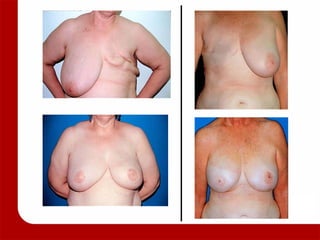
  • #9 They are able to achieve wonderful results in reconstruction like these patients who have had breast reconstruction following mastectomy, where patient quality of life is markedly increased from an emotional, physical, and cosmesis standpoint. Despite results like these , clinical limitations in reconstruction following tumor removal are often realized.
  • #23 Guta Percha- a natural resin rubber from a malaysian tree called the Isonandra Gutta tree Terylene, a polyester fiber, the first wholly synthetic fibre invented in the United Kingdom.