DR. YAJNADATTA SARANGI
GUIDED BY-DR. SUNIL KUMAR
ASST. PROFESSOR
DEPT. OF GENERAL SURGERY
HYPERTHERMIC INTRAPERITONEAL
CHEMOTHERAPY
BASICS
 Principle of giving intraperitoneal chemotherapy
in presence of high temperature for peritoneal
metastasis.
 Almost always given combined with Cyto
reductive surgery
PERITONEAL CARCINOMATOSIS
 Shedding, implantation and dissemination of a
tumor, either localized or widespread to
peritoneum and serosal surface of intra peritoneal
viscera as well as adjacent structure of abdominal
cavity
 Traditionally considered as end stage disease
 With palliative chemo median survival was 6
month
DR. Paul Sugarbaker
Pioneer in CRS AND HIPEC
IN HIS EXTENSIVE STUDY IN PERITONEAL CARCINOMATOSIS HE SHOWED A
ASTONISHING RESULT OF MEDIAN SURVIVAL OF 17 YR
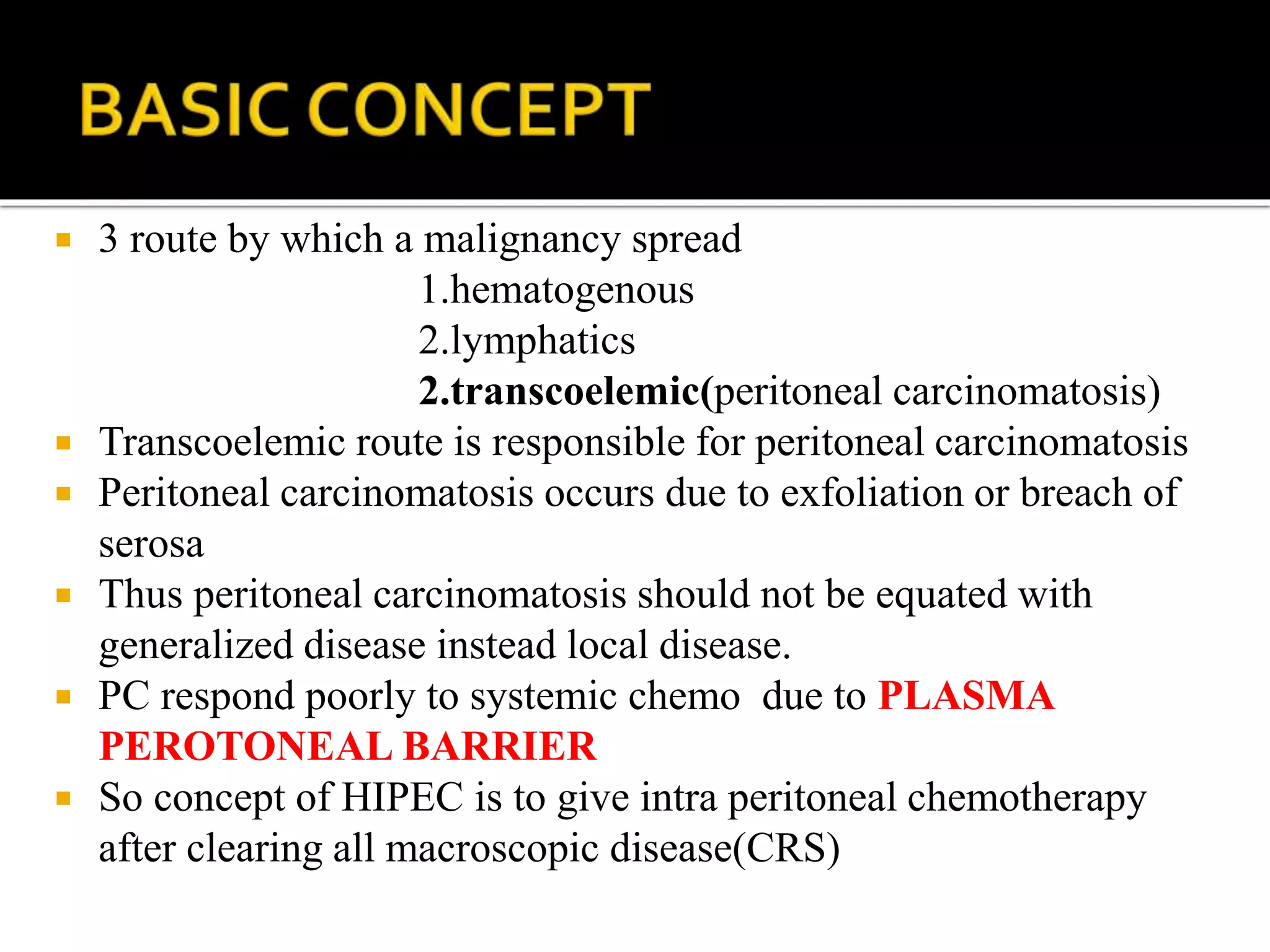
 3 route by which a malignancy spread
1.hematogenous
2.lymphatics
2.transcoelemic(peritoneal carcinomatosis)
 Transcoelemic route is responsible for peritoneal carcinomatosis
 Peritoneal carcinomatosis occurs due to exfoliation or breach of
serosa
 Thus peritoneal carcinomatosis should not be equated with
generalized disease instead local disease.
 PC respond poorly to systemic chemo due to PLASMA
PEROTONEAL BARRIER
 So concept of HIPEC is to give intra peritoneal chemotherapy
after clearing all macroscopic disease(CRS)
TUMOR
Rationale
 Synergistic cytotoxic effect of heat (42 to 43
degree) and chemotherapy
 Hyperthermia itself has anticancer activity
 This temperature causes protein denaturation,
impairs DNA repair and inhibit oxidative
metabolism
 Vasodilatation improving tumor oxygenation
which improves effect of chemotherapeutic agent
 Heat increases optimal diffusion of chemotherapy
 Heat increases concentration of chemo drugs in
peritoneum
 HIPEC almost always given in association with
cyto reductive surgery
 CRS take care of macroscopic disease in
peritoneal cavity
 HIPEC takes care of microscopic disease in
peritoneal cavity
 Chemotherapeutic drugs like mitomycin C have a
high intra peritoneal concentration than plasma
concentration
 CT drugs have limited penetration through nodule
 So for HIPEC to be effective only when residual
tumor size after CRS not more than 2mm(2.5mm)
 Completeness of cytoreduction is one of the
significant factor affecting survival after HIPEC
 Staging laparoscopy
CYTOREDUCTIVE SURGERY
 Removal of all visible peritoneal deposits,
peritoneum,omentum and involved other organs.
CRS Maximum
score13*3=39
CRS
 Midline incision
 All 13 region evaluated
 Peritoneum from right and left hemidiphgram,
right and left paracolic gutter and pelvic
peritoneum excised(peritonectomy)
 Adjacent organ removed if necessary
 Greater omentum , lesser omentum removed
 Glissonian capsule if required
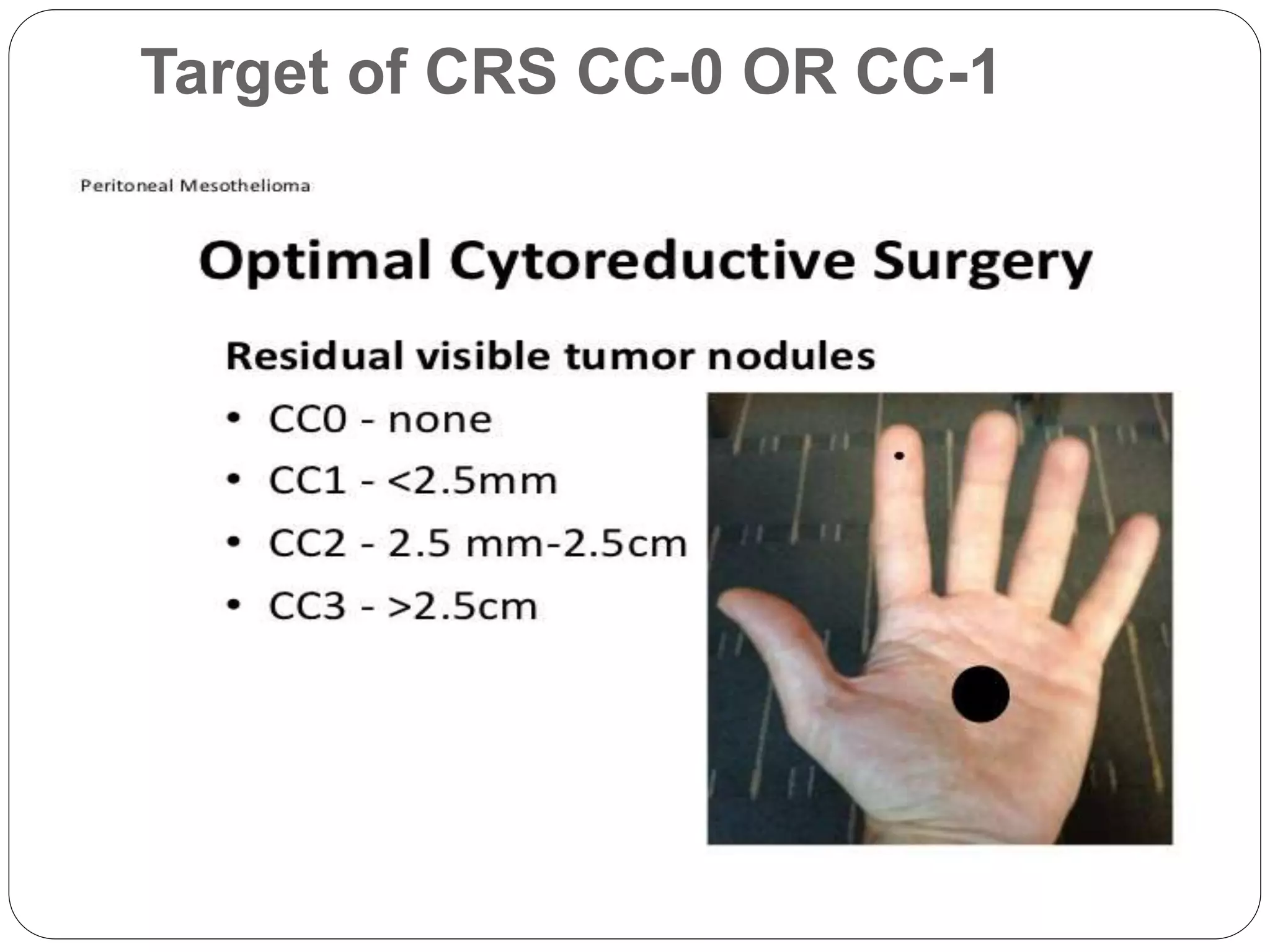
Target of CRS CC-0 OR CC-1
HIPEC TECHNIQUES
3 methods to administer intraperitoneal
chemotherapy
 OPEN(COLLOSIUM)
 CLOSED
 SEMICLOSED
Open Technique
 Hyperthermic solution administered and manually
stirred
 Uniformly distribute hyperthermia solution to
all quadrant of abdomen
ADVANTAGE-uniformly distributed in all quadrant
DISADVANTGE-difficult to maintain temperature
theoretical exposure to team
Semiclosed HIPEC
 Abdomen covered with plastic sheet and small
opening given through which surgeon
manipulates
Disadv-Non uniform distribution
Adv-temperature better controlled
Closed HIPEC
Abdomen closed completely and through multiple catheter
chemo administered.
Advantages-earlier achievement of required
temperature
Safer for care givers
Disadvantage-
non uniform distribution
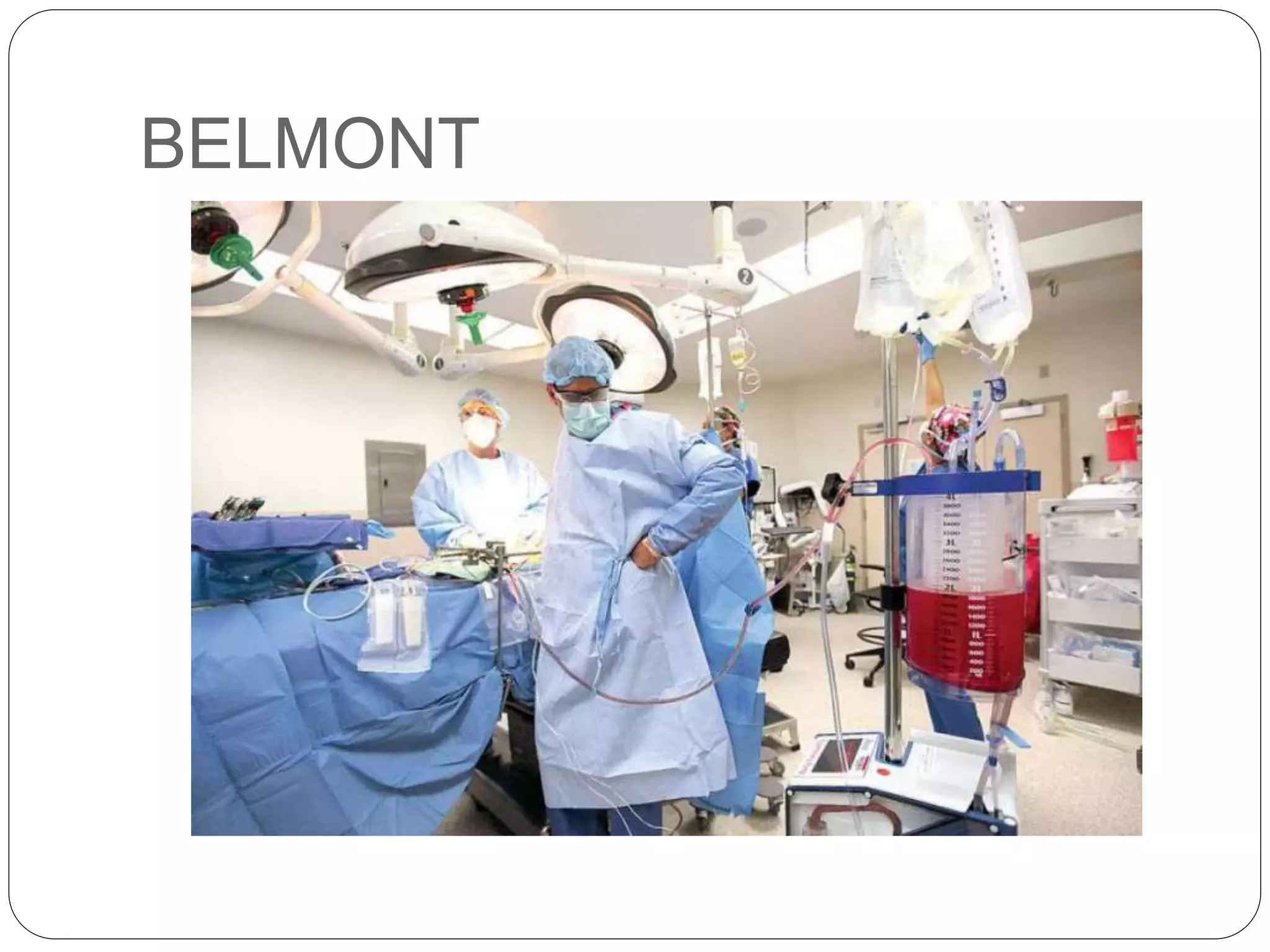
BELMONT Technique(closed)
 First 2 L of isotonic fluid administered at 43 to
44 degree
 At 40 degree CT agent added
 Also given IV chemo
simultaneously(BIDIRECTIONAL
CHEMOTHERAPY)
 Drain inserted in all five peritonectomy region
 Duration of HIPEC depends on drugs
MITOMYCIN C-90MINS
OXALIPLATIN -30MINS
BELMONT
Types of intraperitoneal chemotherapy regimen
1.Neoadjuvant intraperitoneal plus
intravenous chemotherapy
 Pt in whom PC diagnose at staging laparoscopy
 both IV and IP chemotherapy given to downgrade
PC
 prevent dissemination
 Definitive surgery done after 3-4 cycles
 Disadvantage-extensive adhesion occurs
2.Intraoperative HIPEC plus intravenous
chemotherapy
 Most widely used
 IP chemo at time of CRS and IV Chemo after CRS
2.EPIC(Early postoperative intraperitoneal
chemotherapy)
 IP chemo given through drains on POD 1 to 5
 Drugs given over 1 hour and drains are clamped for next 23
hour
4.Adjuvant intraperitoneal and systemic
chemotherapy
through drain place through index CRS
adjuvant chemo given
Indications of CRS and HIPEC
 Psedomyxoma peritoni
 Peritoneal mesothelioma
 Primary colon and rectal cancer with
peritoneal seeding(M1C)
 Colorectal carcinoma with peritoneal cytology
positive
 Ovarian carcinoma with PC
 Primary gastric cancer
Contraindications to CRs+HIPEC
 Poor performance status(ECOG <2)
 Presence of extrabdominal metastasis
 Diffuse widespread PC
 Presence of unresectable liver metastasis
 Presence of more than 3 or more resectable
metastasis in liver
 Evidence of ureteric or billiary obstruction
 More than one site of small bowel involvement or
gross involvement of small bowel
 Even small volume disease in hepatodudenal
ligament
 PCI MORE THAN 17 (20)
complication
 Morbidity(22-34%)
 Mortality(.8-1.4%)
 Hematological toxicity
 Entero cutaneous fistula
 Sepsis
 Intrabodminal sepsis
 Wound morbidity
 Higher the PCI higher the morbidity
 Hematological toxicity more after mitomycin C
 Pulmonary complications due to subdiphgramtic
peritoneal stripping
 Oxaliplatin associated with higher intraabdominal
bleeding
 M1C
 STAGE 4 DISEASE
 Previously palliation preferred
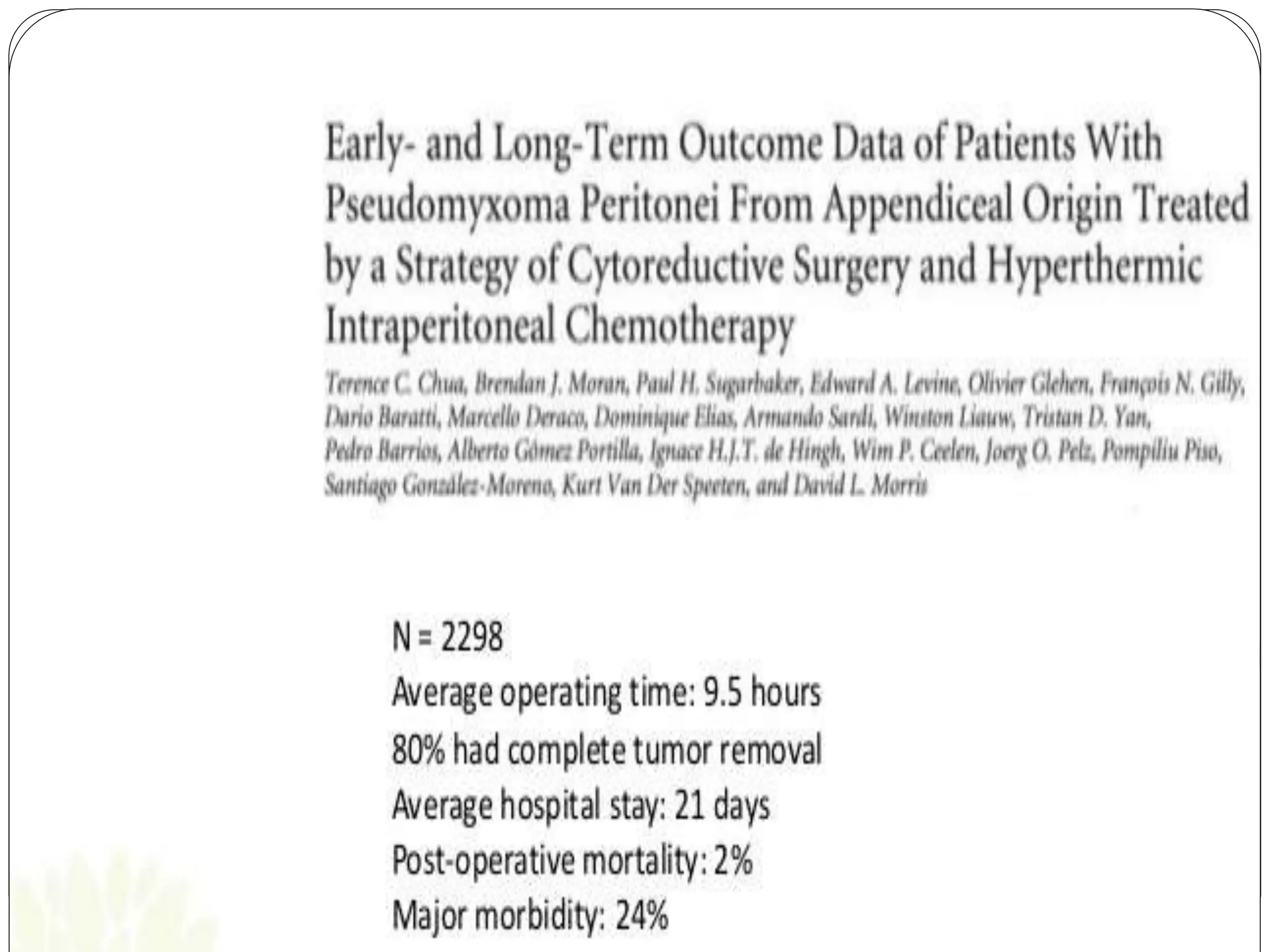
 Verwal et al-
 Palliation and chemo vs CRS and HIPEC
 Better survival with hipec
 PRODIGE 7TRIAL
 Oxaliplatin HIPEC and CRS better survival
 NCCN-good PS, limited PC(PCI LESSTHAN
17),R0 OR CC-0/1
 Consider neoadjuvant FOLFIRIWith
Bevacizumab before CRS and HIPEC
 Mitomycin C vs oxaliplatin in HIPEC
Prophylactic HIPEC in colorectal
carcinoma
 T4a
 N2
 Mucinous histology
 Incomplete resection in emergency setting
Psedomyxoma peritonei
 Gelatinous ascitis and multifocal peritoneal
epithelial implants secreting copious globules of
extra cellular mucin
 Most commonly associated with appendicular
adenocarcinoma
 3 types
 Disseminated peritoneal carcinomatosis(DPAM)
 Peritoneal mucinous carcinomatosis(PMCA)
 PMCA with intermediate prognosis
 Excellent survival after CRS and HIPEC
 Sugarbaker et al- median survival of 17 year
GASTRIC CANCER
3 scenario
 Prophylactic HIPEC in advanced gastric cancer to
prevent PC
 In established case of PC
 Palliative for intractable ascitis
Mitomycin c and cisplatin used
Ovarian cancer
 Majority are stage 3(spread through PT cavity) at
diagnosis
 CRS+HIPEC preferred for patient with stage 3
and 4 Epithelial ovarian carcinoma with no
residual disease more than 1cm
 Paclitaxel and cisplatin are standard
 NCCN – CISPLATIN
PERITONEAL MESOTHELIOMA
 Patient with PCI score less than 20 ideal
candidate
 Epitheloid variant showed better response than
sarcomatoid and biphasic variant
 IP cisplatin standard
Conclusion
 Patients of CRS, PMP,Ovarian carcinoma with
peritoneal carcinomatosis should offered HIPEC
and CRS
 HIPEC preferred if only CC0 OR CC1 achieved
by CRS i.e less than 2.5mm
 Best results are with appendicular
adenocarcinoma with PC(PMP)
 https://www.youtube.com/watch?v=UYhdq8AlkTg
THANK YOU

Hyperthermic intraperitoneal chemotherapy

  • 1.
    DR. YAJNADATTA SARANGI GUIDEDBY-DR. SUNIL KUMAR ASST. PROFESSOR DEPT. OF GENERAL SURGERY HYPERTHERMIC INTRAPERITONEAL CHEMOTHERAPY
  • 2.
    BASICS  Principle ofgiving intraperitoneal chemotherapy in presence of high temperature for peritoneal metastasis.  Almost always given combined with Cyto reductive surgery
  • 3.
    PERITONEAL CARCINOMATOSIS  Shedding,implantation and dissemination of a tumor, either localized or widespread to peritoneum and serosal surface of intra peritoneal viscera as well as adjacent structure of abdominal cavity  Traditionally considered as end stage disease  With palliative chemo median survival was 6 month
  • 4.
    DR. Paul Sugarbaker Pioneerin CRS AND HIPEC IN HIS EXTENSIVE STUDY IN PERITONEAL CARCINOMATOSIS HE SHOWED A ASTONISHING RESULT OF MEDIAN SURVIVAL OF 17 YR
  • 7.
     3 routeby which a malignancy spread 1.hematogenous 2.lymphatics 2.transcoelemic(peritoneal carcinomatosis)  Transcoelemic route is responsible for peritoneal carcinomatosis  Peritoneal carcinomatosis occurs due to exfoliation or breach of serosa  Thus peritoneal carcinomatosis should not be equated with generalized disease instead local disease.  PC respond poorly to systemic chemo due to PLASMA PEROTONEAL BARRIER  So concept of HIPEC is to give intra peritoneal chemotherapy after clearing all macroscopic disease(CRS)
  • 8.
  • 9.
    Rationale  Synergistic cytotoxiceffect of heat (42 to 43 degree) and chemotherapy  Hyperthermia itself has anticancer activity  This temperature causes protein denaturation, impairs DNA repair and inhibit oxidative metabolism  Vasodilatation improving tumor oxygenation which improves effect of chemotherapeutic agent  Heat increases optimal diffusion of chemotherapy  Heat increases concentration of chemo drugs in peritoneum
  • 10.
     HIPEC almostalways given in association with cyto reductive surgery  CRS take care of macroscopic disease in peritoneal cavity  HIPEC takes care of microscopic disease in peritoneal cavity  Chemotherapeutic drugs like mitomycin C have a high intra peritoneal concentration than plasma concentration
  • 11.
     CT drugshave limited penetration through nodule  So for HIPEC to be effective only when residual tumor size after CRS not more than 2mm(2.5mm)  Completeness of cytoreduction is one of the significant factor affecting survival after HIPEC  Staging laparoscopy
  • 12.
    CYTOREDUCTIVE SURGERY  Removalof all visible peritoneal deposits, peritoneum,omentum and involved other organs.
  • 13.
  • 14.
    CRS  Midline incision All 13 region evaluated  Peritoneum from right and left hemidiphgram, right and left paracolic gutter and pelvic peritoneum excised(peritonectomy)  Adjacent organ removed if necessary  Greater omentum , lesser omentum removed  Glissonian capsule if required
  • 15.
    Target of CRSCC-0 OR CC-1
  • 16.
    HIPEC TECHNIQUES 3 methodsto administer intraperitoneal chemotherapy  OPEN(COLLOSIUM)  CLOSED  SEMICLOSED
  • 17.
    Open Technique  Hyperthermicsolution administered and manually stirred  Uniformly distribute hyperthermia solution to all quadrant of abdomen ADVANTAGE-uniformly distributed in all quadrant DISADVANTGE-difficult to maintain temperature theoretical exposure to team
  • 19.
    Semiclosed HIPEC  Abdomencovered with plastic sheet and small opening given through which surgeon manipulates Disadv-Non uniform distribution Adv-temperature better controlled
  • 21.
    Closed HIPEC Abdomen closedcompletely and through multiple catheter chemo administered. Advantages-earlier achievement of required temperature Safer for care givers Disadvantage- non uniform distribution
  • 22.
    BELMONT Technique(closed)  First2 L of isotonic fluid administered at 43 to 44 degree  At 40 degree CT agent added  Also given IV chemo simultaneously(BIDIRECTIONAL CHEMOTHERAPY)  Drain inserted in all five peritonectomy region
  • 23.
     Duration ofHIPEC depends on drugs MITOMYCIN C-90MINS OXALIPLATIN -30MINS
  • 24.
  • 25.
    Types of intraperitonealchemotherapy regimen 1.Neoadjuvant intraperitoneal plus intravenous chemotherapy  Pt in whom PC diagnose at staging laparoscopy  both IV and IP chemotherapy given to downgrade PC  prevent dissemination  Definitive surgery done after 3-4 cycles  Disadvantage-extensive adhesion occurs
  • 26.
    2.Intraoperative HIPEC plusintravenous chemotherapy  Most widely used  IP chemo at time of CRS and IV Chemo after CRS 2.EPIC(Early postoperative intraperitoneal chemotherapy)  IP chemo given through drains on POD 1 to 5  Drugs given over 1 hour and drains are clamped for next 23 hour
  • 27.
    4.Adjuvant intraperitoneal andsystemic chemotherapy through drain place through index CRS adjuvant chemo given
  • 28.
    Indications of CRSand HIPEC  Psedomyxoma peritoni  Peritoneal mesothelioma  Primary colon and rectal cancer with peritoneal seeding(M1C)  Colorectal carcinoma with peritoneal cytology positive  Ovarian carcinoma with PC  Primary gastric cancer
  • 29.
    Contraindications to CRs+HIPEC Poor performance status(ECOG <2)  Presence of extrabdominal metastasis  Diffuse widespread PC  Presence of unresectable liver metastasis  Presence of more than 3 or more resectable metastasis in liver  Evidence of ureteric or billiary obstruction  More than one site of small bowel involvement or gross involvement of small bowel  Even small volume disease in hepatodudenal ligament  PCI MORE THAN 17 (20)
  • 30.
    complication  Morbidity(22-34%)  Mortality(.8-1.4%) Hematological toxicity  Entero cutaneous fistula  Sepsis  Intrabodminal sepsis  Wound morbidity
  • 31.
     Higher thePCI higher the morbidity  Hematological toxicity more after mitomycin C  Pulmonary complications due to subdiphgramtic peritoneal stripping  Oxaliplatin associated with higher intraabdominal bleeding
  • 32.
     M1C  STAGE4 DISEASE  Previously palliation preferred
  • 33.
     Verwal etal-  Palliation and chemo vs CRS and HIPEC  Better survival with hipec  PRODIGE 7TRIAL  Oxaliplatin HIPEC and CRS better survival  NCCN-good PS, limited PC(PCI LESSTHAN 17),R0 OR CC-0/1  Consider neoadjuvant FOLFIRIWith Bevacizumab before CRS and HIPEC  Mitomycin C vs oxaliplatin in HIPEC
  • 35.
    Prophylactic HIPEC incolorectal carcinoma  T4a  N2  Mucinous histology  Incomplete resection in emergency setting
  • 36.
    Psedomyxoma peritonei  Gelatinousascitis and multifocal peritoneal epithelial implants secreting copious globules of extra cellular mucin  Most commonly associated with appendicular adenocarcinoma  3 types  Disseminated peritoneal carcinomatosis(DPAM)  Peritoneal mucinous carcinomatosis(PMCA)  PMCA with intermediate prognosis  Excellent survival after CRS and HIPEC  Sugarbaker et al- median survival of 17 year
  • 37.
    GASTRIC CANCER 3 scenario Prophylactic HIPEC in advanced gastric cancer to prevent PC  In established case of PC  Palliative for intractable ascitis Mitomycin c and cisplatin used
  • 38.
    Ovarian cancer  Majorityare stage 3(spread through PT cavity) at diagnosis  CRS+HIPEC preferred for patient with stage 3 and 4 Epithelial ovarian carcinoma with no residual disease more than 1cm  Paclitaxel and cisplatin are standard  NCCN – CISPLATIN
  • 39.
    PERITONEAL MESOTHELIOMA  Patientwith PCI score less than 20 ideal candidate  Epitheloid variant showed better response than sarcomatoid and biphasic variant  IP cisplatin standard
  • 40.
    Conclusion  Patients ofCRS, PMP,Ovarian carcinoma with peritoneal carcinomatosis should offered HIPEC and CRS  HIPEC preferred if only CC0 OR CC1 achieved by CRS i.e less than 2.5mm  Best results are with appendicular adenocarcinoma with PC(PMP)
  • 41.
  • 42.