





Cytoreductive Surgery plus
HIPEC:
NEW STANDARD for Treating
Peritoneal Surface Malignancies
Mary Ondinee M. Igot, MD, MSCM, FPCP, FPSO,
FPSMO
Medical Oncologist / Neuro – Oncologist
Outline
• Peritoneal Metastases
• Cytoreductive Surgery plus Hyperthermic
Intraperitoneal Chemotherapy (CRS-HIPEC) for
Peritoneal Metastases
• Fundamentals
• Technical Requirements
• Chemotherapy Used
• The Right Patient
Peritoneal Metastases
• Peritoneal dissemination from gastrointestinal and
gynecological malignancies is common.
• Traditionally, it has been regarded as an end-stage
disease which was only amenable to palliation and
systemic chemotherapy.
• Poor literature on effective treatments because they
are often excluded from clinical trials because they
have “non-measurable disease.”
Peritoneal Metastases
• NIHILISTIC ATTITUDE toward this condition.
• Second most common cause of death after liver metastases
• Prone to frequent hospitalizations because of recurrent
obstruction and intraabdominal infections
• Virtually incurable
• AVERAGE LIFE EXPECTANCY: 6 months
• With best systemic chemotherapy,
• MEDIAN OVERALL SURVIVAL: 20 months
• MEDIAN DISEASE FREE SURVIVAL: 10 months
Cytoreductive Surgery (CRS) =
Peritonectomy + Organ Resection
• 1930s, attempting to remove all visible deposits was
reported for ovarian cancers and eventually was
accepted as a treatment with survival benefit.
• Attempts have been done in various non-gynecologic
malignancies.
“It is what the surgeon does not see
that kills the patient.”
• Paul Sugarbaker
• Peritoneal metastases should
not be equated with
generalized disease.
• Involvement of the peritoneal
surfaces may occur in the
absence of hematogeneous
metastases or it may
represent the dominant clinical
picture.
• Peritoneal metastases =
Locoregional disease
The Sugarbaker
Technique
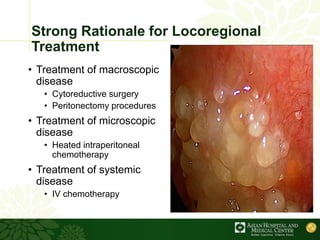
Strong Rationale for Locoregional
Treatment
• Treatment of macroscopic
disease
• Cytoreductive surgery
• Peritonectomy procedures
• Treatment of microscopic
disease
• Heated intraperitoneal
chemotherapy
• Treatment of systemic
disease
• IV chemotherapy
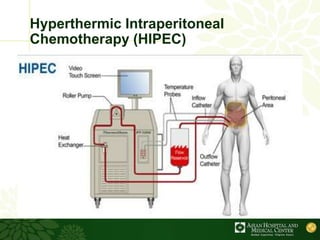
Hyperthermic Intraperitoneal
Chemotherapy (HIPEC)
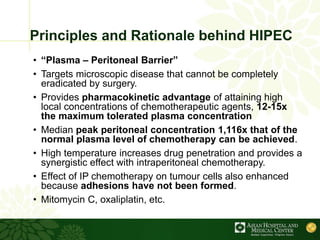
Principles and Rationale behind HIPEC
• “Plasma – Peritoneal Barrier”
• Targets microscopic disease that cannot be completely
eradicated by surgery.
• Provides pharmacokinetic advantage of attaining high
local concentrations of chemotherapeutic agents, 12-15x
the maximum tolerated plasma concentration
• Median peak peritoneal concentration 1,116x that of the
normal plasma level of chemotherapy can be achieved.
• High temperature increases drug penetration and provides a
synergistic effect with intraperitoneal chemotherapy.
• Effect of IP chemotherapy on tumour cells also enhanced
because adhesions have not been formed.
• Mitomycin C, oxaliplatin, etc.
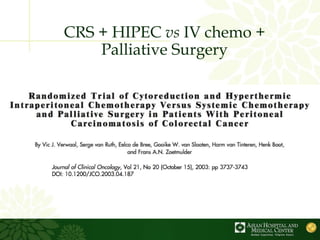
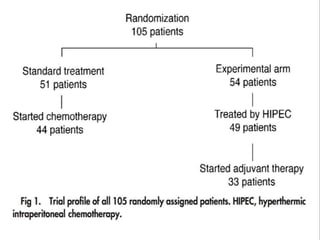
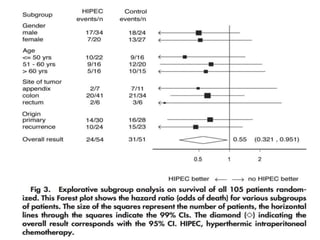
CRS + HIPEC vs IV chemo +
Palliative Surgery
12.6 months
22.4 months
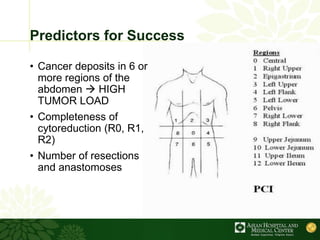
Predictors for Success
• Cancer deposits in 6 or
more regions of the
abdomen  HIGH
TUMOR LOAD
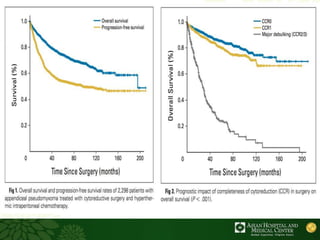
• Completeness of
cytoreduction (R0, R1,
R2)
• Number of resections
and anastomoses
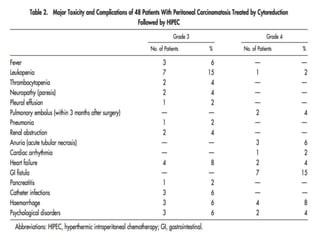
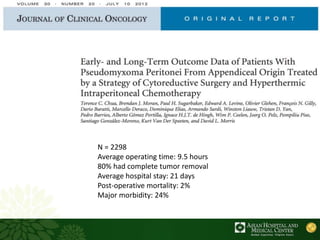
N = 2298
Average operating time: 9.5 hours
80% had complete tumor removal
Average hospital stay: 21 days
Post-operative mortality: 2%
Major morbidity: 24%
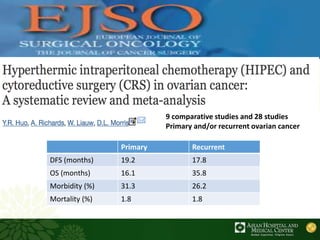
9 comparative studies and 28 studies
Primary and/or recurrent ovarian cancer
Primary Recurrent
DFS (months) 19.2 17.8
OS (months) 16.1 35.8
Morbidity (%) 31.3 26.2
Mortality (%) 1.8 1.8
Present Indications
• Pseudomyxoma peritoneii or jelly belly
• Appendiceal adenocarcinoma
• Peritoneal mesothelioma
• Colorectal cancer with peritoneal metastases
• Ovarian cancer with peritoneal metastases
• Gastric cancer with peritoneal metastases
The Eligible Patient
• Patient-Related Criteria
• Good performance status
• No major comorbidities
• BMI > 35 is a relative contraindication
• Physiologic age is considered
• Patients less than 65 yrs are good candidates
• If more than 65 yrs, carefully selected
• Patient must be motivated and must understand and accept the
risks of the procedure
• Disease-Related Criteria
• Primary cancer: Ovarian, CRC, primary peritoneal,
mesothelioma  considered as part of standard care already
• Others: gastric, sarcoma, etc…
• Histology: Signet ring, poorly differentiated/undifferentiated
The Eligible Patient
• Absolute Contraindications:
• Extra-abdominal disease
• Extensive intra-abdominal disease
• Cancer of unknown primary
The Eligible Patient
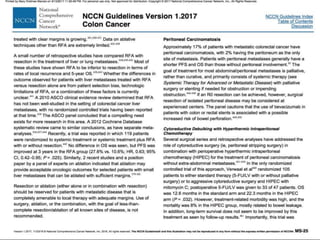
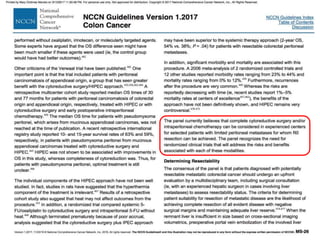
Why should I refer my patient?
• It more than doubles the survival.
• Just last year, it has already been incorporated in the
NCCN 2017 First Quarter Guidelines.
Why should I refer my patient?
• It more than doubles the survival.
• Just this year, it has already been incorporated in the
NCCN 2017 First Quarter Guidelines.
• Now a standard treatment. Offer to avoid legal
complications.
“They thought I was overly aggressive.
Turned out, I was right all along.”
-Dr Paul Sugarbaker
Thank you!

Hyperthermic Intraperitoneal Chemotherapy for Peritoneal Surface Malignancies

  • 1.
    Cytoreductive Surgery plus HIPEC: NEWSTANDARD for Treating Peritoneal Surface Malignancies Mary Ondinee M. Igot, MD, MSCM, FPCP, FPSO, FPSMO Medical Oncologist / Neuro – Oncologist
  • 2.
    Outline • Peritoneal Metastases •Cytoreductive Surgery plus Hyperthermic Intraperitoneal Chemotherapy (CRS-HIPEC) for Peritoneal Metastases • Fundamentals • Technical Requirements • Chemotherapy Used • The Right Patient
  • 3.
    Peritoneal Metastases • Peritonealdissemination from gastrointestinal and gynecological malignancies is common. • Traditionally, it has been regarded as an end-stage disease which was only amenable to palliation and systemic chemotherapy. • Poor literature on effective treatments because they are often excluded from clinical trials because they have “non-measurable disease.”
  • 4.
    Peritoneal Metastases • NIHILISTICATTITUDE toward this condition. • Second most common cause of death after liver metastases • Prone to frequent hospitalizations because of recurrent obstruction and intraabdominal infections • Virtually incurable • AVERAGE LIFE EXPECTANCY: 6 months • With best systemic chemotherapy, • MEDIAN OVERALL SURVIVAL: 20 months • MEDIAN DISEASE FREE SURVIVAL: 10 months
  • 5.
    Cytoreductive Surgery (CRS)= Peritonectomy + Organ Resection • 1930s, attempting to remove all visible deposits was reported for ovarian cancers and eventually was accepted as a treatment with survival benefit. • Attempts have been done in various non-gynecologic malignancies.
  • 6.
    “It is whatthe surgeon does not see that kills the patient.” • Paul Sugarbaker • Peritoneal metastases should not be equated with generalized disease. • Involvement of the peritoneal surfaces may occur in the absence of hematogeneous metastases or it may represent the dominant clinical picture. • Peritoneal metastases = Locoregional disease The Sugarbaker Technique
  • 7.
    Strong Rationale forLocoregional Treatment • Treatment of macroscopic disease • Cytoreductive surgery • Peritonectomy procedures • Treatment of microscopic disease • Heated intraperitoneal chemotherapy • Treatment of systemic disease • IV chemotherapy
  • 8.
  • 9.
    Principles and Rationalebehind HIPEC • “Plasma – Peritoneal Barrier” • Targets microscopic disease that cannot be completely eradicated by surgery. • Provides pharmacokinetic advantage of attaining high local concentrations of chemotherapeutic agents, 12-15x the maximum tolerated plasma concentration • Median peak peritoneal concentration 1,116x that of the normal plasma level of chemotherapy can be achieved. • High temperature increases drug penetration and provides a synergistic effect with intraperitoneal chemotherapy. • Effect of IP chemotherapy on tumour cells also enhanced because adhesions have not been formed. • Mitomycin C, oxaliplatin, etc.
  • 10.
    CRS + HIPECvs IV chemo + Palliative Surgery
  • 12.
  • 14.
    Predictors for Success •Cancer deposits in 6 or more regions of the abdomen  HIGH TUMOR LOAD • Completeness of cytoreduction (R0, R1, R2) • Number of resections and anastomoses
  • 15.
    N = 2298 Averageoperating time: 9.5 hours 80% had complete tumor removal Average hospital stay: 21 days Post-operative mortality: 2% Major morbidity: 24%
  • 17.
    9 comparative studiesand 28 studies Primary and/or recurrent ovarian cancer Primary Recurrent DFS (months) 19.2 17.8 OS (months) 16.1 35.8 Morbidity (%) 31.3 26.2 Mortality (%) 1.8 1.8
  • 19.
    Present Indications • Pseudomyxomaperitoneii or jelly belly • Appendiceal adenocarcinoma • Peritoneal mesothelioma • Colorectal cancer with peritoneal metastases • Ovarian cancer with peritoneal metastases • Gastric cancer with peritoneal metastases
  • 20.
    The Eligible Patient •Patient-Related Criteria • Good performance status • No major comorbidities • BMI > 35 is a relative contraindication • Physiologic age is considered • Patients less than 65 yrs are good candidates • If more than 65 yrs, carefully selected • Patient must be motivated and must understand and accept the risks of the procedure
  • 21.
    • Disease-Related Criteria •Primary cancer: Ovarian, CRC, primary peritoneal, mesothelioma  considered as part of standard care already • Others: gastric, sarcoma, etc… • Histology: Signet ring, poorly differentiated/undifferentiated The Eligible Patient
  • 22.
    • Absolute Contraindications: •Extra-abdominal disease • Extensive intra-abdominal disease • Cancer of unknown primary The Eligible Patient
  • 23.
    Why should Irefer my patient? • It more than doubles the survival. • Just last year, it has already been incorporated in the NCCN 2017 First Quarter Guidelines.
  • 26.
    Why should Irefer my patient? • It more than doubles the survival. • Just this year, it has already been incorporated in the NCCN 2017 First Quarter Guidelines. • Now a standard treatment. Offer to avoid legal complications.
  • 28.
    “They thought Iwas overly aggressive. Turned out, I was right all along.” -Dr Paul Sugarbaker
  • 29.