BREAST CONSERVATIVE
SURGERY & RECONSTRUCTION
AFTER MASTECTOMY
Dr. GANESHKUMAR M
POST GRADUATE
STUDENT
GENERAL SURGERY
BREAST CONSERVATIVE SURGERY
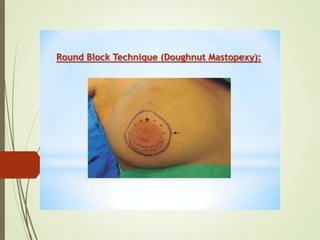
• REDUCTION / MASTOPEXY
• INTRINSIC TISSE REARRANGEMENT
• LOCO-REGIONAL FLAPS.
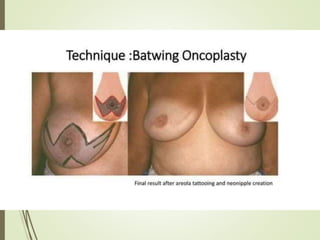
BATWING MASTOPEXY
HEMI BAT-WING MASTOPEXY
TRIANGLE RESECTION
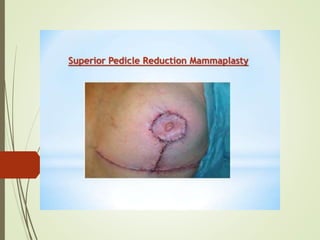
SUPERIOR PEDICLE INVERTED T MAMMOPLASTY
MATRIX ROTATION
BREAST RECONSTRUCTION
SURGERY
• Breast reconstruction is a surgical procedure
that restores shape to your breast after
mastectomy.
• It can be done using
 Flaps
 Implants
BREAST RECONSTRUCTION WITH
IMPLANTS
• Breast reconstruction begins with placement
of a breast implant or tissue expander, either
at the time of mastectomy (immediate
reconstruction) or during a later procedure
(delayed reconstruction).
• A breast implant is a round or teardrop-
shaped silicone shell filled with salt water
(saline) or silicone gel.
TIMING OF RECONSTRUCTION
• DELAYED
• IMMEDIATE
• DELAYED IMMEDIATE
TISSUE EXPANDERS
• Tissue expansion is a process that stretches remaining
chest skin and soft tissues to make room for the breast
implant using saline injected through a valve.
• A newer type of tissue expander uses carbon dioxide.
Compared with the expansion using saline, the gradual
expansion using carbon dioxide may decrease the
amount of discomfort.
• After the tissue is adequately expanded, a second
surgery is performed to remove the tissue expander
and replace it with a permanent implant.
BREAST IMPLANTS
LOCATION OF IMPLANT
• SUB – PECTORAL IMPLANT
• Provides muscle coverage for tissue expander or
the final implant from radiation
• Less chance of wound dehiscence, infection,
wound healing complications.
• PRE- PECTORAL IMPLANT
• Less chance of post op pain, muscle spasm,
hematoma, reconstructive failure.
• Lesser operating time.
• More chance of infection.
TRAM FLAP
• Transverse Rectus
Abdominis Muscle flap.
• can be a free flap or a
pedicled flap.
• A pedicled TRAM flap uses
whole rectus muscle and it
receives blood supply from
SUPERIOR EPIGASTRIC
VESSELS
MUSCLE SPARING TRAM FLAP
• Muscle-sparing free TRAM flap,
only a portion of rectus
abdominis muscle, which may
help you retain abdominal
strength after surgery.
• INDICATIONS
• Breast of all sizes
• Breast ptosis
• CONTRA – INDICATIONS
• Previous abdominoplasty
• Patients who are unable to tolerate longer
procedure and long period of recovery
MUSCLE SPARING TRAM FLAP
• Muscle-sparing free TRAM flap,
only a portion of rectus
abdominis muscle, which may
help retain abdominal
strength after surgery.
Zones of TRAM
• Zone 1 TRAM on the
side of pedicle
• Zone 2 TRAM on
contralateral side
• Zone 3 lateral to
ipsilateral TRAM
• Zone 4 lateral to the
contralateral TRAM
LATISSMUS MUSCLE FLAP
• Includes skin, fat along with the LD muscle,
tunneling it under the skin to chest.
• It is a pedicled flap based on THORACO DORSAL
VESSELS.
• Can also be used as a free flap in case of
inadvertant inury to the pedicle
• Used for small and medium-sized breasts or for
creating a pocket for a breast implant.
LATISSMUS MUSCLE FLAP
DIEP FLAP
• Deep Inferior Epigastric Perforator (DIEP) flap
• Similar to TRAM flap, but only skin and fat are
removed. Minimal muscle tissue is taken to
form the new breast mound. It requires
expertise in microsurgery.
• Advantage:- retain more strength in
abdomen.
• Highest rate of well being and cost effective.
DIEP FLAP
SIEA FLAP
• Superficial Inferior Epigastric Artery (SIEA)
flap uses the same abdominal tissue as DIEP
flap but relies on blood vessels that aren't as
deep within the abdomen.
• Less invasive.
• Low success rate.
SIEA FLAP
THIGH BASED FLAPS
• Based on the PROFUNDA FEMORIS ARTERY
PERFORATOR.
• May be Transverse (TUG), Vertical (VUG),
Diagonal (DUG).
• Can be used as a staked flaps which may be
anastomosed separately to the recipient
vessels or as flow through design.
GLUTEAL BASED FLAPS
• Free flap based on SUPERIOR AND INFERIOR
GLUTEAL ARTERY AND VEIN.
• PRE- OP IMAGING
• CT angiogram or MR angiogram
• Useful in patients with high risk for flap failure
like obesity, h/o abdominoplasty, bilateral
reconstruction.
POST OP MONITORING
• FLUORESCENT ANGIOGRAPHY
• Using indocyanine green
• NEAR INFRA-RED SPECTROSCOPY
• Probe is placed on skin paddle to measure
oxygenation of superficial tissues.
AUTOLOGOUS FAT GRAFTING
• Uses liposuction to gather fat tissue from
thighs, abdomen or gluteal region to
reconstruct the breast or to improve the
appearance of breast after reconstruction.
NIPPLE RECONSTRUCTION
• Followed by medical tattooing
THANK YOU

BREAST RECONSTRUCTIVE SURGERY.pptx

  • 1.
    BREAST CONSERVATIVE SURGERY &RECONSTRUCTION AFTER MASTECTOMY Dr. GANESHKUMAR M POST GRADUATE STUDENT GENERAL SURGERY
  • 2.
    BREAST CONSERVATIVE SURGERY •REDUCTION / MASTOPEXY • INTRINSIC TISSE REARRANGEMENT • LOCO-REGIONAL FLAPS.
  • 29.
  • 32.
  • 48.
  • 49.
  • 65.
  • 67.
    BREAST RECONSTRUCTION SURGERY • Breastreconstruction is a surgical procedure that restores shape to your breast after mastectomy. • It can be done using  Flaps  Implants
  • 68.
    BREAST RECONSTRUCTION WITH IMPLANTS •Breast reconstruction begins with placement of a breast implant or tissue expander, either at the time of mastectomy (immediate reconstruction) or during a later procedure (delayed reconstruction). • A breast implant is a round or teardrop- shaped silicone shell filled with salt water (saline) or silicone gel.
  • 69.
    TIMING OF RECONSTRUCTION •DELAYED • IMMEDIATE • DELAYED IMMEDIATE
  • 70.
    TISSUE EXPANDERS • Tissueexpansion is a process that stretches remaining chest skin and soft tissues to make room for the breast implant using saline injected through a valve. • A newer type of tissue expander uses carbon dioxide. Compared with the expansion using saline, the gradual expansion using carbon dioxide may decrease the amount of discomfort. • After the tissue is adequately expanded, a second surgery is performed to remove the tissue expander and replace it with a permanent implant.
  • 71.
  • 73.
    LOCATION OF IMPLANT •SUB – PECTORAL IMPLANT • Provides muscle coverage for tissue expander or the final implant from radiation • Less chance of wound dehiscence, infection, wound healing complications. • PRE- PECTORAL IMPLANT • Less chance of post op pain, muscle spasm, hematoma, reconstructive failure. • Lesser operating time. • More chance of infection.
  • 74.
    TRAM FLAP • TransverseRectus Abdominis Muscle flap. • can be a free flap or a pedicled flap. • A pedicled TRAM flap uses whole rectus muscle and it receives blood supply from SUPERIOR EPIGASTRIC VESSELS
  • 75.
    MUSCLE SPARING TRAMFLAP • Muscle-sparing free TRAM flap, only a portion of rectus abdominis muscle, which may help you retain abdominal strength after surgery.
  • 76.
    • INDICATIONS • Breastof all sizes • Breast ptosis • CONTRA – INDICATIONS • Previous abdominoplasty • Patients who are unable to tolerate longer procedure and long period of recovery
  • 77.
    MUSCLE SPARING TRAMFLAP • Muscle-sparing free TRAM flap, only a portion of rectus abdominis muscle, which may help retain abdominal strength after surgery.
  • 78.
    Zones of TRAM •Zone 1 TRAM on the side of pedicle • Zone 2 TRAM on contralateral side • Zone 3 lateral to ipsilateral TRAM • Zone 4 lateral to the contralateral TRAM
  • 79.
    LATISSMUS MUSCLE FLAP •Includes skin, fat along with the LD muscle, tunneling it under the skin to chest. • It is a pedicled flap based on THORACO DORSAL VESSELS. • Can also be used as a free flap in case of inadvertant inury to the pedicle • Used for small and medium-sized breasts or for creating a pocket for a breast implant.
  • 80.
  • 81.
    DIEP FLAP • DeepInferior Epigastric Perforator (DIEP) flap • Similar to TRAM flap, but only skin and fat are removed. Minimal muscle tissue is taken to form the new breast mound. It requires expertise in microsurgery. • Advantage:- retain more strength in abdomen. • Highest rate of well being and cost effective.
  • 82.
  • 83.
    SIEA FLAP • SuperficialInferior Epigastric Artery (SIEA) flap uses the same abdominal tissue as DIEP flap but relies on blood vessels that aren't as deep within the abdomen. • Less invasive. • Low success rate.
  • 84.
  • 85.
    THIGH BASED FLAPS •Based on the PROFUNDA FEMORIS ARTERY PERFORATOR. • May be Transverse (TUG), Vertical (VUG), Diagonal (DUG). • Can be used as a staked flaps which may be anastomosed separately to the recipient vessels or as flow through design.
  • 86.
    GLUTEAL BASED FLAPS •Free flap based on SUPERIOR AND INFERIOR GLUTEAL ARTERY AND VEIN. • PRE- OP IMAGING • CT angiogram or MR angiogram • Useful in patients with high risk for flap failure like obesity, h/o abdominoplasty, bilateral reconstruction.
  • 88.
    POST OP MONITORING •FLUORESCENT ANGIOGRAPHY • Using indocyanine green • NEAR INFRA-RED SPECTROSCOPY • Probe is placed on skin paddle to measure oxygenation of superficial tissues.
  • 89.
    AUTOLOGOUS FAT GRAFTING •Uses liposuction to gather fat tissue from thighs, abdomen or gluteal region to reconstruct the breast or to improve the appearance of breast after reconstruction.
  • 90.
  • 93.