Oncoplastic Breast
Surgery
Dr. Fadi Alnehlaoui
Surgical Oncology Specialist
Zulekha Hospital , Sharjah
Breast Conserving Treatment
• Local Surgery to the breast followed by radiation
treatment .
• The goals of BCT are to provide the survival equivalent
of mastectomy, and a low rate of recurrence in the
treated breast.
Breast Conserving Treatment
• BCT is appropriate for most women with early stage
breast cancer
• There are clear contraindications to it, such as
multicentric disease and persistently positive surgical
resection margins.
• In fact, the 5-year survival of BCS with radiation is not
statistically different when compared with mastectomy
Breast-Conservative Surgery (BCS)
• Conservative surgery in breast cancer management has
long been the standard for tumours < 3cm but many series
have extended the indications for breast conserving surgery
to include tumour sizes of up to 4cm, and even larger
for intraductal cancer with the use of neoadjuvant therapy
Breast-Conservation Surgery (BCS)
• BCS procedures include
quadrantectomy and
lumpectomy.
Breast-Conservation Surgery (BCS)
• BCS procedures include
quadrantectomy and
lumpectomy.
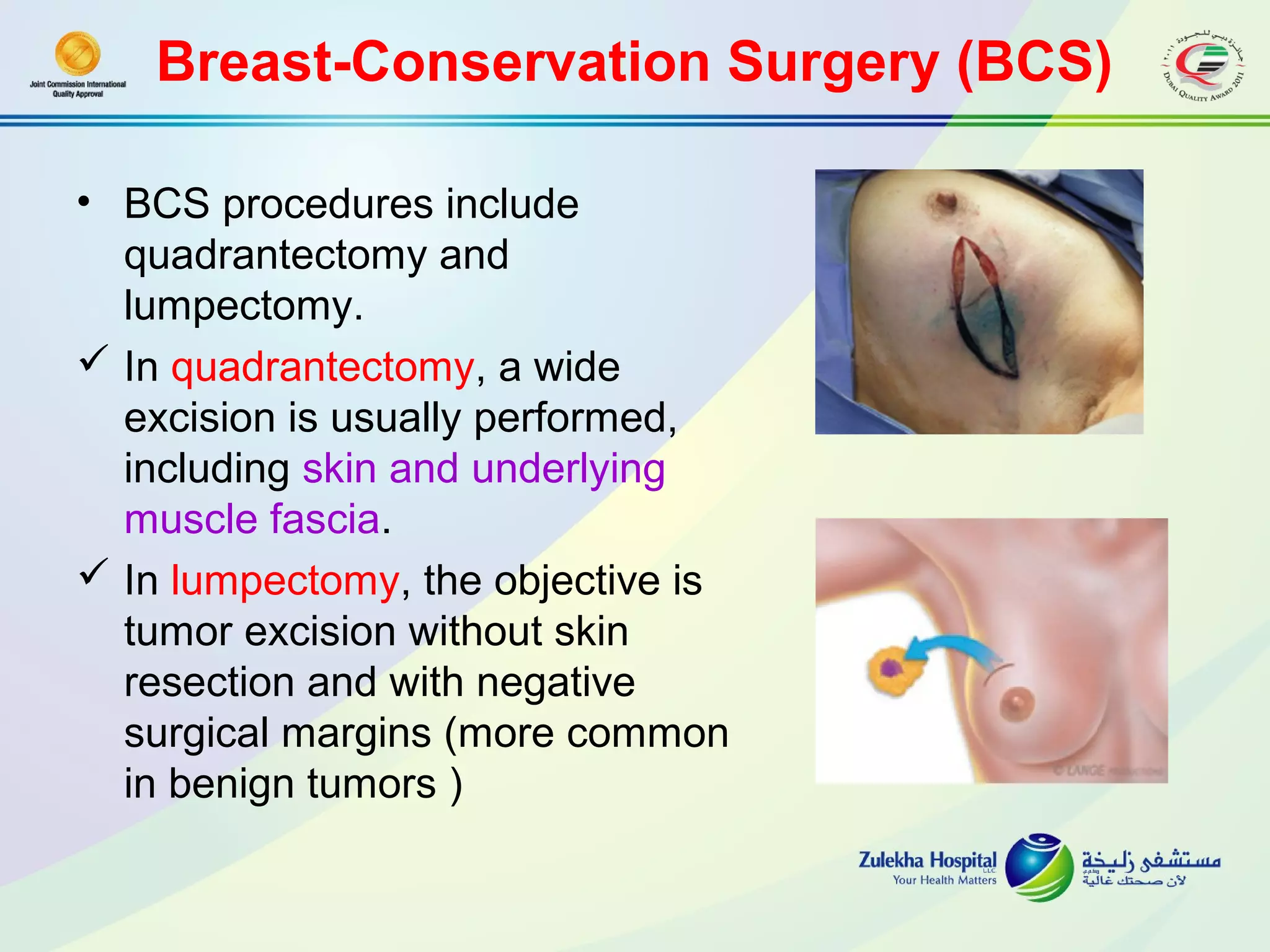
 In quadrantectomy, a wide
excision is usually performed,
including skin and underlying
muscle fascia.
Breast-Conservation Surgery (BCS)
• BCS procedures include
quadrantectomy and
lumpectomy.
 In quadrantectomy, a wide
excision is usually performed,
including skin and underlying
muscle fascia.
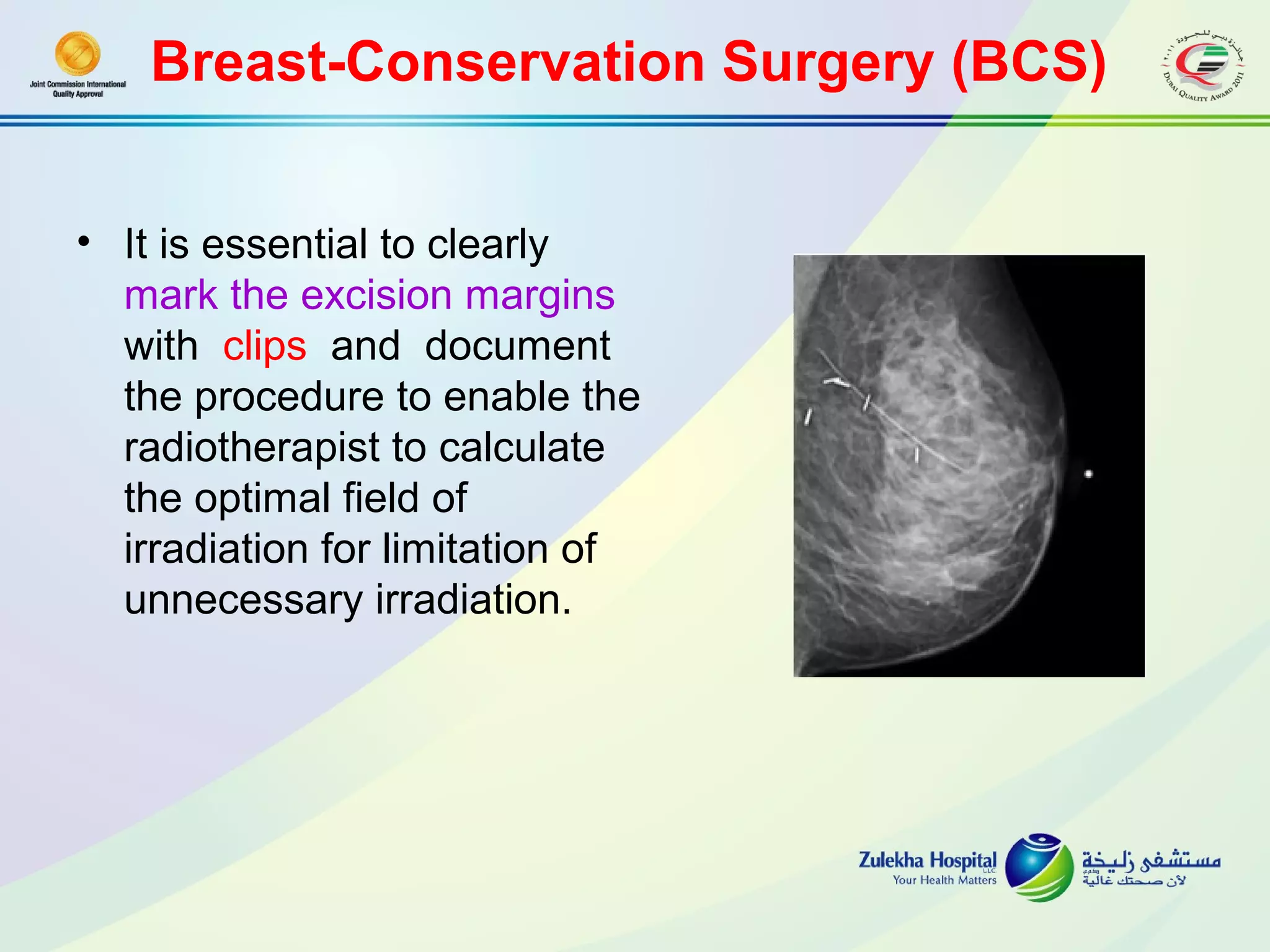
 In lumpectomy, the objective is
tumor excision without skin
resection and with negative
surgical margins (more common
in benign tumors )
Breast-Conservation Surgery (BCS)
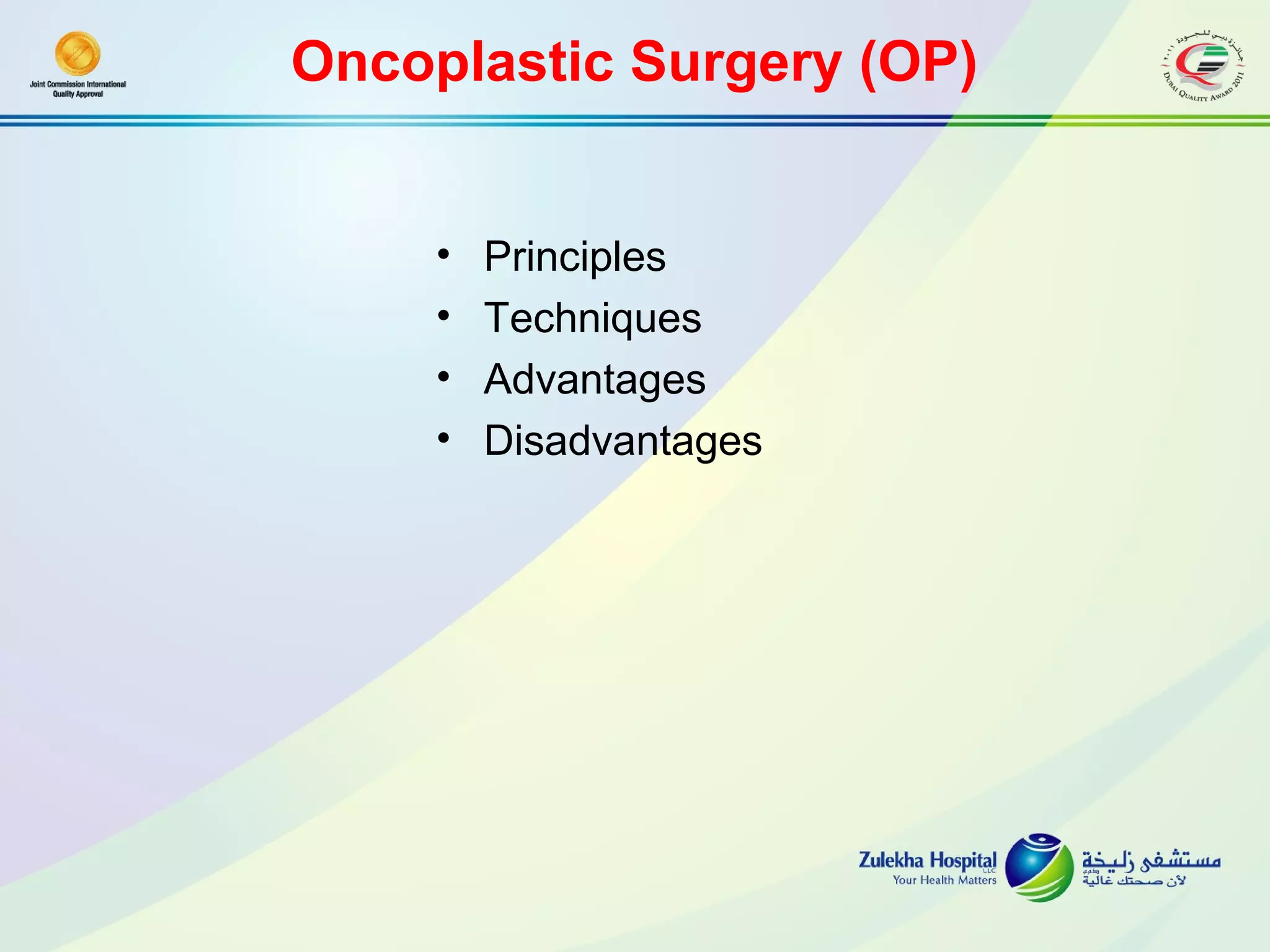
• It is essential to clearly
mark the excision margins
with clips and document
the procedure to enable the
radiotherapist to calculate
the optimal field of
irradiation for limitation of
unnecessary irradiation.
Breast-Conservation Surgery (BCS)
The predominant issue in BCS remains the compromise
between a wide excision with clear margins and a satisfactory
aesthetic results.
Breast-Conservation Surgery (BCS)
The predominant issue in BCS remains the compromise
between a wide excision with clear margins and a satisfactory
aesthetic results.
•In spite of the acceptance that most BCS defects can be
managed with primary closure, the aesthetic outcome may be
unpredictable and frequently achieve an unsatisfactory
outcome .
• In fact, approximately
10% to 30% of patients
submitted to BCS are
not satisfied with the
aesthetic outcome
Breast-Conservation Surgery (BCS)
• The main reasons of like
poor aesthetic results are
related to the tumour
resection which can
produce : asymmetry,
retraction, and volume
changes in the breast.
• In addition, radiation can
also have a negative
effect on the native
breast.
Types of Reconstructions after BCS
• Many techniques are used for reconstruction after
quadrantectomy or partial mastectomy
1. Breast implants
2. Fat grafting
3. Flap procedures
4. Oncoplastic breast procedures
Types of Reconstructions after BCS
1. BREAST IMPLANT
• In some women, a breast
implant can be placed to
restore volume and shape
after a partial resection.
• This method more used after
total mastectomy than partial
Types of Reconstructions after BCS
2. FAT GRAFTING
• Fat is harvested by liposuction from a part of the body where
it is unwanted, and then grafted by injection to correct a
breast contour deformity caused by breast partial resection.
Types of Reconstructions after BCS
3. FLAP PROCEDURES
• Some defects may be reconstructed with adipofascial
flaps, the details of which vary depending on the size and
location of the excised tumor .
• A common example is inframammary adipofascial flap
Types of Reconstructions after BCS
4. ONCOPLASTIC BREAST RECONSTRUCTION
• The most common way for reconstruction & Breast reshape
after partial resection
Types of Reconstructions after BCS
4. ONCOPLASTIC BREAST RECONSTRUCTION
• The most common way for reconstruction & Breast reshape
after partial resection
• Oncoplastic surgery merges the principles of oncology and
plastic surgery to reshape the breast , and this methods
depends on breast itself in reconstruction
History of Oncoplastic Surgery (OP)
• The history of Oncoplastic surgery is relatively new and
has not been well chronicled.
• In Uk, the reorganization of breast services led to the
establishment of the Interface Training Group between
breast and plastic surgeons in 2002.
• In the United States, the Society of Surgical Oncology
(SSO) approved Breast Oncology fellowships in 2003
and began training its first class of fellows and
oncoplastic techniques in July 2004.
Oncoplastic Surgery (OP)
• Principles
• Techniques
• Advantages
• Disadvantages
Principles of Oncoplastic Surgery (OP)
• Oncoplastic approach may begin at :
- The time of BCS(Immediate)
- Weeks after BCS (Delayed-immediate)
- Months to years afterwards (Delayed).
Mechanisms of Oncoplastic Surgery (OP)
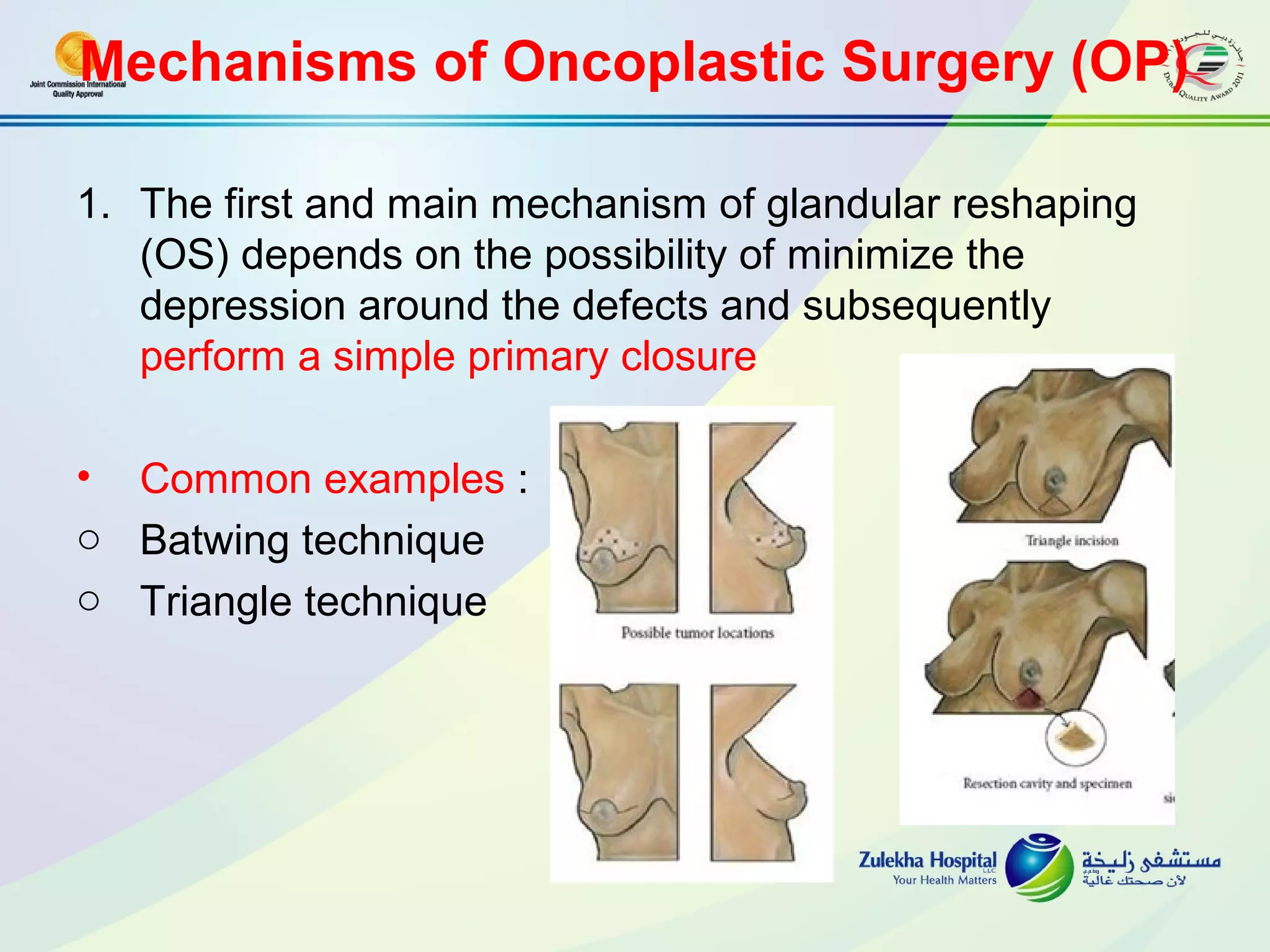
1. The first and main mechanism of glandular reshaping
(OS) depends on the possibility of minimize the
depression around the defects and subsequently
perform a simple primary closure
• Common examples :
o Batwing technique
o Triangle technique
Mechanisms of Oncoplastic Surgery (OP)
2. When additional defects caused by the breast cancer
removal are less than moderate and the remaining breast
tissue is sufficient, broad dissection of the breast
parenchyma around the defects from the skin and chest
wall can be performed, and the defects are subsequently
filled using a full-thickness segment of fibroglandular
breast tissue advancement, rotation and transposition ..
• Examples :
o Reduction techniques
o Rotation flap techniques
Mechanisms of Oncoplastic Surgery (OP)
3. Surgery of the contralateral breast may be requested to
improve symmetry and may take the form of a reduction
mammoplasty or mastopexy.
Mechanisms of Oncoplastic Surgery (OP)
Oncoplastic Techniques for Breast
• The criteria in choosing the
technique is determined by
the surgeon’s experience
and several points :
o
tumour location
o
form & size of the breast.
o
existing scars
o
symmetrisation of the
contralateral breast
Oncoplastic Techniques for Breast
• Probably, all these goals are
not achieved by any single
procedure and each
technique has advantages
and limitations
Oncoplastic Techniques for Breast
• Because the onco principles are different in central
tumor removal than peripheral and so the plastic
reconstruction will be different , we can classify the
techniques of OP based on the site of the tumor :
1. Peripheral tumors
2. Central tumors
Peripheral Tumors
Peripheral Tumors
• There are many Oncoplastic techniques appears in last
few years deal with peripheral tumours
• In general practice experience There are 6 essential
Techniques used for peripheral tumours , and all the
other ways can considers as subtechniques and derived
from the following basic techniques:
1. Lumpectomy mammoplasty
2. Rotation flap technique
3. Round block technique
4. Tennis racket technique
5. Reduction Technique
6. Inframammary breast flap
• Mammoplasty lumpectomy is term
used to described simple excision
of tumor till prepectoralis fascia
with the skin above with simple
closing
• It is applicable when the tumor is
located far from the Nipple -
Areolar Complex (NAC), and this
allows for larger margins
compared to standard
lumpectomy.
• The skin incision may be
elliptical , parallelogram or triangle
1- lumpectomy Mammoplasty
• After tumor excited with breast
tissues around , the incision are
separated and undergo glandular
reshaping to maintain the breast
shape without a divot .
1- lumpectomy Mammoplasty
• After tumor excited with breast
tissues around , the incision are
separated and undergo glandular
reshaping to maintain the breast
shape without a divot .
• The disadvantage of this
technique is an increased scar
length (especially in some cases
like parallelogram shape ), and
care must be taken against
removing too much skin to
broadly prevent shifting of the
NAC, so this procedure can be
used just in small tumors .
• This method is derived from the
common known plastic
technique (Rotation Flap )
• Incisions of the rotation flap
include a semi-circular line of
the NAC and other semi-circular
arc at the margin line of the
breast , then big Out
semicircular line are drawn
connecting these outer arc
2- Rotation Flap Technique
• The breast tissue within the
area is removed ,and the other
part of breast is used as a skin
and subcutaneous tissue flap
and elevated and rotated to fill
in the defect .
2- Rotation Flap Technique
• The breast tissue within the
area is removed ,and the other
part of breast is used as a skin
and subcutaneous tissue flap
and elevated and rotated to fill
in the defect .
• This technique can be used at
any site of breast , and If has
done with as axillary triangular
windows called Burow’s
Triangle Displacement
Tequnique
2- Rotation Flap Technique
• The round block technique can be
used in patients with small- to
moderate-sized breasts without
ptosis and for tumours located
near the NAC without nipple
invasion.
3- Round block technique (Periareolar
Mammoplasty (Donut Mastopexy)
• The round block technique can be
used in patients with small- to
moderate-sized breasts without
ptosis and for tumours located
near the NAC without nipple
invasion.
• Two circular skin markings are
made on the breasts :The inner
one is made on the areolar border,
and the external marking border
varies based on the tumour size
and location, nipple position, and
the degree of ptosis.
3- Round block technique (Periareolar
Mammoplasty (Donut Mastopexy)
• De-epithelialization of tissue between
the two incisions is done.
• Care must be taken to prevent injury
to the dermis to preserve blood
supply to the NAC
3- Round block technique (Periareolar
Mammoplasty (Donut Mastopexy)
• After separation of the skin around
the tumour, excision is performed
including the tumour and normal
breast tissue till the peripectoralis
fascia
3- Round block technique (Periareolar
Mammoplasty (Donut Mastopexy)
• The surrounding breast
tissue undergoes
undermining and
approximation for glandular
reshaping
3- Round block technique (Periareolar
Mammoplasty (Donut Mastopexy)
• The two periareolar skin
incisions are closed using a
running suture technique
while checking for symmetry
of the two breasts
3- Round block technique (Periareolar
Mammoplasty (Donut Mastopexy)
• The cosmetic results are
satisfactory because there are
only perimamillary scars , and in
the case of a large NAC, a
smaller neo-areola may be
created
3- Round block technique (Periareolar
Mamoplasty (Donut Mastopexy)
• Many subtechniques are derived
from this method which depend
of site of the tumour and size of
resection
• Example of like these
subtechniques is Crescent
technique which use for upper
pole small tumours
3- Round block technique (Periareolar
Mamoplasty (Donut Mastopexy)
• The tennis racket method uses both
circular line of the NAC, (like
periareolar technique ) with a wedge-
shaped incision from the external
circular line around the tumor .
4- Tennis Racket Method
• Removal of the breast tissue within
the wedge-shaped incision is done
with de-epithelization between the
two circular incision lines .
• The surrounding breast tissues
outside the wedge are brought
together, the defects are filled with
sutures, and the NAC is
recentralized.
4- Tennis Racket Method
• Then, the skin layers of the
external circular incision are
sutured along with the
repositioned NAC .
4- Tennis Racket Method
• Then, the skin layers of the
external circular incision are
sutured along with the
repositioned NAC .
• an advantage of this technique
is that it can be used for all
sites in breasts, and many
subtechniques are derived
from it
( Medial ,Lateral .J and S
mammoplasty )
4- Tennis Racket Method
5- REDUCTION MAMMOPLASTY
• The same technique used in plastic surgery for breast
reduction
• Oncoplastic reduction mammoplasty is used if the
patient has a large breast volume or if there is breast
ptosis.
• The location of the tumor is
thought to be the most
important factor in the
choice of a pedicle.
5- REDUCTION MAMMOPLASTY
• The location of the tumor is
thought to be the most
important factor in the
choice of a pedicle.
o An inferiorly based pedicle
is used if the tumor is
located in the upper breast
5- REDUCTION MAMMOPLASTY
• The location of the tumor is
thought to be the most
important factor in the
choice of a pedicle.
o An inferiorly based pedicle
is used if the tumor is
located in the upper breast
o while the superiorly based
pedicle is used if it is
located in the lower breast.
5- REDUCTION MAMMOPLASTY
• Oncoplastic reduction
mammoplasty has many
cosmetic, functional, and
oncological advantages (Back
pain and shoulder pain due to
large breasts can be resolved,
Excision of surrounding breast
tissue after partial mastectomy
increases the safety of the
resection margins and Reduction
at the other breast is also may
done at the same time …)
5- REDUCTION MAMMOPLASTY
6- Intramammary Flap (IMF)
• It is new described
Technique
• By using inferior
flap from the
residual Brest to fill
the defect
• is suitable just for
tumour at upper
outer quadrant
Other Subtechniques of OP in
peripheral Tumors
Other Subtechniques of OP
• Many other subtechniques are used in peripheral
tumours , and most of these subtechniques are
derived from the basic ways explained before , and
sometimes with merging between more than one
techniques
Other Subtechniques of OP
• Many other subtechniques are used in peripheral
tumours , and most of these subtechniques are
derived from the basic ways explained before , and
sometimes with merge between multiple
techniques
• We can classified these methods depends on the
site of tumor
- Upper pole
- Lower pole
- Other sites (Lateral or Medial )
Lower pole of Breast
• This allows access to
lesions from 5 o’clock to 7
o’clock, going clockwise.
Upper pole
Lower pole
Medial pole Lateral pole
1- Triangle Incision
• this technique is derived from
mammoplasty lumpectomy
with kind of reduction
• The tumour excised here with
just approximating of the
breast gland then primary
closeting to skin is done
• Is ideal for small tumour
which does not need regular
reduction
2- Superior-Pedicle, Inverted-T
Mammoplasty
• This technique is used for tumors
at the junction of the inferior
quadrants, as well as those
inferolateral, inferomedial and
close to the inferior mammary fold
(IMF)
2- Superior-Pedicle, Inverted-T
Mammoplasty
• It is one of reduction
mammary plasty technique
which uses superior pedicle
Flap with de-
epithelialisation to support
NAC
2- Superior-Pedicle, Inverted-T
Mammoplasty
• It is one of reduction
mammary plasty technique
which uses superior pedicle
Flap with de-
epithelialisation to support
NAC
• The mammary gland is
raised from the prepectoral
fascia following incision at
the IMF (Inferior mammary
Fold ).
2- Superior-Pedicle, Inverted-T
Mammoplasty
• Wide excision to the tumor and
the Breast gland and skin at the
junction of the inferior quadrants
is done
2- Superior-Pedicle, Inverted-T
Mammoplasty
• Wide excision to the tumor and
the Breast gland and skin at the
junction of the inferior quadrants
is done
• The remaining breast tissue are
then reapproximated and the
skin then closed .
2- Superior-Pedicle, Inverted-T
Mammoplasty
• In this fashion, a satisfactory
result can be obtained
producing a smaller, higher
and narrower breast
• When contralateral
symmetrisation is required, it is
usually done with the same
technique
a operative design
3- Vertical-Scar Mammoplasty
• Used for tumours at the
inferior quadrant junction , in
smaller non-ptotic breasts of
medium size.
• This technique is merge
between Tennis racket method
and reduction plasty
• It is the same as the inverted
T, but without the IMF incision
• sometimes a glandular
rotation is required to
reconstitute the defect left after
tumourectomy.
4- Inferior Mammary Fold (IMF)
Mammaplasty
• Designed for tumours at or
slightly above the IMF.
• This technique makes it
possible to avoid significant
scars (as with the inverted-
T) by lowering the IMF.
4- Inferior Mammary Fold (IMF)
Mammaplasty
• Excision is performed en bloc
to the prepectoral fascia with
upper and lower margins ,
and the two wounds edges
are attached to each other
• This technique can not be
used with short areola-IMF
distances, but it is useful for
modifying the lower breast
pole .
Upper pole of Breast
• This allows access to
lesions from (10 o’clock to 2
o’clock going clockwise)
• Techniques used here work
well for patients with larger,
more ptotic breasts who will
benefit from lifting the nipple
areolar complex.
Upper pole
Lower pole
Medial pole Lateral pole
1- Batwing Mastopexy
• This technique is type of
Periareolar Mammoplasty
• It is also known as inverted V
or omega plasty due to the
incision shape, which looks
similar to an inverted V or an
"omega" symbol .
• It is ideal for superior quadrant
and superiomedial tumours .
• This method uses a semi-
circular line at the upper
margin of the NAC and
another semi-circular line
above , with two angled
incisions to connect these
two lines in a wing-like
fashion to remove the
lesion
• The inferior quadrants and
NAC are elevated and
attached to the upper part
following excision.
1- Batwing Mastopexy
• The defect is closed by pulling
up the inferior breast tissue and
suturing the layers together
• Contralateral breast
symmetrisation is generally
performed with an alternative
technique .
1- Batwing Mastopexy
• An advantage of this
procedure is the inclusion of
the NAC border in the incision
line to hide the wound and the
easy addition of central
quadrantectomy if nipple
invasion is found during the
procedure .
Hemibatwing Resection
• The same Batwing technique
but the resection extend just
to one side instate of both
• Has the same result of
batwing method
• This method uses rotation flap
technique with axillary triangular
incision window which helps in
the rotation of the flap and can
be useful in axillary lymph node
dissection
2- Burow’s Triangle Displacement
Technique
• This method is applicable to
relatively large tumors located in
the upper pole especially in UIQ
with some distance from the
nipple .
2- Burow’s Triangle Displacement
Technique
• This method is applicable to
relatively large tumors located in
the upper pole especially in UIQ
with some distance from the
nipple .
• The disadvantage of this
technique is its relatively large
incision.
2- Burow’s Triangle Displacement
Technique
• It is type of periareolar (round
block ) technique at upper
pole
3- Crescent Mastopexy
• It is type of periareolar (round
block ) technique at upper
pole
• The final scar just semiarc at
the NAC line
• Is suitable for small tumors
near the NAC
3- Crescent Mastopexy
4- Inferior-Pedicle Inverted-T
Mammoplasty
• This technique is ideal for superior quadrant
junction tumours that are close enough to the areola
(particularly in ptotic breasts) .
4- Inferior-Pedicle Inverted-T
Mammoplasty
• It uses reduction
technique via the inferior
pedicle
4- Inferior-Pedicle Inverted-T
Mammoplasty
• It uses reduction
technique via the inferior
pedicle
• The zone of
quadrantectomy is at the
junction of the superior
quadrants .
• The technique facilitates
the removal of any skin
associated with the
tumour, and gland
resection is- as usual- to
the prepectoral plane
4- Inferior-Pedicle Inverted-T
Mammoplasty
• The skin is raised laterally,
leaving the NAC vascularised
by an inferior thick
parenchymal flaps supplied by
intercostal perforators, then
raised and transposed to fill the
tumourectomy defect
4- Inferior-Pedicle Inverted-T
Mammoplasty
• Skin closure
completes the
procedure, and the
breast is higher on
the chest wall,
thereby correcting
ptosis.
4- Inferior-Pedicle Inverted-T
Mammoplasty
• Skin closure
completes the
procedure, and the
breast is higher on
the chest wall,
thereby correcting
ptosis.
• The resulting scars
are identical to those
obtained with
superior-pedicle
inverted-T techniques
4- Inferior-Pedicle Inverted-T
Mammoplasty
• If required, symmetrisation
is more easily performed on
the contralateral breast with
a superiorpedicle procedure.
• Include lateral and medial folds
• The techniques used here are
derived from Tennis Racket
method plus rotation flaps
• Many subtechniques are
developed depending on the
site of tumor :
1. Lateral mamoplasty
2. Medial mamoplasty
3. J & S mamoplasty
Upper pole
Lower pole
Medial pole Lateral pole
Other sites of Breast tumors
1- Lateral Mammoplasty
• Used for Tumors at the lateral
quadrant junction or,
superolateral .
• The technique is rocket method
by using 2 periareolar lines with
outer wedge shape incision in
lateral side of breast
1- Lateral Mammoplasty
• The resulting scar is
periareolar with a lateral
radial extension
2- Medial Mammoplasty
• This technique is equivalent to
the lateral mammoplasty but for
medial tumors
• It is more challenging due to the
much reduced tissue volume
and relative immobility of the
inferiomedial breast.
2- Medial Mammaplasty
• Suturing of the adjacent breast
tissue is not always possible
and In these cases, a lateral
Rotation flap can be done by
raised inframammary fold and
then rotated medially into the
defect.
• As usual, the resulting breast
has a narrower base and sits
higher on the thoracic wall.
3- J- and L-Mammaplasty
• These techniques sit between
a pure vertical-scar and an
inverted-T mammoplasty
• Ideal for tumours localised to the
lateral or inferolateral quadrants
• The vertical incision below the
areola is extended laterally,
allowing limitation of the
inframammary scar in large-
volume breasts.
Central Tumors
Central Tumors
• Central tumours represent 5-20%
of breast tumors
• These tumors have long been
considered to be more serious,
multifocal and more likely to recur.
• In the past, close proximity of the
tumor to the NAC was an indication
for total mastectomy or skin
sparing mastectomy, but now
Centreal tumors may also benefit
from breast-conserving surgery.
Central Tumors
• Cancers Resection must be
similarly wide to avoid surgical
re-excisions and secondary
mastectomies
• Deep central tumors that are
more than 3cm from the
areola are considered to be
"peripheral" and are
therefore treated accordingly.
Central Tumors
• Several techniques have been used depending on the
tumor and the size and form of the breast.
• The surgery should be done to remove the tumor with NAC
enblock (NACectomies )
Central Tumors
• Several techniques have been used depending on the
tumor and the size and form of the breast.
• The surgery should be done to remove the tumor with NAC
enblock (NACectomies )
• The most common techniques for central tumours :
1. Purse-String Suture Technique
2. Horizontal Technique
3. Mammoplasty-Associated Techniques
1- Purse-String Suture Technique
• En bloc excision, via a
periareolar incision, of the
nipple-areola complex
(NAC) and underlying tissue
as far as the prepectoral
fascia is done
1- Purse-String Suture Technique
• Round defects after central
quadrantectomy are brought
together after undermining
the nearby breast tissue,
and This is performed from
deep to superficial produces
a breast with a reduced
base width but increased
projection
1- Purse-String Suture Technique
• Round defects after central
quadrantectomy are brought
together after undermining
the nearby breast tissue,
and This is performed from
deep to superficial produces
a breast with a reduced
base width but increased
projection
• skin is closed by a
continuous running stitch
technique using purse-string
sutures
• This technique should only be
performed when the defect is
small enough to be closed
using nearby breast tissue.
1- Purse-String Suture Technique
• This technique should only be
performed when the defect is
small enough to be closed
using nearby breast tissue.
• Using purse-string sutures can
yield satisfactory cosmetic
results by conserving the breast
and reconstructing the NAC and
tattoo after radiation therapy .
1- Purse-String Suture Technique
2- Horizontal Technique
• This is similar to the
periareolar (Pers-String )
technique in all respects
except the skin incision,
which is semielliptical in the
shape of an eye, causing
final horizontal scar after
compleating the resection
a medial retroareolar tumour
b horizontal semielliptical excision with skin-gland dissection
c operative specimen with nipple areolar
complex en bloc with the glandular cone
d NACectomy to the
prepectoral fascia
2- Horizontal Technique
e reconstitution of glandular
cone by approximation
commencing deeply
f skin closure giving a good result in both form and volume
2- Horizontal Technique
3- Mammoplasty-Associated
Techniques
• If the tumor is larger or
deeper, and the breast
volume allows , a breast
reduction can be performed
in association with
NACectomy.
a retroareolar central tumour
b inverted-T operative markings after
neoadjuvant chemotherapy (segments 1 + 2
= 20cm; segment 3 = 11 cm)
c very wide excision (weight of excised
specimen: 330 g)
d reapproximation of glandular
pillars and skin closure
3- Mammoplasty-Associated
Techniques
• A symmetrisation on the
contralateral breast is
frequently required in a
subsequent operation
immediately or after adjuvant
radiotherapy has been
completed.
• NAC reconstruction is
conveniently performed at
this second sitting .
• It can be done :
- with either areolar skin
grafting and a nipple graft
(S flap)
- areolar tattooing and local
flaps (F flap).
NAC reconstruction
ADVANTAGES OF OP
• In Oncoplastic surgery we can remove more than 20% of
the breast with good result
• The rate of breast deformity would therefore be much
increased in the absence of the various techniques
described above.
• The scar burden is often small , even sometimes being
significant but anyway radiotherapy usually improves the
long-term appearance with little fibrous reaction
ADVANTAGES OF OP
• Quality of excision margins is better in using OP techniques
because we can resect more volume than Lumpectpmy .
• Overall survival and five-year recurrence rates are identical
to standard conservative surgery
• in OP procedure we can Preserving the shape and
appearance of the breast
• Immediate symmetrisation can be done without other
reconstructive gestures
ADVANTAGES OF OP
ADVANTAGES OF OP
• By immediate reconstruction to Opposite breast , in
2.8 % of cases , an unexpected cancer was observed.
Although the diagnosis of occult cancer is not a reason
to perform an Opposite breast reduction, but this
procedure can be advantageous for high-risk patients
and especially for patients with previous breast cancer .
Limitations of OP
Limitations of OP
•The duration of intervention is longer, and specifically
trained surgeons are required to obtain optimal results.
•The average complication rate ( most common fat
necrosis ) in the Oncoplastic is little bit higher compared
with simple lumpectomy and this complication was
significantly higher in the delayed group and contributed by
radiation therapy.
• Most patients submitted to reduction mammoplasty
reconstruction had bilateral procedures ,This aspect can
be viewed as a negative point, however it also has the
advantages of allowing for sampling of glandular tissue
and treated occult cancer in other site
Limitations of OP
• Sometimes re-excision of glandular tissue will be
required if close or positive margins are observed,
and that time thus fact could make it difficult to
locate the residual tumor and to perform margin
re-excision after doing oncoplastic techniques , so
in theses patients with those characteristics
require more meticulous intraoperative margins
evaluation to avoid the need for re-operation
Limitations of OS
CONCLUSION
• Despite of the popularity of BCS, which constitutes 50-
70% of all breast cancer surgeries, discussions regarding
cosmetic results after BCS are not specifically conducted.
• Oncoplastic Surgery techniques are very good methods
for partial reconstructions after partial mastectomy in term
of oncologic and aesthetic results with low disadvantages
CONCLUSION
• Choosing of OP procedures depends on the patient's
breast size, tumour location, excised volume, and
volume of the remaining breast tissue and at last
surgeon experience .
• In patients receiving BCS , Oncoplastic breast surgery
allows us to make immediate reconstruction or delay in
some cases when it is not possible to do that
immediately (like high risk for positive margins )
Thank
You

Breast oncoplastic surgery

  • 1.
    Oncoplastic Breast Surgery Dr. FadiAlnehlaoui Surgical Oncology Specialist Zulekha Hospital , Sharjah
  • 2.
    Breast Conserving Treatment •Local Surgery to the breast followed by radiation treatment . • The goals of BCT are to provide the survival equivalent of mastectomy, and a low rate of recurrence in the treated breast.
  • 3.
    Breast Conserving Treatment •BCT is appropriate for most women with early stage breast cancer • There are clear contraindications to it, such as multicentric disease and persistently positive surgical resection margins. • In fact, the 5-year survival of BCS with radiation is not statistically different when compared with mastectomy
  • 4.
    Breast-Conservative Surgery (BCS) •Conservative surgery in breast cancer management has long been the standard for tumours < 3cm but many series have extended the indications for breast conserving surgery to include tumour sizes of up to 4cm, and even larger for intraductal cancer with the use of neoadjuvant therapy
  • 5.
    Breast-Conservation Surgery (BCS) •BCS procedures include quadrantectomy and lumpectomy.
  • 6.
    Breast-Conservation Surgery (BCS) •BCS procedures include quadrantectomy and lumpectomy.  In quadrantectomy, a wide excision is usually performed, including skin and underlying muscle fascia.
  • 7.
    Breast-Conservation Surgery (BCS) •BCS procedures include quadrantectomy and lumpectomy.  In quadrantectomy, a wide excision is usually performed, including skin and underlying muscle fascia.  In lumpectomy, the objective is tumor excision without skin resection and with negative surgical margins (more common in benign tumors )
  • 8.
    Breast-Conservation Surgery (BCS) •It is essential to clearly mark the excision margins with clips and document the procedure to enable the radiotherapist to calculate the optimal field of irradiation for limitation of unnecessary irradiation.
  • 9.
    Breast-Conservation Surgery (BCS) Thepredominant issue in BCS remains the compromise between a wide excision with clear margins and a satisfactory aesthetic results.
  • 10.
    Breast-Conservation Surgery (BCS) Thepredominant issue in BCS remains the compromise between a wide excision with clear margins and a satisfactory aesthetic results. •In spite of the acceptance that most BCS defects can be managed with primary closure, the aesthetic outcome may be unpredictable and frequently achieve an unsatisfactory outcome . • In fact, approximately 10% to 30% of patients submitted to BCS are not satisfied with the aesthetic outcome
  • 11.
    Breast-Conservation Surgery (BCS) •The main reasons of like poor aesthetic results are related to the tumour resection which can produce : asymmetry, retraction, and volume changes in the breast. • In addition, radiation can also have a negative effect on the native breast.
  • 12.
  • 13.
    Types of Reconstructionsafter BCS • Many techniques are used for reconstruction after quadrantectomy or partial mastectomy 1. Breast implants 2. Fat grafting 3. Flap procedures 4. Oncoplastic breast procedures
  • 14.
    Types of Reconstructionsafter BCS 1. BREAST IMPLANT • In some women, a breast implant can be placed to restore volume and shape after a partial resection. • This method more used after total mastectomy than partial
  • 15.
    Types of Reconstructionsafter BCS 2. FAT GRAFTING • Fat is harvested by liposuction from a part of the body where it is unwanted, and then grafted by injection to correct a breast contour deformity caused by breast partial resection.
  • 16.
    Types of Reconstructionsafter BCS 3. FLAP PROCEDURES • Some defects may be reconstructed with adipofascial flaps, the details of which vary depending on the size and location of the excised tumor . • A common example is inframammary adipofascial flap
  • 17.
    Types of Reconstructionsafter BCS 4. ONCOPLASTIC BREAST RECONSTRUCTION • The most common way for reconstruction & Breast reshape after partial resection
  • 18.
    Types of Reconstructionsafter BCS 4. ONCOPLASTIC BREAST RECONSTRUCTION • The most common way for reconstruction & Breast reshape after partial resection • Oncoplastic surgery merges the principles of oncology and plastic surgery to reshape the breast , and this methods depends on breast itself in reconstruction
  • 19.
    History of OncoplasticSurgery (OP) • The history of Oncoplastic surgery is relatively new and has not been well chronicled. • In Uk, the reorganization of breast services led to the establishment of the Interface Training Group between breast and plastic surgeons in 2002. • In the United States, the Society of Surgical Oncology (SSO) approved Breast Oncology fellowships in 2003 and began training its first class of fellows and oncoplastic techniques in July 2004.
  • 20.
    Oncoplastic Surgery (OP) •Principles • Techniques • Advantages • Disadvantages
  • 21.
    Principles of OncoplasticSurgery (OP) • Oncoplastic approach may begin at : - The time of BCS(Immediate) - Weeks after BCS (Delayed-immediate) - Months to years afterwards (Delayed).
  • 22.
  • 23.
    1. The firstand main mechanism of glandular reshaping (OS) depends on the possibility of minimize the depression around the defects and subsequently perform a simple primary closure • Common examples : o Batwing technique o Triangle technique Mechanisms of Oncoplastic Surgery (OP)
  • 24.
    2. When additionaldefects caused by the breast cancer removal are less than moderate and the remaining breast tissue is sufficient, broad dissection of the breast parenchyma around the defects from the skin and chest wall can be performed, and the defects are subsequently filled using a full-thickness segment of fibroglandular breast tissue advancement, rotation and transposition .. • Examples : o Reduction techniques o Rotation flap techniques Mechanisms of Oncoplastic Surgery (OP)
  • 25.
    3. Surgery ofthe contralateral breast may be requested to improve symmetry and may take the form of a reduction mammoplasty or mastopexy. Mechanisms of Oncoplastic Surgery (OP)
  • 26.
  • 27.
    Oncoplastic Techniques forBreast • The criteria in choosing the technique is determined by the surgeon’s experience and several points : o tumour location o form & size of the breast. o existing scars o symmetrisation of the contralateral breast
  • 28.
    Oncoplastic Techniques forBreast • Probably, all these goals are not achieved by any single procedure and each technique has advantages and limitations
  • 29.
    Oncoplastic Techniques forBreast • Because the onco principles are different in central tumor removal than peripheral and so the plastic reconstruction will be different , we can classify the techniques of OP based on the site of the tumor : 1. Peripheral tumors 2. Central tumors
  • 30.
  • 31.
    Peripheral Tumors • Thereare many Oncoplastic techniques appears in last few years deal with peripheral tumours • In general practice experience There are 6 essential Techniques used for peripheral tumours , and all the other ways can considers as subtechniques and derived from the following basic techniques: 1. Lumpectomy mammoplasty 2. Rotation flap technique 3. Round block technique 4. Tennis racket technique 5. Reduction Technique 6. Inframammary breast flap
  • 32.
    • Mammoplasty lumpectomyis term used to described simple excision of tumor till prepectoralis fascia with the skin above with simple closing • It is applicable when the tumor is located far from the Nipple - Areolar Complex (NAC), and this allows for larger margins compared to standard lumpectomy. • The skin incision may be elliptical , parallelogram or triangle 1- lumpectomy Mammoplasty
  • 33.
    1- lumpectomy Mammoplasty •After tumor excited with breast tissues around , the incision are separated and undergo glandular reshaping to maintain the breast shape without a divot .
  • 34.
    1- lumpectomy Mammoplasty •After tumor excited with breast tissues around , the incision are separated and undergo glandular reshaping to maintain the breast shape without a divot . • The disadvantage of this technique is an increased scar length (especially in some cases like parallelogram shape ), and care must be taken against removing too much skin to broadly prevent shifting of the NAC, so this procedure can be used just in small tumors .
  • 35.
    • This methodis derived from the common known plastic technique (Rotation Flap ) • Incisions of the rotation flap include a semi-circular line of the NAC and other semi-circular arc at the margin line of the breast , then big Out semicircular line are drawn connecting these outer arc 2- Rotation Flap Technique
  • 36.
    • The breasttissue within the area is removed ,and the other part of breast is used as a skin and subcutaneous tissue flap and elevated and rotated to fill in the defect . 2- Rotation Flap Technique
  • 37.
    • The breasttissue within the area is removed ,and the other part of breast is used as a skin and subcutaneous tissue flap and elevated and rotated to fill in the defect . • This technique can be used at any site of breast , and If has done with as axillary triangular windows called Burow’s Triangle Displacement Tequnique 2- Rotation Flap Technique
  • 38.
    • The roundblock technique can be used in patients with small- to moderate-sized breasts without ptosis and for tumours located near the NAC without nipple invasion. 3- Round block technique (Periareolar Mammoplasty (Donut Mastopexy)
  • 39.
    • The roundblock technique can be used in patients with small- to moderate-sized breasts without ptosis and for tumours located near the NAC without nipple invasion. • Two circular skin markings are made on the breasts :The inner one is made on the areolar border, and the external marking border varies based on the tumour size and location, nipple position, and the degree of ptosis. 3- Round block technique (Periareolar Mammoplasty (Donut Mastopexy)
  • 40.
    • De-epithelialization oftissue between the two incisions is done. • Care must be taken to prevent injury to the dermis to preserve blood supply to the NAC 3- Round block technique (Periareolar Mammoplasty (Donut Mastopexy)
  • 41.
    • After separationof the skin around the tumour, excision is performed including the tumour and normal breast tissue till the peripectoralis fascia 3- Round block technique (Periareolar Mammoplasty (Donut Mastopexy)
  • 42.
    • The surroundingbreast tissue undergoes undermining and approximation for glandular reshaping 3- Round block technique (Periareolar Mammoplasty (Donut Mastopexy)
  • 43.
    • The twoperiareolar skin incisions are closed using a running suture technique while checking for symmetry of the two breasts 3- Round block technique (Periareolar Mammoplasty (Donut Mastopexy)
  • 44.
    • The cosmeticresults are satisfactory because there are only perimamillary scars , and in the case of a large NAC, a smaller neo-areola may be created 3- Round block technique (Periareolar Mamoplasty (Donut Mastopexy)
  • 45.
    • Many subtechniquesare derived from this method which depend of site of the tumour and size of resection • Example of like these subtechniques is Crescent technique which use for upper pole small tumours 3- Round block technique (Periareolar Mamoplasty (Donut Mastopexy)
  • 46.
    • The tennisracket method uses both circular line of the NAC, (like periareolar technique ) with a wedge- shaped incision from the external circular line around the tumor . 4- Tennis Racket Method
  • 47.
    • Removal ofthe breast tissue within the wedge-shaped incision is done with de-epithelization between the two circular incision lines . • The surrounding breast tissues outside the wedge are brought together, the defects are filled with sutures, and the NAC is recentralized. 4- Tennis Racket Method
  • 48.
    • Then, theskin layers of the external circular incision are sutured along with the repositioned NAC . 4- Tennis Racket Method
  • 49.
    • Then, theskin layers of the external circular incision are sutured along with the repositioned NAC . • an advantage of this technique is that it can be used for all sites in breasts, and many subtechniques are derived from it ( Medial ,Lateral .J and S mammoplasty ) 4- Tennis Racket Method
  • 50.
    5- REDUCTION MAMMOPLASTY •The same technique used in plastic surgery for breast reduction • Oncoplastic reduction mammoplasty is used if the patient has a large breast volume or if there is breast ptosis.
  • 51.
    • The locationof the tumor is thought to be the most important factor in the choice of a pedicle. 5- REDUCTION MAMMOPLASTY
  • 52.
    • The locationof the tumor is thought to be the most important factor in the choice of a pedicle. o An inferiorly based pedicle is used if the tumor is located in the upper breast 5- REDUCTION MAMMOPLASTY
  • 53.
    • The locationof the tumor is thought to be the most important factor in the choice of a pedicle. o An inferiorly based pedicle is used if the tumor is located in the upper breast o while the superiorly based pedicle is used if it is located in the lower breast. 5- REDUCTION MAMMOPLASTY
  • 54.
    • Oncoplastic reduction mammoplastyhas many cosmetic, functional, and oncological advantages (Back pain and shoulder pain due to large breasts can be resolved, Excision of surrounding breast tissue after partial mastectomy increases the safety of the resection margins and Reduction at the other breast is also may done at the same time …) 5- REDUCTION MAMMOPLASTY
  • 55.
    6- Intramammary Flap(IMF) • It is new described Technique • By using inferior flap from the residual Brest to fill the defect • is suitable just for tumour at upper outer quadrant
  • 56.
    Other Subtechniques ofOP in peripheral Tumors
  • 57.
    Other Subtechniques ofOP • Many other subtechniques are used in peripheral tumours , and most of these subtechniques are derived from the basic ways explained before , and sometimes with merging between more than one techniques
  • 58.
    Other Subtechniques ofOP • Many other subtechniques are used in peripheral tumours , and most of these subtechniques are derived from the basic ways explained before , and sometimes with merge between multiple techniques • We can classified these methods depends on the site of tumor - Upper pole - Lower pole - Other sites (Lateral or Medial )
  • 59.
    Lower pole ofBreast • This allows access to lesions from 5 o’clock to 7 o’clock, going clockwise. Upper pole Lower pole Medial pole Lateral pole
  • 60.
    1- Triangle Incision •this technique is derived from mammoplasty lumpectomy with kind of reduction • The tumour excised here with just approximating of the breast gland then primary closeting to skin is done • Is ideal for small tumour which does not need regular reduction
  • 61.
    2- Superior-Pedicle, Inverted-T Mammoplasty •This technique is used for tumors at the junction of the inferior quadrants, as well as those inferolateral, inferomedial and close to the inferior mammary fold (IMF)
  • 62.
    2- Superior-Pedicle, Inverted-T Mammoplasty •It is one of reduction mammary plasty technique which uses superior pedicle Flap with de- epithelialisation to support NAC
  • 63.
    2- Superior-Pedicle, Inverted-T Mammoplasty •It is one of reduction mammary plasty technique which uses superior pedicle Flap with de- epithelialisation to support NAC • The mammary gland is raised from the prepectoral fascia following incision at the IMF (Inferior mammary Fold ).
  • 64.
    2- Superior-Pedicle, Inverted-T Mammoplasty •Wide excision to the tumor and the Breast gland and skin at the junction of the inferior quadrants is done
  • 65.
    2- Superior-Pedicle, Inverted-T Mammoplasty •Wide excision to the tumor and the Breast gland and skin at the junction of the inferior quadrants is done • The remaining breast tissue are then reapproximated and the skin then closed .
  • 66.
    2- Superior-Pedicle, Inverted-T Mammoplasty •In this fashion, a satisfactory result can be obtained producing a smaller, higher and narrower breast • When contralateral symmetrisation is required, it is usually done with the same technique a operative design
  • 67.
    3- Vertical-Scar Mammoplasty •Used for tumours at the inferior quadrant junction , in smaller non-ptotic breasts of medium size. • This technique is merge between Tennis racket method and reduction plasty • It is the same as the inverted T, but without the IMF incision • sometimes a glandular rotation is required to reconstitute the defect left after tumourectomy.
  • 68.
    4- Inferior MammaryFold (IMF) Mammaplasty • Designed for tumours at or slightly above the IMF. • This technique makes it possible to avoid significant scars (as with the inverted- T) by lowering the IMF.
  • 69.
    4- Inferior MammaryFold (IMF) Mammaplasty • Excision is performed en bloc to the prepectoral fascia with upper and lower margins , and the two wounds edges are attached to each other • This technique can not be used with short areola-IMF distances, but it is useful for modifying the lower breast pole .
  • 70.
    Upper pole ofBreast • This allows access to lesions from (10 o’clock to 2 o’clock going clockwise) • Techniques used here work well for patients with larger, more ptotic breasts who will benefit from lifting the nipple areolar complex. Upper pole Lower pole Medial pole Lateral pole
  • 71.
    1- Batwing Mastopexy •This technique is type of Periareolar Mammoplasty • It is also known as inverted V or omega plasty due to the incision shape, which looks similar to an inverted V or an "omega" symbol . • It is ideal for superior quadrant and superiomedial tumours .
  • 72.
    • This methoduses a semi- circular line at the upper margin of the NAC and another semi-circular line above , with two angled incisions to connect these two lines in a wing-like fashion to remove the lesion • The inferior quadrants and NAC are elevated and attached to the upper part following excision. 1- Batwing Mastopexy
  • 73.
    1- Batwing Mastopexy •The defect is closed by pulling up the inferior breast tissue and suturing the layers together • Contralateral breast symmetrisation is generally performed with an alternative technique .
  • 74.
    1- Batwing Mastopexy •An advantage of this procedure is the inclusion of the NAC border in the incision line to hide the wound and the easy addition of central quadrantectomy if nipple invasion is found during the procedure .
  • 75.
    Hemibatwing Resection • Thesame Batwing technique but the resection extend just to one side instate of both • Has the same result of batwing method
  • 76.
    • This methoduses rotation flap technique with axillary triangular incision window which helps in the rotation of the flap and can be useful in axillary lymph node dissection 2- Burow’s Triangle Displacement Technique
  • 77.
    • This methodis applicable to relatively large tumors located in the upper pole especially in UIQ with some distance from the nipple . 2- Burow’s Triangle Displacement Technique
  • 78.
    • This methodis applicable to relatively large tumors located in the upper pole especially in UIQ with some distance from the nipple . • The disadvantage of this technique is its relatively large incision. 2- Burow’s Triangle Displacement Technique
  • 79.
    • It istype of periareolar (round block ) technique at upper pole 3- Crescent Mastopexy
  • 80.
    • It istype of periareolar (round block ) technique at upper pole • The final scar just semiarc at the NAC line • Is suitable for small tumors near the NAC 3- Crescent Mastopexy
  • 81.
    4- Inferior-Pedicle Inverted-T Mammoplasty •This technique is ideal for superior quadrant junction tumours that are close enough to the areola (particularly in ptotic breasts) .
  • 82.
    4- Inferior-Pedicle Inverted-T Mammoplasty •It uses reduction technique via the inferior pedicle
  • 83.
    4- Inferior-Pedicle Inverted-T Mammoplasty •It uses reduction technique via the inferior pedicle • The zone of quadrantectomy is at the junction of the superior quadrants . • The technique facilitates the removal of any skin associated with the tumour, and gland resection is- as usual- to the prepectoral plane
  • 84.
    4- Inferior-Pedicle Inverted-T Mammoplasty •The skin is raised laterally, leaving the NAC vascularised by an inferior thick parenchymal flaps supplied by intercostal perforators, then raised and transposed to fill the tumourectomy defect
  • 85.
    4- Inferior-Pedicle Inverted-T Mammoplasty •Skin closure completes the procedure, and the breast is higher on the chest wall, thereby correcting ptosis.
  • 86.
    4- Inferior-Pedicle Inverted-T Mammoplasty •Skin closure completes the procedure, and the breast is higher on the chest wall, thereby correcting ptosis. • The resulting scars are identical to those obtained with superior-pedicle inverted-T techniques
  • 87.
    4- Inferior-Pedicle Inverted-T Mammoplasty •If required, symmetrisation is more easily performed on the contralateral breast with a superiorpedicle procedure.
  • 88.
    • Include lateraland medial folds • The techniques used here are derived from Tennis Racket method plus rotation flaps • Many subtechniques are developed depending on the site of tumor : 1. Lateral mamoplasty 2. Medial mamoplasty 3. J & S mamoplasty Upper pole Lower pole Medial pole Lateral pole Other sites of Breast tumors
  • 89.
    1- Lateral Mammoplasty •Used for Tumors at the lateral quadrant junction or, superolateral . • The technique is rocket method by using 2 periareolar lines with outer wedge shape incision in lateral side of breast
  • 90.
    1- Lateral Mammoplasty •The resulting scar is periareolar with a lateral radial extension
  • 91.
    2- Medial Mammoplasty •This technique is equivalent to the lateral mammoplasty but for medial tumors • It is more challenging due to the much reduced tissue volume and relative immobility of the inferiomedial breast.
  • 92.
    2- Medial Mammaplasty •Suturing of the adjacent breast tissue is not always possible and In these cases, a lateral Rotation flap can be done by raised inframammary fold and then rotated medially into the defect. • As usual, the resulting breast has a narrower base and sits higher on the thoracic wall.
  • 93.
    3- J- andL-Mammaplasty • These techniques sit between a pure vertical-scar and an inverted-T mammoplasty • Ideal for tumours localised to the lateral or inferolateral quadrants • The vertical incision below the areola is extended laterally, allowing limitation of the inframammary scar in large- volume breasts.
  • 94.
  • 95.
    Central Tumors • Centraltumours represent 5-20% of breast tumors • These tumors have long been considered to be more serious, multifocal and more likely to recur. • In the past, close proximity of the tumor to the NAC was an indication for total mastectomy or skin sparing mastectomy, but now Centreal tumors may also benefit from breast-conserving surgery.
  • 96.
    Central Tumors • CancersResection must be similarly wide to avoid surgical re-excisions and secondary mastectomies • Deep central tumors that are more than 3cm from the areola are considered to be "peripheral" and are therefore treated accordingly.
  • 97.
    Central Tumors • Severaltechniques have been used depending on the tumor and the size and form of the breast. • The surgery should be done to remove the tumor with NAC enblock (NACectomies )
  • 98.
    Central Tumors • Severaltechniques have been used depending on the tumor and the size and form of the breast. • The surgery should be done to remove the tumor with NAC enblock (NACectomies ) • The most common techniques for central tumours : 1. Purse-String Suture Technique 2. Horizontal Technique 3. Mammoplasty-Associated Techniques
  • 99.
    1- Purse-String SutureTechnique • En bloc excision, via a periareolar incision, of the nipple-areola complex (NAC) and underlying tissue as far as the prepectoral fascia is done
  • 100.
    1- Purse-String SutureTechnique • Round defects after central quadrantectomy are brought together after undermining the nearby breast tissue, and This is performed from deep to superficial produces a breast with a reduced base width but increased projection
  • 101.
    1- Purse-String SutureTechnique • Round defects after central quadrantectomy are brought together after undermining the nearby breast tissue, and This is performed from deep to superficial produces a breast with a reduced base width but increased projection • skin is closed by a continuous running stitch technique using purse-string sutures
  • 102.
    • This techniqueshould only be performed when the defect is small enough to be closed using nearby breast tissue. 1- Purse-String Suture Technique
  • 103.
    • This techniqueshould only be performed when the defect is small enough to be closed using nearby breast tissue. • Using purse-string sutures can yield satisfactory cosmetic results by conserving the breast and reconstructing the NAC and tattoo after radiation therapy . 1- Purse-String Suture Technique
  • 104.
    2- Horizontal Technique •This is similar to the periareolar (Pers-String ) technique in all respects except the skin incision, which is semielliptical in the shape of an eye, causing final horizontal scar after compleating the resection
  • 105.
    a medial retroareolartumour b horizontal semielliptical excision with skin-gland dissection c operative specimen with nipple areolar complex en bloc with the glandular cone d NACectomy to the prepectoral fascia 2- Horizontal Technique
  • 106.
    e reconstitution ofglandular cone by approximation commencing deeply f skin closure giving a good result in both form and volume 2- Horizontal Technique
  • 107.
    3- Mammoplasty-Associated Techniques • Ifthe tumor is larger or deeper, and the breast volume allows , a breast reduction can be performed in association with NACectomy.
  • 108.
    a retroareolar centraltumour b inverted-T operative markings after neoadjuvant chemotherapy (segments 1 + 2 = 20cm; segment 3 = 11 cm) c very wide excision (weight of excised specimen: 330 g) d reapproximation of glandular pillars and skin closure 3- Mammoplasty-Associated Techniques • A symmetrisation on the contralateral breast is frequently required in a subsequent operation immediately or after adjuvant radiotherapy has been completed.
  • 109.
    • NAC reconstructionis conveniently performed at this second sitting . • It can be done : - with either areolar skin grafting and a nipple graft (S flap) - areolar tattooing and local flaps (F flap). NAC reconstruction
  • 110.
  • 111.
    • In Oncoplasticsurgery we can remove more than 20% of the breast with good result • The rate of breast deformity would therefore be much increased in the absence of the various techniques described above. • The scar burden is often small , even sometimes being significant but anyway radiotherapy usually improves the long-term appearance with little fibrous reaction ADVANTAGES OF OP
  • 112.
    • Quality ofexcision margins is better in using OP techniques because we can resect more volume than Lumpectpmy . • Overall survival and five-year recurrence rates are identical to standard conservative surgery • in OP procedure we can Preserving the shape and appearance of the breast • Immediate symmetrisation can be done without other reconstructive gestures ADVANTAGES OF OP
  • 113.
    ADVANTAGES OF OP •By immediate reconstruction to Opposite breast , in 2.8 % of cases , an unexpected cancer was observed. Although the diagnosis of occult cancer is not a reason to perform an Opposite breast reduction, but this procedure can be advantageous for high-risk patients and especially for patients with previous breast cancer .
  • 114.
  • 115.
    Limitations of OP •Theduration of intervention is longer, and specifically trained surgeons are required to obtain optimal results. •The average complication rate ( most common fat necrosis ) in the Oncoplastic is little bit higher compared with simple lumpectomy and this complication was significantly higher in the delayed group and contributed by radiation therapy.
  • 116.
    • Most patientssubmitted to reduction mammoplasty reconstruction had bilateral procedures ,This aspect can be viewed as a negative point, however it also has the advantages of allowing for sampling of glandular tissue and treated occult cancer in other site Limitations of OP
  • 117.
    • Sometimes re-excisionof glandular tissue will be required if close or positive margins are observed, and that time thus fact could make it difficult to locate the residual tumor and to perform margin re-excision after doing oncoplastic techniques , so in theses patients with those characteristics require more meticulous intraoperative margins evaluation to avoid the need for re-operation Limitations of OS
  • 118.
    CONCLUSION • Despite ofthe popularity of BCS, which constitutes 50- 70% of all breast cancer surgeries, discussions regarding cosmetic results after BCS are not specifically conducted. • Oncoplastic Surgery techniques are very good methods for partial reconstructions after partial mastectomy in term of oncologic and aesthetic results with low disadvantages
  • 119.
    CONCLUSION • Choosing ofOP procedures depends on the patient's breast size, tumour location, excised volume, and volume of the remaining breast tissue and at last surgeon experience . • In patients receiving BCS , Oncoplastic breast surgery allows us to make immediate reconstruction or delay in some cases when it is not possible to do that immediately (like high risk for positive margins )
  • 120.