Breast Oncoplasty
Techniques
Presenter: Dr Shivangi Saha
Moderator : Prof . Anurag Srivastava
We will be covering :
• Definition
• History of OPBS
• Indications
• Contraindications
• Advantages and disadvantages
• Elements of selection
• classification
• Basic techniques –Level I and level II Oncoplasty
• Latest concepts on anatomy of breast
• Algorithm for method of oncoplastic reconstruction
Definition
• An approach to allow wide excision for BCS without compromising
the natural shape of the breast or oncological safety ,and is based
upon integration of plastic surgery techniques .
• Includes :
• Excision with adequately wide free margins -loco regional control
• Immediate remodelling -to improve the cosmetic result
• when needed –C/l breast symmetrisation and reconstruction of the
nipple -areola complex (NAC),
• Immediate/ late reconstruction after mastectomy
Florian Fitzal, Peter Schrenk (2010)
ONCOPLASTIC BREAST SURGERY
History of Oncoplastic Breast Surgery
• 1980 – Jean-Yves Petit , France (Idea & Concept)
•1998 – Ausdretch , Germany (Definition ,Techniques of OPBS)
Father of modern OPBS
•2008 – Alexander Munhoz , Brazil ( Classification of defects,Correction)
•2010 – Krishna B Clough, France (Refined Classification of OPBS)
The evolution of mastectomies in the oncoplastic breast surgery era
Gland Surg. 2013
Can be offered to:
1. Scheduled for BCS:
• Patients with breast cancer
a. poor cosmetic result expected after standard BCS:
i. Unfavorable tumor to breast size ratio: >10-20 %
breast volume is removed
ii. Unfavorable tumor location
b.Who consider reduction mammaplasty / mastopexy due to
breast hyperplasia / ptosis
2. After standard BCS :
a. Who need re-excision for involved margins
b. With free margins -seek correction of defects for
cosmetic reasons
3.Scheduled for mastectomy: who seek immediate breast
reconstruction
Ideally suited :
• Early T1, T2 breast cancer with size < 4 cm
• Good breast to tumour ratio
• N0 or N1 axillary disease
Contraindications:
• T3,T4 ,>N1 lesions
• No tumor-free margins obtained
• No change or progression after
neoadjuvant therapy
• Multicentric
• No adjuvant radiotherapy
• Inflammatory breast cancer
Parameters OPBS(case n=26) BCS (control n=52)
T3 53.8% 53.8%
T4 23.1% 26.9%
Initial size 5.26 ± 1.66cm 5.25 ± 1.52cm
Surgical weight 307 ± 221g 208 ± 139g
Surgical margin 16 ± 8mm 11 ± 8mm
LR 7.7% 11.5%
DFS 76.9% 67.3%
OPBS is a safe procedure for LABC, offering the
similar oncologic results to classic BCS.
Advantages of OPBS
• Resection of larger volumes
• Free margins obtained more frequently (LOE III)
• fewer reoperations (LOE IV)
• Better cosmesis (LOE IV)
• OPBS extends the indications for BCS –larger tumors
• C/l procedures may detect previously unknown cancer
• C/l reduction mammaplasty may reduce the risk of breast cancer
• more homogenous dose distribution of radiation
Disadvantages of OPBS
• Longer duration of surgery
• More visible scars
• Less refunding from insurance companies for concomitant procedures
performed either in the same or the c/l breast
• Experience in oncological and plastic reconstructive surgery-in one-
team approach
• timing and planning of two disciplines-in two-team approach
• Higher complication rate Florian Fitzal, Peter Schrenk (2010)
• use of OPBS did not confer
an increased risk of surgical
complications, despite the
longer operative time
• 75,972 patients underwent BCS
2005 -2014
• 1363 (1.8 %) underwent OPBS
• OPBS with soft tissue transfer
had a significantly longer
operative time 83 vs. 59 min
Elements for selection :
Excision
volume
Glandular
density
Tumor
location
Excision Volume :
3/8
Tumor location :
•
Glandular Density:
A dense glandular
breast (BIRADS 3/4) can
easily be mobilized by
dual-plane undermining
without risk of necrosis.
Low-density breast tissue
with a major fatty
composition (BIRADS
1/2) has a higher risk of
fat necrosis
• Volume Displacement OPBS
Types of Oncoplastic Breast Surgery:
rearrange breast tissue
by bringing local
(dermo)glandular flaps
into the defect
• Volume Replacement OPBS
Mini Latdorsi flap/ T-A flap/TDAP/LICAP
distant autologous tissue
flaps or implants to
substitute for tissue loss.
Simple (Level –I ) - 20 %
volume Loss
Complex (Level-II) - 20% to
50% volume loss
Level - I - Oncoplasty
• Simple & suitable for small defects
• Can be done by general/ breast surgeon
• Bi-Planar dermoglandular mobilization to fill defects
• Random pattern blood supply
Level –II Oncoplasty
• Complex Procedures
• Requires training & Plastic Surgical expertise
• Large volume resections
• Rotation of Breast pedicles based on definite vascular pedicles
• Need for Contra-lateral procedures
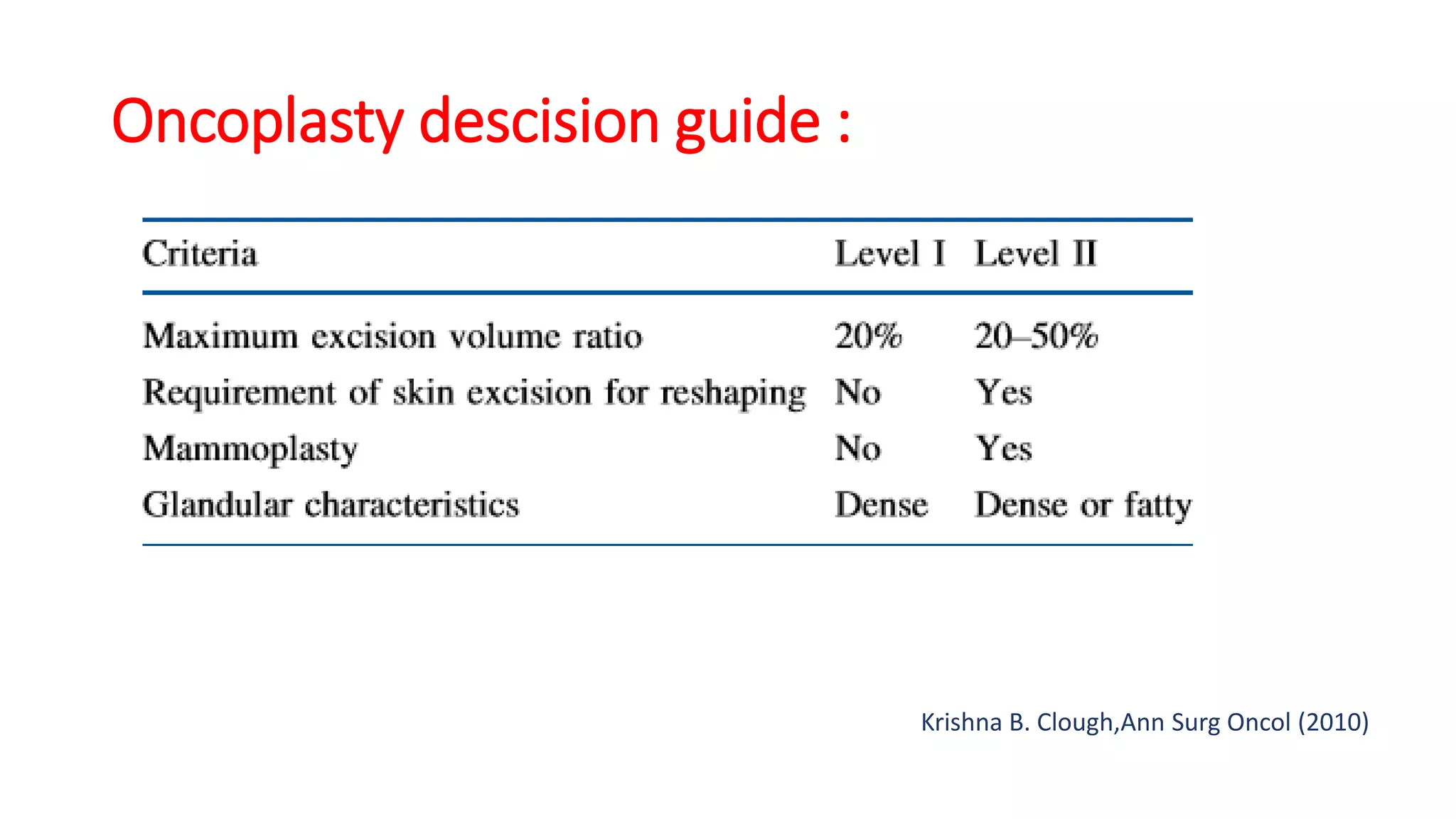
Oncoplasty descision guide :
Krishna B. Clough,Ann Surg Oncol (2010)
Basic Principles of Breast Oncoplasty
Planning Incisions
• Aesthetically placed
• Minimal scar burden
• Adequate access to optimal cancer surgery
• Conforming with the needs of Reconstructive surgery
Ideal Location of Incisions
• Breast
• Infra-mammary
• Peri-areolar
• Trans- axillary
• Flap Donor sites –
• Hidden naturally by clothing
• TRAM – Supra-pubic area , LD – Upper
Back
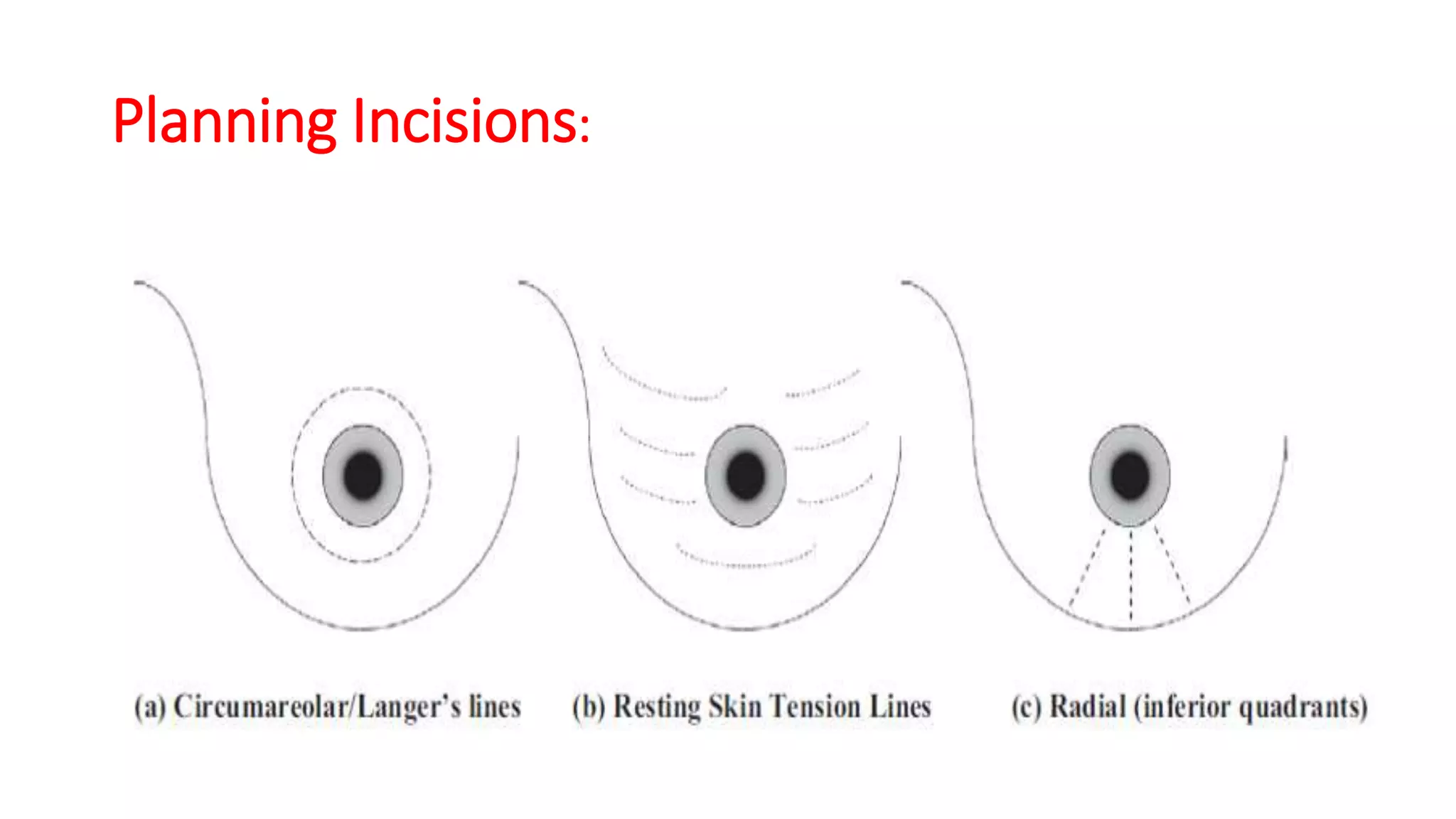
Planning Incisions:
•Tumors Located Upper half of Breast
• Avoid Radial Incisions
• Circumareolar / Elliptical incisions preferred
•Tumors Located in lower half of breast
• Radial
• Reduction Mammoplasty
• Inverted “T” or Triangle Incisions
•Avoid Radial incisions in upper half
Planning Incisions
Planning Incisions
Planning Incisions
Basic Surgical Technique - OPBS
• Tissue respect & Maintain vascularity
• Sharp Dissection – Cautery/ Knife
• Adequate margins
• Layered Closure & drains?
• Clip – Cavity walls before tissue rearrangement
• Orient the specimen
• Obtain Preop ,intraop and Postop Photographs.
level I OPBS:step by step :
• Skin incision
• Skin undermining and glandular
mobilisation
• NAC undermining
Krishna B. Clough,Ann Surg Oncol (2010)
• Undermining the breast from
both the skin and pectoralis
muscle (dual-plane undermining)
• Full-thickness excision
• Before closing the defect, metal
clips are placed on the
subcutaneous tissue ,pectoralis
muscle and lateral edges of the
resection bed to guide future
radiotherapy
• Glandular reapproximation
• Nipple recentralization.
1 A skin crescent is
deepithelialized opposite to
the lumpectomy bed in the
upper outer quadrant.
2 NAC is recentralized to avoid
NAC deviation post
lumpectomy
Central/Retroareolar Lesions :
• Grisotti dermoglandular flap
• Purse string closure
• Batwing/Hemibatwing /modified Hemibatwing
Level II Oncoplasty techniques
Technique:Grisotti flap
Technique: Purse string suture
Technique :Batwing Oncoplasty
Final result after areola tattooing and neonipple creation
Upper pole tumors
Technique:Round block
mammoplasty
Upper pole tumors
Technique: Inferior Pedicle Mammoplasty
upper outer quadrant
tumors
Technique : Tennis racquet
excision
Technique: J- Mammoplasty for LOQ lesions
Technique: Superior
Pedicle Mammoplasty
with Inverted T
Scar/Vertical Scar for
lower pole lesions
The only prerequisite is a
medium-sized, large or
ptotic breast with an
inframammary fold to
areola distance of at least
6 cm.
Lower inner
quadrant tumors
Technique: V –
Mammoplasty
Level II
oncoplasty
quadrant
wise
satisfactory aesthetic outcome 90.3%.
with local recurrence in 6.8%
In the absence of robust design ,Current evidence supporting efficacy
of OPBS is based on poorly designed studies .
Further studies particularly RCTs are required to assess oncological
safety and cosmetic results of OPBS
Latest concepts: Anatomy of breast
Horizontal fibrous septum(PF at 5th rib to nipple )
Medial vertical
ligament
(along sternum 2nd
to 5th rib )
Lateral vertical
ligament
(along lateral border
of pec minor )
Anteriorly merge into
coopers ligament
Würinger, Mader et al.
ONCOPLASTIC BREAST SURGERY
Horizontal fibrous septum
Medial vertical
ligament
Lateral vertical
ligament
CAUDALLY:
Perforators from 4th 5th 6th
intercostal artery
CRANIALLY:
Thoracoacromian artery (4th ICS )
Lateral thoracic artery
Perforating
branches of internal
thoracic artery 2nd
to 4th ICS
Branches from
lateral thoracic
artery
Lateral cutaneous branch of 4th
and 5th intercostal nerve –
SUPPLY TO NIPPLE
Algorithm for method of oncoplastic reconstruction
Piper et al. Oncoplastic breast surgery Gland Surgery, Vol 4, No 2 April 2015
Take home message :
• OPBS has extended the scope of BCS
• Descision is guided by excision volume ,tumor location and glandular
density
• Classified based on the amount of tissue excised
• Various techniques to suit each location
• Randomised trials are needed to evaluate the safety and cosmesis
Thank you

oncoplasty breast

  • 1.
    Breast Oncoplasty Techniques Presenter: DrShivangi Saha Moderator : Prof . Anurag Srivastava
  • 2.
    We will becovering : • Definition • History of OPBS • Indications • Contraindications • Advantages and disadvantages • Elements of selection • classification • Basic techniques –Level I and level II Oncoplasty • Latest concepts on anatomy of breast • Algorithm for method of oncoplastic reconstruction
  • 3.
    Definition • An approachto allow wide excision for BCS without compromising the natural shape of the breast or oncological safety ,and is based upon integration of plastic surgery techniques . • Includes : • Excision with adequately wide free margins -loco regional control • Immediate remodelling -to improve the cosmetic result • when needed –C/l breast symmetrisation and reconstruction of the nipple -areola complex (NAC), • Immediate/ late reconstruction after mastectomy Florian Fitzal, Peter Schrenk (2010) ONCOPLASTIC BREAST SURGERY
  • 4.
    History of OncoplasticBreast Surgery • 1980 – Jean-Yves Petit , France (Idea & Concept) •1998 – Ausdretch , Germany (Definition ,Techniques of OPBS) Father of modern OPBS •2008 – Alexander Munhoz , Brazil ( Classification of defects,Correction) •2010 – Krishna B Clough, France (Refined Classification of OPBS) The evolution of mastectomies in the oncoplastic breast surgery era Gland Surg. 2013
  • 5.
    Can be offeredto: 1. Scheduled for BCS: • Patients with breast cancer a. poor cosmetic result expected after standard BCS: i. Unfavorable tumor to breast size ratio: >10-20 % breast volume is removed ii. Unfavorable tumor location b.Who consider reduction mammaplasty / mastopexy due to breast hyperplasia / ptosis
  • 6.
    2. After standardBCS : a. Who need re-excision for involved margins b. With free margins -seek correction of defects for cosmetic reasons 3.Scheduled for mastectomy: who seek immediate breast reconstruction
  • 7.
    Ideally suited : •Early T1, T2 breast cancer with size < 4 cm • Good breast to tumour ratio • N0 or N1 axillary disease
  • 8.
    Contraindications: • T3,T4 ,>N1lesions • No tumor-free margins obtained • No change or progression after neoadjuvant therapy • Multicentric • No adjuvant radiotherapy • Inflammatory breast cancer
  • 9.
    Parameters OPBS(case n=26)BCS (control n=52) T3 53.8% 53.8% T4 23.1% 26.9% Initial size 5.26 ± 1.66cm 5.25 ± 1.52cm Surgical weight 307 ± 221g 208 ± 139g Surgical margin 16 ± 8mm 11 ± 8mm LR 7.7% 11.5% DFS 76.9% 67.3% OPBS is a safe procedure for LABC, offering the similar oncologic results to classic BCS.
  • 10.
    Advantages of OPBS •Resection of larger volumes • Free margins obtained more frequently (LOE III) • fewer reoperations (LOE IV) • Better cosmesis (LOE IV) • OPBS extends the indications for BCS –larger tumors • C/l procedures may detect previously unknown cancer • C/l reduction mammaplasty may reduce the risk of breast cancer • more homogenous dose distribution of radiation
  • 11.
    Disadvantages of OPBS •Longer duration of surgery • More visible scars • Less refunding from insurance companies for concomitant procedures performed either in the same or the c/l breast • Experience in oncological and plastic reconstructive surgery-in one- team approach • timing and planning of two disciplines-in two-team approach • Higher complication rate Florian Fitzal, Peter Schrenk (2010)
  • 12.
    • use ofOPBS did not confer an increased risk of surgical complications, despite the longer operative time • 75,972 patients underwent BCS 2005 -2014 • 1363 (1.8 %) underwent OPBS • OPBS with soft tissue transfer had a significantly longer operative time 83 vs. 59 min
  • 13.
    Elements for selection: Excision volume Glandular density Tumor location
  • 14.
  • 15.
  • 16.
    Glandular Density: A denseglandular breast (BIRADS 3/4) can easily be mobilized by dual-plane undermining without risk of necrosis. Low-density breast tissue with a major fatty composition (BIRADS 1/2) has a higher risk of fat necrosis
  • 17.
    • Volume DisplacementOPBS Types of Oncoplastic Breast Surgery: rearrange breast tissue by bringing local (dermo)glandular flaps into the defect • Volume Replacement OPBS Mini Latdorsi flap/ T-A flap/TDAP/LICAP distant autologous tissue flaps or implants to substitute for tissue loss. Simple (Level –I ) - 20 % volume Loss Complex (Level-II) - 20% to 50% volume loss
  • 18.
    Level - I- Oncoplasty • Simple & suitable for small defects • Can be done by general/ breast surgeon • Bi-Planar dermoglandular mobilization to fill defects • Random pattern blood supply
  • 19.
    Level –II Oncoplasty •Complex Procedures • Requires training & Plastic Surgical expertise • Large volume resections • Rotation of Breast pedicles based on definite vascular pedicles • Need for Contra-lateral procedures
  • 20.
    Oncoplasty descision guide: Krishna B. Clough,Ann Surg Oncol (2010)
  • 21.
    Basic Principles ofBreast Oncoplasty Planning Incisions • Aesthetically placed • Minimal scar burden • Adequate access to optimal cancer surgery • Conforming with the needs of Reconstructive surgery
  • 22.
    Ideal Location ofIncisions • Breast • Infra-mammary • Peri-areolar • Trans- axillary • Flap Donor sites – • Hidden naturally by clothing • TRAM – Supra-pubic area , LD – Upper Back
  • 23.
    Planning Incisions: •Tumors LocatedUpper half of Breast • Avoid Radial Incisions • Circumareolar / Elliptical incisions preferred •Tumors Located in lower half of breast • Radial • Reduction Mammoplasty • Inverted “T” or Triangle Incisions •Avoid Radial incisions in upper half
  • 24.
  • 25.
  • 26.
  • 27.
    Basic Surgical Technique- OPBS • Tissue respect & Maintain vascularity • Sharp Dissection – Cautery/ Knife • Adequate margins • Layered Closure & drains? • Clip – Cavity walls before tissue rearrangement • Orient the specimen • Obtain Preop ,intraop and Postop Photographs.
  • 28.
    level I OPBS:stepby step : • Skin incision • Skin undermining and glandular mobilisation • NAC undermining Krishna B. Clough,Ann Surg Oncol (2010)
  • 29.
    • Undermining thebreast from both the skin and pectoralis muscle (dual-plane undermining) • Full-thickness excision
  • 30.
    • Before closingthe defect, metal clips are placed on the subcutaneous tissue ,pectoralis muscle and lateral edges of the resection bed to guide future radiotherapy • Glandular reapproximation
  • 31.
    • Nipple recentralization. 1A skin crescent is deepithelialized opposite to the lumpectomy bed in the upper outer quadrant. 2 NAC is recentralized to avoid NAC deviation post lumpectomy
  • 32.
    Central/Retroareolar Lesions : •Grisotti dermoglandular flap • Purse string closure • Batwing/Hemibatwing /modified Hemibatwing Level II Oncoplasty techniques
  • 33.
  • 34.
  • 35.
    Technique :Batwing Oncoplasty Finalresult after areola tattooing and neonipple creation
  • 36.
  • 37.
    Upper pole tumors Technique:Inferior Pedicle Mammoplasty
  • 38.
    upper outer quadrant tumors Technique: Tennis racquet excision
  • 39.
  • 40.
    Technique: Superior Pedicle Mammoplasty withInverted T Scar/Vertical Scar for lower pole lesions The only prerequisite is a medium-sized, large or ptotic breast with an inframammary fold to areola distance of at least 6 cm.
  • 41.
  • 42.
  • 43.
    satisfactory aesthetic outcome90.3%. with local recurrence in 6.8%
  • 44.
    In the absenceof robust design ,Current evidence supporting efficacy of OPBS is based on poorly designed studies . Further studies particularly RCTs are required to assess oncological safety and cosmetic results of OPBS
  • 45.
    Latest concepts: Anatomyof breast Horizontal fibrous septum(PF at 5th rib to nipple ) Medial vertical ligament (along sternum 2nd to 5th rib ) Lateral vertical ligament (along lateral border of pec minor ) Anteriorly merge into coopers ligament Würinger, Mader et al. ONCOPLASTIC BREAST SURGERY
  • 46.
    Horizontal fibrous septum Medialvertical ligament Lateral vertical ligament CAUDALLY: Perforators from 4th 5th 6th intercostal artery CRANIALLY: Thoracoacromian artery (4th ICS ) Lateral thoracic artery Perforating branches of internal thoracic artery 2nd to 4th ICS Branches from lateral thoracic artery Lateral cutaneous branch of 4th and 5th intercostal nerve – SUPPLY TO NIPPLE
  • 47.
    Algorithm for methodof oncoplastic reconstruction Piper et al. Oncoplastic breast surgery Gland Surgery, Vol 4, No 2 April 2015
  • 48.
    Take home message: • OPBS has extended the scope of BCS • Descision is guided by excision volume ,tumor location and glandular density • Classified based on the amount of tissue excised • Various techniques to suit each location • Randomised trials are needed to evaluate the safety and cosmesis
  • 49.

Editor's Notes

  • #4 OPS is based upon the integration of plastic surgery techniques for immediate reshaping after wide excision for breast cancer he success of BCS for breast cancer is based on the tenet of complete removal of the cancer with adequate surgical margins, while preserving the natural shape and appearance of the breast. Achieving both goals together in the same operation can be challenging, and BCS has not always produced good cosmetic results in all patients. One of the limiting factors is the amount of tissue removed, not only in terms of absolute volume but also in relation to tumor location and relative size of breast
  • #5  plastic surgery techniques were transposed into breast-conse)rving therapy to avoid late unsatisfactory aesthetic results in 1980s in France by Jean-Yves Petit (Institut Goustave-Roussy according to Audretsch is tumor specific immediate reconstruction for breast conservation by using plastic techniques.
  • #9  First and second trimester of pregnancy Previous breast therapeutic irradiation Active collagen vascular disease
  • #11 6.1 : Resection of larger breast volumes (Kaur, Petit et al. 2005; Schrenk, Huemeret al. 2006, Giacalone, Rogeret al. 2007): The amount of breast tissue resected largely depends on the size of the breast and more volume excised does not automatically result in wider resection margins Wider free margins (level III evidence) (Kaur, Petit et al. 2005; Schrenk, Huemer et al. 2006, Giacalone, Roger et al. 2007) Free margins are obtained more frequently (level III evidence) (Kaur, Petit et al. 2005; Schrenk, Huemer et al. 2006, Giacalone, Rogeret al. 2007) and fewer patients may need reoperations (level IV evidence) Better cosmetic results (especially in women who wish to reduce breast weight or ptosis) (level IV evidence) OPS extends the indications for BCS and patients with larger tumors are scheduled to BCS (level IV evidence) Contralateral procedures done for symmetrization may detect previously unknown cancer (Petit, Rietjenset al.1997) Contralateral reduction mammaplasty may reduce the risk of breast cancer (Boice, Perrsonet al.2000) A reduced breast volume allows a more homogenous dose distribution of postoperative radiation
  • #13 Results. We identified 75,972 patients who underwent BCS for breast cancer between 2005 and 2014, of whom 1363 (1.8 %) underwent OBS with soft tissue transfer. Compared with the standard lumpectomy group, patients undergoing OBS were more likely to be younger, had a lower body mass index, were less likely to be smokers, and more often received neoadjuvant chemotherapy. OBS with soft tissue transfer also had a significantly longer operative time (83 vs. 59 min; p\0.001). The multivariable analysis confirmed that soft tissue transfer OBS was not an independent predictor of overall complications (odds ratio 0.78; 95 % confidence interval 0.50–1.19). Conclusions. These data confirm that the use of OBS with soft tissue transfer for breast cancer treatment does not confer an increased risk of surgical complications, despite the longer operative time. This is important given the increasing use of oncoplastic surgery techniques within North America.
  • #16 Add pictures
  • #17 Although the clinical exam is reliable, mammographic evaluation is a more reproducible approach for breast density determination. Breast density predicts the fatty composition of the breast and determines the ability to perform extensive breast undermining and reshaping without complications. Breast density can be classified into four categories based on the Breast Imaging Reporting and Data System (BIRADS): fatty (1), scattered fibroglandular (2), heterogeneously dense (3) or extremely dense breast tissue (4).8 Undermining the breast from both the skin and pectoralis muscle (dual-plane undermining) is a major requirement to perform level I OPS.A dense glandular breast (BIRADS 3/4) can easily be mobilized by dual-plane undermining without risk of necrosis. Low-density breast tissue with a major fatty composition (BIRADS 1/2) has a higher risk of fat necrosis after extensive undermining. Low breast density should provoke the decision to either limit the amount of undermining during level I OPS or proceed to a level II OPS that requires only posterior undermining, leaving the skin attached.
  • #18 volume displacement volume Volume displacement techniques rearrange breast tissue by bringing local (dermo)glandular flaps into the defect (advancement, rotation or transposition flaps) (Galimberti, Zurrida et al. 1993; Anderson, Masettiet al.2005; Benelli 2006). Inferior and superior pedicle mammaplasty techniques are preferable in patients with large or ptotic breasts. They facilitate reconstruction of defects located in any breast quadrant when the skin incision patterns are rotated according to the location of the tumor in the breast (Schönegg, Keppkeet al. 1987; Daher 1993; Clough, Lewis et al. 2003). Some reduction techniques retain breast tissue usually discarded with cosmetic reduction mammaplasty to cover quadrantectomy defects (Clough, Krollet al.1999; McCulley, Macmillan 2005; Schrenk, Huemer et al. 2006; Fitzal, Nehrer et al. 2007) (Fig. 2, Fig. 3). Centrally located carcinomas require resection and reconstruction of the NAC using either volume displacement techniques or mastectomy with immediate reconstruction (Huemer, Schrenk et al. 2007; Fitzal, Mittlböck et al. 2008). (Association of Breast Surgery at BASO et al. 2007; Masetti, Di Leone et al. 2006; Anderson, Masetti et al. 2005; Rezai, Darsow et al. 2008)
  • #21 Oncoplastic Classification System We propose a new classification of OPS techniques into two levels based upon the amount of tissue excised and the relative level of surgical difficulty. A level I approach is based on dual-plane undermining, including the nipple– areola complex (NAC), and NAC recentralization if nipple 1376 K. B. Clough et al. deviation is anticipated. No skin excision is required. Level II techniques allow major volume resection. They encompass more complex procedures derived from breast reduction techniques. These ‘‘therapeutic mammoplasties’’ involve extensive skin excision and breast reshaping.9 They result in a significantly smaller, rounder breast. Bilevel Classification Our bilevel classification system leads to a practical guide of OPS techniques (Table 1). This guide allows for selection of the most appropriate OPS procedure during surgical planning. I. If less than 20% of the breast volume is excised, a level I procedure is often adequate. These procedures can be performed by all breast surgeons without specific training in plastic surgery. II. Anticipation of 20–50% breast volume excision will require a level II procedure with excision of excess skin to reshape the breast. They are based upon mammoplasty techniques and require specific training in OPS. Another major consideration in the patient selection criteria is glandular density. If the breast parenchyma is fatty in composition, it may be risky to use a level I technique. Therefore, when planning a large resection in a fatty breast, employing a level II procedure will rOncoplastic
  • #24 Kraissl’s lines of tension to limit visible scaring
  • #29 Skin incision Skin undermining and glandular mobilization for reshaping NAC undermining NAC deviation towards the excision area. NAC repositioning is easily performed with simple undermining: this is a key component of both level I and II OPS. The first step is to completely transect the terminal ducts and separate the NAC from the underlying breast tissue. A width of 0.5–1 cm of attached glandular tissue is maintained to ensure the integrity of the vascular supply. This appropriate amount of subareolar tissue prevents NAC necrosis and avoids venous congestion. Ultimately, the level of NAC sensitivity may be reduced after extensive mobilization and undermining.11
  • #32 An area of periareolar skin opposite the excision defect is deepithelialized in the shape of a crescent. For level I procedures, the width of deepithelializationcanmeasureupto6 cm.Deepithelization should be achieved sharply, using a scalpel blade or fine scissors. The vascular supply of the NAC after its separation from the gland and deepithelialization is based on the dermal vasculature.13
  • #37 ROUND BLOCK TECH:skin drawing Concentric periareolar incision Circumferential skin undermining Reapproximation of glandular flap Final scar
  • #38 The only prerequisite is a medium-sized, large or ptotic breast with an inframammary fold to areola distance of at least 6 cm. Fatty tissue necrosis is most commonly seen at the top of the inferior pedicle. It is caused by decreased blood supply to the pedicle peak and leads to difficulties In distinguishing fatty tissue necrosis from cancer recurrence. PREOPERATIVE DRAWING inf PEDICLE DEEPITHELISATION WIDE RESECTION COMLEMENTARY RESECTION OF MEDIAL AND LATERAL PILLARS ADVANCEMENT OF INFERIOR PEDICLE INTO THE DEFECT AND SKIN CLOSURE
  • #40 PREOPERATIVE DRAWING WIDE RESECTION DEEPITHELISATION of nac Breast reshaping NAC recentralisation
  • #41 (Ribeiro 1975; Clough, Thomas et al. 2004; Huemer, Schrenk et al. 2007; McCulley, Macmillan 2005) FOR LOWER POLE LESIONS PREOPERATIVE DRAWING SUP PEDICLE DEEPITHELISATIONAND ELEVATION WIDE RESECTION REAPPROXIMATION OF MEDIAL AND LATERAL GLANDULAR FLAPS FINAL RESULT AFTER CONTRALATERAL SYMMETRIZATION Superior pedicle oncoplastic reduction mammaplasty is preferred in patients with large or moderate-sized breasts who wish to reduce breast weight for cosmetic reasons and a tumor located in the lower quadrant of the breast. The distance from the present to the future nipple position should not extend 10 – 12 cm as this impedes areola insetting with decreased blood supply to the areola. The pronounced fullness of the upper pole tends to descend down to the inferior pole within months
  • #42 V MAMMOPLASTY FOR LIQ PREOP DRAWING WEDGE SHAPED EXCISIOPN UPTO INFRAMAMMARY CREASE INCISDION EXTENDED UPTO AXILLA MEDIAL ROTATION OF LATERAL GLANDULAR FLAP TO FILL THE DEFECT AND RESHAPE THE BREAST FINAL RESULT
  • #44 .
  • #46 The ligamentous suspension consists of a horizontal fibrous septum originating from the pectoralis fascia at the level of the fifth rib heading toward the nipple and its vertical ligamentous extensions which provide a medial and lateral line of fixation on either border of the septum(Fig. 1 – 4). The medial vertical ligament stretches from the sternum along the second to the fifth rib, while the lateral vertical ligament attaches along the lateral border of the pectoralis minor muscle. Cranially, the vertical ligaments are connected along the second rib by the superficial fascia and in this way form a circle of fibrous attachments. The line of fixation of this circle follows the borders of the pectoralis major muscle origin to a great extent. In an anterior direction, the vertical ligaments merge into the capsule of the breast. Thus, the ligamentous suspension also connects with the ligamenta suspensoria as described by Cooper (Cooper 1840b) as stretching from the anterior sheet of the superficial mammary fascia into the skin. Arising from the same origin at the thoracic wall, the ligamentous suspension also has a superficial cutaneous component that merges into the overlying skin, thereby defining the actual bounds and shape of the breast. A rather weak medial cutaneous ligament stretches into the skin overlying the sternum. The superficial lateral ligament builds a strong connection between the pectoralis minor muscle and the skin and fascia of the axilla, thus producing an axillary hollow by the suspensory ligament of the axilla(Fig. 4). The superficial cutaneous part of the horizontal septum stretches from the same origin at the level of the fifth rib into the submammary crease by densifications of Cooper’s ligaments(Fig. 2); it thereby forms the submammary crease. The main importance of the ligamentous suspension lies in the fact that it acts as a guiding structure for neurovascular supply. The deep component of the ligamentous suspension, which attaches the breast to the thoracic wall, has a predictable relationship to the main vessels and nerves of the breast and the nipple-areola complex. It resembles the mesentery of the intestine both in its thin, pliable structure and in functional terms. The remaining parts of the breast receive no distinct vessels from the thoracic wall, as mentioned in previous descriptions of the hypervascular and hypovascular zones of the anterior chest wall (Palmer, Taylor 1986). The horizontal septum is covered cranially and caudally by two dense layers of vessels running toward the nipple (Fig. 2, Fig. 3). The very distinct cranial layer consists of branches of the thoracoacromial artery, emerging from the pectoralis major at the level of the fourth intercostal space, and a branch of the lateral thoracic artery. The caudal vascular layer is built by cutaneous perforating branches from anastomoses of the fourth and fifth, rarely also the sixth intercostal arteries, which together run in a cranial direction to attach to the horizontal septum. The residual part of the fibrous circle also acts as a guiding structure for the main vascular supply, continuing to run subcutaneously along the capsule of the gland and finally building a subdermal periareolar network (Fig. 4). These are the perforating branches from anastomoses of the internal thoracic artery, which follow the medial vertical ligament, arising from the second to the fourth intercostal spaces, and branches of the lateral thoracic artery arising at the same level, which follow the lateral vertical ligament. These vessels run subcutaneously, protected within channels built by the fibrous structures of the ligaments, which merge into the superficial fascia. At the subdermal periareolar plexus, they anastomose with the vessels which come along the horizontal septum. Both the large vessels and the large nerves run along the ligamentous suspension (1998). To the extent that they are developed, the anterior cutaneous branches of the second to fourth intercostal nerves are guided a long t he medial ligament and the corresponding lateral cutaneous branches along the lateral ligament (Fig. 4). Most importantly, the main nerve to the nipple, the deep branch of the lateral cutaneous branch of the fourth or sometimes the fifth intercostal nerve, always runs along the horizontal septum(Fig. 3). Understanding the course of the main neurovascular supply along the horizontal septum is of avail in preserving viability and sensitivity to the nipple in operations of the breast, e.g. in breast reductions (Würinger 1999, 2005, 2010; Deventer et al. 2008; Hamdi et al. 2009).