MICROBIAL
GENETICS
PREPARED BY
WELFREDO YU,JR.
STRUCTURE AND FUNCTION
OF GENETIC MATERIAL
DNA & RNA
DNA=deoxyribonucleic acid
RNA=ribonucleic acid
Basic building blocks:
Nucleotides
Phosphate group
Pentose sugar
Nitrogenous base
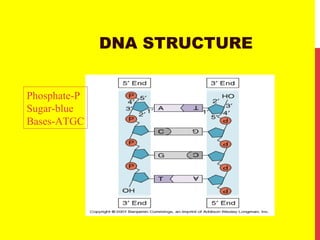
STRUCTURE OF DNA
Double stranded (double helix)
Chains of nucleotides
5’ to 3’ (strands are anti-parallel)
Complimentary base pairing
• A-T
• G-C
DNA STRUCTURE
Phosphate-P
Sugar-blue
Bases-ATGC
DNA REPLICATION
Bacteria have closed, circular DNA
Genome: genetic material in an organism
E. coli
• 4 million base pairs
• 1 mm long (over 1000 times larger that actual bacterial cell)
• DNA takes up around 10% of cell volume
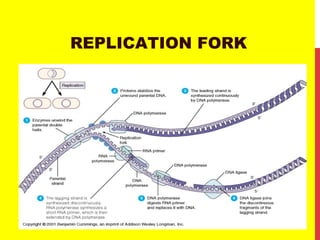
DNA REPLICATION-OCCURS AT
THE REPLICATION FORK
5’ to 3 ‘
DNA helicase-unzips + parental DNA strand
that is used as a template
• Leading stand (5’ to 3’-continuous)
*DNA polymerase-joins growing DNA strand after
nucleotides are aligned (complimentary)
• Lagging strand (5’ to 3’-not continuous)
*RNA polymerase (makes short RNA primer)
*DNA polymerase (extends RNA primer then digests RNA
primer and replaces it with DNA)
*DNA ligase (seals Okazaki fragments-the newly formed
DNA fragments)
REPLICATION FORK
PROTEIN SYNTHESIS
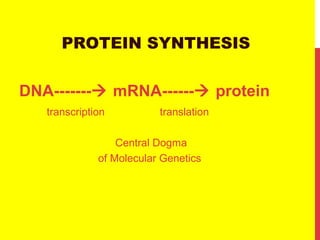
DNA------- mRNA------ protein
transcription translation
Central Dogma
of Molecular Genetics
TRANSCRIPTION
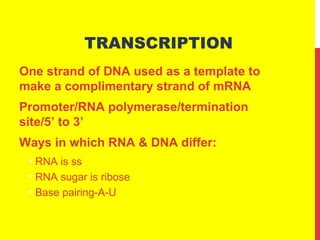
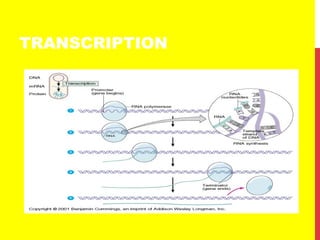
One strand of DNA used as a template to
make a complimentary strand of mRNA
Promoter/RNA polymerase/termination
site/5’ to 3’
Ways in which RNA & DNA differ:
• RNA is ss
• RNA sugar is ribose
• Base pairing-A-U
TRANSCRIPTION
TYPES OF RNA
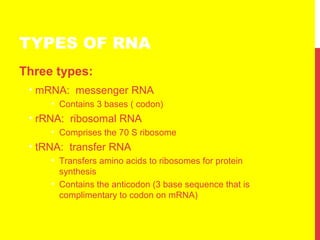
Three types:
• mRNA: messenger RNA
• Contains 3 bases ( codon)
• rRNA: ribosomal RNA
• Comprises the 70 S ribosome
• tRNA: transfer RNA
• Transfers amino acids to ribosomes for protein
synthesis
• Contains the anticodon (3 base sequence that is
complimentary to codon on mRNA)
GENETIC CODE
DNA: triplet code
mRNA: codon (complimentary to triplet code of DNA)
tRNA: anticodon (complimentary to codon)
GENETIC CODE
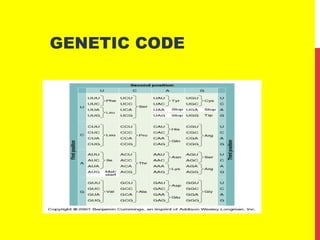
Codons: code for the production of a specific amino acid
20 amino acids
3 base code
Degenerative: more than 1 codon codes for an amino acid
Universal: in all living organisms
GENETIC CODE
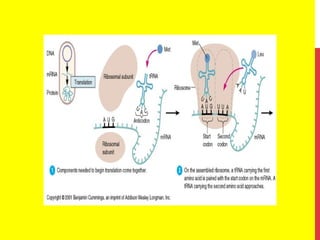
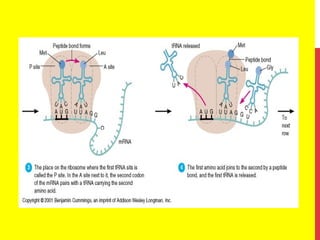
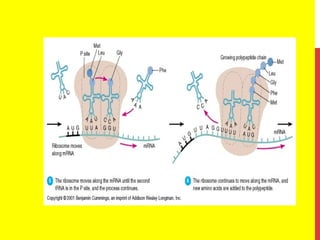
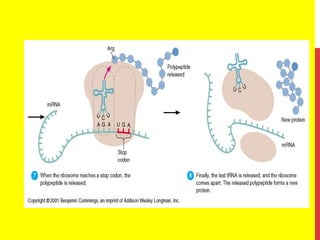
TRANSLATION
Three parts:
• Initiation-start codon (AUG)
• Elongation-ribosome moves along mRNA
• Termination: stop codon reached/polypeptide
released and new protein forms
rRNA=subunits that form the 70 S
ribosomes (protein synthesis occurs here)
tRNA=transfers amino acids to ribosomes
for protein synthesis)
MUTATIONS
Changes in base sequence of DNA/lethal and inheritable
Can be:
• Harmful
• Lethal
• Helpful
• Silent
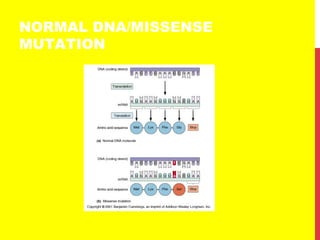
NORMAL DNA/MISSENSE
MUTATION
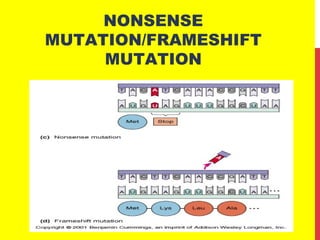
NONSENSE
MUTATION/FRAMESHIFT
MUTATION
GENETIC TRANSFER
IN BACTERIA
Genetic transfer-results in genetic variation
Genetic variation-needed for evolution
Three ways:
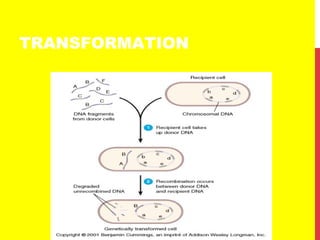
• Transformation: genes transferred from one
bacterium to another as “naked” DNA
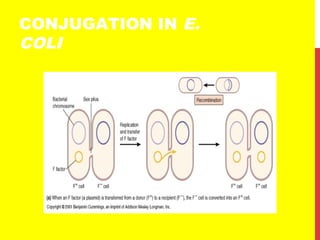
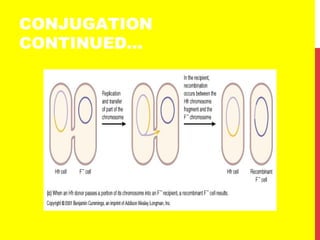
• Conjugation: plasmids transferred 1 bacteria to
another via a pilus
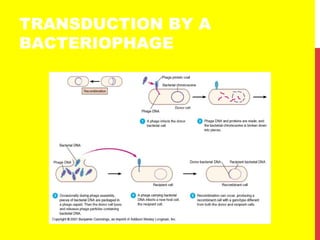
• Transduction: DNA transferred from 1 bacteria to
another by a virus
TRANSDUCTION BY A
BACTERIOPHAGE
TRANSFORMATION
CONJUGATION IN E.
COLI
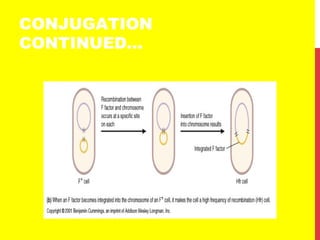
CONJUGATION
CONTINUED…
CONJUGATION
CONTINUED…

MICROBIAL GENETICS

Editor's Notes

  • #3 DNA and RNA-polymers Nucleotides-monomers
  • #4 A-adenine T-thymine G-guanine C-cytosine
  • #5 Hydrogen bonds-hold base pairs together 5’ end-means P comes off 5’ carbon of deoxyribose sugar 3’means P comes of 3’ end of deoxyribose sugar
  • #7 During replication, on parental ds DNA is converted into 2 identical ds daughter molecules… After DNA helicase unzips DNA strand, free nucleotides present in cytoplasm are matched up to exposed bases on the single stranded parental DNA Dna polymerase can add nucleotides only to the 3’ end Okazaki fragments-1000 nucleotides
  • #10 mRNA-messenger RNA
  • #12 mRNA-messenger
  • #14 64 total codons 3 STOP codons uaa,uga,uag 1 start codon (for protein synthesis) aug (also a sense codon that forms aa)
  • #21 Silent-neutral
  • #22 Missense-just one different amino acid formed-caused from a base substitution, single base is replaced with a different one
  • #23 Nonsense mutation-base substitution in the middle of the mRNA results in the formation of the stop codon/protein synthesis stopped Frameshift-1 or a few nucleotides are deleted or inserted-alters 3by3 transitional reading frame/produces inactive protein Base substitutions and frameshift mutations occur spontaneously or by chemicals in the environment
  • #24 Transduction-DNA passed from 1 bacteria to another in a bacteriophage (virus) and then incorporated into the host DNA
  • #27 F factor-plasmid F+ cell –donor/f- is recipient Hfr-when plasmid becomes incorporated into chromosome of bacteria, that cell is called a high frequency of recombination cell During conjugation, hfr cell can transfer chromosomal dna to f-cell