BIOL 350 - Principles of Genetics

• Instructors
 ‣ Dr.Vicki Corbin
 ‣ Dr. Stuart Macdonald
• Textbook
 ‣ Genetics: Analysis of Genes and Genomes
   D. L. Hartl & E. W. Jones, 7th Edition

• Email
 ‣ genet350sp09@ku.edu
Chapter 1

Genes, Genomes & Genetic
         Analysis
Genetics & Genomics

• Genetics
 ‣ The study of biologically inherited traits
 ‣ Includes classical transmission, molecular, population
   & quantitative genetics

• Genomics
 ‣ The study of the sequence, organization, and
   function of genomes
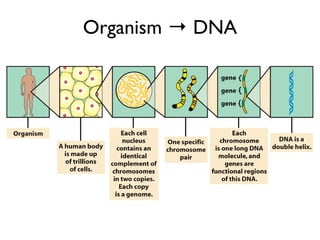
Organism → DNA
DNA is the Genetic Material


• Inherited traits are influenced by genes
  transmitted from parents to offspring
• Genes are composed of the chemical
  deoxyribonucleic acid (DNA)
• DNA is the hereditary material in all cellular
  organisms
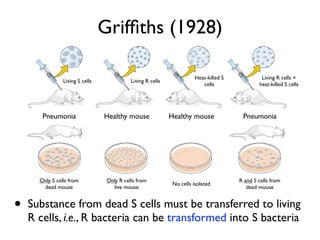
Griffiths (1928)

                                                                        Heat-killed S            Living R cells +
                Living S cells              Living R cells
                                                                           cells                heat-killed S cells


       Pneumonia                 Healthy mouse               Healthy mouse               Pneumonia


      Only S cells from           Only R cells from                                     R and S cells from
                                                              No cells isolated
       dead mouse                   live mouse                                             dead mouse


•   Substance from dead S cells must be transferred to living
    R cells, i.e., R bacteria can be transformed into S bacteria
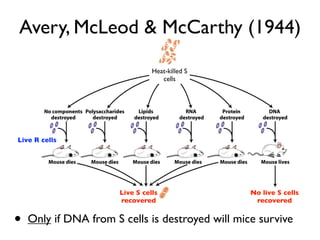
Avery, McLeod & McCarthy (1944)
                                 Heat-killed S
                                    cells


Live R cells


                       Live S cells               No live S cells
                       recovered                   recovered


•   Only if DNA from S cells is destroyed will mice survive
Properties of DNA

1. Carries blueprint for all parts of a complex
   organism - DNA must allow diversity
2. Every cell has the same genetic makeup - at every
   cell division DNA must be faithfully replicated
3. Encodes all proteins made in an organism, and
   signals when and where they should be made -
   DNA must have informational content
4. Individuals are not genetically identical - on occasion
   DNA must be able to change
Structure of DNA

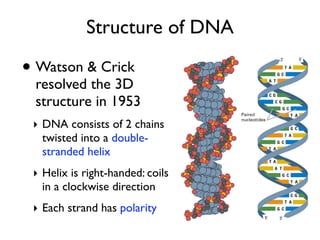
• Watson & Crick
 resolved the 3D
 structure in 1953
 ‣ DNA consists of 2 chains
   twisted into a double-
   stranded helix
 ‣ Helix is right-handed: coils
   in a clockwise direction
 ‣ Each strand has polarity
DNA Composition

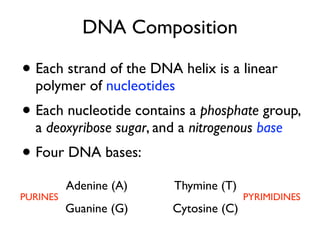
• Each strand of the DNA helix is a linear
  polymer of nucleotides
• Each nucleotide contains a phosphate group,
  a deoxyribose sugar, and a nitrogenous base
• Four DNA bases:
          Adenine (A)     Thymine (T)
PURINES                                 PYRIMIDINES
          Guanine (G)    Cytosine (C)
Complementary Base Pairing
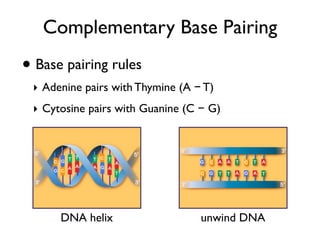
• Base pairing rules
 ‣ Adenine pairs with Thymine (A − T)
 ‣ Cytosine pairs with Guanine (C − G)


      DNA helix                   unwind DNA
DNA Replication

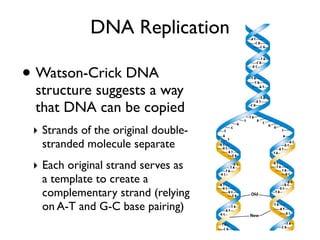
• Watson-Crick DNA
 structure suggests a way
 that DNA can be copied
 ‣ Strands of the original double-
   stranded molecule separate
 ‣ Each original strand serves as
   a template to create a
   complementary strand (relying
   on A-T and G-C base pairing)
Overview
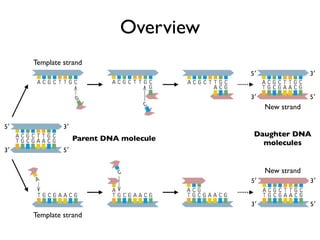
     Template strand
                                         5′                3′


                                         3′                5′
                                              New strand

5′            3′
                                          Daughter DNA
                   Parent DNA molecule
                                            molecules
3′            5′


                                              New strand
                                         5′                3′


                                         3′                5′
     Template strand
Outcome of DNA Replication

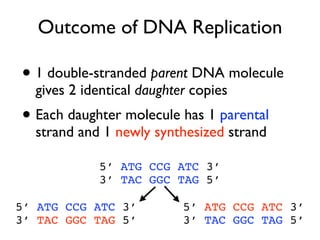
• 1 double-stranded parent DNA molecule
  gives 2 identical daughter copies
• Each daughter molecule has 1 parental
  strand and 1 newly synthesized strand

            5’ ATG CCG ATC 3’
            3’ TAC GGC TAG 5’

5’ ATG CCG ATC 3’          5’ ATG CCG ATC 3’
3’ TAC GGC TAG 5’          3’ TAC GGC TAG 5’
DNA = Information


• Sequence of bases (A, C, G, & T) along a
  DNA molecule encodes genetic information
 ‣ Huge information potential: a sequence of DNA 10
   bases has 410 (> 1 million) possible forms

• A DNA molecule can encode vast number
  of different proteins
Noncoding DNA
• Only a fraction of the total DNA in an
  organism codes for protein
• What does noncoding DNA do?
 ‣ Regulatory DNA sequence - controls when, where,
   and how much protein-coding genes are expressed
   (i.e., turned on)
 ‣ Some DNA is transcribed into RNA molecules that
   are themselves functional (and are never translated)
 ‣ Junk DNA - sequence with no known function
DNA → → Protein


• DNA sequence provides the information
  encoding the amino acid sequence of a
  polypeptide chain (a protein)
• BUT this is an indirect process
 ‣ DNA codes for RNA via transcription
 ‣ RNA codes for protein via translation
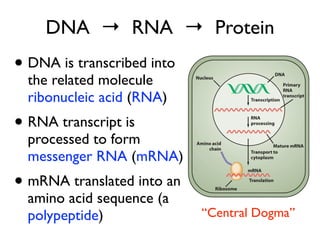
DNA → RNA → Protein
• DNA is transcribed into
  the related molecule
  ribonucleic acid (RNA)
• RNA transcript is
  processed to form
  messenger RNA (mRNA)
• mRNA translated into an
  amino acid sequence (a
  polypeptide)              “Central Dogma”
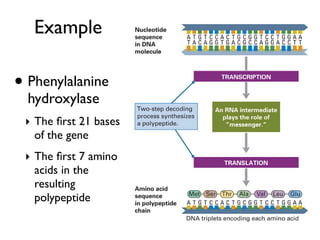
Example

• Phenylalanine
  hydroxylase
 ‣ The first 21 bases
   of the gene
 ‣ The first 7 amino
   acids in the
   resulting
   polypeptide
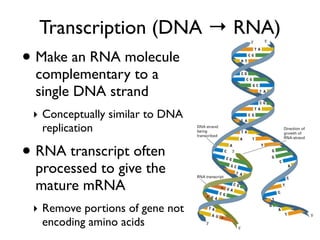
Transcription (DNA → RNA)
• Make an RNA molecule
  complementary to a
  single DNA strand
 ‣ Conceptually similar to DNA
   replication

• RNA transcript often
  processed to give the
  mature mRNA
 ‣ Remove portions of gene not
   encoding amino acids
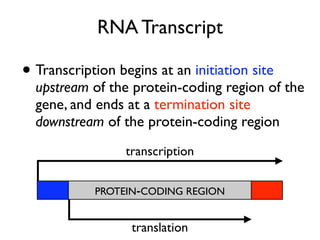
RNA Transcript

• Transcription begins at an initiation site
  upstream of the protein-coding region of the
  gene, and ends at a termination site
  downstream of the protein-coding region
                  transcription


            PROTEIN-CODING REGION


                   translation
RNA

• RNA (ribonucleic acid) is structurally similar
  to DNA
 ‣ RNA contains a ribose sugar (DNA contains
   deoxyribose)
 ‣ RNA is typically single-stranded
 ‣ RNA contains the base Uracil (U) rather than Thymine
   (T)
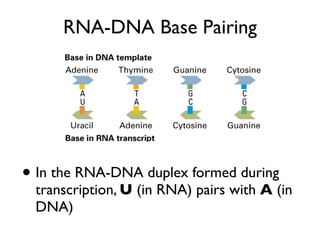
RNA-DNA Base Pairing


• In the RNA-DNA duplex formed during
 transcription, U (in RNA) pairs with A (in
 DNA)
Role of RNA Intermediate

• The mature mRNA transcript serves as a
  “working copy” of the gene
• Increases number of copies of the genetic
  information in the cell
 ‣ remember each cell hold just 2 copies of the DNA
   gene

• Provides an additional level of regulation
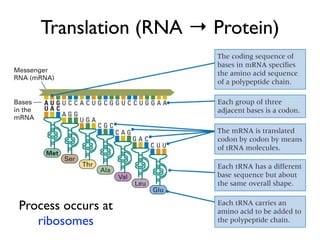
Translation (RNA → Protein)


Process occurs at
   ribosomes
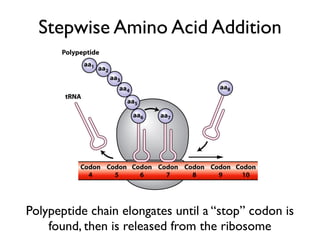
Stepwise Amino Acid Addition


Polypeptide chain elongates until a “stop” codon is
    found, then is released from the ribosome
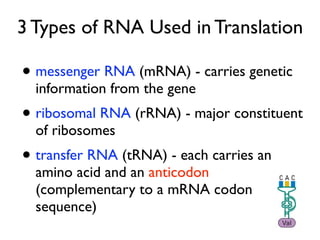
3 Types of RNA Used in Translation

• messenger RNA (mRNA) - carries genetic
  information from the gene
• ribosomal RNA (rRNA) - major constituent
  of ribosomes
• transfer RNA (tRNA) - each carries an
  amino acid and an anticodon
  (complementary to a mRNA codon
  sequence)
Triplet Code
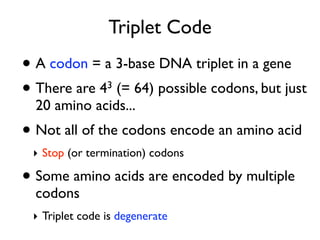
• A codon = a 3-base DNA triplet in a gene
• There are 4 (= 64) possible codons, but just
                3

  20 amino acids...
• Not all of the codons encode an amino acid
 ‣ Stop (or termination) codons

• Some amino acids are encoded by multiple
  codons
 ‣ Triplet code is degenerate
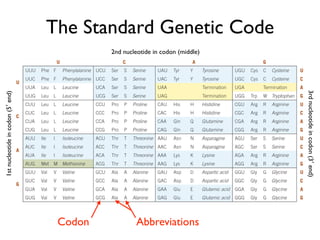
The Standard Genetic Code
                                            2nd nucleotide in codon (middle)


                                                                               3rd nucleotide in codon (3′ end)
1st nucleotide in codon (5′ end)


                                    Codon            Abbreviations
Start & Stop Codons

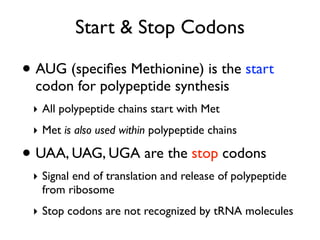
• AUG (specifies Methionine) is the start
  codon for polypeptide synthesis
 ‣ All polypeptide chains start with Met
 ‣ Met is also used within polypeptide chains

• UAA, UAG, UGA are the stop codons
 ‣ Signal end of translation and release of polypeptide
   from ribosome
 ‣ Stop codons are not recognized by tRNA molecules
Universal Code?
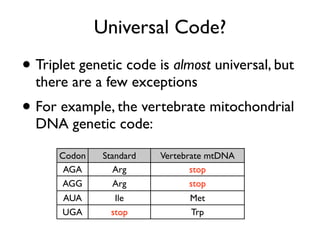
• Triplet genetic code is almost universal, but
  there are a few exceptions
• For example, the vertebrate mitochondrial
  DNA genetic code:

      Codon    Standard   Vertebrate mtDNA
       AGA        Arg            stop
       AGG        Arg            stop
       AUA        Ile           Met
       UGA       stop           Trp
Polypeptide → Protein

• Polypeptide resulting from
  transcription/translation is
  not the final protein
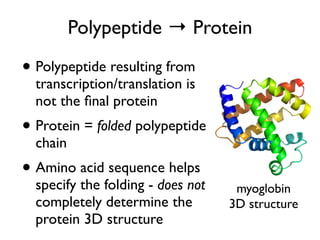
• Protein = folded polypeptide
  chain
• Amino acid sequence helps
  specify the folding - does not    myoglobin
  completely determine the         3D structure
  protein 3D structure
Genes Change by Mutation

• Mutation = a heritable change in the
  genome sequence
• A mutation gives a mutant gene sequence,
  which will produce a mutant mRNA and
  protein, and yield a mutant phenotype
 ‣ A phenotype is any observable quality, characteristic
   or trait
Drosophila white Gene Mutation

• The product of the white gene operates in
  the pigment synthesis pathway
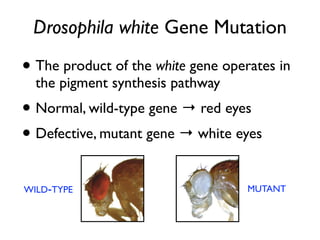
• Normal, wild-type gene → red eyes
• Defective, mutant gene → white eyes
WILD-TYPE                           MUTANT
Phenylketonuria (PKU)

• Normal individual
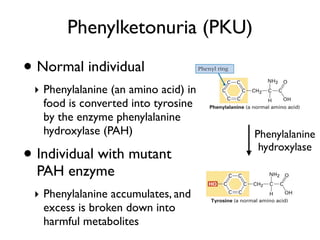
 ‣ Phenylalanine (an amino acid) in
   food is converted into tyrosine
   by the enzyme phenylalanine
   hydroxylase (PAH)                  Phenylalanine

• Individual with mutant               hydroxylase

  PAH enzyme
 ‣ Phenylalanine accumulates, and
   excess is broken down into
   harmful metabolites
PKU Disease
• Individuals with a PAH enzyme mutation
  have mental retardation
• PKU is one of very few diseases that can be
  controlled by diet (if caught early)
 ‣ US has tested all newborns since the 1960’s - if positive
   they are put on a diet low in phenylalanine

• Incidence of PKU:
 ‣ 1 in 10,000 Caucasian children
 ‣ 1 in 200,000 African-American children
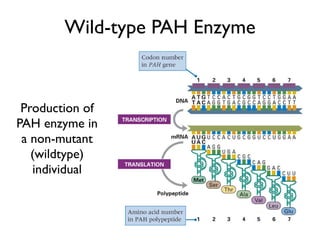
Wild-type PAH Enzyme


 Production of
PAH enzyme in
 a non-mutant
   (wildtype)
   individual
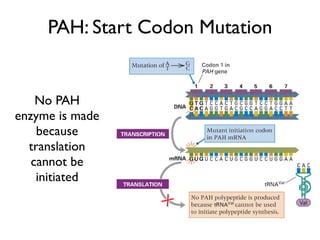
PAH: Start Codon Mutation


    No PAH
enzyme is made
    because
  translation
   cannot be
    initiated
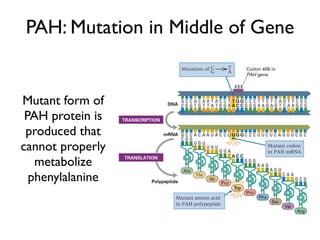
PAH: Mutation in Middle of Gene


Mutant form of
 PAH protein is
 produced that
cannot properly
   metabolize
  phenylalanine
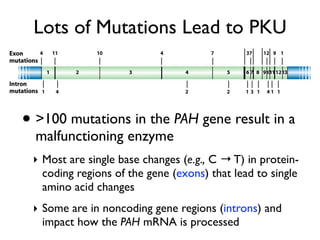
Lots of Mutations Lead to PKU


• >100 mutations in the PAH gene result in a
  malfunctioning enzyme
 ‣ Most are single base changes (e.g., C → T) in protein-
   coding regions of the gene (exons) that lead to single
   amino acid changes
 ‣ Some are in noncoding gene regions (introns) and
   impact how the PAH mRNA is processed
Genes & Environment
          Influence Traits
• PKU shows that a single gene can have a
  major effect on a trait
• Also demonstrates that environment is very
  important
 ‣ PKU mutations have no effect on individuals that
   severly restrict their phenylalanine intake

• Many traits show this kind of gene-by-
  environment interaction
Polygenic Traits

• PKU is unusual in that only one gene can
  mutate to give the disease
• Most traits are polygenic, and are influenced
  by many genes (along with environmental
  factors)
 ‣ Most human diseases are complex traits
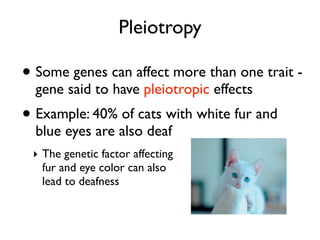
Pleiotropy

• Some genes can affect more than one trait -
  gene said to have pleiotropic effects
• Example: 40% of cats with white fur and
  blue eyes are also deaf
 ‣ The genetic factor affecting
   fur and eye color can also
   lead to deafness

Justin.Key

  • 1.
    BIOL 350 -Principles of Genetics • Instructors ‣ Dr.Vicki Corbin ‣ Dr. Stuart Macdonald • Textbook ‣ Genetics: Analysis of Genes and Genomes D. L. Hartl & E. W. Jones, 7th Edition • Email ‣ genet350sp09@ku.edu
  • 2.
    Chapter 1 Genes, Genomes& Genetic Analysis
  • 3.
    Genetics & Genomics •Genetics ‣ The study of biologically inherited traits ‣ Includes classical transmission, molecular, population & quantitative genetics • Genomics ‣ The study of the sequence, organization, and function of genomes
  • 4.
  • 5.
    DNA is theGenetic Material • Inherited traits are influenced by genes transmitted from parents to offspring • Genes are composed of the chemical deoxyribonucleic acid (DNA) • DNA is the hereditary material in all cellular organisms
  • 6.
    Griffiths (1928) Heat-killed S Living R cells + Living S cells Living R cells cells heat-killed S cells Pneumonia Healthy mouse Healthy mouse Pneumonia Only S cells from Only R cells from R and S cells from No cells isolated dead mouse live mouse dead mouse • Substance from dead S cells must be transferred to living R cells, i.e., R bacteria can be transformed into S bacteria
  • 7.
    Avery, McLeod &McCarthy (1944) Heat-killed S cells Live R cells Live S cells No live S cells recovered recovered • Only if DNA from S cells is destroyed will mice survive
  • 8.
    Properties of DNA 1.Carries blueprint for all parts of a complex organism - DNA must allow diversity 2. Every cell has the same genetic makeup - at every cell division DNA must be faithfully replicated 3. Encodes all proteins made in an organism, and signals when and where they should be made - DNA must have informational content 4. Individuals are not genetically identical - on occasion DNA must be able to change
  • 9.
    Structure of DNA •Watson & Crick resolved the 3D structure in 1953 ‣ DNA consists of 2 chains twisted into a double- stranded helix ‣ Helix is right-handed: coils in a clockwise direction ‣ Each strand has polarity
  • 10.
    DNA Composition • Eachstrand of the DNA helix is a linear polymer of nucleotides • Each nucleotide contains a phosphate group, a deoxyribose sugar, and a nitrogenous base • Four DNA bases: Adenine (A) Thymine (T) PURINES PYRIMIDINES Guanine (G) Cytosine (C)
  • 11.
    Complementary Base Pairing •Base pairing rules ‣ Adenine pairs with Thymine (A − T) ‣ Cytosine pairs with Guanine (C − G) DNA helix unwind DNA
  • 12.
    DNA Replication • Watson-CrickDNA structure suggests a way that DNA can be copied ‣ Strands of the original double- stranded molecule separate ‣ Each original strand serves as a template to create a complementary strand (relying on A-T and G-C base pairing)
  • 13.
    Overview Template strand 5′ 3′ 3′ 5′ New strand 5′ 3′ Daughter DNA Parent DNA molecule molecules 3′ 5′ New strand 5′ 3′ 3′ 5′ Template strand
  • 14.
    Outcome of DNAReplication • 1 double-stranded parent DNA molecule gives 2 identical daughter copies • Each daughter molecule has 1 parental strand and 1 newly synthesized strand 5’ ATG CCG ATC 3’ 3’ TAC GGC TAG 5’ 5’ ATG CCG ATC 3’ 5’ ATG CCG ATC 3’ 3’ TAC GGC TAG 5’ 3’ TAC GGC TAG 5’
  • 15.
    DNA = Information •Sequence of bases (A, C, G, & T) along a DNA molecule encodes genetic information ‣ Huge information potential: a sequence of DNA 10 bases has 410 (> 1 million) possible forms • A DNA molecule can encode vast number of different proteins
  • 16.
    Noncoding DNA • Onlya fraction of the total DNA in an organism codes for protein • What does noncoding DNA do? ‣ Regulatory DNA sequence - controls when, where, and how much protein-coding genes are expressed (i.e., turned on) ‣ Some DNA is transcribed into RNA molecules that are themselves functional (and are never translated) ‣ Junk DNA - sequence with no known function
  • 17.
    DNA → →Protein • DNA sequence provides the information encoding the amino acid sequence of a polypeptide chain (a protein) • BUT this is an indirect process ‣ DNA codes for RNA via transcription ‣ RNA codes for protein via translation
  • 18.
    DNA → RNA→ Protein • DNA is transcribed into the related molecule ribonucleic acid (RNA) • RNA transcript is processed to form messenger RNA (mRNA) • mRNA translated into an amino acid sequence (a polypeptide) “Central Dogma”
  • 19.
    Example • Phenylalanine hydroxylase ‣ The first 21 bases of the gene ‣ The first 7 amino acids in the resulting polypeptide
  • 20.
    Transcription (DNA →RNA) • Make an RNA molecule complementary to a single DNA strand ‣ Conceptually similar to DNA replication • RNA transcript often processed to give the mature mRNA ‣ Remove portions of gene not encoding amino acids
  • 21.
    RNA Transcript • Transcriptionbegins at an initiation site upstream of the protein-coding region of the gene, and ends at a termination site downstream of the protein-coding region transcription PROTEIN-CODING REGION translation
  • 22.
    RNA • RNA (ribonucleicacid) is structurally similar to DNA ‣ RNA contains a ribose sugar (DNA contains deoxyribose) ‣ RNA is typically single-stranded ‣ RNA contains the base Uracil (U) rather than Thymine (T)
  • 23.
    RNA-DNA Base Pairing •In the RNA-DNA duplex formed during transcription, U (in RNA) pairs with A (in DNA)
  • 24.
    Role of RNAIntermediate • The mature mRNA transcript serves as a “working copy” of the gene • Increases number of copies of the genetic information in the cell ‣ remember each cell hold just 2 copies of the DNA gene • Provides an additional level of regulation
  • 25.
    Translation (RNA →Protein) Process occurs at ribosomes
  • 26.
    Stepwise Amino AcidAddition Polypeptide chain elongates until a “stop” codon is found, then is released from the ribosome
  • 27.
    3 Types ofRNA Used in Translation • messenger RNA (mRNA) - carries genetic information from the gene • ribosomal RNA (rRNA) - major constituent of ribosomes • transfer RNA (tRNA) - each carries an amino acid and an anticodon (complementary to a mRNA codon sequence)
  • 28.
    Triplet Code • Acodon = a 3-base DNA triplet in a gene • There are 4 (= 64) possible codons, but just 3 20 amino acids... • Not all of the codons encode an amino acid ‣ Stop (or termination) codons • Some amino acids are encoded by multiple codons ‣ Triplet code is degenerate
  • 29.
    The Standard GeneticCode 2nd nucleotide in codon (middle) 3rd nucleotide in codon (3′ end) 1st nucleotide in codon (5′ end) Codon Abbreviations
  • 30.
    Start & StopCodons • AUG (specifies Methionine) is the start codon for polypeptide synthesis ‣ All polypeptide chains start with Met ‣ Met is also used within polypeptide chains • UAA, UAG, UGA are the stop codons ‣ Signal end of translation and release of polypeptide from ribosome ‣ Stop codons are not recognized by tRNA molecules
  • 31.
    Universal Code? • Tripletgenetic code is almost universal, but there are a few exceptions • For example, the vertebrate mitochondrial DNA genetic code: Codon Standard Vertebrate mtDNA AGA Arg stop AGG Arg stop AUA Ile Met UGA stop Trp
  • 32.
    Polypeptide → Protein •Polypeptide resulting from transcription/translation is not the final protein • Protein = folded polypeptide chain • Amino acid sequence helps specify the folding - does not myoglobin completely determine the 3D structure protein 3D structure
  • 33.
    Genes Change byMutation • Mutation = a heritable change in the genome sequence • A mutation gives a mutant gene sequence, which will produce a mutant mRNA and protein, and yield a mutant phenotype ‣ A phenotype is any observable quality, characteristic or trait
  • 34.
    Drosophila white GeneMutation • The product of the white gene operates in the pigment synthesis pathway • Normal, wild-type gene → red eyes • Defective, mutant gene → white eyes WILD-TYPE MUTANT
  • 35.
    Phenylketonuria (PKU) • Normalindividual ‣ Phenylalanine (an amino acid) in food is converted into tyrosine by the enzyme phenylalanine hydroxylase (PAH) Phenylalanine • Individual with mutant hydroxylase PAH enzyme ‣ Phenylalanine accumulates, and excess is broken down into harmful metabolites
  • 36.
    PKU Disease • Individualswith a PAH enzyme mutation have mental retardation • PKU is one of very few diseases that can be controlled by diet (if caught early) ‣ US has tested all newborns since the 1960’s - if positive they are put on a diet low in phenylalanine • Incidence of PKU: ‣ 1 in 10,000 Caucasian children ‣ 1 in 200,000 African-American children
  • 37.
    Wild-type PAH Enzyme Production of PAH enzyme in a non-mutant (wildtype) individual
  • 38.
    PAH: Start CodonMutation No PAH enzyme is made because translation cannot be initiated
  • 39.
    PAH: Mutation inMiddle of Gene Mutant form of PAH protein is produced that cannot properly metabolize phenylalanine
  • 40.
    Lots of MutationsLead to PKU • >100 mutations in the PAH gene result in a malfunctioning enzyme ‣ Most are single base changes (e.g., C → T) in protein- coding regions of the gene (exons) that lead to single amino acid changes ‣ Some are in noncoding gene regions (introns) and impact how the PAH mRNA is processed
  • 41.
    Genes & Environment Influence Traits • PKU shows that a single gene can have a major effect on a trait • Also demonstrates that environment is very important ‣ PKU mutations have no effect on individuals that severly restrict their phenylalanine intake • Many traits show this kind of gene-by- environment interaction
  • 42.
    Polygenic Traits • PKUis unusual in that only one gene can mutate to give the disease • Most traits are polygenic, and are influenced by many genes (along with environmental factors) ‣ Most human diseases are complex traits
  • 43.
    Pleiotropy • Some genescan affect more than one trait - gene said to have pleiotropic effects • Example: 40% of cats with white fur and blue eyes are also deaf ‣ The genetic factor affecting fur and eye color can also lead to deafness