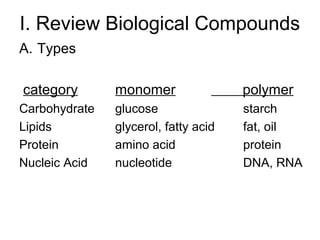
I. Review Biological Compounds
A. Types

category       monomer                polymer
Carbohydrate   glucose                starch
Lipids         glycerol, fatty acid   fat, oil
Protein        amino acid             protein
Nucleic Acid   nucleotide             DNA, RNA
B. Protein
     A sequence of amino acids held together
     by peptide bonds

     There are 20 different types of amino acids
     and the different arrangements of bonding
     determines the protein
B1. Structure
1.Primary Structure
      Sequence of amino acids = chain
2. Secondary Structure
      Folds & bends due to amino acid interactions
3. Tertiary Structure
      3-D shape (usually functional enzyme)
4. Quaternary Structure
      More than one chain of amino acids
C. Nucleic Acids

1.Types
     Monomer          Polymer

     DNA Nucleotide   DNA

     RNA Nucleotide   RNA
2. Components of nucleotides

 a. Phosphate Group – symbol


                O-
                 |

     H- O- P=O
                 |
                 O-
b. 5 – Carbon Sugar

     Deoxyribose           Ribose
C5                         C5
      O                         O
C4          C1              C4      C1

C3          C2              C3      C2

HO          H              HO       OH
c. Nitrogen Base
               DNA           RNA

Purines      Adenine (A)    Adenine (A)
(2 rings)    Guanine (G)    Guanine (G)

Pyrimidine   Thymine (T)    Uracil (U)
(1 ring)     Cytosine (C)   Cytosine (C)
3. Base Pairing

   A=T            A=U

   C=G            C=G
D. Definitions

1.DNA – A double-helix molecule made of
         DNA nucleotides.

2. Gene – A segment of the DNA molecule
         that codes for a specific trait.
3. Chromosome – A structure made up of
         either 1 or 2 DNA molecules
(each
         is a double helix)
1 DOUBLE HELIX            2 DOUBLE HELIX
II. DNA Structure

A.Nucleotides
          Monomer (4 different types)

          Bacteria has millions

          Plants/animals has billions
purine (A), (G)
                      = 2 rings
5        N - BASE
 4   1

           pyrimidine (T)(U)(C)
 3   2                 = 1 ring
B. Double Helix Polymer

1.Backbone

The    of one nucleotide (5’) binds with
deoxyribose sugar of another nucleotide
(3’).
Covalent bond
between the of
one nucleotide and
3rd carbon of
another nucleotide.
2. N-Bases – N base of one nucleotide H bonds
to another N base on a separate nucleotide
           DOUBLE HELIX
Nucleotides N bases paired


                 2 nm
III. DNA Replication
Copy the DNA strand (Genetic info) so that
when a cell divides (mitosis, meiosis) they
get an exact copy.


1. SEMICONSERVATIVE
REPLICATION
A. General
  3’  5’               3’        5’   3’        5’
  A T                       AT             AT
  T A                       TA             TA
  GC                        GC             GC

  CG                        CG             CG
  T A                       TA             TA
 5’      3’             5’     3’ 5’       3’
Parental DNA   Enzyme reads template 3’ to 5’
Double Helix   synthesizes new DNA 5’ to 3’
3’                              5’
           5’                              3’
STEP 1          DNA Helicase separates helix
                by breaking the hydrogen bonds
DNA Helicase    between the N-bases.
                                 replication fork
      3’                                        5’

      5’                                        3’
STEP 2
         DNA Polymerase

   1. 2 Enzymes bond = 1 to each strand
   2. Each enzyme reads the original 3’ to 5’
   3. Each enzyme makes new DNA 5’ to 3’
   4. Pairs free DNA nucleotides with parent strand
   5. Bonds P to sugar to form backbone of new strand
5’
  3’             5’              3’

  5’
                                        3’

1.As drawn, upper DNA Polymerase synthesizes
new strand as it follows helicase.

2.As drawn, lower DNA Polymerase detaches as
come to unwound DNA helix
5’

  3’               5’              3’

  5’                               5’

                                   3’

Lower DNA Polymerase synthesize
fragments and the DNA Polymerase
detach off fragments.
3’                5’
        5’                3’
             3’           5’

        5’                 3’

 STEP 3
 DNA Ligase - Joins the
backbone of the strands
Centromere – specific sequence of DNA that joins
two DNA molecules together.

DNA Polymerase proofreads as goes along (only 1
mistake/10, 000 pairs but enzymes find and repair
the mistakes).
END RESULT
3’                5’

5’                3’

3’                5’

5’                3’
I. Central Dogma
One gene         one protein (really = polypeptide)

General:
 1. A functional protein may be > 1 chain


 2. Not all proteins are enzymes
3. 1 gene = 100’s-1000’s of nucleotides

4. 1000’s genes per chromosome

5. Start               Stop               on mRNA

   AUG             UAG, UAA, UGA
A. Nucleus
       3’                                      5’
DNA          T   A C   C T     A C G G’
       5’                                      3’
             A   T G G A       T G C C
TRANSCRIPTION          copy information from
                       DNA gene into mRNA

             A   U G   G   A   U G   C   C
mRNA    5’                                     3’
B. Cytoplasm – the mRNA leaves the nucleus
by pores & goes to ribosome in the cytoplasm

rRNA –
makes up part of the ribosome

                                TRANSLATION
tRNA -
carries specific
amino acids        Amino Acid
Converts the information from
mRNA into a protein


primary structure of a protein

secondary structure of a protein

tertiary structure of a protein
II. Protein Synthesis
A. DNA           vs.    RNA
   double strand        single strand

  thymine               uracil

  deoxyribose           ribose
B. RNA types
1.mRNA (messenger RNA)

Copy (where U replaces T) of DNA template
gene (carries DNA code to the ribosme).

Enzyme reads the DNA 3’ to 5’ but lays the
new nucleotides down 5’ to 3’ = makes
mRNA 5’ to 3’
mRNA (messenger RNA)
              start                   stop

5’ A U G G A U G C C U A G                   3’


    CODON (corresponds to one amino acid)

Start codon              Stop codon
   AUG                      UAG
                            UGA
                            UAA
2. rRNA = Ribosomal RNA

Make ribosomes by combining two
subunits (small and large)

Where protein synthesis occurs.
Ribosome structure (two subunits)

    small subunit

    large subunit
      1st binding site          2nd binding site


       catalytic site
3. tRNA = Transfer RNA
Brings amino acids to mRNA/rRNA

Anticodon = three consecutive nucleotides
 on tRNA and pair to the codon on mRNA

 Codon     =     AUG
 Anticodon =     UAC
 Amino Acid =    Met =       methionine
Structure   anticodon

            UAC


                 Amino Acid
TRANSCRIPTION
1. Where Occurs          nucleus

2. General         DNA             mRNA

  Only one side of DNA Helix is copied into
  mRNA (not always the same side for
  different genes).
3. Parts of Transcription
INITIATION

a. RNA Polymerase binds to a promotor
   (TATA*****), which tells the enzyme that the
   gene starts on the complimentary strand of
   the DNA Helix.
CONTINUE INITIATION


b. RNA Polymerase reads the template 3’ to 5’

  but bonds new nucleotides for mRNA 5’ to 3’
PROMOTOR
5’                                   3’
     T A T A A T G C A A C T A T A A

3’   A T A T T A C G T T G A T A T T 5’


                  RNA Polymerase (enzyme)
ELONGATION

a. RNA Polymerase unwinds DNA Helix


b. RNA Polymerase moves along the DNA Helix
     and reads the template 3’ to 5’
c. RNA Polymerase adds (bonds together) free
      RNA nucleotides 5’ to 3’


d. Continues until enzyme reaches stop on DNA
5’                                                 3’
      T A T A A T G C A A C T A T A A
                         3’
                    C A A
      A T A T T AC G T T G A T A T T
3’                                                 5’
                       G
                      U
                5’   A

     The RNA Polymerase (blue) is reading the
     DNA gene (bottom black) from 3’ to 5’ but
     adding new nucleotides (RNA) from 5’ to 3’.
     As it does this it is producing the mRNA
     (RED) 5’ to 3’.
U A A


         A
          U
           C
            A
             A
              C
               G
                U
                 A


The RNA Polymerase continues to add RNA
nucleotides until it reaches a stop.
5. Termination

a. Once the RNA Polymerase reaches this
   point it detaches from the DNA (which
   reforms the double helix). What is formed is
   called a transcription unit.
b. RNA SPLICING

1.Need to remove introns

2.Need to bond together exons

3.Need to add cap and tail

4.Then have mRNA
DNA


mRNA
5’ GPPP A   U G C A A C U A U A A
AAAAAA3’
TRANSLATION

Where: Cytoplasm

General:
 mRNA moves into the cytoplasm.
 Ribosomes “read” the mRNA.
 Produce a protein.
1. INITIATION
Use:
      tRNA-aa complex

    Ribsomes

    mRNA
NIT
                                             SMALL SUBU
        5’                                                3’

             A   U   G   C   A   A   C   U   A    U   A   A
             U A     C
                                                              mRNA


tRNA                                             LARGE SUBUNIT
                 AA1


   1ST tRNA enters the site in the large subunit of the ribosome.
   Bonds to the mRNA with the small subunit.
5’                                                     3’

     A   U   G   C     A   A   C   U   A   U   A   A
     U A     C   G U U


         AA1     AA2


2nd tRNA bonds to the second site in the ribosome.
5’                                                     3’

     A   U   G   C     A   A   C   U   A   U   A   A
     U A     C   G U U


         AA1     AA2


In the catalytic site AA1 is bonded to AA2.
5’                                                       3’

           A   U   G     C    A    A   C   U   A   U   A   A
                         G U U

U A    C


                   AA1       AA2


      Ribosome moves toward the 3’ end of the mRNA.
      Causes the 1st tRNA to leave and the 2nd site to be open.
5’                                                         3’

           A   U   G     C    A    A   C     U   A   U   A   A
                         G U U         G A U

U A    C


                   AA1       AA2       AA3


      3rd tRNA enters the open site on Ribosome.
5’                                                         3’

           A   U   G     C    A    A   C     U   A   U   A   A
                         G U U         G A U

U A    C


                   AA1       AA2       AA3


                    The AA1-AA2 bond to AA3.
5’                                                         3’

           A   U   G     C    A    A   C     U   A   U   A   A
                         G U U         G A U

U A    C


                   AA1       AA2       AA3


Ribosome moves down mRNA
toward the 3’ end.
5’                                                             3’

            A       U   G     C    A    A   C     U   A   U   A   A
G U U
                                            G A U


    U A         C

                        AA1       AA2       AA3


Causes 3rd tRNA to move in 1st site and 2nd tRNA leave ribosome sites.
Reaches stop codon on the mRNA.
5’                                                         3’

                   A   U     G     C    A    A   C   U   A   U   A   A


G U U
                       G A    U


    U A       C


                             AA1       AA2       AA3


All detach.

3. dna

  • 1.
    I. Review BiologicalCompounds A. Types category monomer polymer Carbohydrate glucose starch Lipids glycerol, fatty acid fat, oil Protein amino acid protein Nucleic Acid nucleotide DNA, RNA
  • 2.
    B. Protein A sequence of amino acids held together by peptide bonds There are 20 different types of amino acids and the different arrangements of bonding determines the protein
  • 3.
    B1. Structure 1.Primary Structure Sequence of amino acids = chain 2. Secondary Structure Folds & bends due to amino acid interactions 3. Tertiary Structure 3-D shape (usually functional enzyme) 4. Quaternary Structure More than one chain of amino acids
  • 5.
    C. Nucleic Acids 1.Types Monomer Polymer DNA Nucleotide DNA RNA Nucleotide RNA
  • 6.
    2. Components ofnucleotides a. Phosphate Group – symbol O- | H- O- P=O | O-
  • 7.
    b. 5 –Carbon Sugar Deoxyribose Ribose C5 C5 O O C4 C1 C4 C1 C3 C2 C3 C2 HO H HO OH
  • 8.
    c. Nitrogen Base DNA RNA Purines Adenine (A) Adenine (A) (2 rings) Guanine (G) Guanine (G) Pyrimidine Thymine (T) Uracil (U) (1 ring) Cytosine (C) Cytosine (C)
  • 9.
    3. Base Pairing A=T A=U C=G C=G
  • 10.
    D. Definitions 1.DNA –A double-helix molecule made of DNA nucleotides. 2. Gene – A segment of the DNA molecule that codes for a specific trait.
  • 11.
    3. Chromosome –A structure made up of either 1 or 2 DNA molecules (each is a double helix) 1 DOUBLE HELIX 2 DOUBLE HELIX
  • 12.
    II. DNA Structure A.Nucleotides Monomer (4 different types) Bacteria has millions Plants/animals has billions
  • 13.
    purine (A), (G) = 2 rings 5 N - BASE 4 1 pyrimidine (T)(U)(C) 3 2 = 1 ring
  • 14.
    B. Double HelixPolymer 1.Backbone The of one nucleotide (5’) binds with deoxyribose sugar of another nucleotide (3’).
  • 15.
    Covalent bond between theof one nucleotide and 3rd carbon of another nucleotide.
  • 16.
    2. N-Bases –N base of one nucleotide H bonds to another N base on a separate nucleotide DOUBLE HELIX
  • 17.
  • 18.
    III. DNA Replication Copythe DNA strand (Genetic info) so that when a cell divides (mitosis, meiosis) they get an exact copy. 1. SEMICONSERVATIVE REPLICATION
  • 19.
    A. General 3’ 5’ 3’ 5’ 3’ 5’ A T AT AT T A TA TA GC GC GC CG CG CG T A TA TA 5’ 3’ 5’ 3’ 5’ 3’ Parental DNA Enzyme reads template 3’ to 5’ Double Helix synthesizes new DNA 5’ to 3’
  • 20.
    3’ 5’ 5’ 3’ STEP 1 DNA Helicase separates helix by breaking the hydrogen bonds DNA Helicase between the N-bases. replication fork 3’ 5’ 5’ 3’
  • 21.
    STEP 2 DNA Polymerase 1. 2 Enzymes bond = 1 to each strand 2. Each enzyme reads the original 3’ to 5’ 3. Each enzyme makes new DNA 5’ to 3’ 4. Pairs free DNA nucleotides with parent strand 5. Bonds P to sugar to form backbone of new strand
  • 22.
    5’ 3’ 5’ 3’ 5’ 3’ 1.As drawn, upper DNA Polymerase synthesizes new strand as it follows helicase. 2.As drawn, lower DNA Polymerase detaches as come to unwound DNA helix
  • 23.
    5’ 3’ 5’ 3’ 5’ 5’ 3’ Lower DNA Polymerase synthesize fragments and the DNA Polymerase detach off fragments.
  • 24.
    3’ 5’ 5’ 3’ 3’ 5’ 5’ 3’ STEP 3 DNA Ligase - Joins the backbone of the strands
  • 25.
    Centromere – specificsequence of DNA that joins two DNA molecules together. DNA Polymerase proofreads as goes along (only 1 mistake/10, 000 pairs but enzymes find and repair the mistakes).
  • 26.
    END RESULT 3’ 5’ 5’ 3’ 3’ 5’ 5’ 3’
  • 27.
    I. Central Dogma Onegene one protein (really = polypeptide) General: 1. A functional protein may be > 1 chain 2. Not all proteins are enzymes
  • 28.
    3. 1 gene= 100’s-1000’s of nucleotides 4. 1000’s genes per chromosome 5. Start Stop on mRNA AUG UAG, UAA, UGA
  • 29.
    A. Nucleus 3’ 5’ DNA T A C C T A C G G’ 5’ 3’ A T G G A T G C C TRANSCRIPTION copy information from DNA gene into mRNA A U G G A U G C C mRNA 5’ 3’
  • 30.
    B. Cytoplasm –the mRNA leaves the nucleus by pores & goes to ribosome in the cytoplasm rRNA – makes up part of the ribosome TRANSLATION tRNA - carries specific amino acids Amino Acid
  • 31.
    Converts the informationfrom mRNA into a protein primary structure of a protein secondary structure of a protein tertiary structure of a protein
  • 32.
    II. Protein Synthesis A.DNA vs. RNA double strand single strand thymine uracil deoxyribose ribose
  • 33.
    B. RNA types 1.mRNA(messenger RNA) Copy (where U replaces T) of DNA template gene (carries DNA code to the ribosme). Enzyme reads the DNA 3’ to 5’ but lays the new nucleotides down 5’ to 3’ = makes mRNA 5’ to 3’
  • 34.
    mRNA (messenger RNA) start stop 5’ A U G G A U G C C U A G 3’ CODON (corresponds to one amino acid) Start codon Stop codon AUG UAG UGA UAA
  • 35.
    2. rRNA =Ribosomal RNA Make ribosomes by combining two subunits (small and large) Where protein synthesis occurs.
  • 36.
    Ribosome structure (twosubunits) small subunit large subunit 1st binding site 2nd binding site catalytic site
  • 37.
    3. tRNA =Transfer RNA Brings amino acids to mRNA/rRNA Anticodon = three consecutive nucleotides on tRNA and pair to the codon on mRNA Codon = AUG Anticodon = UAC Amino Acid = Met = methionine
  • 38.
    Structure anticodon UAC Amino Acid
  • 39.
    TRANSCRIPTION 1. Where Occurs nucleus 2. General DNA mRNA Only one side of DNA Helix is copied into mRNA (not always the same side for different genes).
  • 40.
    3. Parts ofTranscription INITIATION a. RNA Polymerase binds to a promotor (TATA*****), which tells the enzyme that the gene starts on the complimentary strand of the DNA Helix.
  • 41.
    CONTINUE INITIATION b. RNAPolymerase reads the template 3’ to 5’ but bonds new nucleotides for mRNA 5’ to 3’
  • 42.
    PROMOTOR 5’ 3’ T A T A A T G C A A C T A T A A 3’ A T A T T A C G T T G A T A T T 5’ RNA Polymerase (enzyme)
  • 43.
    ELONGATION a. RNA Polymeraseunwinds DNA Helix b. RNA Polymerase moves along the DNA Helix and reads the template 3’ to 5’
  • 44.
    c. RNA Polymeraseadds (bonds together) free RNA nucleotides 5’ to 3’ d. Continues until enzyme reaches stop on DNA
  • 45.
    5’ 3’ T A T A A T G C A A C T A T A A 3’ C A A A T A T T AC G T T G A T A T T 3’ 5’ G U 5’ A The RNA Polymerase (blue) is reading the DNA gene (bottom black) from 3’ to 5’ but adding new nucleotides (RNA) from 5’ to 3’. As it does this it is producing the mRNA (RED) 5’ to 3’.
  • 46.
    U A A A U C A A C G U A The RNA Polymerase continues to add RNA nucleotides until it reaches a stop.
  • 47.
    5. Termination a. Oncethe RNA Polymerase reaches this point it detaches from the DNA (which reforms the double helix). What is formed is called a transcription unit.
  • 48.
    b. RNA SPLICING 1.Needto remove introns 2.Need to bond together exons 3.Need to add cap and tail 4.Then have mRNA
  • 49.
    DNA mRNA 5’ GPPP A U G C A A C U A U A A AAAAAA3’
  • 50.
    TRANSLATION Where: Cytoplasm General: mRNAmoves into the cytoplasm. Ribosomes “read” the mRNA. Produce a protein.
  • 51.
    1. INITIATION Use: tRNA-aa complex Ribsomes mRNA
  • 52.
    NIT SMALL SUBU 5’ 3’ A U G C A A C U A U A A U A C mRNA tRNA LARGE SUBUNIT AA1 1ST tRNA enters the site in the large subunit of the ribosome. Bonds to the mRNA with the small subunit.
  • 53.
    5’ 3’ A U G C A A C U A U A A U A C G U U AA1 AA2 2nd tRNA bonds to the second site in the ribosome.
  • 54.
    5’ 3’ A U G C A A C U A U A A U A C G U U AA1 AA2 In the catalytic site AA1 is bonded to AA2.
  • 55.
    5’ 3’ A U G C A A C U A U A A G U U U A C AA1 AA2 Ribosome moves toward the 3’ end of the mRNA. Causes the 1st tRNA to leave and the 2nd site to be open.
  • 56.
    5’ 3’ A U G C A A C U A U A A G U U G A U U A C AA1 AA2 AA3 3rd tRNA enters the open site on Ribosome.
  • 57.
    5’ 3’ A U G C A A C U A U A A G U U G A U U A C AA1 AA2 AA3 The AA1-AA2 bond to AA3.
  • 58.
    5’ 3’ A U G C A A C U A U A A G U U G A U U A C AA1 AA2 AA3 Ribosome moves down mRNA toward the 3’ end.
  • 59.
    5’ 3’ A U G C A A C U A U A A G U U G A U U A C AA1 AA2 AA3 Causes 3rd tRNA to move in 1st site and 2nd tRNA leave ribosome sites. Reaches stop codon on the mRNA.
  • 60.
    5’ 3’ A U G C A A C U A U A A G U U G A U U A C AA1 AA2 AA3 All detach.