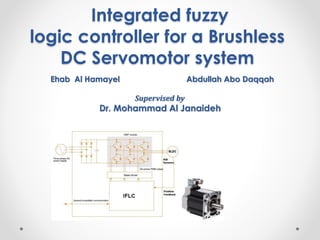
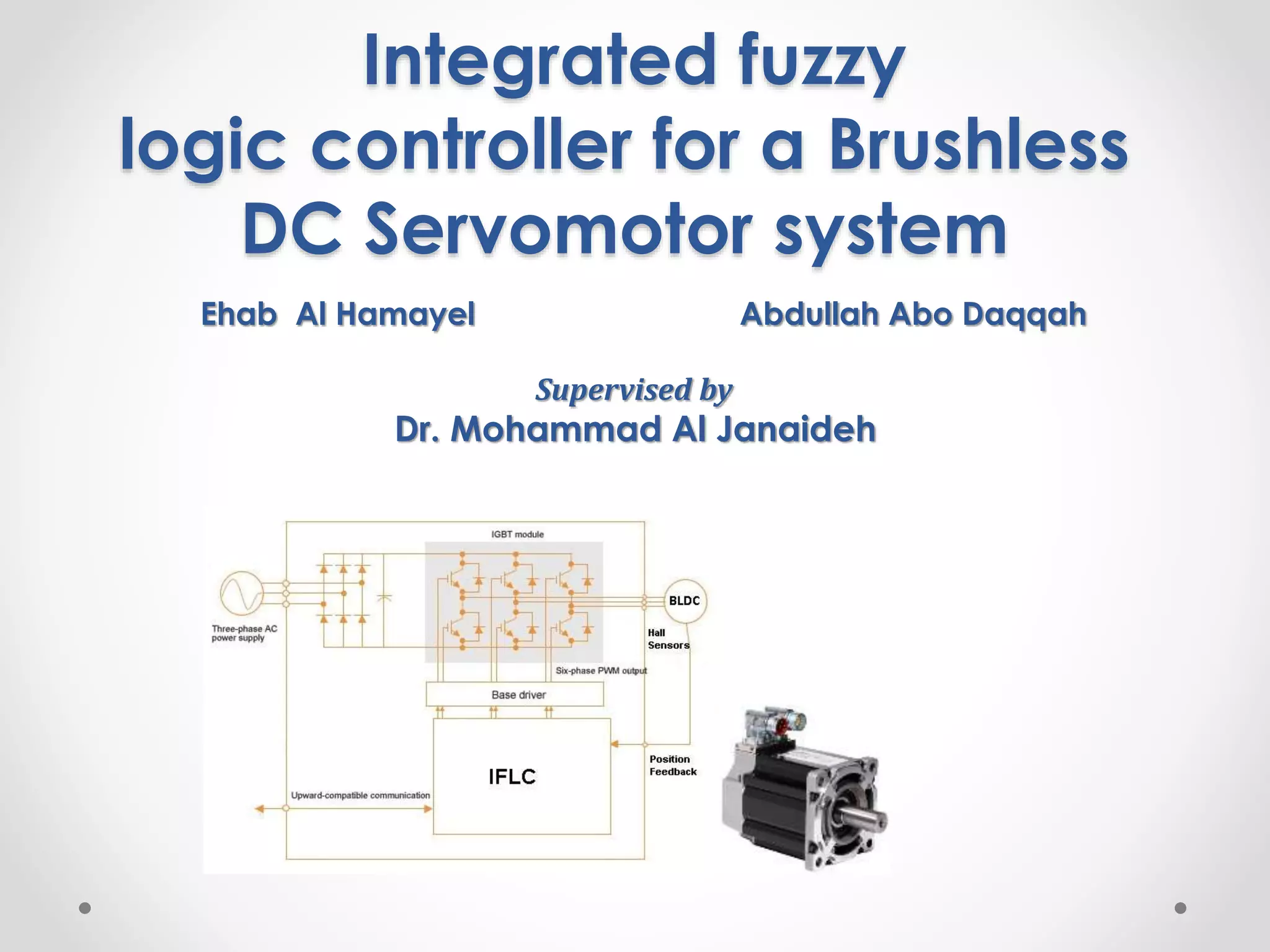
Integrated fuzzy
logic controller for a Brushless
DC Servomotor system
Ehab Al Hamayel Abdullah Abo Daqqah
Supervised by
Dr. Mohammad Al Janaideh
Outlines
• Abstract
• Problem description.
• The Mathematical Model Of the system.
• The control system.
• Conclusion
Keywords: BLDC: Brushless DC servomotor
FLC: Fuzzy logic controller
IFLC: Integrated fuzzy logic controller
Abstract
• The proposed controller systems consist of two -input fuzzy
integrated fuzzy logic controller (IFLC) for rotation speed
control of brushless dc servomotor drive.
• The input for the controller are error e(t), and change in error
(first derivative of error ce(t)) with a single-output.
• The IFLC is designed using FLC and proportional derivation
integral (PID) controllers.
• The brushless dc motors (BLDC) are used in various applications
such as defense, industries, robotics, etc. In these applications,
the motor should be precisely controlled to give the desired
performance.
• BLDC motors are relatively easy to control, and considered to
be high performance motor that is capable of providing large
amounts of torque over a vast speed range.
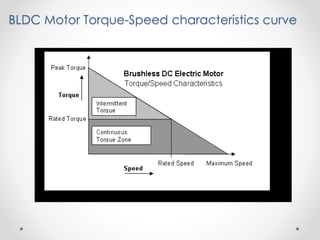
• The Torque vs. speed curve is shown in figure.1
Problem description
BLDC Motor Torque-Speed characteristics curve
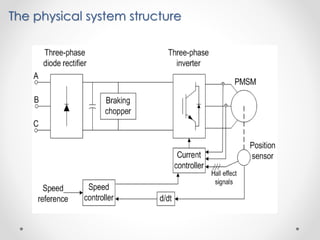
The physical system structure
The mathematical model
The voltage equation of motor can be described by
The electromagnetic torque is linearly proportional to the
armature current and the equation is given by:
The load torque
And the motion equation can be expressed as:
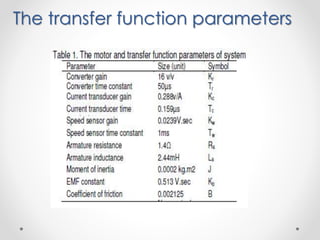
The transfer function parameters
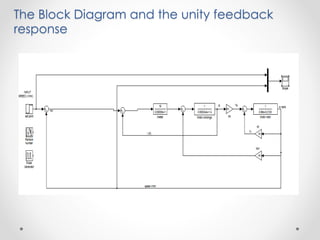
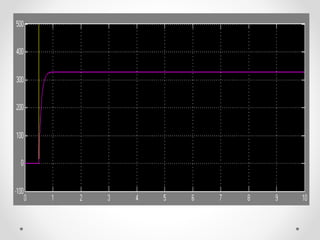
The Block Diagram and the unity feedback
response
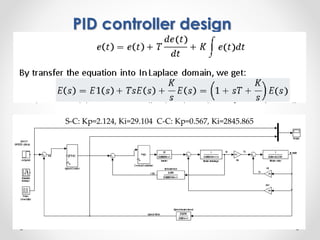
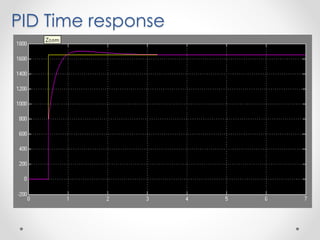
PID controller design
S-C: Kp=2.124, Ki=29.104 C-C: Kp=0.567, Ki=2845.865
PID Time response
Increasing Friction and inertia
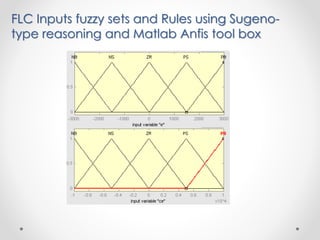
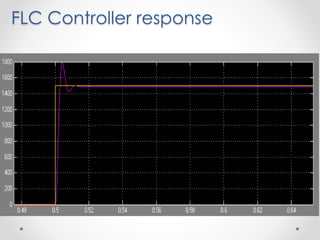
FLC Controller
Cd k= 1*10^(-14), Cd k1= 1000, Sat=[-6000, 6000] (optimal response)
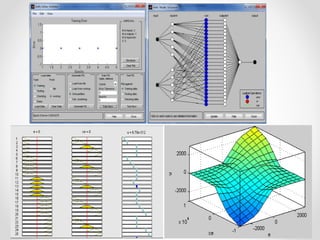
FLC Inputs fuzzy sets and Rules using Sugeno-
type reasoning and Matlab Anfis tool box
FLC Controller response
IFLC Controller
Cd k= 1*10^(-14), Sat=[-1000, 1000], C-S: Kp= 30, KI= 88.107, Kd=1.00
C-C: Kp=1.00, Ki= 350.941 (optimal response)
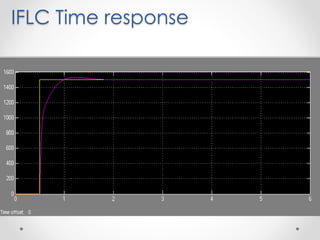
IFLC Time response
Conclusion
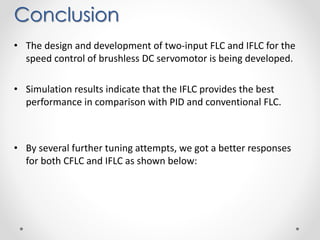
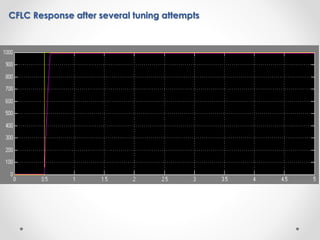
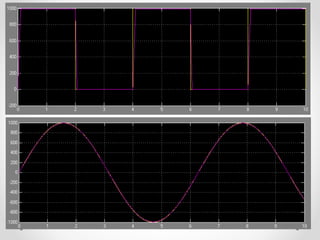
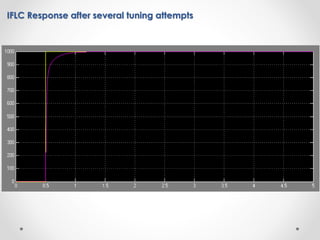
• The design and development of two-input FLC and IFLC for the
speed control of brushless DC servomotor is being developed.
• Simulation results indicate that the IFLC provides the best
performance in comparison with PID and conventional FLC.
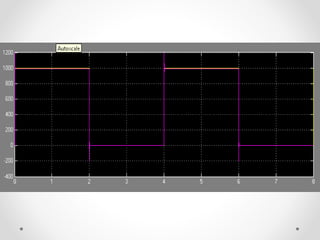
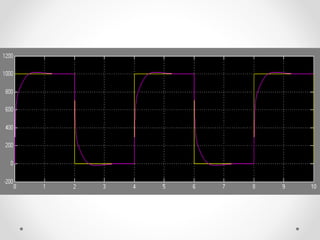
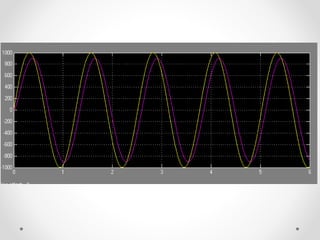
• By several further tuning attempts, we got a better responses
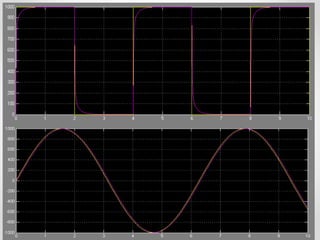
for both CFLC and IFLC as shown below:
CFLC Response after several tuning attempts
IFLC Response after several tuning attempts
• The present system can further be improved by adding one more
input variable (change of change of error cce). With three-input
IFLC will get superior, more robust, faster, flexible, cost-effective,
insensitive to the parameter variations control system , but it will
require more computational time, so it’s necessary to use more
powerful processing unit.
THANK YOU

Integrated fuzzy logic controller for a Brushless DC Servomotor system

  • 1.
    Integrated fuzzy logic controllerfor a Brushless DC Servomotor system Ehab Al Hamayel Abdullah Abo Daqqah Supervised by Dr. Mohammad Al Janaideh
  • 2.
    Outlines • Abstract • Problemdescription. • The Mathematical Model Of the system. • The control system. • Conclusion Keywords: BLDC: Brushless DC servomotor FLC: Fuzzy logic controller IFLC: Integrated fuzzy logic controller
  • 3.
    Abstract • The proposedcontroller systems consist of two -input fuzzy integrated fuzzy logic controller (IFLC) for rotation speed control of brushless dc servomotor drive. • The input for the controller are error e(t), and change in error (first derivative of error ce(t)) with a single-output. • The IFLC is designed using FLC and proportional derivation integral (PID) controllers.
  • 4.
    • The brushlessdc motors (BLDC) are used in various applications such as defense, industries, robotics, etc. In these applications, the motor should be precisely controlled to give the desired performance. • BLDC motors are relatively easy to control, and considered to be high performance motor that is capable of providing large amounts of torque over a vast speed range. • The Torque vs. speed curve is shown in figure.1 Problem description
  • 5.
    BLDC Motor Torque-Speedcharacteristics curve
  • 6.
  • 8.
    The mathematical model Thevoltage equation of motor can be described by The electromagnetic torque is linearly proportional to the armature current and the equation is given by: The load torque And the motion equation can be expressed as:
  • 10.
  • 11.
    The Block Diagramand the unity feedback response
  • 13.
    PID controller design S-C:Kp=2.124, Ki=29.104 C-C: Kp=0.567, Ki=2845.865
  • 14.
  • 15.
  • 16.
    FLC Controller Cd k=1*10^(-14), Cd k1= 1000, Sat=[-6000, 6000] (optimal response)
  • 17.
    FLC Inputs fuzzysets and Rules using Sugeno- type reasoning and Matlab Anfis tool box
  • 19.
  • 21.
    IFLC Controller Cd k=1*10^(-14), Sat=[-1000, 1000], C-S: Kp= 30, KI= 88.107, Kd=1.00 C-C: Kp=1.00, Ki= 350.941 (optimal response)
  • 22.
  • 25.
    Conclusion • The designand development of two-input FLC and IFLC for the speed control of brushless DC servomotor is being developed. • Simulation results indicate that the IFLC provides the best performance in comparison with PID and conventional FLC. • By several further tuning attempts, we got a better responses for both CFLC and IFLC as shown below:
  • 26.
    CFLC Response afterseveral tuning attempts
  • 28.
    IFLC Response afterseveral tuning attempts
  • 30.
    • The presentsystem can further be improved by adding one more input variable (change of change of error cce). With three-input IFLC will get superior, more robust, faster, flexible, cost-effective, insensitive to the parameter variations control system , but it will require more computational time, so it’s necessary to use more powerful processing unit.
  • 31.