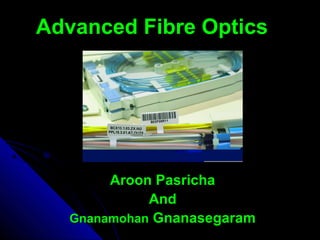
Advanced Fibre OpticsAdvanced Fibre Optics
Aroon PasrichaAroon Pasricha
AndAnd
GnanamohanGnanamohan GnanasegaramGnanasegaram
OverviewOverview
 IntroductionIntroduction
 Composition of optical fibreComposition of optical fibre
 Operation of the fibre optic systemOperation of the fibre optic system
 Advantages and disadvantagesAdvantages and disadvantages
 Analog and digital communicationAnalog and digital communication
 Two main types of cablesTwo main types of cables
 Pulse SpreadingPulse Spreading
 Transmission LossTransmission Loss
 InterviewsInterviews
 ConclusionsConclusions
IntroductionIntroduction
Fibre optics is being used to transmit television,
voice, and digital data signals by light waves
over flexible hair like threads of glass and
plastic. It has evolved into a system of great
importance and use since the 1980’s.
The advantages of fibre optics compared to
coaxial cable or twisted pair cable, are endless.
Millions of dollars are being spent to put light
wave communication systems into operation, as
a result of its performance.
Composition of optical fibreComposition of optical fibre
 Silica based glass or plastic filaments areSilica based glass or plastic filaments are
spun and packed into bundles of severalspun and packed into bundles of several
hundreds or thousands. Bundles may behundreds or thousands. Bundles may be
put together as rods or ribbons and sheets.put together as rods or ribbons and sheets.
 These bundles are flexible and can beThese bundles are flexible and can be
twisted and contorted to conduct light andtwisted and contorted to conduct light and
images around cornersimages around corners
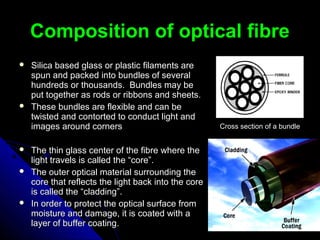
 The thin glass center of the fibre where theThe thin glass center of the fibre where the
light travels is called the “core”.light travels is called the “core”.
 The outer optical material surrounding theThe outer optical material surrounding the
core that reflects the light back into the corecore that reflects the light back into the core
is called the “cladding”.is called the “cladding”.
 In order to protect the optical surface fromIn order to protect the optical surface from
moisture and damage, it is coated with amoisture and damage, it is coated with a
layer of buffer coating.layer of buffer coating.
Cross section of a bundle
Operation of the fibre optic systemOperation of the fibre optic system
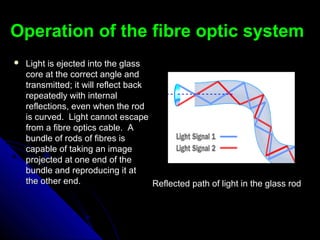
 Light is ejected into the glassLight is ejected into the glass
core at the correct angle andcore at the correct angle and
transmitted; it will reflect backtransmitted; it will reflect back
repeatedly with internalrepeatedly with internal
reflections, even when the rodreflections, even when the rod
is curved. Light cannot escapeis curved. Light cannot escape
from a fibre optics cable. Afrom a fibre optics cable. A
bundle of rods of fibres isbundle of rods of fibres is
capable of taking an imagecapable of taking an image
projected at one end of theprojected at one end of the
bundle and reproducing it atbundle and reproducing it at
the other end.the other end. Reflected path of light in the glass rod
Operation of the fibre optic systemOperation of the fibre optic system
 In a fibre optic system, there are a few major components to performIn a fibre optic system, there are a few major components to perform
the task of communicationthe task of communication..
 The Input Modulator is needed; this modulates the incoming signalThe Input Modulator is needed; this modulates the incoming signal
with a light beam.with a light beam.
 A light emitting device is used; it can be either a light emitting diodeA light emitting device is used; it can be either a light emitting diode
(LED) or a semiconductor laser diode.(LED) or a semiconductor laser diode.
 A fibre optic cable is used as a transportation medium.A fibre optic cable is used as a transportation medium.
 A fibre optic system converts an electrical signal to an infrared lightA fibre optic system converts an electrical signal to an infrared light
signal, and then transmits the signal onto an optical fibre.signal, and then transmits the signal onto an optical fibre.
 An Output Modulator is used to separate the signal from the lightAn Output Modulator is used to separate the signal from the light
beam.beam.
 Special connectors must be used to couple the light from the sourceSpecial connectors must be used to couple the light from the source
to the fibre and from the fibre to the detector.to the fibre and from the fibre to the detector.
Advantages and DisadvantagesAdvantages and Disadvantages
ADVANTAGESADVANTAGES
 Fibre optic cables have a much greater bandwidth than metal cables.Fibre optic cables have a much greater bandwidth than metal cables.
 Fibre optic cable is less susceptible to signal degradation than copper wire.Fibre optic cable is less susceptible to signal degradation than copper wire.
 Fibre optic cables weigh less than a copper wire cable.Fibre optic cables weigh less than a copper wire cable.
 Data can be transmitted digitally.Data can be transmitted digitally.
 Lower-power transmitters can be used instead of the high-voltage electricalLower-power transmitters can be used instead of the high-voltage electrical
transmitters used for copper wires.transmitters used for copper wires.
 Unlike electrical signals in copper wires, light signals from one fibre do notUnlike electrical signals in copper wires, light signals from one fibre do not
interfere with those of other fibres in the same cable.interfere with those of other fibres in the same cable.
 Because no electricity is passed through optical cable it is non-flammable,Because no electricity is passed through optical cable it is non-flammable,
and immune to lightning.and immune to lightning.
 Impossible to tap into a fibre optics cable, making it more secureImpossible to tap into a fibre optics cable, making it more secure
Advantages and DisadvantagesAdvantages and Disadvantages
DISADVANTAGESDISADVANTAGES
 Fibre optics are that the cables are expensive to install.Fibre optics are that the cables are expensive to install.
 The termination of a fibre optics cable is complex and requiresThe termination of a fibre optics cable is complex and requires
special tools.special tools.
 They are more fragile than coaxial cable.They are more fragile than coaxial cable.
Analog and Digital CommunicationAnalog and Digital Communication
 An analog signal changes continuously, while a digital signal can beAn analog signal changes continuously, while a digital signal can be
at only a certain number of discrete levels.at only a certain number of discrete levels.
 Conventionally, analog is used for audio and video communication.Conventionally, analog is used for audio and video communication.
 Analog technology has been used because our ears detectAnalog technology has been used because our ears detect
continuous fluctuations in sound levels, not just the presence orcontinuous fluctuations in sound levels, not just the presence or
absence of sound.absence of sound.
 Going through a system where the analog signal can not beGoing through a system where the analog signal can not be
successfully reproduced outputs a distorted signal which is whatsuccessfully reproduced outputs a distorted signal which is what
happens when we get a distorted voice on the telephone or radio.happens when we get a distorted voice on the telephone or radio.
 Digital transmission works the best; both analog and digital signalsDigital transmission works the best; both analog and digital signals
are found in audio and telephone systems.are found in audio and telephone systems.
 Analog signals are converted to digital before transmission and thenAnalog signals are converted to digital before transmission and then
back to analog signals.back to analog signals.
Two main types of cablesTwo main types of cables
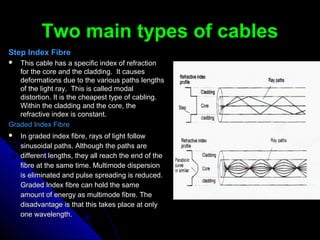
Step Index FibreStep Index Fibre
 This cable has a specific index of refractionThis cable has a specific index of refraction
for the core and the cladding. It causesfor the core and the cladding. It causes
deformations due to the various paths lengthsdeformations due to the various paths lengths
of the light ray. This is called modalof the light ray. This is called modal
distortion. It is the cheapest type of cabling.distortion. It is the cheapest type of cabling.
Within the cladding and the core, theWithin the cladding and the core, the
refractive index is constant.refractive index is constant.
Graded Index FibreGraded Index Fibre
 In graded index fibre, rays of light followIn graded index fibre, rays of light follow
sinusoidal paths. Although the paths aresinusoidal paths. Although the paths are
different lengths, they all reach the end of thedifferent lengths, they all reach the end of the
fibre at the same time. Multimode dispersionfibre at the same time. Multimode dispersion
is eliminated and pulse spreading is reduced.is eliminated and pulse spreading is reduced.
Graded Index fibre can hold the sameGraded Index fibre can hold the same
amount of energy as multimode fibre. Theamount of energy as multimode fibre. The
disadvantage is that this takes place at onlydisadvantage is that this takes place at only
one wavelength.one wavelength.
Pulse SpreadingPulse Spreading
 Optical fibres that carry data consist of pulses of lightOptical fibres that carry data consist of pulses of light
energy following each other. The fibre has a limit as toenergy following each other. The fibre has a limit as to
how many pulses per second can be sent to it and behow many pulses per second can be sent to it and be
expected to emerge intact at the other end. This isexpected to emerge intact at the other end. This is
known as pulse spreading which limits the Bandwidth ofknown as pulse spreading which limits the Bandwidth of
the fibre.the fibre.
 The pulse sets off down the fibre with a square waveThe pulse sets off down the fibre with a square wave
shape. As it travels along the fibre, it progressively getsshape. As it travels along the fibre, it progressively gets
wider and the peak intensity decreases.wider and the peak intensity decreases.
Transmission LossTransmission Loss
 The transmission loss or attenuation of an optical fibre isThe transmission loss or attenuation of an optical fibre is
perhaps the most important characteristic of the fibre;perhaps the most important characteristic of the fibre;
this determines if a system is practical. It controls (1)this determines if a system is practical. It controls (1)
spacing between repeaters and (2) the type of opticalspacing between repeaters and (2) the type of optical
transmitter and receiver to be used.transmitter and receiver to be used.
 As light waves travel down an optical fibre, they lose partAs light waves travel down an optical fibre, they lose part
of their energy because of various imperfections in theof their energy because of various imperfections in the
fibre. These losses are measured in decibels perfibre. These losses are measured in decibels per
kilometers (dB/km).kilometers (dB/km).
InterviewsInterviews
Kushner, Jeff, Fibre Solutions Specialist, CORNINGKushner, Jeff, Fibre Solutions Specialist, CORNING
 Stated fibre optics is a revolution that may affect our lives as much asStated fibre optics is a revolution that may affect our lives as much as
computers and integrated circuits have. Fibre optics is beingcomputers and integrated circuits have. Fibre optics is being
compared in importance with microwave and satellite transmissions incompared in importance with microwave and satellite transmissions in
the advanced world of communications.the advanced world of communications.
Ali, Zafar, Configuration Supervisor, Unisys Canada Inc.Ali, Zafar, Configuration Supervisor, Unisys Canada Inc.
 stated that fibre optics will make using devices that use services suchstated that fibre optics will make using devices that use services such
as two-way television that was too costly before the development ofas two-way television that was too costly before the development of
fibre optics easier to use with better quality. In addition to an incrediblefibre optics easier to use with better quality. In addition to an incredible
bandwidth, fibre optics has smaller and lighter cables thanbandwidth, fibre optics has smaller and lighter cables than
conventional copper-conductor systems, with immunity to electricalconventional copper-conductor systems, with immunity to electrical
noise, and numerous other advantages.noise, and numerous other advantages.
ConclusionConclusion
 The age of optical communications is a new era. In several waysThe age of optical communications is a new era. In several ways
fibre optics is a pivotal breakthrough from the electricfibre optics is a pivotal breakthrough from the electric
communication we have been accustomed to. Instead of electronscommunication we have been accustomed to. Instead of electrons
moving back and forth over a regular copper or metallic wire to carrymoving back and forth over a regular copper or metallic wire to carry
signals, light waves navigate tiny fibres of glass or plastic tosignals, light waves navigate tiny fibres of glass or plastic to
accomplish the same purpose.accomplish the same purpose.
 With a bandwidth and information capacity a thousand times greaterWith a bandwidth and information capacity a thousand times greater
than that of copper circuits, fibre optics may soon provide us with allthan that of copper circuits, fibre optics may soon provide us with all
the communication technology we could want in a lifetime, at a costthe communication technology we could want in a lifetime, at a cost
efficient price.efficient price.
 Any new communication system that does not use fibre optics, orAny new communication system that does not use fibre optics, or
consider its use, is obsolete even before it has been built. It isconsider its use, is obsolete even before it has been built. It is
apparent that the average technician may also become supersededapparent that the average technician may also become superseded
if he or she fails to master fibre optics. After all, the technician will beif he or she fails to master fibre optics. After all, the technician will be
responsible for repairing and maintaining fibre- optic systemsresponsible for repairing and maintaining fibre- optic systems
wherever they are used, not the engineer.wherever they are used, not the engineer.
THE ENDTHE END

fibre-optics

  • 1.
    Advanced Fibre OpticsAdvancedFibre Optics Aroon PasrichaAroon Pasricha AndAnd GnanamohanGnanamohan GnanasegaramGnanasegaram
  • 2.
    OverviewOverview  IntroductionIntroduction  Compositionof optical fibreComposition of optical fibre  Operation of the fibre optic systemOperation of the fibre optic system  Advantages and disadvantagesAdvantages and disadvantages  Analog and digital communicationAnalog and digital communication  Two main types of cablesTwo main types of cables  Pulse SpreadingPulse Spreading  Transmission LossTransmission Loss  InterviewsInterviews  ConclusionsConclusions
  • 3.
    IntroductionIntroduction Fibre optics isbeing used to transmit television, voice, and digital data signals by light waves over flexible hair like threads of glass and plastic. It has evolved into a system of great importance and use since the 1980’s. The advantages of fibre optics compared to coaxial cable or twisted pair cable, are endless. Millions of dollars are being spent to put light wave communication systems into operation, as a result of its performance.
  • 4.
    Composition of opticalfibreComposition of optical fibre  Silica based glass or plastic filaments areSilica based glass or plastic filaments are spun and packed into bundles of severalspun and packed into bundles of several hundreds or thousands. Bundles may behundreds or thousands. Bundles may be put together as rods or ribbons and sheets.put together as rods or ribbons and sheets.  These bundles are flexible and can beThese bundles are flexible and can be twisted and contorted to conduct light andtwisted and contorted to conduct light and images around cornersimages around corners  The thin glass center of the fibre where theThe thin glass center of the fibre where the light travels is called the “core”.light travels is called the “core”.  The outer optical material surrounding theThe outer optical material surrounding the core that reflects the light back into the corecore that reflects the light back into the core is called the “cladding”.is called the “cladding”.  In order to protect the optical surface fromIn order to protect the optical surface from moisture and damage, it is coated with amoisture and damage, it is coated with a layer of buffer coating.layer of buffer coating. Cross section of a bundle
  • 5.
    Operation of thefibre optic systemOperation of the fibre optic system  Light is ejected into the glassLight is ejected into the glass core at the correct angle andcore at the correct angle and transmitted; it will reflect backtransmitted; it will reflect back repeatedly with internalrepeatedly with internal reflections, even when the rodreflections, even when the rod is curved. Light cannot escapeis curved. Light cannot escape from a fibre optics cable. Afrom a fibre optics cable. A bundle of rods of fibres isbundle of rods of fibres is capable of taking an imagecapable of taking an image projected at one end of theprojected at one end of the bundle and reproducing it atbundle and reproducing it at the other end.the other end. Reflected path of light in the glass rod
  • 6.
    Operation of thefibre optic systemOperation of the fibre optic system  In a fibre optic system, there are a few major components to performIn a fibre optic system, there are a few major components to perform the task of communicationthe task of communication..  The Input Modulator is needed; this modulates the incoming signalThe Input Modulator is needed; this modulates the incoming signal with a light beam.with a light beam.  A light emitting device is used; it can be either a light emitting diodeA light emitting device is used; it can be either a light emitting diode (LED) or a semiconductor laser diode.(LED) or a semiconductor laser diode.  A fibre optic cable is used as a transportation medium.A fibre optic cable is used as a transportation medium.  A fibre optic system converts an electrical signal to an infrared lightA fibre optic system converts an electrical signal to an infrared light signal, and then transmits the signal onto an optical fibre.signal, and then transmits the signal onto an optical fibre.  An Output Modulator is used to separate the signal from the lightAn Output Modulator is used to separate the signal from the light beam.beam.  Special connectors must be used to couple the light from the sourceSpecial connectors must be used to couple the light from the source to the fibre and from the fibre to the detector.to the fibre and from the fibre to the detector.
  • 7.
    Advantages and DisadvantagesAdvantagesand Disadvantages ADVANTAGESADVANTAGES  Fibre optic cables have a much greater bandwidth than metal cables.Fibre optic cables have a much greater bandwidth than metal cables.  Fibre optic cable is less susceptible to signal degradation than copper wire.Fibre optic cable is less susceptible to signal degradation than copper wire.  Fibre optic cables weigh less than a copper wire cable.Fibre optic cables weigh less than a copper wire cable.  Data can be transmitted digitally.Data can be transmitted digitally.  Lower-power transmitters can be used instead of the high-voltage electricalLower-power transmitters can be used instead of the high-voltage electrical transmitters used for copper wires.transmitters used for copper wires.  Unlike electrical signals in copper wires, light signals from one fibre do notUnlike electrical signals in copper wires, light signals from one fibre do not interfere with those of other fibres in the same cable.interfere with those of other fibres in the same cable.  Because no electricity is passed through optical cable it is non-flammable,Because no electricity is passed through optical cable it is non-flammable, and immune to lightning.and immune to lightning.  Impossible to tap into a fibre optics cable, making it more secureImpossible to tap into a fibre optics cable, making it more secure
  • 8.
    Advantages and DisadvantagesAdvantagesand Disadvantages DISADVANTAGESDISADVANTAGES  Fibre optics are that the cables are expensive to install.Fibre optics are that the cables are expensive to install.  The termination of a fibre optics cable is complex and requiresThe termination of a fibre optics cable is complex and requires special tools.special tools.  They are more fragile than coaxial cable.They are more fragile than coaxial cable.
  • 9.
    Analog and DigitalCommunicationAnalog and Digital Communication  An analog signal changes continuously, while a digital signal can beAn analog signal changes continuously, while a digital signal can be at only a certain number of discrete levels.at only a certain number of discrete levels.  Conventionally, analog is used for audio and video communication.Conventionally, analog is used for audio and video communication.  Analog technology has been used because our ears detectAnalog technology has been used because our ears detect continuous fluctuations in sound levels, not just the presence orcontinuous fluctuations in sound levels, not just the presence or absence of sound.absence of sound.  Going through a system where the analog signal can not beGoing through a system where the analog signal can not be successfully reproduced outputs a distorted signal which is whatsuccessfully reproduced outputs a distorted signal which is what happens when we get a distorted voice on the telephone or radio.happens when we get a distorted voice on the telephone or radio.  Digital transmission works the best; both analog and digital signalsDigital transmission works the best; both analog and digital signals are found in audio and telephone systems.are found in audio and telephone systems.  Analog signals are converted to digital before transmission and thenAnalog signals are converted to digital before transmission and then back to analog signals.back to analog signals.
  • 10.
    Two main typesof cablesTwo main types of cables Step Index FibreStep Index Fibre  This cable has a specific index of refractionThis cable has a specific index of refraction for the core and the cladding. It causesfor the core and the cladding. It causes deformations due to the various paths lengthsdeformations due to the various paths lengths of the light ray. This is called modalof the light ray. This is called modal distortion. It is the cheapest type of cabling.distortion. It is the cheapest type of cabling. Within the cladding and the core, theWithin the cladding and the core, the refractive index is constant.refractive index is constant. Graded Index FibreGraded Index Fibre  In graded index fibre, rays of light followIn graded index fibre, rays of light follow sinusoidal paths. Although the paths aresinusoidal paths. Although the paths are different lengths, they all reach the end of thedifferent lengths, they all reach the end of the fibre at the same time. Multimode dispersionfibre at the same time. Multimode dispersion is eliminated and pulse spreading is reduced.is eliminated and pulse spreading is reduced. Graded Index fibre can hold the sameGraded Index fibre can hold the same amount of energy as multimode fibre. Theamount of energy as multimode fibre. The disadvantage is that this takes place at onlydisadvantage is that this takes place at only one wavelength.one wavelength.
  • 11.
    Pulse SpreadingPulse Spreading Optical fibres that carry data consist of pulses of lightOptical fibres that carry data consist of pulses of light energy following each other. The fibre has a limit as toenergy following each other. The fibre has a limit as to how many pulses per second can be sent to it and behow many pulses per second can be sent to it and be expected to emerge intact at the other end. This isexpected to emerge intact at the other end. This is known as pulse spreading which limits the Bandwidth ofknown as pulse spreading which limits the Bandwidth of the fibre.the fibre.  The pulse sets off down the fibre with a square waveThe pulse sets off down the fibre with a square wave shape. As it travels along the fibre, it progressively getsshape. As it travels along the fibre, it progressively gets wider and the peak intensity decreases.wider and the peak intensity decreases.
  • 12.
    Transmission LossTransmission Loss The transmission loss or attenuation of an optical fibre isThe transmission loss or attenuation of an optical fibre is perhaps the most important characteristic of the fibre;perhaps the most important characteristic of the fibre; this determines if a system is practical. It controls (1)this determines if a system is practical. It controls (1) spacing between repeaters and (2) the type of opticalspacing between repeaters and (2) the type of optical transmitter and receiver to be used.transmitter and receiver to be used.  As light waves travel down an optical fibre, they lose partAs light waves travel down an optical fibre, they lose part of their energy because of various imperfections in theof their energy because of various imperfections in the fibre. These losses are measured in decibels perfibre. These losses are measured in decibels per kilometers (dB/km).kilometers (dB/km).
  • 13.
    InterviewsInterviews Kushner, Jeff, FibreSolutions Specialist, CORNINGKushner, Jeff, Fibre Solutions Specialist, CORNING  Stated fibre optics is a revolution that may affect our lives as much asStated fibre optics is a revolution that may affect our lives as much as computers and integrated circuits have. Fibre optics is beingcomputers and integrated circuits have. Fibre optics is being compared in importance with microwave and satellite transmissions incompared in importance with microwave and satellite transmissions in the advanced world of communications.the advanced world of communications. Ali, Zafar, Configuration Supervisor, Unisys Canada Inc.Ali, Zafar, Configuration Supervisor, Unisys Canada Inc.  stated that fibre optics will make using devices that use services suchstated that fibre optics will make using devices that use services such as two-way television that was too costly before the development ofas two-way television that was too costly before the development of fibre optics easier to use with better quality. In addition to an incrediblefibre optics easier to use with better quality. In addition to an incredible bandwidth, fibre optics has smaller and lighter cables thanbandwidth, fibre optics has smaller and lighter cables than conventional copper-conductor systems, with immunity to electricalconventional copper-conductor systems, with immunity to electrical noise, and numerous other advantages.noise, and numerous other advantages.
  • 14.
    ConclusionConclusion  The ageof optical communications is a new era. In several waysThe age of optical communications is a new era. In several ways fibre optics is a pivotal breakthrough from the electricfibre optics is a pivotal breakthrough from the electric communication we have been accustomed to. Instead of electronscommunication we have been accustomed to. Instead of electrons moving back and forth over a regular copper or metallic wire to carrymoving back and forth over a regular copper or metallic wire to carry signals, light waves navigate tiny fibres of glass or plastic tosignals, light waves navigate tiny fibres of glass or plastic to accomplish the same purpose.accomplish the same purpose.  With a bandwidth and information capacity a thousand times greaterWith a bandwidth and information capacity a thousand times greater than that of copper circuits, fibre optics may soon provide us with allthan that of copper circuits, fibre optics may soon provide us with all the communication technology we could want in a lifetime, at a costthe communication technology we could want in a lifetime, at a cost efficient price.efficient price.  Any new communication system that does not use fibre optics, orAny new communication system that does not use fibre optics, or consider its use, is obsolete even before it has been built. It isconsider its use, is obsolete even before it has been built. It is apparent that the average technician may also become supersededapparent that the average technician may also become superseded if he or she fails to master fibre optics. After all, the technician will beif he or she fails to master fibre optics. After all, the technician will be responsible for repairing and maintaining fibre- optic systemsresponsible for repairing and maintaining fibre- optic systems wherever they are used, not the engineer.wherever they are used, not the engineer.
  • 15.