A Vocational Training from-
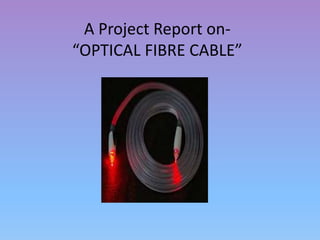
A Project Report on- 
“OPTICAL FIBRE CABLE”
What is an ‘optical fibre’? 
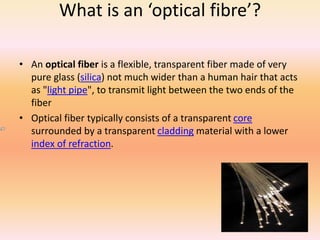
• An optical fiber is a flexible, transparent fiber made of very 
pure glass (silica) not much wider than a human hair that acts 
as "light pipe", to transmit light between the two ends of the 
fiber 
• Optical fiber typically consists of a transparent core 
surrounded by a transparent cladding material with a lower 
index of refraction.
Working Principle of an ‘Optical Fibre’ 
1. An optical fiber is a cylindrical dielectric waveguide 
(nonconducting waveguide) that transmits light along 
its axis, by the process of total internal reflection. 
2. The fiber consists of a core surrounded by a 
cladding layer, both of which are made of 
dielectric materials. 
3. To confine the optical signal in the core, the 
refractive index of the core must be greater 
than that of the cladding.
Optical Fibre can be classified on the 
following heads- 
1. On the basis of “mode of operation” 
2. On the basis of “design of cable” 
3. On the basis of “index of the cable” 
4. On the basis of “structure”
Types of fiber optic cable of index 
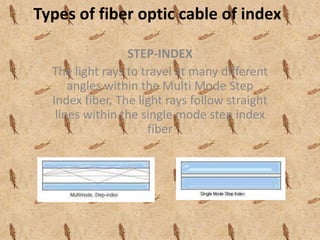
STEP-INDEX 
The light rays to travel at many different 
angles within the Multi Mode Step 
Index fiber, The light rays follow straight 
lines within the single mode step index 
fiber
Types of ‘Optical Fibre’ 
• There are two basic types of fiber: 
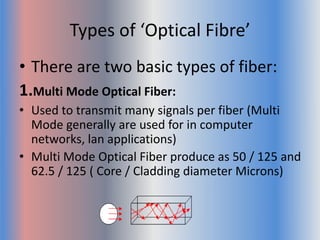
1.Multi Mode Optical Fiber: 
• Used to transmit many signals per fiber (Multi 
Mode generally are used for in computer 
networks, lan applications) 
• Multi Mode Optical Fiber produce as 50 / 125 and 
62.5 / 125 ( Core / Cladding diameter Microns)
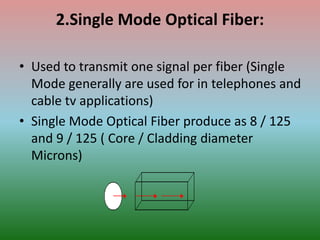
2.Single Mode Optical Fiber: 
• Used to transmit one signal per fiber (Single 
Mode generally are used for in telephones and 
cable tv applications) 
• Single Mode Optical Fiber produce as 8 / 125 
and 9 / 125 ( Core / Cladding diameter 
Microns)
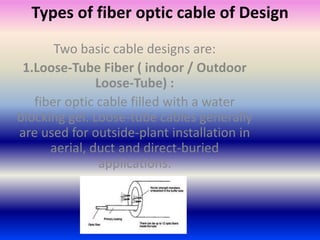
Types of fiber optic cable of Design 
Two basic cable designs are: 
1.Loose-Tube Fiber ( indoor / Outdoor 
Loose-Tube) : 
fiber optic cable filled with a water 
blocking gel. Loose-tube cables generally 
are used for outside-plant installation in 
aerial, duct and direct-buried 
applications.
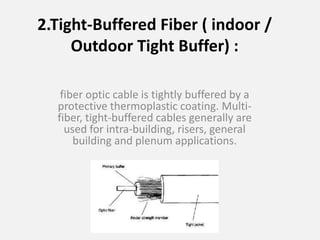
2.Tight-Buffered Fiber ( indoor / 
Outdoor Tight Buffer) : 
fiber optic cable is tightly buffered by a 
protective thermoplastic coating. Multi-fiber, 
tight-buffered cables generally are 
used for intra-building, risers, general 
building and plenum applications.
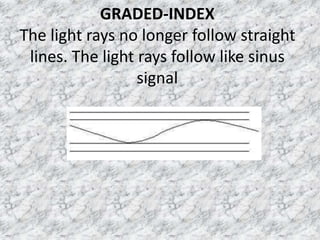
GRADED-INDEX 
The light rays no longer follow straight 
lines. The light rays follow like sinus 
signal
Other types of Optical Fibre Cable- 
• Types of fiber optic cable of structures 
• Three types of material make up fiber-optic cables 
• Glass Optical Fiber: 
• Glass fiber-optic cable has a Glass core and cladding. Glass fiber-optic 
cable the Fastest and the most expensive. 
• Plastic Optical Fiber (POF): 
• Plastic fiber-optic cable has a plastic core and cladding. Plastic fiber-optic 
cable is cheapest and slowest. It is suitable for short distance. 
• Plastic Coated Silica Cable: 
• (PCS). PCS fiber-optic cable has a Glass core and Plastic cladding. 
PCS fiber-optic cable cheaper than Glass optical fiber and slower 
than Glass optical fiber.
Color Codes in an Optical Fibre 
• Patch cords 
• The buffer or jacket on patch cords is often 
color-coded to indicate the type of fiber used. 
The strain relief "boot" that protects the fiber 
from bending at a connector is color-coded to 
indicate the type of connection. Connectors 
with a plastic shell typically use a color-coded 
shell.
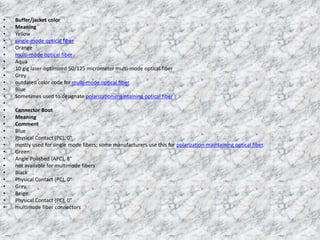
• Buffer/jacket color 
• Meaning 
• Yellow 
• single-mode optical fiber 
• Orange 
• multi-mode optical fiber 
• Aqua 
• 10 gig laser-optimized 50/125 micrometer multi-mode optical fiber 
• Grey 
• outdated color code for multi-mode optical fiber 
• Blue 
• Sometimes used to designate polarization-maintaining optical fiber 
• 
• Connector Boot 
• Meaning 
• Comment 
• Blue 
• Physical Contact (PC), 0° 
• mostly used for single mode fibers; some manufacturers use this for polarization-maintaining optical fiber. 
• Green 
• Angle Polished (APC), 8° 
• not available for multimode fibers 
• Black 
• Physical Contact (PC), 0° 
• Grey, 
• Beige 
• Physical Contact (PC), 0° 
• multimode fiber connectors
Some Parameters should be considered 
while operating an optical fibre cable,they 
are- 
• Optical cables sends data at 182,000 km/s, resulting in 5.5 ms of latency for 
each 1000 km. Thus the round-trip delay time is around 11 ms. 
• Because the infrared light used in communications can not be seen, there is a 
potential laser safety hazard to technicians. In some cases the power levels are 
high enough to damage eyes, particularly when lenses or microscopes are used to 
inspect fibers which are inadvertently emitting invisible IR. Inspection microscopes 
with optical safety filters are available to guard against this. 
• Typical modern Multimode Graded-Index fibers have 3 dB/km of attenuation 
loss at 850 nm and 1 dB/km at 1300 nm. 9/125 Singlemode loses 0.4/0.25 
dB/km at 1310/1550 nm. POF (plastic optical fiber) loses much more: 1 dB/m 
at 650 nm. Plastic Optical Fiber is large core (about 1mm) fiber suitable only 
for short, low speed networks such as within cars.
Applications Of FIBRE OPTIC Cables- 
• Fiber optic cables find many uses in a wide variety of industries and applications. 
Some uses of fiber optic cables include: 
• Medical 
Used as light guides, imaging tools and also as lasers for surgeries 
• Defense/Government 
Used as hydrophones for seismic and SONAR uses, as wiring in aircraft, submarines 
and other vehicles and also for field networking 
• Data Storage 
Used for data transmission 
• Telecommunications 
Fiber is laid and used for transmitting and receiving purposes 
• Networking 
Used to connect users and servers in a variety of network settings and help 
increase the speed and accuracy of data transmission 
• Industrial/Commercial 
Used for imaging in hard to reach areas, as wiring where EMI is an issue, as 
sensory devices to make temperature, pressure and other measurements, and as 
wiring in automobiles and in industrial settings
This Project is prepared under the 
Guidance of- 
1.Mr. XYZ 
2.Mr. ABC
This Presentation is prepared by- 
• VIKASH KUMAR 
• NEHA SHARMA (Group Leader)
vikash kumar- Optical fibre

vikash kumar- Optical fibre

  • 1.
  • 2.
    A Project Reporton- “OPTICAL FIBRE CABLE”
  • 3.
    What is an‘optical fibre’? • An optical fiber is a flexible, transparent fiber made of very pure glass (silica) not much wider than a human hair that acts as "light pipe", to transmit light between the two ends of the fiber • Optical fiber typically consists of a transparent core surrounded by a transparent cladding material with a lower index of refraction.
  • 4.
    Working Principle ofan ‘Optical Fibre’ 1. An optical fiber is a cylindrical dielectric waveguide (nonconducting waveguide) that transmits light along its axis, by the process of total internal reflection. 2. The fiber consists of a core surrounded by a cladding layer, both of which are made of dielectric materials. 3. To confine the optical signal in the core, the refractive index of the core must be greater than that of the cladding.
  • 5.
    Optical Fibre canbe classified on the following heads- 1. On the basis of “mode of operation” 2. On the basis of “design of cable” 3. On the basis of “index of the cable” 4. On the basis of “structure”
  • 6.
    Types of fiberoptic cable of index STEP-INDEX The light rays to travel at many different angles within the Multi Mode Step Index fiber, The light rays follow straight lines within the single mode step index fiber
  • 7.
    Types of ‘OpticalFibre’ • There are two basic types of fiber: 1.Multi Mode Optical Fiber: • Used to transmit many signals per fiber (Multi Mode generally are used for in computer networks, lan applications) • Multi Mode Optical Fiber produce as 50 / 125 and 62.5 / 125 ( Core / Cladding diameter Microns)
  • 8.
    2.Single Mode OpticalFiber: • Used to transmit one signal per fiber (Single Mode generally are used for in telephones and cable tv applications) • Single Mode Optical Fiber produce as 8 / 125 and 9 / 125 ( Core / Cladding diameter Microns)
  • 9.
    Types of fiberoptic cable of Design Two basic cable designs are: 1.Loose-Tube Fiber ( indoor / Outdoor Loose-Tube) : fiber optic cable filled with a water blocking gel. Loose-tube cables generally are used for outside-plant installation in aerial, duct and direct-buried applications.
  • 10.
    2.Tight-Buffered Fiber (indoor / Outdoor Tight Buffer) : fiber optic cable is tightly buffered by a protective thermoplastic coating. Multi-fiber, tight-buffered cables generally are used for intra-building, risers, general building and plenum applications.
  • 11.
    GRADED-INDEX The lightrays no longer follow straight lines. The light rays follow like sinus signal
  • 12.
    Other types ofOptical Fibre Cable- • Types of fiber optic cable of structures • Three types of material make up fiber-optic cables • Glass Optical Fiber: • Glass fiber-optic cable has a Glass core and cladding. Glass fiber-optic cable the Fastest and the most expensive. • Plastic Optical Fiber (POF): • Plastic fiber-optic cable has a plastic core and cladding. Plastic fiber-optic cable is cheapest and slowest. It is suitable for short distance. • Plastic Coated Silica Cable: • (PCS). PCS fiber-optic cable has a Glass core and Plastic cladding. PCS fiber-optic cable cheaper than Glass optical fiber and slower than Glass optical fiber.
  • 13.
    Color Codes inan Optical Fibre • Patch cords • The buffer or jacket on patch cords is often color-coded to indicate the type of fiber used. The strain relief "boot" that protects the fiber from bending at a connector is color-coded to indicate the type of connection. Connectors with a plastic shell typically use a color-coded shell.
  • 14.
    • Buffer/jacket color • Meaning • Yellow • single-mode optical fiber • Orange • multi-mode optical fiber • Aqua • 10 gig laser-optimized 50/125 micrometer multi-mode optical fiber • Grey • outdated color code for multi-mode optical fiber • Blue • Sometimes used to designate polarization-maintaining optical fiber • • Connector Boot • Meaning • Comment • Blue • Physical Contact (PC), 0° • mostly used for single mode fibers; some manufacturers use this for polarization-maintaining optical fiber. • Green • Angle Polished (APC), 8° • not available for multimode fibers • Black • Physical Contact (PC), 0° • Grey, • Beige • Physical Contact (PC), 0° • multimode fiber connectors
  • 15.
    Some Parameters shouldbe considered while operating an optical fibre cable,they are- • Optical cables sends data at 182,000 km/s, resulting in 5.5 ms of latency for each 1000 km. Thus the round-trip delay time is around 11 ms. • Because the infrared light used in communications can not be seen, there is a potential laser safety hazard to technicians. In some cases the power levels are high enough to damage eyes, particularly when lenses or microscopes are used to inspect fibers which are inadvertently emitting invisible IR. Inspection microscopes with optical safety filters are available to guard against this. • Typical modern Multimode Graded-Index fibers have 3 dB/km of attenuation loss at 850 nm and 1 dB/km at 1300 nm. 9/125 Singlemode loses 0.4/0.25 dB/km at 1310/1550 nm. POF (plastic optical fiber) loses much more: 1 dB/m at 650 nm. Plastic Optical Fiber is large core (about 1mm) fiber suitable only for short, low speed networks such as within cars.
  • 16.
    Applications Of FIBREOPTIC Cables- • Fiber optic cables find many uses in a wide variety of industries and applications. Some uses of fiber optic cables include: • Medical Used as light guides, imaging tools and also as lasers for surgeries • Defense/Government Used as hydrophones for seismic and SONAR uses, as wiring in aircraft, submarines and other vehicles and also for field networking • Data Storage Used for data transmission • Telecommunications Fiber is laid and used for transmitting and receiving purposes • Networking Used to connect users and servers in a variety of network settings and help increase the speed and accuracy of data transmission • Industrial/Commercial Used for imaging in hard to reach areas, as wiring where EMI is an issue, as sensory devices to make temperature, pressure and other measurements, and as wiring in automobiles and in industrial settings
  • 17.
    This Project isprepared under the Guidance of- 1.Mr. XYZ 2.Mr. ABC
  • 18.
    This Presentation isprepared by- • VIKASH KUMAR • NEHA SHARMA (Group Leader)