Fiber optics
Presented by Ricky, Amit,
Ayush, Arpit
Content
Introductions
Evolution of fiber optics
What are fiber optics ?
Structure of fiber optics
Working Principle of fiber optics
Fiber Optical communication system
Advantages/Disadvantages of fiber optics
Application of fiber Optics
Conclusion
FIBERS OPTICS 2
Introduction
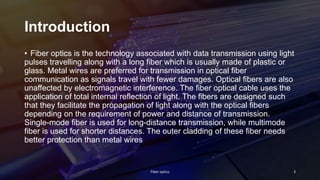
• Fiber optics is the technology associated with data transmission using light
pulses travelling along with a long fiber which is usually made of plastic or
glass. Metal wires are preferred for transmission in optical fiber
communication as signals travel with fewer damages. Optical fibers are also
unaffected by electromagnetic interference. The fiber optical cable uses the
application of total internal reflection of light. The fibers are designed such
that they facilitate the propagation of light along with the optical fibers
depending on the requirement of power and distance of transmission.
Single-mode fiber is used for long-distance transmission, while multimode
fiber is used for shorter distances. The outer cladding of these fiber needs
better protection than metal wires
Fiber optics 3
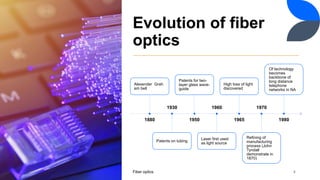
Evolution of fiber
optics
1880
Alexender Grah
am bell
1930
Patents on tubing
1950
Patents for two-
layer glass wave-
guide
1960
Laser first used
as light source
1965
High loss of light
discovered
1970
Refining of
manufacturing
process (John
Tyndall
demonstrate in
1870)
1980
Of technology
becomes
backbone of
long distance
telephone
networks in NA
Fiber optics 4
What is fiber optics?
1
Fiber optic(or "optical fiber ")
refers to the medium and the
technology associated with the
trans mission of information as
light impulses along a glass or
plastic wire or wires carries much
more information than
conventional copper wire.
2
Most telephone company long-
distances lines are now fiber
optics.
Optical fibers use light to send
information through the optical
medium.
FIBER OPTICS 5
structure
Core
Cladding
Coating
Workings principle
• Total internal reflection
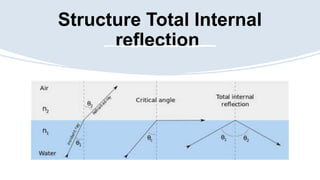
• When a ray of light travels from a denser to a rarer
medium such that the angle of incidence is greater than
the critical angle, the ray reflects back into the same
medium this phenomena is called total internal reflection.
• In the optical fiber the rays undergo repeated total
number of reflections until it emerges out of the other end
of the fiber, even if the fiber, even if the fiber is bent.
Structure Total Internal
reflection
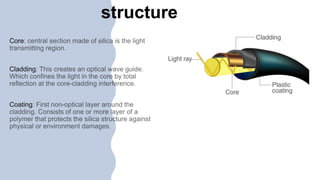
Core: central section made of silica is the light transmitting region.
Cladding: This creates an optical wave guide. Whichconfines the light in the coreby total reflection at the core-cladding interference.
Coating: First non-optical layer around the cladding. Consists of one or more layer of a polymer that protects the silica structureagainst physical or environment damages.
Optical fiber
communicatio
n system
• In fiber optic communication,
data is transmitted from the
source to the destination by
sending light pulses through
optical fibers. It changes
electrical pulses to light signals
and vice versa for
communication. Fiber optic
communications are preferred
when a huge amount of data
needs to be transmitted across
large distances
Fiber optics 9
The process of communication using
fiber optics
• Conversion of input electrical data to light
signals : The data to be sent by the sender is in the
form of electrical signals. These signals are converted
to light pulses by the transmitter circuitry using a light
source. A light source is of two types: LED and a laser
diode.
• Transmission of light signals: The light signal is
transmitted over a network of optical fiber cables.
During transmission, the signals should not become
too weak or distorted.
• Receiving of light signals: The receiver detects
the light signals using a photodetector that converts
light pulses to electrical pulses. Photodetectors are of
two types: PN photodiode and avalanche photodiode
Advantages of the fiber optics
• It's one of the easiest ways to install.
• It has the ability to perform data transmissions at high speeds.
• In front of the coaxial cable or twisted pair, which are usually the most common, the fiber
cable is much thinner, which makes it lighter.
• It transmits the data in a stable way.
• The heavy data like video and voice are transmitted in real time.
• The navigation speed reaches 2 million bps, which is technically impossible with the
conventional system.
• It is fully compatible with digital technology.
• The material of which it is made has high resistance against heat, cold and corrosion.
• It is not affected by electromagnetic interference.
• The materials for their manufacture are easily found in nature.
Fiber optics
Disadvantages of fiber optics
• The fragility of the cable is high, which makes it a very delicate element.
• For cases where there is a breakdown in the wiring, making a splice is a difficult procedure to perform.
• Transmitters and receivers for this type of medium are highly costly.
• The execution of the installation of this technology is very expensive.
• The service of data transmission through optical fiber is more expensive than the conventional ones.
• Highly qualified personnel are required to perform both the installation and any repairs to a fault that
presents the wiring.
• Optical fiber installation is more expensive than twisted pair cables.
• If the cables are not properly aligned during installation and/or repair, the transmission is affected.
• A parallel physical pathway is required to install the wiring.
• The availability of the connectors is usually limited
Application of fiber optics
• Medicine: Used as light guides, imaging tools and also as lasers for surgeries
• Defense/government: Used as radios for seismic and sonar waves, as wiring in
airplanes, submarines and other vehicles.
• Telecommunications: The fiber is put and used to transmit and receive
information.
• Networks — used to connect users and servers in a variety of network
configurations and help increase the speed and accuracy of data transmission
• Industrial/Commercial: Used for imaging in difficult-to-reach areas.
• It is used in sensors to measure temperature and pressure
• In car wiring.
• Broadcast/CATV: Broadcast/cable companies are using fiber optic cables for
CATV, HDTV, Internet, video on demand and other uses.
Conclusion
14
• This conclusion our study of fiber optics
communication have looked at how
• They work and how they are made ,
properties of fibers ,Application......
• Although this presentation does not cover
all the aspects of optical work it will have
equipped you knowledge and skills essential
to the fiber optics industry.
ppt fi optics.pptx

ppt fi optics.pptx

  • 1.
    Fiber optics Presented byRicky, Amit, Ayush, Arpit
  • 2.
    Content Introductions Evolution of fiberoptics What are fiber optics ? Structure of fiber optics Working Principle of fiber optics Fiber Optical communication system Advantages/Disadvantages of fiber optics Application of fiber Optics Conclusion FIBERS OPTICS 2
  • 3.
    Introduction • Fiber opticsis the technology associated with data transmission using light pulses travelling along with a long fiber which is usually made of plastic or glass. Metal wires are preferred for transmission in optical fiber communication as signals travel with fewer damages. Optical fibers are also unaffected by electromagnetic interference. The fiber optical cable uses the application of total internal reflection of light. The fibers are designed such that they facilitate the propagation of light along with the optical fibers depending on the requirement of power and distance of transmission. Single-mode fiber is used for long-distance transmission, while multimode fiber is used for shorter distances. The outer cladding of these fiber needs better protection than metal wires Fiber optics 3
  • 4.
    Evolution of fiber optics 1880 AlexenderGrah am bell 1930 Patents on tubing 1950 Patents for two- layer glass wave- guide 1960 Laser first used as light source 1965 High loss of light discovered 1970 Refining of manufacturing process (John Tyndall demonstrate in 1870) 1980 Of technology becomes backbone of long distance telephone networks in NA Fiber optics 4
  • 5.
    What is fiberoptics? 1 Fiber optic(or "optical fiber ") refers to the medium and the technology associated with the trans mission of information as light impulses along a glass or plastic wire or wires carries much more information than conventional copper wire. 2 Most telephone company long- distances lines are now fiber optics. Optical fibers use light to send information through the optical medium. FIBER OPTICS 5
  • 6.
  • 7.
    Workings principle • Totalinternal reflection • When a ray of light travels from a denser to a rarer medium such that the angle of incidence is greater than the critical angle, the ray reflects back into the same medium this phenomena is called total internal reflection. • In the optical fiber the rays undergo repeated total number of reflections until it emerges out of the other end of the fiber, even if the fiber, even if the fiber is bent.
  • 8.
    Structure Total Internal reflection Core:central section made of silica is the light transmitting region. Cladding: This creates an optical wave guide. Whichconfines the light in the coreby total reflection at the core-cladding interference. Coating: First non-optical layer around the cladding. Consists of one or more layer of a polymer that protects the silica structureagainst physical or environment damages.
  • 9.
    Optical fiber communicatio n system •In fiber optic communication, data is transmitted from the source to the destination by sending light pulses through optical fibers. It changes electrical pulses to light signals and vice versa for communication. Fiber optic communications are preferred when a huge amount of data needs to be transmitted across large distances Fiber optics 9
  • 10.
    The process ofcommunication using fiber optics • Conversion of input electrical data to light signals : The data to be sent by the sender is in the form of electrical signals. These signals are converted to light pulses by the transmitter circuitry using a light source. A light source is of two types: LED and a laser diode. • Transmission of light signals: The light signal is transmitted over a network of optical fiber cables. During transmission, the signals should not become too weak or distorted. • Receiving of light signals: The receiver detects the light signals using a photodetector that converts light pulses to electrical pulses. Photodetectors are of two types: PN photodiode and avalanche photodiode
  • 11.
    Advantages of thefiber optics • It's one of the easiest ways to install. • It has the ability to perform data transmissions at high speeds. • In front of the coaxial cable or twisted pair, which are usually the most common, the fiber cable is much thinner, which makes it lighter. • It transmits the data in a stable way. • The heavy data like video and voice are transmitted in real time. • The navigation speed reaches 2 million bps, which is technically impossible with the conventional system. • It is fully compatible with digital technology. • The material of which it is made has high resistance against heat, cold and corrosion. • It is not affected by electromagnetic interference. • The materials for their manufacture are easily found in nature. Fiber optics
  • 12.
    Disadvantages of fiberoptics • The fragility of the cable is high, which makes it a very delicate element. • For cases where there is a breakdown in the wiring, making a splice is a difficult procedure to perform. • Transmitters and receivers for this type of medium are highly costly. • The execution of the installation of this technology is very expensive. • The service of data transmission through optical fiber is more expensive than the conventional ones. • Highly qualified personnel are required to perform both the installation and any repairs to a fault that presents the wiring. • Optical fiber installation is more expensive than twisted pair cables. • If the cables are not properly aligned during installation and/or repair, the transmission is affected. • A parallel physical pathway is required to install the wiring. • The availability of the connectors is usually limited
  • 13.
    Application of fiberoptics • Medicine: Used as light guides, imaging tools and also as lasers for surgeries • Defense/government: Used as radios for seismic and sonar waves, as wiring in airplanes, submarines and other vehicles. • Telecommunications: The fiber is put and used to transmit and receive information. • Networks — used to connect users and servers in a variety of network configurations and help increase the speed and accuracy of data transmission • Industrial/Commercial: Used for imaging in difficult-to-reach areas. • It is used in sensors to measure temperature and pressure • In car wiring. • Broadcast/CATV: Broadcast/cable companies are using fiber optic cables for CATV, HDTV, Internet, video on demand and other uses.
  • 14.
    Conclusion 14 • This conclusionour study of fiber optics communication have looked at how • They work and how they are made , properties of fibers ,Application...... • Although this presentation does not cover all the aspects of optical work it will have equipped you knowledge and skills essential to the fiber optics industry.