FIBER OPTICS AND ITS
CONSTRUCTION &WORKING
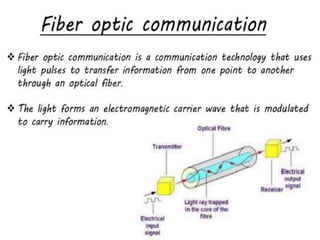
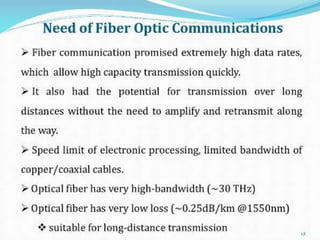
• A fiber optic cable is a network cable that contains strands of
glass fibers inside an insulated casing. They're designed for
long distance, high-performance data networking, and
telecommunications.
• Compared to wired cables, fiber optic cables provide higher
bandwidth and can transmit data over longer distances. Fiber
optic cables support much of the world's internet, cable
television, and telephone systems.
• NOTE :Fiber optic cables carry communication signals using
pulses of light generated by small lasers or light-emitting
diodes.
• The entire globe is covered with these optical fiber cable these
cables are laid below the ground and under the ocean.
• It gives the data security as well because the signal is confined
with in the optical fiber and no side entry is allowed.
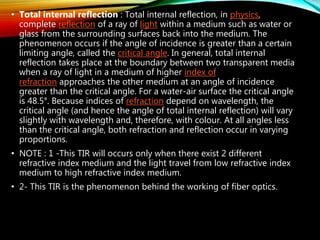
• Total internal reflection : Total internal reflection, in physics,
complete reflection of a ray of light within a medium such as water or
glass from the surrounding surfaces back into the medium. The
phenomenon occurs if the angle of incidence is greater than a certain
limiting angle, called the critical angle. In general, total internal
reflection takes place at the boundary between two transparent media
when a ray of light in a medium of higher index of
refraction approaches the other medium at an angle of incidence
greater than the critical angle. For a water-air surface the critical angle
is 48.5°. Because indices of refraction depend on wavelength, the
critical angle (and hence the angle of total internal reflection) will vary
slightly with wavelength and, therefore, with colour. At all angles less
than the critical angle, both refraction and reflection occur in varying
proportions.
• NOTE : 1 -This TIR will occurs only when there exist 2 different
refractive index medium and the light travel from low refractive index
medium to high refractive index medium.
• 2- This TIR is the phenomenon behind the working of fiber optics.
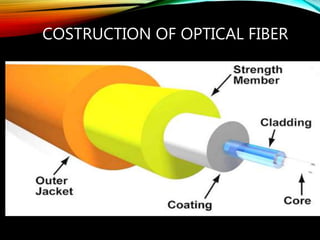
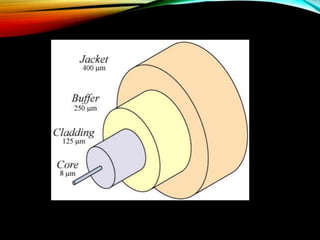
COSTRUCTION OF OPTICAL FIBER
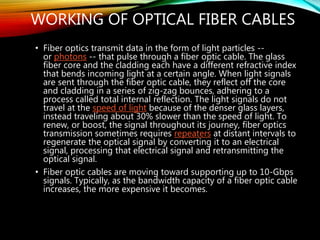
WORKING OF OPTICAL FIBER CABLES
• Fiber optics transmit data in the form of light particles --
or photons -- that pulse through a fiber optic cable. The glass
fiber core and the cladding each have a different refractive index
that bends incoming light at a certain angle. When light signals
are sent through the fiber optic cable, they reflect off the core
and cladding in a series of zig-zag bounces, adhering to a
process called total internal reflection. The light signals do not
travel at the speed of light because of the denser glass layers,
instead traveling about 30% slower than the speed of light. To
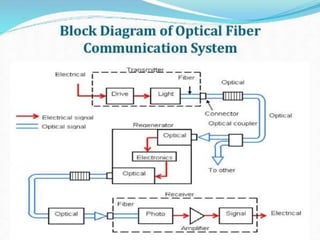
renew, or boost, the signal throughout its journey, fiber optics
transmission sometimes requires repeaters at distant intervals to
regenerate the optical signal by converting it to an electrical
signal, processing that electrical signal and retransmitting the
optical signal.
• Fiber optic cables are moving toward supporting up to 10-Gbps
signals. Typically, as the bandwidth capacity of a fiber optic cable
increases, the more expensive it becomes.
OPTICAL FIBER IN LAN
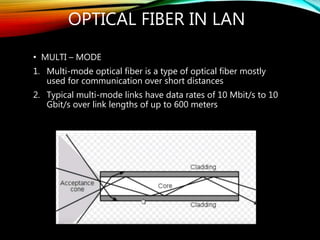
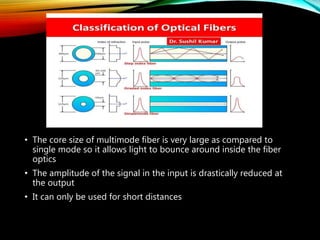
• MULTI – MODE
1. Multi-mode optical fiber is a type of optical fiber mostly
used for communication over short distances
2. Typical multi-mode links have data rates of 10 Mbit/s to 10
Gbit/s over link lengths of up to 600 meters
• The core size of multimode fiber is very large as compared to
single mode so it allows light to bounce around inside the fiber
optics
• The amplitude of the signal in the input is drastically reduced at
the output
• It can only be used for short distances
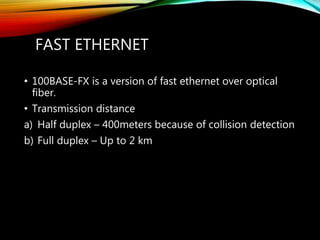
FAST ETHERNET
• 100BASE-FX is a version of fast ethernet over optical
fiber.
• Transmission distance
a) Half duplex – 400meters because of collision detection
b) Full duplex – Up to 2 km
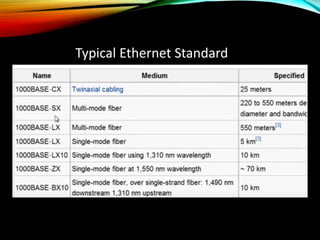
Typical Ethernet Standard
ADVANTAGES
• Fiber optic cables have much greater band width than metal
cables.
• Optical fiber cables are immune to electromagnetic interferance.
• Optical fibers have a higher carrying capacity.
• Optical fibers are much thinner and lighter compared to copper
wires.
• Optical fibers are difficult to tap
• Optical fibers can be made cheaper compared to metal wires.
• Optical fiber cables use light signal unlike electrical signals
transmitted in copper wires.
DISADVANTAGES
• Optical fibers are difficult to splice.
• Optical fibers are more expensive to install.
• Optical fiber cables are highly susceptible to
being damaged.
• Optical fibers are highly fragile.
• Optical cables can't be curved.
OPTICAL FIBER NETWORKS
 Virtually every phone call we make today, every text message we
send, every internet-based application and service we use is at
some point converted to photons that travel down a vast
network of optical fibers. more than two billion kilometers of
optical fibers have been deployed, a string of glass that could be
wrapped around the globe more than 50,000 times. well over
100 million people now enjoy fiber optic connections directly to
their homes.
• Optical fibers also link up the majority of cell towers, where the
radio frequency photons picked up from billions of mobile
phone users are immediately converted to infrared photons for
efficient fiber optic backhaul into all-fiber metropolitan,
regional, long-haul and submarine networks that connect cities,
span countries and bridge continents.
The role of optical fiber communication technologies is to ensure that
cost-effective network traffic scaling can continue to enable future
communications services as an underpinning of today’s digital
information society. this article overviews the scaling of optical fiber
communications, highlights practical as well as fundamental problems
in network scalability, and points to some solutions currently being
explored by the global fiber optic communications community.
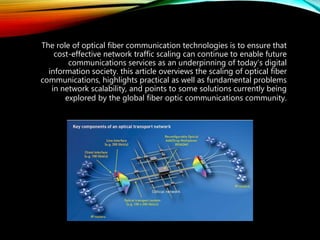
THE MODERN TRANSPORT NETWORK
• An optical transport network (see figure on facing page)
interconnects Internet Protocol (IP) packet routers that pass
data packets from a data source to the intended recipient,
preferably along minimum-hop transmission paths.
• These routers are connected through optical client
interfaces, which today offer connections of up to 100
Gbit/s over distances of around 40 km. Compact and low-
cost client interfaces can directly tie a router to other
nearby routers or connect a router to an optical transport
system that in turn establishes a connection to distant
routers.
• These signals can traverse thousands of kilometers of fiber
without any intermediate electronic processing, passing
only through optical amplifiers and optical filter
components that can be dynamically reconfigured to add
and drop signals or to switch them to different parts of the
network, through reconfigurable optical add-drop
multiplexers.
• In contrast to optical client signals, optical line signals are
designed with spectral stacking in mind. Modern
wavelength division multiplexed (WDM) optical transport
systems carry about 100 optical signals at up to 200 Gbit/s
each, on a 50 GHz optical frequency grid, for an overall
capacity of about 20 Tbit/s on a single optical fiber.

Fiber optics

  • 1.
    FIBER OPTICS ANDITS CONSTRUCTION &WORKING
  • 2.
    • A fiberoptic cable is a network cable that contains strands of glass fibers inside an insulated casing. They're designed for long distance, high-performance data networking, and telecommunications. • Compared to wired cables, fiber optic cables provide higher bandwidth and can transmit data over longer distances. Fiber optic cables support much of the world's internet, cable television, and telephone systems. • NOTE :Fiber optic cables carry communication signals using pulses of light generated by small lasers or light-emitting diodes. • The entire globe is covered with these optical fiber cable these cables are laid below the ground and under the ocean. • It gives the data security as well because the signal is confined with in the optical fiber and no side entry is allowed.
  • 3.
    • Total internalreflection : Total internal reflection, in physics, complete reflection of a ray of light within a medium such as water or glass from the surrounding surfaces back into the medium. The phenomenon occurs if the angle of incidence is greater than a certain limiting angle, called the critical angle. In general, total internal reflection takes place at the boundary between two transparent media when a ray of light in a medium of higher index of refraction approaches the other medium at an angle of incidence greater than the critical angle. For a water-air surface the critical angle is 48.5°. Because indices of refraction depend on wavelength, the critical angle (and hence the angle of total internal reflection) will vary slightly with wavelength and, therefore, with colour. At all angles less than the critical angle, both refraction and reflection occur in varying proportions. • NOTE : 1 -This TIR will occurs only when there exist 2 different refractive index medium and the light travel from low refractive index medium to high refractive index medium. • 2- This TIR is the phenomenon behind the working of fiber optics.
  • 4.
  • 5.
    WORKING OF OPTICALFIBER CABLES • Fiber optics transmit data in the form of light particles -- or photons -- that pulse through a fiber optic cable. The glass fiber core and the cladding each have a different refractive index that bends incoming light at a certain angle. When light signals are sent through the fiber optic cable, they reflect off the core and cladding in a series of zig-zag bounces, adhering to a process called total internal reflection. The light signals do not travel at the speed of light because of the denser glass layers, instead traveling about 30% slower than the speed of light. To renew, or boost, the signal throughout its journey, fiber optics transmission sometimes requires repeaters at distant intervals to regenerate the optical signal by converting it to an electrical signal, processing that electrical signal and retransmitting the optical signal. • Fiber optic cables are moving toward supporting up to 10-Gbps signals. Typically, as the bandwidth capacity of a fiber optic cable increases, the more expensive it becomes.
  • 11.
    OPTICAL FIBER INLAN • MULTI – MODE 1. Multi-mode optical fiber is a type of optical fiber mostly used for communication over short distances 2. Typical multi-mode links have data rates of 10 Mbit/s to 10 Gbit/s over link lengths of up to 600 meters
  • 12.
    • The coresize of multimode fiber is very large as compared to single mode so it allows light to bounce around inside the fiber optics • The amplitude of the signal in the input is drastically reduced at the output • It can only be used for short distances
  • 14.
    FAST ETHERNET • 100BASE-FXis a version of fast ethernet over optical fiber. • Transmission distance a) Half duplex – 400meters because of collision detection b) Full duplex – Up to 2 km
  • 15.
  • 16.
    ADVANTAGES • Fiber opticcables have much greater band width than metal cables. • Optical fiber cables are immune to electromagnetic interferance. • Optical fibers have a higher carrying capacity. • Optical fibers are much thinner and lighter compared to copper wires. • Optical fibers are difficult to tap • Optical fibers can be made cheaper compared to metal wires. • Optical fiber cables use light signal unlike electrical signals transmitted in copper wires.
  • 17.
    DISADVANTAGES • Optical fibersare difficult to splice. • Optical fibers are more expensive to install. • Optical fiber cables are highly susceptible to being damaged. • Optical fibers are highly fragile. • Optical cables can't be curved.
  • 18.
    OPTICAL FIBER NETWORKS Virtually every phone call we make today, every text message we send, every internet-based application and service we use is at some point converted to photons that travel down a vast network of optical fibers. more than two billion kilometers of optical fibers have been deployed, a string of glass that could be wrapped around the globe more than 50,000 times. well over 100 million people now enjoy fiber optic connections directly to their homes. • Optical fibers also link up the majority of cell towers, where the radio frequency photons picked up from billions of mobile phone users are immediately converted to infrared photons for efficient fiber optic backhaul into all-fiber metropolitan, regional, long-haul and submarine networks that connect cities, span countries and bridge continents.
  • 19.
    The role ofoptical fiber communication technologies is to ensure that cost-effective network traffic scaling can continue to enable future communications services as an underpinning of today’s digital information society. this article overviews the scaling of optical fiber communications, highlights practical as well as fundamental problems in network scalability, and points to some solutions currently being explored by the global fiber optic communications community.
  • 20.
    THE MODERN TRANSPORTNETWORK • An optical transport network (see figure on facing page) interconnects Internet Protocol (IP) packet routers that pass data packets from a data source to the intended recipient, preferably along minimum-hop transmission paths. • These routers are connected through optical client interfaces, which today offer connections of up to 100 Gbit/s over distances of around 40 km. Compact and low- cost client interfaces can directly tie a router to other nearby routers or connect a router to an optical transport system that in turn establishes a connection to distant routers.
  • 21.
    • These signalscan traverse thousands of kilometers of fiber without any intermediate electronic processing, passing only through optical amplifiers and optical filter components that can be dynamically reconfigured to add and drop signals or to switch them to different parts of the network, through reconfigurable optical add-drop multiplexers. • In contrast to optical client signals, optical line signals are designed with spectral stacking in mind. Modern wavelength division multiplexed (WDM) optical transport systems carry about 100 optical signals at up to 200 Gbit/s each, on a 50 GHz optical frequency grid, for an overall capacity of about 20 Tbit/s on a single optical fiber.