CHAPTER – 3
FIBRE TO FABRIC
CREATED BY – RAVI PRAKASH SINGH
FOR CLASS – VIII
SUBJECT – PHYSICS (SCIENCE)
Thursday, January 18, 2018RAVI PRAKASH SINGH 1
IMPORTANCE OF CLOTHES
 Following are the importance
of clothes :
1) They protect from heat.
2) They protect from cold.
3) They make us look nice &
decent(सभ्य).
Thursday, January 18, 2018RAVI PRAKASH SINGH 2
FIBRE
A material which is available in the
form of thin and continuous strand is
called FIBRE.
There are two types of fibre, viz.
1) Natural fibre and
2) Man-made Fibre or Synthetic
Fibre
Thursday, January 18, 2018RAVI PRAKASH SINGH 3
TYPES OF FIBRE:
NATURAL FIBERS
The fibers which are obtained from plants
and animals are called Natural Fibers.
Examples: cotton, jute, silk, wool.
MAN-MADE FIBERS
The fibers that are synthesized in laboratory
are called Man-made Fiber.
Examples: Nylon, Acrylic, terrylene, terry-
cotton Polyester etc.
Thursday, January 18, 2018RAVI PRAKASH SINGH 4
TYPES OF NATURAL FIBRE:
PLANT FIBRE:
The fibers which are obtained from
plants and animals are called Plant
fibers.
Examples: Cotton, jute and flex.
ANIMAL FIBRE:
The fibers which are obtained from
plants and animals are called Animal
fibers.
Examples: Silk and wool.
Thursday, January 18, 2018RAVI PRAKASH SINGH 5
ANIMAL FIBRES
Thursday, January 18, 2018RAVI PRAKASH SINGH 6
The common animal fibers are
wool and silk.
 Wool is obtained from
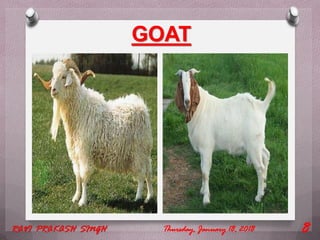
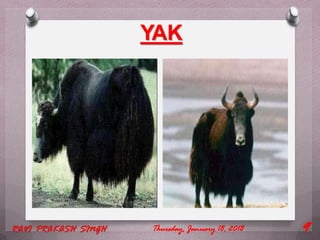
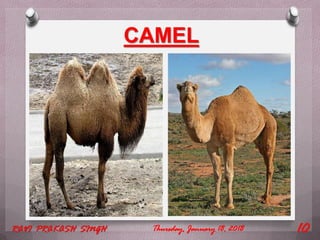
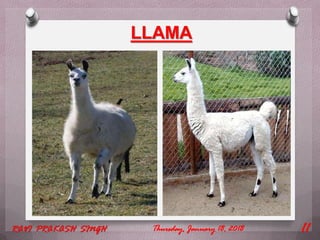
sheep, goat, yak, camel,
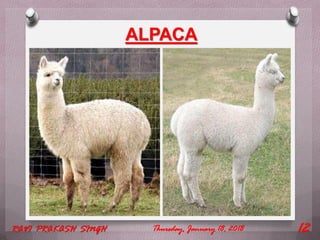
llama, alpaca etc.
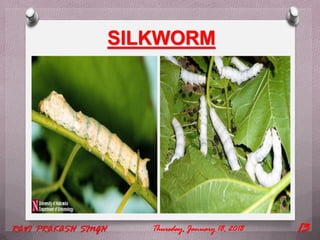
 Silk is obtained from silk
worm.
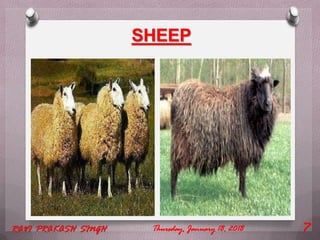
SHEEP
Thursday, January 18, 2018RAVI PRAKASH SINGH 7
GOAT
Thursday, January 18, 2018RAVI PRAKASH SINGH 8
YAK
Thursday, January 18, 2018RAVI PRAKASH SINGH 9
CAMEL
Thursday, January 18, 2018RAVI PRAKASH SINGH 10
LLAMA
Thursday, January 18, 2018RAVI PRAKASH SINGH 11
ALPACA
Thursday, January 18, 2018RAVI PRAKASH SINGH 12
SILKWORM
Thursday, January 18, 2018RAVI PRAKASH SINGH 13
WOOL
 Wool is obtained from the fleece (hair) of
sheep, goat, camel, yak, rabbit, llama,
alpaca and other animals.
 These animals have a thick coat of hair on
their bodies because the hair traps air and
air is a poor conductor of heat.
 So thick layer of hair keeps their body
warm and protects them from harsh cold.
 For obtaining wool, animal are reared and
then their hair is cut and processed into
wool.
Thursday, January 18, 2018RAVI PRAKASH SINGH 14
Fleece and Wool bearing animals
Fleece and Wool bearing animals like sheep,
goat, camel, yak, etc. bear two types of hair –
coarse hair and fine-soft under hair.
Fine soft hair is found close to the skin in such
animals.
The fine soft under hair of animal like sheep goat
etc. is called FLEECE.
Animals having fine soft hair (fleece) on their
body are called Wool Bearing Animals.
Thursday, January 18, 2018RAVI PRAKASH SINGH 15
ANIMAL WOOL
 Many breeds of sheep are found in India.
 Sheep gives milk and meat; in addition to wool, but are
reared mainly to obtain wool in different parts of the
world. Sheep wool is most common wool.
 Angora wool is obtained from Angora Goats of Jammu
Kashmir is soft wool used for making shawls.
 Angora Goats are found in hilly regions, such as
Jammu and Kashmir.
 Pashmina wool is obtained from Pashmina Goats.
 Yak wool is obtained commonly in Tibet and Laddakh.
 Alpaca and Llama found in South America also give
wool.
 Camel hair is also used as wool.
Thursday, January 18, 2018RAVI PRAKASH SINGH 16
REARING AND BREEDING OF SHEEP
 Sheep are reared in many parts our country
like Jammu and Kashmir, Himachal Pradesh,
Uttaranchal, Sikkim, Arunachal Pradesh,
Haryana, Punjab, Rajasthan, Gujarat etc.
 Sheep feed on grass and leaves. They are also
fed with a mixture of pulses, corn, jowar,
oilcakes and minerals.
 In winter sheep are kept indoors and fed
on leaves, grain and dry fodder.
 Some breeds of sheep have thick hair on their
body which yield good quality wool in large
quantities. They are selectively bred to get
sheep of good breed.
Thursday, January 18, 2018RAVI PRAKASH SINGH 17
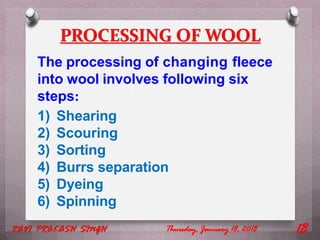
PROCESSING OF WOOL
The processing of changing fleece
into wool involves following six
steps:
1) Shearing
2) Scouring
3) Sorting
4) Burrs separation
5) Dyeing
6) Spinning
Thursday, January 18, 2018RAVI PRAKASH SINGH 18
PROCESSING OF WOOL
1) The fleece (hair) of the sheep is removed from
its body along with a thin layer of dead skin by
using machines.
The process of removal of the fleece from
animal is called shearing.
2) The sheared skin with hair is washed in tanks
to remove grease, dust and dirt.
The process of washing the sheared wool in
hot water followed by drying is called
scouring.
Thursday, January 18, 2018RAVI PRAKASH SINGH 19
PROCESSING OF WOOL
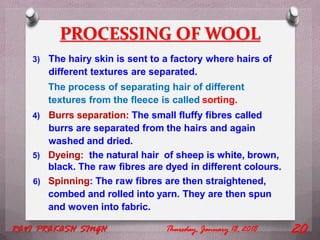
3) The hairy skin is sent to a factory where hairs of
different textures are separated.
The process of separating hair of different
textures from the fleece is called sorting.
4) Burrs separation: The small fluffy fibres called
burrs are separated from the hairs and again
washed and dried.
5) Dyeing: the natural hair of sheep is white, brown,
black. The raw fibres are dyed in different colours.
6) Spinning: The raw fibres are then straightened,
combed and rolled into yarn. They are then spun
and woven into fabric.
Thursday, January 18, 2018RAVI PRAKASH SINGH 20
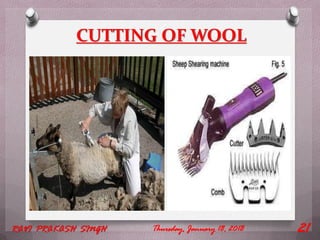
CUTTING OF WOOL
Thursday, January 18, 2018RAVI PRAKASH SINGH 21
YARN TYPES & ITS USES
There Are Two Types Yarn:
1) LONG YARN
2) SHORTER YARN
The long yarn threads are usually
knitted to make sweaters, mufflers,
caps, and socks.
The shorter yarn threads are woven
into fabrics.
Thursday, January 18, 2018RAVI PRAKASH SINGH 22
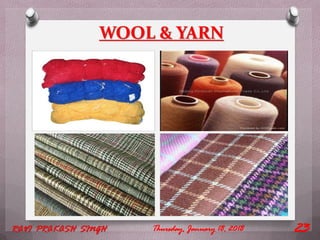
WOOL & YARN
Thursday, January 18, 2018RAVI PRAKASH SINGH 23
USES OF WOOL
Wool is used for making warm
clothes, such as sweater, cap,
shawl, gloves, and blanket etc.
Wool is also used in making
carpets and upholstery
Thursday, January 18, 2018RAVI PRAKASH SINGH 24
SILK
Silk fiber is obtained from the cocoons of the
silkworms (silk moth). The silk moth lives on the
leaves of mulberry plants.
TYPES OF SILK
Different types of silk worm produce different
types of silk in terms of luster and texture.
For example- tassar silk, mooga silk, kosa silk,
etc. are produced by different types of silk moth.
Mulberry silk is the most common silk moth.
SERICULTURE
The rearing of silkworms for obtaining silk is
called sericulture.
Thursday, January 18, 2018RAVI PRAKASH SINGH 25
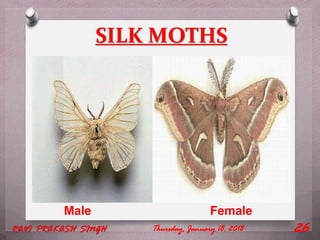
Male Female
SILK MOTHS
Thursday, January 18, 2018RAVI PRAKASH SINGH 26
History of Silk:
 Silk was discovered in China; around 3500 BC. Silk
became a prized possession because of its fine quality
and luster.
 Originally, it was used by emperors only. It was through
trade that silk spread to other parts of the world
 over a period of time. Silk was a staple item of trade
during ancient times. Due to this, the ancient trade
routes which linked China to other parts of the world are
called ‘Silk Route’.
 As per historians, silk was produced in India also. Proof
of use of silk during the Indus Valley Civilization has
also been found.
Thursday, January 18, 2018RAVI PRAKASH SINGH 27
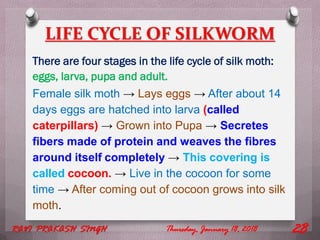
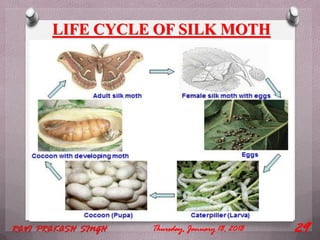
LIFE CYCLE OF SILKWORM
There are four stages in the life cycle of silk moth:
eggs, larva, pupa and adult.
Female silk moth → Lays eggs → After about 14
days eggs are hatched into larva (called
caterpillars) → Grown into Pupa → Secretes
fibers made of protein and weaves the fibres
around itself completely → This covering is
called cocoon. → Live in the cocoon for some
time → After coming out of cocoon grows into silk
moth.
Thursday, January 18, 2018RAVI PRAKASH SINGH 28
Adult silk moth
LIFE CYCLE OF SILK MOTH
Thursday, January 18, 2018RAVI PRAKASH SINGH 29
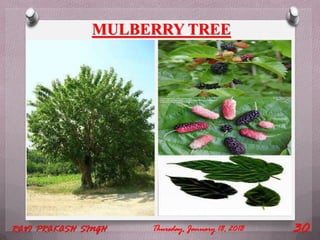
MULBERRY TREE
Thursday, January 18, 2018RAVI PRAKASH SINGH 30
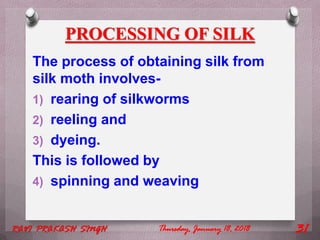
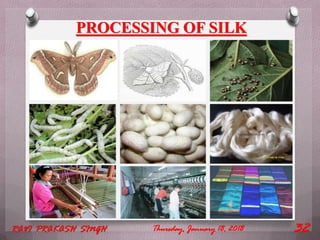
PROCESSING OF SILK
The process of obtaining silk from
silk moth involves-
1) rearing of silkworms
2) reeling and
3) dyeing.
This is followed by
4) spinning and weaving
Thursday, January 18, 2018RAVI PRAKASH SINGH 31
PROCESSING OF SILK
Thursday, January 18, 2018RAVI PRAKASH SINGH 32
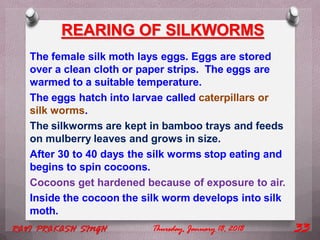
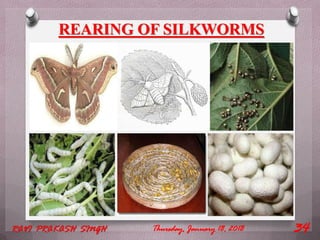
The female silk moth lays eggs. Eggs are stored
over a clean cloth or paper strips. The eggs are
warmed to a suitable temperature.
The eggs hatch into larvae called caterpillars or
silk worms.
The silkworms are kept in bamboo trays and feeds
on mulberry leaves and grows in size.
After 30 to 40 days the silk worms stop eating and
begins to spin cocoons.
Cocoons get hardened because of exposure to air.
Inside the cocoon the silk worm develops into silk
moth.
REARING OF SILKWORMS
Thursday, January 18, 2018RAVI PRAKASH SINGH 33
REARING OF SILKWORMS
Thursday, January 18, 2018RAVI PRAKASH SINGH 34
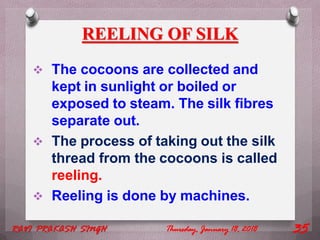
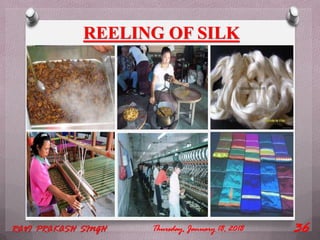
REELING OF SILK
 The cocoons are collected and
kept in sunlight or boiled or
exposed to steam. The silk fibres
separate out.
 The process of taking out the silk
thread from the cocoons is called
reeling.
 Reeling is done by machines.
Thursday, January 18, 2018RAVI PRAKASH SINGH 35
REELING OF SILK
Thursday, January 18, 2018RAVI PRAKASH SINGH 36
DYEING, SPINNING AND WEAVING
DYEING
The silk fibres are then dyed in
different coloured.
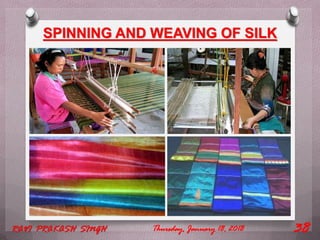
SPINNING AND WEAVING
The silk fibres are then spun into
threads and woven into different
types of silk cloth i.e. fiber.
Thursday, January 18, 2018RAVI PRAKASH SINGH 37
SPINNING AND WEAVING OF SILK
Thursday, January 18, 2018RAVI PRAKASH SINGH 38
USES OF SILK
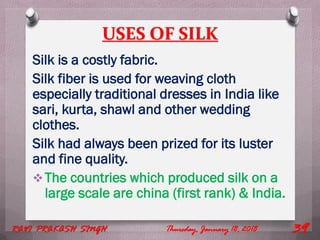
Silk is a costly fabric.
Silk fiber is used for weaving cloth
especially traditional dresses in India like
sari, kurta, shawl and other wedding
clothes.
Silk had always been prized for its luster
and fine quality.
The countries which produced silk on a
large scale are china (first rank) & India.
Thursday, January 18, 2018RAVI PRAKASH SINGH 39
PLANT FIBER
The common plant fibres are
Cotton, and Jute.
Cotton is obtained from
the flower of the cotton
plant.
Jute fiber is obtained from
the stem of the jute plant.
Thursday, January 18, 2018RAVI PRAKASH SINGH
4
CULTIVATION OF COTTON
Cotton is cultivated in black clayey soil. It needs warm
climate. The sowing of cotton crop is done in early spring.
Cotton plants are bushy and about 1-2 meters tall. The
plants start flowering in about 60 days and give whitish -
yellow flowers.
The flowers turn reddish in a few days. Flowers slowly
grow into spherical walnut-like structures. These are
called cotton ball.
Fibres of cotton grow on these seeds. After some time
green cotton balls turn brown.
At maturity, the cotton bolls burst open and the white
cotton fibre can be seen.
Thursday, January 18, 2018RAVI PRAKASH SINGH 41
PROCESSING OF COTTON
Ginning:
The cotton picked up from the plants has seeds in it. The
process of removing cotton seeds from pods is called
ginning.
Ginning was traditionally done by hand. Now-a-days,
machines are used in ginning.
Spinning:
The process of making yarn from fibre is called spinning.
The raw cotton is supplied to industry in the form of
bales.
Thursday, January 18, 2018RAVI PRAKASH SINGH 42
STEPS IN MAKING COTTON YARN
The raw cotton is loosened and cleaned;
to remove straw and dried leaves.
The cleaned cotton is then fed into a
machine.
The cotton fibre are combed, straightened
and converted into a rope like structure
called sliver.
The sliver of cotton fibre is converted into
yarn by spinning using machines.
Thursday, January 18, 2018RAVI PRAKASH SINGH 43
PROCESSING OF COTTON
WEAVING:
The process of arranging two sets of yarn together to make a
fabric is called weaving.
The big reels of yarn are called bobbins. These bobbins are
used for weaving the cloth.
Cloth is woven on looms. After that they bleached and dyed to
give a finish.
KNITTING:
Knitting can be done by hand and machine.
Just two yarns are used in knitting while more than two
yarns are used in weaving.
Sweater, socks, scarf and caps are knitted from the wool.
Thursday, January 18, 2018RAVI PRAKASH SINGH 44
COTTON IN INDIA
Cotton is cultivated mainly in
Maharashtra, Gujarat, Haryana, Punjab,
Rajasthan, Tamil Nadu and Madhya
Pradesh.
USES OF COTTON
Cotton is mostly used for making clothes
of various kinds.
Examples: towels, bed-sheet, curtains,
saris.
Thursday, January 18, 2018RAVI PRAKASH SINGH 45
Jute
 Jute fiber is obtained from the stem of the jute
plant. It is cultivated in rainy season.
 Jute fibre is pale- yellow in colour and 2to 3
meter long. Jute fibre is very strong. Jute fibre
has silky texture.
 Jute is grown in alluvial soil which is found
usually in the Delta Region of the Ganges and
Brahmaputra rivers.
 In India, jute is mainly grown in west Bengal,
Bihar and Assam.
 Jute plants are about 2.5 to 3.5 meter in
height.
 It bears yellow flowers in 3 to 4 months.
Thursday, January 18, 2018RAVI PRAKASH SINGH 46
JUTE
 Jute plants are usually cut at the flowering stage.
 A good quality fibre is obtained from plants which are
cut at the flowering stage.
 After falling of dry leaves bundles of dry plants are
kept in a pond for a few days.
 In this period the gummy skin rots out to separate
the fibre. This process is called RETTING.
 The jute fiber is obtained from the retted jute by
hand.
 Jute fibre is used mainly for making gunny bags,
shopping bags, ropes, carpets, curtains, etc.
Thursday, January 18, 2018RAVI PRAKASH SINGH 47
Synthetic Fibre
Synthetic fibre is quite strong, wrinkle-
resistant and quick drying.
These are used in making different
materials; like clothes, neck-ties, sails,
sweater, shawls, carpet and blankets.
They are also used in making boats,
skating boards etc.
Thursday, January 18, 2018RAVI PRAKASH SINGH 48
Thursday, January 18, 2018RAVI PRAKASH SINGH 49

Fibre to fabric class 7 fin al

  • 1.
    CHAPTER – 3 FIBRETO FABRIC CREATED BY – RAVI PRAKASH SINGH FOR CLASS – VIII SUBJECT – PHYSICS (SCIENCE) Thursday, January 18, 2018RAVI PRAKASH SINGH 1
  • 2.
    IMPORTANCE OF CLOTHES Following are the importance of clothes : 1) They protect from heat. 2) They protect from cold. 3) They make us look nice & decent(सभ्य). Thursday, January 18, 2018RAVI PRAKASH SINGH 2
  • 3.
    FIBRE A material whichis available in the form of thin and continuous strand is called FIBRE. There are two types of fibre, viz. 1) Natural fibre and 2) Man-made Fibre or Synthetic Fibre Thursday, January 18, 2018RAVI PRAKASH SINGH 3
  • 4.
    TYPES OF FIBRE: NATURALFIBERS The fibers which are obtained from plants and animals are called Natural Fibers. Examples: cotton, jute, silk, wool. MAN-MADE FIBERS The fibers that are synthesized in laboratory are called Man-made Fiber. Examples: Nylon, Acrylic, terrylene, terry- cotton Polyester etc. Thursday, January 18, 2018RAVI PRAKASH SINGH 4
  • 5.
    TYPES OF NATURALFIBRE: PLANT FIBRE: The fibers which are obtained from plants and animals are called Plant fibers. Examples: Cotton, jute and flex. ANIMAL FIBRE: The fibers which are obtained from plants and animals are called Animal fibers. Examples: Silk and wool. Thursday, January 18, 2018RAVI PRAKASH SINGH 5
  • 6.
    ANIMAL FIBRES Thursday, January18, 2018RAVI PRAKASH SINGH 6 The common animal fibers are wool and silk.  Wool is obtained from sheep, goat, yak, camel, llama, alpaca etc.  Silk is obtained from silk worm.
  • 7.
    SHEEP Thursday, January 18,2018RAVI PRAKASH SINGH 7
  • 8.
    GOAT Thursday, January 18,2018RAVI PRAKASH SINGH 8
  • 9.
    YAK Thursday, January 18,2018RAVI PRAKASH SINGH 9
  • 10.
    CAMEL Thursday, January 18,2018RAVI PRAKASH SINGH 10
  • 11.
    LLAMA Thursday, January 18,2018RAVI PRAKASH SINGH 11
  • 12.
    ALPACA Thursday, January 18,2018RAVI PRAKASH SINGH 12
  • 13.
    SILKWORM Thursday, January 18,2018RAVI PRAKASH SINGH 13
  • 14.
    WOOL  Wool isobtained from the fleece (hair) of sheep, goat, camel, yak, rabbit, llama, alpaca and other animals.  These animals have a thick coat of hair on their bodies because the hair traps air and air is a poor conductor of heat.  So thick layer of hair keeps their body warm and protects them from harsh cold.  For obtaining wool, animal are reared and then their hair is cut and processed into wool. Thursday, January 18, 2018RAVI PRAKASH SINGH 14
  • 15.
    Fleece and Woolbearing animals Fleece and Wool bearing animals like sheep, goat, camel, yak, etc. bear two types of hair – coarse hair and fine-soft under hair. Fine soft hair is found close to the skin in such animals. The fine soft under hair of animal like sheep goat etc. is called FLEECE. Animals having fine soft hair (fleece) on their body are called Wool Bearing Animals. Thursday, January 18, 2018RAVI PRAKASH SINGH 15
  • 16.
    ANIMAL WOOL  Manybreeds of sheep are found in India.  Sheep gives milk and meat; in addition to wool, but are reared mainly to obtain wool in different parts of the world. Sheep wool is most common wool.  Angora wool is obtained from Angora Goats of Jammu Kashmir is soft wool used for making shawls.  Angora Goats are found in hilly regions, such as Jammu and Kashmir.  Pashmina wool is obtained from Pashmina Goats.  Yak wool is obtained commonly in Tibet and Laddakh.  Alpaca and Llama found in South America also give wool.  Camel hair is also used as wool. Thursday, January 18, 2018RAVI PRAKASH SINGH 16
  • 17.
    REARING AND BREEDINGOF SHEEP  Sheep are reared in many parts our country like Jammu and Kashmir, Himachal Pradesh, Uttaranchal, Sikkim, Arunachal Pradesh, Haryana, Punjab, Rajasthan, Gujarat etc.  Sheep feed on grass and leaves. They are also fed with a mixture of pulses, corn, jowar, oilcakes and minerals.  In winter sheep are kept indoors and fed on leaves, grain and dry fodder.  Some breeds of sheep have thick hair on their body which yield good quality wool in large quantities. They are selectively bred to get sheep of good breed. Thursday, January 18, 2018RAVI PRAKASH SINGH 17
  • 18.
    PROCESSING OF WOOL Theprocessing of changing fleece into wool involves following six steps: 1) Shearing 2) Scouring 3) Sorting 4) Burrs separation 5) Dyeing 6) Spinning Thursday, January 18, 2018RAVI PRAKASH SINGH 18
  • 19.
    PROCESSING OF WOOL 1)The fleece (hair) of the sheep is removed from its body along with a thin layer of dead skin by using machines. The process of removal of the fleece from animal is called shearing. 2) The sheared skin with hair is washed in tanks to remove grease, dust and dirt. The process of washing the sheared wool in hot water followed by drying is called scouring. Thursday, January 18, 2018RAVI PRAKASH SINGH 19
  • 20.
    PROCESSING OF WOOL 3)The hairy skin is sent to a factory where hairs of different textures are separated. The process of separating hair of different textures from the fleece is called sorting. 4) Burrs separation: The small fluffy fibres called burrs are separated from the hairs and again washed and dried. 5) Dyeing: the natural hair of sheep is white, brown, black. The raw fibres are dyed in different colours. 6) Spinning: The raw fibres are then straightened, combed and rolled into yarn. They are then spun and woven into fabric. Thursday, January 18, 2018RAVI PRAKASH SINGH 20
  • 21.
    CUTTING OF WOOL Thursday,January 18, 2018RAVI PRAKASH SINGH 21
  • 22.
    YARN TYPES &ITS USES There Are Two Types Yarn: 1) LONG YARN 2) SHORTER YARN The long yarn threads are usually knitted to make sweaters, mufflers, caps, and socks. The shorter yarn threads are woven into fabrics. Thursday, January 18, 2018RAVI PRAKASH SINGH 22
  • 23.
    WOOL & YARN Thursday,January 18, 2018RAVI PRAKASH SINGH 23
  • 24.
    USES OF WOOL Woolis used for making warm clothes, such as sweater, cap, shawl, gloves, and blanket etc. Wool is also used in making carpets and upholstery Thursday, January 18, 2018RAVI PRAKASH SINGH 24
  • 25.
    SILK Silk fiber isobtained from the cocoons of the silkworms (silk moth). The silk moth lives on the leaves of mulberry plants. TYPES OF SILK Different types of silk worm produce different types of silk in terms of luster and texture. For example- tassar silk, mooga silk, kosa silk, etc. are produced by different types of silk moth. Mulberry silk is the most common silk moth. SERICULTURE The rearing of silkworms for obtaining silk is called sericulture. Thursday, January 18, 2018RAVI PRAKASH SINGH 25
  • 26.
    Male Female SILK MOTHS Thursday,January 18, 2018RAVI PRAKASH SINGH 26
  • 27.
    History of Silk: Silk was discovered in China; around 3500 BC. Silk became a prized possession because of its fine quality and luster.  Originally, it was used by emperors only. It was through trade that silk spread to other parts of the world  over a period of time. Silk was a staple item of trade during ancient times. Due to this, the ancient trade routes which linked China to other parts of the world are called ‘Silk Route’.  As per historians, silk was produced in India also. Proof of use of silk during the Indus Valley Civilization has also been found. Thursday, January 18, 2018RAVI PRAKASH SINGH 27
  • 28.
    LIFE CYCLE OFSILKWORM There are four stages in the life cycle of silk moth: eggs, larva, pupa and adult. Female silk moth → Lays eggs → After about 14 days eggs are hatched into larva (called caterpillars) → Grown into Pupa → Secretes fibers made of protein and weaves the fibres around itself completely → This covering is called cocoon. → Live in the cocoon for some time → After coming out of cocoon grows into silk moth. Thursday, January 18, 2018RAVI PRAKASH SINGH 28
  • 29.
    Adult silk moth LIFECYCLE OF SILK MOTH Thursday, January 18, 2018RAVI PRAKASH SINGH 29
  • 30.
    MULBERRY TREE Thursday, January18, 2018RAVI PRAKASH SINGH 30
  • 31.
    PROCESSING OF SILK Theprocess of obtaining silk from silk moth involves- 1) rearing of silkworms 2) reeling and 3) dyeing. This is followed by 4) spinning and weaving Thursday, January 18, 2018RAVI PRAKASH SINGH 31
  • 32.
    PROCESSING OF SILK Thursday,January 18, 2018RAVI PRAKASH SINGH 32
  • 33.
    The female silkmoth lays eggs. Eggs are stored over a clean cloth or paper strips. The eggs are warmed to a suitable temperature. The eggs hatch into larvae called caterpillars or silk worms. The silkworms are kept in bamboo trays and feeds on mulberry leaves and grows in size. After 30 to 40 days the silk worms stop eating and begins to spin cocoons. Cocoons get hardened because of exposure to air. Inside the cocoon the silk worm develops into silk moth. REARING OF SILKWORMS Thursday, January 18, 2018RAVI PRAKASH SINGH 33
  • 34.
    REARING OF SILKWORMS Thursday,January 18, 2018RAVI PRAKASH SINGH 34
  • 35.
    REELING OF SILK The cocoons are collected and kept in sunlight or boiled or exposed to steam. The silk fibres separate out.  The process of taking out the silk thread from the cocoons is called reeling.  Reeling is done by machines. Thursday, January 18, 2018RAVI PRAKASH SINGH 35
  • 36.
    REELING OF SILK Thursday,January 18, 2018RAVI PRAKASH SINGH 36
  • 37.
    DYEING, SPINNING ANDWEAVING DYEING The silk fibres are then dyed in different coloured. SPINNING AND WEAVING The silk fibres are then spun into threads and woven into different types of silk cloth i.e. fiber. Thursday, January 18, 2018RAVI PRAKASH SINGH 37
  • 38.
    SPINNING AND WEAVINGOF SILK Thursday, January 18, 2018RAVI PRAKASH SINGH 38
  • 39.
    USES OF SILK Silkis a costly fabric. Silk fiber is used for weaving cloth especially traditional dresses in India like sari, kurta, shawl and other wedding clothes. Silk had always been prized for its luster and fine quality. The countries which produced silk on a large scale are china (first rank) & India. Thursday, January 18, 2018RAVI PRAKASH SINGH 39
  • 40.
    PLANT FIBER The commonplant fibres are Cotton, and Jute. Cotton is obtained from the flower of the cotton plant. Jute fiber is obtained from the stem of the jute plant. Thursday, January 18, 2018RAVI PRAKASH SINGH 4
  • 41.
    CULTIVATION OF COTTON Cottonis cultivated in black clayey soil. It needs warm climate. The sowing of cotton crop is done in early spring. Cotton plants are bushy and about 1-2 meters tall. The plants start flowering in about 60 days and give whitish - yellow flowers. The flowers turn reddish in a few days. Flowers slowly grow into spherical walnut-like structures. These are called cotton ball. Fibres of cotton grow on these seeds. After some time green cotton balls turn brown. At maturity, the cotton bolls burst open and the white cotton fibre can be seen. Thursday, January 18, 2018RAVI PRAKASH SINGH 41
  • 42.
    PROCESSING OF COTTON Ginning: Thecotton picked up from the plants has seeds in it. The process of removing cotton seeds from pods is called ginning. Ginning was traditionally done by hand. Now-a-days, machines are used in ginning. Spinning: The process of making yarn from fibre is called spinning. The raw cotton is supplied to industry in the form of bales. Thursday, January 18, 2018RAVI PRAKASH SINGH 42
  • 43.
    STEPS IN MAKINGCOTTON YARN The raw cotton is loosened and cleaned; to remove straw and dried leaves. The cleaned cotton is then fed into a machine. The cotton fibre are combed, straightened and converted into a rope like structure called sliver. The sliver of cotton fibre is converted into yarn by spinning using machines. Thursday, January 18, 2018RAVI PRAKASH SINGH 43
  • 44.
    PROCESSING OF COTTON WEAVING: Theprocess of arranging two sets of yarn together to make a fabric is called weaving. The big reels of yarn are called bobbins. These bobbins are used for weaving the cloth. Cloth is woven on looms. After that they bleached and dyed to give a finish. KNITTING: Knitting can be done by hand and machine. Just two yarns are used in knitting while more than two yarns are used in weaving. Sweater, socks, scarf and caps are knitted from the wool. Thursday, January 18, 2018RAVI PRAKASH SINGH 44
  • 45.
    COTTON IN INDIA Cottonis cultivated mainly in Maharashtra, Gujarat, Haryana, Punjab, Rajasthan, Tamil Nadu and Madhya Pradesh. USES OF COTTON Cotton is mostly used for making clothes of various kinds. Examples: towels, bed-sheet, curtains, saris. Thursday, January 18, 2018RAVI PRAKASH SINGH 45
  • 46.
    Jute  Jute fiberis obtained from the stem of the jute plant. It is cultivated in rainy season.  Jute fibre is pale- yellow in colour and 2to 3 meter long. Jute fibre is very strong. Jute fibre has silky texture.  Jute is grown in alluvial soil which is found usually in the Delta Region of the Ganges and Brahmaputra rivers.  In India, jute is mainly grown in west Bengal, Bihar and Assam.  Jute plants are about 2.5 to 3.5 meter in height.  It bears yellow flowers in 3 to 4 months. Thursday, January 18, 2018RAVI PRAKASH SINGH 46
  • 47.
    JUTE  Jute plantsare usually cut at the flowering stage.  A good quality fibre is obtained from plants which are cut at the flowering stage.  After falling of dry leaves bundles of dry plants are kept in a pond for a few days.  In this period the gummy skin rots out to separate the fibre. This process is called RETTING.  The jute fiber is obtained from the retted jute by hand.  Jute fibre is used mainly for making gunny bags, shopping bags, ropes, carpets, curtains, etc. Thursday, January 18, 2018RAVI PRAKASH SINGH 47
  • 48.
    Synthetic Fibre Synthetic fibreis quite strong, wrinkle- resistant and quick drying. These are used in making different materials; like clothes, neck-ties, sails, sweater, shawls, carpet and blankets. They are also used in making boats, skating boards etc. Thursday, January 18, 2018RAVI PRAKASH SINGH 48
  • 49.
    Thursday, January 18,2018RAVI PRAKASH SINGH 49