CREATED BY – RAVI PRAKASH SINGH
FOR CLASS – VIII
SUBJECT – PHYSICS (SCIENCE)
Friday, December 29, 2017 1RAVI PRAKASH SINGH
STARS & SOLAR SYSTEM
Friday, December 29, 2017 RAVI PRAKASH SINGH 2
UNIVERSE (ब्रम्हांड)
The vast space (अंतरिक्ष) which includes
everything that exists on the earth & around
it is called UNIVERSE.
 The branch of science that deals with the
study of heavenly bodies is called
ASTRONMY (खगोऱ विज्ञहन).
 People who study about the universe are
called ASTRONOMERS (खगोऱविदों).
Friday, December 29, 2017 RAVI PRAKASH SINGH 3
UNIVERSE (ब्रम्हांड)
Friday, December 29, 2017 RAVI PRAKASH SINGH 4
CELESTIAL OBJECTS (खगोऱीय / आकहशीय िस्तु )
THE OBJECTS WHICH EXIST IN THE SKY ARE
CALLED CELESTIAL OBJECTS.
Example - Satellites (Moon), Planets, Asteroids,
comets, meteoroids, stars.
Friday, December 29, 2017 RAVI PRAKASH SINGH 5
SOLAR SYSTEM (सौर मांडऱ)
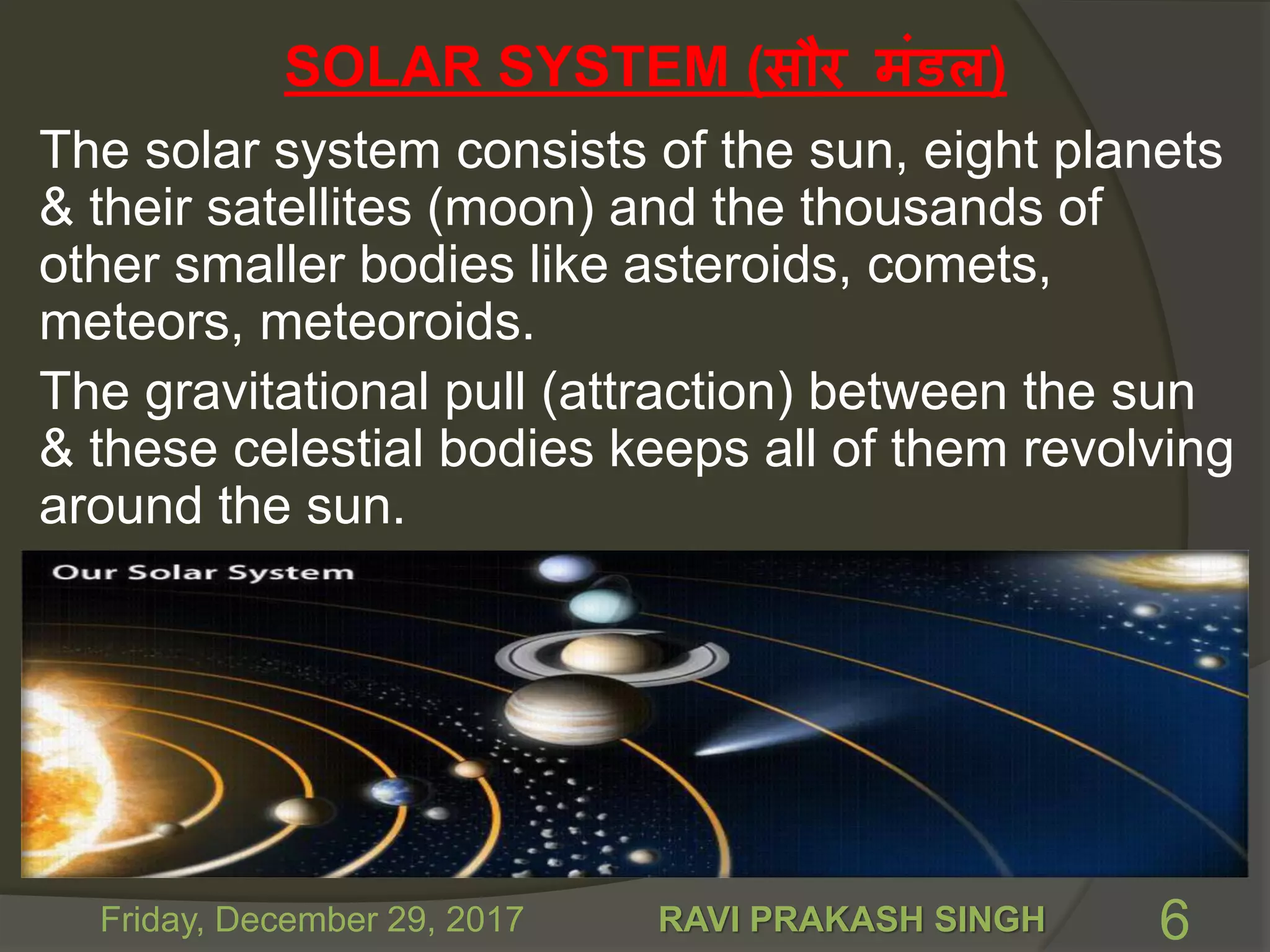
The solar system consists of the sun, eight planets
& their satellites (moon) and the thousands of
other smaller bodies like asteroids, comets,
meteors, meteoroids.
The gravitational pull (attraction) between the sun
& these celestial bodies keeps all of them revolving
around the sun.
Friday, December 29, 2017 RAVI PRAKASH SINGH 6
SOLAR SYSTEM (सौर मांडऱ)
Friday, December 29, 2017 RAVI PRAKASH SINGH 7
GALAXY (आकहशगांगह)
The group of millions or billions of stars, together with gas and dust, held
together by gravitational attraction is called galaxy.
 Galaxies are huge collections of stars, dust and gas.
 Galaxies are divided into three basic types, spirals, elliptical &
irregulars.
 Galaxies come in many different sizes, shapes and brightness and like
stars are found alone, in pairs or in larger groups called clusters.
 Our Galaxy Milky Way contains about 200 billion stars & countless other
objects.
 Our galaxy is called Spiral Galaxy because the stars of this galaxy spread
out from its centre like a spiral
Friday, December 29, 2017 RAVI PRAKASH SINGH 8
GALAXY (आकहशगांगह)
Friday, December 29, 2017 RAVI PRAKASH SINGH 9
Friday, December 29, 2017 RAVI PRAKASH SINGH 10
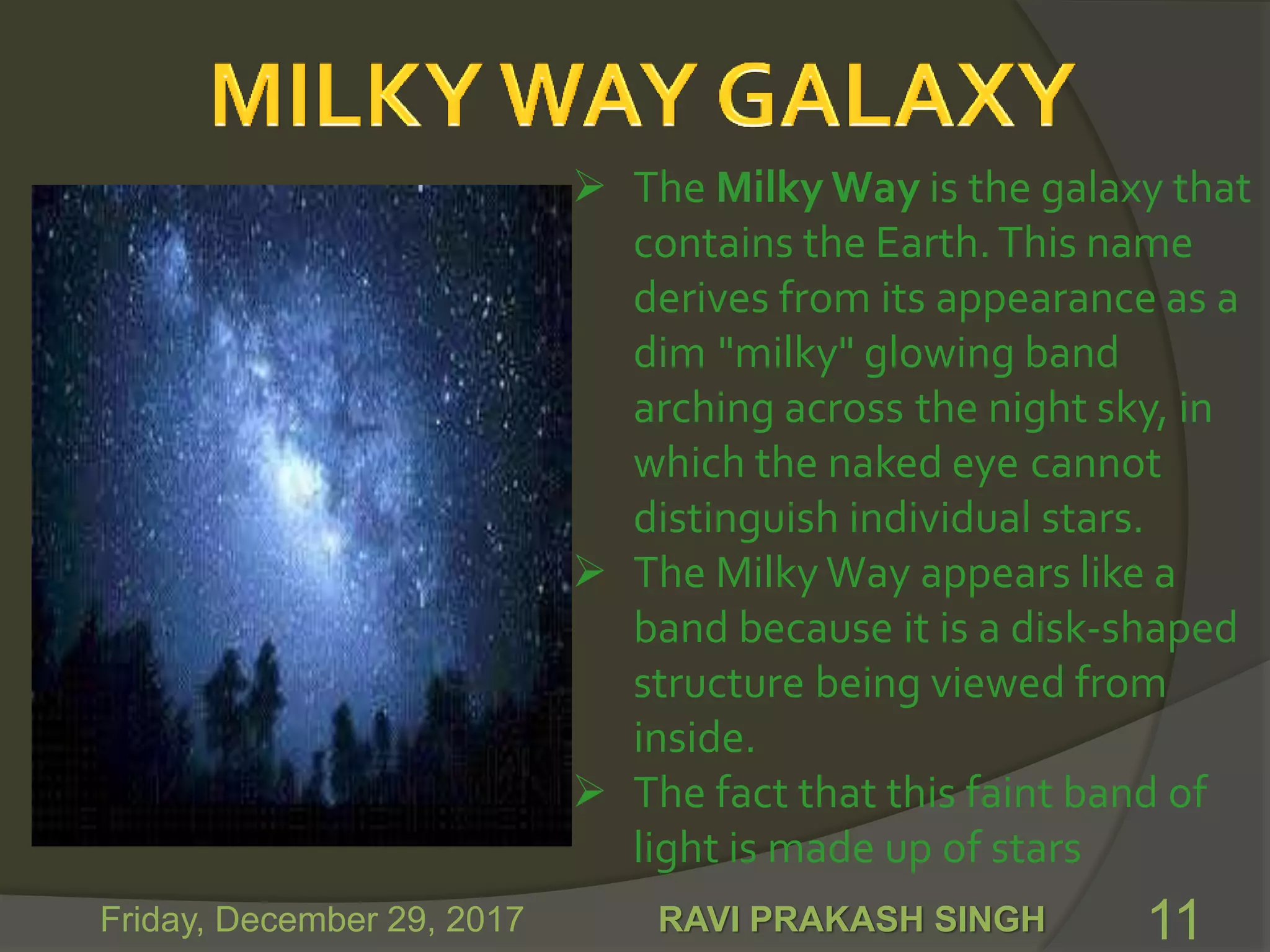
 The Milky Way is the galaxy that
contains the Earth.This name
derives from its appearance as a
dim "milky" glowing band
arching across the night sky, in
which the naked eye cannot
distinguish individual stars.
 The Milky Way appears like a
band because it is a disk-shaped
structure being viewed from
inside.
 The fact that this faint band of
light is made up of stars
Friday, December 29, 2017 RAVI PRAKASH SINGH 11
LIGHT YEARS (प्रकहश िर्ष)
Light Year is the distance covered by light in
one year.
Light year is the unit of astronomical distance.
ONE LIGHT YEAR = 9.46*1012 KM
The huge distances between the earth and other
celestial bodies are measured in light years.
After the sun the nearest star is “proxima centauri or
Alpha centuari”.
The distance between proxima centauri & Earth is
4.3 light years.
Friday, December 29, 2017 RAVI PRAKASH SINGH 12
ASTRONOMICAL UNIT (A.U.)
Astronomical unit (A.U.) is a unit for
measuring distance and sizes of
celestial objects.
 One A.U. is equal to the mean
distance between the earth & the sun
 i.e. 1 A.U. = 1.5 × 10¹¹ m
Friday, December 29, 2017 RAVI PRAKASH SINGH 13
SUN (सूरज)
THE SUN IS A STAR CONSISTS MOSTLY OF HYDROGEN
GAS WHICH IS EXTREMELY HOT.
 The sun is a major source of heat and light energy for all the
planets & their satellites in the solar system.
 The temperature of sun is 6000° k.
 Sunlight takes about 8 minutes to reach the earth.
 It has a diameter of about 1,392,684 km
Friday, December 29, 2017 RAVI PRAKASH SINGH 14
Named for: Messenger of the Roman gods
Diameter: 1.39 million kilometers
Volume: 1.41×10¹⁸
km3[8)
STARS(तहरह)
STARS are the celestial objects that are extremely
hot & have light of their own.
 The stars appear to be small because they are
very, very far away from us.
 SUN is the star which is nearest to the earth.
 Sun looks much bigger & brighter because it is
much nearer to us than any other star.
 The revolution of earth around the sun & its rotation
about its axis is the causes for four minutes earlier
rising of the same star after each day.
Friday, December 29, 2017 RAVI PRAKASH SINGH 15
STARS (तहरह)
Friday, December 29, 2017 RAVI PRAKASH SINGH 16
STARS(तहरह)
 The star appear to move from east to west due to rotation
of earth on its axis from west to east ,
 Hence, star which is appears to rise in the east in the
evening appear to set in the west in the early morning.
 Surface temperature of star determines colour of star.
 Stars with LOW temperature (coldest stars) appear RED.
 Stars with High temperature appear WHITE.
 Stars with very High temperature (hottest stars) appear
BLUE.
 SIRIUS is the brightest star in the night sky after sun.
Friday, December 29, 2017 RAVI PRAKASH SINGH 17
POLE STAR (ध्रुि तहरह)
THE STAR WHICH APPEARS
STATIONARY FROM THE
EARTH IS CALLED POLE STAR.
It is special star present in the
Northern hemisphere.
The pole star appears to be
stationary & does not change its
position with time because it lies
on the axis of rotation of the earth
It helps travellers to find direction
at night.
Friday, December 29, 2017 RAVI PRAKASH SINGH 18
PLANETS (ग्र्)
Planets are large celestial objects which revolve
around the sun in closed elliptical paths.
Planets revolve around the sun in definite elliptical
paths called orbits.
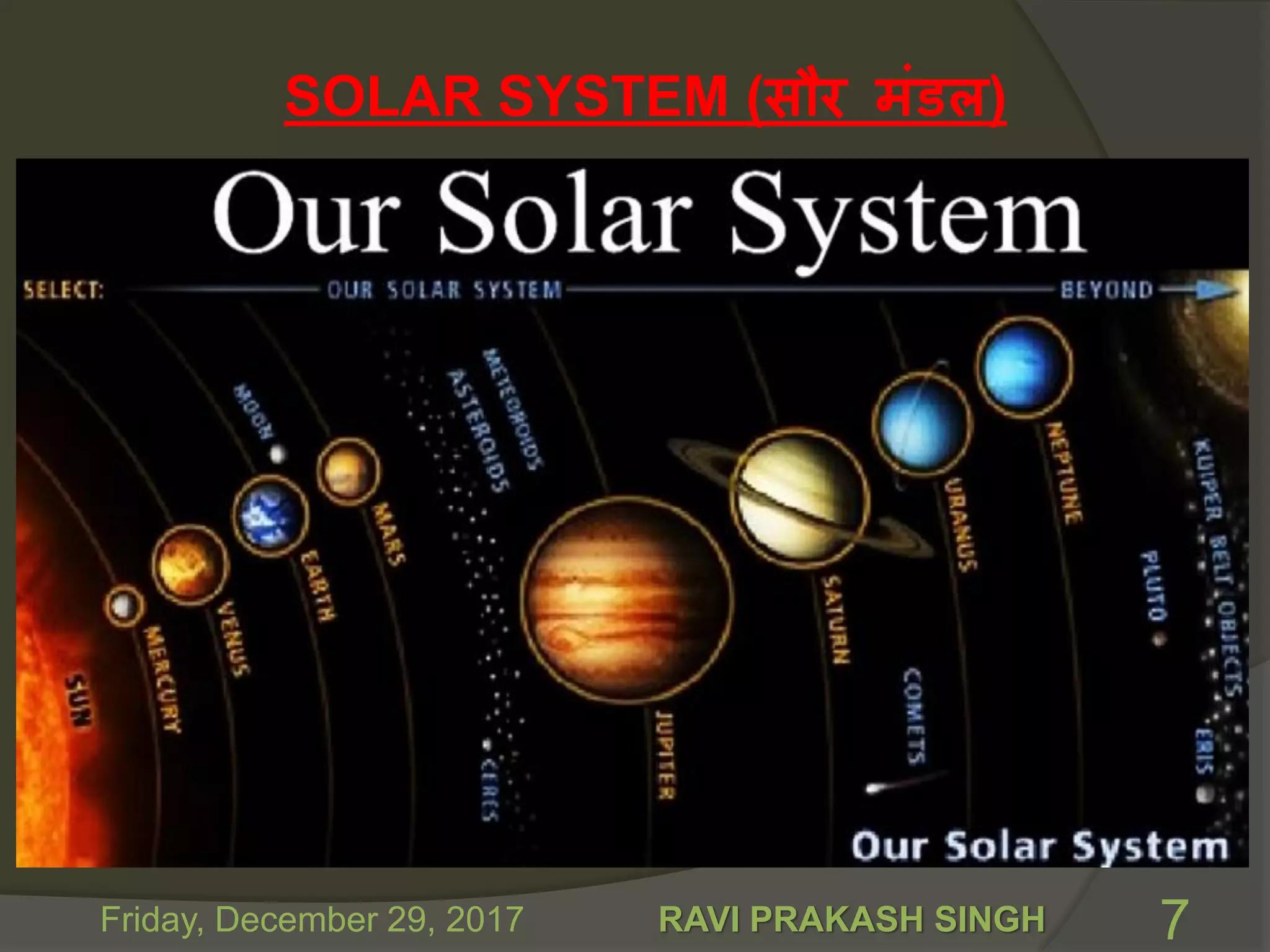
The 8 planets of solar system are:-
1) Mercury
2) Venus
3) Earth
4) Mars
5) Jupiter
6) Saturn
7) Uranus
8) Neptune
Friday, December 29, 2017 RAVI PRAKASH SINGH 19
PLANETS (ग्र्)
 A planet is made up of rock & metal or gas.
 Planets do not have their own light. so they
don't twinkle like the stars. Planets reflect
sunlight that is incident on them.
 All the planets revolve around the sun & also
rotate on its axis.
 A Day for a planet equals to time taken by it to
complete one rotation around its own axis.
 A Year for a planet equals to time taken by it to
complete one revolution around the sun in its orbit.
Friday, December 29, 2017 RAVI PRAKASH SINGH 20
PLANETS (ग्र्)
There are two main categories of planets
according to composition and size are
1) Small Rocky Planets or the Terrestrial
planets – they have solid & rocky surface
(Mercury, Venus, Earth, Mars)
2) Gas Giants or The Jovian planets – they
are very large in size & are made up largely of
gases (Jupiter, Saturn, Uranus, and Neptune)
Friday, December 29, 2017 RAVI PRAKASH SINGH 21
TERRESTRIAL PLANETS
 Mercury, Venus, Earth
and Mars
 Close to Sun
 Small masses, radii
 Rocky, solid surfaces
 High densities
 Slow rotation
 Weak magnetic field
 No rings
 Few moons
JOVIAN PLANETS
 Jupiter, Saturn, Uranus,
and Neptune
 Far from Sun
 Large masses and radii
 Gaseous surface
 Low densities
 Fast rotation
 Strong magnetic field
 Many rings
 Many moons
Friday, December 29, 2017 RAVI PRAKASH SINGH 22
INNER & OUTER PLANET
INNER PLANETS (आांतररक ग्र्)
A planet whose orbit lies within the asteroid belt is
called Inner planet.
Mercury, Venus, Earth and Mars are inner planets.
OUTER PLANETS (बह्री ग्र्)
A planet whose orbit lies outside the asteroid belt is
called Outer Planets.
Jupiter, Saturn, Uranus & Neptune are outer planets.
The outer planets have several moons and a system
of rings.
Friday, December 29, 2017 RAVI PRAKASH SINGH 23
PLANETS (ग्र्)
Friday, December 29, 2017 24RAVI PRAKASH SINGH
THE RELATIVE SIZE OF THE PLANETS IN THE SOLAR SYSTEM
Friday, December 29, 2017 RAVI PRAKASH SINGH 25
Smallest to Largest planets:
Mercury, Mars Venus, Earth, Neptune, Uranus,
Saturn, Jupiter
REVOLUTION (ऩररक्रमण) & ROTATION
PERIOD OF REVOLUTION
The time taken by a planet to complete one full
revolution around the sun is called its period of
revolution.
PERIOD OF ROTATION
The time taken by a planet to rotate a full 360
degrees on its axis is called its period of rotation.
AXIS OF ROTATION
The Axis Of Rotation is an imaginary line going
from the north pole to the south pole.
Friday, December 29, 2017 RAVI PRAKASH SINGH 26
Friday, December 29, 2017 RAVI PRAKASH SINGH 27
MERCURY (बुध)
 Mercury is the First planet from the sun.
 Mercury is the smallest planet in the solar system as well as the
closest to the sun.
 It takes about 88 earth days to complete one revolution around
the sun.
 MercuryisTerrestrial Planet
 Lots of craters like the moon
 Hot during day and cold at night
 Mercury has no moon.
 It is yellowish orange in colour.
 It is called morning or evening star because it is occasionally
visible just before sunrise or just after sunset .
 Temperature : -173 to 427 degree Celsius.
 mercury shows phases like moon.
Friday, December 29, 2017 RAVI PRAKASH SINGH 28
Named for: Messenger of the Roman gods
Diameter: 3,031 miles (4,878 km)
Orbit: 88 Earth days
Day: 58.6 Earth days
Friday, December 29, 2017 RAVI PRAKASH SINGH 29
VENUS (शुक्र)
 Venus is the Second planet from the sun
 It completes one revolution around the sun in 225 days.
 It has no moons.
 Venus rotates from east to west (opposite direction).
 Terrestrial planet.
 Venus is the closest planet to the earth (Earth’s sister planet).
 It is the Brightest Objects seen in the night sky.
 It is also called as shining planet.
 It is also called morning or evening star because it is usually visible only during
these times.
 It is silver blue in colour and is hot planet.
 1 year – 225 Earth days.
 Temperature – 462 degree Celsius.
 It appears as morning star in eastern horizon and as a evening star in western sky
(horizon).
 Venus is hotter than Mercury because it has high carbon dioxide in its atmosphere.
 Venus also shows phases like moon.
Friday, December 29, 2017 RAVI PRAKASH SINGH 30
Named for: Roman goddess of love and beauty
Diameter: 7,521 miles (12,104 km)
Orbit: 225 Earth days
Day: 241 Earth days
Friday, December 29, 2017 RAVI PRAKASH SINGH 31
Friday, December 29, 2017 RAVI PRAKASH SINGH 32
EARTH (ऩृथ्िी)
 Earth is the Third planet from the sun
 It is the only planet that supports life in our Solar System.
 It takes 365 days & 6hrs for the earth to complete one
revolution around the sun.
 The earth takes 24 hrs. to complete one rotation
 Earth has one moon
 The portion of the earth facing the sun at any time has DAY.
 The portion of the earth facing away the sun at any time has
NIGHT
 71% of the Earth’s crust is covered with water
 Terrestrial planet.
 Consists of oceans, continents, atmosphere.
 Temperature : -87 to 57 degree Celsius.
Friday, December 29, 2017 RAVI PRAKASH SINGH 33
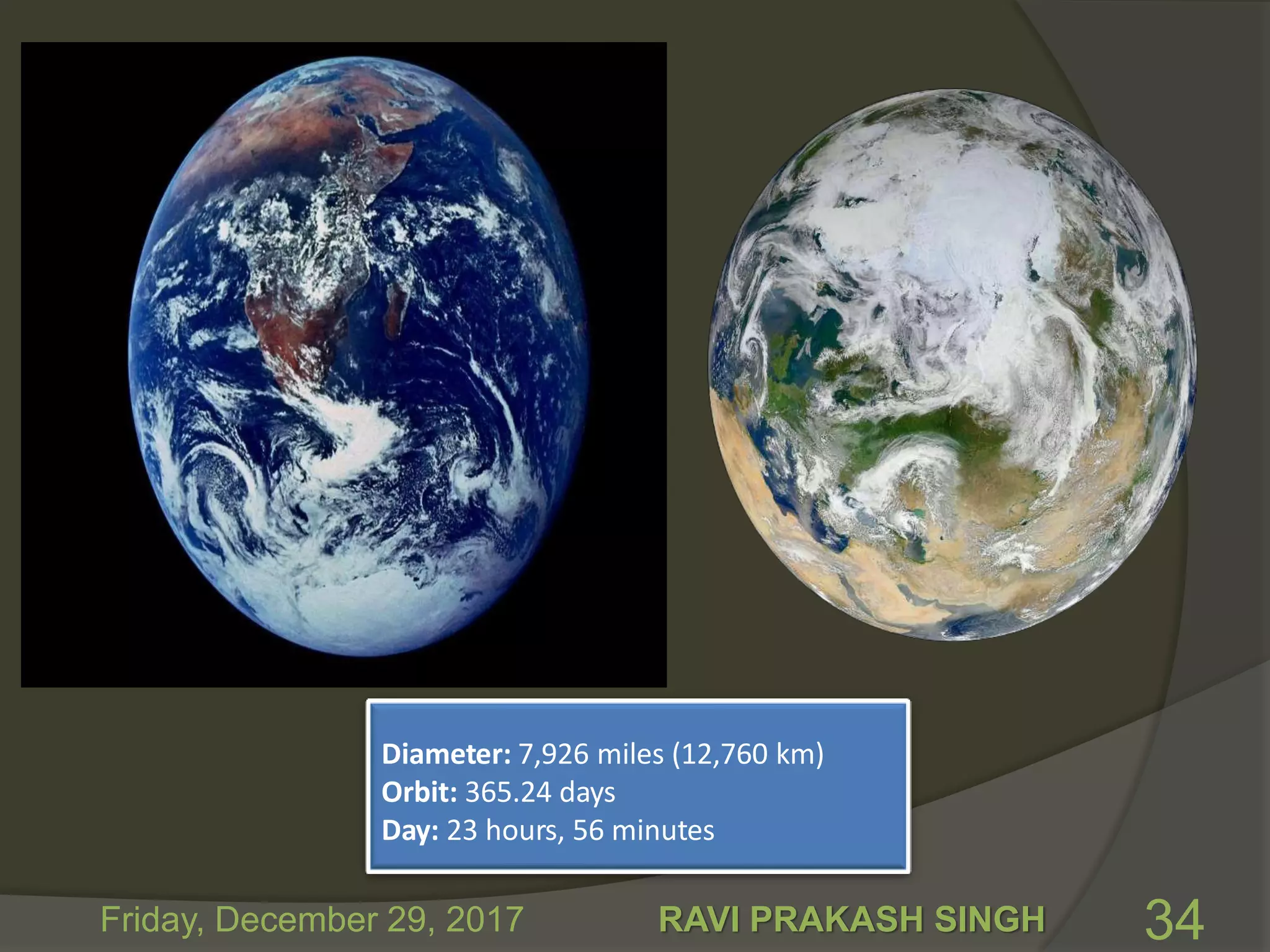
Diameter: 7,926 miles (12,760 km)
Orbit: 365.24 days
Day: 23 hours, 56 minutes
Friday, December 29, 2017 RAVI PRAKASH SINGH 34
HOW LIFE IS POSSIBLE ON EARTH
1) The Earth has an atmosphere (which contains many
gases including oxygen & carbon dioxide).
2) The Earth has large quantities of water on its surface.
3) The Earth has a suitable temperature range.
4) The Earth has a protective layer of ozone.
 Earth’s axis is not perpendicular to the plane of its orbit
but titled at an angle of 23.5 degree.
 When the earth’s northern hemisphere is tilted towards
the sun, it is summer in the northern hemisphere, while it
is winter in the southern hemisphere
 The reversed happens when the northern hemisphere is
tilted away from the sun.
 Autumn & spring occur when the earth is between these
two extreme positions in its orbit
Friday, December 29, 2017 RAVI PRAKASH SINGH 35
ROTATION & REVOLUTION OF EARTH
 The earth rotates (or spins) on an imaginary axis
which passes through its north & south poles.
 The axis of rotation of earth is slightly tilted with
respect to the plane of its orbit around the sun.
 An important consequence of the rotation of the
earth on its axis is that it causes day & night on
the earth.
 An important consequence of the motion of tilted
earth around the sun is that it causes different
seasons on the earth(such as SUMMER,
WINTER, SPRING, AUTUMN etc.)
Friday, December 29, 2017 RAVI PRAKASH SINGH 36
MARS (मांगऱ)
 Mars is the Fourth planet from the sun
 Mars completes one revolution around the sun in about 687 days.
 Mars is Called the Red planet because its surface appears to be
red.
 Mars has 2 moons named PHOBOS & DEIMOS.
 It is a small sized planet, half as diameter of Earth
 Mars is well visible to the naked eye
 Terrestrial planet.
 Mars is rocky, dusty and dry.
 Mars has polar ice-caps like Earth.
 1 year – 687 Earth days.
 1 day – 24 Earth hours, 37 mins.
 Temperature : -214 to -5 degree Celsius.
Friday, December 29, 2017 RAVI PRAKASH SINGH 37
Named for: Roman god of war
Diameter: 4,217 miles (6,787 km)
Orbit: 687 Earth days
Day: Just more than one Earth day (24 hours, 37 minutes)
Friday, December 29, 2017 RAVI PRAKASH SINGH 38
Has surface
covered with
craters and
mountains.
Temperatures
ranging from -
120 degree C
to 25 degree C.
Has a very
thin atmosphere .
Is seen as a
reddish object in
the sky .
Is seen as a
reddish object in
the sky
Mars has approximately half
the diameter of Earth.
Friday, December 29, 2017 RAVI PRAKASH SINGH 39
JUPITER (बृ्स्ऩतत)
 Jupiter is the Fifth planet from the sun
 Jupiter is the largest planet in the solar system.
 Jupiter is made mainly of hydrogen & helium
 Jupiter has about 63 known moons!!!
 Jupiter's four larger moons are called Io, Europa, Callisto and
Ganymede.
 Gas planet (Windy clouds of Ammonia and Water)
 It Has a red spot (it is actually a giant storm that has been raging for
years..
 1 year – 4331 Earth days (12 Earth years)
 1 day – 9 Earth hours, 56 mins.
 Temperature is -148 degree Celsius.
 It rotates the fastest among all planets.
 Jupiter is the vacuum cleaner of the solar system for it sucks in
comets, asteroids and meteoroids which could be of hazard for Earth.
Friday, December 29, 2017 RAVI PRAKASH SINGH 40
Named for: Ruler of the Roman gods
Diameter: 86,881 miles (139,822 km)
Orbit: 11.9 Earth years
Day: 9.8 Earth hours
Friday, December 29, 2017 RAVI PRAKASH SINGH 41
GREAT RED
SPOT
SATURN (शतन)
 Saturn is the Sixth planet from the sun
 Saturn is the second biggest planet in solar system.
 Saturn is also is made mainly of hydrogen & helium
 The most distinguishing feature of Saturn is well-developed
system of colourful rings around it
 There are 31 moons orbiting Saturn
 The largest moons of Saturn is TITAN.
 The rings around Saturn are made up of frozen gases, water ice
and rock.
 So the rings are not solid bands around the planet.
 7 flat rings made of Ice, Rocks and Dust.
 1 year – 10759 Earth days (29 Earth years)
 1 day – 10 Earth hours, 39 mins.
 Temperature : -178 degree Celsius.
Friday, December 29, 2017 RAVI PRAKASH SINGH 42
Named for: Roman god of agriculture
Diameter: 74,900 miles (120,500 km)
Orbit: 29.5 Earth years
Day: About 10.5 Earth hours
Friday, December 29, 2017 RAVI PRAKASH SINGH 43
RING OF SATURN
Friday, December 29, 2017 RAVI PRAKASH SINGH 44
URANUS (अरुण)
 Uranus is the Seventh planet from the sun
 Uranus is the second coldest planet.
 Like Saturn, Uranus has a system of rings
 Saturn has at least 27 moons – largest are
Oberon and Titania
 It is medium sized planet of the Solar System
 Uranus is made up of hydrogen & helium
 Gas planet and windy.
 1 year – 30687 Earth days (84 Earth years)
 1 day – 17 Earth hours, 15 mins
 Temperature : - 216 degrees Celsius
Friday, December 29, 2017 RAVI PRAKASH SINGH 45
Friday, December 29, 2017 RAVI PRAKASH SINGH 46
Named for: Personification of heaven in ancient myth
Diameter: 31,763 miles (51,120 km)
Orbit: 84 Earth years
Day: 18 Earth hours
27
Is 7th planet of
our solar system.
Is 2,870,972,200
km away from
sun
Has 27 moons
Has 13 rings
around it
Is made of - water, rocks,
methane, and ammonia
ices.
Takes 10.14 hrs to
rotate once on its
own axis
Takes 84 years for
one revolution
around the sun.
God of heavens
Friday, December 29, 2017 RAVI PRAKASH SINGH 47
NEPTUNE (िरूण)
 Neptune is the Eight planet from the sun
 It is quite far away but still can be spotted with small
telescopes
 Neptune has four rings.
 Gas planet – icy.
 Windiest planet in the Solar System.
 It has at least 13 moons & largest is Triton
 Neptune is coldest planet.
 1 year – 60190 Earth days (165 Earth years)
 Gas planet – icy.
 1 day – 16 Earth hours, 7 mins.
 Temperature - -214 degrees Celsius
Friday, December 29, 2017 RAVI PRAKASH SINGH 48
Named for: Roman god of water
Diameter: 30,775 miles (49,530 km)
Orbit: 165 Earth years
Day: 19 Earth hours
Friday, December 29, 2017 RAVI PRAKASH SINGH 49
Is 8th planet of our solar
system.
Has 13 moons
dark spot
The god of the sea
Takes 14 hours for
one rotation on its
own axis.
Takes 165 years
for one
revolution
around sun.
Is at the distance of
4,498,252,900 km from
the sun
Has atmosphere
made of-
hydrogen, helium,
and methane.
Friday, December 29, 2017 RAVI PRAKASH SINGH 50
MOON (चहांद, चांद्रमह, शशश)
The moon is a natural satellite of the earth, and it
reflects the sunlight incident on it.
The surface of the moon is dusty and full of crater
If the moon is observed closely, we find craters,
depressions on the surface of the moon, which
might have been formed by the collision of some
heavenly body like a meteorite with the moon.
Friday, December 29, 2017 RAVI PRAKASH SINGH 52
MOON (चहांद)
Friday, December 29, 2017 53RAVI PRAKASH SINGH
PHASE OF MOON
Friday, December 29, 2017 RAVI PRAKASH SINGH 54
The different shapes of the disc of the moon observed
during a month are called the phases of the moon.
MOON
 IT TAKES 29.5 DAYS FOR MOON TO ROTATE THE EARTH.
 THE SURFACE OF THE MOON IS COVERED WITH HARD &
LOOSE DIRT,CRATERS & MOUNTAINS.
 SINCE THERE IS NO AIR & WATER, LIFE IS IMPOSSIBLE ON
MOON’S SURFACE.
Friday, December 29, 2017 RAVI PRAKASH SINGH 55
FORMATION OF THE PHASES
 Due to its revolution around the earth, when it is at
different positions in its path, the apparent disc of the
moon changes, which gives rise to its phases.
 When the moon is between the sun and the earth, the
illuminated portion of the moon is away from the
earth, and we are not able to see the moon. We call
this day as the 'new moon day'.
 With time, the position of the moon changes and the
illuminated portion of the moon exposed to the earth
gradually increases. Thus, the size of the apparent
disc of the moon increases gradually from a crescent
to a full round when the earth lies between the moon
and the sun. We call this day the 'full moon day'.
Friday, December 29, 2017 RAVI PRAKASH SINGH 56
PHASES OF MOON & MOON’S LIGHT
 We are able to see the moon because the sunlight falling on
the moon reflected towards the earth.
 The day on which the moon is not visible is called the “NEW
MOON DAY”.
 The day on which the whole bright disc of moon is visible to
us is called the “FULL MOON DAY”.
 We have one new moon & one full moon day during a
month.
 As moon revolves around the earth once every month &
moves around the sun along with earth, different amounts of
its sun-lit surface are turned towards the earth leading to
change in the appearance of moon & formation of phases of
the moon.
Friday, December 29, 2017 RAVI PRAKASH SINGH 57
 As seen from the Earth, a solar
eclipse occurs when the Moon
passes between the Sun and
Earth, and the Moon fully or
partially blocks the Sun.
 This can happen only at new
moon, when the Sun and the
Moon are in conjunction as seen
from Earth.
 In a total eclipse, the disk of the
Sun is fully obscured by the
Moon.
 In partial and annular
eclipses only part of the Sun is
obscured.
Friday, December 29, 2017 RAVI PRAKASH SINGH 58
 A lunar eclipse occurs when the Moon
passes directly behind the Earth into its
umbra.
 This can occur only when the Sun, Earth, and
Moon are aligned exactly, or very closely so,
with the Earth in the middle.
 Hence, a lunar eclipse can only occur the night
of a full moon.The type and length of an
eclipse depend upon the Moon's location
relative to its orbital nodes.
 Unlike a solar eclipse, which can only be
viewed from a certain relatively small area of
the world, a lunar eclipse may be viewed from
anywhere on the night side of the Earth.
 A lunar eclipse lasts for a few hours, whereas a
total solar eclipse lasts for only a few minutes
at any given place, due to the smaller size of
the moon's shadow.Also unlike solar eclipses,
lunar eclipses are safe to view without any eye
protection or special precautions, as they are
no brighter than the full moon itself.
Friday, December 29, 2017 RAVI PRAKASH SINGH 59
CONSTELLATION
A group of stars that has a recognisable shape is
called constellation.
 Earth rotates on its axis, this makes most constellations
appear to rise in the east and set in the west during the
night.
 Major constellations are the Ursa Major, Ursa Minor
and Cassiopeia.
Friday, December 29, 2017 RAVI PRAKASH SINGH 60
Friday, December 29, 2017 RAVI PRAKASH SINGH 61
URSA MAJOR (सप्तवर्षमांडऱ)
 The Ursa major constellation consists of
seven bright stars arranged in a
pattern resembling like big bear. So it
is known as the BIG BEAR.
 The Ursa major constellation is visible
during the summer season.
 The Ursa Major is shaped like a ladle
(चमचा) and is called as the BIG
DIPPER (कल्छु ऱ).
 It consists of seven stars placed in the
form of a dipper.
 In India, it is popularly called the
SAPTARSHI.
Friday, December 29, 2017 RAVI PRAKASH SINGH 62
URSA MAJOR
Friday, December 29, 2017 RAVI PRAKASH SINGH 63
URSA MINOR
 Ursa Minor also known as the
LITTLE BEAR, is a constellation in
the Northern Sky.
 Like the Great Bear, the tail of the
Little Bear look like the handle of a
ladle.
 The brightest stars form a shape that
is also known as the LITTLE
DIPPER.
 It contains the north celestial pole
and the polar star Polaris
 It was one of the 48 constellations.
Friday, December 29, 2017 RAVI PRAKASH SINGH 64
ORION
 Another popular
constellation is the Orion,
which is shaped in the form
of a hunter.
 Three middle stars in the
Orion lead to a brighter star
in the sky, called Sirius.
 The Orion constellation is
visible to us in the sky during
Winter Season.
Friday, December 29, 2017 RAVI PRAKASH SINGH 65
CASSIOPEIA
 The Cassiopeia constellation is
thought represent Queen seated
on chair.
 Cassiopeia is another prominent
constellation in the Northern sky.
 It is visible during Winter in the
early part of night.
 It looks like a distorted letter W or
M.
 Cassiopeia constellation consists
of 5 main stars.
Friday, December 29, 2017 RAVI PRAKASH SINGH 66
Other Members of Solar System
 Apart from the sun and the planets,
the solar system also consists of
celestial bodies such as meteors,
comets and artificial satellites.
 Meteoroids are much smaller than
Asteroids & comets
Friday, December 29, 2017 RAVI PRAKASH SINGH 67
METEOR (उल्कह)
A meteor is made up of debris (मलबा, कचिा,
टूटे हुए टुकडे).
 A meteor enters the Earth's atmosphere at
a very high speed. The friction with the
atmosphere makes the meteor hot and it
burns till it disintegrates.
 As meteor falls to the ground, it glows
brightly. This is why it is called a shooting
star.
Friday, December 29, 2017 RAVI PRAKASH SINGH 68
METEOR
Friday, December 29, 2017 RAVI PRAKASH SINGH 69
METEOROID
METEORITES (उल्कहवऩांड/ टूटह ्ुआ तहरह)
A meteor which does not burn up completely on
entering the earth’s atmosphere & lands on earth
is known as a meteorite.
 Some meteors reach the ground before they
burn completely and evaporate. These are
called Meteorites.
 More than 90 percent of meteorites are of
rock, while the remainder consist wholly or
partly of iron and nickel
Friday, December 29, 2017 RAVI PRAKASH SINGH 70
ASTEROIDS (क्षुद्र ग्र्)
Asteroids are the small celestial
objects which revolve around the
sun in the gap between the orbits
of mars & Jupiter.
 This gap is called the asteroid
belt.
 Asteroids are also called minor
planets.
 Asteroids are made of Rubble
(मलवा, िोड़ी, पत्थि के टुकडे).
Friday, December 29, 2017 RAVI PRAKASH SINGH 71
ASTEROIDS (क्षुद्र ग्र्)
Friday, December 29, 2017 RAVI PRAKASH SINGH 72
ASTEROIDS BELTS
Friday, December 29, 2017 RAVI PRAKASH SINGH 73
Friday, December 29, 2017 RAVI PRAKASH SINGH 74
COMETS (धूमके तु)
Comets is a celestial object consisting of
a nucleus of ice and dust and, when near
the sun, a “tail” of gas and dust particles
pointing away from the sun.
 Comets contain dust, ice, carbon
dioxide, ammonia, methane and more.
 scientists to call them snowy dirtballs.
 Icy nucleus, which evaporates and gets
blown into space by solar wind pressure
 The best known periodic comet is the
Halley's comet. It appear after every
76 years. (seen in 1986- expected to
seen in 2062).
Friday, December 29, 2017 RAVI PRAKASH SINGH 75
Comets
Dirty snowballs - dust and rock in methane, ammonia and ice
All light is reflected from the Sun - the comet makes no light of its own
The nucleus is a few km in diameter
Friday, December 29, 2017 RAVI PRAKASH SINGH 76
Halley’s Comet in 1986
Friday, December 29, 2017 RAVI PRAKASH SINGH 78
NATURAL SATELLITES
Satellite is a celestial bodies like moon that
revolves around that revolves around a
planet.
 Moon is the natural satellite of the earth.
 The satellites revolve around the planets due to
the gravitational pull of the planets.
 The satellites have no light of their own, they
reflect sunlight.
 Mercury & Venus does not have satellites.
Friday, December 29, 2017 RAVI PRAKASH SINGH 80
ARTIFICIAL SATELLITES
Man made objects which revolves around planet is
called Artificial satellites.
 They are much closer than moon
 It transmit radio, telephone, television signal.
 It helps us in sending back information for weather
forecasting (giving advance warning of floods,
cyclones etc.),
 It helps us in military surveillance (निगिाि़ी)
 They are used for surveying the natural resources of
the earth.
 They are used to collect in formation about other
planets ,stars & galaxies, etc.
Friday, December 29, 2017 RAVI PRAKASH SINGH 82
Aryabhatta
Bhaskara - 1
Friday, December 29, 2017 RAVI PRAKASH SINGH 83
Bhaskara - 2
Ariane Passenger
Friday, December 29, 2017 RAVI PRAKASH SINGH 84
INDIANSATELLITES & OTHERS
 Indian space research organisms
(ISRO) is incharge of Indian
satellites.
 The first satellite made in India,
Arybhatta was launched in 1975 by
a soviet rocket.
 The world's first artificial satellite,
the Sputnik 1, was launched by the
Soviet Union in 1957.
Friday, December 29, 2017 RAVI PRAKASH SINGH 85
GEOSTATIONARY SATELLITE
A geostationary satellite is an earth-orbiting
satellite, placed at an altitude of approximately
35,800 kilometers (22,300 miles) directly over
the equator, that revolves in the same direction
the earth rotates (west to east).
The time period of revolution of geostationary
satellite around earth is equal to the time period
of rotation of earth on its axis i.e. 24 hours.
These satellite stay in same relative position
to the earth surface. So, broadcasting station
does not lose contact with receiver
Friday, December 29, 2017 RAVI PRAKASH SINGH 86
GEOSYNCHRONOUS SATELLITE
A geosynchronous satellite is
a satellite in
geosynchronous orbit, with an
orbital period the same as the
Earth's rotation period.
Such a satellite returns to the
same position in the sky after
each sidereal day, and over the
course of a day traces out a path
in the sky that is typically some
form of analemma
Friday, December 29, 2017 RAVI PRAKASH SINGH 87
A black hole is a place in
space where gravity pulls so
much that even light can
not get out.
The gravity is so strong
because matter has been
squeezed into a tiny space.
This can happen when a
star is dying. Because no
light can get out, people
can't see black holes. They
are invisible.
Black hole
Friday, December 29, 2017 RAVI PRAKASH SINGH 88
Nebula
a cloud of gas and
dust in outer space,
visible in the night
sky either as an
indistinct bright
patch or as a dark
silhouette against
other luminous
matter.
Friday, December 29, 2017 RAVI PRAKASH SINGH 90
When a star like the Sun dies,
it casts its outer layers into
space, leaving its hot, dense
core to cool over the eons. But
some other types of stars
expire with titanic explosions,
called supernovae.
A supernova can shine as
brightly as an entire galaxy of
billions of "normal" stars. Some
of these explosions completely
destroy the star, while others
leave behind either a super-
dense neutron star or a black
hole
The death of the star
Friday, December 29, 2017 RAVI PRAKASH SINGH 91
Kuiper belt, is a region of the Solar System
beyond the planets, extending from the orbit of
Neptune (at 30AU) to approximately 50AU from
the Sun.
It is similar to the asteroid belt, although it is far
larger—20 times as wide and 20 to 200 times as
massive.
Like the asteroid belt, it consists mainly of small
bodies, or remnants from the Solar System's
formation.
While most asteroids are composed primarily of
rock and metal, Kuiper belt objects are composed
largely of frozen volatiles (termed "ices"), such as
methane, ammonia and water.
The classical belt is home to at least three dwarf
planets: Pluto, Haumea, and Makemake.
Friday, December 29, 2017 RAVI PRAKASH SINGH 92
 Asteroids are a class of small Solar System bodies
in orbit around the Sun.
 They have also been called planetoids, especially
the larger ones.
 These terms have historically been applied to any
astronomical object orbiting the Sun that did not
show the disk of a planet and was not observed to
have the characteristics of an active comet, but as
small objects in the outer Solar System were
discovered, their volatile-based surfaces were
found to more closely resemble comets, and so
were often distinguished from traditional
asteroids.
 Thus the term asteroid has come increasingly to
refer specifically to the small bodies of the inner
Solar System out to the orbit of Jupiter, which are
usually rocky or metallic.
Friday, December 29, 2017 RAVI PRAKASH SINGH 93
Friday, December 29, 2017 RAVI PRAKASH SINGH 94
A star is a massive, luminous sphere of plasma
held together by gravity.
The nearest star to Earth is the Sun, which is the
source of most of the energy on the planet.
Other stars are visible from Earth during the
night when they are not obscured by
atmospheric phenomena, appearing as a
multitude of fixed luminous points because of
their immense distance.
Historically, the most prominent stars on the
celestial
sphere were grouped together into
constellations and asterisms, and the brightest
stars gained proper names.
Extensive catalogues of stars have been
assembled by astronomers, which provide
standardized star designations.
Friday, December 29, 2017 RAVI PRAKASH SINGH 95
Friday, December 29, 2017 RAVI PRAKASH SINGH 96
Friday, December 29, 2017RAVI PRAKASH SINGH 97

Our universe (stars & solar system) class 8

  • 1.
    CREATED BY –RAVI PRAKASH SINGH FOR CLASS – VIII SUBJECT – PHYSICS (SCIENCE) Friday, December 29, 2017 1RAVI PRAKASH SINGH
  • 2.
    STARS & SOLARSYSTEM Friday, December 29, 2017 RAVI PRAKASH SINGH 2
  • 3.
    UNIVERSE (ब्रम्हांड) The vastspace (अंतरिक्ष) which includes everything that exists on the earth & around it is called UNIVERSE.  The branch of science that deals with the study of heavenly bodies is called ASTRONMY (खगोऱ विज्ञहन).  People who study about the universe are called ASTRONOMERS (खगोऱविदों). Friday, December 29, 2017 RAVI PRAKASH SINGH 3
  • 4.
  • 5.
    CELESTIAL OBJECTS (खगोऱीय/ आकहशीय िस्तु ) THE OBJECTS WHICH EXIST IN THE SKY ARE CALLED CELESTIAL OBJECTS. Example - Satellites (Moon), Planets, Asteroids, comets, meteoroids, stars. Friday, December 29, 2017 RAVI PRAKASH SINGH 5
  • 6.
    SOLAR SYSTEM (सौरमांडऱ) The solar system consists of the sun, eight planets & their satellites (moon) and the thousands of other smaller bodies like asteroids, comets, meteors, meteoroids. The gravitational pull (attraction) between the sun & these celestial bodies keeps all of them revolving around the sun. Friday, December 29, 2017 RAVI PRAKASH SINGH 6
  • 7.
    SOLAR SYSTEM (सौरमांडऱ) Friday, December 29, 2017 RAVI PRAKASH SINGH 7
  • 8.
    GALAXY (आकहशगांगह) The groupof millions or billions of stars, together with gas and dust, held together by gravitational attraction is called galaxy.  Galaxies are huge collections of stars, dust and gas.  Galaxies are divided into three basic types, spirals, elliptical & irregulars.  Galaxies come in many different sizes, shapes and brightness and like stars are found alone, in pairs or in larger groups called clusters.  Our Galaxy Milky Way contains about 200 billion stars & countless other objects.  Our galaxy is called Spiral Galaxy because the stars of this galaxy spread out from its centre like a spiral Friday, December 29, 2017 RAVI PRAKASH SINGH 8
  • 9.
  • 10.
    Friday, December 29,2017 RAVI PRAKASH SINGH 10
  • 11.
     The MilkyWay is the galaxy that contains the Earth.This name derives from its appearance as a dim "milky" glowing band arching across the night sky, in which the naked eye cannot distinguish individual stars.  The Milky Way appears like a band because it is a disk-shaped structure being viewed from inside.  The fact that this faint band of light is made up of stars Friday, December 29, 2017 RAVI PRAKASH SINGH 11
  • 12.
    LIGHT YEARS (प्रकहशिर्ष) Light Year is the distance covered by light in one year. Light year is the unit of astronomical distance. ONE LIGHT YEAR = 9.46*1012 KM The huge distances between the earth and other celestial bodies are measured in light years. After the sun the nearest star is “proxima centauri or Alpha centuari”. The distance between proxima centauri & Earth is 4.3 light years. Friday, December 29, 2017 RAVI PRAKASH SINGH 12
  • 13.
    ASTRONOMICAL UNIT (A.U.) Astronomicalunit (A.U.) is a unit for measuring distance and sizes of celestial objects.  One A.U. is equal to the mean distance between the earth & the sun  i.e. 1 A.U. = 1.5 × 10¹¹ m Friday, December 29, 2017 RAVI PRAKASH SINGH 13
  • 14.
    SUN (सूरज) THE SUNIS A STAR CONSISTS MOSTLY OF HYDROGEN GAS WHICH IS EXTREMELY HOT.  The sun is a major source of heat and light energy for all the planets & their satellites in the solar system.  The temperature of sun is 6000° k.  Sunlight takes about 8 minutes to reach the earth.  It has a diameter of about 1,392,684 km Friday, December 29, 2017 RAVI PRAKASH SINGH 14 Named for: Messenger of the Roman gods Diameter: 1.39 million kilometers Volume: 1.41×10¹⁸ km3[8)
  • 15.
    STARS(तहरह) STARS are thecelestial objects that are extremely hot & have light of their own.  The stars appear to be small because they are very, very far away from us.  SUN is the star which is nearest to the earth.  Sun looks much bigger & brighter because it is much nearer to us than any other star.  The revolution of earth around the sun & its rotation about its axis is the causes for four minutes earlier rising of the same star after each day. Friday, December 29, 2017 RAVI PRAKASH SINGH 15
  • 16.
    STARS (तहरह) Friday, December29, 2017 RAVI PRAKASH SINGH 16
  • 17.
    STARS(तहरह)  The starappear to move from east to west due to rotation of earth on its axis from west to east ,  Hence, star which is appears to rise in the east in the evening appear to set in the west in the early morning.  Surface temperature of star determines colour of star.  Stars with LOW temperature (coldest stars) appear RED.  Stars with High temperature appear WHITE.  Stars with very High temperature (hottest stars) appear BLUE.  SIRIUS is the brightest star in the night sky after sun. Friday, December 29, 2017 RAVI PRAKASH SINGH 17
  • 18.
    POLE STAR (ध्रुितहरह) THE STAR WHICH APPEARS STATIONARY FROM THE EARTH IS CALLED POLE STAR. It is special star present in the Northern hemisphere. The pole star appears to be stationary & does not change its position with time because it lies on the axis of rotation of the earth It helps travellers to find direction at night. Friday, December 29, 2017 RAVI PRAKASH SINGH 18
  • 19.
    PLANETS (ग्र्) Planets arelarge celestial objects which revolve around the sun in closed elliptical paths. Planets revolve around the sun in definite elliptical paths called orbits. The 8 planets of solar system are:- 1) Mercury 2) Venus 3) Earth 4) Mars 5) Jupiter 6) Saturn 7) Uranus 8) Neptune Friday, December 29, 2017 RAVI PRAKASH SINGH 19
  • 20.
    PLANETS (ग्र्)  Aplanet is made up of rock & metal or gas.  Planets do not have their own light. so they don't twinkle like the stars. Planets reflect sunlight that is incident on them.  All the planets revolve around the sun & also rotate on its axis.  A Day for a planet equals to time taken by it to complete one rotation around its own axis.  A Year for a planet equals to time taken by it to complete one revolution around the sun in its orbit. Friday, December 29, 2017 RAVI PRAKASH SINGH 20
  • 21.
    PLANETS (ग्र्) There aretwo main categories of planets according to composition and size are 1) Small Rocky Planets or the Terrestrial planets – they have solid & rocky surface (Mercury, Venus, Earth, Mars) 2) Gas Giants or The Jovian planets – they are very large in size & are made up largely of gases (Jupiter, Saturn, Uranus, and Neptune) Friday, December 29, 2017 RAVI PRAKASH SINGH 21
  • 22.
    TERRESTRIAL PLANETS  Mercury,Venus, Earth and Mars  Close to Sun  Small masses, radii  Rocky, solid surfaces  High densities  Slow rotation  Weak magnetic field  No rings  Few moons JOVIAN PLANETS  Jupiter, Saturn, Uranus, and Neptune  Far from Sun  Large masses and radii  Gaseous surface  Low densities  Fast rotation  Strong magnetic field  Many rings  Many moons Friday, December 29, 2017 RAVI PRAKASH SINGH 22
  • 23.
    INNER & OUTERPLANET INNER PLANETS (आांतररक ग्र्) A planet whose orbit lies within the asteroid belt is called Inner planet. Mercury, Venus, Earth and Mars are inner planets. OUTER PLANETS (बह्री ग्र्) A planet whose orbit lies outside the asteroid belt is called Outer Planets. Jupiter, Saturn, Uranus & Neptune are outer planets. The outer planets have several moons and a system of rings. Friday, December 29, 2017 RAVI PRAKASH SINGH 23
  • 24.
    PLANETS (ग्र्) Friday, December29, 2017 24RAVI PRAKASH SINGH
  • 25.
    THE RELATIVE SIZEOF THE PLANETS IN THE SOLAR SYSTEM Friday, December 29, 2017 RAVI PRAKASH SINGH 25 Smallest to Largest planets: Mercury, Mars Venus, Earth, Neptune, Uranus, Saturn, Jupiter
  • 26.
    REVOLUTION (ऩररक्रमण) &ROTATION PERIOD OF REVOLUTION The time taken by a planet to complete one full revolution around the sun is called its period of revolution. PERIOD OF ROTATION The time taken by a planet to rotate a full 360 degrees on its axis is called its period of rotation. AXIS OF ROTATION The Axis Of Rotation is an imaginary line going from the north pole to the south pole. Friday, December 29, 2017 RAVI PRAKASH SINGH 26
  • 27.
    Friday, December 29,2017 RAVI PRAKASH SINGH 27
  • 28.
    MERCURY (बुध)  Mercuryis the First planet from the sun.  Mercury is the smallest planet in the solar system as well as the closest to the sun.  It takes about 88 earth days to complete one revolution around the sun.  MercuryisTerrestrial Planet  Lots of craters like the moon  Hot during day and cold at night  Mercury has no moon.  It is yellowish orange in colour.  It is called morning or evening star because it is occasionally visible just before sunrise or just after sunset .  Temperature : -173 to 427 degree Celsius.  mercury shows phases like moon. Friday, December 29, 2017 RAVI PRAKASH SINGH 28
  • 29.
    Named for: Messengerof the Roman gods Diameter: 3,031 miles (4,878 km) Orbit: 88 Earth days Day: 58.6 Earth days Friday, December 29, 2017 RAVI PRAKASH SINGH 29
  • 30.
    VENUS (शुक्र)  Venusis the Second planet from the sun  It completes one revolution around the sun in 225 days.  It has no moons.  Venus rotates from east to west (opposite direction).  Terrestrial planet.  Venus is the closest planet to the earth (Earth’s sister planet).  It is the Brightest Objects seen in the night sky.  It is also called as shining planet.  It is also called morning or evening star because it is usually visible only during these times.  It is silver blue in colour and is hot planet.  1 year – 225 Earth days.  Temperature – 462 degree Celsius.  It appears as morning star in eastern horizon and as a evening star in western sky (horizon).  Venus is hotter than Mercury because it has high carbon dioxide in its atmosphere.  Venus also shows phases like moon. Friday, December 29, 2017 RAVI PRAKASH SINGH 30
  • 31.
    Named for: Romangoddess of love and beauty Diameter: 7,521 miles (12,104 km) Orbit: 225 Earth days Day: 241 Earth days Friday, December 29, 2017 RAVI PRAKASH SINGH 31
  • 32.
    Friday, December 29,2017 RAVI PRAKASH SINGH 32
  • 33.
    EARTH (ऩृथ्िी)  Earthis the Third planet from the sun  It is the only planet that supports life in our Solar System.  It takes 365 days & 6hrs for the earth to complete one revolution around the sun.  The earth takes 24 hrs. to complete one rotation  Earth has one moon  The portion of the earth facing the sun at any time has DAY.  The portion of the earth facing away the sun at any time has NIGHT  71% of the Earth’s crust is covered with water  Terrestrial planet.  Consists of oceans, continents, atmosphere.  Temperature : -87 to 57 degree Celsius. Friday, December 29, 2017 RAVI PRAKASH SINGH 33
  • 34.
    Diameter: 7,926 miles(12,760 km) Orbit: 365.24 days Day: 23 hours, 56 minutes Friday, December 29, 2017 RAVI PRAKASH SINGH 34
  • 35.
    HOW LIFE ISPOSSIBLE ON EARTH 1) The Earth has an atmosphere (which contains many gases including oxygen & carbon dioxide). 2) The Earth has large quantities of water on its surface. 3) The Earth has a suitable temperature range. 4) The Earth has a protective layer of ozone.  Earth’s axis is not perpendicular to the plane of its orbit but titled at an angle of 23.5 degree.  When the earth’s northern hemisphere is tilted towards the sun, it is summer in the northern hemisphere, while it is winter in the southern hemisphere  The reversed happens when the northern hemisphere is tilted away from the sun.  Autumn & spring occur when the earth is between these two extreme positions in its orbit Friday, December 29, 2017 RAVI PRAKASH SINGH 35
  • 36.
    ROTATION & REVOLUTIONOF EARTH  The earth rotates (or spins) on an imaginary axis which passes through its north & south poles.  The axis of rotation of earth is slightly tilted with respect to the plane of its orbit around the sun.  An important consequence of the rotation of the earth on its axis is that it causes day & night on the earth.  An important consequence of the motion of tilted earth around the sun is that it causes different seasons on the earth(such as SUMMER, WINTER, SPRING, AUTUMN etc.) Friday, December 29, 2017 RAVI PRAKASH SINGH 36
  • 37.
    MARS (मांगऱ)  Marsis the Fourth planet from the sun  Mars completes one revolution around the sun in about 687 days.  Mars is Called the Red planet because its surface appears to be red.  Mars has 2 moons named PHOBOS & DEIMOS.  It is a small sized planet, half as diameter of Earth  Mars is well visible to the naked eye  Terrestrial planet.  Mars is rocky, dusty and dry.  Mars has polar ice-caps like Earth.  1 year – 687 Earth days.  1 day – 24 Earth hours, 37 mins.  Temperature : -214 to -5 degree Celsius. Friday, December 29, 2017 RAVI PRAKASH SINGH 37
  • 38.
    Named for: Romangod of war Diameter: 4,217 miles (6,787 km) Orbit: 687 Earth days Day: Just more than one Earth day (24 hours, 37 minutes) Friday, December 29, 2017 RAVI PRAKASH SINGH 38
  • 39.
    Has surface covered with cratersand mountains. Temperatures ranging from - 120 degree C to 25 degree C. Has a very thin atmosphere . Is seen as a reddish object in the sky . Is seen as a reddish object in the sky Mars has approximately half the diameter of Earth. Friday, December 29, 2017 RAVI PRAKASH SINGH 39
  • 40.
    JUPITER (बृ्स्ऩतत)  Jupiteris the Fifth planet from the sun  Jupiter is the largest planet in the solar system.  Jupiter is made mainly of hydrogen & helium  Jupiter has about 63 known moons!!!  Jupiter's four larger moons are called Io, Europa, Callisto and Ganymede.  Gas planet (Windy clouds of Ammonia and Water)  It Has a red spot (it is actually a giant storm that has been raging for years..  1 year – 4331 Earth days (12 Earth years)  1 day – 9 Earth hours, 56 mins.  Temperature is -148 degree Celsius.  It rotates the fastest among all planets.  Jupiter is the vacuum cleaner of the solar system for it sucks in comets, asteroids and meteoroids which could be of hazard for Earth. Friday, December 29, 2017 RAVI PRAKASH SINGH 40
  • 41.
    Named for: Rulerof the Roman gods Diameter: 86,881 miles (139,822 km) Orbit: 11.9 Earth years Day: 9.8 Earth hours Friday, December 29, 2017 RAVI PRAKASH SINGH 41 GREAT RED SPOT
  • 42.
    SATURN (शतन)  Saturnis the Sixth planet from the sun  Saturn is the second biggest planet in solar system.  Saturn is also is made mainly of hydrogen & helium  The most distinguishing feature of Saturn is well-developed system of colourful rings around it  There are 31 moons orbiting Saturn  The largest moons of Saturn is TITAN.  The rings around Saturn are made up of frozen gases, water ice and rock.  So the rings are not solid bands around the planet.  7 flat rings made of Ice, Rocks and Dust.  1 year – 10759 Earth days (29 Earth years)  1 day – 10 Earth hours, 39 mins.  Temperature : -178 degree Celsius. Friday, December 29, 2017 RAVI PRAKASH SINGH 42
  • 43.
    Named for: Romangod of agriculture Diameter: 74,900 miles (120,500 km) Orbit: 29.5 Earth years Day: About 10.5 Earth hours Friday, December 29, 2017 RAVI PRAKASH SINGH 43
  • 44.
    RING OF SATURN Friday,December 29, 2017 RAVI PRAKASH SINGH 44
  • 45.
    URANUS (अरुण)  Uranusis the Seventh planet from the sun  Uranus is the second coldest planet.  Like Saturn, Uranus has a system of rings  Saturn has at least 27 moons – largest are Oberon and Titania  It is medium sized planet of the Solar System  Uranus is made up of hydrogen & helium  Gas planet and windy.  1 year – 30687 Earth days (84 Earth years)  1 day – 17 Earth hours, 15 mins  Temperature : - 216 degrees Celsius Friday, December 29, 2017 RAVI PRAKASH SINGH 45
  • 46.
    Friday, December 29,2017 RAVI PRAKASH SINGH 46 Named for: Personification of heaven in ancient myth Diameter: 31,763 miles (51,120 km) Orbit: 84 Earth years Day: 18 Earth hours
  • 47.
    27 Is 7th planetof our solar system. Is 2,870,972,200 km away from sun Has 27 moons Has 13 rings around it Is made of - water, rocks, methane, and ammonia ices. Takes 10.14 hrs to rotate once on its own axis Takes 84 years for one revolution around the sun. God of heavens Friday, December 29, 2017 RAVI PRAKASH SINGH 47
  • 48.
    NEPTUNE (िरूण)  Neptuneis the Eight planet from the sun  It is quite far away but still can be spotted with small telescopes  Neptune has four rings.  Gas planet – icy.  Windiest planet in the Solar System.  It has at least 13 moons & largest is Triton  Neptune is coldest planet.  1 year – 60190 Earth days (165 Earth years)  Gas planet – icy.  1 day – 16 Earth hours, 7 mins.  Temperature - -214 degrees Celsius Friday, December 29, 2017 RAVI PRAKASH SINGH 48
  • 49.
    Named for: Romangod of water Diameter: 30,775 miles (49,530 km) Orbit: 165 Earth years Day: 19 Earth hours Friday, December 29, 2017 RAVI PRAKASH SINGH 49
  • 50.
    Is 8th planetof our solar system. Has 13 moons dark spot The god of the sea Takes 14 hours for one rotation on its own axis. Takes 165 years for one revolution around sun. Is at the distance of 4,498,252,900 km from the sun Has atmosphere made of- hydrogen, helium, and methane. Friday, December 29, 2017 RAVI PRAKASH SINGH 50
  • 51.
    MOON (चहांद, चांद्रमह,शशश) The moon is a natural satellite of the earth, and it reflects the sunlight incident on it. The surface of the moon is dusty and full of crater If the moon is observed closely, we find craters, depressions on the surface of the moon, which might have been formed by the collision of some heavenly body like a meteorite with the moon. Friday, December 29, 2017 RAVI PRAKASH SINGH 52
  • 52.
    MOON (चहांद) Friday, December29, 2017 53RAVI PRAKASH SINGH
  • 53.
    PHASE OF MOON Friday,December 29, 2017 RAVI PRAKASH SINGH 54 The different shapes of the disc of the moon observed during a month are called the phases of the moon.
  • 54.
    MOON  IT TAKES29.5 DAYS FOR MOON TO ROTATE THE EARTH.  THE SURFACE OF THE MOON IS COVERED WITH HARD & LOOSE DIRT,CRATERS & MOUNTAINS.  SINCE THERE IS NO AIR & WATER, LIFE IS IMPOSSIBLE ON MOON’S SURFACE. Friday, December 29, 2017 RAVI PRAKASH SINGH 55
  • 55.
    FORMATION OF THEPHASES  Due to its revolution around the earth, when it is at different positions in its path, the apparent disc of the moon changes, which gives rise to its phases.  When the moon is between the sun and the earth, the illuminated portion of the moon is away from the earth, and we are not able to see the moon. We call this day as the 'new moon day'.  With time, the position of the moon changes and the illuminated portion of the moon exposed to the earth gradually increases. Thus, the size of the apparent disc of the moon increases gradually from a crescent to a full round when the earth lies between the moon and the sun. We call this day the 'full moon day'. Friday, December 29, 2017 RAVI PRAKASH SINGH 56
  • 56.
    PHASES OF MOON& MOON’S LIGHT  We are able to see the moon because the sunlight falling on the moon reflected towards the earth.  The day on which the moon is not visible is called the “NEW MOON DAY”.  The day on which the whole bright disc of moon is visible to us is called the “FULL MOON DAY”.  We have one new moon & one full moon day during a month.  As moon revolves around the earth once every month & moves around the sun along with earth, different amounts of its sun-lit surface are turned towards the earth leading to change in the appearance of moon & formation of phases of the moon. Friday, December 29, 2017 RAVI PRAKASH SINGH 57
  • 57.
     As seenfrom the Earth, a solar eclipse occurs when the Moon passes between the Sun and Earth, and the Moon fully or partially blocks the Sun.  This can happen only at new moon, when the Sun and the Moon are in conjunction as seen from Earth.  In a total eclipse, the disk of the Sun is fully obscured by the Moon.  In partial and annular eclipses only part of the Sun is obscured. Friday, December 29, 2017 RAVI PRAKASH SINGH 58
  • 58.
     A lunareclipse occurs when the Moon passes directly behind the Earth into its umbra.  This can occur only when the Sun, Earth, and Moon are aligned exactly, or very closely so, with the Earth in the middle.  Hence, a lunar eclipse can only occur the night of a full moon.The type and length of an eclipse depend upon the Moon's location relative to its orbital nodes.  Unlike a solar eclipse, which can only be viewed from a certain relatively small area of the world, a lunar eclipse may be viewed from anywhere on the night side of the Earth.  A lunar eclipse lasts for a few hours, whereas a total solar eclipse lasts for only a few minutes at any given place, due to the smaller size of the moon's shadow.Also unlike solar eclipses, lunar eclipses are safe to view without any eye protection or special precautions, as they are no brighter than the full moon itself. Friday, December 29, 2017 RAVI PRAKASH SINGH 59
  • 59.
    CONSTELLATION A group ofstars that has a recognisable shape is called constellation.  Earth rotates on its axis, this makes most constellations appear to rise in the east and set in the west during the night.  Major constellations are the Ursa Major, Ursa Minor and Cassiopeia. Friday, December 29, 2017 RAVI PRAKASH SINGH 60
  • 60.
    Friday, December 29,2017 RAVI PRAKASH SINGH 61
  • 61.
    URSA MAJOR (सप्तवर्षमांडऱ) The Ursa major constellation consists of seven bright stars arranged in a pattern resembling like big bear. So it is known as the BIG BEAR.  The Ursa major constellation is visible during the summer season.  The Ursa Major is shaped like a ladle (चमचा) and is called as the BIG DIPPER (कल्छु ऱ).  It consists of seven stars placed in the form of a dipper.  In India, it is popularly called the SAPTARSHI. Friday, December 29, 2017 RAVI PRAKASH SINGH 62
  • 62.
    URSA MAJOR Friday, December29, 2017 RAVI PRAKASH SINGH 63
  • 63.
    URSA MINOR  UrsaMinor also known as the LITTLE BEAR, is a constellation in the Northern Sky.  Like the Great Bear, the tail of the Little Bear look like the handle of a ladle.  The brightest stars form a shape that is also known as the LITTLE DIPPER.  It contains the north celestial pole and the polar star Polaris  It was one of the 48 constellations. Friday, December 29, 2017 RAVI PRAKASH SINGH 64
  • 64.
    ORION  Another popular constellationis the Orion, which is shaped in the form of a hunter.  Three middle stars in the Orion lead to a brighter star in the sky, called Sirius.  The Orion constellation is visible to us in the sky during Winter Season. Friday, December 29, 2017 RAVI PRAKASH SINGH 65
  • 65.
    CASSIOPEIA  The Cassiopeiaconstellation is thought represent Queen seated on chair.  Cassiopeia is another prominent constellation in the Northern sky.  It is visible during Winter in the early part of night.  It looks like a distorted letter W or M.  Cassiopeia constellation consists of 5 main stars. Friday, December 29, 2017 RAVI PRAKASH SINGH 66
  • 66.
    Other Members ofSolar System  Apart from the sun and the planets, the solar system also consists of celestial bodies such as meteors, comets and artificial satellites.  Meteoroids are much smaller than Asteroids & comets Friday, December 29, 2017 RAVI PRAKASH SINGH 67
  • 67.
    METEOR (उल्कह) A meteoris made up of debris (मलबा, कचिा, टूटे हुए टुकडे).  A meteor enters the Earth's atmosphere at a very high speed. The friction with the atmosphere makes the meteor hot and it burns till it disintegrates.  As meteor falls to the ground, it glows brightly. This is why it is called a shooting star. Friday, December 29, 2017 RAVI PRAKASH SINGH 68
  • 68.
    METEOR Friday, December 29,2017 RAVI PRAKASH SINGH 69 METEOROID
  • 69.
    METEORITES (उल्कहवऩांड/ टूटह्ुआ तहरह) A meteor which does not burn up completely on entering the earth’s atmosphere & lands on earth is known as a meteorite.  Some meteors reach the ground before they burn completely and evaporate. These are called Meteorites.  More than 90 percent of meteorites are of rock, while the remainder consist wholly or partly of iron and nickel Friday, December 29, 2017 RAVI PRAKASH SINGH 70
  • 70.
    ASTEROIDS (क्षुद्र ग्र्) Asteroidsare the small celestial objects which revolve around the sun in the gap between the orbits of mars & Jupiter.  This gap is called the asteroid belt.  Asteroids are also called minor planets.  Asteroids are made of Rubble (मलवा, िोड़ी, पत्थि के टुकडे). Friday, December 29, 2017 RAVI PRAKASH SINGH 71
  • 71.
    ASTEROIDS (क्षुद्र ग्र्) Friday,December 29, 2017 RAVI PRAKASH SINGH 72 ASTEROIDS BELTS
  • 72.
    Friday, December 29,2017 RAVI PRAKASH SINGH 73
  • 73.
    Friday, December 29,2017 RAVI PRAKASH SINGH 74
  • 74.
    COMETS (धूमके तु) Cometsis a celestial object consisting of a nucleus of ice and dust and, when near the sun, a “tail” of gas and dust particles pointing away from the sun.  Comets contain dust, ice, carbon dioxide, ammonia, methane and more.  scientists to call them snowy dirtballs.  Icy nucleus, which evaporates and gets blown into space by solar wind pressure  The best known periodic comet is the Halley's comet. It appear after every 76 years. (seen in 1986- expected to seen in 2062). Friday, December 29, 2017 RAVI PRAKASH SINGH 75
  • 75.
    Comets Dirty snowballs -dust and rock in methane, ammonia and ice All light is reflected from the Sun - the comet makes no light of its own The nucleus is a few km in diameter Friday, December 29, 2017 RAVI PRAKASH SINGH 76 Halley’s Comet in 1986
  • 76.
    Friday, December 29,2017 RAVI PRAKASH SINGH 78
  • 77.
    NATURAL SATELLITES Satellite isa celestial bodies like moon that revolves around that revolves around a planet.  Moon is the natural satellite of the earth.  The satellites revolve around the planets due to the gravitational pull of the planets.  The satellites have no light of their own, they reflect sunlight.  Mercury & Venus does not have satellites. Friday, December 29, 2017 RAVI PRAKASH SINGH 80
  • 78.
    ARTIFICIAL SATELLITES Man madeobjects which revolves around planet is called Artificial satellites.  They are much closer than moon  It transmit radio, telephone, television signal.  It helps us in sending back information for weather forecasting (giving advance warning of floods, cyclones etc.),  It helps us in military surveillance (निगिाि़ी)  They are used for surveying the natural resources of the earth.  They are used to collect in formation about other planets ,stars & galaxies, etc. Friday, December 29, 2017 RAVI PRAKASH SINGH 82
  • 79.
    Aryabhatta Bhaskara - 1 Friday,December 29, 2017 RAVI PRAKASH SINGH 83
  • 80.
    Bhaskara - 2 ArianePassenger Friday, December 29, 2017 RAVI PRAKASH SINGH 84
  • 81.
    INDIANSATELLITES & OTHERS Indian space research organisms (ISRO) is incharge of Indian satellites.  The first satellite made in India, Arybhatta was launched in 1975 by a soviet rocket.  The world's first artificial satellite, the Sputnik 1, was launched by the Soviet Union in 1957. Friday, December 29, 2017 RAVI PRAKASH SINGH 85
  • 82.
    GEOSTATIONARY SATELLITE A geostationarysatellite is an earth-orbiting satellite, placed at an altitude of approximately 35,800 kilometers (22,300 miles) directly over the equator, that revolves in the same direction the earth rotates (west to east). The time period of revolution of geostationary satellite around earth is equal to the time period of rotation of earth on its axis i.e. 24 hours. These satellite stay in same relative position to the earth surface. So, broadcasting station does not lose contact with receiver Friday, December 29, 2017 RAVI PRAKASH SINGH 86
  • 83.
    GEOSYNCHRONOUS SATELLITE A geosynchronoussatellite is a satellite in geosynchronous orbit, with an orbital period the same as the Earth's rotation period. Such a satellite returns to the same position in the sky after each sidereal day, and over the course of a day traces out a path in the sky that is typically some form of analemma Friday, December 29, 2017 RAVI PRAKASH SINGH 87
  • 84.
    A black holeis a place in space where gravity pulls so much that even light can not get out. The gravity is so strong because matter has been squeezed into a tiny space. This can happen when a star is dying. Because no light can get out, people can't see black holes. They are invisible. Black hole Friday, December 29, 2017 RAVI PRAKASH SINGH 88
  • 85.
    Nebula a cloud ofgas and dust in outer space, visible in the night sky either as an indistinct bright patch or as a dark silhouette against other luminous matter. Friday, December 29, 2017 RAVI PRAKASH SINGH 90
  • 86.
    When a starlike the Sun dies, it casts its outer layers into space, leaving its hot, dense core to cool over the eons. But some other types of stars expire with titanic explosions, called supernovae. A supernova can shine as brightly as an entire galaxy of billions of "normal" stars. Some of these explosions completely destroy the star, while others leave behind either a super- dense neutron star or a black hole The death of the star Friday, December 29, 2017 RAVI PRAKASH SINGH 91
  • 87.
    Kuiper belt, isa region of the Solar System beyond the planets, extending from the orbit of Neptune (at 30AU) to approximately 50AU from the Sun. It is similar to the asteroid belt, although it is far larger—20 times as wide and 20 to 200 times as massive. Like the asteroid belt, it consists mainly of small bodies, or remnants from the Solar System's formation. While most asteroids are composed primarily of rock and metal, Kuiper belt objects are composed largely of frozen volatiles (termed "ices"), such as methane, ammonia and water. The classical belt is home to at least three dwarf planets: Pluto, Haumea, and Makemake. Friday, December 29, 2017 RAVI PRAKASH SINGH 92
  • 88.
     Asteroids area class of small Solar System bodies in orbit around the Sun.  They have also been called planetoids, especially the larger ones.  These terms have historically been applied to any astronomical object orbiting the Sun that did not show the disk of a planet and was not observed to have the characteristics of an active comet, but as small objects in the outer Solar System were discovered, their volatile-based surfaces were found to more closely resemble comets, and so were often distinguished from traditional asteroids.  Thus the term asteroid has come increasingly to refer specifically to the small bodies of the inner Solar System out to the orbit of Jupiter, which are usually rocky or metallic. Friday, December 29, 2017 RAVI PRAKASH SINGH 93
  • 89.
    Friday, December 29,2017 RAVI PRAKASH SINGH 94 A star is a massive, luminous sphere of plasma held together by gravity. The nearest star to Earth is the Sun, which is the source of most of the energy on the planet. Other stars are visible from Earth during the night when they are not obscured by atmospheric phenomena, appearing as a multitude of fixed luminous points because of their immense distance. Historically, the most prominent stars on the celestial sphere were grouped together into constellations and asterisms, and the brightest stars gained proper names. Extensive catalogues of stars have been assembled by astronomers, which provide standardized star designations.
  • 90.
    Friday, December 29,2017 RAVI PRAKASH SINGH 95
  • 91.
    Friday, December 29,2017 RAVI PRAKASH SINGH 96
  • 92.
    Friday, December 29,2017RAVI PRAKASH SINGH 97