CLASS :- VII
SUBJECT :- CHEMISTRY
MADE BY :- RAVI PRAKASH SINGH
Monday, December 11, 2017 RAVI PRAKASH SINGH 1
CHAPTER – 15
FOREST
Monday, December 11, 2017 RAVI PRAKASH SINGH 2
FOREST
An area with high density of trees is called FOREST.
A forest is a system which is composed of plants,
animals and microorganisms.
Monday, December 11, 2017 RAVI PRAKASH SINGH 3
COMPONENT OF FOREST
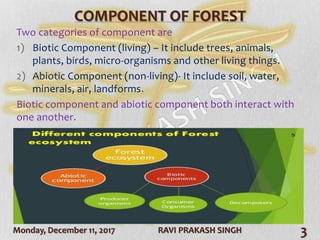
Two categories of component are
1) Biotic Component (living) – It include trees, animals,
plants, birds, micro-organisms and other living things.
2) Abiotic Component (non-living)- It include soil, water,
minerals, air, landforms.
Biotic component and abiotic component both interact with
one another.
Monday, December 11, 2017 RAVI PRAKASH SINGH 4
LIFE IN FOREST
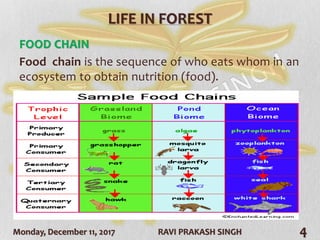
FOOD CHAIN
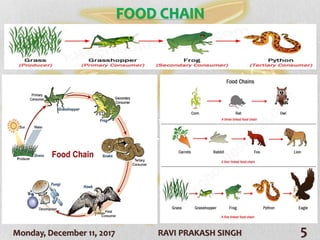
Food chain is the sequence of who eats whom in an
ecosystem to obtain nutrition (food).
Monday, December 11, 2017 RAVI PRAKASH SINGH 5
FOOD CHAIN
Monday, December 11, 2017 RAVI PRAKASH SINGH 6
FOOD WEB
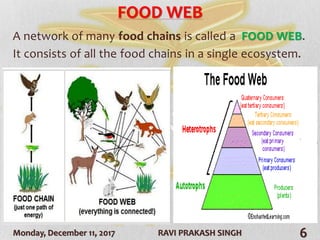
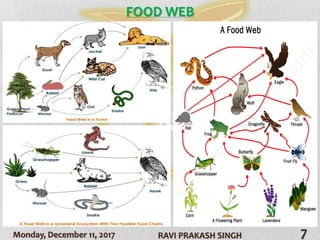
A network of many food chains is called a FOOD WEB.
It consists of all the food chains in a single ecosystem.
Monday, December 11, 2017 RAVI PRAKASH SINGH 7
FOOD WEB
Monday, December 11, 2017 RAVI PRAKASH SINGH 8
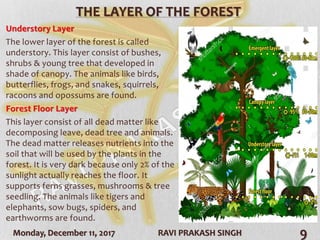
THE LAYER OF THE FOREST
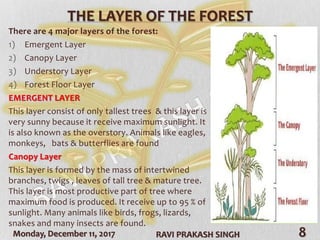
There are 4 major layers of the forest:
1) Emergent Layer
2) Canopy Layer
3) Understory Layer
4) Forest Floor Layer
EMERGENT LAYER
This layer consist of only tallest trees & this layer is
very sunny because it receive maximum sunlight. It
is also known as the overstory. Animals like eagles,
monkeys, bats & butterflies are found
Canopy Layer
This layer is formed by the mass of intertwined
branches, twigs , leaves of tall tree & mature tree.
This layer is most productive part of tree where
maximum food is produced. It receive up to 95 % of
sunlight. Many animals like birds, frogs, lizards,
snakes and many insects are found.
Monday, December 11, 2017 RAVI PRAKASH SINGH 9
THE LAYER OF THE FOREST
Understory Layer
The lower layer of the forest is called
understory. This layer consist of bushes,
shrubs & young tree that developed in
shade of canopy. The animals like birds,
butterflies, frogs, and snakes, squirrels,
racoons and opossums are found.
Forest Floor Layer
This layer consist of all dead matter like
decomposing leave, dead tree and animals.
The dead matter releases nutrients into the
soil that will be used by the plants in the
forest. It is very dark because only 2% of the
sunlight actually reaches the floor. It
supports ferns grasses, mushrooms & tree
seedling. The animals like tigers and
elephants, sow bugs, spiders, and
earthworms are found.
Monday, December 11, 2017 RAVI PRAKASH SINGH 10
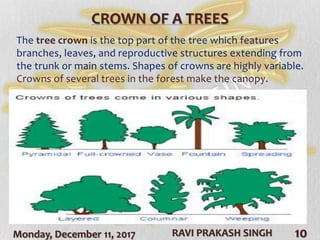
CROWN OF A TREES
The tree crown is the top part of the tree which features
branches, leaves, and reproductive structures extending from
the trunk or main stems. Shapes of crowns are highly variable.
Crowns of several trees in the forest make the canopy.
Monday, December 11, 2017 RAVI PRAKASH SINGH 11
IMPORTANCE OF FOREST
1) Provide habitats for animals and livelihoods for humans.
2) It mitigate climate change (By the process of transpiration
and photosynthesis, forests maintain the temperature).
3) Forests prevent soil erosion.
4) Trees absorb carbon dioxide and turn it into wood.
5) Forests pump out oxygen we need to live and absorb the
carbon dioxide we exhale.
6) Groups of trees can also serve as a windbreak.
7) It regulate the water cycle.
8) It provide fodder for cattle & provide firewood etc.
9) It provide medicinal plant and spices.
10) It provide raw material to industries like paper, plywood,
rayon etc.
11) It provide products such as gum, wax, rubber, and honey.
Monday, December 11, 2017 RAVI PRAKASH SINGH 12
IMPORTANCE OF FOREST
11) They provide employment opportunities to people.
12) Forest resource became a source of foreign exchange in our
country.
13) Reduce atmospheric pollution.
14) It provide protection to wild life.
15) It help in regulating gaseous cycle of the atmosphere and the
earth's temperature.
16) Forests bear many flowers, fruits and roots which are suitable
for human consumption.
17) forests provide wood for the production of furniture and in the
building of wooden houses.
18) Forests covering a large area promote perfect seasonal rains
through their vast amounts of transpiration.
19) Forests promote biodiversity to a great extent.
20) It produce humus & maintain soil fertility.
Monday, December 11, 2017 RAVI PRAKASH SINGH 13
DEFORESTATION
Large scale cutting of trees to clear land for human use is called
Deforestation.
Deforestation is the conversion of forest land to non-forest
land for use such as arable land, pasture, urban use, logged
area.
CAUSES OF DEFORESTATION
1) Logging (cutting for wood)
2) Mining
3) Oil and gas extraction
4) Cattle ranching
5) Agriculture
6) Construction
Monday, December 11, 2017 RAVI PRAKASH SINGH 14
CONSEQUENCE OF DEFORESTATION
1) Soil erosion and loss of soil fertility.
2) Loss of habitat for many species.
3) Loss of Biodiversity - Extinction of species of plants and animals.
4) Increases greenhouse gas emissions leads to Global warming
(Climate change).
5) Shortage of drinking water at many places.
6) It disrupts (baadhit) the water cycle.
7) Loss of natural beauty of an area.
8) Desertification - (dry, hot, arid conditions).
9) Pollution - (ground, water and air pollution from oil extraction
and mining chemicals).
10) Displacement of people.
11) Loss of culture.
Monday, December 11, 2017 RAVI PRAKASH SINGH 15
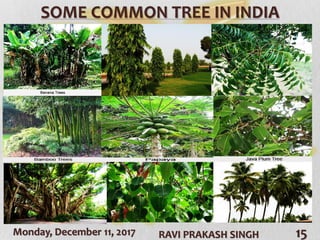
SOME COMMON TREE IN INDIA
Monday, December 11, 2017 RAVI PRAKASH SINGH 16
SOME COMMON TREE IN INDIA
• BANYAN TREE
The national tree of India is the banyan. The banyan tree lives for an
incredible length of time. This huge tree towers over its neighbours &
has the widest reaching roots of all known trees, easily covering
several acres.
• TEAK TREE
It is used for making furniture & doors. It has also medicinal value. Its
bark is useful in fever.
• NEEM TREE
It is also known as Miracle Tree. It has good medicinal value. It is
useful tree in rehabilitating the waste land areas.
• EUCALYPTUS
It is a tall tree. There are more than 700 species of Eucalyptus all over
the world
Monday, December 11, 2017 RAVI PRAKASH SINGH 17
SOME COMMON TREE IN INDIA
• SAL
Sal is a large sub deciduous tree. It is found in all parts of
India. It is worshipped by the Buddhists and the Hindus in
India.
• ASHOKA
Ashoka tree (the sorrow-less tree) is a flowering tree &
considered sacred through out India and Srilanka.
• AMALTAS TREE
Amaltas also called The Golden Shower Tree. It is widely
grown as an ornamental plants. Every part of this plant is
recognised for its medicinal properties.
Monday, December 11, 2017 RAVI PRAKASH SINGH 18

Forest class 7

  • 1.
    CLASS :- VII SUBJECT:- CHEMISTRY MADE BY :- RAVI PRAKASH SINGH Monday, December 11, 2017 RAVI PRAKASH SINGH 1 CHAPTER – 15 FOREST
  • 2.
    Monday, December 11,2017 RAVI PRAKASH SINGH 2 FOREST An area with high density of trees is called FOREST. A forest is a system which is composed of plants, animals and microorganisms.
  • 3.
    Monday, December 11,2017 RAVI PRAKASH SINGH 3 COMPONENT OF FOREST Two categories of component are 1) Biotic Component (living) – It include trees, animals, plants, birds, micro-organisms and other living things. 2) Abiotic Component (non-living)- It include soil, water, minerals, air, landforms. Biotic component and abiotic component both interact with one another.
  • 4.
    Monday, December 11,2017 RAVI PRAKASH SINGH 4 LIFE IN FOREST FOOD CHAIN Food chain is the sequence of who eats whom in an ecosystem to obtain nutrition (food).
  • 5.
    Monday, December 11,2017 RAVI PRAKASH SINGH 5 FOOD CHAIN
  • 6.
    Monday, December 11,2017 RAVI PRAKASH SINGH 6 FOOD WEB A network of many food chains is called a FOOD WEB. It consists of all the food chains in a single ecosystem.
  • 7.
    Monday, December 11,2017 RAVI PRAKASH SINGH 7 FOOD WEB
  • 8.
    Monday, December 11,2017 RAVI PRAKASH SINGH 8 THE LAYER OF THE FOREST There are 4 major layers of the forest: 1) Emergent Layer 2) Canopy Layer 3) Understory Layer 4) Forest Floor Layer EMERGENT LAYER This layer consist of only tallest trees & this layer is very sunny because it receive maximum sunlight. It is also known as the overstory. Animals like eagles, monkeys, bats & butterflies are found Canopy Layer This layer is formed by the mass of intertwined branches, twigs , leaves of tall tree & mature tree. This layer is most productive part of tree where maximum food is produced. It receive up to 95 % of sunlight. Many animals like birds, frogs, lizards, snakes and many insects are found.
  • 9.
    Monday, December 11,2017 RAVI PRAKASH SINGH 9 THE LAYER OF THE FOREST Understory Layer The lower layer of the forest is called understory. This layer consist of bushes, shrubs & young tree that developed in shade of canopy. The animals like birds, butterflies, frogs, and snakes, squirrels, racoons and opossums are found. Forest Floor Layer This layer consist of all dead matter like decomposing leave, dead tree and animals. The dead matter releases nutrients into the soil that will be used by the plants in the forest. It is very dark because only 2% of the sunlight actually reaches the floor. It supports ferns grasses, mushrooms & tree seedling. The animals like tigers and elephants, sow bugs, spiders, and earthworms are found.
  • 10.
    Monday, December 11,2017 RAVI PRAKASH SINGH 10 CROWN OF A TREES The tree crown is the top part of the tree which features branches, leaves, and reproductive structures extending from the trunk or main stems. Shapes of crowns are highly variable. Crowns of several trees in the forest make the canopy.
  • 11.
    Monday, December 11,2017 RAVI PRAKASH SINGH 11 IMPORTANCE OF FOREST 1) Provide habitats for animals and livelihoods for humans. 2) It mitigate climate change (By the process of transpiration and photosynthesis, forests maintain the temperature). 3) Forests prevent soil erosion. 4) Trees absorb carbon dioxide and turn it into wood. 5) Forests pump out oxygen we need to live and absorb the carbon dioxide we exhale. 6) Groups of trees can also serve as a windbreak. 7) It regulate the water cycle. 8) It provide fodder for cattle & provide firewood etc. 9) It provide medicinal plant and spices. 10) It provide raw material to industries like paper, plywood, rayon etc. 11) It provide products such as gum, wax, rubber, and honey.
  • 12.
    Monday, December 11,2017 RAVI PRAKASH SINGH 12 IMPORTANCE OF FOREST 11) They provide employment opportunities to people. 12) Forest resource became a source of foreign exchange in our country. 13) Reduce atmospheric pollution. 14) It provide protection to wild life. 15) It help in regulating gaseous cycle of the atmosphere and the earth's temperature. 16) Forests bear many flowers, fruits and roots which are suitable for human consumption. 17) forests provide wood for the production of furniture and in the building of wooden houses. 18) Forests covering a large area promote perfect seasonal rains through their vast amounts of transpiration. 19) Forests promote biodiversity to a great extent. 20) It produce humus & maintain soil fertility.
  • 13.
    Monday, December 11,2017 RAVI PRAKASH SINGH 13 DEFORESTATION Large scale cutting of trees to clear land for human use is called Deforestation. Deforestation is the conversion of forest land to non-forest land for use such as arable land, pasture, urban use, logged area. CAUSES OF DEFORESTATION 1) Logging (cutting for wood) 2) Mining 3) Oil and gas extraction 4) Cattle ranching 5) Agriculture 6) Construction
  • 14.
    Monday, December 11,2017 RAVI PRAKASH SINGH 14 CONSEQUENCE OF DEFORESTATION 1) Soil erosion and loss of soil fertility. 2) Loss of habitat for many species. 3) Loss of Biodiversity - Extinction of species of plants and animals. 4) Increases greenhouse gas emissions leads to Global warming (Climate change). 5) Shortage of drinking water at many places. 6) It disrupts (baadhit) the water cycle. 7) Loss of natural beauty of an area. 8) Desertification - (dry, hot, arid conditions). 9) Pollution - (ground, water and air pollution from oil extraction and mining chemicals). 10) Displacement of people. 11) Loss of culture.
  • 15.
    Monday, December 11,2017 RAVI PRAKASH SINGH 15 SOME COMMON TREE IN INDIA
  • 16.
    Monday, December 11,2017 RAVI PRAKASH SINGH 16 SOME COMMON TREE IN INDIA • BANYAN TREE The national tree of India is the banyan. The banyan tree lives for an incredible length of time. This huge tree towers over its neighbours & has the widest reaching roots of all known trees, easily covering several acres. • TEAK TREE It is used for making furniture & doors. It has also medicinal value. Its bark is useful in fever. • NEEM TREE It is also known as Miracle Tree. It has good medicinal value. It is useful tree in rehabilitating the waste land areas. • EUCALYPTUS It is a tall tree. There are more than 700 species of Eucalyptus all over the world
  • 17.
    Monday, December 11,2017 RAVI PRAKASH SINGH 17 SOME COMMON TREE IN INDIA • SAL Sal is a large sub deciduous tree. It is found in all parts of India. It is worshipped by the Buddhists and the Hindus in India. • ASHOKA Ashoka tree (the sorrow-less tree) is a flowering tree & considered sacred through out India and Srilanka. • AMALTAS TREE Amaltas also called The Golden Shower Tree. It is widely grown as an ornamental plants. Every part of this plant is recognised for its medicinal properties.
  • 18.
    Monday, December 11,2017 RAVI PRAKASH SINGH 18