Presentation title
Presenter name
Class : 7th
Subject : Science
Chapter 9. Soil
Presented by : Swayam R. Khobragade
Point to be discussed
1. Soil
2. Soil containing life
3. Soil Profile
4. Layers of soil
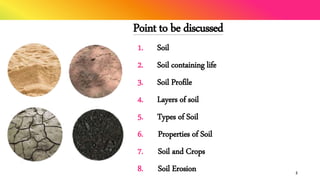
5. Types of Soil
6. Properties of Soil
7. Soil and Crops
8. Soil Erosion 2
Soil
The soil is the topmost layer of the earth’s crust mainly composed of
organic minerals and rock particles that support life. Soil is one of the
most important natural resources. It supports the growth of plants by
holding the roots firmly and supply water and nutrients . It is the home
for many organisms. Soil is very important for practicing agriculture.
As, Agriculture provides food, clothing and shelter for all. Soil is thus an
inseparable part of our life.
3
Soil containing life
Soil contains different types of living organisms that help in
sustaining life.
Soil comprises millions and billions of living organisms that
form a complex ecosystem and is the most precious resource to
humans. The plants and animals present in the soil help in
maintaining the fertility of soil.
4
Soil Profile
5
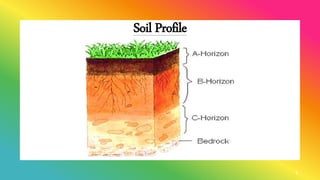
The soil consists of distinct layers which are also called Horizons of the Soil.
The Soil Profile is a vertical section of the soil which depicts all the layers of the soil. The layers of the
soil can be seen if we dig deep through it like while creating a well or while laying the foundation of a
building.
 Humus – The decaying matter in the soil is called Humus.
 Weathering - Soil is formed when rocks break down. This process is also called Weathering. The
weathering of rocks takes place because of rains, flowing water, winds, temperature and climatic
conditions of a place.
 Parent Rock - The nature of the soil that is its texture and availability of minerals depends upon the
rock from which it is formed. This rock is often called as the Parent Rock.
Soil Profile
6
Layers of Soil
7
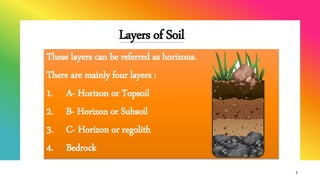
These layers can be referred as horizons.
There are mainly four layers :
1. A- Horizon or Topsoil
2. B- Horizon or Subsoil
3. C- Horizon or regolith
4. Bedrock
8
A-Horizon or topsoil- It is the top most soil, which is dark in colour
and rich in humus. It is soft, porous, and has the ability to retain
water.
B-Horizon or Sub-Soil- It is the middle next layer of the soil profile.
It has lessor humus and more minerals. The layer is harder and more
compact.
C-Horizon or Regolith- It is the third layer made up of small lumps
of rocks with cracks and split.
Bedrocks – It is the lowermost hard layer and is very difficult to dig
with a spade.
Types of Soil
9
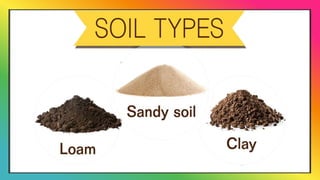
The soil is classified on the basis of the proportion of particles of
various sizes.
 If soil contains greater proportion of big particles it is called sandy
soil.
 If the proportion of fine particles is relatively higher, then it is called
clayey soil.
 If the amount of large and fine particles is about the same, then the
soil is called loamy.
 Thus, the soil can be classified as sandy, clayey and loamy.
10
Properties of Soil
All soils contain mineral particles, organic matter, water and air. The
combinations of these determine the soil’s properties –
1. Texture
2. Structure
3. Porosity
4. Chemistry
5. Colour
11
Soil and Crops
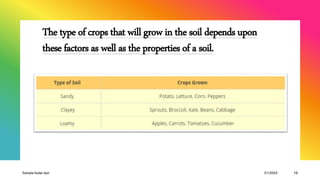
Different kinds of soils are found in different regions because of the following
factors that decide the soil structure of that place:
temperature
humidity
rainfall
sunlight
winds
12
The type of crops that will grow in the soil depends upon
these factors as well as the properties of a soil.
Sample footer text 3/1/20XX 13
What is soil erosion?
 When the top layer of soil gets removed it is called soil erosion.
 The soil erosion mainly occurs when the soil is left loose without vegetation or
when deforestation occurs.
 In such a situation, strong winds and flowing water or rainwater takes away the
topsoil and therefore decrease its quality.
 Also, this kills the organisms living inside the soil.
 The roots of the plants and trees keep the soil together and allow several
microorganisms to grow and survive there. Therefore, it is always advised to plant
more trees and avoid deforestation.
14
Word Meanings
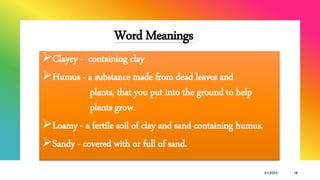
Clayey - containing clay
Humus - a substance made from dead leaves and
plants, that you put into the ground to help
plants grow.
Loamy - a fertile soil of clay and sand containing humus.
Sandy - covered with or full of sand.
3/1/20XX 15
Thank you
16

Class 7th Science Chapter- 9. soil

  • 1.
    Presentation title Presenter name Class: 7th Subject : Science Chapter 9. Soil Presented by : Swayam R. Khobragade
  • 2.
    Point to bediscussed 1. Soil 2. Soil containing life 3. Soil Profile 4. Layers of soil 5. Types of Soil 6. Properties of Soil 7. Soil and Crops 8. Soil Erosion 2
  • 3.
    Soil The soil isthe topmost layer of the earth’s crust mainly composed of organic minerals and rock particles that support life. Soil is one of the most important natural resources. It supports the growth of plants by holding the roots firmly and supply water and nutrients . It is the home for many organisms. Soil is very important for practicing agriculture. As, Agriculture provides food, clothing and shelter for all. Soil is thus an inseparable part of our life. 3
  • 4.
    Soil containing life Soilcontains different types of living organisms that help in sustaining life. Soil comprises millions and billions of living organisms that form a complex ecosystem and is the most precious resource to humans. The plants and animals present in the soil help in maintaining the fertility of soil. 4
  • 5.
    Soil Profile 5 The soilconsists of distinct layers which are also called Horizons of the Soil. The Soil Profile is a vertical section of the soil which depicts all the layers of the soil. The layers of the soil can be seen if we dig deep through it like while creating a well or while laying the foundation of a building.  Humus – The decaying matter in the soil is called Humus.  Weathering - Soil is formed when rocks break down. This process is also called Weathering. The weathering of rocks takes place because of rains, flowing water, winds, temperature and climatic conditions of a place.  Parent Rock - The nature of the soil that is its texture and availability of minerals depends upon the rock from which it is formed. This rock is often called as the Parent Rock.
  • 6.
  • 7.
    Layers of Soil 7 Theselayers can be referred as horizons. There are mainly four layers : 1. A- Horizon or Topsoil 2. B- Horizon or Subsoil 3. C- Horizon or regolith 4. Bedrock
  • 8.
    8 A-Horizon or topsoil-It is the top most soil, which is dark in colour and rich in humus. It is soft, porous, and has the ability to retain water. B-Horizon or Sub-Soil- It is the middle next layer of the soil profile. It has lessor humus and more minerals. The layer is harder and more compact. C-Horizon or Regolith- It is the third layer made up of small lumps of rocks with cracks and split. Bedrocks – It is the lowermost hard layer and is very difficult to dig with a spade.
  • 9.
    Types of Soil 9 Thesoil is classified on the basis of the proportion of particles of various sizes.  If soil contains greater proportion of big particles it is called sandy soil.  If the proportion of fine particles is relatively higher, then it is called clayey soil.  If the amount of large and fine particles is about the same, then the soil is called loamy.  Thus, the soil can be classified as sandy, clayey and loamy.
  • 10.
  • 11.
    Properties of Soil Allsoils contain mineral particles, organic matter, water and air. The combinations of these determine the soil’s properties – 1. Texture 2. Structure 3. Porosity 4. Chemistry 5. Colour 11
  • 12.
    Soil and Crops Differentkinds of soils are found in different regions because of the following factors that decide the soil structure of that place: temperature humidity rainfall sunlight winds 12
  • 13.
    The type ofcrops that will grow in the soil depends upon these factors as well as the properties of a soil. Sample footer text 3/1/20XX 13
  • 14.
    What is soilerosion?  When the top layer of soil gets removed it is called soil erosion.  The soil erosion mainly occurs when the soil is left loose without vegetation or when deforestation occurs.  In such a situation, strong winds and flowing water or rainwater takes away the topsoil and therefore decrease its quality.  Also, this kills the organisms living inside the soil.  The roots of the plants and trees keep the soil together and allow several microorganisms to grow and survive there. Therefore, it is always advised to plant more trees and avoid deforestation. 14
  • 15.
    Word Meanings Clayey -containing clay Humus - a substance made from dead leaves and plants, that you put into the ground to help plants grow. Loamy - a fertile soil of clay and sand containing humus. Sandy - covered with or full of sand. 3/1/20XX 15
  • 16.