FIBER OPTIC BASICS
Part 6 - Evolution of Ethernet
Evolution of Ethernet
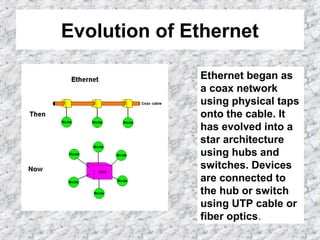
Ethernet began as
a coax network
using physical taps
onto the cable. It
has evolved into a
star architecture
using hubs and
switches. Devices
are connected to
the hub or switch
using UTP cable or
fiber optics.
FDDI-The First All-Fiber Network
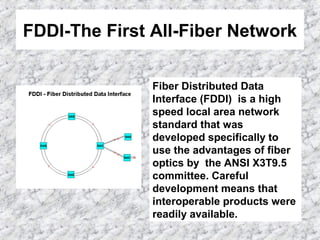
Fiber Distributed Data
Interface (FDDI) is a high
speed local area network
standard that was
developed specifically to
use the advantages of fiber
optics by the ANSI X3T9.5
committee. Careful
development means that
interoperable products were
readily available.
FDDI-The First All-Fiber Network
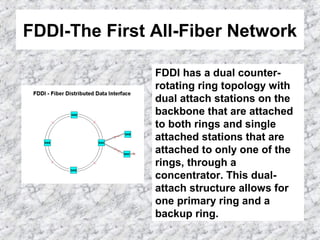
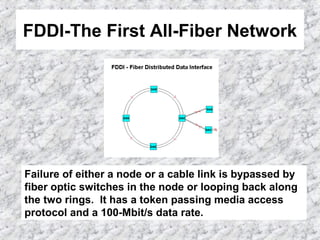
FDDI has a dual counter-
rotating ring topology with
dual attach stations on the
backbone that are attached
to both rings and single
attached stations that are
attached to only one of the
rings, through a
concentrator. This dual-
attach structure allows for
one primary ring and a
backup ring.
FDDI-The First All-Fiber Network
Failure of either a node or a cable link is bypassed by
fiber optic switches in the node or looping back along
the two rings. It has a token passing media access
protocol and a 100-Mbit/s data rate.
IBM ESCON Mainframe Network
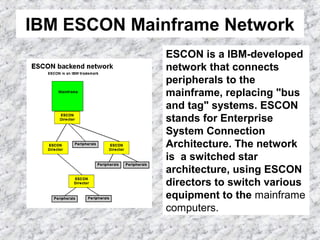
ESCON is a IBM-developed
network that connects
peripherals to the
mainframe, replacing "bus
and tag" systems. ESCON
stands for Enterprise
System Connection
Architecture. The network
is a switched star
architecture, using ESCON
directors to switch various
equipment to the mainframe
computers.
IBM ESCON Mainframe Network
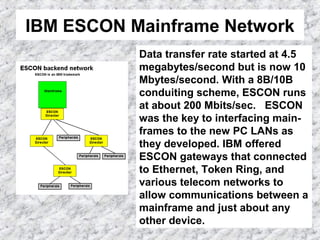
Data transfer rate started at 4.5
megabytes/second but is now 10
Mbytes/second. With a 8B/10B
conduiting scheme, ESCON runs
at about 200 Mbits/sec. ESCON
was the key to interfacing main-
frames to the new PC LANs as
they developed. IBM offered
ESCON gateways that connected
to Ethernet, Token Ring, and
various telecom networks to
allow communications between a
mainframe and just about any
other device.
Fiber Optic LANs
• Every LAN offers a fiber option or can be
converted with “media converters”
– (Ethernet, Token Ring, Arcnet, etc.)
• FDDI was first LAN designed for fiber
• ESCON the first mainframe back-end network
in fiber
• LAN Backbones today are predominately
fiber
• Fiber to the desk has not been popular due to
cost of electronics
Fiber Optic LANs
Today most large LANs use fiber optics in the backbone and
UTP cabling to the desktop. The backbone is running at
100 Megabit/s or 1 Gigabit/s while 100 Mb/s is the max to
the desktop. Backbone distances and speeds, along with a
interest in going to even higher speeds (10 Gb/s) makes
fiber easy to justify in the backbone. In fact most backbone
cables have both SM and MM fiber for future upgrades.
But Category-rated UTP has been able to handle the desktop
connection speeds so far and the traditional architecture
standardized in TIA/EIA 568 favors the UTP solution.
Some users have analyzed using fiber to the desk without a
telecom closet (or telecom room as it is preferentially called
today) and found it cheaper than a backbone fiber/desktop
UTP connection, when one downsizes the telecom closet or
doesn’t use it all, due to fiber’s architecture not needing the
space, power, ground or AC.
Other Applications of Fiber Optics
Communications
– Cellular/Wireless/PCS
antennas
– Wireless LAN antennas
– Utility network management
Security
– Closed-circuit TV
– Intrusion Sensors
– Surveillance proofing
Fiber has found many
other uses.
Cellular systems are
not wireless - most
antennas are
connected via buried
fiber optic cables.
Likewise, wireless
LANs require cabling
and fiber provides
greater distances from
hubs and switches and
immunity to noise.
Other Applications of Fiber Optics
Communications
– Cellular/Wireless/PCS
antennas
– Wireless LAN antennas
– Utility network management
Security
– Closed-circuit TV
– Intrusion Sensors
– Surveillance proofing
Utilities have used fiber
for managing their
grids and
communications
throughout their
networks for many
years. Recent problems
have had many
upgrading their
systems.
Security systems use
lots of fiber.
Other Applications of Fiber Optics
CCTV cameras use fiber to extend their reach, for
example in large airport terminals, outdoors in power
plants or inside and outside big office buildings.
Fibers can also be used as sensors, for example
sensing intruders on fences or walking across buried
fiber sensors.
And, of course, fiber is very difficult to “tap,” making it
popular for secure military and government networks.
Other Applications of Fiber Optics
Building Management:
Process Control
Sensors
High voltage/current
Chemicals
Hazardous
environments
Building management systems can
use fiber in place of copper cable for
longer distances and greater
security.
Industrial networks favor fiber for
process control applications due to
its distance capability and immunity
to electrical noise.
Fiber optic sensors are available for
a number of applications, including
measuring high voltages and
currents as in power grids,
dangerous chemicals and can
operate in hazardous environments
since they are intrinsically safe.

Fiber optics 1-6

  • 1.
    FIBER OPTIC BASICS Part6 - Evolution of Ethernet
  • 2.
    Evolution of Ethernet Ethernetbegan as a coax network using physical taps onto the cable. It has evolved into a star architecture using hubs and switches. Devices are connected to the hub or switch using UTP cable or fiber optics.
  • 3.
    FDDI-The First All-FiberNetwork Fiber Distributed Data Interface (FDDI) is a high speed local area network standard that was developed specifically to use the advantages of fiber optics by the ANSI X3T9.5 committee. Careful development means that interoperable products were readily available.
  • 4.
    FDDI-The First All-FiberNetwork FDDI has a dual counter- rotating ring topology with dual attach stations on the backbone that are attached to both rings and single attached stations that are attached to only one of the rings, through a concentrator. This dual- attach structure allows for one primary ring and a backup ring.
  • 5.
    FDDI-The First All-FiberNetwork Failure of either a node or a cable link is bypassed by fiber optic switches in the node or looping back along the two rings. It has a token passing media access protocol and a 100-Mbit/s data rate.
  • 6.
    IBM ESCON MainframeNetwork ESCON is a IBM-developed network that connects peripherals to the mainframe, replacing "bus and tag" systems. ESCON stands for Enterprise System Connection Architecture. The network is a switched star architecture, using ESCON directors to switch various equipment to the mainframe computers.
  • 7.
    IBM ESCON MainframeNetwork Data transfer rate started at 4.5 megabytes/second but is now 10 Mbytes/second. With a 8B/10B conduiting scheme, ESCON runs at about 200 Mbits/sec. ESCON was the key to interfacing main- frames to the new PC LANs as they developed. IBM offered ESCON gateways that connected to Ethernet, Token Ring, and various telecom networks to allow communications between a mainframe and just about any other device.
  • 8.
    Fiber Optic LANs •Every LAN offers a fiber option or can be converted with “media converters” – (Ethernet, Token Ring, Arcnet, etc.) • FDDI was first LAN designed for fiber • ESCON the first mainframe back-end network in fiber • LAN Backbones today are predominately fiber • Fiber to the desk has not been popular due to cost of electronics
  • 9.
    Fiber Optic LANs Todaymost large LANs use fiber optics in the backbone and UTP cabling to the desktop. The backbone is running at 100 Megabit/s or 1 Gigabit/s while 100 Mb/s is the max to the desktop. Backbone distances and speeds, along with a interest in going to even higher speeds (10 Gb/s) makes fiber easy to justify in the backbone. In fact most backbone cables have both SM and MM fiber for future upgrades. But Category-rated UTP has been able to handle the desktop connection speeds so far and the traditional architecture standardized in TIA/EIA 568 favors the UTP solution. Some users have analyzed using fiber to the desk without a telecom closet (or telecom room as it is preferentially called today) and found it cheaper than a backbone fiber/desktop UTP connection, when one downsizes the telecom closet or doesn’t use it all, due to fiber’s architecture not needing the space, power, ground or AC.
  • 10.
    Other Applications ofFiber Optics Communications – Cellular/Wireless/PCS antennas – Wireless LAN antennas – Utility network management Security – Closed-circuit TV – Intrusion Sensors – Surveillance proofing Fiber has found many other uses. Cellular systems are not wireless - most antennas are connected via buried fiber optic cables. Likewise, wireless LANs require cabling and fiber provides greater distances from hubs and switches and immunity to noise.
  • 11.
    Other Applications ofFiber Optics Communications – Cellular/Wireless/PCS antennas – Wireless LAN antennas – Utility network management Security – Closed-circuit TV – Intrusion Sensors – Surveillance proofing Utilities have used fiber for managing their grids and communications throughout their networks for many years. Recent problems have had many upgrading their systems. Security systems use lots of fiber.
  • 12.
    Other Applications ofFiber Optics CCTV cameras use fiber to extend their reach, for example in large airport terminals, outdoors in power plants or inside and outside big office buildings. Fibers can also be used as sensors, for example sensing intruders on fences or walking across buried fiber sensors. And, of course, fiber is very difficult to “tap,” making it popular for secure military and government networks.
  • 13.
    Other Applications ofFiber Optics Building Management: Process Control Sensors High voltage/current Chemicals Hazardous environments Building management systems can use fiber in place of copper cable for longer distances and greater security. Industrial networks favor fiber for process control applications due to its distance capability and immunity to electrical noise. Fiber optic sensors are available for a number of applications, including measuring high voltages and currents as in power grids, dangerous chemicals and can operate in hazardous environments since they are intrinsically safe.