Part 3
Special Systems
Referenced Publications
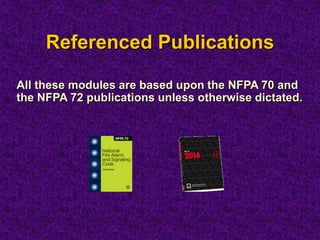
All these modules are based upon the NFPA 70 and
the NFPA 72 publications unless otherwise dictated.
Agenda
 Part 1 Fire Alarm System Fundamentals
 Part 2 Initiating Devices
Protected Premises Fire Alarm Systems
Part 3 Circuits & Pathways
Inspection Testing & Maintenance
Notification Appliances
Special Functions
Agenda
NFPA 72
 Chapter 21 Emergency Control Functions &
Interfaces
Chapter 23 Protected Premises Fire Alarm
Systems
Chapter 24 Emergency Communication Systems
Chapter 26 Supervising Station Alarm Systems
Chapter 27 Public Emergency Alarm Reporting
Systems
Chapter 29 Single and Multiple-Station Alarms
and Household Fire Alarm
Chapters 22 / 25 / 28 Reserved
Protected Premises Fire Alarm
System
Chapter 23
23.1 Application
23.2 General
23.3 System Features
23.4 System Performance an Integrity
23.5 Performance if Indicating Device Circuits (IDC)
23.6 Performance if Signaling Line Circuits (SLC)
23.7 Performance if Notification Appliance Circuits
(NAC)s
23.8 System Requirements
21.9 In Building Fire Emergency Voice/Alarm
Communications
Protected Premises Fire Alarm
System
Chapter 23
23.10 Prerecorded (Digital) Voice and Tone Fire Alarm
Systems
23.11 Two Way Communications
23.12 Signal Annunciation
23.13 Suppression System Activation
23.14 Off Premises Signals
23.15 Guard’s Tour Supervisory Service
23.16 Suppression Signal System (Except Reporting)
23.17 Protected Premises Fire Safety Functions
23.18 Special Requirements for Low-Power Radio
Systems (Wireless)
Protected Premises Fire Alarm
System
23.1.1* The application, installation, and performance of fire
alarm systems within protected premises, including fire
alarm and supervisory signals, shall comply with the
requirements of this chapter
23.1.2 The requirements of Chapters 10, 14, 12, 17, 18, 21,
24 and 26 shall also apply, unless they are in conflict with
this chapter
23.1.5 The requirements of 24.4.1 shall apply where in-
building fire emergency voice/alarm communications
systems are used
Protected Premises Fire Alarm
System
23.1.1* The application, installation, and performance of fire
23.2.1* Purpose. The systems covered in Chapter 23 shall
be for the protection of life or property, or both
23.2.2.1 A record of installed software and firmware version
numbers shall be maintained at the location of the fire
alarm control unit
23.2.2.1.2* The compatible software or firmware versions
shall be documented at the initial acceptance test and at
any reacceptance tests
Protected Premises Fire Alarm
System
23.1.1* The application, installation, and performance of fire
23.2.2.2* All software and firmware shall be protected from
unauthorized changes
23.2.3.1 Nonrequired protected premises systems and
components shall meet the requirements of this Code.
Protected Premises Fire Alarm
System
23.3.1 Required Systems. Features for required systems
shall be based on the requirements of other applicable
codes or statutes that have been adopted by the
enforcing jurisdiction.
23.3.2 Nonrequired Systems. The features for a
nonrequired system shall be established by the system
designer on the basis of the goals and objectives
intended by the system owner
Protected Premises Fire Alarm
System
23.3.3.1 Building Fire Alarm Systems. Protected premises
fire alarm systems that serve the general fire alarm
needs of a building or buildings shall include one or more
of the following systems or functions:
(1) Manual fire alarm signal initiation
(2) Automatic fire alarm and supervisory signal initiation
(3) Monitoring of abnormal conditions in fire suppression systems
(4) Activation of fire suppression systems
(5) Activation of fire safety functions
(6) Activation of fire alarm notification appliances
(7) In-building fire emergency voice/alarm communications
(8) Guard’s tour supervisory service
(9) Process monitoring supervisory systems
(10) Activation of off-premises signals
(11) Combination systems
Protected Premises Fire Alarm
System
23.3.3.1 Building Fire Alarm Systems. Protected premises
23.4.2 Circuit Designations. Initiating device circuits,
notification appliance circuits, and signaling line circuits
shall be designated by class, depending on the circuit’s
capability to continue to operate during specified fault
conditions as indicated in Sections 23.5 through 23.7.
Protected Premises Fire Alarm
System
23.4.2.2* Class A and Class X circuits using physical
conductors…
(1) For a distance not to exceed 10 ft (3.0 m) where the outgoing and
return conductors enter or exit the initiating device, notification
appliance, or control unit enclosures
(2) For single raceway drops to individual devices or appliances
(3) For single raceway drops to multiple devices or appliances
installed within a single room not exceeding 1000 ft2 (93 m2) in area
Protected Premises Fire Alarm
System
23.5 Performance of Initiating Device Circuits (IDCs)
23.5.1 The assignment of class designations to initiating
device circuits shall be based on their performance
capabilities under abnormal (fault) conditions in
accordance with the requirements for Class A or Class B
pathways specified in Chapter 12 …
23.5.2 An open or ground condition shall result in the
annunciation of a trouble signal
23.5.3 The circuit shall maintain alarm receipt capability
during the application of a single ground fault.
Protected Premises Fire Alarm
System
23.6* Performance of Signaling Line Circuits (SLCs)
23.6.1 The assignment of class designations to signaling
line circuits shall be based on their performance
capabilities under abnormal (fault) conditions in
accordance with the requirements for Class A, Class B,
or Class X pathways specified in Chapter 12
23.6.2 An open, short circuit, or ground fault shall result in
the annunciation of a trouble signal.
23.6.3 Class B pathways shall maintain alarm capability
during the application of a single ground fault.
Protected Premises Fire Alarm
System
23.7 Performance of Notification Appliance Circuits
(NACs)
23.7.1 The assignment of class designations to notification
appliance circuits shall be based on their performance
capabilities under abnormal (fault) conditions in
accordance with the requirements for Class A or Class B
pathways specified in Chapter 12 …
23.7.2 An open or ground condition shall result in the
annunciation of a trouble signal.
23.7.3 The circuit shall maintain alarm capability during the
application of a single ground fault.
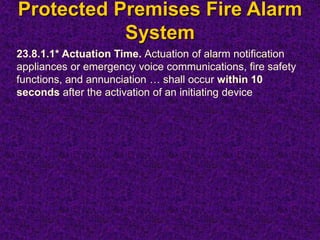
Protected Premises Fire Alarm
System
23.8.1.1* Actuation Time. Actuation of alarm notification
appliances or emergency voice communications, fire safety
functions, and annunciation … shall occur within 10
seconds after the activation of an initiating device
Protected Premises Fire Alarm
System
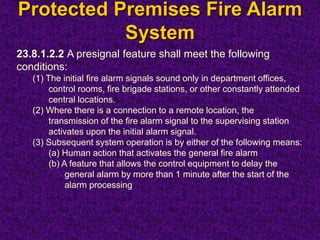
23.8.1.2.2 A presignal feature shall meet the following
conditions:
(1) The initial fire alarm signals sound only in department offices,
control rooms, fire brigade stations, or other constantly attended
central locations.
(2) Where there is a connection to a remote location, the
transmission of the fire alarm signal to the supervising station
activates upon the initial alarm signal.
(3) Subsequent system operation is by either of the following means:
(a) Human action that activates the general fire alarm
(b) A feature that allows the control equipment to delay the
general alarm by more than 1 minute after the start of the
alarm processing
Protected Premises Fire Alarm
System
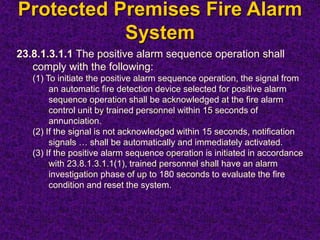
23.8.1.3.1.1 The positive alarm sequence operation shall
comply with the following:
(1) To initiate the positive alarm sequence operation, the signal from
an automatic fire detection device selected for positive alarm
sequence operation shall be acknowledged at the fire alarm
control unit by trained personnel within 15 seconds of
annunciation.
(2) If the signal is not acknowledged within 15 seconds, notification
signals … shall be automatically and immediately activated.
(3) If the positive alarm sequence operation is initiated in accordance
with 23.8.1.3.1.1(1), trained personnel shall have an alarm
investigation phase of up to 180 seconds to evaluate the fire
condition and reset the system.
Protected Premises Fire Alarm
System
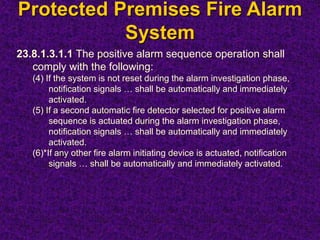
23.8.1.3.1.1 The positive alarm sequence operation shall
comply with the following:
(4) If the system is not reset during the alarm investigation phase,
notification signals … shall be automatically and immediately
activated.
(5) If a second automatic fire detector selected for positive alarm
sequence is actuated during the alarm investigation phase,
notification signals … shall be automatically and immediately
activated.
(6)*If any other fire alarm initiating device is actuated, notification
signals … shall be automatically and immediately activated.
Protected Premises Fire Alarm
System
23.8.2* Fire Alarm Control Units
23.8.2.2 Except as permitted in 23.8.2.3, the fire alarm systems
components shall be permitted to share control equipment or shall
be able to operate as stand-alone subsystems, but, in any case, they
shall be arranged to function as a single system
23.8.2.3 Where the building is not served by a building fire alarm system,
independent dedicated function fire alarm systems and/or releasing
fire alarm systems shall not be required to be interconnected to
function as a single system
Protected Premises Fire Alarm
System
23.8.2.5 The method of interconnection of fire alarm control
units shall meet the monitoring requirements of Section
10.17 and NFPA 70, National Electrical Code, Article
760, and shall be achieved by the following recognized
means:
(1) Electrical contacts listed for the connected load
(2) Data communications over a signaling line circuit(s) dedicated to
the fire alarm or shared with other premises operating systems
(3) Other listed methods
Protected Premises Fire Alarm
System
23.8.2.6.1 All signal control and transport equipment (such
as routers, servers) located in a critical fire alarm or fire
safety function signaling path shall be listed for fire alarm
service, unless the following conditions are met:
(1) The equipment meets … requirements of 10.14.1.
(2) The equipment is provided with primary and secondary power …
as required in Sections 10.5 and 10.17.
(3) All programming and configuration ensure a fire alarm system
actuation time as required in 23.8.1.1.
(4) System bandwidth is monitored to … the operation of the fire
alarm system or fire safety functions take place within 10
seconds; failure shall be indicated within 200 seconds.
(5) Failure of any equipment that is critical to the operation of the fire
alarm system … is indicated at the master fire alarm control unit
within 200 seconds.
Protected Premises Fire Alarm
System
23.8.2.7 Each interconnected fire alarm control unit shall be
separately monitored for alarm, supervisory, and trouble
conditions
23.8.2.10 Remote resetting and silencing of a fire alarm
control unit from other than the protected premises shall
be permitted with the approval of the authority having
jurisdiction
Protected Premises Fire Alarm
System
23.8.3.1 A protected premises fire alarm system shall be
permitted to be interconnected to a household fire alarm
system(s) for the purpose of activating the notification
appliances connected to the household fire alarm system
23.8.4.1* Fire alarm systems shall be permitted to share
components, equipment, circuitry, and installation wiring
with non–fire alarm systems
23.8.4.2 Operation of a non–fire system function(s)
originating within a connected non–fire system shall not
interfere with the required operation of the fire alarm
system, unless otherwise permitted by this Code
Protected Premises Fire Alarm
System
23.8.4.3.1* For non–fire alarm equipment listed to the
performance requirements specified in 10.14.1, the
requirements of 23.8.4.3.1.1 through 23.8.4.3.1.3 shall
apply
A.23.8.4.3.1 For systems such as carbon monoxide
detection, fire extinguisher electronic monitoring
device, emergency communication (mass
notification), or intrusion
Protected Premises Fire Alarm
System
23.8.4.5* In combination systems, fire alarm signals shall be
distinctive, clearly recognizable, and shall be indicated as
follows in descending order of priority, except where
otherwise required by other governing laws, codes or
standards, or by other parts of this Code:
(1) Signals associated with life safety
(2) Signals associated with property protection
(3) Trouble signals associated with life and/or property protection
(4) All other signals
23.8.4.7* Signals from carbon monoxide detectors and
carbon monoxide detection systems transmitted to a fire
alarm system shall be permitted to be supervisory
signals
Protected Premises Fire Alarm
System
23.8.4.8* Fire Extinguisher Electronic Monitoring
Devices and Systems. Signals from a fire extinguisher
electronic monitoring device or fire extinguisher
monitoring system transmitted to a fire alarm system
shall be permitted to be supervisory signals
23.8.5.1.1 All initiating devices shall be installed in
accordance with Chapter 17 and tested in accordance
with Chapter 14
23.8.5.2 Fire Alarm Signal Initiation — Manual. Manual
fire alarm signal initiation shall comply with the
requirements of Section 17.14
Protected Premises Fire Alarm
System
23.8.5.3.1 Automatic fire alarm signal initiating devices that
have integral trouble signal contacts shall be connected
to the initiating device circuit so that a trouble condition
within a device does not impair alarm transmission from
any other initiating device.
Protected Premises Fire Alarm
System
23.8.5.4.1* Systems equipped with alarm verification
features shall be permitted under the following conditions:
(1) The alarm verification feature is not initially enabled, unless
conditions or occupant activities that are expected to cause
nuisance alarms are anticipated in the area that is protected by
the smoke detectors. Enabling of the alarm verification feature
shall be protected by password or limited access.
(2) A smoke detector that is continuously subjected to a smoke
concentration above alarm threshold does not delay the system
functions of Sections 10.6 through 10.13, 23.8.1.1, or 21.2.1 by
more than 1 minute.
(3) Actuation of an alarm-initiating device other than a smoke
detector causes the system functions of Sections 10.6 through
10.13, 23.8.1.1, or 21.2.1 without additional delay.
(4) The current status of the alarm verification feature is shown on
the record of completion
Protected Premises Fire Alarm
System
23.8.5.4.2 If automatic drift compensation of sensitivity for a
fire detector is provided, the fire alarm control unit shall
identify the affected detector when the limit of
compensation is reached
23.8.5.4.3 Systems that require the operation of two
automatic detectors to initiate the alarm response shall
be permitted, provided that the following conditions are
satisfied:
(1) The systems are not prohibited by the authority having
jurisdiction.
(2) At least two automatic detectors are in each protected space.
(3) The alarm verification feature is not used.
Protected Premises Fire Alarm
System
23.8.5.5.2* The number of waterflow alarm-initiating devices
permitted to be connected to a single initiating device
circuit shall not exceed five
23.8.5.6.2* The number of supervisory signal–initiating
devices permitted to be connected to a single initiating
device circuit shall not exceed 20
23.8.5.7.2 The integrity of each fire suppression system
actuating device and its circuit shall comply with
10.17.1.1, 10.17.1.2, and other applicable NFPA
standards
Protected Premises Fire Alarm
System
23.8.5.9.1 Where fire pumps are required to be monitored
and a building fire alarm system is installed, a pump
running signal shall be permitted to be a supervisory or
alarm signal
23.8.5.10.2 Fire alarm and supervisory signals generated at
the releasing service fire alarm control unit shall be
annunciated at a protected premises fire alarm unit
23.8.5.10.4 If a valve is installed in the connection between
a suppression system and an initiating device, the valve
shall be supervised in accordance with Chapter 17
Protected Premises Fire Alarm
System
23.8.6.2.1 Visible signals shall not be required in exit stair
enclosures and exit passageways
23.8.6.2.2 Visible signals shall not be required in elevator
cars
23.8.6.2.3 The evacuation signal shall not be required to
operate in exit stair enclosures and exit passageways
23.8.6.2.4 The evacuation signal shall not be required to
operate in elevator cars
Protected Premises Fire Alarm
System
23.8.6.3.2 The boundaries of notification zones shall be
coincident with building outer walls, building fire or
smoke compartment boundaries, floor separations
23.13.1 Releasing service fire alarm control units used for
automatic or manual activation of a fire suppression
system shall be listed for releasing service.
23.13.2 Releasing devices for suppression systems shall be
listed for use with releasing service control units
Protected Premises Fire Alarm
System
23.13.3 Each releasing device shall be monitored for
integrity (supervised) in accordance with applicable
NFPA standards
23.13.5 Releasing service fire alarm systems used for fire
suppression–releasing service shall be provided with a
disconnect switch to allow the system to be tested
without actuating the fire suppression systems
Protected Premises Fire Alarm
System
23.13.5.1 Operation of a disconnect switch or a disable
function shall cause a supervisory signal at the releasing
service fire alarm control unit.
23.13.5.2 The disconnect shall be a physical switch and not
be accomplished by using software.
Protected Premises Fire Alarm
System
23.15 Guard’s Tour Supervisory Service
23.15.1 Guard’s tour reporting stations shall be listed for the
application
23.15.2 The number of guard’s tour reporting stations, their
locations, and the route to be followed by the guard for
operating the stations shall be approved for the particular
installation in accordance with NFPA 601
Protected Premises Fire Alarm
System
23.18* Special Requirements for Low-Power Radio
(Wireless) Systems
23.18.1* Listing Requirements. Compliance with Section
23.18 shall require the use of low-power radio equipment
specifically listed for the purpose
23.18.4.5 Removal of a low-power radio transmitter from its
installed location shall cause immediate transmission of
a distinctive supervisory signal that indicates its removal
and individually identifies the affected device

Fire alarm 3-b-protected_premises_fire_alarm_system

  • 1.
  • 2.
    Referenced Publications All thesemodules are based upon the NFPA 70 and the NFPA 72 publications unless otherwise dictated.
  • 3.
    Agenda  Part 1Fire Alarm System Fundamentals  Part 2 Initiating Devices Protected Premises Fire Alarm Systems Part 3 Circuits & Pathways Inspection Testing & Maintenance Notification Appliances Special Functions
  • 4.
    Agenda NFPA 72  Chapter21 Emergency Control Functions & Interfaces Chapter 23 Protected Premises Fire Alarm Systems Chapter 24 Emergency Communication Systems Chapter 26 Supervising Station Alarm Systems Chapter 27 Public Emergency Alarm Reporting Systems Chapter 29 Single and Multiple-Station Alarms and Household Fire Alarm Chapters 22 / 25 / 28 Reserved
  • 5.
    Protected Premises FireAlarm System Chapter 23 23.1 Application 23.2 General 23.3 System Features 23.4 System Performance an Integrity 23.5 Performance if Indicating Device Circuits (IDC) 23.6 Performance if Signaling Line Circuits (SLC) 23.7 Performance if Notification Appliance Circuits (NAC)s 23.8 System Requirements 21.9 In Building Fire Emergency Voice/Alarm Communications
  • 6.
    Protected Premises FireAlarm System Chapter 23 23.10 Prerecorded (Digital) Voice and Tone Fire Alarm Systems 23.11 Two Way Communications 23.12 Signal Annunciation 23.13 Suppression System Activation 23.14 Off Premises Signals 23.15 Guard’s Tour Supervisory Service 23.16 Suppression Signal System (Except Reporting) 23.17 Protected Premises Fire Safety Functions 23.18 Special Requirements for Low-Power Radio Systems (Wireless)
  • 7.
    Protected Premises FireAlarm System 23.1.1* The application, installation, and performance of fire alarm systems within protected premises, including fire alarm and supervisory signals, shall comply with the requirements of this chapter 23.1.2 The requirements of Chapters 10, 14, 12, 17, 18, 21, 24 and 26 shall also apply, unless they are in conflict with this chapter 23.1.5 The requirements of 24.4.1 shall apply where in- building fire emergency voice/alarm communications systems are used
  • 8.
    Protected Premises FireAlarm System 23.1.1* The application, installation, and performance of fire 23.2.1* Purpose. The systems covered in Chapter 23 shall be for the protection of life or property, or both 23.2.2.1 A record of installed software and firmware version numbers shall be maintained at the location of the fire alarm control unit 23.2.2.1.2* The compatible software or firmware versions shall be documented at the initial acceptance test and at any reacceptance tests
  • 9.
    Protected Premises FireAlarm System 23.1.1* The application, installation, and performance of fire 23.2.2.2* All software and firmware shall be protected from unauthorized changes 23.2.3.1 Nonrequired protected premises systems and components shall meet the requirements of this Code.
  • 10.
    Protected Premises FireAlarm System 23.3.1 Required Systems. Features for required systems shall be based on the requirements of other applicable codes or statutes that have been adopted by the enforcing jurisdiction. 23.3.2 Nonrequired Systems. The features for a nonrequired system shall be established by the system designer on the basis of the goals and objectives intended by the system owner
  • 11.
    Protected Premises FireAlarm System 23.3.3.1 Building Fire Alarm Systems. Protected premises fire alarm systems that serve the general fire alarm needs of a building or buildings shall include one or more of the following systems or functions: (1) Manual fire alarm signal initiation (2) Automatic fire alarm and supervisory signal initiation (3) Monitoring of abnormal conditions in fire suppression systems (4) Activation of fire suppression systems (5) Activation of fire safety functions (6) Activation of fire alarm notification appliances (7) In-building fire emergency voice/alarm communications (8) Guard’s tour supervisory service (9) Process monitoring supervisory systems (10) Activation of off-premises signals (11) Combination systems
  • 12.
    Protected Premises FireAlarm System 23.3.3.1 Building Fire Alarm Systems. Protected premises 23.4.2 Circuit Designations. Initiating device circuits, notification appliance circuits, and signaling line circuits shall be designated by class, depending on the circuit’s capability to continue to operate during specified fault conditions as indicated in Sections 23.5 through 23.7.
  • 13.
    Protected Premises FireAlarm System 23.4.2.2* Class A and Class X circuits using physical conductors… (1) For a distance not to exceed 10 ft (3.0 m) where the outgoing and return conductors enter or exit the initiating device, notification appliance, or control unit enclosures (2) For single raceway drops to individual devices or appliances (3) For single raceway drops to multiple devices or appliances installed within a single room not exceeding 1000 ft2 (93 m2) in area
  • 14.
    Protected Premises FireAlarm System 23.5 Performance of Initiating Device Circuits (IDCs) 23.5.1 The assignment of class designations to initiating device circuits shall be based on their performance capabilities under abnormal (fault) conditions in accordance with the requirements for Class A or Class B pathways specified in Chapter 12 … 23.5.2 An open or ground condition shall result in the annunciation of a trouble signal 23.5.3 The circuit shall maintain alarm receipt capability during the application of a single ground fault.
  • 15.
    Protected Premises FireAlarm System 23.6* Performance of Signaling Line Circuits (SLCs) 23.6.1 The assignment of class designations to signaling line circuits shall be based on their performance capabilities under abnormal (fault) conditions in accordance with the requirements for Class A, Class B, or Class X pathways specified in Chapter 12 23.6.2 An open, short circuit, or ground fault shall result in the annunciation of a trouble signal. 23.6.3 Class B pathways shall maintain alarm capability during the application of a single ground fault.
  • 16.
    Protected Premises FireAlarm System 23.7 Performance of Notification Appliance Circuits (NACs) 23.7.1 The assignment of class designations to notification appliance circuits shall be based on their performance capabilities under abnormal (fault) conditions in accordance with the requirements for Class A or Class B pathways specified in Chapter 12 … 23.7.2 An open or ground condition shall result in the annunciation of a trouble signal. 23.7.3 The circuit shall maintain alarm capability during the application of a single ground fault.
  • 17.
    Protected Premises FireAlarm System 23.8.1.1* Actuation Time. Actuation of alarm notification appliances or emergency voice communications, fire safety functions, and annunciation … shall occur within 10 seconds after the activation of an initiating device
  • 18.
    Protected Premises FireAlarm System 23.8.1.2.2 A presignal feature shall meet the following conditions: (1) The initial fire alarm signals sound only in department offices, control rooms, fire brigade stations, or other constantly attended central locations. (2) Where there is a connection to a remote location, the transmission of the fire alarm signal to the supervising station activates upon the initial alarm signal. (3) Subsequent system operation is by either of the following means: (a) Human action that activates the general fire alarm (b) A feature that allows the control equipment to delay the general alarm by more than 1 minute after the start of the alarm processing
  • 19.
    Protected Premises FireAlarm System 23.8.1.3.1.1 The positive alarm sequence operation shall comply with the following: (1) To initiate the positive alarm sequence operation, the signal from an automatic fire detection device selected for positive alarm sequence operation shall be acknowledged at the fire alarm control unit by trained personnel within 15 seconds of annunciation. (2) If the signal is not acknowledged within 15 seconds, notification signals … shall be automatically and immediately activated. (3) If the positive alarm sequence operation is initiated in accordance with 23.8.1.3.1.1(1), trained personnel shall have an alarm investigation phase of up to 180 seconds to evaluate the fire condition and reset the system.
  • 20.
    Protected Premises FireAlarm System 23.8.1.3.1.1 The positive alarm sequence operation shall comply with the following: (4) If the system is not reset during the alarm investigation phase, notification signals … shall be automatically and immediately activated. (5) If a second automatic fire detector selected for positive alarm sequence is actuated during the alarm investigation phase, notification signals … shall be automatically and immediately activated. (6)*If any other fire alarm initiating device is actuated, notification signals … shall be automatically and immediately activated.
  • 21.
    Protected Premises FireAlarm System 23.8.2* Fire Alarm Control Units 23.8.2.2 Except as permitted in 23.8.2.3, the fire alarm systems components shall be permitted to share control equipment or shall be able to operate as stand-alone subsystems, but, in any case, they shall be arranged to function as a single system 23.8.2.3 Where the building is not served by a building fire alarm system, independent dedicated function fire alarm systems and/or releasing fire alarm systems shall not be required to be interconnected to function as a single system
  • 22.
    Protected Premises FireAlarm System 23.8.2.5 The method of interconnection of fire alarm control units shall meet the monitoring requirements of Section 10.17 and NFPA 70, National Electrical Code, Article 760, and shall be achieved by the following recognized means: (1) Electrical contacts listed for the connected load (2) Data communications over a signaling line circuit(s) dedicated to the fire alarm or shared with other premises operating systems (3) Other listed methods
  • 23.
    Protected Premises FireAlarm System 23.8.2.6.1 All signal control and transport equipment (such as routers, servers) located in a critical fire alarm or fire safety function signaling path shall be listed for fire alarm service, unless the following conditions are met: (1) The equipment meets … requirements of 10.14.1. (2) The equipment is provided with primary and secondary power … as required in Sections 10.5 and 10.17. (3) All programming and configuration ensure a fire alarm system actuation time as required in 23.8.1.1. (4) System bandwidth is monitored to … the operation of the fire alarm system or fire safety functions take place within 10 seconds; failure shall be indicated within 200 seconds. (5) Failure of any equipment that is critical to the operation of the fire alarm system … is indicated at the master fire alarm control unit within 200 seconds.
  • 24.
    Protected Premises FireAlarm System 23.8.2.7 Each interconnected fire alarm control unit shall be separately monitored for alarm, supervisory, and trouble conditions 23.8.2.10 Remote resetting and silencing of a fire alarm control unit from other than the protected premises shall be permitted with the approval of the authority having jurisdiction
  • 25.
    Protected Premises FireAlarm System 23.8.3.1 A protected premises fire alarm system shall be permitted to be interconnected to a household fire alarm system(s) for the purpose of activating the notification appliances connected to the household fire alarm system 23.8.4.1* Fire alarm systems shall be permitted to share components, equipment, circuitry, and installation wiring with non–fire alarm systems 23.8.4.2 Operation of a non–fire system function(s) originating within a connected non–fire system shall not interfere with the required operation of the fire alarm system, unless otherwise permitted by this Code
  • 26.
    Protected Premises FireAlarm System 23.8.4.3.1* For non–fire alarm equipment listed to the performance requirements specified in 10.14.1, the requirements of 23.8.4.3.1.1 through 23.8.4.3.1.3 shall apply A.23.8.4.3.1 For systems such as carbon monoxide detection, fire extinguisher electronic monitoring device, emergency communication (mass notification), or intrusion
  • 27.
    Protected Premises FireAlarm System 23.8.4.5* In combination systems, fire alarm signals shall be distinctive, clearly recognizable, and shall be indicated as follows in descending order of priority, except where otherwise required by other governing laws, codes or standards, or by other parts of this Code: (1) Signals associated with life safety (2) Signals associated with property protection (3) Trouble signals associated with life and/or property protection (4) All other signals 23.8.4.7* Signals from carbon monoxide detectors and carbon monoxide detection systems transmitted to a fire alarm system shall be permitted to be supervisory signals
  • 28.
    Protected Premises FireAlarm System 23.8.4.8* Fire Extinguisher Electronic Monitoring Devices and Systems. Signals from a fire extinguisher electronic monitoring device or fire extinguisher monitoring system transmitted to a fire alarm system shall be permitted to be supervisory signals 23.8.5.1.1 All initiating devices shall be installed in accordance with Chapter 17 and tested in accordance with Chapter 14 23.8.5.2 Fire Alarm Signal Initiation — Manual. Manual fire alarm signal initiation shall comply with the requirements of Section 17.14
  • 29.
    Protected Premises FireAlarm System 23.8.5.3.1 Automatic fire alarm signal initiating devices that have integral trouble signal contacts shall be connected to the initiating device circuit so that a trouble condition within a device does not impair alarm transmission from any other initiating device.
  • 30.
    Protected Premises FireAlarm System 23.8.5.4.1* Systems equipped with alarm verification features shall be permitted under the following conditions: (1) The alarm verification feature is not initially enabled, unless conditions or occupant activities that are expected to cause nuisance alarms are anticipated in the area that is protected by the smoke detectors. Enabling of the alarm verification feature shall be protected by password or limited access. (2) A smoke detector that is continuously subjected to a smoke concentration above alarm threshold does not delay the system functions of Sections 10.6 through 10.13, 23.8.1.1, or 21.2.1 by more than 1 minute. (3) Actuation of an alarm-initiating device other than a smoke detector causes the system functions of Sections 10.6 through 10.13, 23.8.1.1, or 21.2.1 without additional delay. (4) The current status of the alarm verification feature is shown on the record of completion
  • 31.
    Protected Premises FireAlarm System 23.8.5.4.2 If automatic drift compensation of sensitivity for a fire detector is provided, the fire alarm control unit shall identify the affected detector when the limit of compensation is reached 23.8.5.4.3 Systems that require the operation of two automatic detectors to initiate the alarm response shall be permitted, provided that the following conditions are satisfied: (1) The systems are not prohibited by the authority having jurisdiction. (2) At least two automatic detectors are in each protected space. (3) The alarm verification feature is not used.
  • 32.
    Protected Premises FireAlarm System 23.8.5.5.2* The number of waterflow alarm-initiating devices permitted to be connected to a single initiating device circuit shall not exceed five 23.8.5.6.2* The number of supervisory signal–initiating devices permitted to be connected to a single initiating device circuit shall not exceed 20 23.8.5.7.2 The integrity of each fire suppression system actuating device and its circuit shall comply with 10.17.1.1, 10.17.1.2, and other applicable NFPA standards
  • 33.
    Protected Premises FireAlarm System 23.8.5.9.1 Where fire pumps are required to be monitored and a building fire alarm system is installed, a pump running signal shall be permitted to be a supervisory or alarm signal 23.8.5.10.2 Fire alarm and supervisory signals generated at the releasing service fire alarm control unit shall be annunciated at a protected premises fire alarm unit 23.8.5.10.4 If a valve is installed in the connection between a suppression system and an initiating device, the valve shall be supervised in accordance with Chapter 17
  • 34.
    Protected Premises FireAlarm System 23.8.6.2.1 Visible signals shall not be required in exit stair enclosures and exit passageways 23.8.6.2.2 Visible signals shall not be required in elevator cars 23.8.6.2.3 The evacuation signal shall not be required to operate in exit stair enclosures and exit passageways 23.8.6.2.4 The evacuation signal shall not be required to operate in elevator cars
  • 35.
    Protected Premises FireAlarm System 23.8.6.3.2 The boundaries of notification zones shall be coincident with building outer walls, building fire or smoke compartment boundaries, floor separations 23.13.1 Releasing service fire alarm control units used for automatic or manual activation of a fire suppression system shall be listed for releasing service. 23.13.2 Releasing devices for suppression systems shall be listed for use with releasing service control units
  • 36.
    Protected Premises FireAlarm System 23.13.3 Each releasing device shall be monitored for integrity (supervised) in accordance with applicable NFPA standards 23.13.5 Releasing service fire alarm systems used for fire suppression–releasing service shall be provided with a disconnect switch to allow the system to be tested without actuating the fire suppression systems
  • 37.
    Protected Premises FireAlarm System 23.13.5.1 Operation of a disconnect switch or a disable function shall cause a supervisory signal at the releasing service fire alarm control unit. 23.13.5.2 The disconnect shall be a physical switch and not be accomplished by using software.
  • 38.
    Protected Premises FireAlarm System 23.15 Guard’s Tour Supervisory Service 23.15.1 Guard’s tour reporting stations shall be listed for the application 23.15.2 The number of guard’s tour reporting stations, their locations, and the route to be followed by the guard for operating the stations shall be approved for the particular installation in accordance with NFPA 601
  • 39.
    Protected Premises FireAlarm System 23.18* Special Requirements for Low-Power Radio (Wireless) Systems 23.18.1* Listing Requirements. Compliance with Section 23.18 shall require the use of low-power radio equipment specifically listed for the purpose 23.18.4.5 Removal of a low-power radio transmitter from its installed location shall cause immediate transmission of a distinctive supervisory signal that indicates its removal and individually identifies the affected device