Part 3
Special Systems
Referenced Publications
All these modules are based upon the NFPA 70 and
the NFPA 72 publications unless otherwise dictated.
Agenda
 Part 1 Fire Alarm System Fundamentals
 Part 2 Initiating Devices
Protected Premises Fire Alarm Systems
Part 3 Circuits & Pathways
Inspection Testing & Maintenance
Notification Appliances
Special Functions
Agenda
NFPA 72
 Chapter 21 Emergency Control Functions &
Interfaces
 Chapter 23 Protected Premises Fire Alarm
Systems
 Chapter 24 Emergency Communication
Systems
 Chapter 26 Supervising Station Alarm Systems
Chapter 27 Public Emergency Alarm Reporting
Systems
Chapter 29 Single and Multiple-Station Alarms
and Household Fire Alarm
Chapters 22 / 25 / 28 Reserved
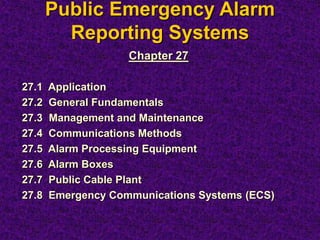
Public Emergency Alarm
Reporting Systems
Chapter 27
27.1 Application
27.2 General Fundamentals
27.3 Management and Maintenance
27.4 Communications Methods
27.5 Alarm Processing Equipment
27.6 Alarm Boxes
27.7 Public Cable Plant
27.8 Emergency Communications Systems (ECS)
Public Emergency Alarm
Reporting Systems
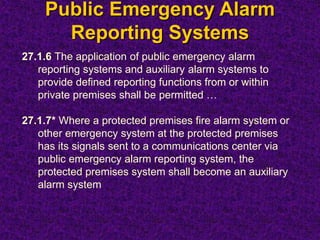
27.1.6 The application of public emergency alarm
reporting systems and auxiliary alarm systems to
provide defined reporting functions from or within
private premises shall be permitted …
27.1.7* Where a protected premises fire alarm system or
other emergency system at the protected premises
has its signals sent to a communications center via
public emergency alarm reporting system, the
protected premises system shall become an auxiliary
alarm system
Public Emergency Alarm
Reporting Systems
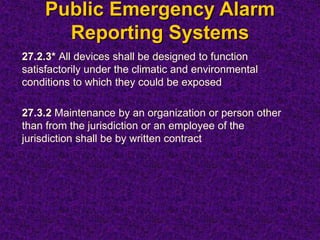
27.2.3* All devices shall be designed to function
satisfactorily under the climatic and environmental
conditions to which they could be exposed
27.3.2 Maintenance by an organization or person other
than from the jurisdiction or an employee of the
jurisdiction shall be by written contract
Public Emergency Alarm
Reporting Systems
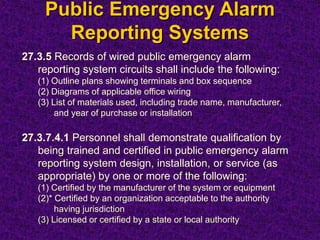
27.3.5 Records of wired public emergency alarm
reporting system circuits shall include the following:
(1) Outline plans showing terminals and box sequence
(2) Diagrams of applicable office wiring
(3) List of materials used, including trade name, manufacturer,
and year of purchase or installation
27.3.7.4.1 Personnel shall demonstrate qualification by
being trained and certified in public emergency alarm
reporting system design, installation, or service (as
appropriate) by one or more of the following:
(1) Certified by the manufacturer of the system or equipment
(2)* Certified by an organization acceptable to the authority
having jurisdiction
(3) Licensed or certified by a state or local authority
Public Emergency Alarm
Reporting Systems
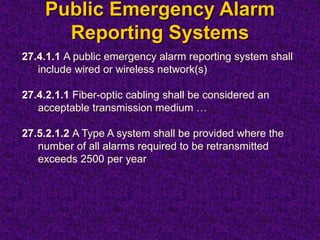
27.4.1.1 A public emergency alarm reporting system shall
include wired or wireless network(s)
27.4.2.1.1 Fiber-optic cabling shall be considered an
acceptable transmission medium …
27.5.2.1.2 A Type A system shall be provided where the
number of all alarms required to be retransmitted
exceeds 2500 per year
Public Emergency Alarm
Reporting Systems
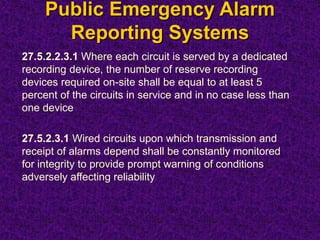
27.5.2.2.3.1 Where each circuit is served by a dedicated
recording device, the number of reserve recording
devices required on-site shall be equal to at least 5
percent of the circuits in service and in no case less than
one device
27.5.2.3.1 Wired circuits upon which transmission and
receipt of alarms depend shall be constantly monitored
for integrity to provide prompt warning of conditions
adversely affecting reliability
Public Emergency Alarm
Reporting Systems
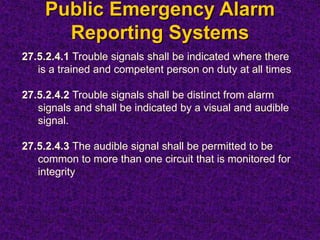
27.5.2.4.1 Trouble signals shall be indicated where there
is a trained and competent person on duty at all times
27.5.2.4.2 Trouble signals shall be distinct from alarm
signals and shall be indicated by a visual and audible
signal.
27.5.2.4.3 The audible signal shall be permitted to be
common to more than one circuit that is monitored for
integrity
Public Emergency Alarm
Reporting Systems
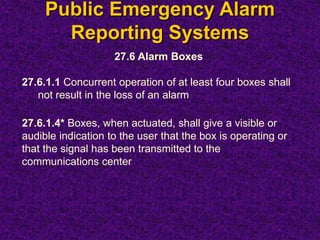
27.6 Alarm Boxes
27.6.1.1 Concurrent operation of at least four boxes shall
not result in the loss of an alarm
27.6.1.4* Boxes, when actuated, shall give a visible or
audible indication to the user that the box is operating or
that the signal has been transmitted to the
communications center
Public Emergency Alarm
Reporting Systems
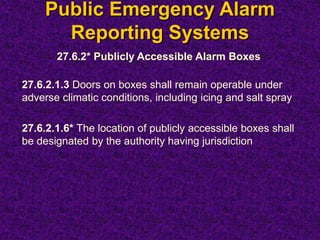
27.6.2* Publicly Accessible Alarm Boxes
27.6.2.1.3 Doors on boxes shall remain operable under
adverse climatic conditions, including icing and salt spray
27.6.2.1.6* The location of publicly accessible boxes shall
be designated by the authority having jurisdiction
Public Emergency Alarm
Reporting Systems
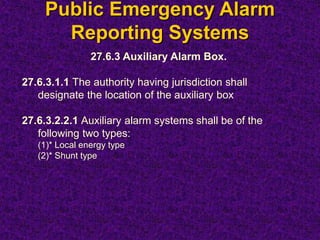
27.6.3 Auxiliary Alarm Box.
27.6.3.1.1 The authority having jurisdiction shall
designate the location of the auxiliary box
27.6.3.2.2.1 Auxiliary alarm systems shall be of the
following two types:
(1)* Local energy type
(2)* Shunt type
Public Emergency Alarm
Reporting Systems
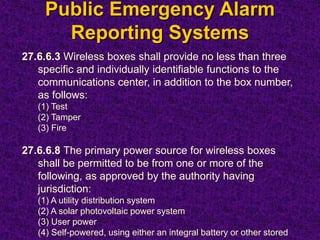
27.6.6.3 Wireless boxes shall provide no less than three
specific and individually identifiable functions to the
communications center, in addition to the box number,
as follows:
(1) Test
(2) Tamper
(3) Fire
27.6.6.8 The primary power source for wireless boxes
shall be permitted to be from one or more of the
following, as approved by the authority having
jurisdiction:
(1) A utility distribution system
(2) A solar photovoltaic power system
(3) User power
(4) Self-powered, using either an integral battery or other stored

Fire alarm 3-e-public_emergency_alarm_reporting_systems

  • 1.
  • 2.
    Referenced Publications All thesemodules are based upon the NFPA 70 and the NFPA 72 publications unless otherwise dictated.
  • 3.
    Agenda  Part 1Fire Alarm System Fundamentals  Part 2 Initiating Devices Protected Premises Fire Alarm Systems Part 3 Circuits & Pathways Inspection Testing & Maintenance Notification Appliances Special Functions
  • 4.
    Agenda NFPA 72  Chapter21 Emergency Control Functions & Interfaces  Chapter 23 Protected Premises Fire Alarm Systems  Chapter 24 Emergency Communication Systems  Chapter 26 Supervising Station Alarm Systems Chapter 27 Public Emergency Alarm Reporting Systems Chapter 29 Single and Multiple-Station Alarms and Household Fire Alarm Chapters 22 / 25 / 28 Reserved
  • 5.
    Public Emergency Alarm ReportingSystems Chapter 27 27.1 Application 27.2 General Fundamentals 27.3 Management and Maintenance 27.4 Communications Methods 27.5 Alarm Processing Equipment 27.6 Alarm Boxes 27.7 Public Cable Plant 27.8 Emergency Communications Systems (ECS)
  • 6.
    Public Emergency Alarm ReportingSystems 27.1.6 The application of public emergency alarm reporting systems and auxiliary alarm systems to provide defined reporting functions from or within private premises shall be permitted … 27.1.7* Where a protected premises fire alarm system or other emergency system at the protected premises has its signals sent to a communications center via public emergency alarm reporting system, the protected premises system shall become an auxiliary alarm system
  • 7.
    Public Emergency Alarm ReportingSystems 27.2.3* All devices shall be designed to function satisfactorily under the climatic and environmental conditions to which they could be exposed 27.3.2 Maintenance by an organization or person other than from the jurisdiction or an employee of the jurisdiction shall be by written contract
  • 8.
    Public Emergency Alarm ReportingSystems 27.3.5 Records of wired public emergency alarm reporting system circuits shall include the following: (1) Outline plans showing terminals and box sequence (2) Diagrams of applicable office wiring (3) List of materials used, including trade name, manufacturer, and year of purchase or installation 27.3.7.4.1 Personnel shall demonstrate qualification by being trained and certified in public emergency alarm reporting system design, installation, or service (as appropriate) by one or more of the following: (1) Certified by the manufacturer of the system or equipment (2)* Certified by an organization acceptable to the authority having jurisdiction (3) Licensed or certified by a state or local authority
  • 9.
    Public Emergency Alarm ReportingSystems 27.4.1.1 A public emergency alarm reporting system shall include wired or wireless network(s) 27.4.2.1.1 Fiber-optic cabling shall be considered an acceptable transmission medium … 27.5.2.1.2 A Type A system shall be provided where the number of all alarms required to be retransmitted exceeds 2500 per year
  • 10.
    Public Emergency Alarm ReportingSystems 27.5.2.2.3.1 Where each circuit is served by a dedicated recording device, the number of reserve recording devices required on-site shall be equal to at least 5 percent of the circuits in service and in no case less than one device 27.5.2.3.1 Wired circuits upon which transmission and receipt of alarms depend shall be constantly monitored for integrity to provide prompt warning of conditions adversely affecting reliability
  • 11.
    Public Emergency Alarm ReportingSystems 27.5.2.4.1 Trouble signals shall be indicated where there is a trained and competent person on duty at all times 27.5.2.4.2 Trouble signals shall be distinct from alarm signals and shall be indicated by a visual and audible signal. 27.5.2.4.3 The audible signal shall be permitted to be common to more than one circuit that is monitored for integrity
  • 12.
    Public Emergency Alarm ReportingSystems 27.6 Alarm Boxes 27.6.1.1 Concurrent operation of at least four boxes shall not result in the loss of an alarm 27.6.1.4* Boxes, when actuated, shall give a visible or audible indication to the user that the box is operating or that the signal has been transmitted to the communications center
  • 13.
    Public Emergency Alarm ReportingSystems 27.6.2* Publicly Accessible Alarm Boxes 27.6.2.1.3 Doors on boxes shall remain operable under adverse climatic conditions, including icing and salt spray 27.6.2.1.6* The location of publicly accessible boxes shall be designated by the authority having jurisdiction
  • 14.
    Public Emergency Alarm ReportingSystems 27.6.3 Auxiliary Alarm Box. 27.6.3.1.1 The authority having jurisdiction shall designate the location of the auxiliary box 27.6.3.2.2.1 Auxiliary alarm systems shall be of the following two types: (1)* Local energy type (2)* Shunt type
  • 15.
    Public Emergency Alarm ReportingSystems 27.6.6.3 Wireless boxes shall provide no less than three specific and individually identifiable functions to the communications center, in addition to the box number, as follows: (1) Test (2) Tamper (3) Fire 27.6.6.8 The primary power source for wireless boxes shall be permitted to be from one or more of the following, as approved by the authority having jurisdiction: (1) A utility distribution system (2) A solar photovoltaic power system (3) User power (4) Self-powered, using either an integral battery or other stored