Fiber Optic Communication
System
Presenter : Saffi Sultan
Purpose of using fiber optic communication
 For gigabits and beyond gigabits transmission of data, the fiber optic
communication is the ideal choice.
This type of communication is used to transmit voice, video,
telemetry and data over long distances and local area networks or
computer networks.
It uses light wave technology to transmit the data over a fiber by
changing electronic signals into light.
Basic Elements
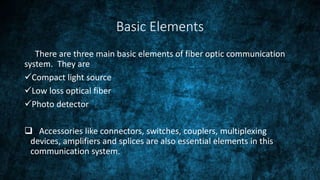
There are three main basic elements of fiber optic communication
system. They are
Compact light source
Low loss optical fiber
Photo detector
 Accessories like connectors, switches, couplers, multiplexing
devices, amplifiers and splices are also essential elements in this
communication system.
Compact Light Source
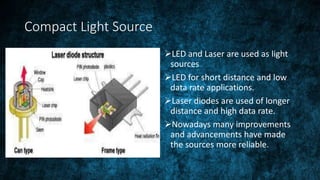
LED and Laser are used as light
sources
LED for short distance and low
data rate applications.
Laser diodes are used of longer
distance and high data rate.
Nowadays many improvements
and advancements have made
the sources more reliable.
Comparison of LED and Laser diode
Low loss optical fiber
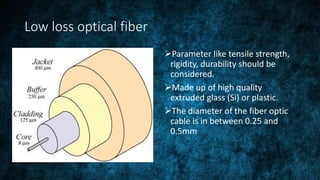
Parameter like tensile strength,
rigidity, durability should be
considered.
Made up of high quality
extruded glass (Si) or plastic.
The diameter of the fiber optic
cable is in between 0.25 and
0.5mm
Types of optical fibers
Single mode fibers:
Transmits one signal per fiber
It is used in telephone and TV sets
Multi mode fibers:
Transmits many signals per fiber
It is used in computer and LAN
Photo Detectors:
It converts light signal back to an electrical signal.
There are two types
i) PN photo diode
ii) Avalanche Photo diode
Composition of materials vary based on application’s wavelength
(Silicon, Germanium, InGaAs, etc.)
Overview of fiber optic communication
Working:
A fiber optic communication network consists of transmitting and
receiving circuitry, a light source and detector devices.
When the electrical signal is given as input, it converts them into light
signal with the help of a light source in the transmitter circuitry.
The light beam from the source is carried by a fiber optic cable to the
destination circuitry wherein the information is transmitted back to
the electrical signal by a receiver circuit.
Receiver Circuit:
The receiver circuit consists of a photo detector along with an
appropriate electronic circuit.
The photo detector is capable of measuring magnitude, frequency
and phase of the optic field.
Both LED and Laser can be used as light sources based on the
application.
THANK
YOU

Fiber Optic Communication System

  • 1.
  • 2.
    Purpose of usingfiber optic communication  For gigabits and beyond gigabits transmission of data, the fiber optic communication is the ideal choice. This type of communication is used to transmit voice, video, telemetry and data over long distances and local area networks or computer networks. It uses light wave technology to transmit the data over a fiber by changing electronic signals into light.
  • 3.
    Basic Elements There arethree main basic elements of fiber optic communication system. They are Compact light source Low loss optical fiber Photo detector  Accessories like connectors, switches, couplers, multiplexing devices, amplifiers and splices are also essential elements in this communication system.
  • 4.
    Compact Light Source LEDand Laser are used as light sources LED for short distance and low data rate applications. Laser diodes are used of longer distance and high data rate. Nowadays many improvements and advancements have made the sources more reliable.
  • 5.
    Comparison of LEDand Laser diode
  • 6.
    Low loss opticalfiber Parameter like tensile strength, rigidity, durability should be considered. Made up of high quality extruded glass (Si) or plastic. The diameter of the fiber optic cable is in between 0.25 and 0.5mm
  • 7.
    Types of opticalfibers Single mode fibers: Transmits one signal per fiber It is used in telephone and TV sets Multi mode fibers: Transmits many signals per fiber It is used in computer and LAN
  • 8.
    Photo Detectors: It convertslight signal back to an electrical signal. There are two types i) PN photo diode ii) Avalanche Photo diode Composition of materials vary based on application’s wavelength (Silicon, Germanium, InGaAs, etc.)
  • 9.
    Overview of fiberoptic communication
  • 10.
    Working: A fiber opticcommunication network consists of transmitting and receiving circuitry, a light source and detector devices. When the electrical signal is given as input, it converts them into light signal with the help of a light source in the transmitter circuitry. The light beam from the source is carried by a fiber optic cable to the destination circuitry wherein the information is transmitted back to the electrical signal by a receiver circuit.
  • 11.
    Receiver Circuit: The receivercircuit consists of a photo detector along with an appropriate electronic circuit. The photo detector is capable of measuring magnitude, frequency and phase of the optic field. Both LED and Laser can be used as light sources based on the application.
  • 12.