FHRP
www.silantia.com1
 There are 3 types of First Hop Redundancy Protocol (FHRP).
 HSRP version 1 and version 2
 VRRP
 GLBP
All above protocol run on per VRF and per VDC basis and all 3 can act as BFD
client.
Only one of these supports IPv6.
FHRP is L3 concept which requires M1 line cards to be present on VDC.
HSRP
www.silantia.com2
 Hot Standby Router Protocol
 Version 1
 Uses IP 224.0.0.2 and UDP port 1985 for Hello messages
 The virtual MAC address is in form of 0000.0C07.ACxy, where xy
is the HSRP group number in hex
 Supports up to 255 group
 Version 2
 Uses IP 224.0.0.102 for Hello messages
 Supports large number of HSRP group up to 4095
 The virtual MAC address is in form of 0000.0C9F.Fxyz, where
xyz is the HSRP group number in hex
HSRP
www.silantia.com3
 In NX-OS all HSRP configuration is done under hsrp <group#> in interface
configuration mode.
 One difference to remember is there is no Standby command all standby commands
in IOS are replaced with hsrp command.
 E.g. show standby brief is replaced with show hsrp brief in NX-OS.
 Always turn on “feature hsrp” before configuring anything. Turning on feature loads
HSRP commands and software module into NX-OS which will allows you configure
HSRP.
HSRP
www.silantia.com4
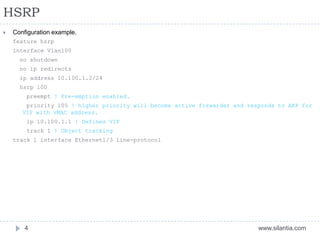
 Configuration example.
feature hsrp
interface Vlan100
no shutdown
no ip redirects
ip address 10.100.1.2/24
hsrp 100
preempt ! Pre-emption enabled.
priority 105 ! higher priority will become active forwarder and responds to ARP for
VIP with vMAC address.
ip 10.100.1.1 ! Defines VIP
track 1 ! Object tracking
track 1 interface Ethernet1/3 line-protocol
HSRP
www.silantia.com5
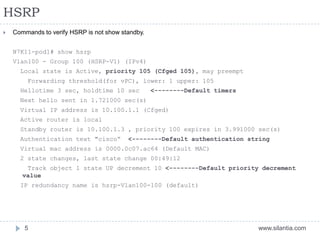
 Commands to verify HSRP is not show standby.
N7K11-pod1# show hsrp
Vlan100 - Group 100 (HSRP-V1) (IPv4)
Local state is Active, priority 105 (Cfged 105), may preempt
Forwarding threshold(for vPC), lower: 1 upper: 105
Hellotime 3 sec, holdtime 10 sec <--------Default timers
Next hello sent in 1.721000 sec(s)
Virtual IP address is 10.100.1.1 (Cfged)
Active router is local
Standby router is 10.100.1.3 , priority 100 expires in 3.991000 sec(s)
Authentication text "cisco“ <--------Default authentication string
Virtual mac address is 0000.0c07.ac64 (Default MAC)
2 state changes, last state change 00:49:12
Track object 1 state UP decrement 10 <--------Default priority decrement
value
IP redundancy name is hsrp-Vlan100-100 (default)
VPC and HSRP
www.silantia.com6
 Each vpc peer is a active HSRP forwarder regardless of their priority. i.e if any packet with
destination IP address as Virtual IP and MAC address as Virtual MAC address received on a
standby gateway it will be routed locally without going thru vpc peer.
 You no longer need to configure different priority value for different SVI or No need to configure
multiple HSRP group on single interface to load balance traffic.
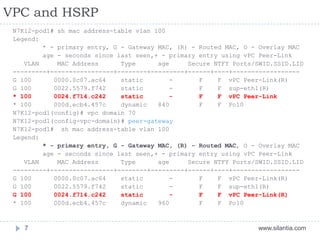
 VPC also introduces a concept of peer-gateway. If peer-gateway is enabled then both vpc peers
forward traffic destined to each other’s MAC addresses.
 This whole slide will be explained in lab demo.
VPC and HSRP
www.silantia.com7
N7K12-pod1# sh mac address-table vlan 100
Legend:
* - primary entry, G - Gateway MAC, (R) - Routed MAC, O - Overlay MAC
age - seconds since last seen,+ - primary entry using vPC Peer-Link
VLAN MAC Address Type age Secure NTFY Ports/SWID.SSID.LID
---------+-----------------+--------+---------+------+----+------------------
G 100 0000.0c07.ac64 static - F F vPC Peer-Link(R)
G 100 0022.5579.f742 static - F F sup-eth1(R)
* 100 0024.f714.c242 static - F F vPC Peer-Link
* 100 000d.ecb4.457c dynamic 840 F F Po10
N7K12-pod1(config)# vpc domain 70
N7K12-pod1(config-vpc-domain)# peer-gateway
N7K12-pod1# sh mac address-table vlan 100
Legend:
* - primary entry, G - Gateway MAC, (R) - Routed MAC, O - Overlay MAC
age - seconds since last seen,+ - primary entry using vPC Peer-Link
VLAN MAC Address Type age Secure NTFY Ports/SWID.SSID.LID
---------+-----------------+--------+---------+------+----+------------------
G 100 0000.0c07.ac64 static - F F vPC Peer-Link(R)
G 100 0022.5579.f742 static - F F sup-eth1(R)
G 100 0024.f714.c242 static - F F vPC Peer-Link(R)
* 100 000d.ecb4.457c dynamic 960 F F Po10
VRRP
www.silantia.com8
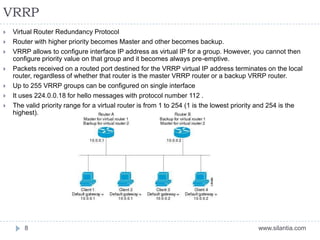
 Virtual Router Redundancy Protocol
 Router with higher priority becomes Master and other becomes backup.
 VRRP allows to configure interface IP address as virtual IP for a group. However, you cannot then
configure priority value on that group and it becomes always pre-emptive.
 Packets received on a routed port destined for the VRRP virtual IP address terminates on the local
router, regardless of whether that router is the master VRRP router or a backup VRRP router.
 Up to 255 VRRP groups can be configured on single interface
 It uses 224.0.0.18 for hello messages with protocol number 112 .
 The valid priority range for a virtual router is from 1 to 254 (1 is the lowest priority and 254 is the
highest).
VRRP
www.silantia.com9
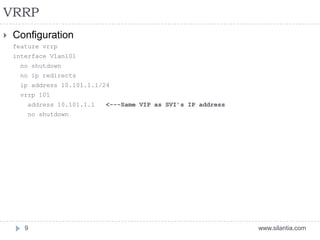
 Configuration
feature vrrp
interface Vlan101
no shutdown
no ip redirects
ip address 10.101.1.1/24
vrrp 101
address 10.101.1.1 <---Same VIP as SVI’s IP address
no shutdown
VRRP
www.silantia.com10
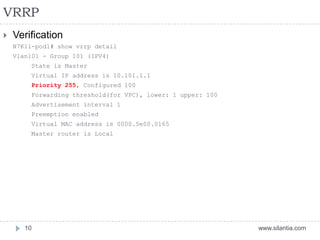
 Verification
N7K11-pod1# show vrrp detail
Vlan101 - Group 101 (IPV4)
State is Master
Virtual IP address is 10.101.1.1
Priority 255, Configured 100
Forwarding threshold(for VPC), lower: 1 upper: 100
Advertisement interval 1
Preemption enabled
Virtual MAC address is 0000.5e00.0165
Master router is Local
GLBP
www.silantia.com11
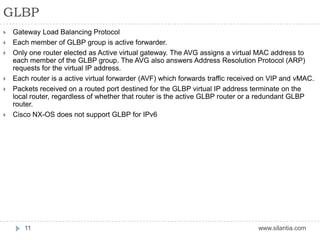
 Gateway Load Balancing Protocol
 Each member of GLBP group is active forwarder.
 Only one router elected as Active virtual gateway. The AVG assigns a virtual MAC address to
each member of the GLBP group. The AVG also answers Address Resolution Protocol (ARP)
requests for the virtual IP address.
 Each router is a active virtual forwarder (AVF) which forwards traffic received on VIP and vMAC.
 Packets received on a routed port destined for the GLBP virtual IP address terminate on the
local router, regardless of whether that router is the active GLBP router or a redundant GLBP
router.
 Cisco NX-OS does not support GLBP for IPv6
GLBP
www.silantia.com12
 Three types of load balancing that you can configure
 load-balancing [host-dependent | round-robin | weighted]
 Round-robin—GLBP cycles through the virtual MAC addresses sent in ARP replies, load
balancing the traffic across all the AVFs.
 Weighted—AVG uses the advertised weight for an AVF to decide the load directed to the AVF. A
higher weight means that the AVG directs more traffic to the AVF.
 Host dependent—GLBP uses the MAC address of the host to determine which virtual MAC
address to direct the host to use. This algorithm guarantees that a host gets the same virtual
MAC address if the number of virtual forwarders does not change.
GLBP
www.silantia.com13
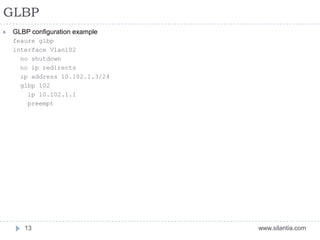
 GLBP configuration example
feaure glbp
interface Vlan102
no shutdown
no ip redirects
ip address 10.102.1.3/24
glbp 102
ip 10.102.1.1
preempt
GLBP
www.silantia.com14
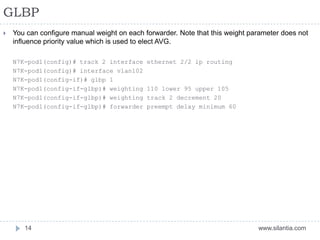
 You can configure manual weight on each forwarder. Note that this weight parameter does not
influence priority value which is used to elect AVG.
N7K-pod1(config)# track 2 interface ethernet 2/2 ip routing
N7K-pod1(config)# interface vlan102
N7K-pod1(config-if)# glbp 1
N7K-pod1(config-if-glbp)# weighting 110 lower 95 upper 105
N7K-pod1(config-if-glbp)# weighting track 2 decrement 20
N7K-pod1(config-if-glbp)# forwarder preempt delay minimum 60
GLBP
www.silantia.com15
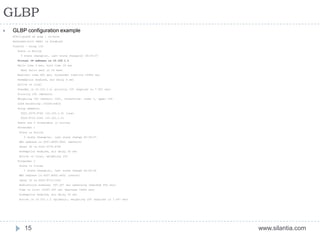
 GLBP configuration example
N7K12-pod1# sh glbp | no-more
Extended-hold (NSF) is Disabled
Vlan102 - Group 102
State is Active
3 state change(s), last state change(s) 00:29:37
Virtual IP address is 10.102.1.1
Hello time 3 sec, hold time 10 sec
Next hello sent in 53 msec
Redirect time 600 sec, forwarder time-out 14400 sec
Preemption enabled, min delay 0 sec
Active is local
Standby is 10.102.1.2, priority 100 (expires in 7.547 sec)
Priority 100 (default)
Weighting 100 (default 100), thresholds: lower 1, upper 100
Load balancing: round-robin
Group members:
0022.5579.F742 (10.102.1.3) local
0024.F714.C242 (10.102.1.2)
There are 2 forwarders (1 active)
Forwarder 1
State is Active
2 state change(s), last state change 00:29:27
MAC address is 0007.B400.6601 (default)
Owner ID is 0022.5579.F742
Preemption enabled, min delay 30 sec
Active is local, weighting 100
Forwarder 2
State is Listen
1 state change(s), last state change 00:29:24
MAC address is 0007.B400.6602 (learnt)
Owner ID is 0024.F714.C242
Redirection enabled, 597.547 sec remaining (maximum 600 sec)
Time to live: 14397.547 sec (maximum 14400 sec)
Preemption enabled, min delay 30 sec
Active is 10.102.1.2 (primary), weighting 100 (expires in 7.547 sec)
GLBP
www.silantia.com16
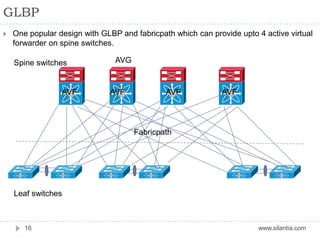
 One popular design with GLBP and fabricpath which can provide upto 4 active virtual
forwarder on spine switches.
AVF AVF AVF AVF
AVGSpine switches
Leaf switches
Fabricpath
FHRP
www.silantia.com17
 Q & A

Fhrp notes

  • 1.
    FHRP www.silantia.com1  There are3 types of First Hop Redundancy Protocol (FHRP).  HSRP version 1 and version 2  VRRP  GLBP All above protocol run on per VRF and per VDC basis and all 3 can act as BFD client. Only one of these supports IPv6. FHRP is L3 concept which requires M1 line cards to be present on VDC.
  • 2.
    HSRP www.silantia.com2  Hot StandbyRouter Protocol  Version 1  Uses IP 224.0.0.2 and UDP port 1985 for Hello messages  The virtual MAC address is in form of 0000.0C07.ACxy, where xy is the HSRP group number in hex  Supports up to 255 group  Version 2  Uses IP 224.0.0.102 for Hello messages  Supports large number of HSRP group up to 4095  The virtual MAC address is in form of 0000.0C9F.Fxyz, where xyz is the HSRP group number in hex
  • 3.
    HSRP www.silantia.com3  In NX-OSall HSRP configuration is done under hsrp <group#> in interface configuration mode.  One difference to remember is there is no Standby command all standby commands in IOS are replaced with hsrp command.  E.g. show standby brief is replaced with show hsrp brief in NX-OS.  Always turn on “feature hsrp” before configuring anything. Turning on feature loads HSRP commands and software module into NX-OS which will allows you configure HSRP.
  • 4.
    HSRP www.silantia.com4  Configuration example. featurehsrp interface Vlan100 no shutdown no ip redirects ip address 10.100.1.2/24 hsrp 100 preempt ! Pre-emption enabled. priority 105 ! higher priority will become active forwarder and responds to ARP for VIP with vMAC address. ip 10.100.1.1 ! Defines VIP track 1 ! Object tracking track 1 interface Ethernet1/3 line-protocol
  • 5.
    HSRP www.silantia.com5  Commands toverify HSRP is not show standby. N7K11-pod1# show hsrp Vlan100 - Group 100 (HSRP-V1) (IPv4) Local state is Active, priority 105 (Cfged 105), may preempt Forwarding threshold(for vPC), lower: 1 upper: 105 Hellotime 3 sec, holdtime 10 sec <--------Default timers Next hello sent in 1.721000 sec(s) Virtual IP address is 10.100.1.1 (Cfged) Active router is local Standby router is 10.100.1.3 , priority 100 expires in 3.991000 sec(s) Authentication text "cisco“ <--------Default authentication string Virtual mac address is 0000.0c07.ac64 (Default MAC) 2 state changes, last state change 00:49:12 Track object 1 state UP decrement 10 <--------Default priority decrement value IP redundancy name is hsrp-Vlan100-100 (default)
  • 6.
    VPC and HSRP www.silantia.com6 Each vpc peer is a active HSRP forwarder regardless of their priority. i.e if any packet with destination IP address as Virtual IP and MAC address as Virtual MAC address received on a standby gateway it will be routed locally without going thru vpc peer.  You no longer need to configure different priority value for different SVI or No need to configure multiple HSRP group on single interface to load balance traffic.  VPC also introduces a concept of peer-gateway. If peer-gateway is enabled then both vpc peers forward traffic destined to each other’s MAC addresses.  This whole slide will be explained in lab demo.
  • 7.
    VPC and HSRP www.silantia.com7 N7K12-pod1#sh mac address-table vlan 100 Legend: * - primary entry, G - Gateway MAC, (R) - Routed MAC, O - Overlay MAC age - seconds since last seen,+ - primary entry using vPC Peer-Link VLAN MAC Address Type age Secure NTFY Ports/SWID.SSID.LID ---------+-----------------+--------+---------+------+----+------------------ G 100 0000.0c07.ac64 static - F F vPC Peer-Link(R) G 100 0022.5579.f742 static - F F sup-eth1(R) * 100 0024.f714.c242 static - F F vPC Peer-Link * 100 000d.ecb4.457c dynamic 840 F F Po10 N7K12-pod1(config)# vpc domain 70 N7K12-pod1(config-vpc-domain)# peer-gateway N7K12-pod1# sh mac address-table vlan 100 Legend: * - primary entry, G - Gateway MAC, (R) - Routed MAC, O - Overlay MAC age - seconds since last seen,+ - primary entry using vPC Peer-Link VLAN MAC Address Type age Secure NTFY Ports/SWID.SSID.LID ---------+-----------------+--------+---------+------+----+------------------ G 100 0000.0c07.ac64 static - F F vPC Peer-Link(R) G 100 0022.5579.f742 static - F F sup-eth1(R) G 100 0024.f714.c242 static - F F vPC Peer-Link(R) * 100 000d.ecb4.457c dynamic 960 F F Po10
  • 8.
    VRRP www.silantia.com8  Virtual RouterRedundancy Protocol  Router with higher priority becomes Master and other becomes backup.  VRRP allows to configure interface IP address as virtual IP for a group. However, you cannot then configure priority value on that group and it becomes always pre-emptive.  Packets received on a routed port destined for the VRRP virtual IP address terminates on the local router, regardless of whether that router is the master VRRP router or a backup VRRP router.  Up to 255 VRRP groups can be configured on single interface  It uses 224.0.0.18 for hello messages with protocol number 112 .  The valid priority range for a virtual router is from 1 to 254 (1 is the lowest priority and 254 is the highest).
  • 9.
    VRRP www.silantia.com9  Configuration feature vrrp interfaceVlan101 no shutdown no ip redirects ip address 10.101.1.1/24 vrrp 101 address 10.101.1.1 <---Same VIP as SVI’s IP address no shutdown
  • 10.
    VRRP www.silantia.com10  Verification N7K11-pod1# showvrrp detail Vlan101 - Group 101 (IPV4) State is Master Virtual IP address is 10.101.1.1 Priority 255, Configured 100 Forwarding threshold(for VPC), lower: 1 upper: 100 Advertisement interval 1 Preemption enabled Virtual MAC address is 0000.5e00.0165 Master router is Local
  • 11.
    GLBP www.silantia.com11  Gateway LoadBalancing Protocol  Each member of GLBP group is active forwarder.  Only one router elected as Active virtual gateway. The AVG assigns a virtual MAC address to each member of the GLBP group. The AVG also answers Address Resolution Protocol (ARP) requests for the virtual IP address.  Each router is a active virtual forwarder (AVF) which forwards traffic received on VIP and vMAC.  Packets received on a routed port destined for the GLBP virtual IP address terminate on the local router, regardless of whether that router is the active GLBP router or a redundant GLBP router.  Cisco NX-OS does not support GLBP for IPv6
  • 12.
    GLBP www.silantia.com12  Three typesof load balancing that you can configure  load-balancing [host-dependent | round-robin | weighted]  Round-robin—GLBP cycles through the virtual MAC addresses sent in ARP replies, load balancing the traffic across all the AVFs.  Weighted—AVG uses the advertised weight for an AVF to decide the load directed to the AVF. A higher weight means that the AVG directs more traffic to the AVF.  Host dependent—GLBP uses the MAC address of the host to determine which virtual MAC address to direct the host to use. This algorithm guarantees that a host gets the same virtual MAC address if the number of virtual forwarders does not change.
  • 13.
    GLBP www.silantia.com13  GLBP configurationexample feaure glbp interface Vlan102 no shutdown no ip redirects ip address 10.102.1.3/24 glbp 102 ip 10.102.1.1 preempt
  • 14.
    GLBP www.silantia.com14  You canconfigure manual weight on each forwarder. Note that this weight parameter does not influence priority value which is used to elect AVG. N7K-pod1(config)# track 2 interface ethernet 2/2 ip routing N7K-pod1(config)# interface vlan102 N7K-pod1(config-if)# glbp 1 N7K-pod1(config-if-glbp)# weighting 110 lower 95 upper 105 N7K-pod1(config-if-glbp)# weighting track 2 decrement 20 N7K-pod1(config-if-glbp)# forwarder preempt delay minimum 60
  • 15.
    GLBP www.silantia.com15  GLBP configurationexample N7K12-pod1# sh glbp | no-more Extended-hold (NSF) is Disabled Vlan102 - Group 102 State is Active 3 state change(s), last state change(s) 00:29:37 Virtual IP address is 10.102.1.1 Hello time 3 sec, hold time 10 sec Next hello sent in 53 msec Redirect time 600 sec, forwarder time-out 14400 sec Preemption enabled, min delay 0 sec Active is local Standby is 10.102.1.2, priority 100 (expires in 7.547 sec) Priority 100 (default) Weighting 100 (default 100), thresholds: lower 1, upper 100 Load balancing: round-robin Group members: 0022.5579.F742 (10.102.1.3) local 0024.F714.C242 (10.102.1.2) There are 2 forwarders (1 active) Forwarder 1 State is Active 2 state change(s), last state change 00:29:27 MAC address is 0007.B400.6601 (default) Owner ID is 0022.5579.F742 Preemption enabled, min delay 30 sec Active is local, weighting 100 Forwarder 2 State is Listen 1 state change(s), last state change 00:29:24 MAC address is 0007.B400.6602 (learnt) Owner ID is 0024.F714.C242 Redirection enabled, 597.547 sec remaining (maximum 600 sec) Time to live: 14397.547 sec (maximum 14400 sec) Preemption enabled, min delay 30 sec Active is 10.102.1.2 (primary), weighting 100 (expires in 7.547 sec)
  • 16.
    GLBP www.silantia.com16  One populardesign with GLBP and fabricpath which can provide upto 4 active virtual forwarder on spine switches. AVF AVF AVF AVF AVGSpine switches Leaf switches Fabricpath
  • 17.