VLAN Trunking Protocol (VTP)
Trunk Links
•A trunk link is capable of supporting multiple
VLANs.
•Trunk links are typically used to connect switches
to other switches or routers.
•It support trunk links on both Fast Ethernet and
Gigabit Ethernet ports.
VTP
•VTP is a messaging protocol that uses Layer 2 trunk frames
to manage the addition, deletion, and renaming of VLANs
on a network-wide basis.
•VTP allows a network manager to configure a switch so that it
will propagate VLAN configurations to other switches in the
network.
•The switch can be configured in the role of a VTP server or a
VTP client.
•VTP stores VLAN configurations in the VLAN database called
vlan.dat.
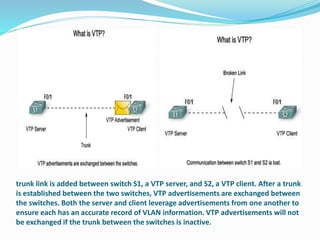
trunk link is added between switch S1, a VTP server, and S2, a VTP client. After a trunk
is established between the two switches, VTP advertisements are exchanged between
the switches. Both the server and client leverage advertisements from one another to
ensure each has an accurate record of VLAN information. VTP advertisements will not
be exchanged if the trunk between the switches is inactive.
VTP Benefits
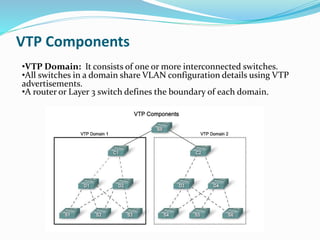
VTP Components
•VTP Domain: It consists of one or more interconnected switches.
•All switches in a domain share VLAN configuration details using VTP
advertisements.
•A router or Layer 3 switch defines the boundary of each domain.
2. VTP Advertisements - VTP uses a hierarchy of advertisements to
distribute and synchronize VLAN configurations across the network.
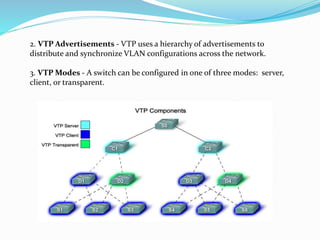
3. VTP Modes - A switch can be configured in one of three modes: server,
client, or transparent.
4. VTP Server - VTP servers advertise the VTP domain VLAN information to
other VTP-enabled switches in the same VTP domain.
VTP servers store the VLAN information for the entire domain in NVRAM.
The server is where VLAN can created, deleted, or renamed for the domain.
5. VTP Client - VTP clients function the same way as VTP servers, but you
cannot create, change, or delete VLANs on a VTP client.
A VTP client only stores the VLAN information for the entire domain while the
switch is on.
A switch reset deletes the VLAN information.
You must configure VTP client mode on a switch.
6. VTP Transparent - Transparent switches forward VTP advertisements to VTP
clients and VTP servers.
Transparent switches do not participate in VTP.
VLANs that are created, renamed, or deleted on transparent switches are local to
that switch only.
7. VTP Pruning-VTP pruning increases network
available bandwidth by restricting flooded traffic to
those trunk links that the traffic must use to reach
the destination devices.
Or
It prevents unnecessary flooding of broadcast
information from one VLAN across all trunks in a
VTP domain.
When VTP pruning is enabled on a network, it
reconfigures the trunk link based o which ports are
configured with which VLANs
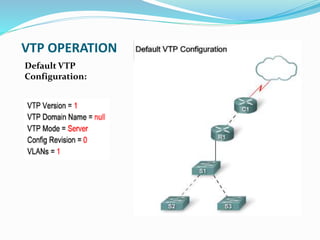
VTP OPERATION
Default VTP
Configuration:
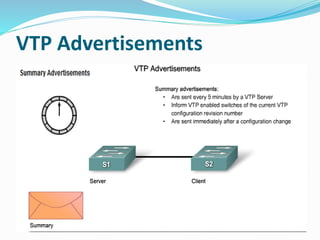
VTP Advertisements
Subset Advertisements
Request advertisements are sent if:
-The VTP domain name has been changed
-The switch receives a summary advertisement with a higher configuration revision
number than its own.
-A subset advertisement message is missed for some reason
-The switch has been reset
Configuring VTP
VLAN Trunking Protocol (VTP)

VLAN Trunking Protocol (VTP)

  • 1.
  • 2.
    Trunk Links •A trunklink is capable of supporting multiple VLANs. •Trunk links are typically used to connect switches to other switches or routers. •It support trunk links on both Fast Ethernet and Gigabit Ethernet ports.
  • 3.
    VTP •VTP is amessaging protocol that uses Layer 2 trunk frames to manage the addition, deletion, and renaming of VLANs on a network-wide basis. •VTP allows a network manager to configure a switch so that it will propagate VLAN configurations to other switches in the network. •The switch can be configured in the role of a VTP server or a VTP client. •VTP stores VLAN configurations in the VLAN database called vlan.dat.
  • 4.
    trunk link isadded between switch S1, a VTP server, and S2, a VTP client. After a trunk is established between the two switches, VTP advertisements are exchanged between the switches. Both the server and client leverage advertisements from one another to ensure each has an accurate record of VLAN information. VTP advertisements will not be exchanged if the trunk between the switches is inactive.
  • 5.
  • 6.
    VTP Components •VTP Domain:It consists of one or more interconnected switches. •All switches in a domain share VLAN configuration details using VTP advertisements. •A router or Layer 3 switch defines the boundary of each domain.
  • 7.
    2. VTP Advertisements- VTP uses a hierarchy of advertisements to distribute and synchronize VLAN configurations across the network. 3. VTP Modes - A switch can be configured in one of three modes: server, client, or transparent.
  • 8.
    4. VTP Server- VTP servers advertise the VTP domain VLAN information to other VTP-enabled switches in the same VTP domain. VTP servers store the VLAN information for the entire domain in NVRAM. The server is where VLAN can created, deleted, or renamed for the domain. 5. VTP Client - VTP clients function the same way as VTP servers, but you cannot create, change, or delete VLANs on a VTP client. A VTP client only stores the VLAN information for the entire domain while the switch is on. A switch reset deletes the VLAN information. You must configure VTP client mode on a switch. 6. VTP Transparent - Transparent switches forward VTP advertisements to VTP clients and VTP servers. Transparent switches do not participate in VTP. VLANs that are created, renamed, or deleted on transparent switches are local to that switch only.
  • 9.
    7. VTP Pruning-VTPpruning increases network available bandwidth by restricting flooded traffic to those trunk links that the traffic must use to reach the destination devices. Or It prevents unnecessary flooding of broadcast information from one VLAN across all trunks in a VTP domain. When VTP pruning is enabled on a network, it reconfigures the trunk link based o which ports are configured with which VLANs
  • 10.
  • 11.
  • 12.
  • 13.
    Request advertisements aresent if: -The VTP domain name has been changed -The switch receives a summary advertisement with a higher configuration revision number than its own. -A subset advertisement message is missed for some reason -The switch has been reset
  • 14.