
OSPF
Contents
• Introduction
• Features
• Link state routing protocol
• Definitions
• Area
• Bringing up adjacencies
• ECMP (Equal Cost Multi path)
Introduction
• OSPF is a link-state routing protocol.
• OSPF designed to be run internal to a single
Autonomous System.
• Each OSPF router maintains an identical Link state
database describing the Autonomous System's
topology.
• routing table is calculated by constructing a shortest-
path tree by using the link state database.
• OSPF quickly detects topological changes in the AS
and calculates new loop-free routes after a period of
convergence.
Features
• Equal-cost multi path
• An area routing capability is provided, enabling an
additional level of routing protection and a reduction
in routing protocol traffic.
• all OSPF routing protocol exchanges are
authenticated
Link state routing Protocol
• Introduction
• Distributing maps
• Calculating the routing table
Introduction
• The basic concept of link-state routing protocol is that
every node constructs a map of the connectivity of
the network, in the form of a graph showing which
nodes are connected to which other nodes.
• Each node independently calculates the best next hop
from it for every possible destination in the network.
• The collection of best next hops forms the routing
table for the node.
Introduction (continue)
• Each router maintains a link-state database
describing the Autonomous System's topology.
• Each participating router has an identical link state
database.
• Each individual piece of this database is a particular
router's local state.
• The router distributes its local state throughout the
Autonomous System by flooding.
• All routers run the same link state algorithm
simultaneously.
• Each router constructs a tree of shortest paths with
itself as root From the link-state database.
Distributing maps
• Determining the neighbors of each node
• Distributing the information for the map : LSA message
flooded throughout the network. The LSA message
a) Identifies the node which is producing it.
b) Identifies all the other nodes to which it is directly connected.
• Creating the map : Map for the network will be constructed
by using the set of LSA’s.
• Notes about this stage : The link-state message giving
information about the neighbors is recomputed, and then
flooded throughout the network, whenever there is a change in
the connectivity between the node and its neighbors.
Calculating the routing table
• Calculating the shortest paths : Each node independently
runs SPF algorithm over the map to determine the shortest path
from itself to every other node in the network
• Filling the routing table : To create the routing table, it is
only necessary to walk the tree, remembering the identity of the
node at the head of each branch, and filling in the routing table
entry for each node one comes across with that identity.
Definitions
• Router ID : A 32-bit number assigned to each router running
the OSPF protocol. This number uniquely identifies the router
within an Autonomous System.
• Adjacency : A relationship formed between selected
neighboring routers for the purpose of exchanging routing
information.
• Link state advertisement : Unit of data describing the local
state of a router’s interfaces and adjacencies.
• Hello Protocol : establishes and maintains neighbor
relationships. Hello protocol elects DR and BDR using election
process.
• Flooding :distributes and synchronizes the link-state database
between OSPF routers.
Definitions (Continue..)
• DR : Generates an LSA for the network.
• BDR : The Backup Designated Router is adjacent to all routers
on the network, and becomes Designated Router when the
previous Designated Router fails.
Area
• Introduction
• OSPF areas
Introduction
• OSPF allows sets of adjacent networks to be grouped
together. Such a group, together with the routers
having interfaces to any one of the included networks
is called an area.
• Each area has its own link-state database.
• The topology of an area is hidden from the rest of the
Autonomous System , which enables a significant
reduction in routing traffic.
• Routing within the area is determined only by the
area's own topology.
• The routers belonging to the same area have identical
area link-state databases.
Introduction (Continue)
• Routing in the Autonomous System takes place on
two levels : a) intra-area routing
b) inter-area routing
• Routers classified inside area as shown below:
Internal routers : A router with all directly connected
networks belonging to the same area.
Area Boarder Routers : Router connected to multiple areas
are called area border routers
Backbone Router : A router that has an interface to the
backbone area.
AS boundary router : A router that exchanges routing
information with routers belonging to other Autonomous
Systems.
OSPF Areas
• Backbone :
a) The OSPF backbone is the OSPF Area 0
b) The OSPF backbone always contains all area border routers.
c) The backbone is responsible for distributing routing
information between non-backbone areas.
• Virtual Links :
a) Virtual links can be configured between any two backbone
routers that have an interface to a common non-backbone
area.
b) Virtual links belong to the backbone.
c) The routing protocol traffic that flows along the virtual link
uses intra- area routing.
OSPF Areas
• Stub Area :
a) OSPF allows certain areas to be configured as stub areas.
b) AS- external-LSAs are not flooded into stub areas. This
reduces the link-state database size, and therefore the
memory requirements, for a stub area's internal routers.
c) Backbone cann’t be configured as stub area
d) Virtual links cannot be configured through stub areas.
Bringing up adjacencies
• Hello protocol
• The Synchronization of Databases
• DR
• Neighbor states
• Example for adjacency bring-up
Hello protocol
• The Hello Protocol is responsible for establishing and
maintaining neighbor relationships.
• the Hello Protocol elects a DR and BDR for the
network.
• Each router advertises hello packets itself by
periodically multicasting Hello Packets On broadcast
networks.
The Synchronization of Databases
• The synchronization process begins as soon as the
routers attempt to bring up the adjacency.
• Each router describes its database by sending a
sequence of Database Description packets to its
neighbor.
• Each Database Description Packet describes a set of
LSAs belonging to the router's database.
• This sending and receiving of Database Description
packets is called the "Database Exchange Process".
During this process, the two routers form a
master/slave relationship.
The Synchronization of Databases
(cont)
• When the Database Description Process has
completed and all Link State Requests have been
satisfied, the databases are deemed synchronized
and the routers are marked fully adjacent.
• At this time the adjacency is fully functional and is
advertised in the two routers' router-LSAs.
• The adjacency is used by the flooding procedure as
soon as the Database Exchange Process begins.
DR
• DR performs two main functions for the routing
protocol:
a) DR originates a network-LSA on behalf of the network. This
LSA lists the set of routers currently attached to the network
including the Designated Router.
b) The Designated Router becomes adjacent to all other routers
on the network.
• DR is elected by the Hello Protocol.
• When a router's interface to a network first becomes
functional, it checks to see whether there is currently
a DR for the network. If there is, it accepts that DR,
regardless of its Router Priority. Otherwise, the
router itself becomes Designated Router if it has the
highest Router Priority on the network.
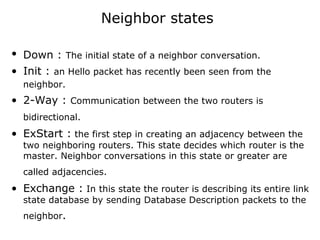
Neighbor states
• Down : The initial state of a neighbor conversation.
• Init : an Hello packet has recently been seen from the
neighbor.
• 2-Way : Communication between the two routers is
bidirectional.
• ExStart : the first step in creating an adjacency between the
two neighboring routers. This state decides which router is the
master. Neighbor conversations in this state or greater are
called adjacencies.
• Exchange : In this state the router is describing its entire link
state database by sending Database Description packets to the
neighbor.
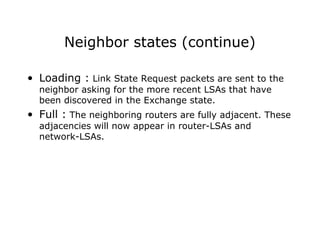
Neighbor states (continue)
• Loading : Link State Request packets are sent to the
neighbor asking for the more recent LSAs that have
been discovered in the Exchange state.
• Full : The neighboring routers are fully adjacent. These
adjacencies will now appear in router-LSAs and
network-LSAs.
Neighbor states (continue)
Figure : Neighbor state changes (Hello Protocol)
Neighbor states (continue)
Figure : Neighbor state changes (Database Exchange)
Example for adjacency bring-up
ECMP
• The cost of a route is described by a single
dimensionless metric.
• When several equal-cost routes to a destination
exist, traffic is distributed equally among them.
QUESTIONS???

Ospf

  • 1.
  • 2.
    Contents • Introduction • Features •Link state routing protocol • Definitions • Area • Bringing up adjacencies • ECMP (Equal Cost Multi path)
  • 3.
    Introduction • OSPF isa link-state routing protocol. • OSPF designed to be run internal to a single Autonomous System. • Each OSPF router maintains an identical Link state database describing the Autonomous System's topology. • routing table is calculated by constructing a shortest- path tree by using the link state database. • OSPF quickly detects topological changes in the AS and calculates new loop-free routes after a period of convergence.
  • 4.
    Features • Equal-cost multipath • An area routing capability is provided, enabling an additional level of routing protection and a reduction in routing protocol traffic. • all OSPF routing protocol exchanges are authenticated
  • 5.
    Link state routingProtocol • Introduction • Distributing maps • Calculating the routing table
  • 6.
    Introduction • The basicconcept of link-state routing protocol is that every node constructs a map of the connectivity of the network, in the form of a graph showing which nodes are connected to which other nodes. • Each node independently calculates the best next hop from it for every possible destination in the network. • The collection of best next hops forms the routing table for the node.
  • 7.
    Introduction (continue) • Eachrouter maintains a link-state database describing the Autonomous System's topology. • Each participating router has an identical link state database. • Each individual piece of this database is a particular router's local state. • The router distributes its local state throughout the Autonomous System by flooding. • All routers run the same link state algorithm simultaneously. • Each router constructs a tree of shortest paths with itself as root From the link-state database.
  • 8.
    Distributing maps • Determiningthe neighbors of each node • Distributing the information for the map : LSA message flooded throughout the network. The LSA message a) Identifies the node which is producing it. b) Identifies all the other nodes to which it is directly connected. • Creating the map : Map for the network will be constructed by using the set of LSA’s. • Notes about this stage : The link-state message giving information about the neighbors is recomputed, and then flooded throughout the network, whenever there is a change in the connectivity between the node and its neighbors.
  • 9.
    Calculating the routingtable • Calculating the shortest paths : Each node independently runs SPF algorithm over the map to determine the shortest path from itself to every other node in the network • Filling the routing table : To create the routing table, it is only necessary to walk the tree, remembering the identity of the node at the head of each branch, and filling in the routing table entry for each node one comes across with that identity.
  • 10.
    Definitions • Router ID: A 32-bit number assigned to each router running the OSPF protocol. This number uniquely identifies the router within an Autonomous System. • Adjacency : A relationship formed between selected neighboring routers for the purpose of exchanging routing information. • Link state advertisement : Unit of data describing the local state of a router’s interfaces and adjacencies. • Hello Protocol : establishes and maintains neighbor relationships. Hello protocol elects DR and BDR using election process. • Flooding :distributes and synchronizes the link-state database between OSPF routers.
  • 11.
    Definitions (Continue..) • DR: Generates an LSA for the network. • BDR : The Backup Designated Router is adjacent to all routers on the network, and becomes Designated Router when the previous Designated Router fails.
  • 12.
  • 13.
    Introduction • OSPF allowssets of adjacent networks to be grouped together. Such a group, together with the routers having interfaces to any one of the included networks is called an area. • Each area has its own link-state database. • The topology of an area is hidden from the rest of the Autonomous System , which enables a significant reduction in routing traffic. • Routing within the area is determined only by the area's own topology. • The routers belonging to the same area have identical area link-state databases.
  • 14.
    Introduction (Continue) • Routingin the Autonomous System takes place on two levels : a) intra-area routing b) inter-area routing • Routers classified inside area as shown below: Internal routers : A router with all directly connected networks belonging to the same area. Area Boarder Routers : Router connected to multiple areas are called area border routers Backbone Router : A router that has an interface to the backbone area. AS boundary router : A router that exchanges routing information with routers belonging to other Autonomous Systems.
  • 15.
    OSPF Areas • Backbone: a) The OSPF backbone is the OSPF Area 0 b) The OSPF backbone always contains all area border routers. c) The backbone is responsible for distributing routing information between non-backbone areas. • Virtual Links : a) Virtual links can be configured between any two backbone routers that have an interface to a common non-backbone area. b) Virtual links belong to the backbone. c) The routing protocol traffic that flows along the virtual link uses intra- area routing.
  • 16.
    OSPF Areas • StubArea : a) OSPF allows certain areas to be configured as stub areas. b) AS- external-LSAs are not flooded into stub areas. This reduces the link-state database size, and therefore the memory requirements, for a stub area's internal routers. c) Backbone cann’t be configured as stub area d) Virtual links cannot be configured through stub areas.
  • 17.
    Bringing up adjacencies •Hello protocol • The Synchronization of Databases • DR • Neighbor states • Example for adjacency bring-up
  • 18.
    Hello protocol • TheHello Protocol is responsible for establishing and maintaining neighbor relationships. • the Hello Protocol elects a DR and BDR for the network. • Each router advertises hello packets itself by periodically multicasting Hello Packets On broadcast networks.
  • 19.
    The Synchronization ofDatabases • The synchronization process begins as soon as the routers attempt to bring up the adjacency. • Each router describes its database by sending a sequence of Database Description packets to its neighbor. • Each Database Description Packet describes a set of LSAs belonging to the router's database. • This sending and receiving of Database Description packets is called the "Database Exchange Process". During this process, the two routers form a master/slave relationship.
  • 20.
    The Synchronization ofDatabases (cont) • When the Database Description Process has completed and all Link State Requests have been satisfied, the databases are deemed synchronized and the routers are marked fully adjacent. • At this time the adjacency is fully functional and is advertised in the two routers' router-LSAs. • The adjacency is used by the flooding procedure as soon as the Database Exchange Process begins.
  • 21.
    DR • DR performstwo main functions for the routing protocol: a) DR originates a network-LSA on behalf of the network. This LSA lists the set of routers currently attached to the network including the Designated Router. b) The Designated Router becomes adjacent to all other routers on the network. • DR is elected by the Hello Protocol. • When a router's interface to a network first becomes functional, it checks to see whether there is currently a DR for the network. If there is, it accepts that DR, regardless of its Router Priority. Otherwise, the router itself becomes Designated Router if it has the highest Router Priority on the network.
  • 22.
    Neighbor states • Down: The initial state of a neighbor conversation. • Init : an Hello packet has recently been seen from the neighbor. • 2-Way : Communication between the two routers is bidirectional. • ExStart : the first step in creating an adjacency between the two neighboring routers. This state decides which router is the master. Neighbor conversations in this state or greater are called adjacencies. • Exchange : In this state the router is describing its entire link state database by sending Database Description packets to the neighbor.
  • 23.
    Neighbor states (continue) •Loading : Link State Request packets are sent to the neighbor asking for the more recent LSAs that have been discovered in the Exchange state. • Full : The neighboring routers are fully adjacent. These adjacencies will now appear in router-LSAs and network-LSAs.
  • 24.
    Neighbor states (continue) Figure: Neighbor state changes (Hello Protocol)
  • 25.
    Neighbor states (continue) Figure: Neighbor state changes (Database Exchange)
  • 26.
  • 27.
    ECMP • The costof a route is described by a single dimensionless metric. • When several equal-cost routes to a destination exist, traffic is distributed equally among them.
  • 28.