Performance Analysis and Functionality
Comparison of FHRP Protocols
BY:
USMAN ANWAR
North China Electric Power University
School of Control and Computer Engineering
2019年6月14日
Study Contents
 Introduction
 Research Purpose
 First hope redundancy protocols
 Results And Discussions
 Conclusion
Study Contents
 Introduction
 Research Purpose
 First hope redundancy protocols
 Results And Discussions
 Conclusion
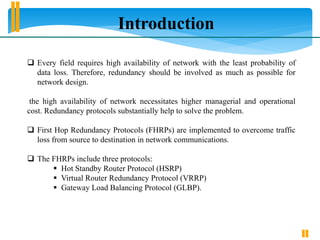
 Every field requires high availability of network with the least probability of
data loss. Therefore, redundancy should be involved as much as possible for
network design.
the high availability of network necessitates higher managerial and operational
cost. Redundancy protocols substantially help to solve the problem.
 First Hop Redundancy Protocols (FHRPs) are implemented to overcome traffic
loss from source to destination in network communications.
 The FHRPs include three protocols:
 Hot Standby Router Protocol (HSRP)
 Virtual Router Redundancy Protocol (VRRP)
 Gateway Load Balancing Protocol (GLBP).
Introduction
 The comprehensive data of the protocols, their working and comparison
between them. The comparison indicates that which protocol is best in which
scenario and which is best among the three protocols. These protocols work on
layer 3 devices that are on the Transport layer.
Cont…
Study Contents
 Introduction
 Research Purpose
 First hope redundancy protocols
 Results And Discussions
 Conclusion
 Evaluate FHRP using GNS3 simulator to deal with the necessity of redundancy in
networks
 Minimizing the packet loss in network communications by FHRP.
Research Purpose
Study Contents
 Introduction
 Research Purpose
 First hope redundancy protocols
 Results And Discussions
 Conclusion
First Hop Redundancy Protocol cont…
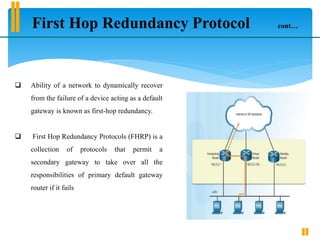
 Ability of a network to dynamically recover
from the failure of a device acting as a default
gateway is known as first-hop redundancy.
 First Hop Redundancy Protocols (FHRP) is a
collection of protocols that permit a
secondary gateway to take over all the
responsibilities of primary default gateway
router if it fails
First Hope Redundancy Protocol cont…
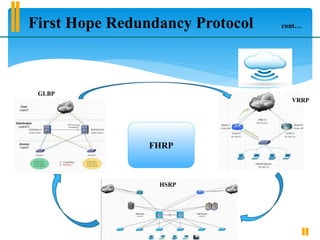
FHRP
GLBP
VRRP
HSRP
First Hope Redundancy Protocol cont…
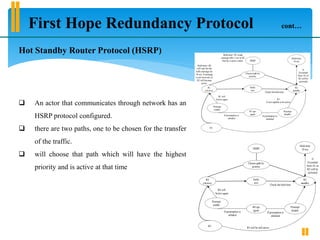
Hot Standby Router Protocol (HSRP)
 An actor that communicates through network has an
HSRP protocol configured.
 there are two paths, one to be chosen for the transfer
of the traffic.
 will choose that path which will have the highest
priority and is active at that time
Choose path by
priority
Hello
text
R1
(Active)
R2
standby
Hold time= R2
will wait for the
hello message for
10 sec, if message
is not received, so
R2 will become
active.
HSRP
Preempt
enable
R1 ups
again
Preempt
disable
Hold time
10 sec
R3
If
Exceeded
from 10, so
R2 will be
activated
Hold time= R1 sends
message after 3 sec to R2
that he is active router.
Check the hold time
R1
Is not capable to be active
If preemption is
enbaled
If preemption is
disbaled
R1 will
Active again
Choose path by
priority
Hello
text
R4
(Active)
R5
standby
HSRP
Preempt
enable
R4 ups
again
Preempt
disable
Hold time
10 sec
R3
If
Exceeded
from 10, so
R2 will be
activated
Check the hold time
If preemption is
enbaled
If preemption is
disbaled
R4 will
Active again
R5 will be still active
First Hope Redundancy Protocol cont…
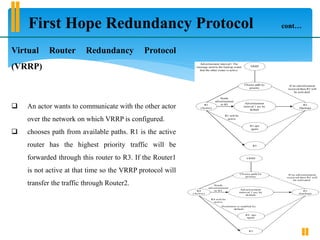
Virtual Router Redundancy Protocol
(VRRP)
 An actor wants to communicate with the other actor
over the network on which VRRP is configured.
 chooses path from available paths. R1 is the active
router has the highest priority traffic will be
forwarded through this router to R3. If the Router1
is not active at that time so the VRRP protocol will
transfer the traffic through Router2.
VRRP
Choose path by
priority
Advertisement
interval 1 sec by
default
R1 ups
again
R3
R1
(Active)
R2
(backup)
Advertisement interval= The
message send to the backup router
that the other router is active.
If no advertisement
received then R2 will
be activated.
R1 will be
active
Sends
advertisement
to R2
VRRP
Choose path by
priority
Advertisement
interval 1 sec by
default
R4 ups
again
R3
R4
(Active)
R5
(backup)
If no advertisement
received then R5 will
be activated.
R4 will be
active
Sends
advertisement
to R5
Preemtion is enabled by
default
First Hope Redundancy Protocol cont…
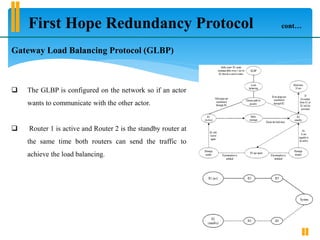
Gateway Load Balancing Protocol (GLBP)
 The GLBP is configured on the network so if an actor
wants to communicate with the other actor.
 Router 1 is active and Router 2 is the standby router at
the same time both routers can send the traffic to
achieve the load balancing.
Study Contents
 Introduction
 Research Purpose
 First hope redundancy protocols
 Results And Discussions
 Conclusion
RESULTS AND DISCUSSIONS
Protocols Packet
Size
CPU
utilization
(%)
Convergence
duration
[second]
Bandwidth
Utilization
[Kbps]
HSRP 100 0.69 8.056 0-1
VRRP 68 1.06 9.934 0-1
GLBP 108 0.54 7.344 0-1
Comparison of HSRP, VRRP and GLBP by using default values of hold
time, priority, preempt and ‘Hello’ time.
COMPARISION RESULTS AND DISCUSSIONS
Protocols Packet
Size
CPU
utilization
(%)
Convergenc
e duration
[Sec.]
Bandwidth
Utilization
[Kbps]
HSRP 100 1.78 3.564 0-3
VRRP 68 2.15 7.935 0-3
GLBP 108 1.62 2.983 0-3
Test was performed by setting priority value 215, hold time to 6
seconds and rest to be the same.
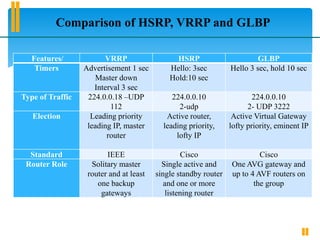
Comparison of HSRP, VRRP and GLBP
Features/ VRRP HSRP GLBP
Timers Advertisement 1 sec
Master down
Interval 3 sec
Hello: 3sec
Hold:10 sec
Hello 3 sec, hold 10 sec
Type of Traffic 224.0.0.18 –UDP
112
224.0.0.10
2-udp
224.0.0.10
2- UDP 3222
Election Leading priority
leading IP, master
router
Active router,
leading priority,
lofty IP
Active Virtual Gateway
lofty priority, eminent IP
Standard IEEE Cisco Cisco
Router Role Solitary master
router and at least
one backup
gateways
Single active and
single standby router
and one or more
listening router
One AVG gateway and
up to 4 AVF routers on
the group
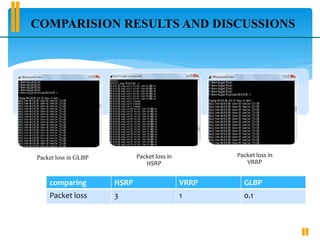
COMPARISION RESULTS AND DISCUSSIONS
Packet loss in GLBP Packet loss in
HSRP
Packet loss in
VRRP
comparing HSRP VRRP GLBP
Packet loss 3 1 0.1
Study Contents
 Introduction
 Research Purpose
 First hope redundancy protocols
 Results And Discussions
 Conclusion
Conclusion cont..
 After a detailed review of these protocols, we have concluded that GLBP
outperforms HSRP and VRRP. It utilizes available resources more
effectively than the other two protocols.
 When I consider the stability of networks or load balancing, GLBP gives the
required provisions.
 These results are so essential for choosing the best suitable redundancy
protocol even when our network goes large.
 FHRPs provide cheaper and simple redundancy features for networks
Conclusion
 I have compared these protocols according to some useful parameters like
bandwidth consumption, CPU utilization and convergence time.
first hope redundancy protocol in networks.pptx

first hope redundancy protocol in networks.pptx

  • 1.
    Performance Analysis andFunctionality Comparison of FHRP Protocols BY: USMAN ANWAR North China Electric Power University School of Control and Computer Engineering 2019年6月14日
  • 2.
    Study Contents  Introduction Research Purpose  First hope redundancy protocols  Results And Discussions  Conclusion
  • 3.
    Study Contents  Introduction Research Purpose  First hope redundancy protocols  Results And Discussions  Conclusion
  • 4.
     Every fieldrequires high availability of network with the least probability of data loss. Therefore, redundancy should be involved as much as possible for network design. the high availability of network necessitates higher managerial and operational cost. Redundancy protocols substantially help to solve the problem.  First Hop Redundancy Protocols (FHRPs) are implemented to overcome traffic loss from source to destination in network communications.  The FHRPs include three protocols:  Hot Standby Router Protocol (HSRP)  Virtual Router Redundancy Protocol (VRRP)  Gateway Load Balancing Protocol (GLBP). Introduction
  • 5.
     The comprehensivedata of the protocols, their working and comparison between them. The comparison indicates that which protocol is best in which scenario and which is best among the three protocols. These protocols work on layer 3 devices that are on the Transport layer. Cont…
  • 6.
    Study Contents  Introduction Research Purpose  First hope redundancy protocols  Results And Discussions  Conclusion
  • 7.
     Evaluate FHRPusing GNS3 simulator to deal with the necessity of redundancy in networks  Minimizing the packet loss in network communications by FHRP. Research Purpose
  • 8.
    Study Contents  Introduction Research Purpose  First hope redundancy protocols  Results And Discussions  Conclusion
  • 9.
    First Hop RedundancyProtocol cont…  Ability of a network to dynamically recover from the failure of a device acting as a default gateway is known as first-hop redundancy.  First Hop Redundancy Protocols (FHRP) is a collection of protocols that permit a secondary gateway to take over all the responsibilities of primary default gateway router if it fails
  • 10.
    First Hope RedundancyProtocol cont… FHRP GLBP VRRP HSRP
  • 11.
    First Hope RedundancyProtocol cont… Hot Standby Router Protocol (HSRP)  An actor that communicates through network has an HSRP protocol configured.  there are two paths, one to be chosen for the transfer of the traffic.  will choose that path which will have the highest priority and is active at that time Choose path by priority Hello text R1 (Active) R2 standby Hold time= R2 will wait for the hello message for 10 sec, if message is not received, so R2 will become active. HSRP Preempt enable R1 ups again Preempt disable Hold time 10 sec R3 If Exceeded from 10, so R2 will be activated Hold time= R1 sends message after 3 sec to R2 that he is active router. Check the hold time R1 Is not capable to be active If preemption is enbaled If preemption is disbaled R1 will Active again Choose path by priority Hello text R4 (Active) R5 standby HSRP Preempt enable R4 ups again Preempt disable Hold time 10 sec R3 If Exceeded from 10, so R2 will be activated Check the hold time If preemption is enbaled If preemption is disbaled R4 will Active again R5 will be still active
  • 12.
    First Hope RedundancyProtocol cont… Virtual Router Redundancy Protocol (VRRP)  An actor wants to communicate with the other actor over the network on which VRRP is configured.  chooses path from available paths. R1 is the active router has the highest priority traffic will be forwarded through this router to R3. If the Router1 is not active at that time so the VRRP protocol will transfer the traffic through Router2. VRRP Choose path by priority Advertisement interval 1 sec by default R1 ups again R3 R1 (Active) R2 (backup) Advertisement interval= The message send to the backup router that the other router is active. If no advertisement received then R2 will be activated. R1 will be active Sends advertisement to R2 VRRP Choose path by priority Advertisement interval 1 sec by default R4 ups again R3 R4 (Active) R5 (backup) If no advertisement received then R5 will be activated. R4 will be active Sends advertisement to R5 Preemtion is enabled by default
  • 13.
    First Hope RedundancyProtocol cont… Gateway Load Balancing Protocol (GLBP)  The GLBP is configured on the network so if an actor wants to communicate with the other actor.  Router 1 is active and Router 2 is the standby router at the same time both routers can send the traffic to achieve the load balancing.
  • 14.
    Study Contents  Introduction Research Purpose  First hope redundancy protocols  Results And Discussions  Conclusion
  • 15.
    RESULTS AND DISCUSSIONS ProtocolsPacket Size CPU utilization (%) Convergence duration [second] Bandwidth Utilization [Kbps] HSRP 100 0.69 8.056 0-1 VRRP 68 1.06 9.934 0-1 GLBP 108 0.54 7.344 0-1 Comparison of HSRP, VRRP and GLBP by using default values of hold time, priority, preempt and ‘Hello’ time.
  • 16.
    COMPARISION RESULTS ANDDISCUSSIONS Protocols Packet Size CPU utilization (%) Convergenc e duration [Sec.] Bandwidth Utilization [Kbps] HSRP 100 1.78 3.564 0-3 VRRP 68 2.15 7.935 0-3 GLBP 108 1.62 2.983 0-3 Test was performed by setting priority value 215, hold time to 6 seconds and rest to be the same.
  • 17.
    Comparison of HSRP,VRRP and GLBP Features/ VRRP HSRP GLBP Timers Advertisement 1 sec Master down Interval 3 sec Hello: 3sec Hold:10 sec Hello 3 sec, hold 10 sec Type of Traffic 224.0.0.18 –UDP 112 224.0.0.10 2-udp 224.0.0.10 2- UDP 3222 Election Leading priority leading IP, master router Active router, leading priority, lofty IP Active Virtual Gateway lofty priority, eminent IP Standard IEEE Cisco Cisco Router Role Solitary master router and at least one backup gateways Single active and single standby router and one or more listening router One AVG gateway and up to 4 AVF routers on the group
  • 18.
    COMPARISION RESULTS ANDDISCUSSIONS Packet loss in GLBP Packet loss in HSRP Packet loss in VRRP comparing HSRP VRRP GLBP Packet loss 3 1 0.1
  • 19.
    Study Contents  Introduction Research Purpose  First hope redundancy protocols  Results And Discussions  Conclusion
  • 20.
    Conclusion cont..  Aftera detailed review of these protocols, we have concluded that GLBP outperforms HSRP and VRRP. It utilizes available resources more effectively than the other two protocols.  When I consider the stability of networks or load balancing, GLBP gives the required provisions.  These results are so essential for choosing the best suitable redundancy protocol even when our network goes large.  FHRPs provide cheaper and simple redundancy features for networks
  • 21.
    Conclusion  I havecompared these protocols according to some useful parameters like bandwidth consumption, CPU utilization and convergence time.

Editor's Notes

  • #12 The use case diagram has an actor that communicates with the other actor through the network and in return the other actor gives reply or even sends some messages.