Introduction to  Border Gateway Protocol (BGP 4) Version 1.2
Summary BGP Concept BGP Operation Route Control Configuration Trouble-shooting Juniper vs. Cisco
Concepts The BGP protocol was developed by the IDR Working Group of IETF. A first version of BGP was published in June 1989 as RFC 1105 (BGP-1). A second version was published in June 1990 as RFC 1163 (BGP-2). A third version was published in October 1991 as RFC 1267 (BGP-3).  A fourth version was published in July 1994 as RFC 1654 (BGP-4). The Current version of BGP-4 is documented in RFC 1771 (March 1995).  BGP-4 supports the path vector concept to avoid the potential routing loop introduced by complicated (I.e., full-meshed) Internet topology IP prefix and length advertisements
JUNOS software supports BGP Version 4 and several extensions to the protocol RFC 1771,   A Border Gateway Protocol 4 (BGP-4)   RFC 1772,   Application of the Border Gateway Protocol in the Internet   RFC 1965,   Autonomous System Confederations for BGP   RFC 1966,   BGP Route Reflection: An Alternative to Full-Mesh IBGP   RFC 1997,   BGP Communities Attribute   RFC 2270,   Using a Dedicated AS for Sites Homed to a Single Provider   RFC 2283,   Multiprotocol Extensions for BGP-4   RFC 2385,   Protection of BGP Sessions via the TCP MD5 Signature Option   RFC 2439,  BGP Route Flap Damping   Capabilities Negotiation with BGP4 , IETF draft draft-ietf-idr-cap-neg-01  BGP Extended Communities Attribute , IETF draft-ramachandra-bgp-ext-communities-04.txt  BGP Protocol Overview
Concepts the concept of  classless interdomain routing  to allow better use of existing IP address space and to minimize the rapid growth of routing table size (CIDR, RFC 1519)  policy-based routing using a set of pre-defined path attributes BGP-4 supports route aggregation and AS aggregation (I.e., AS Set and Confederation) fast convergence by requiring the router to inform its neighbors when the previously announced routes become unreachable large routing table size authentication using BGP identifier and AS number. In addition, it supports encrypted signature in every BGP message.
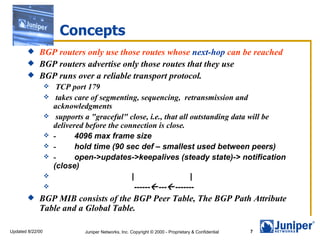
Concepts BGP routers only use those routes whose  next-hop  can be reached BGP routers advertise only those routes that they use BGP runs over a reliable transport protocol. TCP port 179 takes care of segmenting, sequencing,  retransmission and acknowledgments supports a "graceful" close, i.e., that all outstanding data will be delivered before the connection is close. -          4096 max frame size -          hold time (90 sec def – smallest used between peers) -          open->updates->keepalives (steady state)-> notification (close) |  | ------  ---  ------- BGP MIB consists of the BGP Peer Table, The BGP Path Attribute Table and a Global Table.
Concepts Autonomous System (AS) The classic definition of an Autonomous System is a set of routers under a single technical administration, using a single IGP and common metrics to route packets within the AS, and using an EGP to route packets to other ASs. Currently, it has become common for a single AS to use several IGPs and sometimes several sets of metrics within an AS.  The use of the term Autonomous System here stresses the fact that, even when multiple IGPs and metrics are used, the administration of an AS appears to other ASs to have a single coherent interior routing plan and presents a consistent  picture of what destinations are reachable through it.
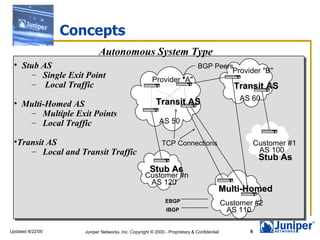
Concepts Autonomous System Type Stub AS Single Exit Point Local Traffic Multi-Homed AS Multiple Exit Points Local Traffic Transit AS Local and Transit Traffic Provider "A" AS 50 Provider "B" AS 60 Customer #1 AS 100 Customer #2 AS 110 Customer #n AS 120 EBGP IBGP Stub As Multi-Homed Stub As Transit AS Transit AS TCP Connections BGP Peers
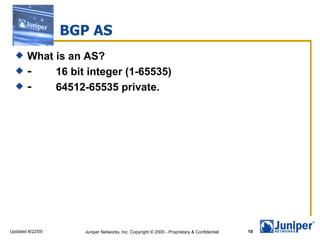
BGP AS What is an AS? -           16 bit integer (1-65535) -           64512-65535 private.
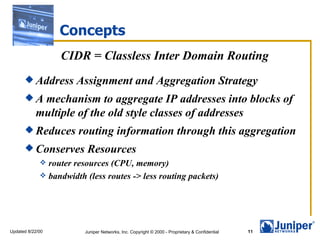
Concepts CIDR = Classless Inter Domain Routing Address Assignment and Aggregation Strategy A mechanism to aggregate IP addresses into blocks of multiple of the old style classes of addresses Reduces routing information through this aggregation Conserves Resources router resources (CPU, memory) bandwidth (less routes -> less routing packets)
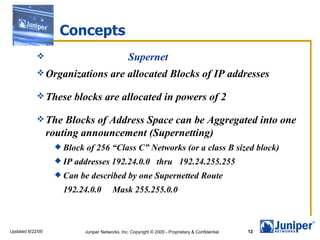
Concepts Supernet Organizations are allocated Blocks of IP addresses These blocks are allocated in powers of 2 The Blocks of Address Space can be Aggregated into one routing announcement (Supernetting) Block of 256 “Class C” Networks (or a class B sized block) IP addresses 192.24.0.0  thru  192.24.255.255 Can be described by one Supernetted Route 192.24.0.0  Mask 255.255.0.0
Concepts Exterior Routes Routes learned from other autonomous systems
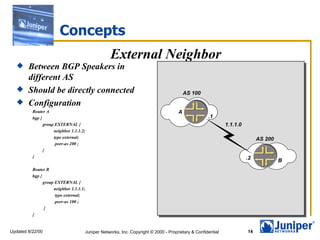
Concepts Between BGP Speakers in different AS Should be directly connected Configuration Router A bgp { group EXTERNAL { neighbor 1.1.1.2; type external; peer-as 200 ; } { Router B bgp { group EXTERNAL { neighbor 1.1.1.1; type external; peer-as 100 ; } { External Neighbor
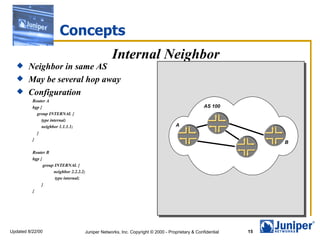
Concepts Neighbor in same AS May be several hop away Configuration Router A bgp { group INTERNAL { type internal; neighbor 1.1.1.1; } } Router B bgp { group INTERNAL { neighbor 2.2.2.2; type internal; } { Internal Neighbor
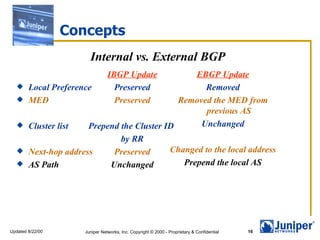
Concepts Internal vs. External BGP Local Preference MED Cluster list Next-hop address AS Path IBGP Update Preserved Preserved Prepend the Cluster ID  by RR Preserved Unchanged EBGP Update Removed Removed the MED from previous AS Unchanged Changed to the local address Prepend the local AS
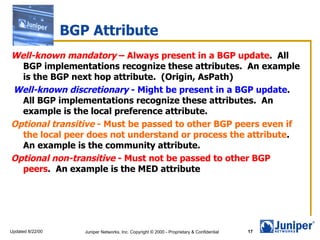
BGP Attribute Well-known mandatory  – Always present in a BGP update .  All BGP implementations recognize these attributes.  An example is the  BGP next hop attribute .  (Origin, AsPath) Well-known discretionary  - Might be present in a BGP update .  All BGP implementations recognize these attributes.  An example is the local preference attribute.  Optional transitive  - Must be passed to other BGP peers even if the local peer does not understand or process the attribute .  An example is the  community attribute .  Optional non-transitive  - Must not be passed to other BGP peers .  An example is the  MED attribute
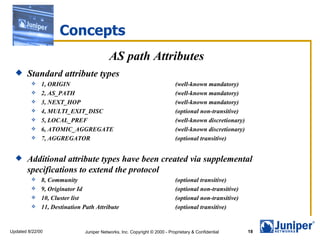
Concepts AS path Attributes Standard attribute types 1, ORIGIN  (well-known mandatory) 2, AS_PATH  (well-known mandatory) 3, NEXT_HOP (well-known mandatory) 4, MULTI_EXIT_DISC (optional non-transitive) 5, LOCAL_PREF (well-known discretionary) 6, ATOMIC_AGGREGATE (well-known discretionary) 7, AGGREGATOR (optional transitive) Additional attribute types have been created via supplemental specifications to extend the protocol 8, Community (optional transitive) 9, Originator Id (optional non-transitive) 10, Cluster list (optional non-transitive) 11, Destination Path Attribute (optional transitive)
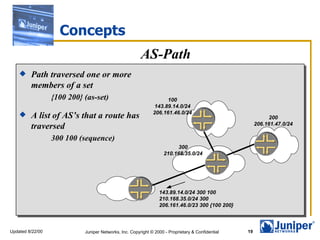
Concepts Path traversed one or more members of a set {100 200} (as-set) A list of AS’s that a route has traversed 300 100 (sequence) AS-Path
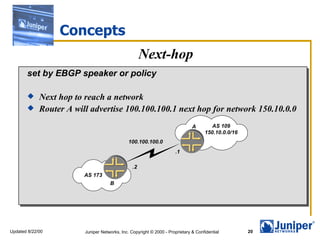
Concepts set by EBGP speaker or policy Next hop to reach a network Router A will advertise 100.100.100.1 next hop for network 150.10.0.0 Next-hop
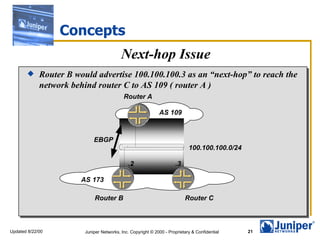
Concepts Router B would advertise 100.100.100.3 as an “next-hop” to reach the network behind router C to AS 109 ( router A ) Next-hop Issue
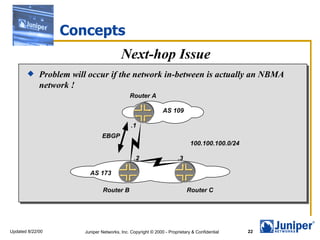
Concepts Problem will occur if the network in-between is actually an NBMA network ! Next-hop Issue
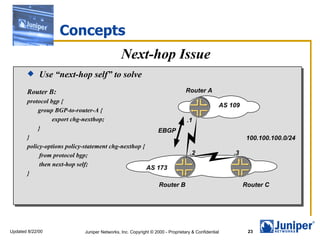
Concepts Use “next-hop self” to solve Next-hop Issue Router B: protocol bgp { group BGP-to-router-A { export chg-nexthop; } } policy-options policy-statement chg-nexthop { from protocol bgp; then next-hop self; }
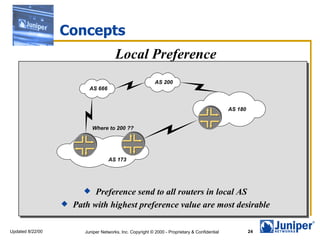
Concepts Preference send to all routers in local AS Path with highest preference value are most desirable Local Preference
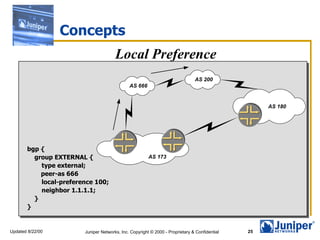
Concepts bgp { group EXTERNAL { type external;   peer-as 666 local-preference 100; neighbor 1.1.1.1; } } Local Preference
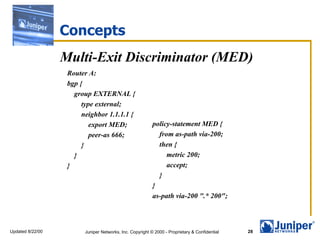
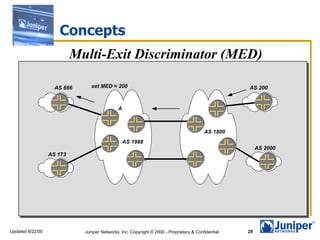
Concepts Multi-Exit Discriminator (MED)  32-bit, non-negative Affects all routes from same AS path Advertised to external neighbors Lower MED value is more preferable
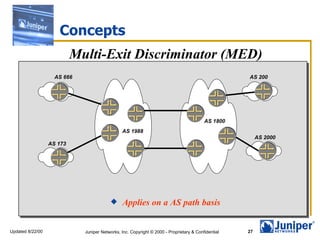
Concepts Applies on a AS path basis Multi-Exit Discriminator (MED)
Concepts Multi-Exit Discriminator (MED) Router A: bgp { group EXTERNAL { type external; neighbor 1.1.1.1 { export MED; peer-as 666; } } } policy-statement MED { from as-path via-200; then { metric 200; accept; } } as-path via-200 ".* 200";
Concepts Multi-Exit Discriminator (MED)
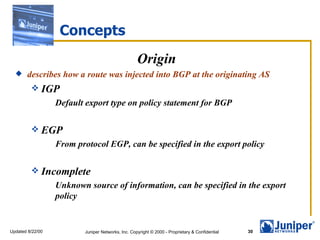
Concepts Origin describes how a route was injected into BGP at the originating AS IGP Default export type on policy statement for BGP EGP From protocol EGP, can be specified in the export policy Incomplete Unknown source of information, can be specified in the export policy
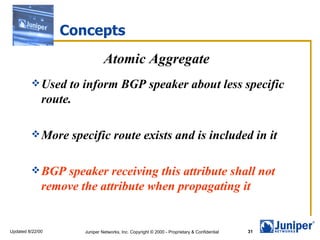
Concepts Atomic Aggregate Used to inform BGP speaker about less specific route. More specific route exists and is included in it BGP speaker receiving this attribute shall not remove the attribute when propagating it
Concepts Aggregator (6-bytes) Last AS number that formed the aggregate route (2 bytes) IP address of the BGP speaker that formed the aggregate route (4-bytes)
Concepts Route Reflector and Confederation Scaling would be an issue when there are too many BGP peer within the AS BGP speaker would not pass the BGP routes learn from an IBGP peer to another IBGP peers Number of connection required = n(n-1)/2
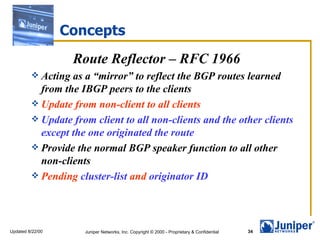
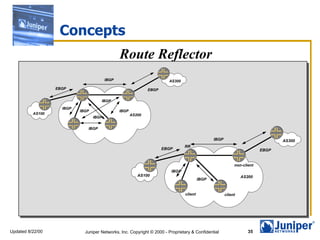
Concepts Route Reflector – RFC 1966 Acting as a “mirror” to reflect the BGP routes learned from the IBGP peers to the clients Update from non-client to all clients Update from client to all non-clients and the other clients except the one originated the route Provide the normal BGP speaker function to all other non-clients Pending  cluster-list  and  originator ID
Concepts Route Reflector
Concepts Route Reflector Loop Prevention Originator ID If the attribute “originator ID” has not been created in the attribute of the route,  the RR will create this attribute The content of “ originator ID ” is the  router ID  of the IBGP peer that pass this route to the RR The RR would not reflect the route back to the originator
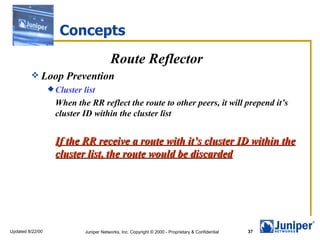
Concepts Route Reflector Loop Prevention Cluster list When the RR reflect the route to other peers, it will prepend it’s cluster ID within the cluster list If the RR receive a route with it’s cluster ID within the cluster list, the route would be discarded
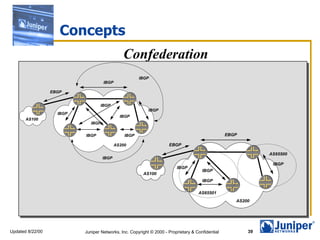
Concepts Confederation – RFC 1965 Scale down an AS into several Sub-ASs Each BGP peers between sub-AS would act as EBGP peer except some of the attributes remain unchanged Local-preference passed  through such a connect   MED, next-hop unchanged between member AS’s of  the confederation.
Concepts Confederation
Summary BGP Concept BGP Operation Route Control Configuration Trouble-shooting Juniper vs. Cisco
BGP Protocol Messages Four types of messages Open Update Keepalive Notification
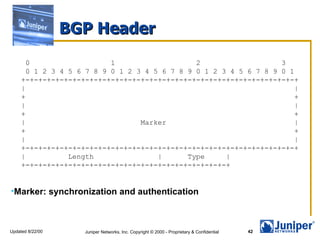
BGP Header 0  1  2  3 0 1 2 3 4 5 6 7 8 9 0 1 2 3 4 5 6 7 8 9 0 1 2 3 4 5 6 7 8 9 0 1 +-+-+-+-+-+-+-+-+-+-+-+-+-+-+-+-+-+-+-+-+-+-+-+-+-+-+-+-+-+-+-+-+ |  | +  + |  | +  + |  Marker  | +  + |  | +-+-+-+-+-+-+-+-+-+-+-+-+-+-+-+-+-+-+-+-+-+-+-+-+-+-+-+-+-+-+-+-+ |  Length  |  Type  | +-+-+-+-+-+-+-+-+-+-+-+-+-+-+-+-+-+-+-+-+-+-+-+-+ Marker: synchronization and authentication
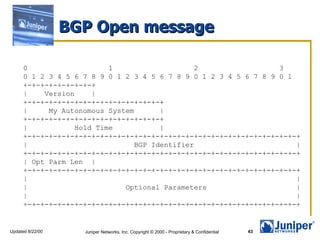
BGP Open message 0  1  2  3 0 1 2 3 4 5 6 7 8 9 0 1 2 3 4 5 6 7 8 9 0 1 2 3 4 5 6 7 8 9 0 1 +-+-+-+-+-+-+-+-+ |  Version  | +-+-+-+-+-+-+-+-+-+-+-+-+-+-+-+-+ |  My Autonomous System  | +-+-+-+-+-+-+-+-+-+-+-+-+-+-+-+-+ |  Hold Time  | +-+-+-+-+-+-+-+-+-+-+-+-+-+-+-+-+-+-+-+-+-+-+-+-+-+-+-+-+-+-+-+-+ |  BGP Identifier  | +-+-+-+-+-+-+-+-+-+-+-+-+-+-+-+-+-+-+-+-+-+-+-+-+-+-+-+-+-+-+-+-+ | Opt Parm Len  | +-+-+-+-+-+-+-+-+-+-+-+-+-+-+-+-+-+-+-+-+-+-+-+-+-+-+-+-+-+-+-+-+ |  | |  Optional Parameters  | |  | +-+-+-+-+-+-+-+-+-+-+-+-+-+-+-+-+-+-+-+-+-+-+-+-+-+-+-+-+-+-+-+-+
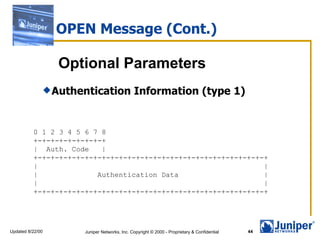
OPEN Message (Cont.) Authentication Information (type 1) Optional Parameters 0 1 2 3 4 5 6 7 8 +-+-+-+-+-+-+-+-+ |  Auth. Code  | +-+-+-+-+-+-+-+-+-+-+-+-+-+-+-+-+-+-+-+-+-+-+-+-+-+-+-+ |  | |  Authentication Data  | |  | +-+-+-+-+-+-+-+-+-+-+-+-+-+-+-+-+-+-+-+-+-+-+-+-+-+-+-+
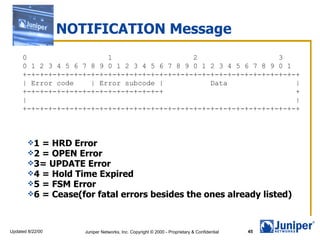
NOTIFICATION Message 0  1  2  3 0 1 2 3 4 5 6 7 8 9 0 1 2 3 4 5 6 7 8 9 0 1 2 3 4 5 6 7 8 9 0 1 +-+-+-+-+-+-+-+-+-+-+-+-+-+-+-+-+-+-+-+-+-+-+-+-+-+-+-+-+-+-+-+-+ | Error code  | Error subcode |  Data  | +-+-+-+-+-+-+-+-+-+-+-+-+-+-+-+-+  + |  | +-+-+-+-+-+-+-+-+-+-+-+-+-+-+-+-+-+-+-+-+-+-+-+-+-+-+-+-+-+-+-+-+ 1 = HRD Error 2 = OPEN Error 3= UPDATE Error 4 = Hold Time Expired 5 = FSM Error 6 = Cease(for fatal errors besides the ones already listed)
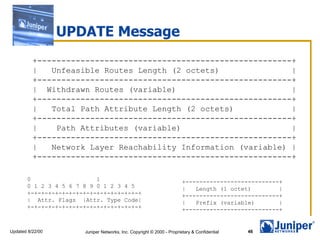
UPDATE Message +-----------------------------------------------------+ |  Unfeasible Routes Length (2 octets)  | +-----------------------------------------------------+ |  Withdrawn Routes (variable)  | +-----------------------------------------------------+ |  Total Path Attribute Length (2 octets)  | +-----------------------------------------------------+ |  Path Attributes (variable)  | +-----------------------------------------------------+ |  Network Layer Reachability Information (variable) | +-----------------------------------------------------+ +---------------------------+ |  Length (1 octet)  | +---------------------------+ |  Prefix (variable)  | +---------------------------+ 0  1 0 1 2 3 4 5 6 7 8 9 0 1 2 3 4 5 +-+-+-+-+-+-+-+-+-+-+-+-+-+-+-+-+ |  Attr. Flags  |Attr. Type Code| +-+-+-+-+-+-+-+-+-+-+-+-+-+-+-+-+
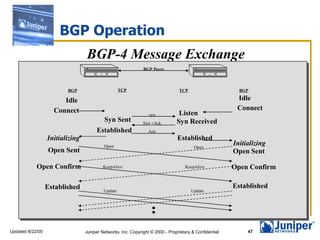
BGP Operation BGP-4 Message Exchange BGP TCP TCP BGP Idle Initializing Open Sent Open Confirm Established Syn Sent Listen Syn Received Idle Initializing Open Sent Open Confirm Established Established Established Connect Connect Open Open KeepAlive KeepAlive syn Syn +Ack Ack BGP Peers Update Update
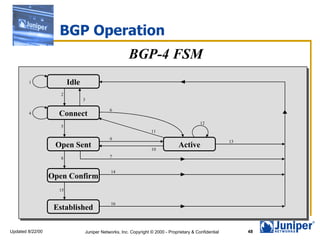
BGP Operation BGP-4 FSM Idle Connect Open Sent Open Confirm Established Active 1 3 11 7 16 14 10 9 6 4 2 12 5 8 15 13
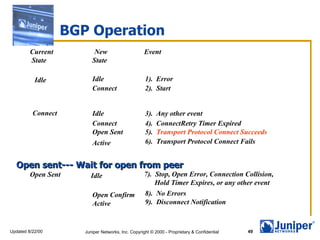
BGP Operation Open sent--- Wait for open from peer  Current State   New  State Event Idle Idle 1).  Error   Connect 2).  Start Connect Idle 3).  Any other event Connect 4).  ConnectRetry Timer Expired Open Sent 5).  Transport Protocol Connect Succeeds Active 6).  Transport Protocol Connect Fails Open Sent Idle 7).  Stop, Open Error, Connection Collision, Hold Timer Expires, or any other event Open Confirm 8).  No Errors Active 9).  Disconnect Notification
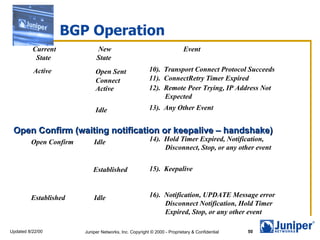
BGP Operation Current  New  Event State  State Open Confirm (waiting notification or keepalive – handshake)   Established 15).  Keepalive Open Confirm Idle 14).  Hold Timer Expired, Notification,  Disconnect, Stop, or any other event Established Idle 16).  Notification, UPDATE Message error Disconnect Notification, Hold Timer  Expired, Stop, or any other event Active Open Sent Connect Active Idle 10).  Transport Connect Protocol Succeeds 11).  ConnectRetry Timer Expired 12).  Remote Peer Trying, IP Address Not  Expected 13).  Any Other Event
Summary BGP Concept BGP Operation Route Control Configuration Trouble-shooting Juniper vs. Cisco
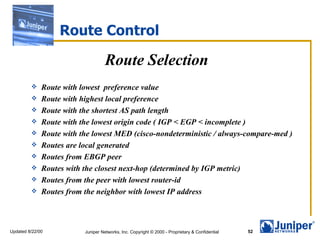
Route Control Route Selection Route with lowest  preference value Route with highest local preference Route with the shortest AS path length Route with the lowest origin code ( IGP < EGP < incomplete ) Route with the lowest MED (cisco-nondeterministic / always-compare-med ) Routes are local generated Routes from EBGP peer Routes with the closest next-hop (determined by IGP metric) Routes from the peer with lowest router-id Routes from the neighbor with lowest IP address
Route Control Policy Control Import / Export Policy Communities AS path Route filtering
Route Control Import / Export Policy Per group / neighbor import / export policy Used for advertise routes originated from the local AS Used for change / add / delete BGP attributes Global specific > Group specific > Neighbor specific
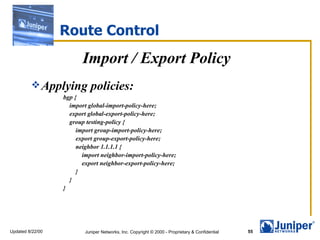
Route Control Import / Export Policy Applying policies: bgp { import global-import-policy-here; export global-export-policy-here; group testing-policy { import group-import-policy-here; export group-export-policy-here; neighbor 1.1.1.1 { import neighbor-import-policy-here; export neighbor-export-policy-here; } } }
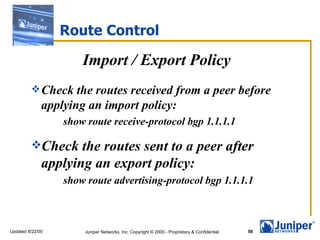
Route Control Import / Export Policy Check the routes received from a peer before applying an import policy: show route receive-protocol bgp 1.1.1.1  Check the routes sent to a peer after applying an export policy: show route advertising-protocol bgp 1.1.1.1
Route Control Community Well-known community no-advertise    Do not advertise to neighbors no-export    Do not advertise outside your confederation/AS no-export-subconfed  Do not advertise outside your subconfederation Define Community community community-name members [ 100:10 100:30 ];
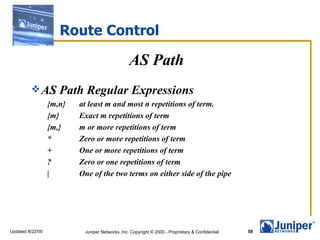
Route Control AS Path AS Path Regular Expressions {m,n} at least m and most n repetitions of term. {m} Exact m repetitions of term {m,} m or more repetitions of term * Zero or more repetitions of term + One or more repetitions of term ? Zero or one repetitions of term | One of the two terms on either side of the pipe
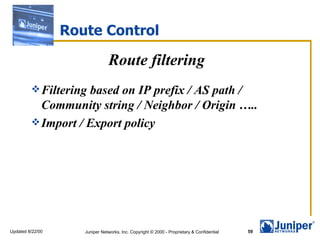
Route Control Route filtering Filtering based on IP prefix / AS path / Community string / Neighbor / Origin ….. Import / Export policy
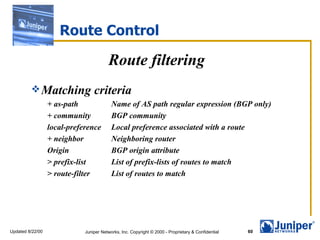
Route Control Route filtering Matching criteria + as-path Name of AS path regular expression (BGP only) + community BGP community local-preference Local preference associated with a route + neighbor Neighboring router Origin BGP origin attribute > prefix-list List of prefix-lists of routes to match > route-filter List of routes to match
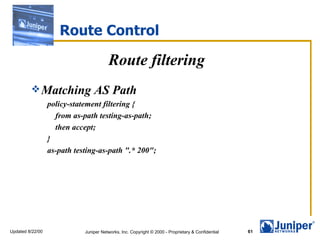
Route Control Route filtering Matching AS Path policy-statement filtering { from as-path testing-as-path; then accept; } as-path testing-as-path &quot;.* 200&quot;;
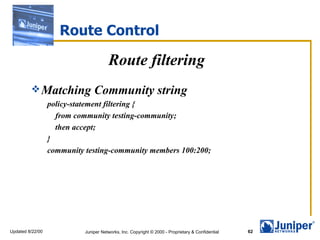
Route Control Route filtering Matching Community string policy-statement filtering { from community testing-community; then accept; } community testing-community members 100:200;
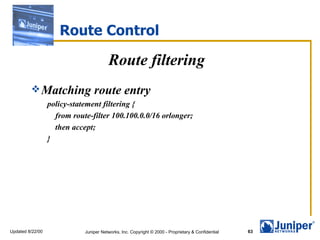
Route Control Route filtering Matching route entry policy-statement filtering { from route-filter 100.100.0.0/16 orlonger; then accept; }
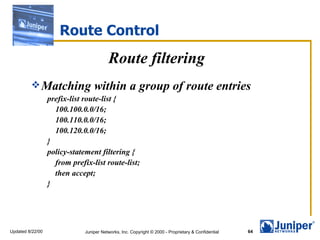
Route Control Route filtering Matching within a group of route entries prefix-list route-list { 100.100.0.0/16; 100.110.0.0/16; 100.120.0.0/16; } policy-statement filtering { from prefix-list route-list; then accept; }
Summary BGP Concept BGP Operation Route Control Configuration Trouble-shooting Juniper vs. Cisco
Configuration BGP minimum configuration [routing-options] autonomous-system <your own AS>; [protocol bgp] group BGP-setup {   type [external | internal];   peer-as <peer’s AS>;   neighbor <peer IP address>; }
Configuration Example [protocol bgp]  group BGP-setup { type external; peer-as 100; neighbor 100.1.1.2; } [routing-options] autonomous-system 200;
Configuration Set the local-preference [protocol bgp] group BGP-setup { type external; local-preference 100; peer-as 100; neighbor 100.1.1.2; } Set the MED [protocol bgp] group BGP-setup { type external; metric-out 200; local-preference 100; peer-as 100; neighbor 100.1.1.2; }
Configuration Change the origin [protocol policy-options] policy-statement change-origin { from protocol aggregate; then { origin incomplete; accept; } } [protocol bgp] group BGP-setup { type external; export change-origin; peer-as 100; neighbor 100.1.1.2; }
Configuration AS-prepend [policy-options] policy-statement as-prepend { from protocol aggregate; then { as-path-prepend “300 300 300&quot;; accept; } } [protocol bgp] group BGP-setup { type external; export as-prepend; peer-as 100; neighbor 100.1.1.2; }
Configuration Attach community [protocol bgp] group BGP-setup { type external; export att-community; peer-as 100; neighbor 100.1.1.2; } [policy-options] policy-statement att-community { then { community set send-community; } } community send-community members [ 100:10 200:10 ];
Configuration Route Reflector [protocol bgp] group RR-client { type internal; cluster 100.1.1.1 ; neighbor 100.1.1.2; neighbor 100.1.1.3; } group non-client { type internal; neighbor 10.1.1.2; } group EBGP { type external; peer-as 100; neighbor 192.168.1.2; }
Configuration Confederation [routing-options] autonomous-system 65000; confederation 200 members [ 65000 65001 ]; [protocol bgp] group confe { type external; peer-as 65001; neighbor 100.1.1.2; }
Configuration Advertise summary network [routing-options] aggregate  { route 202.168.0.0/17 discard; } [policy-options] policy-statement adv-summary { from protocol aggregate; then accept; } [protocol bgp] group BGP-setup { type external; export adv-summary; peer-as 100; neighbor 100.1.1.2; }
Configuration Advertise the routing entries in other protocol   [policy-options] policy-statement adv-ospf { from protocol ospf; then accept; } [protocol bgp] group BGP-setup { type external; export adv-ospf; peer-as 100; neighbor 100.1.1.2; }
Summary BGP concepts BGP Operation Route Control Configuration Trouble-shooting Juniper vs. Cisco
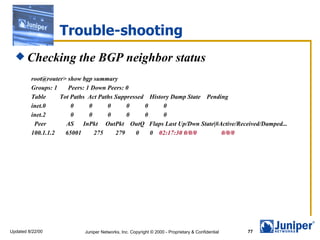
Trouble-shooting Checking the BGP neighbor status root@router> show bgp summary Groups: 1  Peers: 1 Down Peers: 0 Table  Tot Paths  Act Paths Suppressed  History Damp State  Pending inet.0  0  0  0  0  0  0 inet.2  0  0  0  0  0  0 Peer  AS  InPkt  OutPkt  OutQ  Flaps Last Up/Dwn State|#Active/Received/Damped... 100.1.1.2  65001  275  279  0  0  02:17:30 0/0/0  0/0/0
Trouble-shooting Neighbor can’t establish Groups: 1  Peers: 1 Down Peers: 1 Table  Tot Paths  Act Paths Suppressed  History Damp State  Pending inet.0  0  0  0  0  0  0 inet.2  0  0  0  0  0  0 Peer  AS  InPkt  OutPkt  OutQ  Flaps Last Up/Dwn State|#Active/Received/Damped... 100.1.1.2  65001  0  4  0  0  00:00:57  Active Enable traceoption [protocol bgp] traceoptions { file bgp-trace; flag packets detail; flag open detail; }
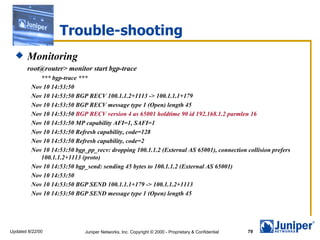
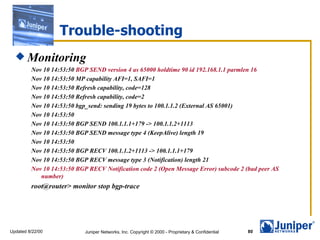
Trouble-shooting Monitoring root@router> monitor start bgp-trace *** bgp-trace *** Nov 10 14:53:50  Nov 10 14:53:50 BGP RECV 100.1.1.2+1113 -> 100.1.1.1+179 Nov 10 14:53:50 BGP RECV message type 1 (Open) length 45 Nov 10 14:53:50  BGP RECV version 4 as 65001 holdtime 90 id 192.168.1.2 parmlen 16 Nov 10 14:53:50 MP capability AFI=1, SAFI=1 Nov 10 14:53:50 Refresh capability, code=128 Nov 10 14:53:50 Refresh capability, code=2 Nov 10 14:53:50 bgp_pp_recv: dropping 100.1.1.2 (External AS 65001), connection collision prefers 100.1.1.2+1113 (proto) Nov 10 14:53:50 bgp_send: sending 45 bytes to 100.1.1.2 (External AS 65001) Nov 10 14:53:50  Nov 10 14:53:50 BGP SEND 100.1.1.1+179 -> 100.1.1.2+1113 Nov 10 14:53:50 BGP SEND message type 1 (Open) length 45
Trouble-shooting Monitoring Nov 10 14:53:50  BGP SEND version 4 as 65000 holdtime 90 id 192.168.1.1 parmlen 16 Nov 10 14:53:50 MP capability AFI=1, SAFI=1 Nov 10 14:53:50 Refresh capability, code=128 Nov 10 14:53:50 Refresh capability, code=2 Nov 10 14:53:50 bgp_send: sending 19 bytes to 100.1.1.2 (External AS 65001) Nov 10 14:53:50  Nov 10 14:53:50 BGP SEND 100.1.1.1+179 -> 100.1.1.2+1113 Nov 10 14:53:50 BGP SEND message type 4 (KeepAlive) length 19 Nov 10 14:53:50  Nov 10 14:53:50 BGP RECV 100.1.1.2+1113 -> 100.1.1.1+179 Nov 10 14:53:50 BGP RECV message type 3 (Notification) length 21 Nov 10 14:53:50 BGP RECV Notification code 2 (Open Message Error) subcode 2 (bad peer AS number) root@router> monitor stop bgp-trace
Trouble-shooting Configuration Near end [routing-options] autonomous-system  65000 ; confederation 200 members [ 65000 65001 65002 ]; [protocol bgp] group bgp-demo {   type external;   peer-as 65001;   neighbor 100.1.1.2; } Far End [routing-options] autonomous-system 65001; confederation 200 members [ 65000 65001 65002 ]; [protocol bgp] admin@Jessie# show protocols bgp  group testing { type external; peer-as 65002 ; neighbor 100.1.1.1; }
Trouble-shooting Logged result: root@router> file show /var/log/?  Possible completions: <[Enter]>  Execute this command <filename>  Filename to display /var/log/bgp-trace  Size: 2459, Last changed: Nov  7 18:41:08 Stop logging: root@router# delete protocols bgp traceoptions  root@router# commit
Trouble-shooting Other problem Local-address definition (cisco’s update-source) [protocol bgp] group <group> { local-address <local IP address>; } Peer AS mis-configured Peer address unreachable Mulithop issue for EBGP [protocol bgp] group <group> { multihop; }
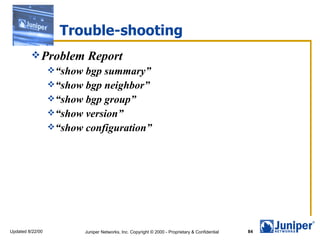
Trouble-shooting Problem Report “ show bgp summary” “ show bgp neighbor” “ show bgp group” “ show version” “ show configuration”
Summary BGP concepts BGP Operation Route Control Configuration Trouble-shooting Juniper vs. Cisco
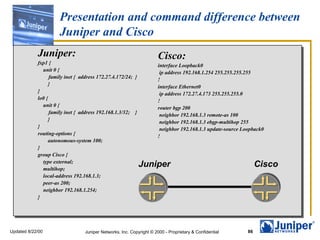
Presentation and command difference between Juniper and Cisco Juniper: fxp1 { unit 0 { family inet {  address 172.27.4.172/24;  } } } lo0 { unit 0 { family inet {  address 192.168.1.3/32;  } } } routing-options { autonomous-system 100; } group Cisco { type external; multihop; local-address 192.168.1.3; peer-as 200; neighbor 192.168.1.254; } Cisco: interface Loopback0 ip address 192.168.1.254 255.255.255.255 ! interface Ethernet0 ip address 172.27.4.173 255.255.255.0 ! router bgp 200 neighbor 192.168.1.3 remote-as 100 neighbor 192.168.1.3 ebgp-multihop 255 neighbor 192.168.1.3 update-source Loopback0 !
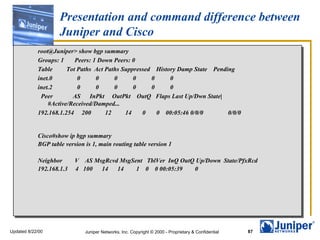
Presentation and command difference between Juniper and Cisco root@Juniper> show bgp summary  Groups: 1  Peers: 1 Down Peers: 0 Table  Tot Paths  Act Paths Suppressed  History Damp State  Pending inet.0  0  0  0  0  0  0 inet.2  0  0  0  0  0  0 Peer  AS  InPkt  OutPkt  OutQ  Flaps Last Up/Dwn State|#Active/Received/Damped... 192.168.1.254  200  12  14  0  0  00:05:46 0/0/0  0/0/0 Cisco#show ip bgp summary  BGP table version is 1, main routing table version 1 Neighbor  V  AS MsgRcvd MsgSent  TblVer  InQ OutQ Up/Down  State/PfxRcd 192.168.1.3  4  100  14  14  1  0  0 00:05:39  0
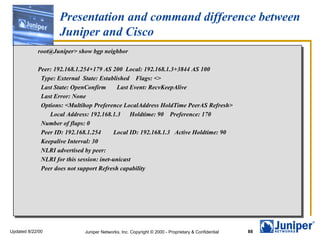
Presentation and command difference between Juniper and Cisco root@Juniper> show bgp neighbor  Peer: 192.168.1.254+179 AS 200  Local: 192.168.1.3+3844 AS 100 Type: External  State: Established  Flags: <> Last State: OpenConfirm  Last Event: RecvKeepAlive Last Error: None Options: <Multihop Preference LocalAddress HoldTime PeerAS Refresh> Local Address: 192.168.1.3  Holdtime: 90  Preference: 170 Number of flaps: 0 Peer ID: 192.168.1.254  Local ID: 192.168.1.3  Active Holdtime: 90 Keepalive Interval: 30 NLRI advertised by peer: NLRI for this session: inet-unicast Peer does not support Refresh capability
Presentation and command difference between Juniper and Cisco Table inet.0 Bit: 10000 Active Prefixes: 0 Received Prefixes: 0 Suppressed due to damping: 0 Table inet.2 Bit: 20000 Active Prefixes: 0 Received Prefixes: 0 Suppressed due to damping: 0 Last traffic (seconds):  Received 3  Sent 3  Checked 3 Input messages:  Total 16  Updates 0  Refreshes 0  Octets 304 Output messages:  Total 18  Updates 0  Refreshes 0  Octets 368 Output Queue[0]: 0 Output Queue[1]: 0 Route Queue Timer: unset  Route Queue: empty
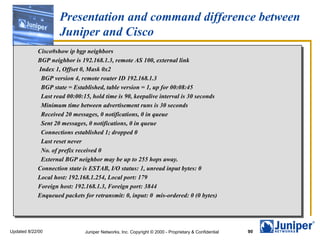
Presentation and command difference between Juniper and Cisco Cisco#show ip bgp neighbors  BGP neighbor is 192.168.1.3, remote AS 100, external link Index 1, Offset 0, Mask 0x2 BGP version 4, remote router ID 192.168.1.3 BGP state = Established, table version = 1, up for 00:08:45 Last read 00:00:15, hold time is 90, keepalive interval is 30 seconds Minimum time between advertisement runs is 30 seconds Received 20 messages, 0 notifications, 0 in queue Sent 20 messages, 0 notifications, 0 in queue Connections established 1; dropped 0 Last reset never No. of prefix received 0 External BGP neighbor may be up to 255 hops away. Connection state is ESTAB, I/O status: 1, unread input bytes: 0 Local host: 192.168.1.254, Local port: 179 Foreign host: 192.168.1.3, Foreign port: 3844 Enqueued packets for retransmit: 0, input: 0  mis-ordered: 0 (0 bytes)
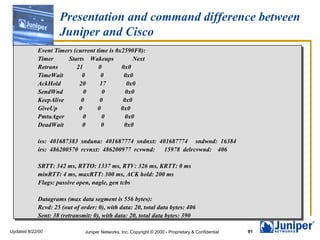
Presentation and command difference between Juniper and Cisco Event Timers (current time is 0x2590F0): Timer  Starts  Wakeups  Next Retrans  21  0  0x0 TimeWait  0  0  0x0 AckHold  20  17  0x0 SendWnd  0  0  0x0 KeepAlive  0  0  0x0 GiveUp  0  0  0x0 PmtuAger  0  0  0x0 DeadWait  0  0  0x0 iss:  401687383  snduna:  401687774  sndnxt:  401687774  sndwnd:  16384 irs:  486200570  rcvnxt:  486200977  rcvwnd:  15978  delrcvwnd:  406 SRTT: 342 ms, RTTO: 1337 ms, RTV: 326 ms, KRTT: 0 ms minRTT: 4 ms, maxRTT: 300 ms, ACK hold: 200 ms Flags: passive open, nagle, gen tcbs Datagrams (max data segment is 556 bytes): Rcvd: 25 (out of order: 0), with data: 20, total data bytes: 406 Sent: 38 (retransmit: 0), with data: 20, total data bytes: 390
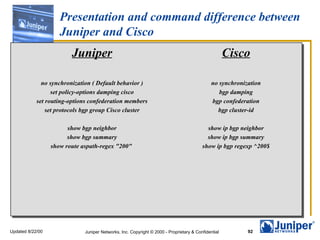
Presentation and command difference between Juniper and Cisco Juniper no synchronization ( Default behavior ) set policy-options damping cisco set routing-options confederation members set protocols bgp group Cisco cluster show bgp neighbor show bgp summary show route aspath-regex &quot;200&quot;  Cisco no synchronization bgp damping bgp confederation bgp cluster-id show ip bgp neighbor show ip bgp summary show ip bgp regexp ^200$
http://www.juniper.net Thank you!

Bgp

  • 1.
    Introduction to Border Gateway Protocol (BGP 4) Version 1.2
  • 2.
    Summary BGP ConceptBGP Operation Route Control Configuration Trouble-shooting Juniper vs. Cisco
  • 3.
    Summary BGP ConceptBGP Operation Route Control Configuration Trouble-shooting Juniper vs. Cisco
  • 4.
    Concepts The BGPprotocol was developed by the IDR Working Group of IETF. A first version of BGP was published in June 1989 as RFC 1105 (BGP-1). A second version was published in June 1990 as RFC 1163 (BGP-2). A third version was published in October 1991 as RFC 1267 (BGP-3). A fourth version was published in July 1994 as RFC 1654 (BGP-4). The Current version of BGP-4 is documented in RFC 1771 (March 1995). BGP-4 supports the path vector concept to avoid the potential routing loop introduced by complicated (I.e., full-meshed) Internet topology IP prefix and length advertisements
  • 5.
    JUNOS software supportsBGP Version 4 and several extensions to the protocol RFC 1771, A Border Gateway Protocol 4 (BGP-4) RFC 1772, Application of the Border Gateway Protocol in the Internet RFC 1965, Autonomous System Confederations for BGP RFC 1966, BGP Route Reflection: An Alternative to Full-Mesh IBGP RFC 1997, BGP Communities Attribute RFC 2270, Using a Dedicated AS for Sites Homed to a Single Provider RFC 2283, Multiprotocol Extensions for BGP-4 RFC 2385, Protection of BGP Sessions via the TCP MD5 Signature Option RFC 2439, BGP Route Flap Damping Capabilities Negotiation with BGP4 , IETF draft draft-ietf-idr-cap-neg-01 BGP Extended Communities Attribute , IETF draft-ramachandra-bgp-ext-communities-04.txt BGP Protocol Overview
  • 6.
    Concepts the conceptof classless interdomain routing to allow better use of existing IP address space and to minimize the rapid growth of routing table size (CIDR, RFC 1519) policy-based routing using a set of pre-defined path attributes BGP-4 supports route aggregation and AS aggregation (I.e., AS Set and Confederation) fast convergence by requiring the router to inform its neighbors when the previously announced routes become unreachable large routing table size authentication using BGP identifier and AS number. In addition, it supports encrypted signature in every BGP message.
  • 7.
    Concepts BGP routersonly use those routes whose next-hop can be reached BGP routers advertise only those routes that they use BGP runs over a reliable transport protocol. TCP port 179 takes care of segmenting, sequencing, retransmission and acknowledgments supports a &quot;graceful&quot; close, i.e., that all outstanding data will be delivered before the connection is close. -         4096 max frame size -         hold time (90 sec def – smallest used between peers) -         open->updates->keepalives (steady state)-> notification (close) | | ------  ---  ------- BGP MIB consists of the BGP Peer Table, The BGP Path Attribute Table and a Global Table.
  • 8.
    Concepts Autonomous System(AS) The classic definition of an Autonomous System is a set of routers under a single technical administration, using a single IGP and common metrics to route packets within the AS, and using an EGP to route packets to other ASs. Currently, it has become common for a single AS to use several IGPs and sometimes several sets of metrics within an AS. The use of the term Autonomous System here stresses the fact that, even when multiple IGPs and metrics are used, the administration of an AS appears to other ASs to have a single coherent interior routing plan and presents a consistent picture of what destinations are reachable through it.
  • 9.
    Concepts Autonomous SystemType Stub AS Single Exit Point Local Traffic Multi-Homed AS Multiple Exit Points Local Traffic Transit AS Local and Transit Traffic Provider &quot;A&quot; AS 50 Provider &quot;B&quot; AS 60 Customer #1 AS 100 Customer #2 AS 110 Customer #n AS 120 EBGP IBGP Stub As Multi-Homed Stub As Transit AS Transit AS TCP Connections BGP Peers
  • 10.
    BGP AS Whatis an AS? -          16 bit integer (1-65535) -          64512-65535 private.
  • 11.
    Concepts CIDR =Classless Inter Domain Routing Address Assignment and Aggregation Strategy A mechanism to aggregate IP addresses into blocks of multiple of the old style classes of addresses Reduces routing information through this aggregation Conserves Resources router resources (CPU, memory) bandwidth (less routes -> less routing packets)
  • 12.
    Concepts Supernet Organizationsare allocated Blocks of IP addresses These blocks are allocated in powers of 2 The Blocks of Address Space can be Aggregated into one routing announcement (Supernetting) Block of 256 “Class C” Networks (or a class B sized block) IP addresses 192.24.0.0 thru 192.24.255.255 Can be described by one Supernetted Route 192.24.0.0 Mask 255.255.0.0
  • 13.
    Concepts Exterior RoutesRoutes learned from other autonomous systems
  • 14.
    Concepts Between BGPSpeakers in different AS Should be directly connected Configuration Router A bgp { group EXTERNAL { neighbor 1.1.1.2; type external; peer-as 200 ; } { Router B bgp { group EXTERNAL { neighbor 1.1.1.1; type external; peer-as 100 ; } { External Neighbor
  • 15.
    Concepts Neighbor insame AS May be several hop away Configuration Router A bgp { group INTERNAL { type internal; neighbor 1.1.1.1; } } Router B bgp { group INTERNAL { neighbor 2.2.2.2; type internal; } { Internal Neighbor
  • 16.
    Concepts Internal vs.External BGP Local Preference MED Cluster list Next-hop address AS Path IBGP Update Preserved Preserved Prepend the Cluster ID by RR Preserved Unchanged EBGP Update Removed Removed the MED from previous AS Unchanged Changed to the local address Prepend the local AS
  • 17.
    BGP Attribute Well-knownmandatory – Always present in a BGP update .  All BGP implementations recognize these attributes.  An example is the BGP next hop attribute . (Origin, AsPath) Well-known discretionary - Might be present in a BGP update .  All BGP implementations recognize these attributes.  An example is the local preference attribute. Optional transitive - Must be passed to other BGP peers even if the local peer does not understand or process the attribute .  An example is the community attribute . Optional non-transitive - Must not be passed to other BGP peers .  An example is the MED attribute
  • 18.
    Concepts AS pathAttributes Standard attribute types 1, ORIGIN (well-known mandatory) 2, AS_PATH (well-known mandatory) 3, NEXT_HOP (well-known mandatory) 4, MULTI_EXIT_DISC (optional non-transitive) 5, LOCAL_PREF (well-known discretionary) 6, ATOMIC_AGGREGATE (well-known discretionary) 7, AGGREGATOR (optional transitive) Additional attribute types have been created via supplemental specifications to extend the protocol 8, Community (optional transitive) 9, Originator Id (optional non-transitive) 10, Cluster list (optional non-transitive) 11, Destination Path Attribute (optional transitive)
  • 19.
    Concepts Path traversedone or more members of a set {100 200} (as-set) A list of AS’s that a route has traversed 300 100 (sequence) AS-Path
  • 20.
    Concepts set byEBGP speaker or policy Next hop to reach a network Router A will advertise 100.100.100.1 next hop for network 150.10.0.0 Next-hop
  • 21.
    Concepts Router Bwould advertise 100.100.100.3 as an “next-hop” to reach the network behind router C to AS 109 ( router A ) Next-hop Issue
  • 22.
    Concepts Problem willoccur if the network in-between is actually an NBMA network ! Next-hop Issue
  • 23.
    Concepts Use “next-hopself” to solve Next-hop Issue Router B: protocol bgp { group BGP-to-router-A { export chg-nexthop; } } policy-options policy-statement chg-nexthop { from protocol bgp; then next-hop self; }
  • 24.
    Concepts Preference sendto all routers in local AS Path with highest preference value are most desirable Local Preference
  • 25.
    Concepts bgp {group EXTERNAL { type external; peer-as 666 local-preference 100; neighbor 1.1.1.1; } } Local Preference
  • 26.
    Concepts Multi-Exit Discriminator(MED) 32-bit, non-negative Affects all routes from same AS path Advertised to external neighbors Lower MED value is more preferable
  • 27.
    Concepts Applies ona AS path basis Multi-Exit Discriminator (MED)
  • 28.
    Concepts Multi-Exit Discriminator(MED) Router A: bgp { group EXTERNAL { type external; neighbor 1.1.1.1 { export MED; peer-as 666; } } } policy-statement MED { from as-path via-200; then { metric 200; accept; } } as-path via-200 &quot;.* 200&quot;;
  • 29.
  • 30.
    Concepts Origin describeshow a route was injected into BGP at the originating AS IGP Default export type on policy statement for BGP EGP From protocol EGP, can be specified in the export policy Incomplete Unknown source of information, can be specified in the export policy
  • 31.
    Concepts Atomic AggregateUsed to inform BGP speaker about less specific route. More specific route exists and is included in it BGP speaker receiving this attribute shall not remove the attribute when propagating it
  • 32.
    Concepts Aggregator (6-bytes)Last AS number that formed the aggregate route (2 bytes) IP address of the BGP speaker that formed the aggregate route (4-bytes)
  • 33.
    Concepts Route Reflectorand Confederation Scaling would be an issue when there are too many BGP peer within the AS BGP speaker would not pass the BGP routes learn from an IBGP peer to another IBGP peers Number of connection required = n(n-1)/2
  • 34.
    Concepts Route Reflector– RFC 1966 Acting as a “mirror” to reflect the BGP routes learned from the IBGP peers to the clients Update from non-client to all clients Update from client to all non-clients and the other clients except the one originated the route Provide the normal BGP speaker function to all other non-clients Pending cluster-list and originator ID
  • 35.
  • 36.
    Concepts Route ReflectorLoop Prevention Originator ID If the attribute “originator ID” has not been created in the attribute of the route, the RR will create this attribute The content of “ originator ID ” is the router ID of the IBGP peer that pass this route to the RR The RR would not reflect the route back to the originator
  • 37.
    Concepts Route ReflectorLoop Prevention Cluster list When the RR reflect the route to other peers, it will prepend it’s cluster ID within the cluster list If the RR receive a route with it’s cluster ID within the cluster list, the route would be discarded
  • 38.
    Concepts Confederation –RFC 1965 Scale down an AS into several Sub-ASs Each BGP peers between sub-AS would act as EBGP peer except some of the attributes remain unchanged Local-preference passed through such a connect MED, next-hop unchanged between member AS’s of the confederation.
  • 39.
  • 40.
    Summary BGP ConceptBGP Operation Route Control Configuration Trouble-shooting Juniper vs. Cisco
  • 41.
    BGP Protocol MessagesFour types of messages Open Update Keepalive Notification
  • 42.
    BGP Header 0 1 2 3 0 1 2 3 4 5 6 7 8 9 0 1 2 3 4 5 6 7 8 9 0 1 2 3 4 5 6 7 8 9 0 1 +-+-+-+-+-+-+-+-+-+-+-+-+-+-+-+-+-+-+-+-+-+-+-+-+-+-+-+-+-+-+-+-+ | | + + | | + + | Marker | + + | | +-+-+-+-+-+-+-+-+-+-+-+-+-+-+-+-+-+-+-+-+-+-+-+-+-+-+-+-+-+-+-+-+ | Length | Type | +-+-+-+-+-+-+-+-+-+-+-+-+-+-+-+-+-+-+-+-+-+-+-+-+ Marker: synchronization and authentication
  • 43.
    BGP Open message0 1 2 3 0 1 2 3 4 5 6 7 8 9 0 1 2 3 4 5 6 7 8 9 0 1 2 3 4 5 6 7 8 9 0 1 +-+-+-+-+-+-+-+-+ | Version | +-+-+-+-+-+-+-+-+-+-+-+-+-+-+-+-+ | My Autonomous System | +-+-+-+-+-+-+-+-+-+-+-+-+-+-+-+-+ | Hold Time | +-+-+-+-+-+-+-+-+-+-+-+-+-+-+-+-+-+-+-+-+-+-+-+-+-+-+-+-+-+-+-+-+ | BGP Identifier | +-+-+-+-+-+-+-+-+-+-+-+-+-+-+-+-+-+-+-+-+-+-+-+-+-+-+-+-+-+-+-+-+ | Opt Parm Len | +-+-+-+-+-+-+-+-+-+-+-+-+-+-+-+-+-+-+-+-+-+-+-+-+-+-+-+-+-+-+-+-+ | | | Optional Parameters | | | +-+-+-+-+-+-+-+-+-+-+-+-+-+-+-+-+-+-+-+-+-+-+-+-+-+-+-+-+-+-+-+-+
  • 44.
    OPEN Message (Cont.)Authentication Information (type 1) Optional Parameters 0 1 2 3 4 5 6 7 8 +-+-+-+-+-+-+-+-+ | Auth. Code | +-+-+-+-+-+-+-+-+-+-+-+-+-+-+-+-+-+-+-+-+-+-+-+-+-+-+-+ | | | Authentication Data | | | +-+-+-+-+-+-+-+-+-+-+-+-+-+-+-+-+-+-+-+-+-+-+-+-+-+-+-+
  • 45.
    NOTIFICATION Message 0 1 2 3 0 1 2 3 4 5 6 7 8 9 0 1 2 3 4 5 6 7 8 9 0 1 2 3 4 5 6 7 8 9 0 1 +-+-+-+-+-+-+-+-+-+-+-+-+-+-+-+-+-+-+-+-+-+-+-+-+-+-+-+-+-+-+-+-+ | Error code | Error subcode | Data | +-+-+-+-+-+-+-+-+-+-+-+-+-+-+-+-+ + | | +-+-+-+-+-+-+-+-+-+-+-+-+-+-+-+-+-+-+-+-+-+-+-+-+-+-+-+-+-+-+-+-+ 1 = HRD Error 2 = OPEN Error 3= UPDATE Error 4 = Hold Time Expired 5 = FSM Error 6 = Cease(for fatal errors besides the ones already listed)
  • 46.
    UPDATE Message +-----------------------------------------------------+| Unfeasible Routes Length (2 octets) | +-----------------------------------------------------+ | Withdrawn Routes (variable) | +-----------------------------------------------------+ | Total Path Attribute Length (2 octets) | +-----------------------------------------------------+ | Path Attributes (variable) | +-----------------------------------------------------+ | Network Layer Reachability Information (variable) | +-----------------------------------------------------+ +---------------------------+ | Length (1 octet) | +---------------------------+ | Prefix (variable) | +---------------------------+ 0 1 0 1 2 3 4 5 6 7 8 9 0 1 2 3 4 5 +-+-+-+-+-+-+-+-+-+-+-+-+-+-+-+-+ | Attr. Flags |Attr. Type Code| +-+-+-+-+-+-+-+-+-+-+-+-+-+-+-+-+
  • 47.
    BGP Operation BGP-4Message Exchange BGP TCP TCP BGP Idle Initializing Open Sent Open Confirm Established Syn Sent Listen Syn Received Idle Initializing Open Sent Open Confirm Established Established Established Connect Connect Open Open KeepAlive KeepAlive syn Syn +Ack Ack BGP Peers Update Update
  • 48.
    BGP Operation BGP-4FSM Idle Connect Open Sent Open Confirm Established Active 1 3 11 7 16 14 10 9 6 4 2 12 5 8 15 13
  • 49.
    BGP Operation Opensent--- Wait for open from peer Current State New State Event Idle Idle 1). Error Connect 2). Start Connect Idle 3). Any other event Connect 4). ConnectRetry Timer Expired Open Sent 5). Transport Protocol Connect Succeeds Active 6). Transport Protocol Connect Fails Open Sent Idle 7). Stop, Open Error, Connection Collision, Hold Timer Expires, or any other event Open Confirm 8). No Errors Active 9). Disconnect Notification
  • 50.
    BGP Operation Current New Event State State Open Confirm (waiting notification or keepalive – handshake) Established 15). Keepalive Open Confirm Idle 14). Hold Timer Expired, Notification, Disconnect, Stop, or any other event Established Idle 16). Notification, UPDATE Message error Disconnect Notification, Hold Timer Expired, Stop, or any other event Active Open Sent Connect Active Idle 10). Transport Connect Protocol Succeeds 11). ConnectRetry Timer Expired 12). Remote Peer Trying, IP Address Not Expected 13). Any Other Event
  • 51.
    Summary BGP ConceptBGP Operation Route Control Configuration Trouble-shooting Juniper vs. Cisco
  • 52.
    Route Control RouteSelection Route with lowest preference value Route with highest local preference Route with the shortest AS path length Route with the lowest origin code ( IGP < EGP < incomplete ) Route with the lowest MED (cisco-nondeterministic / always-compare-med ) Routes are local generated Routes from EBGP peer Routes with the closest next-hop (determined by IGP metric) Routes from the peer with lowest router-id Routes from the neighbor with lowest IP address
  • 53.
    Route Control PolicyControl Import / Export Policy Communities AS path Route filtering
  • 54.
    Route Control Import/ Export Policy Per group / neighbor import / export policy Used for advertise routes originated from the local AS Used for change / add / delete BGP attributes Global specific > Group specific > Neighbor specific
  • 55.
    Route Control Import/ Export Policy Applying policies: bgp { import global-import-policy-here; export global-export-policy-here; group testing-policy { import group-import-policy-here; export group-export-policy-here; neighbor 1.1.1.1 { import neighbor-import-policy-here; export neighbor-export-policy-here; } } }
  • 56.
    Route Control Import/ Export Policy Check the routes received from a peer before applying an import policy: show route receive-protocol bgp 1.1.1.1 Check the routes sent to a peer after applying an export policy: show route advertising-protocol bgp 1.1.1.1
  • 57.
    Route Control CommunityWell-known community no-advertise Do not advertise to neighbors no-export Do not advertise outside your confederation/AS no-export-subconfed Do not advertise outside your subconfederation Define Community community community-name members [ 100:10 100:30 ];
  • 58.
    Route Control ASPath AS Path Regular Expressions {m,n} at least m and most n repetitions of term. {m} Exact m repetitions of term {m,} m or more repetitions of term * Zero or more repetitions of term + One or more repetitions of term ? Zero or one repetitions of term | One of the two terms on either side of the pipe
  • 59.
    Route Control Routefiltering Filtering based on IP prefix / AS path / Community string / Neighbor / Origin ….. Import / Export policy
  • 60.
    Route Control Routefiltering Matching criteria + as-path Name of AS path regular expression (BGP only) + community BGP community local-preference Local preference associated with a route + neighbor Neighboring router Origin BGP origin attribute > prefix-list List of prefix-lists of routes to match > route-filter List of routes to match
  • 61.
    Route Control Routefiltering Matching AS Path policy-statement filtering { from as-path testing-as-path; then accept; } as-path testing-as-path &quot;.* 200&quot;;
  • 62.
    Route Control Routefiltering Matching Community string policy-statement filtering { from community testing-community; then accept; } community testing-community members 100:200;
  • 63.
    Route Control Routefiltering Matching route entry policy-statement filtering { from route-filter 100.100.0.0/16 orlonger; then accept; }
  • 64.
    Route Control Routefiltering Matching within a group of route entries prefix-list route-list { 100.100.0.0/16; 100.110.0.0/16; 100.120.0.0/16; } policy-statement filtering { from prefix-list route-list; then accept; }
  • 65.
    Summary BGP ConceptBGP Operation Route Control Configuration Trouble-shooting Juniper vs. Cisco
  • 66.
    Configuration BGP minimumconfiguration [routing-options] autonomous-system <your own AS>; [protocol bgp] group BGP-setup { type [external | internal]; peer-as <peer’s AS>; neighbor <peer IP address>; }
  • 67.
    Configuration Example [protocolbgp] group BGP-setup { type external; peer-as 100; neighbor 100.1.1.2; } [routing-options] autonomous-system 200;
  • 68.
    Configuration Set thelocal-preference [protocol bgp] group BGP-setup { type external; local-preference 100; peer-as 100; neighbor 100.1.1.2; } Set the MED [protocol bgp] group BGP-setup { type external; metric-out 200; local-preference 100; peer-as 100; neighbor 100.1.1.2; }
  • 69.
    Configuration Change theorigin [protocol policy-options] policy-statement change-origin { from protocol aggregate; then { origin incomplete; accept; } } [protocol bgp] group BGP-setup { type external; export change-origin; peer-as 100; neighbor 100.1.1.2; }
  • 70.
    Configuration AS-prepend [policy-options]policy-statement as-prepend { from protocol aggregate; then { as-path-prepend “300 300 300&quot;; accept; } } [protocol bgp] group BGP-setup { type external; export as-prepend; peer-as 100; neighbor 100.1.1.2; }
  • 71.
    Configuration Attach community[protocol bgp] group BGP-setup { type external; export att-community; peer-as 100; neighbor 100.1.1.2; } [policy-options] policy-statement att-community { then { community set send-community; } } community send-community members [ 100:10 200:10 ];
  • 72.
    Configuration Route Reflector[protocol bgp] group RR-client { type internal; cluster 100.1.1.1 ; neighbor 100.1.1.2; neighbor 100.1.1.3; } group non-client { type internal; neighbor 10.1.1.2; } group EBGP { type external; peer-as 100; neighbor 192.168.1.2; }
  • 73.
    Configuration Confederation [routing-options]autonomous-system 65000; confederation 200 members [ 65000 65001 ]; [protocol bgp] group confe { type external; peer-as 65001; neighbor 100.1.1.2; }
  • 74.
    Configuration Advertise summarynetwork [routing-options] aggregate { route 202.168.0.0/17 discard; } [policy-options] policy-statement adv-summary { from protocol aggregate; then accept; } [protocol bgp] group BGP-setup { type external; export adv-summary; peer-as 100; neighbor 100.1.1.2; }
  • 75.
    Configuration Advertise therouting entries in other protocol [policy-options] policy-statement adv-ospf { from protocol ospf; then accept; } [protocol bgp] group BGP-setup { type external; export adv-ospf; peer-as 100; neighbor 100.1.1.2; }
  • 76.
    Summary BGP conceptsBGP Operation Route Control Configuration Trouble-shooting Juniper vs. Cisco
  • 77.
    Trouble-shooting Checking theBGP neighbor status root@router> show bgp summary Groups: 1 Peers: 1 Down Peers: 0 Table Tot Paths Act Paths Suppressed History Damp State Pending inet.0 0 0 0 0 0 0 inet.2 0 0 0 0 0 0 Peer AS InPkt OutPkt OutQ Flaps Last Up/Dwn State|#Active/Received/Damped... 100.1.1.2 65001 275 279 0 0 02:17:30 0/0/0 0/0/0
  • 78.
    Trouble-shooting Neighbor can’testablish Groups: 1 Peers: 1 Down Peers: 1 Table Tot Paths Act Paths Suppressed History Damp State Pending inet.0 0 0 0 0 0 0 inet.2 0 0 0 0 0 0 Peer AS InPkt OutPkt OutQ Flaps Last Up/Dwn State|#Active/Received/Damped... 100.1.1.2 65001 0 4 0 0 00:00:57 Active Enable traceoption [protocol bgp] traceoptions { file bgp-trace; flag packets detail; flag open detail; }
  • 79.
    Trouble-shooting Monitoring root@router>monitor start bgp-trace *** bgp-trace *** Nov 10 14:53:50 Nov 10 14:53:50 BGP RECV 100.1.1.2+1113 -> 100.1.1.1+179 Nov 10 14:53:50 BGP RECV message type 1 (Open) length 45 Nov 10 14:53:50 BGP RECV version 4 as 65001 holdtime 90 id 192.168.1.2 parmlen 16 Nov 10 14:53:50 MP capability AFI=1, SAFI=1 Nov 10 14:53:50 Refresh capability, code=128 Nov 10 14:53:50 Refresh capability, code=2 Nov 10 14:53:50 bgp_pp_recv: dropping 100.1.1.2 (External AS 65001), connection collision prefers 100.1.1.2+1113 (proto) Nov 10 14:53:50 bgp_send: sending 45 bytes to 100.1.1.2 (External AS 65001) Nov 10 14:53:50 Nov 10 14:53:50 BGP SEND 100.1.1.1+179 -> 100.1.1.2+1113 Nov 10 14:53:50 BGP SEND message type 1 (Open) length 45
  • 80.
    Trouble-shooting Monitoring Nov10 14:53:50 BGP SEND version 4 as 65000 holdtime 90 id 192.168.1.1 parmlen 16 Nov 10 14:53:50 MP capability AFI=1, SAFI=1 Nov 10 14:53:50 Refresh capability, code=128 Nov 10 14:53:50 Refresh capability, code=2 Nov 10 14:53:50 bgp_send: sending 19 bytes to 100.1.1.2 (External AS 65001) Nov 10 14:53:50 Nov 10 14:53:50 BGP SEND 100.1.1.1+179 -> 100.1.1.2+1113 Nov 10 14:53:50 BGP SEND message type 4 (KeepAlive) length 19 Nov 10 14:53:50 Nov 10 14:53:50 BGP RECV 100.1.1.2+1113 -> 100.1.1.1+179 Nov 10 14:53:50 BGP RECV message type 3 (Notification) length 21 Nov 10 14:53:50 BGP RECV Notification code 2 (Open Message Error) subcode 2 (bad peer AS number) root@router> monitor stop bgp-trace
  • 81.
    Trouble-shooting Configuration Nearend [routing-options] autonomous-system 65000 ; confederation 200 members [ 65000 65001 65002 ]; [protocol bgp] group bgp-demo { type external; peer-as 65001; neighbor 100.1.1.2; } Far End [routing-options] autonomous-system 65001; confederation 200 members [ 65000 65001 65002 ]; [protocol bgp] admin@Jessie# show protocols bgp group testing { type external; peer-as 65002 ; neighbor 100.1.1.1; }
  • 82.
    Trouble-shooting Logged result:root@router> file show /var/log/? Possible completions: <[Enter]> Execute this command <filename> Filename to display /var/log/bgp-trace Size: 2459, Last changed: Nov 7 18:41:08 Stop logging: root@router# delete protocols bgp traceoptions root@router# commit
  • 83.
    Trouble-shooting Other problemLocal-address definition (cisco’s update-source) [protocol bgp] group <group> { local-address <local IP address>; } Peer AS mis-configured Peer address unreachable Mulithop issue for EBGP [protocol bgp] group <group> { multihop; }
  • 84.
    Trouble-shooting Problem Report“ show bgp summary” “ show bgp neighbor” “ show bgp group” “ show version” “ show configuration”
  • 85.
    Summary BGP conceptsBGP Operation Route Control Configuration Trouble-shooting Juniper vs. Cisco
  • 86.
    Presentation and commanddifference between Juniper and Cisco Juniper: fxp1 { unit 0 { family inet { address 172.27.4.172/24; } } } lo0 { unit 0 { family inet { address 192.168.1.3/32; } } } routing-options { autonomous-system 100; } group Cisco { type external; multihop; local-address 192.168.1.3; peer-as 200; neighbor 192.168.1.254; } Cisco: interface Loopback0 ip address 192.168.1.254 255.255.255.255 ! interface Ethernet0 ip address 172.27.4.173 255.255.255.0 ! router bgp 200 neighbor 192.168.1.3 remote-as 100 neighbor 192.168.1.3 ebgp-multihop 255 neighbor 192.168.1.3 update-source Loopback0 !
  • 87.
    Presentation and commanddifference between Juniper and Cisco root@Juniper> show bgp summary Groups: 1 Peers: 1 Down Peers: 0 Table Tot Paths Act Paths Suppressed History Damp State Pending inet.0 0 0 0 0 0 0 inet.2 0 0 0 0 0 0 Peer AS InPkt OutPkt OutQ Flaps Last Up/Dwn State|#Active/Received/Damped... 192.168.1.254 200 12 14 0 0 00:05:46 0/0/0 0/0/0 Cisco#show ip bgp summary BGP table version is 1, main routing table version 1 Neighbor V AS MsgRcvd MsgSent TblVer InQ OutQ Up/Down State/PfxRcd 192.168.1.3 4 100 14 14 1 0 0 00:05:39 0
  • 88.
    Presentation and commanddifference between Juniper and Cisco root@Juniper> show bgp neighbor Peer: 192.168.1.254+179 AS 200 Local: 192.168.1.3+3844 AS 100 Type: External State: Established Flags: <> Last State: OpenConfirm Last Event: RecvKeepAlive Last Error: None Options: <Multihop Preference LocalAddress HoldTime PeerAS Refresh> Local Address: 192.168.1.3 Holdtime: 90 Preference: 170 Number of flaps: 0 Peer ID: 192.168.1.254 Local ID: 192.168.1.3 Active Holdtime: 90 Keepalive Interval: 30 NLRI advertised by peer: NLRI for this session: inet-unicast Peer does not support Refresh capability
  • 89.
    Presentation and commanddifference between Juniper and Cisco Table inet.0 Bit: 10000 Active Prefixes: 0 Received Prefixes: 0 Suppressed due to damping: 0 Table inet.2 Bit: 20000 Active Prefixes: 0 Received Prefixes: 0 Suppressed due to damping: 0 Last traffic (seconds): Received 3 Sent 3 Checked 3 Input messages: Total 16 Updates 0 Refreshes 0 Octets 304 Output messages: Total 18 Updates 0 Refreshes 0 Octets 368 Output Queue[0]: 0 Output Queue[1]: 0 Route Queue Timer: unset Route Queue: empty
  • 90.
    Presentation and commanddifference between Juniper and Cisco Cisco#show ip bgp neighbors BGP neighbor is 192.168.1.3, remote AS 100, external link Index 1, Offset 0, Mask 0x2 BGP version 4, remote router ID 192.168.1.3 BGP state = Established, table version = 1, up for 00:08:45 Last read 00:00:15, hold time is 90, keepalive interval is 30 seconds Minimum time between advertisement runs is 30 seconds Received 20 messages, 0 notifications, 0 in queue Sent 20 messages, 0 notifications, 0 in queue Connections established 1; dropped 0 Last reset never No. of prefix received 0 External BGP neighbor may be up to 255 hops away. Connection state is ESTAB, I/O status: 1, unread input bytes: 0 Local host: 192.168.1.254, Local port: 179 Foreign host: 192.168.1.3, Foreign port: 3844 Enqueued packets for retransmit: 0, input: 0 mis-ordered: 0 (0 bytes)
  • 91.
    Presentation and commanddifference between Juniper and Cisco Event Timers (current time is 0x2590F0): Timer Starts Wakeups Next Retrans 21 0 0x0 TimeWait 0 0 0x0 AckHold 20 17 0x0 SendWnd 0 0 0x0 KeepAlive 0 0 0x0 GiveUp 0 0 0x0 PmtuAger 0 0 0x0 DeadWait 0 0 0x0 iss: 401687383 snduna: 401687774 sndnxt: 401687774 sndwnd: 16384 irs: 486200570 rcvnxt: 486200977 rcvwnd: 15978 delrcvwnd: 406 SRTT: 342 ms, RTTO: 1337 ms, RTV: 326 ms, KRTT: 0 ms minRTT: 4 ms, maxRTT: 300 ms, ACK hold: 200 ms Flags: passive open, nagle, gen tcbs Datagrams (max data segment is 556 bytes): Rcvd: 25 (out of order: 0), with data: 20, total data bytes: 406 Sent: 38 (retransmit: 0), with data: 20, total data bytes: 390
  • 92.
    Presentation and commanddifference between Juniper and Cisco Juniper no synchronization ( Default behavior ) set policy-options damping cisco set routing-options confederation members set protocols bgp group Cisco cluster show bgp neighbor show bgp summary show route aspath-regex &quot;200&quot; Cisco no synchronization bgp damping bgp confederation bgp cluster-id show ip bgp neighbor show ip bgp summary show ip bgp regexp ^200$
  • 93.