1
MIZAN-TEPI UNIVERSITY
COLLEGE OF ENGINEERING AND TECHNOLOGY
DEPARTMENT OF MECHANICAL ENGINEERING
Introduction to finite element method (FEM)
OR Finite Element Analysis (FEA)
Course code: MEng 4271
Course Title: Finite Element Method
Degree Program: BSc in Mechanical Engineering
Module: Advanced Design and Analysis
2
3
Learning Objectives
• To present an introduction to the finite element method
• To provide a brief history of the finite element method
• To describe the role of the computer in the development of
the finite element method
• To present the general steps used in the finite element
method
• To illustrate the various types of elements used in the finite
element method
• To show typical applications of the finite element method
• To summarize some of the advantages of the finite element
method
4
Introduction to FEM
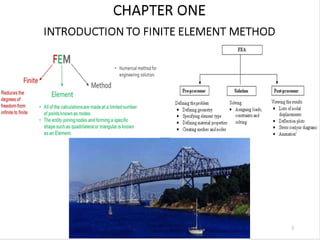
• The finite element method is a numerical method for solving
problems of engineering and mathematical physics.
• It is a numerical technique to obtain an approximate
solution to a class of problems governed by elliptic partial
differential equations.
• Such problems are called as boundary value problems(BVP)
as they consist of a partial differential equation and the
boundary conditions.
• A boundary value problem is a differential equation (or
system of differential equations) to be solved in a domain on
whose boundary a set of conditions is known.
5
Introduction to FEM
Analytical solutions are those given by a mathematical
expression that yields the values of the desired unknown
quantities at any location in a body and are thus valid for an
infinite number of locations in the body
These analytical solutions generally require the solution of
ordinary or partial differential equations, which, because
of the complicated geometries, loadings, and material
properties, are not usually obtainable
Hence we need to rely on numerical methods, such as the
FEM, for acceptable solutions
FEM results in a system of simultaneous algebraic equations
for solution, rather than requiring the solution of
differential equations
6
Introduction FEM
The goal of this procedure is to transform the differential
equations into a set of linear equations, which can then be
solved by the computer in a routine manner
Hence this process of modeling a body by dividing it into an
equivalent system of smaller bodies or units (finite
elements) interconnected at points common to two or
more elements (nodal points or nodes) and/or boundary
lines and/or surfaces is called discretization
7
Introduction FEM
In the finite element method, instead of solving the problem
for the entire body in one operation, we formulate the
equations for each finite element and combine them to
obtain the solution of the whole body.
Briefly, the solution for structural problems typically refers to
determining the displacements at each node and the
stresses within each element making up the structure that
is subjected to applied loads.
In nonstructural problems, the nodal unknowns may, for
instance, may be temperatures or fluid pressures due to
thermal or fluid fluxes.
8
Background of FEM
1940s - Modern development of FEM began in the field of
structural engineering.
1950s - The development of high-speed digital computers
made possible FEM equations to be expressed in matrix
notation.
Early1960s – FEM was extended to three-dimensional
problems. (small strain, small/large displacements, elastic
and non-linear material behavior, buckling problems).
In 1965 Archer developed method for dynamic analysis.
Late1960s - FEM had been applied to nonstructural
applications such as fluid flow, and heat conduction.
9
Introduction FEM
Typical structural areas include,
1. Stress analysis, including
a. Truss and frame analysis, and
b. Stress concentration problems typically associated
with holes, fillets, or
c. Other changes in geometry in a body
2. Buckling
3. Vibration analysis
10
Applications of the FEM
Nonstructural problems include
1. Heat transfer
2. Fluid flow, including seepage through porous media
3. Distribution of electric or magnetic potential
Finally, some biomechanical engineering problems typically
include
1. Analyses of human spine,
2. skull, hip joints,
3. jaw/gum tooth implants,
4. heart, and eye
11
Introduction to Matrix Notation
• Matrix notation represents a simple system for writing and
solving sets of simultaneous algebraic equations.
• Matrix – a rectangular array of quantities arranged in rows
and columns that is used to express and solve a system of
equations.
• A rectangular matrix is indicated by square bracket notation
[ ].
• A column matrix is indicated by brace notation { }
12
Column matrices
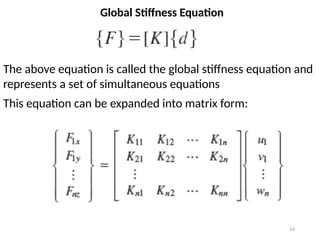
The column matrices represent the force components {F}
acting at various nodes or points (1,2…..,n) on a structure and
the corresponding set of nodal displacements {d}
Notation: Subscripts to the right of F identify the node and
direction of force, respectively. The x, y, and z displacements
at a node are denoted by u, v, and w.
13
Rectangular matrices
• Here are square matrices, a type of rectangular matrices.
• The first [k] is the element stiffness matrix and the second
[K] is the global stiffness matrix
14
Global Stiffness Equation
The above equation is called the global stiffness equation and
represents a set of simultaneous equations
This equation can be expanded into matrix form:
15
Role of the Computer
• With the development of computers in the 1950s, the finite
element method became a practical tool of analysis
• With modern computers computational programs with
millions of unknowns can be solved
• To use the computer, the analyst, having defined the finite
element model, inputs the information for calculation
• The information may include the position of the elemental
nodal coordinates, material properties, the applied load,
boundary conditions, or constraints
• The computer then generates and solves the equations
and outputs results for interpretation
16
Primary Methods Used to Derive the Finite Element
Equations
(1) Direct approach,
(2) Variation approach,
(3) Energy approach and
(4) Weighted residual approach.
17
Direct Methods
Simplest methods and yield a clear physical insight into the
finite element method
• Limited in its application to one-dimensional elements
• There are two general direct approaches:
The force or flexibility method which uses internal forces
as the unknowns to the problems
The displacement or stiffness method which assumes the
displacement of the nodes as the unknowns of the problem
• For computational purposes, the displacement method is
more desirable and is more widely used
18
Variation Methods
• Easier to use for deriving finite element equations
for two- and three-dimensional elements when compared to
the direct methods
• Requires the existence of a functional, that upon minimizing
yields the stiffness matrix and related element equations
• For structural/stress analysis problems, the principle of
minimum potential energy is used as the functional
19
Weighted Residual Methods
• Allow the finite element method to be applied directly to
any differential equation without a variation principle
• A very well-known weighted residual method is the Galerkin
method, for deriving the bar element stiffness matrix and
associated element equations
20
General Steps of the Finite Element Method
Step 1 - Discretize and Select Element Types
Step 2 - Select a Displacement Function
Step 3 - Define the Strain/Displacement and Stress/Strain
Relationships
Step 4 - Derive the Element Stiffness Matrix and Equations
Step 5 - Assemble the Element Equations and Introduce
Boundary Conditions
Step 6 - Solve for the Unknown Degrees of Freedom (or
Generalized Displacements)
Step 7 - Solve for the Element Strains and Stresses
Step 8 - Interpret the Results
21
General Steps of the Finite Element Method
The analyst must make decisions regarding:
• Dividing the structure or continuum into finite
elements
• The element type or types to be used in the analysis
• The kinds of loads to be applied
• The types of boundary conditions or supports to be applied
• The other steps, 2 through 7, are carried out automatically
by a computer program
22
Step 1: Discretize and Select the Element Types
• The total number of elements used and their variation in
size and type are matters of engineering judgment.
• Elements must be made small enough to give usable results
and yet large enough to reduce computational effort.
• The discretized body or mesh is often created with mesh-
generation programs
23
Element Types
24
Element Types
25
Step 2: Select a Displacement Function
The function is defined within the element using the nodal
values of the elements.
• Linear, quadratic, and cubic polynomials are frequently used
functions
• Trigonometric series can also be used
• The continuous quantity, such as the displacement
throughout the body, is approximated by a discrete model
composed of piecewise-continuous functions
26
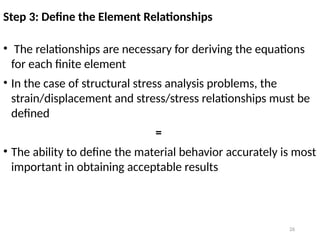
Step 3: Define the Element Relationships
• The relationships are necessary for deriving the equations
for each finite element
• In the case of structural stress analysis problems, the
strain/displacement and stress/stress relationships must be
defined
=
• The ability to define the material behavior accurately is most
important in obtaining acceptable results
27
Step 4: Derive the Element Stiffness Matrix Equations
• These equations can be written in matrix form as:
• Or in compact matrix form as
Where {f} is the vector of element nodal forces, [k] is the
element stiffness matrix, and {d} is the vector of unknown
element nodal degrees of freedom
28
Step 5: Assemble the Element Equations
• The individual element nodal equilibrium equations
generated in step 4 are assembled into the global nodal
equilibrium equations
• The final assembled or global equation is written in matrix
form as:
• Where {F} is the vector of global nodal forces, [K] is the
structure global stiffness matrix, and {d} is now the vector of
known and unknown structure nodal degree of freedom
• Boundary conditions must be invoked to remove the
singularity problem of the global stiffness matrix [K]
29
Step 6: Solve for the Unknown Degrees of Freedom
• A set of simultaneous algebraic equations, accounting for
the boundary conditions, can be written in expanded matrix
form as:
• Where n is now the structure total number of unknown
nodal degrees of freedom
• These equations are then solved for the ds, called the
primary unknowns, using an elimination or iterative method
30
Step 7: Solve for the Element Secondary Quantities
• The secondary quantities are those that can be directly
expressed in terms of the calculated degrees of freedom
from Step 6
• For the structural stress-analysis problems, the important
secondary quantities are stress and strain or moment and
shear forces
31
Step 8: Interpret the Results
• The final goal is to interpret and analyze the results for use
in the design/analysis process
• Postprocessor computer programs help the user to interpret
the results by displaying them in graphical form
• The results are only as good as the inputs assigned by the
user!
32
Applications of the Finite Element Method
Typical structural areas include:
• Stress analysis and stress concentration problems
• Analysis of human spine, skull, hip, etc…
• Buckling, such as in columns or frames
• Vibration analysis
• Impact problems
33
Applications of the Finite Element Method
Nonstructural problems include:
• Heat transfer such as in electronic devices and cooling fins
• Fluid flow including seepage through porous media, air flow
around race cars, or cooling ponds
• Distribution of electric or magnetic potential, such as in
antennas and transistors
34
Advantages of the Finite Element Method
The ability to:
1. Model irregularly shaped bodies quite easily
2. Handle general load conditions without difficulty
3. Model bodies composed of several different materials
4. Handle virtually unlimited numbers and kinds of boundary
conditions
5. Vary the size of the elements
6. Alter the finite element model relatively easily and cheaply
7. Include dynamic effects
8. Handle nonlinear behavior
35
Computer Programs for the Finite Element Method
Two general computer methods of approach to the solution
of problems by the finite element method:
1. General-purpose programs
2. Developing many small, special-purpose programs
Various Commercial Personal Computer Programs for FEM
1. Autodesk Simulation Multiphysics 2. Abaqus
3. ANSYS 4. COSMOS/M
5. GT-STRUDL 6. LS-DYNA
7. MARC 8. MSC/NASTRAN
9. NISA 10. Pro/MECHANICA
11. SAP2000 12. STARDYNE
36
What is Modeling ?
- Modeling and simulation (M&S) is the use of a physical or
logical representation of a given system to generate data and
help determine decisions or make predictions about the
system.
- M&S is widely used in the social and physical sciences,
engineering, manufacturing and product development, among
many other areas.
- A Representation of an object, a system, or an idea in some
form other than that of the entity itself.
- This implies that a model can be used to answer questions
about a system without doing experiments on the real system
37
Why is modeling required?
Modeling may be quite useful:
– To gauge the mass of the Earth, not using any balance
– To quantify the amount of blood inside a living human body
– To predict the population of China for the year 2050
– To assess the impact of 30% reduction in income tax over
the national economy
– To find the temperature at the surface or at the center of
the sun
– Crush Analysis of vehicle
– To determine the mean time between failures (MTBF) or
average life span of an electric bulb etc...
38
General scenario of Modeling a physical problem
39
Mathematical Model
A mathematical model is a mathematical description of
properties and interactions in the system
The development of a mathematical model depends on:
• The system boundary, system components, material
property and their interactions
• Type of analysis that we want to perform, like steady
state or transient analysis
• Assumptions that we will consider while model
development
40
Computational Models
• Procedures of formulating and solving Engineering problems
• Broadly speaking, require simulation to reveal their
behaviors. Whereas the behavior of mathematical models can
be revealed by the application of analytical techniques
• Computational models involve either a large system of
equations and/or an algorithmic component
• Computational Modelling uses numerical Technique to solve
problems
– Finite difference Method
– Finite Element Method
– Finite Volume Method
41
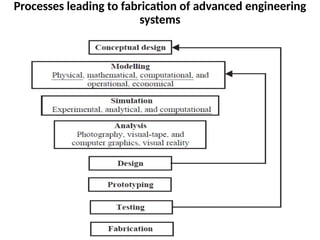
Processes leading to fabrication of advanced engineering
systems
42
The End Of Chapter Two
Thank You
Any Question ??????

chapter 1- introduction to finite element method

  • 1.
    1 MIZAN-TEPI UNIVERSITY COLLEGE OFENGINEERING AND TECHNOLOGY DEPARTMENT OF MECHANICAL ENGINEERING Introduction to finite element method (FEM) OR Finite Element Analysis (FEA) Course code: MEng 4271 Course Title: Finite Element Method Degree Program: BSc in Mechanical Engineering Module: Advanced Design and Analysis
  • 2.
  • 3.
    3 Learning Objectives • Topresent an introduction to the finite element method • To provide a brief history of the finite element method • To describe the role of the computer in the development of the finite element method • To present the general steps used in the finite element method • To illustrate the various types of elements used in the finite element method • To show typical applications of the finite element method • To summarize some of the advantages of the finite element method
  • 4.
    4 Introduction to FEM •The finite element method is a numerical method for solving problems of engineering and mathematical physics. • It is a numerical technique to obtain an approximate solution to a class of problems governed by elliptic partial differential equations. • Such problems are called as boundary value problems(BVP) as they consist of a partial differential equation and the boundary conditions. • A boundary value problem is a differential equation (or system of differential equations) to be solved in a domain on whose boundary a set of conditions is known.
  • 5.
    5 Introduction to FEM Analyticalsolutions are those given by a mathematical expression that yields the values of the desired unknown quantities at any location in a body and are thus valid for an infinite number of locations in the body These analytical solutions generally require the solution of ordinary or partial differential equations, which, because of the complicated geometries, loadings, and material properties, are not usually obtainable Hence we need to rely on numerical methods, such as the FEM, for acceptable solutions FEM results in a system of simultaneous algebraic equations for solution, rather than requiring the solution of differential equations
  • 6.
    6 Introduction FEM The goalof this procedure is to transform the differential equations into a set of linear equations, which can then be solved by the computer in a routine manner Hence this process of modeling a body by dividing it into an equivalent system of smaller bodies or units (finite elements) interconnected at points common to two or more elements (nodal points or nodes) and/or boundary lines and/or surfaces is called discretization
  • 7.
    7 Introduction FEM In thefinite element method, instead of solving the problem for the entire body in one operation, we formulate the equations for each finite element and combine them to obtain the solution of the whole body. Briefly, the solution for structural problems typically refers to determining the displacements at each node and the stresses within each element making up the structure that is subjected to applied loads. In nonstructural problems, the nodal unknowns may, for instance, may be temperatures or fluid pressures due to thermal or fluid fluxes.
  • 8.
    8 Background of FEM 1940s- Modern development of FEM began in the field of structural engineering. 1950s - The development of high-speed digital computers made possible FEM equations to be expressed in matrix notation. Early1960s – FEM was extended to three-dimensional problems. (small strain, small/large displacements, elastic and non-linear material behavior, buckling problems). In 1965 Archer developed method for dynamic analysis. Late1960s - FEM had been applied to nonstructural applications such as fluid flow, and heat conduction.
  • 9.
    9 Introduction FEM Typical structuralareas include, 1. Stress analysis, including a. Truss and frame analysis, and b. Stress concentration problems typically associated with holes, fillets, or c. Other changes in geometry in a body 2. Buckling 3. Vibration analysis
  • 10.
    10 Applications of theFEM Nonstructural problems include 1. Heat transfer 2. Fluid flow, including seepage through porous media 3. Distribution of electric or magnetic potential Finally, some biomechanical engineering problems typically include 1. Analyses of human spine, 2. skull, hip joints, 3. jaw/gum tooth implants, 4. heart, and eye
  • 11.
    11 Introduction to MatrixNotation • Matrix notation represents a simple system for writing and solving sets of simultaneous algebraic equations. • Matrix – a rectangular array of quantities arranged in rows and columns that is used to express and solve a system of equations. • A rectangular matrix is indicated by square bracket notation [ ]. • A column matrix is indicated by brace notation { }
  • 12.
    12 Column matrices The columnmatrices represent the force components {F} acting at various nodes or points (1,2…..,n) on a structure and the corresponding set of nodal displacements {d} Notation: Subscripts to the right of F identify the node and direction of force, respectively. The x, y, and z displacements at a node are denoted by u, v, and w.
  • 13.
    13 Rectangular matrices • Hereare square matrices, a type of rectangular matrices. • The first [k] is the element stiffness matrix and the second [K] is the global stiffness matrix
  • 14.
    14 Global Stiffness Equation Theabove equation is called the global stiffness equation and represents a set of simultaneous equations This equation can be expanded into matrix form:
  • 15.
    15 Role of theComputer • With the development of computers in the 1950s, the finite element method became a practical tool of analysis • With modern computers computational programs with millions of unknowns can be solved • To use the computer, the analyst, having defined the finite element model, inputs the information for calculation • The information may include the position of the elemental nodal coordinates, material properties, the applied load, boundary conditions, or constraints • The computer then generates and solves the equations and outputs results for interpretation
  • 16.
    16 Primary Methods Usedto Derive the Finite Element Equations (1) Direct approach, (2) Variation approach, (3) Energy approach and (4) Weighted residual approach.
  • 17.
    17 Direct Methods Simplest methodsand yield a clear physical insight into the finite element method • Limited in its application to one-dimensional elements • There are two general direct approaches: The force or flexibility method which uses internal forces as the unknowns to the problems The displacement or stiffness method which assumes the displacement of the nodes as the unknowns of the problem • For computational purposes, the displacement method is more desirable and is more widely used
  • 18.
    18 Variation Methods • Easierto use for deriving finite element equations for two- and three-dimensional elements when compared to the direct methods • Requires the existence of a functional, that upon minimizing yields the stiffness matrix and related element equations • For structural/stress analysis problems, the principle of minimum potential energy is used as the functional
  • 19.
    19 Weighted Residual Methods •Allow the finite element method to be applied directly to any differential equation without a variation principle • A very well-known weighted residual method is the Galerkin method, for deriving the bar element stiffness matrix and associated element equations
  • 20.
    20 General Steps ofthe Finite Element Method Step 1 - Discretize and Select Element Types Step 2 - Select a Displacement Function Step 3 - Define the Strain/Displacement and Stress/Strain Relationships Step 4 - Derive the Element Stiffness Matrix and Equations Step 5 - Assemble the Element Equations and Introduce Boundary Conditions Step 6 - Solve for the Unknown Degrees of Freedom (or Generalized Displacements) Step 7 - Solve for the Element Strains and Stresses Step 8 - Interpret the Results
  • 21.
    21 General Steps ofthe Finite Element Method The analyst must make decisions regarding: • Dividing the structure or continuum into finite elements • The element type or types to be used in the analysis • The kinds of loads to be applied • The types of boundary conditions or supports to be applied • The other steps, 2 through 7, are carried out automatically by a computer program
  • 22.
    22 Step 1: Discretizeand Select the Element Types • The total number of elements used and their variation in size and type are matters of engineering judgment. • Elements must be made small enough to give usable results and yet large enough to reduce computational effort. • The discretized body or mesh is often created with mesh- generation programs
  • 23.
  • 24.
  • 25.
    25 Step 2: Selecta Displacement Function The function is defined within the element using the nodal values of the elements. • Linear, quadratic, and cubic polynomials are frequently used functions • Trigonometric series can also be used • The continuous quantity, such as the displacement throughout the body, is approximated by a discrete model composed of piecewise-continuous functions
  • 26.
    26 Step 3: Definethe Element Relationships • The relationships are necessary for deriving the equations for each finite element • In the case of structural stress analysis problems, the strain/displacement and stress/stress relationships must be defined = • The ability to define the material behavior accurately is most important in obtaining acceptable results
  • 27.
    27 Step 4: Derivethe Element Stiffness Matrix Equations • These equations can be written in matrix form as: • Or in compact matrix form as Where {f} is the vector of element nodal forces, [k] is the element stiffness matrix, and {d} is the vector of unknown element nodal degrees of freedom
  • 28.
    28 Step 5: Assemblethe Element Equations • The individual element nodal equilibrium equations generated in step 4 are assembled into the global nodal equilibrium equations • The final assembled or global equation is written in matrix form as: • Where {F} is the vector of global nodal forces, [K] is the structure global stiffness matrix, and {d} is now the vector of known and unknown structure nodal degree of freedom • Boundary conditions must be invoked to remove the singularity problem of the global stiffness matrix [K]
  • 29.
    29 Step 6: Solvefor the Unknown Degrees of Freedom • A set of simultaneous algebraic equations, accounting for the boundary conditions, can be written in expanded matrix form as: • Where n is now the structure total number of unknown nodal degrees of freedom • These equations are then solved for the ds, called the primary unknowns, using an elimination or iterative method
  • 30.
    30 Step 7: Solvefor the Element Secondary Quantities • The secondary quantities are those that can be directly expressed in terms of the calculated degrees of freedom from Step 6 • For the structural stress-analysis problems, the important secondary quantities are stress and strain or moment and shear forces
  • 31.
    31 Step 8: Interpretthe Results • The final goal is to interpret and analyze the results for use in the design/analysis process • Postprocessor computer programs help the user to interpret the results by displaying them in graphical form • The results are only as good as the inputs assigned by the user!
  • 32.
    32 Applications of theFinite Element Method Typical structural areas include: • Stress analysis and stress concentration problems • Analysis of human spine, skull, hip, etc… • Buckling, such as in columns or frames • Vibration analysis • Impact problems
  • 33.
    33 Applications of theFinite Element Method Nonstructural problems include: • Heat transfer such as in electronic devices and cooling fins • Fluid flow including seepage through porous media, air flow around race cars, or cooling ponds • Distribution of electric or magnetic potential, such as in antennas and transistors
  • 34.
    34 Advantages of theFinite Element Method The ability to: 1. Model irregularly shaped bodies quite easily 2. Handle general load conditions without difficulty 3. Model bodies composed of several different materials 4. Handle virtually unlimited numbers and kinds of boundary conditions 5. Vary the size of the elements 6. Alter the finite element model relatively easily and cheaply 7. Include dynamic effects 8. Handle nonlinear behavior
  • 35.
    35 Computer Programs forthe Finite Element Method Two general computer methods of approach to the solution of problems by the finite element method: 1. General-purpose programs 2. Developing many small, special-purpose programs Various Commercial Personal Computer Programs for FEM 1. Autodesk Simulation Multiphysics 2. Abaqus 3. ANSYS 4. COSMOS/M 5. GT-STRUDL 6. LS-DYNA 7. MARC 8. MSC/NASTRAN 9. NISA 10. Pro/MECHANICA 11. SAP2000 12. STARDYNE
  • 36.
    36 What is Modeling? - Modeling and simulation (M&S) is the use of a physical or logical representation of a given system to generate data and help determine decisions or make predictions about the system. - M&S is widely used in the social and physical sciences, engineering, manufacturing and product development, among many other areas. - A Representation of an object, a system, or an idea in some form other than that of the entity itself. - This implies that a model can be used to answer questions about a system without doing experiments on the real system
  • 37.
    37 Why is modelingrequired? Modeling may be quite useful: – To gauge the mass of the Earth, not using any balance – To quantify the amount of blood inside a living human body – To predict the population of China for the year 2050 – To assess the impact of 30% reduction in income tax over the national economy – To find the temperature at the surface or at the center of the sun – Crush Analysis of vehicle – To determine the mean time between failures (MTBF) or average life span of an electric bulb etc...
  • 38.
    38 General scenario ofModeling a physical problem
  • 39.
    39 Mathematical Model A mathematicalmodel is a mathematical description of properties and interactions in the system The development of a mathematical model depends on: • The system boundary, system components, material property and their interactions • Type of analysis that we want to perform, like steady state or transient analysis • Assumptions that we will consider while model development
  • 40.
    40 Computational Models • Proceduresof formulating and solving Engineering problems • Broadly speaking, require simulation to reveal their behaviors. Whereas the behavior of mathematical models can be revealed by the application of analytical techniques • Computational models involve either a large system of equations and/or an algorithmic component • Computational Modelling uses numerical Technique to solve problems – Finite difference Method – Finite Element Method – Finite Volume Method
  • 41.
    41 Processes leading tofabrication of advanced engineering systems
  • 42.
    42 The End OfChapter Two Thank You Any Question ??????