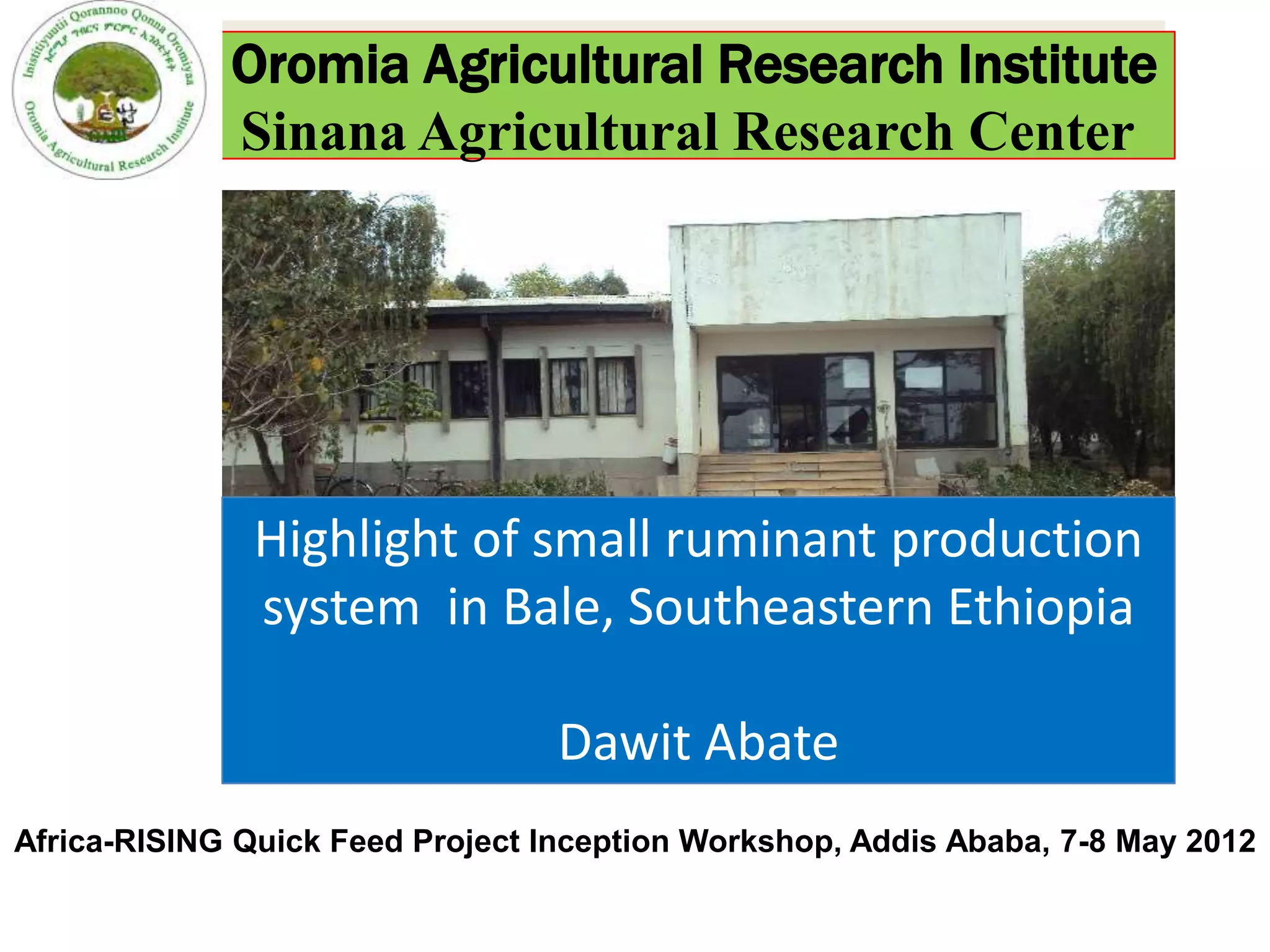
Oromia Agricultural Research Institute
             Sinana Agricultural Research Center


               Highlight of small ruminant production
               system in Bale, Southeastern Ethiopia

                                  Dawit Abate
Africa-RISING Quick Feed Project Inception Workshop, Addis Ababa, 7-8 May 2012
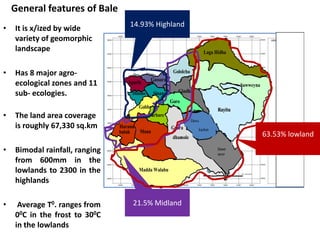
General features of Bale
                                    14.93% Highland
•   It is x/ized by wide
    variety of geomorphic
    landscape                                                               Laga Hidha


•   Has 8 major agro-                                     Gololcha
                                             Gassara
    ecological zones and 11        Agarfa                                                  Sawweyna
                                                            Gindhir
    sub- ecologies.                  Dinsho -Dinsho
                                        Sinana Sinana
                                                        Go
                                                         Goro
                                        Gobba           ro
                                                                                  Rayitu
•   The land area coverage                  Barbare
                                                                     Dawe
    is roughly 67,330 sq.km     Harana                   Gurra          kachen
                                    Mana Angetu
                                buluk    Mana
                                                             -
                                                          dhamole                                     63.53% lowland
•   Bimodal rainfall, ranging                                                     Dawe
                                                                                  serer
    from 600mm in the
    lowlands to 2300 in the             Madda Walabu

    highlands

•    Average T0. ranges from          21.5% Midland
    00C in the frost to 300C
    in the lowlands
General features of Bale …

• The highland agro-ecologies are characterized by mixed
  crop/ livestock farming system

• Where as agro-pastoralism is the main production systems
  and livestock play a great role in the low land

• More than 95% of the population is depending on
  agriculture and 88% live in rural area(BZPEDO, 1999)
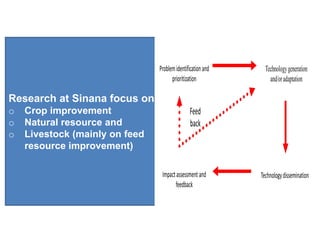
Problem identification and     Technology generation
                                      prioritization             and/or adaptation

Research at Sinana focus on
o   Crop improvement                           Feed
o   Natural resource and                       back
o   Livestock (mainly on feed
    resource improvement)

                                 Impact assessment and       Technology dissemination
                                       feedback
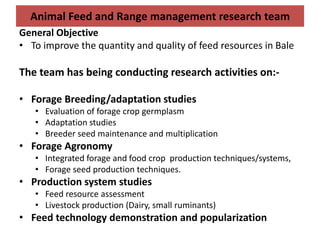
Animal Feed and Range management research team
General Objective
• To improve the quantity and quality of feed resources in Bale

The team has being conducting research activities on:-

• Forage Breeding/adaptation studies
   • Evaluation of forage crop germplasm
   • Adaptation studies
   • Breeder seed maintenance and multiplication
• Forage Agronomy
   • Integrated forage and food crop production techniques/systems,
   • Forage seed production techniques.
• Production system studies
   • Feed resource assessment
   • Livestock production (Dairy, small ruminants)
• Feed technology demonstration and popularization
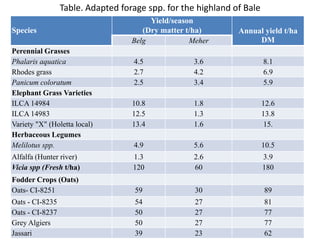
Table. Adapted forage spp. for the highland of Bale
                                           Yield/season
Species                                  (Dry matter t/ha)    Annual yield t/ha
                                   Belg               Meher        DM
Perennial Grasses
Phalaris aquatica                  4.5                 3.6             8.1
Rhodes grass                       2.7                 4.2             6.9
Panicum coloratum                  2.5                 3.4             5.9
Elephant Grass Varieties
ILCA 14984                         10.8                1.8             12.6
ILCA 14983                         12.5                1.3             13.8
Variety "X" (Holetta local)        13.4                1.6              15.
Herbaceous Legumes
Melilotus spp.                     4.9                 5.6             10.5
Alfalfa (Hunter river)             1.3                 2.6             3.9
Vicia spp (Fresh t/ha)             120                 60              180
Fodder Crops (Oats)
Oats- CI-8251                       59                  30             89
Oats - CI-8235                      54                  27             81
Oats - CI-8237                      50                  27             77
Grey Algiers                        50                  27             77
Jassari                             39                  23             62
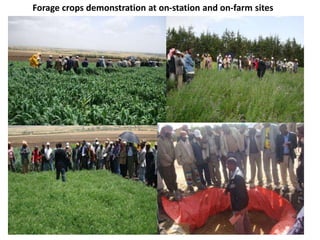
Forage crops demonstration at on-station and on-farm sites
Small ruminant production in Bale
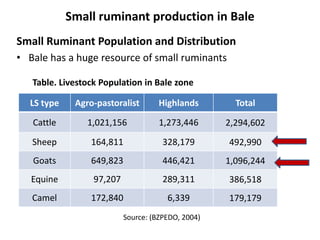
Small Ruminant Population and Distribution
• Bale has a huge resource of small ruminants

   Table. Livestock Population in Bale zone

  LS type    Agro-pastoralist        Highlands        Total

   Cattle       1,021,156            1,273,446      2,294,602
   Sheep         164,811              328,179       492,990
   Goats         649,823              446,421       1,096,244
   Equine         97,207              289,311       386,518
   Camel         172,840               6,339        179,179
                           Source: (BZPEDO, 2004)
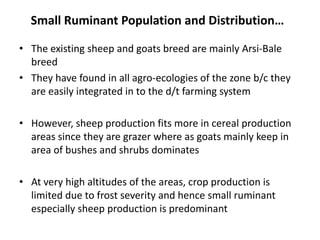
Small Ruminant Population and Distribution…

• The existing sheep and goats breed are mainly Arsi-Bale
  breed
• They have found in all agro-ecologies of the zone b/c they
  are easily integrated in to the d/t farming system

• However, sheep production fits more in cereal production
  areas since they are grazer where as goats mainly keep in
  area of bushes and shrubs dominates

• At very high altitudes of the areas, crop production is
  limited due to frost severity and hence small ruminant
  especially sheep production is predominant
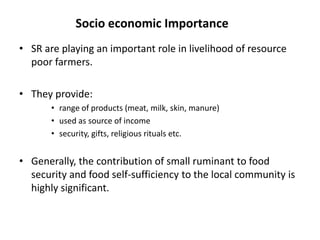
Socio economic Importance
• SR are playing an important role in livelihood of resource
  poor farmers.

• They provide:
       • range of products (meat, milk, skin, manure)
       • used as source of income
       • security, gifts, religious rituals etc.


• Generally, the contribution of small ruminant to food
  security and food self-sufficiency to the local community is
  highly significant.
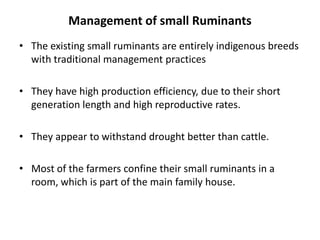
Management of small Ruminants
• The existing small ruminants are entirely indigenous breeds
  with traditional management practices

• They have high production efficiency, due to their short
  generation length and high reproductive rates.

• They appear to withstand drought better than cattle.

• Most of the farmers confine their small ruminants in a
  room, which is part of the main family house.
Feed resources and feeding practices
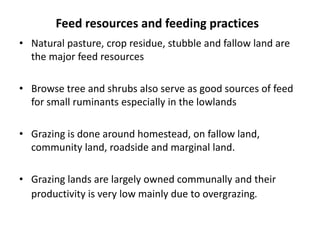
• Natural pasture, crop residue, stubble and fallow land are
  the major feed resources

• Browse tree and shrubs also serve as good sources of feed
  for small ruminants especially in the lowlands

• Grazing is done around homestead, on fallow land,
  community land, roadside and marginal land.

• Grazing lands are largely owned communally and their
  productivity is very low mainly due to overgrazing.
Feed resources and feeding practices
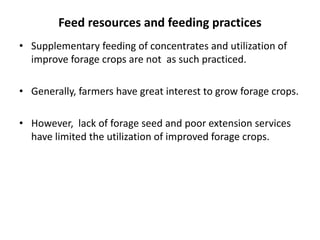
• Supplementary feeding of concentrates and utilization of
  improve forage crops are not as such practiced.

• Generally, farmers have great interest to grow forage crops.

• However, lack of forage seed and poor extension services
  have limited the utilization of improved forage crops.
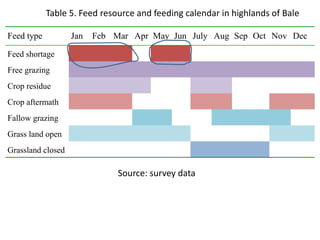
Table 5. Feed resource and feeding calendar in highlands of Bale

Feed type          Jan   Feb Mar Apr May Jun July Aug Sep Oct Nov Dec

Feed shortage
Free grazing
Crop residue
Crop aftermath
Fallow grazing
Grass land open
Grassland closed

                              Source: survey data
Health and Disease
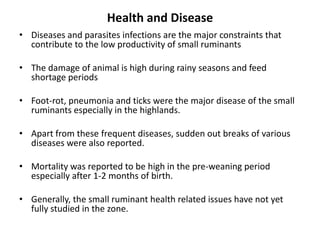
• Diseases and parasites infections are the major constraints that
  contribute to the low productivity of small ruminants

• The damage of animal is high during rainy seasons and feed
  shortage periods

• Foot-rot, pneumonia and ticks were the major disease of the small
  ruminants especially in the highlands.

• Apart from these frequent diseases, sudden out breaks of various
  diseases were also reported.

• Mortality was reported to be high in the pre-weaning period
  especially after 1-2 months of birth.

• Generally, the small ruminant health related issues have not yet
  fully studied in the zone.
Marketing
• Small ruminants are usually sold to meet family needs
    –   to buy food grains
    –   clothing,
    –   house hold miscellaneous petty expenses,
    –   agricultural in puts (fertilizer, herbicides, improved seeds,
    –   credit repayments
• Seasonal shortage of rainfall through its impact on feed availability
  and crop failure forces higher supply of small ruminants to market.
• The price fluctuates with the on set of drought, season (holidays),
  credit repayment time etc.

• The market infrastructures such as roads are very poor. Farmers
  usually sell their animals to the local traders

• Poor marketing chain is among the major problems related to small
  ruminants marketing system.
Major constraints
• Shortage of adequate quantity and quality of feed
  resources
      • Low productivity of grazing land due to population pressures,
        over grazing, recurrent drought, bush encroachment and
        expansion of cultivation
      • The problem was critical in dry seasons.


• The incidence of disease and parasites

• Low genetic potential for some traits

• Shortage of adequate and quality water
Major constraints…
• Traditional management systems (poor housing, breed
  selection)


• Poor access to the market
       • The marketing systems for livestock and their products is
         also not encouraging for agro-pastoralist far from market
         centers.
       • Poor infrastructure development such as roads.


• Lack of livestock research and poor extension services
       • There is no/little intervention works done so far on the
         improvement of production and productivity of local
         breeds.
Suggested Interventions

• Further work is required in introduction, on-farm
  evaluation and popularization of the demand driven and
  adaptive technologies for the livestock keeper of farming
  communities

• Identifying constraints in small ruminant production
  system, marketing chains and developing short and
  important marketing value chains that benefits producers
  is also crucial.

Highlight of small ruminant production system in Bale, Southeastern Ethiopia

  • 1.
    Oromia Agricultural ResearchInstitute Sinana Agricultural Research Center Highlight of small ruminant production system in Bale, Southeastern Ethiopia Dawit Abate Africa-RISING Quick Feed Project Inception Workshop, Addis Ababa, 7-8 May 2012
  • 2.
    General features ofBale 14.93% Highland • It is x/ized by wide variety of geomorphic landscape Laga Hidha • Has 8 major agro- Gololcha Gassara ecological zones and 11 Agarfa Sawweyna Gindhir sub- ecologies. Dinsho -Dinsho Sinana Sinana Go Goro Gobba ro Rayitu • The land area coverage Barbare Dawe is roughly 67,330 sq.km Harana Gurra kachen Mana Angetu buluk Mana - dhamole 63.53% lowland • Bimodal rainfall, ranging Dawe serer from 600mm in the lowlands to 2300 in the Madda Walabu highlands • Average T0. ranges from 21.5% Midland 00C in the frost to 300C in the lowlands
  • 3.
    General features ofBale … • The highland agro-ecologies are characterized by mixed crop/ livestock farming system • Where as agro-pastoralism is the main production systems and livestock play a great role in the low land • More than 95% of the population is depending on agriculture and 88% live in rural area(BZPEDO, 1999)
  • 4.
    Problem identification and Technology generation prioritization and/or adaptation Research at Sinana focus on o Crop improvement Feed o Natural resource and back o Livestock (mainly on feed resource improvement) Impact assessment and Technology dissemination feedback
  • 5.
    Animal Feed andRange management research team General Objective • To improve the quantity and quality of feed resources in Bale The team has being conducting research activities on:- • Forage Breeding/adaptation studies • Evaluation of forage crop germplasm • Adaptation studies • Breeder seed maintenance and multiplication • Forage Agronomy • Integrated forage and food crop production techniques/systems, • Forage seed production techniques. • Production system studies • Feed resource assessment • Livestock production (Dairy, small ruminants) • Feed technology demonstration and popularization
  • 6.
    Table. Adapted foragespp. for the highland of Bale Yield/season Species (Dry matter t/ha) Annual yield t/ha Belg Meher DM Perennial Grasses Phalaris aquatica 4.5 3.6 8.1 Rhodes grass 2.7 4.2 6.9 Panicum coloratum 2.5 3.4 5.9 Elephant Grass Varieties ILCA 14984 10.8 1.8 12.6 ILCA 14983 12.5 1.3 13.8 Variety "X" (Holetta local) 13.4 1.6 15. Herbaceous Legumes Melilotus spp. 4.9 5.6 10.5 Alfalfa (Hunter river) 1.3 2.6 3.9 Vicia spp (Fresh t/ha) 120 60 180 Fodder Crops (Oats) Oats- CI-8251 59 30 89 Oats - CI-8235 54 27 81 Oats - CI-8237 50 27 77 Grey Algiers 50 27 77 Jassari 39 23 62
  • 7.
    Forage crops demonstrationat on-station and on-farm sites
  • 8.
    Small ruminant productionin Bale Small Ruminant Population and Distribution • Bale has a huge resource of small ruminants Table. Livestock Population in Bale zone LS type Agro-pastoralist Highlands Total Cattle 1,021,156 1,273,446 2,294,602 Sheep 164,811 328,179 492,990 Goats 649,823 446,421 1,096,244 Equine 97,207 289,311 386,518 Camel 172,840 6,339 179,179 Source: (BZPEDO, 2004)
  • 9.
    Small Ruminant Populationand Distribution… • The existing sheep and goats breed are mainly Arsi-Bale breed • They have found in all agro-ecologies of the zone b/c they are easily integrated in to the d/t farming system • However, sheep production fits more in cereal production areas since they are grazer where as goats mainly keep in area of bushes and shrubs dominates • At very high altitudes of the areas, crop production is limited due to frost severity and hence small ruminant especially sheep production is predominant
  • 10.
    Socio economic Importance •SR are playing an important role in livelihood of resource poor farmers. • They provide: • range of products (meat, milk, skin, manure) • used as source of income • security, gifts, religious rituals etc. • Generally, the contribution of small ruminant to food security and food self-sufficiency to the local community is highly significant.
  • 11.
    Management of smallRuminants • The existing small ruminants are entirely indigenous breeds with traditional management practices • They have high production efficiency, due to their short generation length and high reproductive rates. • They appear to withstand drought better than cattle. • Most of the farmers confine their small ruminants in a room, which is part of the main family house.
  • 12.
    Feed resources andfeeding practices • Natural pasture, crop residue, stubble and fallow land are the major feed resources • Browse tree and shrubs also serve as good sources of feed for small ruminants especially in the lowlands • Grazing is done around homestead, on fallow land, community land, roadside and marginal land. • Grazing lands are largely owned communally and their productivity is very low mainly due to overgrazing.
  • 13.
    Feed resources andfeeding practices • Supplementary feeding of concentrates and utilization of improve forage crops are not as such practiced. • Generally, farmers have great interest to grow forage crops. • However, lack of forage seed and poor extension services have limited the utilization of improved forage crops.
  • 14.
    Table 5. Feedresource and feeding calendar in highlands of Bale Feed type Jan Feb Mar Apr May Jun July Aug Sep Oct Nov Dec Feed shortage Free grazing Crop residue Crop aftermath Fallow grazing Grass land open Grassland closed Source: survey data
  • 15.
    Health and Disease •Diseases and parasites infections are the major constraints that contribute to the low productivity of small ruminants • The damage of animal is high during rainy seasons and feed shortage periods • Foot-rot, pneumonia and ticks were the major disease of the small ruminants especially in the highlands. • Apart from these frequent diseases, sudden out breaks of various diseases were also reported. • Mortality was reported to be high in the pre-weaning period especially after 1-2 months of birth. • Generally, the small ruminant health related issues have not yet fully studied in the zone.
  • 16.
    Marketing • Small ruminantsare usually sold to meet family needs – to buy food grains – clothing, – house hold miscellaneous petty expenses, – agricultural in puts (fertilizer, herbicides, improved seeds, – credit repayments • Seasonal shortage of rainfall through its impact on feed availability and crop failure forces higher supply of small ruminants to market. • The price fluctuates with the on set of drought, season (holidays), credit repayment time etc. • The market infrastructures such as roads are very poor. Farmers usually sell their animals to the local traders • Poor marketing chain is among the major problems related to small ruminants marketing system.
  • 17.
    Major constraints • Shortageof adequate quantity and quality of feed resources • Low productivity of grazing land due to population pressures, over grazing, recurrent drought, bush encroachment and expansion of cultivation • The problem was critical in dry seasons. • The incidence of disease and parasites • Low genetic potential for some traits • Shortage of adequate and quality water
  • 18.
    Major constraints… • Traditionalmanagement systems (poor housing, breed selection) • Poor access to the market • The marketing systems for livestock and their products is also not encouraging for agro-pastoralist far from market centers. • Poor infrastructure development such as roads. • Lack of livestock research and poor extension services • There is no/little intervention works done so far on the improvement of production and productivity of local breeds.
  • 19.
    Suggested Interventions • Furtherwork is required in introduction, on-farm evaluation and popularization of the demand driven and adaptive technologies for the livestock keeper of farming communities • Identifying constraints in small ruminant production system, marketing chains and developing short and important marketing value chains that benefits producers is also crucial.