

Prepared by
Dr MuhammadAshiq Toor
DVM , B s c (Zoology)
Islamia University of Bahawal Pur (IUB) (2010 – 2015)
+92-344-499-7375
+92-300-364-2402
Antibiotics
Class wise , Spectrum , Bacterial activity ,
MOA & dose rates.
The Spectrum of Antimicrobial Activity
Narrow spectrum (limited spectrum)
 Antimicrobials effective against a (limited spectrum)
of microbial types.
 A drug effective on G+ve or G-ve bacteria.
Broad spectrum (extended spectrum)
 Antimicrobials effective against a (extended spectrum) wide
variety of microbial types .
 A drug effective against both G+ve & G-ve bacteria .
Broad spectrum
Some examples of broad-spectrum antibiotics include :
 Penicillin
 Cephalosporin
 Tetracycline
 Ciprofloxacin
 Levofloxacin
These drugs work on both G+ve & G-ve organisms.
Narrow Spectrum
Vancomycin
Azithromycin
Clarithromycin
Clindamycin
Clindamycin + Benzoyl Peroxide
Erythromycin
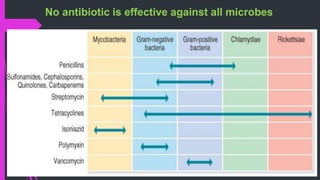
No antibiotic is effective against all microbes
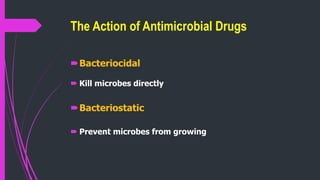
The Action of Antimicrobial Drugs
Bacteriocidal
 Kill microbes directly
Bacteriostatic
 Prevent microbes from growing
Bacteriostatic vs Bactericidal
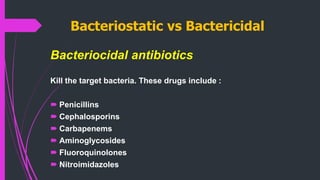
Bacteriocidal antibiotics
Kill the target bacteria. These drugs include :
 Penicillins
 Cephalosporins
 Carbapenems
 Aminoglycosides
 Fluoroquinolones
 Nitroimidazoles
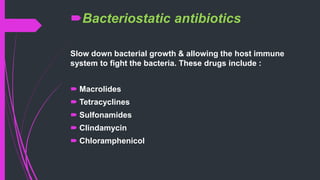
Bacteriostatic antibiotics
Slow down bacterial growth & allowing the host immune
system to fight the bacteria. These drugs include :
 Macrolides
 Tetracyclines
 Sulfonamides
 Clindamycin
 Chloramphenicol
Mechanisms of Antibiotics Action
1- Inhibition of Cell Wall Synthesis
2- Injuring the Plasma Membrane
3- Inhibition of Protein Synthesis
4- Inhibition of Nucleic Acid Synthesis
5- Inhibiting the Synthesis of Essential Metabolites
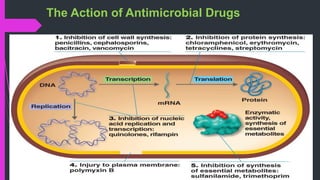
The Action of Antimicrobial Drugs
Mechanisms of Antibiotics Action Dihydrofolate
Mechanisms of Action:
inhibit the last step in the peptidoglycan
synthesis of the cell wall
1. inhibition of transpeptidase
 enzymes
2. activation of penicillin binding
 proteins (PBPs)
3. activation of autolysins
 (murein hydrolases)
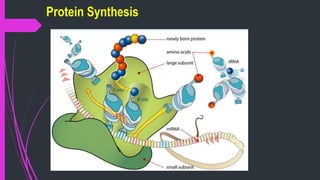
Protein Synthesis
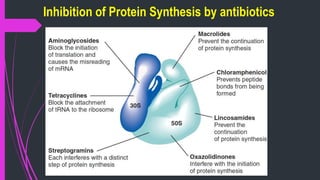
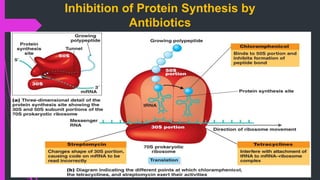
Inhibition of Protein Synthesis by antibiotics
Inhibition of Protein Synthesis by
Antibiotics
Figure 20.4
Inhibition of Cell Wall Synthesis
Transpeptidases, Carboxypeptidases &
Transglycosylases
Penicillin-binding proteins (PBPs(
β-Lactam antibiotics: generally are bacteriocidal agents
1- Beta-Lactam Antibiotics :
 Penicillins
 Cephalosporins
2- Glycopeptides :
 Vancomycin
3- Lipopeptides :
 Daptomycin
4- Polypeptides :
 Bacitracin
Inhibition of Cell Wall Synthesis
1- Aminopenicillins: Ampicillin, Amoxicillin
Ampicillin was limited primarily to Escherichia & Proteus
species .
2- Carboxypenicillins: Carbenicillin, Ticarcillin
Are effective against a broader range of G-ve bacteria i.e
Klebsiella, Enterobacter, & Pseudomonas species .
Broad-spectrum penicillins
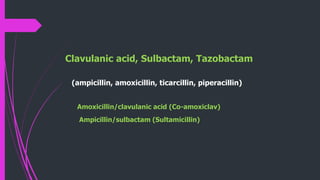
Clavulanic acid, Sulbactam, Tazobactam
(ampicillin, amoxicillin, ticarcillin, piperacillin)
Amoxicillin/clavulanic acid (Co-amoxiclav)
Ampicillin/sulbactam (Sultamicillin)
Cephalosporins
More stable to β-lactamase hydrolysis
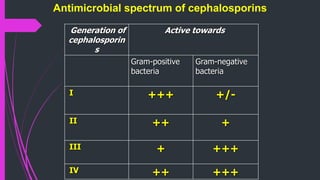
Antimicrobial spectrum of cephalosporins
Generation of
cephalosporin
s
Active towards
Gram-positive
bacteria
Gram-negative
bacteria
І +++ +/-
ІІ ++ +
ІІІ + +++
ІV ++ +++
CEPHALOSPORINS
CLASSIFICATION
A. First Generation
 1. Cephaloridine-Loridine, Ceporan
 2. Cephalothin-Keflin
 3. Cephalexin-Keflex, Ceporex
 4. Cefazolin-Cefacidal
 5. Cephradine-Velosef
 6. Cepharpirin-Cefadyl
 7. Cephadroxil-Doricef, Cefamox
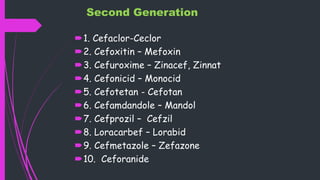
Second Generation
1. Cefaclor-Ceclor
2. Cefoxitin – Mefoxin
3. Cefuroxime – Zinacef, Zinnat
4. Cefonicid – Monocid
5. Cefotetan - Cefotan
6. Cefamdandole – Mandol
7. Cefprozil – Cefzil
8. Loracarbef – Lorabid
9. Cefmetazole – Zefazone
10. Ceforanide
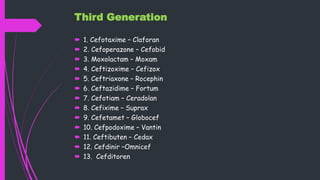
Third Generation
 1. Cefotaxime – Claforan
 2. Cefoperazone – Cefobid
 3. Moxolactam – Moxam
 4. Ceftizoxime – Cefizox
 5. Ceftriaxone – Rocephin
 6. Ceftazidime – Fortum
 7. Cefotiam – Ceradolan
 8. Cefixime – Suprax
 9. Cefetamet – Globocef
 10. Cefpodoxime – Vantin
 11. Ceftibuten – Cedax
 12. Cefdinir –Omnicef
 13. Cefditoren
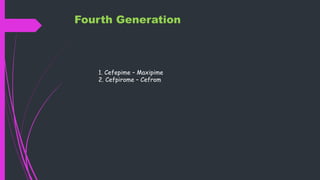
Fourth Generation
1. Cefepime – Maxipime
2. Cefpirome – Cefrom
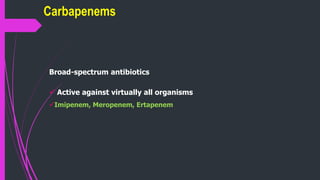
Broad-spectrum antibiotics
 Active against virtually all organisms
Imipenem, Meropenem, Ertapenem
Carbapenems
Narrow-spectrum antibiotics
 Are active only against aerobic & G-ve bacteria
Aztreonam
Monobactams
 Damage cytoplasmic membrane and inhibit RNA transcription
 The treatment of skin infections
 Used in creams, ointments, sprays
Polypeptides: Bacitracin
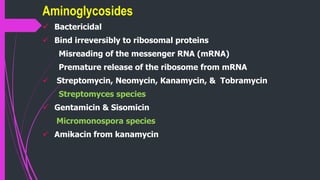
 Bactericidal
 Bind irreversibly to ribosomal proteins
Misreading of the messenger RNA (mRNA)
Premature release of the ribosome from mRNA
 Streptomycin, Neomycin, Kanamycin, & Tobramycin
Streptomyces species
 Gentamicin & Sisomicin
Micromonospora species
 Amikacin from kanamycin
Aminoglycosides
 Broad-spectrum
 Bacteriostatic
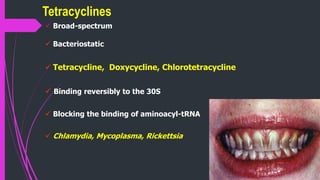
 Tetracycline, Doxycycline, Chlorotetracycline
 Binding reversibly to the 30S
 Blocking the binding of aminoacyl-tRNA
 Chlamydia, Mycoplasma, Rickettsia
Tetracyclines
Chloramphenicol
 Broad spectrum
 Bacteriostatic
 Blocking peptide elongation
 Typhoid fever
 Broad spectrum
 Bacteriostatic
Reversible binding to the 50S rRNA
Erythromycin, Azithromycin, Clarithromycin
Macrolides
Inhibition of Nucleic Acid Synthesis
1- Quinolones
2- Rifampin
3- Metronidazole
 Synthetic
 Inhibit bacterial DNA gyrases (II) or topoisomerases (IV)
Nalidixic acid
Fluoroquinolones:
Ciprofloxacin Levofloxacin Enrofloxacin
Quinolones
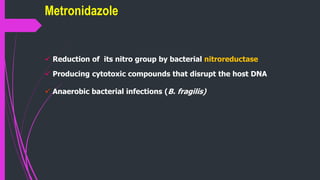
 Reduction of its nitro group by bacterial nitroreductase
 Producing cytotoxic compounds that disrupt the host DNA
 Anaerobic bacterial infections (B. fragilis)
Metronidazole
Antimetabolites
Sulfonamides
 Preventing the synthesis of the folic acid
 Compete with para-amino-benzoic acid (PABA)
Trimethoprim
 Blocks the conversion of dihydrofolate to tetrahydrofolate
 Inhibiting dihydrofolate reductase
 Trimethoprim + sulfamethoxazole: Synergistic combination
 Treatment of acute and chronic urinary tract infections
Antimetabolites
S
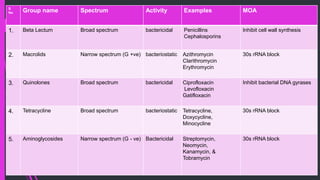
No Group name Spectrum Activity Examples MOA
1. Beta Lectum Broad spectrum bactericidal Penicillins
Cephalosporins
Inhibit cell wall synthesis
2. Macrolids Narrow spectrum (G +ve) bacteriostatic Azithromycin
Clarithromycin
Erythromycin
30s rRNA block
3. Quinolones Broad spectrum bactericidal Ciprofloxacin
Levofloxacin
Gatifloxacin
Inhibit bacterial DNA gyrases
4. Tetracycline Broad spectrum bacteriostatic Tetracycline,
Doxycycline,
Minocycline
30s rRNA block
5. Aminoglycosides Narrow spectrum (G - ve) Bactericidal Streptomycin,
Neomycin,
Kanamycin, &
Tobramycin
30s rRNA block
S
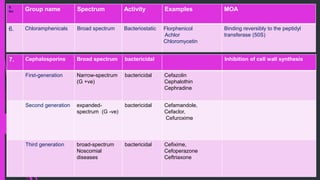
No Group name Spectrum Activity Examples MOA
6. Chloramphenicals Broad spectrum Bacteriostatic Florphenicol
Achlor
Chloromycetin
Binding reversibly to the peptidyl
transferase (50S)
7. Cephalosporins Broad spectrum bactericidal Inhibition of cell wall synthesis
First-generation Narrow-spectrum
(G +ve)
bactericidal Cefazolin
Cephalothin
Cephradine
Second generation expanded-
spectrum (G -ve)
bactericidal Cefamandole,
Cefaclor,
Cefuroxime
Third generation broad-spectrum
Noscomial
diseases
bactericidal Cefixime,
Cefoperazone
Ceftriaxone
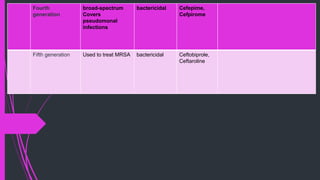
Fourth
generation
broad-spectrum
Covers
pseudomonal
infections
bactericidal Cefepime,
Cefpirome
Fifth generation Used to treat MRSA bactericidal Ceftobiprole,
Ceftaroline
Dose rates of Antibiotics
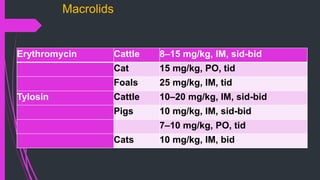
Macrolids
Erythromycin Cattle 8–15 mg/kg, IM, sid-bid
Cat 15 mg/kg, PO, tid
Foals 25 mg/kg, IM, tid
Tylosin Cattle 10–20 mg/kg, IM, sid-bid
Pigs 10 mg/kg, IM, sid-bid
7–10 mg/kg, PO, tid
Cats 10 mg/kg, IM, bid
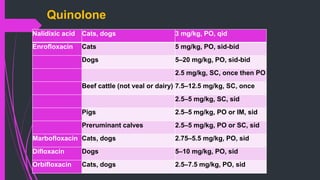
Quinolone
Nalidixic acid Cats, dogs 3 mg/kg, PO, qid
Enrofloxacin Cats 5 mg/kg, PO, sid-bid
Dogs 5–20 mg/kg, PO, sid-bid
2.5 mg/kg, SC, once then PO
Beef cattle (not veal or dairy) 7.5–12.5 mg/kg, SC, once
2.5–5 mg/kg, SC, sid
Pigs 2.5–5 mg/kg, PO or IM, sid
Preruminant calves 2.5–5 mg/kg, PO or SC, sid
Marbofloxacin Cats, dogs 2.75–5.5 mg/kg, PO, sid
Difloxacin Dogs 5–10 mg/kg, PO, sid
Orbifloxacin Cats, dogs 2.5–7.5 mg/kg, PO, sid
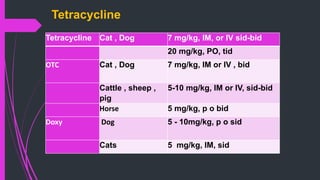
Tetracycline
Tetracycline Cat , Dog 7 mg/kg, IM, or IV sid-bid
20 mg/kg, PO, tid
OTC Cat , Dog 7 mg/kg, IM or IV , bid
Cattle , sheep ,
pig
5-10 mg/kg, IM or IV, sid-bid
Horse 5 mg/kg, p o bid
Doxy Dog 5 - 10mg/kg, p o sid
Cats 5 mg/kg, IM, sid
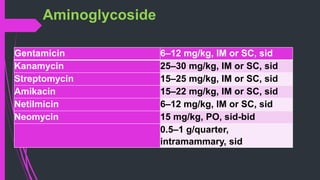
Aminoglycoside
Gentamicin 6–12 mg/kg, IM or SC, sid
Kanamycin 25–30 mg/kg, IM or SC, sid
Streptomycin 15–25 mg/kg, IM or SC, sid
Amikacin 15–22 mg/kg, IM or SC, sid
Netilmicin 6–12 mg/kg, IM or SC, sid
Neomycin 15 mg/kg, PO, sid-bid
0.5–1 g/quarter,
intramammary, sid
Cephalosporin
Dosage, Route, and Frequency
Cephapirin 30 mg/kg, IM or IV, every 4–6 hr
Cefazolin 20–25 mg/kg, IM or IV, tid-qid
Cefpodoxime 8 mg/kg, SC, every 14 days
Cefovecin 5–10 mg/kg, PO sid-bid
Cephalexin 10–30 mg/kg, PO, tid-qid
Cefadroxil 22 mg/kg, PO, bid
Ceftiofur 1.1–2.2 mg/kg, IM, sid
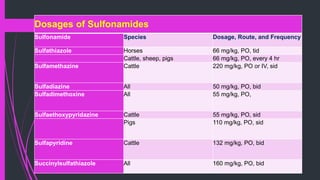
Dosages of Sulfonamides
Sulfonamide Species Dosage, Route, and Frequency
Sulfathiazole Horses 66 mg/kg, PO, tid
Cattle, sheep, pigs 66 mg/kg, PO, every 4 hr
Sulfamethazine Cattle 220 mg/kg, PO or IV, sid
Sulfadiazine All 50 mg/kg, PO, bid
Sulfadimethoxine All 55 mg/kg, PO,
Sulfaethoxypyridazine Cattle 55 mg/kg, PO, sid
Pigs 110 mg/kg, PO, sid
Sulfapyridine Cattle 132 mg/kg, PO, bid
Succinylsulfathiazole All 160 mg/kg, PO, bid
Examples of antibiotics available in
market
Almox-LA:
Composition:
Amoxicilline trihydrate 150mg
Company: Star
Medicine Form: Injectable
Dose Rate: 1m/ 10kg
Availability: 50 ml vial
Price: Rs. 250/=
Tylosel:
Composition:
Tylosin Tartarate 200mg
Company: Selmore
Medicine Form: Injectable
Dose Rate: 0.05ml/kg
Availability 50ml vial
Price: Rs. 221/=
Genton:
Composition:
Gentamycin Sulphate 100mg
Company: ICI
Medicine Form: Injectable
Dose Rate: 1ml/20kg
Availability 50ml vial
Price: Rs. 275/=
Diarex Forte:
Composition
Sulphadiazine 35.5mg
Sulphadimidine 28.4mg
Neomycine Sulphate 1.8mg
Hyoscine Methylbromide 0.04mg
Pectin 7.1mg
Company: zakfas Pharma
Medicine Form: Oral suspension
Dose Rate: 100ml/L.A & 50ml/ S.A
Availability 100ml pack
Price: Rs. 150/=
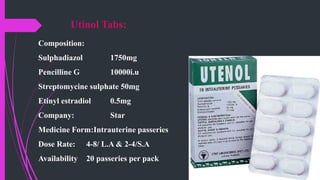
Utinol Tabs:
Composition:
Sulphadiazol 1750mg
Pencilline G 10000i.u
Streptomycine sulphate 50mg
Etinyl estradiol 0.5mg
Company: Star
Medicine Form:Intrauterine passeries
Dose Rate: 4-8/ L.A & 2-4/S.A
Availability 20 passeries per pack
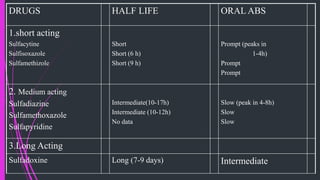
DRUGS HALF LIFE ORAL ABS
1.short acting
Sulfacytine
Sulfisoxazole
Sulfamethizole
Short
Short (6 h)
Short (9 h)
Prompt (peaks in
1-4h)
Prompt
Prompt
2. Medium acting
Sulfadiazine
Sulfamethoxazole
Sulfapyridine
Intermediate(10-17h)
Intermediate (10-12h)
No data
Slow (peak in 4-8h)
Slow
Slow
3.Long Acting
Sulfadoxine Long (7-9 days) Intermediate
Thank u
STUDY WELL!

Antibiotics1

  • 1.
    Prepared by Dr MuhammadAshiqToor DVM , B s c (Zoology) Islamia University of Bahawal Pur (IUB) (2010 – 2015) +92-344-499-7375 +92-300-364-2402
  • 2.
    Antibiotics Class wise ,Spectrum , Bacterial activity , MOA & dose rates.
  • 3.
    The Spectrum ofAntimicrobial Activity Narrow spectrum (limited spectrum)  Antimicrobials effective against a (limited spectrum) of microbial types.  A drug effective on G+ve or G-ve bacteria. Broad spectrum (extended spectrum)  Antimicrobials effective against a (extended spectrum) wide variety of microbial types .  A drug effective against both G+ve & G-ve bacteria .
  • 4.
    Broad spectrum Some examplesof broad-spectrum antibiotics include :  Penicillin  Cephalosporin  Tetracycline  Ciprofloxacin  Levofloxacin These drugs work on both G+ve & G-ve organisms.
  • 5.
  • 6.
    No antibiotic iseffective against all microbes
  • 7.
    The Action ofAntimicrobial Drugs Bacteriocidal  Kill microbes directly Bacteriostatic  Prevent microbes from growing
  • 8.
    Bacteriostatic vs Bactericidal Bacteriocidalantibiotics Kill the target bacteria. These drugs include :  Penicillins  Cephalosporins  Carbapenems  Aminoglycosides  Fluoroquinolones  Nitroimidazoles
  • 9.
    Bacteriostatic antibiotics Slow downbacterial growth & allowing the host immune system to fight the bacteria. These drugs include :  Macrolides  Tetracyclines  Sulfonamides  Clindamycin  Chloramphenicol
  • 10.
    Mechanisms of AntibioticsAction 1- Inhibition of Cell Wall Synthesis 2- Injuring the Plasma Membrane 3- Inhibition of Protein Synthesis 4- Inhibition of Nucleic Acid Synthesis 5- Inhibiting the Synthesis of Essential Metabolites
  • 11.
    The Action ofAntimicrobial Drugs
  • 12.
    Mechanisms of AntibioticsAction Dihydrofolate
  • 13.
    Mechanisms of Action: inhibitthe last step in the peptidoglycan synthesis of the cell wall 1. inhibition of transpeptidase  enzymes 2. activation of penicillin binding  proteins (PBPs) 3. activation of autolysins  (murein hydrolases)
  • 15.
  • 16.
    Inhibition of ProteinSynthesis by antibiotics
  • 17.
    Inhibition of ProteinSynthesis by Antibiotics Figure 20.4
  • 19.
    Inhibition of CellWall Synthesis Transpeptidases, Carboxypeptidases & Transglycosylases Penicillin-binding proteins (PBPs( β-Lactam antibiotics: generally are bacteriocidal agents
  • 20.
    1- Beta-Lactam Antibiotics:  Penicillins  Cephalosporins 2- Glycopeptides :  Vancomycin 3- Lipopeptides :  Daptomycin 4- Polypeptides :  Bacitracin Inhibition of Cell Wall Synthesis
  • 21.
    1- Aminopenicillins: Ampicillin,Amoxicillin Ampicillin was limited primarily to Escherichia & Proteus species . 2- Carboxypenicillins: Carbenicillin, Ticarcillin Are effective against a broader range of G-ve bacteria i.e Klebsiella, Enterobacter, & Pseudomonas species . Broad-spectrum penicillins
  • 22.
    Clavulanic acid, Sulbactam,Tazobactam (ampicillin, amoxicillin, ticarcillin, piperacillin) Amoxicillin/clavulanic acid (Co-amoxiclav) Ampicillin/sulbactam (Sultamicillin)
  • 23.
    Cephalosporins More stable toβ-lactamase hydrolysis
  • 24.
    Antimicrobial spectrum ofcephalosporins Generation of cephalosporin s Active towards Gram-positive bacteria Gram-negative bacteria І +++ +/- ІІ ++ + ІІІ + +++ ІV ++ +++
  • 25.
    CEPHALOSPORINS CLASSIFICATION A. First Generation 1. Cephaloridine-Loridine, Ceporan  2. Cephalothin-Keflin  3. Cephalexin-Keflex, Ceporex  4. Cefazolin-Cefacidal  5. Cephradine-Velosef  6. Cepharpirin-Cefadyl  7. Cephadroxil-Doricef, Cefamox
  • 26.
    Second Generation 1. Cefaclor-Ceclor 2.Cefoxitin – Mefoxin 3. Cefuroxime – Zinacef, Zinnat 4. Cefonicid – Monocid 5. Cefotetan - Cefotan 6. Cefamdandole – Mandol 7. Cefprozil – Cefzil 8. Loracarbef – Lorabid 9. Cefmetazole – Zefazone 10. Ceforanide
  • 27.
    Third Generation  1.Cefotaxime – Claforan  2. Cefoperazone – Cefobid  3. Moxolactam – Moxam  4. Ceftizoxime – Cefizox  5. Ceftriaxone – Rocephin  6. Ceftazidime – Fortum  7. Cefotiam – Ceradolan  8. Cefixime – Suprax  9. Cefetamet – Globocef  10. Cefpodoxime – Vantin  11. Ceftibuten – Cedax  12. Cefdinir –Omnicef  13. Cefditoren
  • 28.
    Fourth Generation 1. Cefepime– Maxipime 2. Cefpirome – Cefrom
  • 29.
    Broad-spectrum antibiotics  Activeagainst virtually all organisms Imipenem, Meropenem, Ertapenem Carbapenems
  • 30.
    Narrow-spectrum antibiotics  Areactive only against aerobic & G-ve bacteria Aztreonam Monobactams
  • 31.
     Damage cytoplasmicmembrane and inhibit RNA transcription  The treatment of skin infections  Used in creams, ointments, sprays Polypeptides: Bacitracin
  • 32.
     Bactericidal  Bindirreversibly to ribosomal proteins Misreading of the messenger RNA (mRNA) Premature release of the ribosome from mRNA  Streptomycin, Neomycin, Kanamycin, & Tobramycin Streptomyces species  Gentamicin & Sisomicin Micromonospora species  Amikacin from kanamycin Aminoglycosides
  • 33.
     Broad-spectrum  Bacteriostatic Tetracycline, Doxycycline, Chlorotetracycline  Binding reversibly to the 30S  Blocking the binding of aminoacyl-tRNA  Chlamydia, Mycoplasma, Rickettsia Tetracyclines
  • 34.
    Chloramphenicol  Broad spectrum Bacteriostatic  Blocking peptide elongation  Typhoid fever
  • 35.
     Broad spectrum Bacteriostatic Reversible binding to the 50S rRNA Erythromycin, Azithromycin, Clarithromycin Macrolides
  • 36.
    Inhibition of NucleicAcid Synthesis 1- Quinolones 2- Rifampin 3- Metronidazole
  • 37.
     Synthetic  Inhibitbacterial DNA gyrases (II) or topoisomerases (IV) Nalidixic acid Fluoroquinolones: Ciprofloxacin Levofloxacin Enrofloxacin Quinolones
  • 38.
     Reduction ofits nitro group by bacterial nitroreductase  Producing cytotoxic compounds that disrupt the host DNA  Anaerobic bacterial infections (B. fragilis) Metronidazole
  • 39.
    Antimetabolites Sulfonamides  Preventing thesynthesis of the folic acid  Compete with para-amino-benzoic acid (PABA)
  • 40.
    Trimethoprim  Blocks theconversion of dihydrofolate to tetrahydrofolate  Inhibiting dihydrofolate reductase  Trimethoprim + sulfamethoxazole: Synergistic combination  Treatment of acute and chronic urinary tract infections Antimetabolites
  • 41.
    S No Group nameSpectrum Activity Examples MOA 1. Beta Lectum Broad spectrum bactericidal Penicillins Cephalosporins Inhibit cell wall synthesis 2. Macrolids Narrow spectrum (G +ve) bacteriostatic Azithromycin Clarithromycin Erythromycin 30s rRNA block 3. Quinolones Broad spectrum bactericidal Ciprofloxacin Levofloxacin Gatifloxacin Inhibit bacterial DNA gyrases 4. Tetracycline Broad spectrum bacteriostatic Tetracycline, Doxycycline, Minocycline 30s rRNA block 5. Aminoglycosides Narrow spectrum (G - ve) Bactericidal Streptomycin, Neomycin, Kanamycin, & Tobramycin 30s rRNA block
  • 42.
    S No Group nameSpectrum Activity Examples MOA 6. Chloramphenicals Broad spectrum Bacteriostatic Florphenicol Achlor Chloromycetin Binding reversibly to the peptidyl transferase (50S) 7. Cephalosporins Broad spectrum bactericidal Inhibition of cell wall synthesis First-generation Narrow-spectrum (G +ve) bactericidal Cefazolin Cephalothin Cephradine Second generation expanded- spectrum (G -ve) bactericidal Cefamandole, Cefaclor, Cefuroxime Third generation broad-spectrum Noscomial diseases bactericidal Cefixime, Cefoperazone Ceftriaxone
  • 43.
  • 44.
    Dose rates ofAntibiotics
  • 45.
    Macrolids Erythromycin Cattle 8–15mg/kg, IM, sid-bid Cat 15 mg/kg, PO, tid Foals 25 mg/kg, IM, tid Tylosin Cattle 10–20 mg/kg, IM, sid-bid Pigs 10 mg/kg, IM, sid-bid 7–10 mg/kg, PO, tid Cats 10 mg/kg, IM, bid
  • 46.
    Quinolone Nalidixic acid Cats,dogs 3 mg/kg, PO, qid Enrofloxacin Cats 5 mg/kg, PO, sid-bid Dogs 5–20 mg/kg, PO, sid-bid 2.5 mg/kg, SC, once then PO Beef cattle (not veal or dairy) 7.5–12.5 mg/kg, SC, once 2.5–5 mg/kg, SC, sid Pigs 2.5–5 mg/kg, PO or IM, sid Preruminant calves 2.5–5 mg/kg, PO or SC, sid Marbofloxacin Cats, dogs 2.75–5.5 mg/kg, PO, sid Difloxacin Dogs 5–10 mg/kg, PO, sid Orbifloxacin Cats, dogs 2.5–7.5 mg/kg, PO, sid
  • 47.
    Tetracycline Tetracycline Cat ,Dog 7 mg/kg, IM, or IV sid-bid 20 mg/kg, PO, tid OTC Cat , Dog 7 mg/kg, IM or IV , bid Cattle , sheep , pig 5-10 mg/kg, IM or IV, sid-bid Horse 5 mg/kg, p o bid Doxy Dog 5 - 10mg/kg, p o sid Cats 5 mg/kg, IM, sid
  • 48.
    Aminoglycoside Gentamicin 6–12 mg/kg,IM or SC, sid Kanamycin 25–30 mg/kg, IM or SC, sid Streptomycin 15–25 mg/kg, IM or SC, sid Amikacin 15–22 mg/kg, IM or SC, sid Netilmicin 6–12 mg/kg, IM or SC, sid Neomycin 15 mg/kg, PO, sid-bid 0.5–1 g/quarter, intramammary, sid
  • 49.
    Cephalosporin Dosage, Route, andFrequency Cephapirin 30 mg/kg, IM or IV, every 4–6 hr Cefazolin 20–25 mg/kg, IM or IV, tid-qid Cefpodoxime 8 mg/kg, SC, every 14 days Cefovecin 5–10 mg/kg, PO sid-bid Cephalexin 10–30 mg/kg, PO, tid-qid Cefadroxil 22 mg/kg, PO, bid Ceftiofur 1.1–2.2 mg/kg, IM, sid
  • 50.
    Dosages of Sulfonamides SulfonamideSpecies Dosage, Route, and Frequency Sulfathiazole Horses 66 mg/kg, PO, tid Cattle, sheep, pigs 66 mg/kg, PO, every 4 hr Sulfamethazine Cattle 220 mg/kg, PO or IV, sid Sulfadiazine All 50 mg/kg, PO, bid Sulfadimethoxine All 55 mg/kg, PO, Sulfaethoxypyridazine Cattle 55 mg/kg, PO, sid Pigs 110 mg/kg, PO, sid Sulfapyridine Cattle 132 mg/kg, PO, bid Succinylsulfathiazole All 160 mg/kg, PO, bid
  • 51.
    Examples of antibioticsavailable in market
  • 52.
    Almox-LA: Composition: Amoxicilline trihydrate 150mg Company:Star Medicine Form: Injectable Dose Rate: 1m/ 10kg Availability: 50 ml vial Price: Rs. 250/=
  • 53.
    Tylosel: Composition: Tylosin Tartarate 200mg Company:Selmore Medicine Form: Injectable Dose Rate: 0.05ml/kg Availability 50ml vial Price: Rs. 221/=
  • 54.
    Genton: Composition: Gentamycin Sulphate 100mg Company:ICI Medicine Form: Injectable Dose Rate: 1ml/20kg Availability 50ml vial Price: Rs. 275/=
  • 55.
    Diarex Forte: Composition Sulphadiazine 35.5mg Sulphadimidine28.4mg Neomycine Sulphate 1.8mg Hyoscine Methylbromide 0.04mg Pectin 7.1mg Company: zakfas Pharma Medicine Form: Oral suspension Dose Rate: 100ml/L.A & 50ml/ S.A Availability 100ml pack Price: Rs. 150/=
  • 56.
    Utinol Tabs: Composition: Sulphadiazol 1750mg PencillineG 10000i.u Streptomycine sulphate 50mg Etinyl estradiol 0.5mg Company: Star Medicine Form:Intrauterine passeries Dose Rate: 4-8/ L.A & 2-4/S.A Availability 20 passeries per pack
  • 57.
    DRUGS HALF LIFEORAL ABS 1.short acting Sulfacytine Sulfisoxazole Sulfamethizole Short Short (6 h) Short (9 h) Prompt (peaks in 1-4h) Prompt Prompt 2. Medium acting Sulfadiazine Sulfamethoxazole Sulfapyridine Intermediate(10-17h) Intermediate (10-12h) No data Slow (peak in 4-8h) Slow Slow 3.Long Acting Sulfadoxine Long (7-9 days) Intermediate
  • 58.