Cross product                                                                                       1

Chapter 7              Cross product
   We are getting ready to study integration in several variables. Until now we have been
doing only differential calculus. One outcome of this study will be our ability to compute
volumes of interesting regions of Rn . As preparation for this we shall learn in this chapter
how to compute volumes of parallelepipeds in R3 . In this material there is a close connection
with the vector product, which we now discuss.

A. Definition of the cross product
     We begin with a simple but interesting problem. Let x, y be given vectors in R3 : x =
(x1 , x2 , x3 ) and y = (y1 , y2 , y3 ). Assume that x and y are linearly independent; in other words,
0, x, y determine a unique plane. We then want to determine a nonzero vector z which is
orthogonal to this plane. That is, we want to solve the equations x • z = 0 and y • z = 0. We
are certain in advance that z will be uniquely determined up to a scalar factor. The equations
in terms of the coordinates of z are

                                    x1 z1 + x2 z2 + x3 z3 = 0,
                                    y1 z1 + y2 z2 + y3 z3 = 0.

It is no surprise that we have two equations but three “unknowns,” as we know z is not going
to be unique. Since x and y are linearly independent, the matrix

                                             x1 x2 x3
                                             y1 y2 y3

has row rank equal to 2, and thus also has column rank 2. Thus it has two linearly independent
columns. To be definite, suppose that the first two columns are independent; in other words,

                                          x1 y2 − x2 y1 = 0.

(This is all a special case of the general discussion in Section 6B.) Then we can solve the
following two equations for the “unknowns” z1 and z2 :


                                     x1 z1 + x2 z2 = −x3 z3 ,
                                     y1 z1 + y2 z2 = −y3 z3 .

The result is
2                                                                                   Chapter 7


                                           x2 y 3 − x3 y 2
                                   z1    =                 z3 ,
                                           x1 y 2 − x2 y 1
                                           x3 y 1 − x1 y 3
                                   z2    =                 z3 .
                                           x1 y 2 − x2 y 1
Notice of course we have an undetermined scalar factor z3 .
   Now we simply make the choice z3 = x1 y2 − x2 y1 (= 0). Then the vector z can be written
                                 
                                  z1 = x2 y3 − x3 y2 ,
                                    z2 = x3 y1 − x1 y3 ,
                                 
                                    z3 = x1 y2 − x2 y1 .
This is precisely what we were trying to find, and we now simply make this a definition:

DEFINITION. The cross product (or vector product) of two vectors x, y in R3 is the vector

                     x × y = (x2 y3 − x3 y2 , x3 y1 − x1 y3 , x1 y2 − x2 y1 ).

DISCUSSION. 1. Our development was based on the assumption that x and y are linearly
independent. But the definition still holds in the case of linear dependence, and produces
x × y = 0. Thus we can say immediately that

                    x and y are linearly dependent ⇐⇒ x × y = 0.

2. We also made the working assumption that x1 y2 − x2 y1 = 0. Either of the other two
choices of independent columns produces the same sort of result. This is clearly seen in the
nice symmetry of the definition.

3. The definition is actually quite easily memorized. Just realize that the first component of
z = x × y is
                                      z1 = x2 y3 − x3 y2
and then a cyclic permutation 1 → 2 → 3 → 1 of the indices automatically produces the other
two components.

4. A convenient mnemonic for the definition is given by the formal determinant expression,
                                                       
                                               ı ˆ ˆ
                                               ˆ  k
                              x × y = det x1 x2 x3  .
                                              y1 y2 y3
Cross product                                                                                  3

In this expression the entries in the first row are the standard unit coordinate vectors, and
the “determinant” is to be calculated by expansion by the minors along the first row.

5. We are left with one true ambiguity in the definition, and that is which sign to take. In our
development we chose z3 = x1 y2 − x2 y1 , but we could have of course chosen z3 = x2 y1 − x1 y2 .
In this case, the entire mathematical community agrees with the choice we have made.

6. Nice special cases:


                                          ˆ× 
                                          ı ˆ       ˆ
                                                  = k,
                                          ˆ ˆ
                                          ×k     = ˆ,
                                                    ı
                                          ˆ ı
                                          k ׈    = .
                                                    ˆ

   7. By the way, two vectors in R3 have a dot product (a scalar) and a cross product (a
vector). The words “dot” and “cross” are somehow weaker than “scalar” and “vector,” but
they have stuck.
ALGEBRAIC PROPERTIES. The cross product is linear in each factor, so we have for
example for vectors x, y, u, v,

                (ax + by) × (cu + dv) = acx × u + adx × v + bcy × u + bdy × v.

It is anticommutative:
                                        y × x = −x × y.
It is not associative: for instance,


                                  ˆ × (ˆ × )
                                  ı    ı ˆ        ı ˆ
                                                = ˆ × k = −ˆ;
                                  (ˆ × ˆ) × 
                                    ı ı     ˆ   = 0 × ˆ = 0.
                                                      j


   PROBLEM 7–1. Let x ∈ R3 be thought of as fixed. Then x × y is a linear function
   from R3 to R3 and thus can be represented in a unique way as a matrix times the column
   vector y. Show that in fact
                                                        
                                           0 −x3 x2
                               x × y =  x3      0 −x1  y.
                                         −x2 x1        0
4                                                                                                                               Chapter 7


    PROBLEM 7–2.          Assuming x = 0 in the preceding problem, find the characteristic
    polynomial of the 3 × 3 matrix given there. What are its eigenvalues?


B. The norm of the cross product
    The approach I want to take here goes back to the Schwarz inequality on p. 1–15, for
which we are now going to give an entirely different proof. Suppose then that x, y ∈ Rn . We
are going to prove |x • y| ≤ x y by calculating the difference of the squares of the two
sides, as follows:

                                                    n           n                     n                2
                   2        2
               x       y        − (x • y)2   =           x2
                                                          i
                                                                     2
                                                                    yi −                   xi y i
                                                   i=1        i=1                   i=1
                                                    n          n                n                n
                                             =           x2
                                                          i
                                                                     2
                                                                    yj   −              xi y i         xj yj
                                                   i=1        j=1               i=1              j=1
                                                    n                    n
                                             =            x2 y j
                                                           i
                                                               2
                                                                    −           xi yi xj yj
                                                  i,j=1                 i,j=1
                                                                         n
                                             =           x2 y j +
                                                          i
                                                              2
                                                                              x2 y i +
                                                                               i
                                                                                   2
                                                                                                     x2 yj
                                                                                                      i
                                                                                                         2

                                                   i<j                  i=1                  i>j
                                                                                    n
                                                  −           xi yi xj yj −               x2 y i −
                                                                                           i
                                                                                               2
                                                                                                                  xi yi xj yj
                                                        i<j                      i=1                        i>j

                                             =           x2 y j +
                                                          i
                                                              2
                                                                              x2 y i − 2
                                                                               j
                                                                                   2
                                                                                                           xi y i xj y j
                                                   i<j                  j>i                      i<j

                                             =            x2 yj − 2xi yi xj yj + x2 yi
                                                           i
                                                              2
                                                                                  j
                                                                                     2

                                                   i<j

                                             =           (xi yj − xj yi )2 .
                                                   i<j


This then proves that x 2 y 2 − (x • y)2 ≥ 0.
   If we specialize to R3 , we have
               2       2
           x       y       − (x • y)2 = (x1 y2 − x2 y1 )2 + (x2 y3 − x3 y2 )2 + (x1 y3 − x3 y1 )2 .
                                 2    2    2
But the right side is precisely z3 + z1 + z2 in the above notation. Thus we have proved the
Cross product                                                                               5

wonderful Lagrange’s identity


                                    2       2
                                x       y       = (x • y)2 + x × y 2 .


This identity relates norms, dot products, and cross products.

     In terms of the angle θ between x and y, we have from p. 1–17 the formula x • y =
 x     y cos θ. Thus,


                                        x×y      =    x   y sin θ.


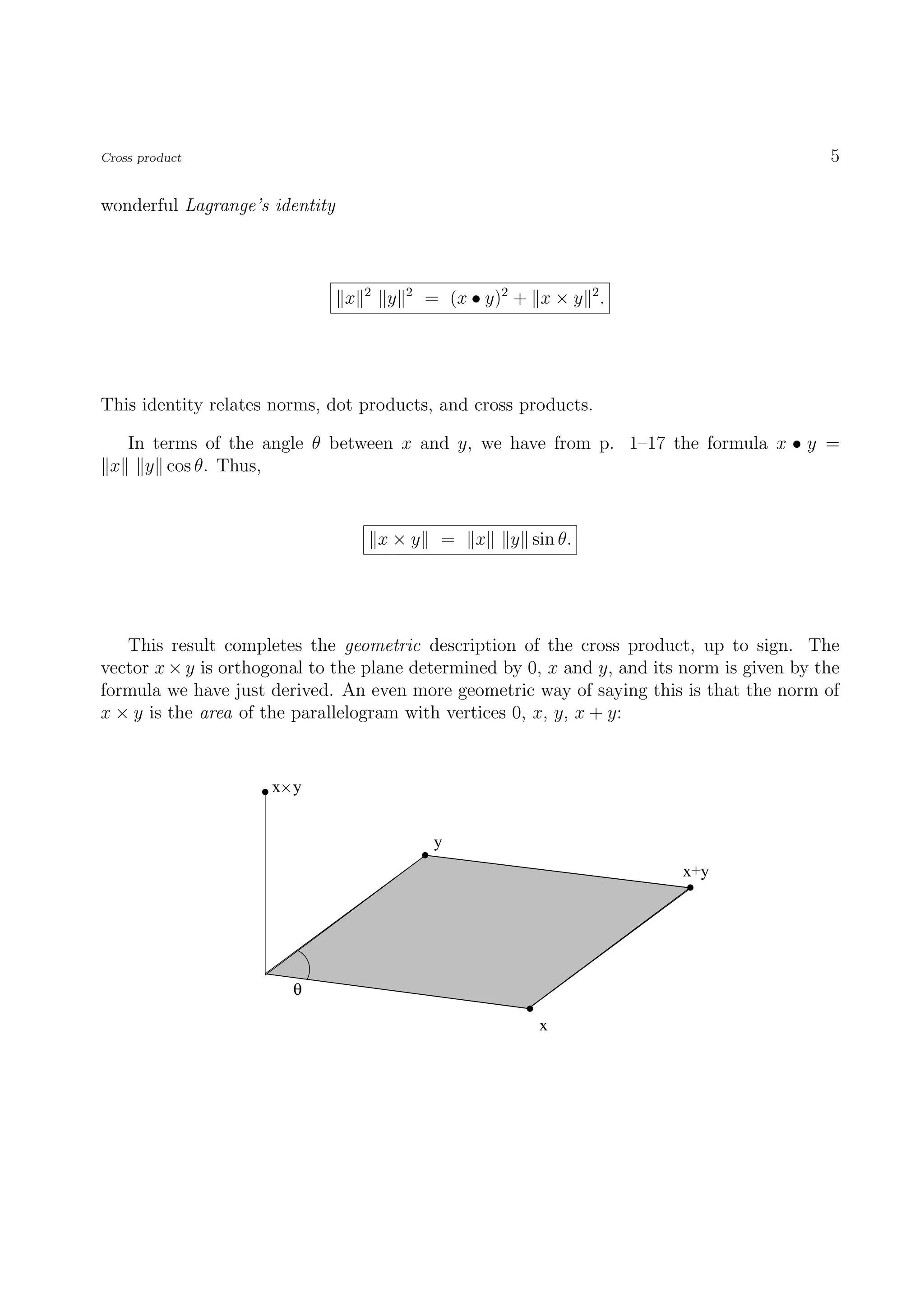
   This result completes the geometric description of the cross product, up to sign. The
vector x × y is orthogonal to the plane determined by 0, x and y, and its norm is given by the
formula we have just derived. An even more geometric way of saying this is that the norm of
x × y is the area of the parallelogram with vertices 0, x, y, x + y:


                     x y


                                                 y
                                                                          x+y


                        θ

                                                              x
6                                                                                                      Chapter 7


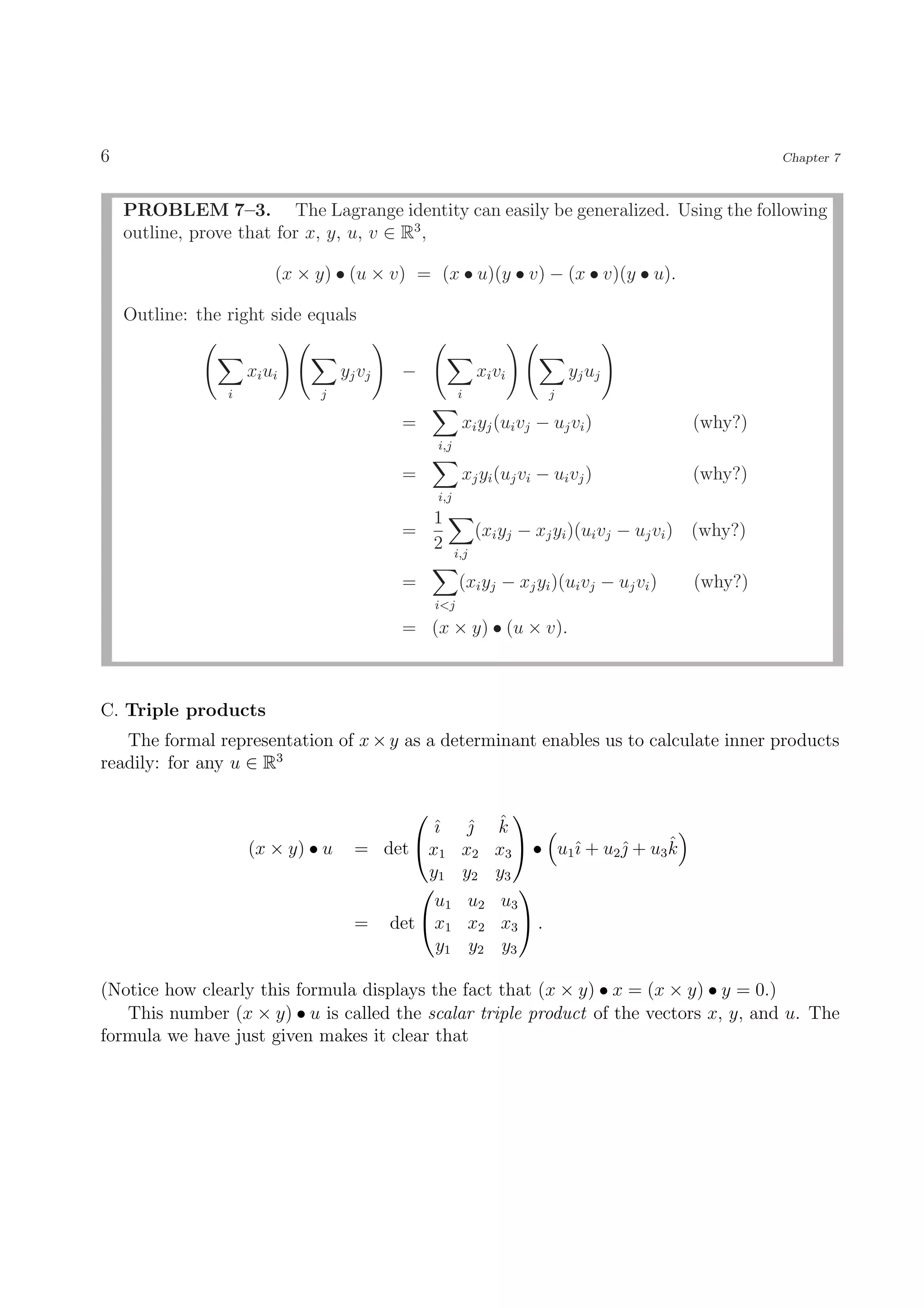
    PROBLEM 7–3. The Lagrange identity can easily be generalized. Using the following
    outline, prove that for x, y, u, v ∈ R3 ,

                          (x × y) • (u × v) = (x • u)(y • v) − (x • v)(y • u).

    Outline: the right side equals


                     x i ui        y j vj   −                xi vi         y j uj
                 i             j                       i               j

                                            =           xi yj (ui vj − uj vi )              (why?)
                                                 i,j

                                            =           xj yi (uj vi − ui vj )              (why?)
                                                 i,j
                                                 1
                                            =                (xi yj − xj yi )(ui vj − uj vi ) (why?)
                                                 2     i,j

                                            =           (xi yj − xj yi )(ui vj − uj vi )    (why?)
                                                 i<j
                                            = (x × y) • (u × v).


C. Triple products
   The formal representation of x × y as a determinant enables us to calculate inner products
readily: for any u ∈ R3

                                                             
                                             ˆı          ˆ ˆ
                                                          k
                     (x × y) • u     = det  x1                     ı      ˆ      ˆ
                                                        x2 x3  • u1ˆ + u2  + u3 k
                                             y1         y2 y3
                                                              
                                              u1         u2 u3
                                     = det  x1          x2 x3  .
                                              y1         y2 y3

(Notice how clearly this formula displays the fact that (x × y) • x = (x × y) • y = 0.)
   This number (x × y) • u is called the scalar triple product of the vectors x, y, and u. The
formula we have just given makes it clear that
Cross product                                                                                  7


                (x × y) • u    = (u × x) • y = (y × u) • x
                               = −(y × x) • u = −(x × u) • y = −(u × y) • x.
Thus we have the interesting phenomenon that writing x, y, u in order gives
                                    (x × y) • u = x • (y × u).
So the triple product doesn’t care which you call × and which you call •. For this reason, it’s
frequently written
                                   [x, y, u] = (x × y) • u.

   PROBLEM 7–4. The vector triple product is (x × y) × u. It can be related to dot
   products by the identity

                                  (x × y) × u = (x • u)y − (y • u)x.

   Prove this by using Problem 7–3 to calculate the dot product of each side of the proposed
   formula with an arbitrary v ∈ R3 .


   PROBLEM 7–5.           Prove quickly that the other vector triple product satisfies

                              x × (y × u) = (x • u)y − (x • y)u.


   The identities in Problems 7–4 and 7–5 can be remembered by expressing the right side of
each as
                vector triple product = (outer•far) near − (outer•near) far.
   The scalar triple product is exactly the device that enables us to compute volumes of
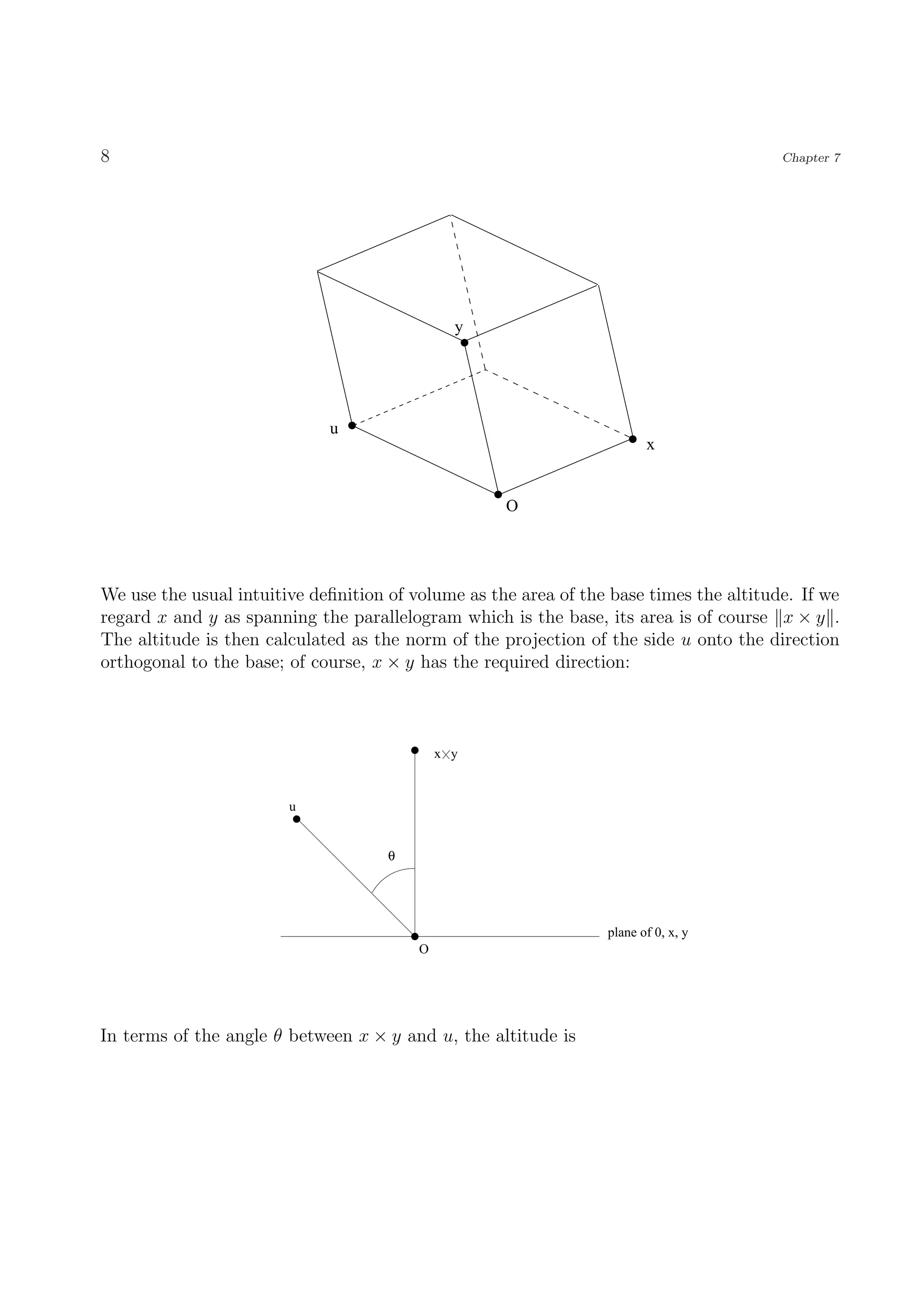
parallelepipeds in R3 . Consider three vectors x, y, u in R3 . They generate a region D called
a parallelepiped as follows:
                    D = {ax + by + cu | 0 ≤ a ≤ 1, 0 ≤ b ≤ 1, 0 ≤ c ≤ 1}.

   PROBLEM 7–6. Prove that

                                   [x × y, y × u, u × x] = [x, y, u]2 .
8                                                                                       Chapter 7


                                               y


                             u
                                                                        x


                                                    O


We use the usual intuitive definition of volume as the area of the base times the altitude. If we
regard x and y as spanning the parallelogram which is the base, its area is of course x × y .
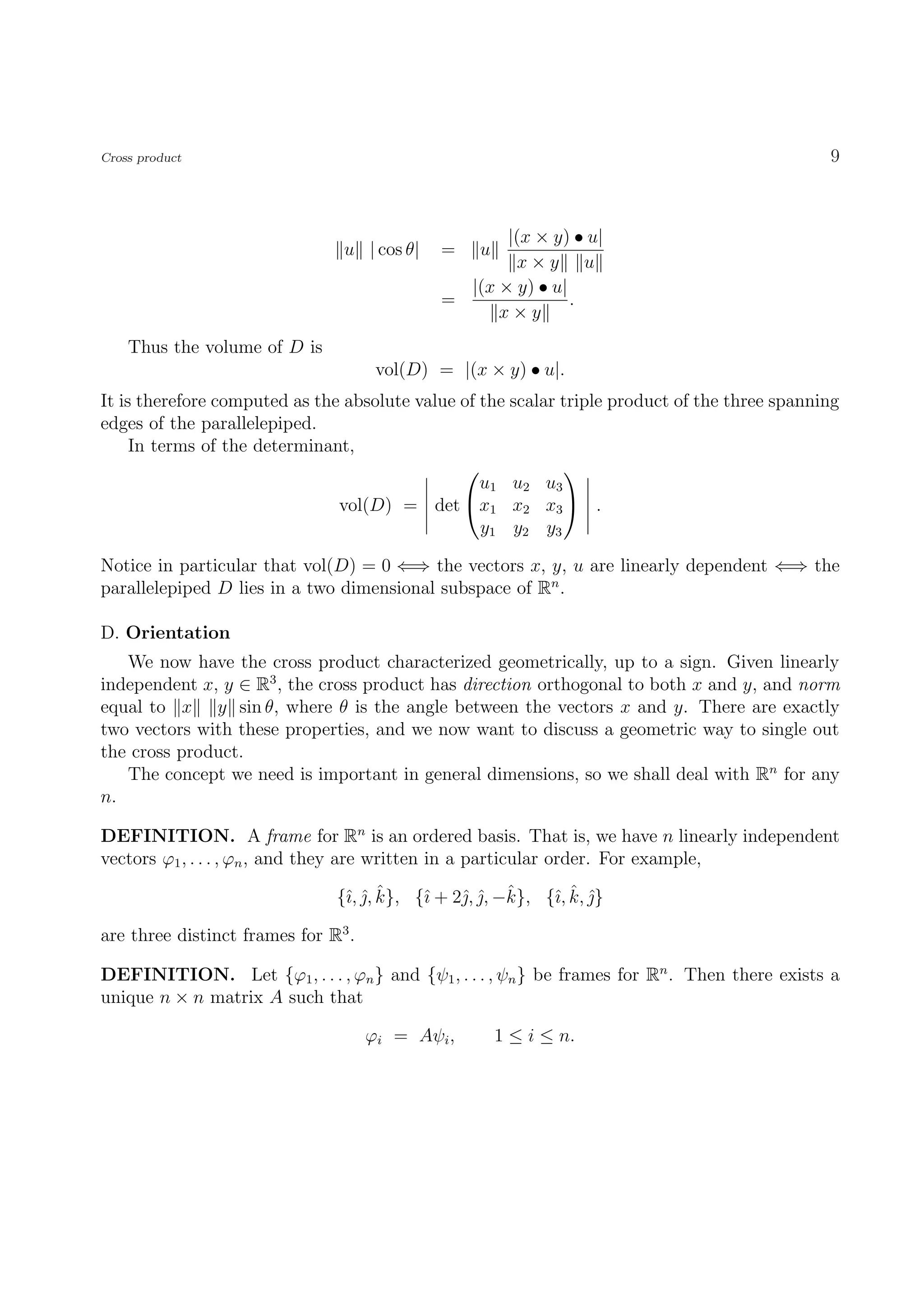
The altitude is then calculated as the norm of the projection of the side u onto the direction
orthogonal to the base; of course, x × y has the required direction:


                                             x y


                        u


                                     θ


                                                                 plane of 0, x, y
                                         O


In terms of the angle θ between x × y and u, the altitude is
Cross product                                                                                  9


                                                    |(x × y) • u|
                                u | cos θ|   =    u
                                                     x×y u
                                               |(x × y) • u|
                                             =               .
                                                   x×y
    Thus the volume of D is
                                      vol(D) = |(x × y) • u|.
It is therefore computed as the absolute value of the scalar triple product of the three spanning
edges of the parallelepiped.
     In terms of the determinant,
                                                            
                                                  u1 u2 u3
                               vol(D) = det x1 x2 x3  .
                                                  y1 y2 y3

Notice in particular that vol(D) = 0 ⇐⇒ the vectors x, y, u are linearly dependent ⇐⇒ the
parallelepiped D lies in a two dimensional subspace of Rn .

D. Orientation
   We now have the cross product characterized geometrically, up to a sign. Given linearly
independent x, y ∈ R3 , the cross product has direction orthogonal to both x and y, and norm
equal to x y sin θ, where θ is the angle between the vectors x and y. There are exactly
two vectors with these properties, and we now want to discuss a geometric way to single out
the cross product.
   The concept we need is important in general dimensions, so we shall deal with Rn for any
n.

DEFINITION. A frame for Rn is an ordered basis. That is, we have n linearly independent
vectors ϕ1 , . . . , ϕn , and they are written in a particular order. For example,

                                ı ˆˆ             ˆ ˆ       ı ˆ ˆ
                               {ˆ, , k}, {ˆ + 2ˆ, , −k}, {ˆ, k, }
                                           ı

are three distinct frames for R3 .

DEFINITION. Let {ϕ1 , . . . , ϕn } and {ψ1 , . . . , ψn } be frames for Rn . Then there exists a
unique n × n matrix A such that

                                     ϕi = Aψi ,       1 ≤ i ≤ n.
10                                                                                        Chapter 7


This matrix is necessarily invertible. We say the two frames have the same orientation if
det A > 0; and opposite orientation if det A < 0.

     PROBLEM 7–7. In the above definition we have used the column vector representa-
     tion of vectors. We may then write the corresponding n × n matrices

                                        Φ    = (ϕ1 . . . ϕn ),
                                        Ψ    = (ψ1 . . . ψn ).

     Prove that the frames have the same orientation ⇐⇒ det Φ and det Ψ have the same
     sign.


     PROBLEM 7–8. Prove that “having the same orientation” is an equivalence relation
     for frames. (Thus, as far as orientation is concerned, there are just two types of frames.)


     PROBLEM 7–9. Prove that if {ϕ1 , . . . , ϕn } and {ψ1 , . . . , ψn } happen to be orthonor-
     mal frames, the matrix A in the definition is in O(n); and the frames have the same
     orientation ⇐⇒ A ∈ SO(n).

                                              e        ˆ                   ı ˆˆ
    Let us say that the coordinate frame {ˆ1 , . . . , en } (also written {ˆ, , k} in the case of
 3
R ) has the standard orientation. The corresponding matrix is the identity matrix I, and
det I = 1. Thus we say that an arbitrary frame {ϕ1 , . . . , ϕn } has the standard orientation if
the corresponding matrix Φ = (ϕ1 . . . ϕn ) has det Φ > 0.

     PROBLEM 7–10. For which dimensions do both {ϕ1 , ϕ2 , . . . , ϕn }
     and {ϕn , ϕ1 , ϕ2 , . . . , ϕn−1 } have the same orientation?


     PROBLEM 7–11. For which dimensions do {ϕ1 , ϕ2 , . . . , ϕn } and
     its “reversal” {ϕn , . . . , ϕ2 , ϕ1 } have the same orientation?

    Now we consider R3 and two vectors x, y whose cross product x×y = 0. Writing everything
as column vectors, we then have from Section C that
                                                             2
                                det(x y x × y) =     x×y         > 0.
Thus the frame {x, y, x × y} has the standard orientation. This fact is what settles the choice
of direction of the cross product.
Cross product                                                                              11

SUMMARY. The cross product x × y is uniquely determined by the geometric description:

  (1) x × y is orthogonal to x and y,

  (2) x × y = area of the parallelogram with edges x and y,

  (3) in case x × y = 0, the frame {x, y, x × y} has the standard orientation.

  Since the cross product is characterized geometrically, we would expect the action of ele-
ments of O(3) to have a predictable outcome. Indeed this is so:
THEOREM. Let A ∈ O(3). Then

                                   A(x × y) = (det A)Ax × Ay.

Thus in case A ∈ SO(3), then A(x × y) = Ax × Ay.
PROOF. We use the characterization in terms of column vectors

                           (x × y) • u = det(x y u),        all u ∈ R3 .

Then for any 3 × 3 real matrix A,


                                (Ax × Ay) • Au   =   det(Ax Ay Au)
                                                 =   det A(x y u)
                                                 =   det A det(x y u)
                                                 =   det A(x × y) • u.

    But
                                (Ax × Ay) • Au = At (Ax × Ay) • u.
Since we have two vectors with the same inner product with all u ∈ R3 , we thus conclude

                                   At (Ax × Ay) = det A(x × y).

If A is also invertible, then

                                  Ax × Ay = det A(At )−1 (x × y).

Finally, if A ∈ O(3), then (At )−1 = A and det A = ±1.
                                                                                      QED
12                                                                                      Chapter 7


    The outcome of our discussion is that the cross product enjoys the double-edged properties
of being characterized completely geometrically and of being easily computed in coordinates.
In Chapter 1 we experienced the same happy situation with dot products on Rn . The dot
product x • y can be completely characterized as x y cos θ, where θ is the angle between
x and y, but also it is easily computed in coordinates.


E. Right hand rule


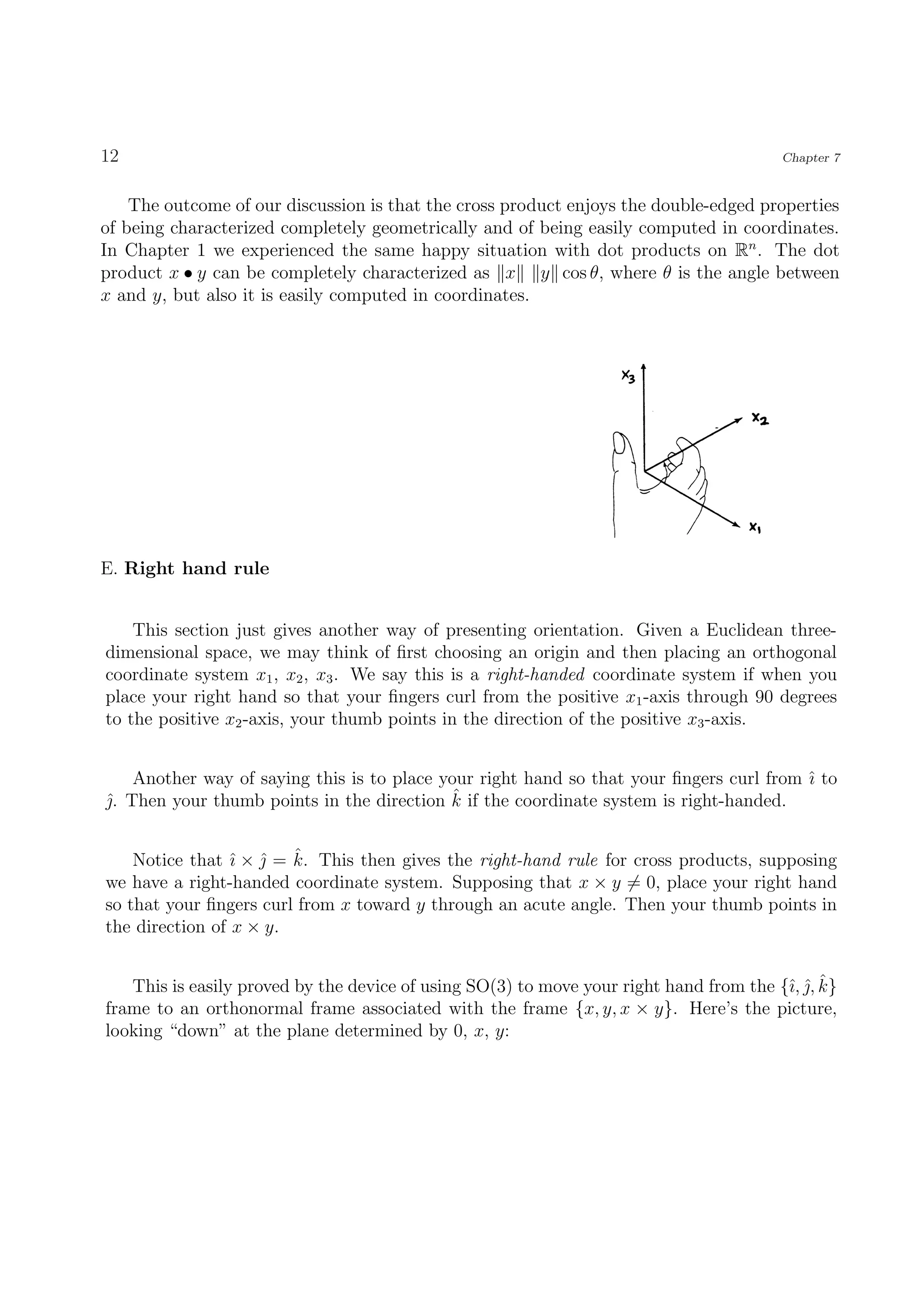
    This section just gives another way of presenting orientation. Given a Euclidean three-
dimensional space, we may think of first choosing an origin and then placing an orthogonal
coordinate system x1 , x2 , x3 . We say this is a right-handed coordinate system if when you
place your right hand so that your fingers curl from the positive x1 -axis through 90 degrees
to the positive x2 -axis, your thumb points in the direction of the positive x3 -axis.


    Another way of saying this is to place your right hand so that your fingers curl from ˆ to
                                                                                         ı
                                            ˆ
. Then your thumb points in the direction k if the coordinate system is right-handed.
ˆ


                 ı ˆ ˆ
    Notice that ˆ ×  = k. This then gives the right-hand rule for cross products, supposing
we have a right-handed coordinate system. Supposing that x × y = 0, place your right hand
so that your fingers curl from x toward y through an acute angle. Then your thumb points in
the direction of x × y.


                                                                                        ı ˆˆ
   This is easily proved by the device of using SO(3) to move your right hand from the {ˆ, , k}
frame to an orthonormal frame associated with the frame {x, y, x × y}. Here’s the picture,
looking “down” at the plane determined by 0, x, y:
Cross product                                                                              13


                           y

                                                y


                                               O             x     x


Let x = x/ x , and let y be the unit vector shown:

                                            y−x •y x
                                    y =                  .
                                            y−x •y x

Thus y = c1 x + c2 y , where c2 > 0. Then

                               x × y = c2 x × y = c2 x x × y .

Thus x × y is a positive scalar multiple of x × y . Now define the matrix A in terms of its
columns,
                                    A = (x y x × y ).
        ı                 ˆ
Then Aˆ = x , Aˆ = y , Ak = x × y . And we know A ∈ SO(3). Thus A takes the right-
                    ˆ to the right-handed frame {x , y , x × y }. This concludes the proof of
handed frame {ˆ, , k}
                ı ˆ
the right-hand rule.

F. What i s SO(3)?
    This seems to be a good place to discuss the fine details of SO(3), the special orthogonal
group on R3 . The members of this group are of course 3 × 3 orthogonal matrices with determi-
nants equal to 1. Let A ∈ SO(3). This matrix of course “acts on” R3 by matrix multiplication,
sending column vectors x to the column vectors Ax. We are going to prove that this “action”
can be described as an ordinary rotation of R3 about an axis.
    We first pause to describe rotations. Suppose that w is a fixed unit vector in R3 , and that
                                                       ˆ
θ is a fixed angle. We use the standard right-handed orientation for R3 . Now we take a view
of R3 looking from w towards 0, and rotate the entire space counter-clockwise about the axis
                    ˆ
w through the angle θ. Let us call the resulting matrix R(w, θ). A couple of things should
 ˆ                                                           ˆ
be noticed. One is that a counter-clockwise rotation with a negative angle θ is actually a
14                                                                                  Chapter 7


clockwise rotation with the positive angle −θ. The other is that adding any integer multiple
of 2π to θ results in the same rotation, according to our convention here.
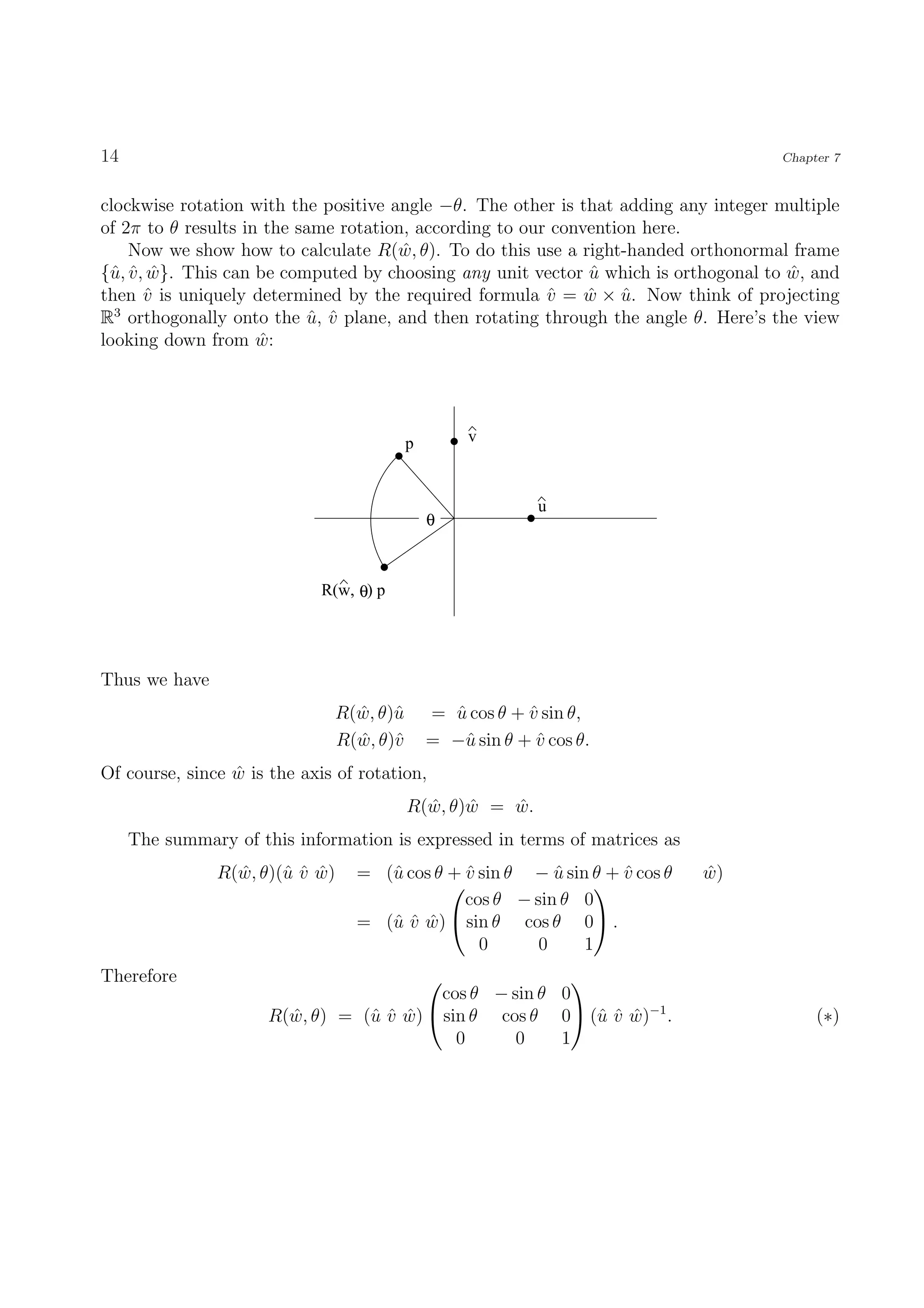
    Now we show how to calculate R(w, θ). To do this use a right-handed orthonormal frame
                                       ˆ
{ˆ, v , w}. This can be computed by choosing any unit vector u which is orthogonal to w, and
 u ˆ ˆ                                                        ˆ                       ˆ
then v is uniquely determined by the required formula v = w × u. Now think of projecting
       ˆ                                                 ˆ    ˆ ˆ
  3
R orthogonally onto the u, v plane, and then rotating through the angle θ. Here’s the view
                            ˆ ˆ
looking down from w: ˆ


                                         p        v


                                                           u
                                             θ


                             R(w, θ) p


Thus we have
                              R(w, θ)ˆ
                                ˆ u          = u cos θ + v sin θ,
                                               ˆ         ˆ
                              R(w, θ)ˆ
                                ˆ v          = −ˆ sin θ + v cos θ.
                                                u         ˆ
Of course, since w is the axis of rotation,
                 ˆ
                                         R(w, θ)w = w.
                                           ˆ    ˆ   ˆ
     The summary of this information is expressed in terms of matrices as
               R(w, θ)(ˆ v w)
                 ˆ     uˆ ˆ      = (ˆ cos θ + v sin θ − u sin θ + v cos θ
                                    u         ˆ          ˆ        ˆ         w)
                                                                            ˆ
                                                              
                                              cos θ − sin θ 0
                                 = (ˆ v w)
                                    uˆ ˆ     sin θ cos θ 0 .
                                                0      0     1
Therefore                                               
                                         cos θ − sin θ 0
                      R(w, θ) = (ˆ v w)  sin θ cos θ 0 (ˆ v w)−1 .
                        ˆ        uˆ ˆ                      uˆ ˆ                          (∗)
                                            0     0    1
Cross product                                                                              15

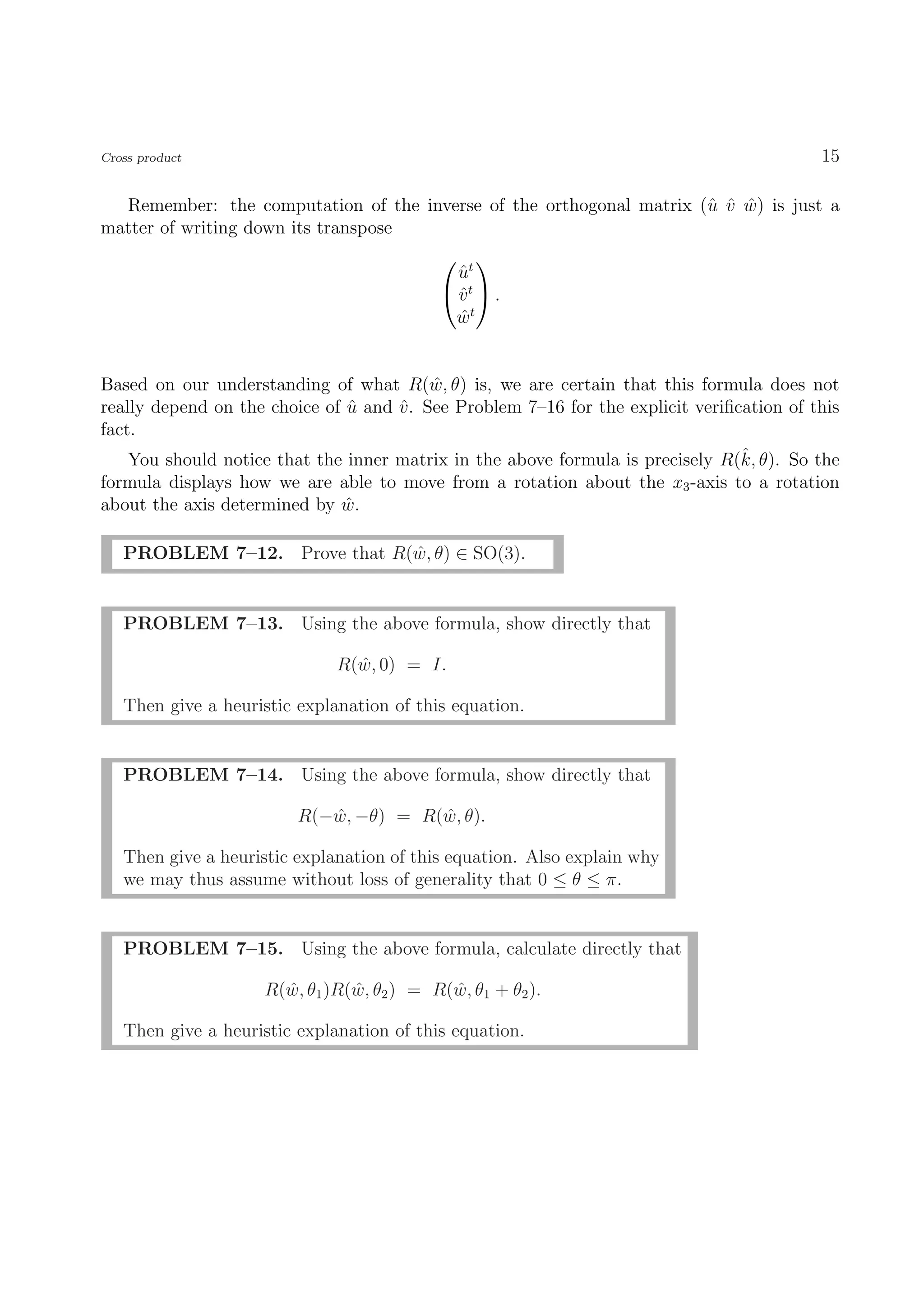
  Remember: the computation of the inverse of the orthogonal matrix (ˆ v w) is just a
                                                                     u ˆ ˆ
matter of writing down its transpose
                                               
                                             ut
                                             ˆ
                                            vt  .
                                             ˆ
                                            wt
                                             ˆ


Based on our understanding of what R(w, θ) is, we are certain that this formula does not
                                          ˆ
really depend on the choice of u and v . See Problem 7–16 for the explicit verification of this
                               ˆ     ˆ
fact.
                                                                                 ˆ
    You should notice that the inner matrix in the above formula is precisely R(k, θ). So the
formula displays how we are able to move from a rotation about the x3 -axis to a rotation
about the axis determined by w.ˆ

   PROBLEM 7–12. Prove that R(w, θ) ∈ SO(3).
                              ˆ


   PROBLEM 7–13. Using the above formula, show directly that

                              R(w, 0) = I.
                                ˆ

   Then give a heuristic explanation of this equation.


   PROBLEM 7–14. Using the above formula, show directly that

                         R(−w, −θ) = R(w, θ).
                            ˆ          ˆ

   Then give a heuristic explanation of this equation. Also explain why
   we may thus assume without loss of generality that 0 ≤ θ ≤ π.


   PROBLEM 7–15. Using the above formula, calculate directly that

                    R(w, θ1 )R(w, θ2 ) = R(w, θ1 + θ2 ).
                      ˆ        ˆ           ˆ

   Then give a heuristic explanation of this equation.
16                                                                                    Chapter 7


     PROBLEM 7–16. Calculate the product and thus obtain from (∗)
                                                                  
                                                        0  −w3 w2
     R(w, θ) = (cos θ)I + (1 − cos θ)(wi wj ) + sin θ  w3
       ˆ                                                    0  −w1  .
                                                       −w2 w1   0

     (This displays R(w, θ) in a form that shows its independence of the
                         ˆ
     choice of u and v .)
               ˆ     ˆ


     PROBLEM 7–17. Show that the action of R(w, θ) can also be expressed in the form
                                             ˆ

                    R(w, θ)x = (cos θ)x + (1 − cos θ)(w • x)w + (sin θ)w × x,
                      ˆ                               ˆ     ˆ          ˆ

     for all x ∈ R3 . Do this two ways:

       a. by simply using Problem 7–16;

       b. by describing the action of R(w, θ) geometrically.
                                        ˆ


     PROBLEM 7–18. Prove that for all x • w = 0,
                                          ˆ

                              R(w, π)x = −x.
                                ˆ

     Give a geometric interpretation of this result. Conversely, suppose
     that for a given rotation there exists a nonzero x ∈ R3 such that

                               R(w, θ)x = −x.
                                 ˆ

     Prove that θ = π and x • w = 0. (Of course, θ could also be π + 2mπ
                              ˆ
     for any integer m.)


     PROBLEM 7–19.          Prove that R(w, θ) is a symmetric matrix ⇐⇒ θ = 0 or π.
                                         ˆ
Cross product                                                                              17

   PROBLEM 7–20.          Backward Andy all his life has insisted upon using a left-handed
   coordinate system for R3 . What formula must he use for R(w, θ) that is the analog of
                                                                 ˆ
   ours found in Problem 7–16?

    We now turn to the perhaps surprising converse of the above material, which states that
the only matrices in SO(3) are rotations! The crucial background for this result is contained
in the following
THEOREM. Let A ∈ SO(n), where n is odd. Then 1 is an eigenvalue of A.
PROOF. Since A−1 = At , we have


                             det(A − I)   =   det(A − AAt )
                                          =   det(A(I − At ))
                                          =   det A det(I − At )
                                          =   det(I − At )
                                          =   det(I − A)
                                          =   (−1)n det(A − I).

    Since n is odd, det(A − I) = 0.
                                                                                        QED

   PROBLEM 7–21.           Give a different proof of this result for the case n = 3, based on
   the characteristic polynomial

                             det(A − λI) = −λ3 + αλ2 + βλ + 1.


   PROBLEM 7–22.          Let A ∈ O(n), but A ∈ SO(n). Prove that −1 is an eigenvalue of
                                              /
   A.

THEOREM. Let A ∈ SO(3). Then there exists a unit vector w ∈ R3 and 0 ≤ θ ≤ π such
                                                        ˆ
that A = R(w, θ).
           ˆ
PROOF. Since A ∈ SO(3), we know from the preceding theorem that 1 is an eigenvalue of
A. Therefore, there exists a unit vector w such that Aw = w.
                                         ˆ            ˆ   ˆ
18                                                                                    Chapter 7


   Choose an orthonormal basis u, v of the subspace of R3 which is orthogonal to w; arrange
                                  ˆ ˆ                                            ˆ
them so that the frame {ˆ, v , w} has the standard orientation:
                        u ˆ ˆ

                                        w
                                        ˆ    = u × v,
                                               ˆ ˆ
                                        v
                                        ˆ    = w × u,
                                               ˆ ˆ
                                        u
                                        ˆ    = v × w.
                                               ˆ ˆ

     Then

                            Aˆ • w
                             u ˆ       = Aˆ • Aw
                                           u   ˆ
                                       = u•w
                                         ˆ ˆ     (A is in O(3))
                                       = 0,

so Aˆ is also orthogonal to w. Thus Aˆ is a linear combination of u and v :
    u                       ˆ        u                            ˆ     ˆ

                                       Aˆ = c1 u + c2 v .
                                        u      ˆ      ˆ

Since Aˆ = u = 1, c2 + c2 = 1. Thus there exists an angle θ such that c1 = cos θ,
          u      ˆ   1  2
c2 = sin θ. That is,

                                     Aˆ = u cos θ + v sin θ.
                                      u   ˆ         ˆ
We conclude that

                             Aˆ
                              v    =    A(w × u)
                                            ˆ ˆ
                                   =    Aw × Aˆ
                                           ˆ     u      (Section D)
                                   =    w × (ˆ cos θ + v sin θ)
                                        ˆ     u          ˆ
                                   =    v cos θ − u sin θ.
                                        ˆ         ˆ

   We now see that A and the rotation R(w, θ) produce the same result on the frame {ˆ, v , w}!
                                          ˆ                                         u ˆ ˆ
Since every x ∈ R3 is a linear combination of u, v , w, we conclude that
                                              ˆ ˆ ˆ

                            Ax = R(w, θ)x
                                   ˆ               for all x ∈ R3 .

Thus A = R(w, θ).
            ˆ
  The final item, that we may require 0 ≤ θ ≤ π, follows immediately from Problem 7–14.
                                                                                  QED
Cross product                                                                                 19

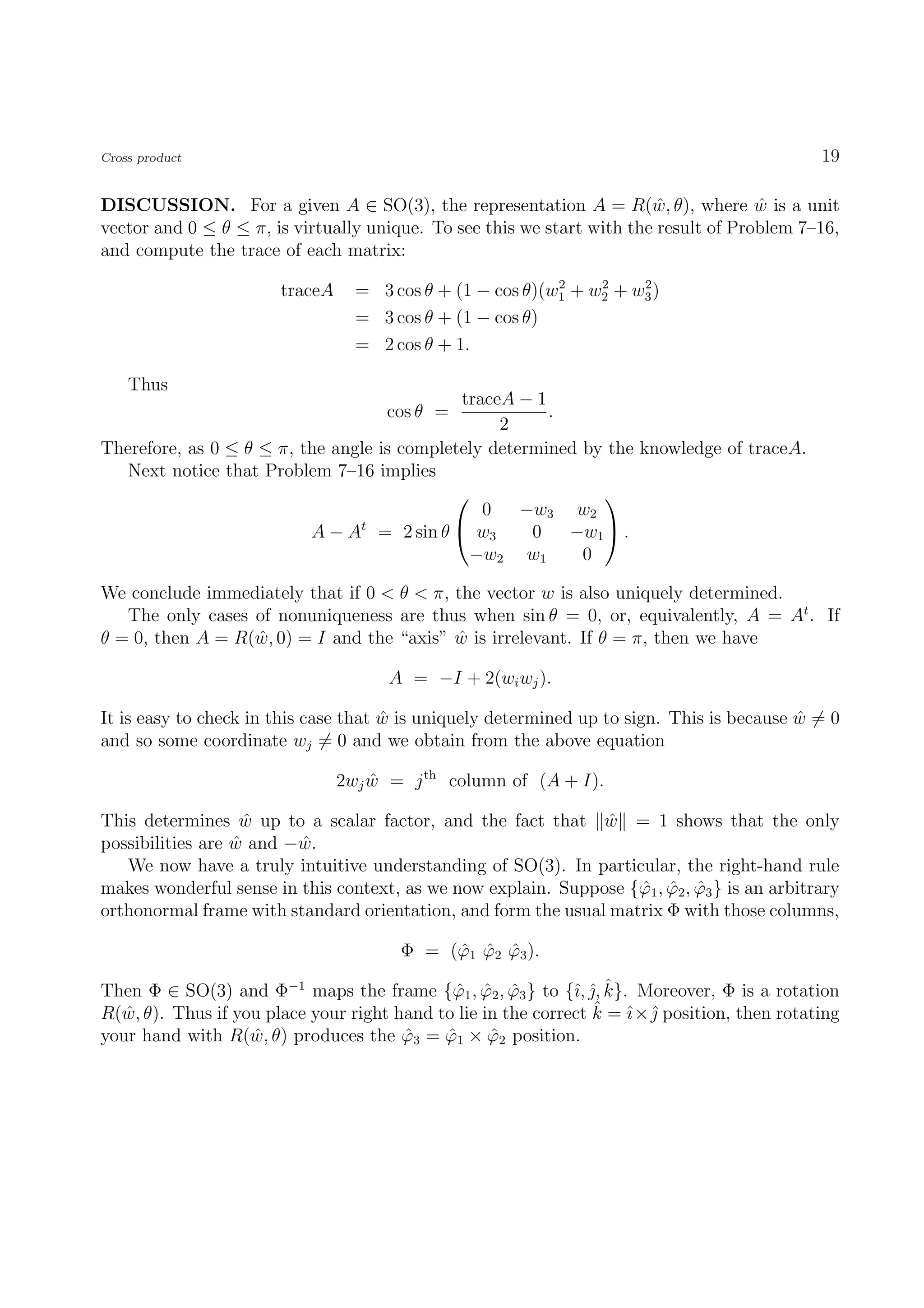
DISCUSSION. For a given A ∈ SO(3), the representation A = R(w, θ), where w is a unit
                                                                         ˆ            ˆ
vector and 0 ≤ θ ≤ π, is virtually unique. To see this we start with the result of Problem 7–16,
and compute the trace of each matrix:
                                                           2    2    2
                       traceA     = 3 cos θ + (1 − cos θ)(w1 + w2 + w3 )
                                  = 3 cos θ + (1 − cos θ)
                                  = 2 cos θ + 1.

    Thus
                                             traceA − 1
                                     cos θ =            .
                                                  2
Therefore, as 0 ≤ θ ≤ π, the angle is completely determined by the knowledge of traceA.
   Next notice that Problem 7–16 implies
                                                             
                                                0    −w3 w2
                          A − At = 2 sin θ  w3       0   −w1  .
                                              −w2 w1        0

We conclude immediately that if 0 < θ < π, the vector w is also uniquely determined.
   The only cases of nonuniqueness are thus when sin θ = 0, or, equivalently, A = At . If
θ = 0, then A = R(w, 0) = I and the “axis” w is irrelevant. If θ = π, then we have
                  ˆ                        ˆ

                                      A = −I + 2(wi wj ).

It is easy to check in this case that w is uniquely determined up to sign. This is because w = 0
                                      ˆ                                                    ˆ
and so some coordinate wj = 0 and we obtain from the above equation

                                2wj w = j th column of (A + I).
                                    ˆ

This determines w up to a scalar factor, and the fact that w = 1 shows that the only
                    ˆ                                          ˆ
possibilities are w and −w.
                  ˆ      ˆ
   We now have a truly intuitive understanding of SO(3). In particular, the right-hand rule
makes wonderful sense in this context, as we now explain. Suppose {ϕ1 , ϕ2 , ϕ3 } is an arbitrary
                                                                   ˆ ˆ ˆ
orthonormal frame with standard orientation, and form the usual matrix Φ with those columns,

                                       Φ = (ϕ1 ϕ2 ϕ3 ).
                                            ˆ ˆ ˆ

                                                              ı ˆˆ
Then Φ ∈ SO(3) and Φ−1 maps the frame {ϕ1 , ϕ2 , ϕ3 } to {ˆ, , k}. Moreover, Φ is a rotation
                                             ˆ ˆ ˆ
                                                                 ˆ ı ˆ
R(w, θ). Thus if you place your right hand to lie in the correct k = ˆ×  position, then rotating
   ˆ
your hand with R(w, θ) produces the ϕ3 = ϕ1 × ϕ2 position.
                   ˆ                   ˆ    ˆ      ˆ
20                                                                                          Chapter 7


                                                                                          ı ˆˆ
     I would say it is almost amazing that a single rotation can move {ϕ1 , ϕ2 , ϕ3 } to {ˆ, , k}!
                                                                       ˆ ˆ ˆ
     Here is a numerical example. Let
                                                        
                                             0 −1 0
                                     A = 0 0 −1 .
                                             1 0       0
                                                                  1
Clearly, A ∈ SO(3). Then we compute traceA = 0, so that cos θ = − 2 and we have θ = 2π/3.
Then                                                         
                                             0    −w3 w2
                         A − At = 2 sin θ  w3      0    −w1 
                                            −w2 w1        0
becomes the equation
                                                             
                        0 −1 −1          √     0    −w3 w2
                      1 0 −1 = 3  w3               0    −w1  ,
                        1 1     0             −w2 w1         0
so we read off immediately that                    
                                                   1
                                              1  
                                         w =
                                         ˆ   √    −1 .
                                               3   1
Thus                                      
                                    0 −1 0
                                   0 0 −1 = R(w, 2π/3).
                                                ˆ
                                    1 0  0

     PROBLEM 7–23.           Let
                                               1      1       1
                                                                
                                               √      √       √
                                              √3
                                                1
                                                        2
                                                     − √21
                                                                6
                                                               1 
                                       A =    3              √ .
                                                                6
                                                1                2
                                               √
                                                 3
                                                      0      − √6

     Find w and θ such that A = R(w, θ).
          ˆ                       ˆ


     PROBLEM 7–24.           Compute

                                         R(w, θ)−1 = R(?, ?).
                                           ˆ
Cross product                                                                            21

   PROBLEM 7–25. Show that the given matrix is in SO(3) and calculate the unique
   w ∈ R3 and 0 ≤ θ ≤ π for it:
   ˆ
                                               
                                      29 −20 28
                                 1 
                                      28 35 −4 .
                                45
                                     −20 20 35


G. Orientation reversal
   It is a relatively easy task to understand those matrices in O(n) which are not in SO(n).
Suppose A is such a matrix. Of course, det A = −1. We conclude from Problem 7–22 that
−1 is an eigenvalue of A. Therefore, there exists a unit vector w:
                                                                ˆ

                                        Aw = −w.
                                         ˆ    ˆ

    Any unit vector w can be used to define a “reflection” matrix S in that direction. Here’s
                    ˆ
a schematic description:


                                                          x
                                             w


                                            O


                                                          Sx


The algebra is governed by

                        (Sx + x) • w = 0,
                                   ˆ
                                 Sx = x + tw
                                           ˆ        for some t ∈ R.

Solving these equations gives t = −2x • w so that
                                        ˆ

                                   Sx = x − 2(x • w)w.
                                                  ˆ ˆ
22                                                                               Chapter 7


This matrix S is called “reflection in the direction w,” and we denote it S(w).
                                                    ˆ                      ˆ

     PROBLEM 7–26.        Prove that the matrix S = S(w) satisfies
                                                      ˆ

       a. S w = −w,
            ˆ    ˆ

       b. S 2 = I,

       c. S ∈ O(n),

       d. det S = −1.


     PROBLEM 7–27.        Prove that

                                       S w = I − 2(wi wj ).
                                         ˆ


   Now we return to the situation of a matrix A ∈ O(n) with det A = −1. We know from
Problem 7–22 that there is a unit vector w satisfying Aw = −w. Now just define B = S(w)A.
                                         ˆ             ˆ    ˆ                       ˆ
Clearly, B ∈ SO(n). Thus,
                                        A = S(w)B.ˆ
Thus A is the product of a reflection S(w) in a direction w and a matrix B ∈ SO(n) with
                                       ˆ                 ˆ
B w = w.
  ˆ   ˆ
     PROBLEM 7–28.             It made no difference whether we chose to write B = SA or
     B = AS, for SA = AS. Prove this by noting that SAw = AS w and then considering
                                                           ˆ       ˆ
     those vectors x which are orthogonal to w.
                                             ˆ

In particular, for n = 3 the matrix A has the representation
                            A = S(w)R(w, θ) = R(w, θ)S(w).
                                  ˆ   ˆ         ˆ      ˆ

     PROBLEM 7–29.        Show that in this n = 3 situation
                                                                        
                                                              0  −w3 w2
                 A = (cos θ)I − (1 + cos θ)(wi wj ) + sin θ  w3  0  −w1  .
                                                             −w2 w1   0
Cross product                                                                              23

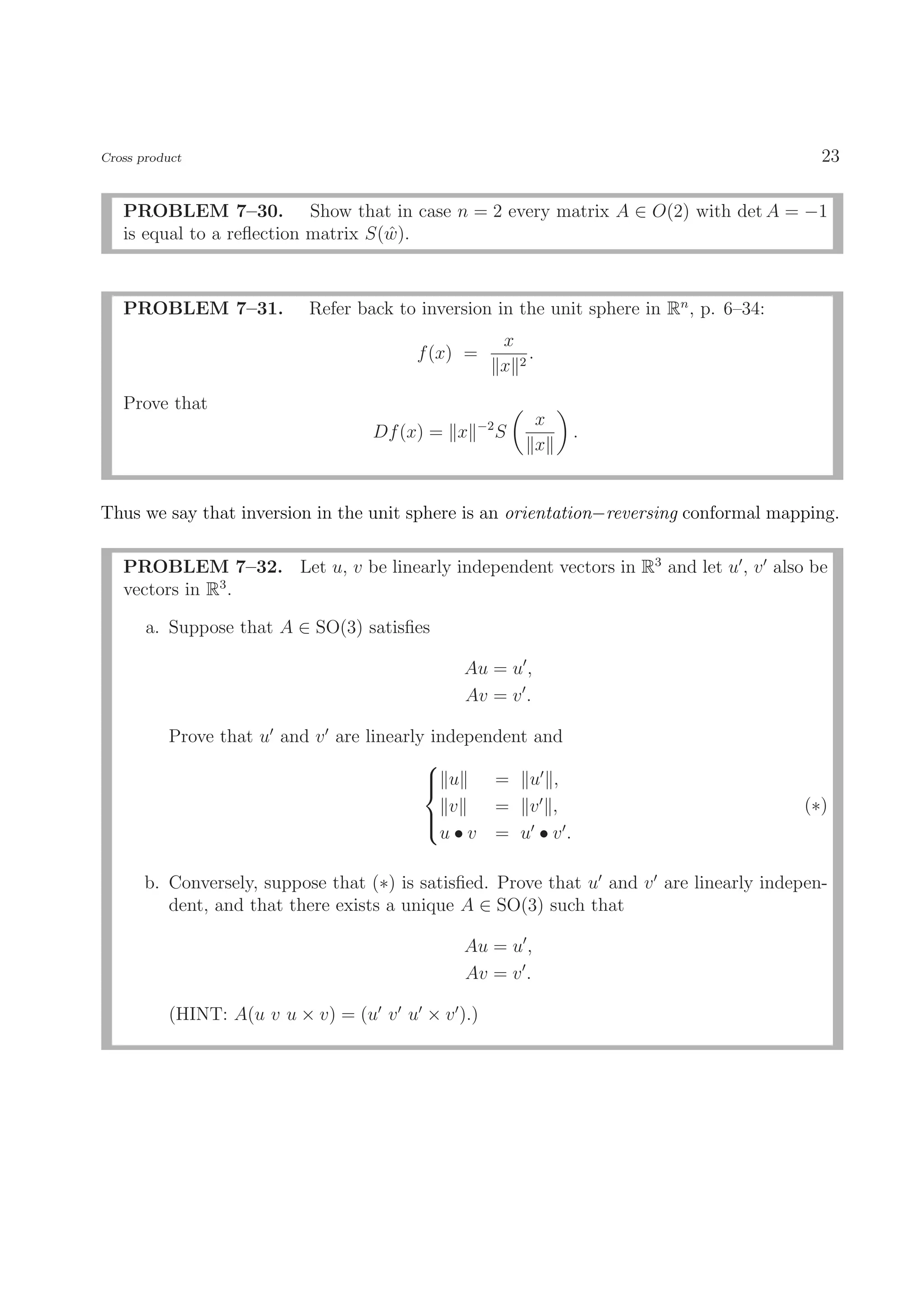
   PROBLEM 7–30. Show that in case n = 2 every matrix A ∈ O(2) with det A = −1
   is equal to a reflection matrix S(w).
                                    ˆ


   PROBLEM 7–31.           Refer back to inversion in the unit sphere in Rn , p. 6–34:
                                                     x
                                        f (x) =          .
                                                     x 2

   Prove that
                                                −2           x
                                   Df (x) = x        S           .
                                                             x


Thus we say that inversion in the unit sphere is an orientation−reversing conformal mapping.

   PROBLEM 7–32. Let u, v be linearly independent vectors in R3 and let u , v also be
   vectors in R3 .

       a. Suppose that A ∈ SO(3) satisfies

                                               Au = u ,
                                               Av = v .

          Prove that u and v are linearly independent and
                                         
                                          u
                                                = u ,
                                            v    = v ,                                   (∗)
                                         
                                         
                                           u•v = u •v.

       b. Conversely, suppose that (∗) is satisfied. Prove that u and v are linearly indepen-
          dent, and that there exists a unique A ∈ SO(3) such that

                                               Au = u ,
                                               Av = v .

          (HINT: A(u v u × v) = (u v u × v ).)
24                                                                                   Chapter 7


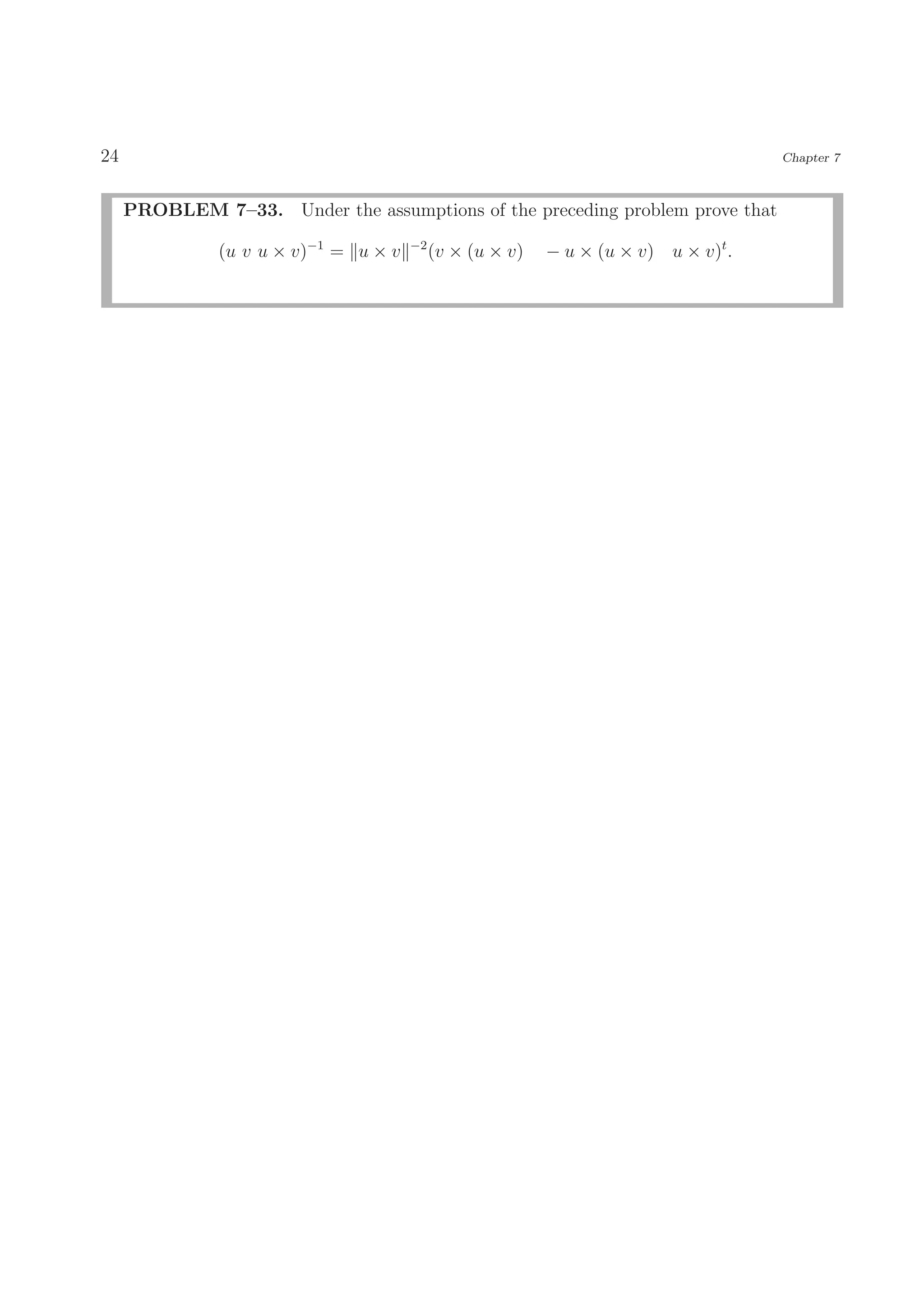
     PROBLEM 7–33. Under the assumptions of the preceding problem prove that

               (u v u × v)−1 = u × v   −2
                                            (v × (u × v)   − u × (u × v) u × v)t .

Cross product

  • 1.
    Cross product 1 Chapter 7 Cross product We are getting ready to study integration in several variables. Until now we have been doing only differential calculus. One outcome of this study will be our ability to compute volumes of interesting regions of Rn . As preparation for this we shall learn in this chapter how to compute volumes of parallelepipeds in R3 . In this material there is a close connection with the vector product, which we now discuss. A. Definition of the cross product We begin with a simple but interesting problem. Let x, y be given vectors in R3 : x = (x1 , x2 , x3 ) and y = (y1 , y2 , y3 ). Assume that x and y are linearly independent; in other words, 0, x, y determine a unique plane. We then want to determine a nonzero vector z which is orthogonal to this plane. That is, we want to solve the equations x • z = 0 and y • z = 0. We are certain in advance that z will be uniquely determined up to a scalar factor. The equations in terms of the coordinates of z are x1 z1 + x2 z2 + x3 z3 = 0, y1 z1 + y2 z2 + y3 z3 = 0. It is no surprise that we have two equations but three “unknowns,” as we know z is not going to be unique. Since x and y are linearly independent, the matrix x1 x2 x3 y1 y2 y3 has row rank equal to 2, and thus also has column rank 2. Thus it has two linearly independent columns. To be definite, suppose that the first two columns are independent; in other words, x1 y2 − x2 y1 = 0. (This is all a special case of the general discussion in Section 6B.) Then we can solve the following two equations for the “unknowns” z1 and z2 : x1 z1 + x2 z2 = −x3 z3 , y1 z1 + y2 z2 = −y3 z3 . The result is
  • 2.
    2 Chapter 7 x2 y 3 − x3 y 2 z1 = z3 , x1 y 2 − x2 y 1 x3 y 1 − x1 y 3 z2 = z3 . x1 y 2 − x2 y 1 Notice of course we have an undetermined scalar factor z3 . Now we simply make the choice z3 = x1 y2 − x2 y1 (= 0). Then the vector z can be written   z1 = x2 y3 − x3 y2 , z2 = x3 y1 − x1 y3 ,  z3 = x1 y2 − x2 y1 . This is precisely what we were trying to find, and we now simply make this a definition: DEFINITION. The cross product (or vector product) of two vectors x, y in R3 is the vector x × y = (x2 y3 − x3 y2 , x3 y1 − x1 y3 , x1 y2 − x2 y1 ). DISCUSSION. 1. Our development was based on the assumption that x and y are linearly independent. But the definition still holds in the case of linear dependence, and produces x × y = 0. Thus we can say immediately that x and y are linearly dependent ⇐⇒ x × y = 0. 2. We also made the working assumption that x1 y2 − x2 y1 = 0. Either of the other two choices of independent columns produces the same sort of result. This is clearly seen in the nice symmetry of the definition. 3. The definition is actually quite easily memorized. Just realize that the first component of z = x × y is z1 = x2 y3 − x3 y2 and then a cyclic permutation 1 → 2 → 3 → 1 of the indices automatically produces the other two components. 4. A convenient mnemonic for the definition is given by the formal determinant expression,   ı ˆ ˆ ˆ  k x × y = det x1 x2 x3  . y1 y2 y3
  • 3.
    Cross product 3 In this expression the entries in the first row are the standard unit coordinate vectors, and the “determinant” is to be calculated by expansion by the minors along the first row. 5. We are left with one true ambiguity in the definition, and that is which sign to take. In our development we chose z3 = x1 y2 − x2 y1 , but we could have of course chosen z3 = x2 y1 − x1 y2 . In this case, the entire mathematical community agrees with the choice we have made. 6. Nice special cases: ˆ×  ı ˆ ˆ = k, ˆ ˆ ×k = ˆ, ı ˆ ı k ׈ = . ˆ 7. By the way, two vectors in R3 have a dot product (a scalar) and a cross product (a vector). The words “dot” and “cross” are somehow weaker than “scalar” and “vector,” but they have stuck. ALGEBRAIC PROPERTIES. The cross product is linear in each factor, so we have for example for vectors x, y, u, v, (ax + by) × (cu + dv) = acx × u + adx × v + bcy × u + bdy × v. It is anticommutative: y × x = −x × y. It is not associative: for instance, ˆ × (ˆ × ) ı ı ˆ ı ˆ = ˆ × k = −ˆ; (ˆ × ˆ) ×  ı ı ˆ = 0 × ˆ = 0. j PROBLEM 7–1. Let x ∈ R3 be thought of as fixed. Then x × y is a linear function from R3 to R3 and thus can be represented in a unique way as a matrix times the column vector y. Show that in fact   0 −x3 x2 x × y =  x3 0 −x1  y. −x2 x1 0
  • 4.
    4 Chapter 7 PROBLEM 7–2. Assuming x = 0 in the preceding problem, find the characteristic polynomial of the 3 × 3 matrix given there. What are its eigenvalues? B. The norm of the cross product The approach I want to take here goes back to the Schwarz inequality on p. 1–15, for which we are now going to give an entirely different proof. Suppose then that x, y ∈ Rn . We are going to prove |x • y| ≤ x y by calculating the difference of the squares of the two sides, as follows: n n n 2 2 2 x y − (x • y)2 = x2 i 2 yi − xi y i i=1 i=1 i=1 n n n n = x2 i 2 yj − xi y i xj yj i=1 j=1 i=1 j=1 n n = x2 y j i 2 − xi yi xj yj i,j=1 i,j=1 n = x2 y j + i 2 x2 y i + i 2 x2 yj i 2 i<j i=1 i>j n − xi yi xj yj − x2 y i − i 2 xi yi xj yj i<j i=1 i>j = x2 y j + i 2 x2 y i − 2 j 2 xi y i xj y j i<j j>i i<j = x2 yj − 2xi yi xj yj + x2 yi i 2 j 2 i<j = (xi yj − xj yi )2 . i<j This then proves that x 2 y 2 − (x • y)2 ≥ 0. If we specialize to R3 , we have 2 2 x y − (x • y)2 = (x1 y2 − x2 y1 )2 + (x2 y3 − x3 y2 )2 + (x1 y3 − x3 y1 )2 . 2 2 2 But the right side is precisely z3 + z1 + z2 in the above notation. Thus we have proved the
  • 5.
    Cross product 5 wonderful Lagrange’s identity 2 2 x y = (x • y)2 + x × y 2 . This identity relates norms, dot products, and cross products. In terms of the angle θ between x and y, we have from p. 1–17 the formula x • y = x y cos θ. Thus, x×y = x y sin θ. This result completes the geometric description of the cross product, up to sign. The vector x × y is orthogonal to the plane determined by 0, x and y, and its norm is given by the formula we have just derived. An even more geometric way of saying this is that the norm of x × y is the area of the parallelogram with vertices 0, x, y, x + y: x y y x+y θ x
  • 6.
    6 Chapter 7 PROBLEM 7–3. The Lagrange identity can easily be generalized. Using the following outline, prove that for x, y, u, v ∈ R3 , (x × y) • (u × v) = (x • u)(y • v) − (x • v)(y • u). Outline: the right side equals x i ui y j vj − xi vi y j uj i j i j = xi yj (ui vj − uj vi ) (why?) i,j = xj yi (uj vi − ui vj ) (why?) i,j 1 = (xi yj − xj yi )(ui vj − uj vi ) (why?) 2 i,j = (xi yj − xj yi )(ui vj − uj vi ) (why?) i<j = (x × y) • (u × v). C. Triple products The formal representation of x × y as a determinant enables us to calculate inner products readily: for any u ∈ R3   ˆı ˆ ˆ  k (x × y) • u = det  x1 ı ˆ ˆ x2 x3  • u1ˆ + u2  + u3 k y1 y2 y3   u1 u2 u3 = det  x1 x2 x3  . y1 y2 y3 (Notice how clearly this formula displays the fact that (x × y) • x = (x × y) • y = 0.) This number (x × y) • u is called the scalar triple product of the vectors x, y, and u. The formula we have just given makes it clear that
  • 7.
    Cross product 7 (x × y) • u = (u × x) • y = (y × u) • x = −(y × x) • u = −(x × u) • y = −(u × y) • x. Thus we have the interesting phenomenon that writing x, y, u in order gives (x × y) • u = x • (y × u). So the triple product doesn’t care which you call × and which you call •. For this reason, it’s frequently written [x, y, u] = (x × y) • u. PROBLEM 7–4. The vector triple product is (x × y) × u. It can be related to dot products by the identity (x × y) × u = (x • u)y − (y • u)x. Prove this by using Problem 7–3 to calculate the dot product of each side of the proposed formula with an arbitrary v ∈ R3 . PROBLEM 7–5. Prove quickly that the other vector triple product satisfies x × (y × u) = (x • u)y − (x • y)u. The identities in Problems 7–4 and 7–5 can be remembered by expressing the right side of each as vector triple product = (outer•far) near − (outer•near) far. The scalar triple product is exactly the device that enables us to compute volumes of parallelepipeds in R3 . Consider three vectors x, y, u in R3 . They generate a region D called a parallelepiped as follows: D = {ax + by + cu | 0 ≤ a ≤ 1, 0 ≤ b ≤ 1, 0 ≤ c ≤ 1}. PROBLEM 7–6. Prove that [x × y, y × u, u × x] = [x, y, u]2 .
  • 8.
    8 Chapter 7 y u x O We use the usual intuitive definition of volume as the area of the base times the altitude. If we regard x and y as spanning the parallelogram which is the base, its area is of course x × y . The altitude is then calculated as the norm of the projection of the side u onto the direction orthogonal to the base; of course, x × y has the required direction: x y u θ plane of 0, x, y O In terms of the angle θ between x × y and u, the altitude is
  • 9.
    Cross product 9 |(x × y) • u| u | cos θ| = u x×y u |(x × y) • u| = . x×y Thus the volume of D is vol(D) = |(x × y) • u|. It is therefore computed as the absolute value of the scalar triple product of the three spanning edges of the parallelepiped. In terms of the determinant,   u1 u2 u3 vol(D) = det x1 x2 x3  . y1 y2 y3 Notice in particular that vol(D) = 0 ⇐⇒ the vectors x, y, u are linearly dependent ⇐⇒ the parallelepiped D lies in a two dimensional subspace of Rn . D. Orientation We now have the cross product characterized geometrically, up to a sign. Given linearly independent x, y ∈ R3 , the cross product has direction orthogonal to both x and y, and norm equal to x y sin θ, where θ is the angle between the vectors x and y. There are exactly two vectors with these properties, and we now want to discuss a geometric way to single out the cross product. The concept we need is important in general dimensions, so we shall deal with Rn for any n. DEFINITION. A frame for Rn is an ordered basis. That is, we have n linearly independent vectors ϕ1 , . . . , ϕn , and they are written in a particular order. For example, ı ˆˆ  ˆ ˆ ı ˆ ˆ {ˆ, , k}, {ˆ + 2ˆ, , −k}, {ˆ, k, } ı are three distinct frames for R3 . DEFINITION. Let {ϕ1 , . . . , ϕn } and {ψ1 , . . . , ψn } be frames for Rn . Then there exists a unique n × n matrix A such that ϕi = Aψi , 1 ≤ i ≤ n.
  • 10.
    10 Chapter 7 This matrix is necessarily invertible. We say the two frames have the same orientation if det A > 0; and opposite orientation if det A < 0. PROBLEM 7–7. In the above definition we have used the column vector representa- tion of vectors. We may then write the corresponding n × n matrices Φ = (ϕ1 . . . ϕn ), Ψ = (ψ1 . . . ψn ). Prove that the frames have the same orientation ⇐⇒ det Φ and det Ψ have the same sign. PROBLEM 7–8. Prove that “having the same orientation” is an equivalence relation for frames. (Thus, as far as orientation is concerned, there are just two types of frames.) PROBLEM 7–9. Prove that if {ϕ1 , . . . , ϕn } and {ψ1 , . . . , ψn } happen to be orthonor- mal frames, the matrix A in the definition is in O(n); and the frames have the same orientation ⇐⇒ A ∈ SO(n). e ˆ ı ˆˆ Let us say that the coordinate frame {ˆ1 , . . . , en } (also written {ˆ, , k} in the case of 3 R ) has the standard orientation. The corresponding matrix is the identity matrix I, and det I = 1. Thus we say that an arbitrary frame {ϕ1 , . . . , ϕn } has the standard orientation if the corresponding matrix Φ = (ϕ1 . . . ϕn ) has det Φ > 0. PROBLEM 7–10. For which dimensions do both {ϕ1 , ϕ2 , . . . , ϕn } and {ϕn , ϕ1 , ϕ2 , . . . , ϕn−1 } have the same orientation? PROBLEM 7–11. For which dimensions do {ϕ1 , ϕ2 , . . . , ϕn } and its “reversal” {ϕn , . . . , ϕ2 , ϕ1 } have the same orientation? Now we consider R3 and two vectors x, y whose cross product x×y = 0. Writing everything as column vectors, we then have from Section C that 2 det(x y x × y) = x×y > 0. Thus the frame {x, y, x × y} has the standard orientation. This fact is what settles the choice of direction of the cross product.
  • 11.
    Cross product 11 SUMMARY. The cross product x × y is uniquely determined by the geometric description: (1) x × y is orthogonal to x and y, (2) x × y = area of the parallelogram with edges x and y, (3) in case x × y = 0, the frame {x, y, x × y} has the standard orientation. Since the cross product is characterized geometrically, we would expect the action of ele- ments of O(3) to have a predictable outcome. Indeed this is so: THEOREM. Let A ∈ O(3). Then A(x × y) = (det A)Ax × Ay. Thus in case A ∈ SO(3), then A(x × y) = Ax × Ay. PROOF. We use the characterization in terms of column vectors (x × y) • u = det(x y u), all u ∈ R3 . Then for any 3 × 3 real matrix A, (Ax × Ay) • Au = det(Ax Ay Au) = det A(x y u) = det A det(x y u) = det A(x × y) • u. But (Ax × Ay) • Au = At (Ax × Ay) • u. Since we have two vectors with the same inner product with all u ∈ R3 , we thus conclude At (Ax × Ay) = det A(x × y). If A is also invertible, then Ax × Ay = det A(At )−1 (x × y). Finally, if A ∈ O(3), then (At )−1 = A and det A = ±1. QED
  • 12.
    12 Chapter 7 The outcome of our discussion is that the cross product enjoys the double-edged properties of being characterized completely geometrically and of being easily computed in coordinates. In Chapter 1 we experienced the same happy situation with dot products on Rn . The dot product x • y can be completely characterized as x y cos θ, where θ is the angle between x and y, but also it is easily computed in coordinates. E. Right hand rule This section just gives another way of presenting orientation. Given a Euclidean three- dimensional space, we may think of first choosing an origin and then placing an orthogonal coordinate system x1 , x2 , x3 . We say this is a right-handed coordinate system if when you place your right hand so that your fingers curl from the positive x1 -axis through 90 degrees to the positive x2 -axis, your thumb points in the direction of the positive x3 -axis. Another way of saying this is to place your right hand so that your fingers curl from ˆ to ı ˆ . Then your thumb points in the direction k if the coordinate system is right-handed. ˆ ı ˆ ˆ Notice that ˆ ×  = k. This then gives the right-hand rule for cross products, supposing we have a right-handed coordinate system. Supposing that x × y = 0, place your right hand so that your fingers curl from x toward y through an acute angle. Then your thumb points in the direction of x × y. ı ˆˆ This is easily proved by the device of using SO(3) to move your right hand from the {ˆ, , k} frame to an orthonormal frame associated with the frame {x, y, x × y}. Here’s the picture, looking “down” at the plane determined by 0, x, y:
  • 13.
    Cross product 13 y y O x x Let x = x/ x , and let y be the unit vector shown: y−x •y x y = . y−x •y x Thus y = c1 x + c2 y , where c2 > 0. Then x × y = c2 x × y = c2 x x × y . Thus x × y is a positive scalar multiple of x × y . Now define the matrix A in terms of its columns, A = (x y x × y ). ı  ˆ Then Aˆ = x , Aˆ = y , Ak = x × y . And we know A ∈ SO(3). Thus A takes the right- ˆ to the right-handed frame {x , y , x × y }. This concludes the proof of handed frame {ˆ, , k} ı ˆ the right-hand rule. F. What i s SO(3)? This seems to be a good place to discuss the fine details of SO(3), the special orthogonal group on R3 . The members of this group are of course 3 × 3 orthogonal matrices with determi- nants equal to 1. Let A ∈ SO(3). This matrix of course “acts on” R3 by matrix multiplication, sending column vectors x to the column vectors Ax. We are going to prove that this “action” can be described as an ordinary rotation of R3 about an axis. We first pause to describe rotations. Suppose that w is a fixed unit vector in R3 , and that ˆ θ is a fixed angle. We use the standard right-handed orientation for R3 . Now we take a view of R3 looking from w towards 0, and rotate the entire space counter-clockwise about the axis ˆ w through the angle θ. Let us call the resulting matrix R(w, θ). A couple of things should ˆ ˆ be noticed. One is that a counter-clockwise rotation with a negative angle θ is actually a
  • 14.
    14 Chapter 7 clockwise rotation with the positive angle −θ. The other is that adding any integer multiple of 2π to θ results in the same rotation, according to our convention here. Now we show how to calculate R(w, θ). To do this use a right-handed orthonormal frame ˆ {ˆ, v , w}. This can be computed by choosing any unit vector u which is orthogonal to w, and u ˆ ˆ ˆ ˆ then v is uniquely determined by the required formula v = w × u. Now think of projecting ˆ ˆ ˆ ˆ 3 R orthogonally onto the u, v plane, and then rotating through the angle θ. Here’s the view ˆ ˆ looking down from w: ˆ p v u θ R(w, θ) p Thus we have R(w, θ)ˆ ˆ u = u cos θ + v sin θ, ˆ ˆ R(w, θ)ˆ ˆ v = −ˆ sin θ + v cos θ. u ˆ Of course, since w is the axis of rotation, ˆ R(w, θ)w = w. ˆ ˆ ˆ The summary of this information is expressed in terms of matrices as R(w, θ)(ˆ v w) ˆ uˆ ˆ = (ˆ cos θ + v sin θ − u sin θ + v cos θ u ˆ ˆ ˆ w) ˆ   cos θ − sin θ 0 = (ˆ v w) uˆ ˆ  sin θ cos θ 0 . 0 0 1 Therefore   cos θ − sin θ 0 R(w, θ) = (ˆ v w)  sin θ cos θ 0 (ˆ v w)−1 . ˆ uˆ ˆ uˆ ˆ (∗) 0 0 1
  • 15.
    Cross product 15 Remember: the computation of the inverse of the orthogonal matrix (ˆ v w) is just a u ˆ ˆ matter of writing down its transpose   ut ˆ  vt  . ˆ wt ˆ Based on our understanding of what R(w, θ) is, we are certain that this formula does not ˆ really depend on the choice of u and v . See Problem 7–16 for the explicit verification of this ˆ ˆ fact. ˆ You should notice that the inner matrix in the above formula is precisely R(k, θ). So the formula displays how we are able to move from a rotation about the x3 -axis to a rotation about the axis determined by w.ˆ PROBLEM 7–12. Prove that R(w, θ) ∈ SO(3). ˆ PROBLEM 7–13. Using the above formula, show directly that R(w, 0) = I. ˆ Then give a heuristic explanation of this equation. PROBLEM 7–14. Using the above formula, show directly that R(−w, −θ) = R(w, θ). ˆ ˆ Then give a heuristic explanation of this equation. Also explain why we may thus assume without loss of generality that 0 ≤ θ ≤ π. PROBLEM 7–15. Using the above formula, calculate directly that R(w, θ1 )R(w, θ2 ) = R(w, θ1 + θ2 ). ˆ ˆ ˆ Then give a heuristic explanation of this equation.
  • 16.
    16 Chapter 7 PROBLEM 7–16. Calculate the product and thus obtain from (∗)   0 −w3 w2 R(w, θ) = (cos θ)I + (1 − cos θ)(wi wj ) + sin θ  w3 ˆ 0 −w1  . −w2 w1 0 (This displays R(w, θ) in a form that shows its independence of the ˆ choice of u and v .) ˆ ˆ PROBLEM 7–17. Show that the action of R(w, θ) can also be expressed in the form ˆ R(w, θ)x = (cos θ)x + (1 − cos θ)(w • x)w + (sin θ)w × x, ˆ ˆ ˆ ˆ for all x ∈ R3 . Do this two ways: a. by simply using Problem 7–16; b. by describing the action of R(w, θ) geometrically. ˆ PROBLEM 7–18. Prove that for all x • w = 0, ˆ R(w, π)x = −x. ˆ Give a geometric interpretation of this result. Conversely, suppose that for a given rotation there exists a nonzero x ∈ R3 such that R(w, θ)x = −x. ˆ Prove that θ = π and x • w = 0. (Of course, θ could also be π + 2mπ ˆ for any integer m.) PROBLEM 7–19. Prove that R(w, θ) is a symmetric matrix ⇐⇒ θ = 0 or π. ˆ
  • 17.
    Cross product 17 PROBLEM 7–20. Backward Andy all his life has insisted upon using a left-handed coordinate system for R3 . What formula must he use for R(w, θ) that is the analog of ˆ ours found in Problem 7–16? We now turn to the perhaps surprising converse of the above material, which states that the only matrices in SO(3) are rotations! The crucial background for this result is contained in the following THEOREM. Let A ∈ SO(n), where n is odd. Then 1 is an eigenvalue of A. PROOF. Since A−1 = At , we have det(A − I) = det(A − AAt ) = det(A(I − At )) = det A det(I − At ) = det(I − At ) = det(I − A) = (−1)n det(A − I). Since n is odd, det(A − I) = 0. QED PROBLEM 7–21. Give a different proof of this result for the case n = 3, based on the characteristic polynomial det(A − λI) = −λ3 + αλ2 + βλ + 1. PROBLEM 7–22. Let A ∈ O(n), but A ∈ SO(n). Prove that −1 is an eigenvalue of / A. THEOREM. Let A ∈ SO(3). Then there exists a unit vector w ∈ R3 and 0 ≤ θ ≤ π such ˆ that A = R(w, θ). ˆ PROOF. Since A ∈ SO(3), we know from the preceding theorem that 1 is an eigenvalue of A. Therefore, there exists a unit vector w such that Aw = w. ˆ ˆ ˆ
  • 18.
    18 Chapter 7 Choose an orthonormal basis u, v of the subspace of R3 which is orthogonal to w; arrange ˆ ˆ ˆ them so that the frame {ˆ, v , w} has the standard orientation: u ˆ ˆ w ˆ = u × v, ˆ ˆ v ˆ = w × u, ˆ ˆ u ˆ = v × w. ˆ ˆ Then Aˆ • w u ˆ = Aˆ • Aw u ˆ = u•w ˆ ˆ (A is in O(3)) = 0, so Aˆ is also orthogonal to w. Thus Aˆ is a linear combination of u and v : u ˆ u ˆ ˆ Aˆ = c1 u + c2 v . u ˆ ˆ Since Aˆ = u = 1, c2 + c2 = 1. Thus there exists an angle θ such that c1 = cos θ, u ˆ 1 2 c2 = sin θ. That is, Aˆ = u cos θ + v sin θ. u ˆ ˆ We conclude that Aˆ v = A(w × u) ˆ ˆ = Aw × Aˆ ˆ u (Section D) = w × (ˆ cos θ + v sin θ) ˆ u ˆ = v cos θ − u sin θ. ˆ ˆ We now see that A and the rotation R(w, θ) produce the same result on the frame {ˆ, v , w}! ˆ u ˆ ˆ Since every x ∈ R3 is a linear combination of u, v , w, we conclude that ˆ ˆ ˆ Ax = R(w, θ)x ˆ for all x ∈ R3 . Thus A = R(w, θ). ˆ The final item, that we may require 0 ≤ θ ≤ π, follows immediately from Problem 7–14. QED
  • 19.
    Cross product 19 DISCUSSION. For a given A ∈ SO(3), the representation A = R(w, θ), where w is a unit ˆ ˆ vector and 0 ≤ θ ≤ π, is virtually unique. To see this we start with the result of Problem 7–16, and compute the trace of each matrix: 2 2 2 traceA = 3 cos θ + (1 − cos θ)(w1 + w2 + w3 ) = 3 cos θ + (1 − cos θ) = 2 cos θ + 1. Thus traceA − 1 cos θ = . 2 Therefore, as 0 ≤ θ ≤ π, the angle is completely determined by the knowledge of traceA. Next notice that Problem 7–16 implies   0 −w3 w2 A − At = 2 sin θ  w3 0 −w1  . −w2 w1 0 We conclude immediately that if 0 < θ < π, the vector w is also uniquely determined. The only cases of nonuniqueness are thus when sin θ = 0, or, equivalently, A = At . If θ = 0, then A = R(w, 0) = I and the “axis” w is irrelevant. If θ = π, then we have ˆ ˆ A = −I + 2(wi wj ). It is easy to check in this case that w is uniquely determined up to sign. This is because w = 0 ˆ ˆ and so some coordinate wj = 0 and we obtain from the above equation 2wj w = j th column of (A + I). ˆ This determines w up to a scalar factor, and the fact that w = 1 shows that the only ˆ ˆ possibilities are w and −w. ˆ ˆ We now have a truly intuitive understanding of SO(3). In particular, the right-hand rule makes wonderful sense in this context, as we now explain. Suppose {ϕ1 , ϕ2 , ϕ3 } is an arbitrary ˆ ˆ ˆ orthonormal frame with standard orientation, and form the usual matrix Φ with those columns, Φ = (ϕ1 ϕ2 ϕ3 ). ˆ ˆ ˆ ı ˆˆ Then Φ ∈ SO(3) and Φ−1 maps the frame {ϕ1 , ϕ2 , ϕ3 } to {ˆ, , k}. Moreover, Φ is a rotation ˆ ˆ ˆ ˆ ı ˆ R(w, θ). Thus if you place your right hand to lie in the correct k = ˆ×  position, then rotating ˆ your hand with R(w, θ) produces the ϕ3 = ϕ1 × ϕ2 position. ˆ ˆ ˆ ˆ
  • 20.
    20 Chapter 7 ı ˆˆ I would say it is almost amazing that a single rotation can move {ϕ1 , ϕ2 , ϕ3 } to {ˆ, , k}! ˆ ˆ ˆ Here is a numerical example. Let   0 −1 0 A = 0 0 −1 . 1 0 0 1 Clearly, A ∈ SO(3). Then we compute traceA = 0, so that cos θ = − 2 and we have θ = 2π/3. Then   0 −w3 w2 A − At = 2 sin θ  w3 0 −w1  −w2 w1 0 becomes the equation     0 −1 −1 √ 0 −w3 w2 1 0 −1 = 3  w3 0 −w1  , 1 1 0 −w2 w1 0 so we read off immediately that   1 1   w = ˆ √ −1 . 3 1 Thus   0 −1 0 0 0 −1 = R(w, 2π/3). ˆ 1 0 0 PROBLEM 7–23. Let  1 1 1  √ √ √  √3 1 2 − √21 6 1  A =  3 √ . 6 1 2 √ 3 0 − √6 Find w and θ such that A = R(w, θ). ˆ ˆ PROBLEM 7–24. Compute R(w, θ)−1 = R(?, ?). ˆ
  • 21.
    Cross product 21 PROBLEM 7–25. Show that the given matrix is in SO(3) and calculate the unique w ∈ R3 and 0 ≤ θ ≤ π for it: ˆ   29 −20 28 1  28 35 −4 . 45 −20 20 35 G. Orientation reversal It is a relatively easy task to understand those matrices in O(n) which are not in SO(n). Suppose A is such a matrix. Of course, det A = −1. We conclude from Problem 7–22 that −1 is an eigenvalue of A. Therefore, there exists a unit vector w: ˆ Aw = −w. ˆ ˆ Any unit vector w can be used to define a “reflection” matrix S in that direction. Here’s ˆ a schematic description: x w O Sx The algebra is governed by (Sx + x) • w = 0, ˆ Sx = x + tw ˆ for some t ∈ R. Solving these equations gives t = −2x • w so that ˆ Sx = x − 2(x • w)w. ˆ ˆ
  • 22.
    22 Chapter 7 This matrix S is called “reflection in the direction w,” and we denote it S(w). ˆ ˆ PROBLEM 7–26. Prove that the matrix S = S(w) satisfies ˆ a. S w = −w, ˆ ˆ b. S 2 = I, c. S ∈ O(n), d. det S = −1. PROBLEM 7–27. Prove that S w = I − 2(wi wj ). ˆ Now we return to the situation of a matrix A ∈ O(n) with det A = −1. We know from Problem 7–22 that there is a unit vector w satisfying Aw = −w. Now just define B = S(w)A. ˆ ˆ ˆ ˆ Clearly, B ∈ SO(n). Thus, A = S(w)B.ˆ Thus A is the product of a reflection S(w) in a direction w and a matrix B ∈ SO(n) with ˆ ˆ B w = w. ˆ ˆ PROBLEM 7–28. It made no difference whether we chose to write B = SA or B = AS, for SA = AS. Prove this by noting that SAw = AS w and then considering ˆ ˆ those vectors x which are orthogonal to w. ˆ In particular, for n = 3 the matrix A has the representation A = S(w)R(w, θ) = R(w, θ)S(w). ˆ ˆ ˆ ˆ PROBLEM 7–29. Show that in this n = 3 situation   0 −w3 w2 A = (cos θ)I − (1 + cos θ)(wi wj ) + sin θ  w3 0 −w1  . −w2 w1 0
  • 23.
    Cross product 23 PROBLEM 7–30. Show that in case n = 2 every matrix A ∈ O(2) with det A = −1 is equal to a reflection matrix S(w). ˆ PROBLEM 7–31. Refer back to inversion in the unit sphere in Rn , p. 6–34: x f (x) = . x 2 Prove that −2 x Df (x) = x S . x Thus we say that inversion in the unit sphere is an orientation−reversing conformal mapping. PROBLEM 7–32. Let u, v be linearly independent vectors in R3 and let u , v also be vectors in R3 . a. Suppose that A ∈ SO(3) satisfies Au = u , Av = v . Prove that u and v are linearly independent and   u  = u , v = v , (∗)   u•v = u •v. b. Conversely, suppose that (∗) is satisfied. Prove that u and v are linearly indepen- dent, and that there exists a unique A ∈ SO(3) such that Au = u , Av = v . (HINT: A(u v u × v) = (u v u × v ).)
  • 24.
    24 Chapter 7 PROBLEM 7–33. Under the assumptions of the preceding problem prove that (u v u × v)−1 = u × v −2 (v × (u × v) − u × (u × v) u × v)t .