1
Randomizing Quicksort
• Randomly permute the elements of the input
array before sorting
• OR ... modify the PARTITION procedure
– At each step of the algorithm we exchange element
A[p] with an element chosen at random from A[p…r]
– The pivot element x = A[p] is equally likely to be any
one of the r – p + 1 elements of the subarray
2
Randomized Algorithms
• No input can elicit worst case behavior
– Worst case occurs only if we get “unlucky” numbers
from the random number generator
• Worst case becomes less likely
– Randomization can NOT eliminate the worst-case but
it can make it less likely!
3
Randomized PARTITION
Alg.: RANDOMIZED-PARTITION(A, p, r)
i ← RANDOM(p, r)
exchange A[p] A[i]↔
return PARTITION(A, p, r)
4
Randomized Quicksort
Alg. : RANDOMIZED-QUICKSORT(A, p, r)
if p < r
then q ← RANDOMIZED-PARTITION(A, p, r)
RANDOMIZED-QUICKSORT(A, p, q)
RANDOMIZED-QUICKSORT(A, q + 1, r)
5
Notation
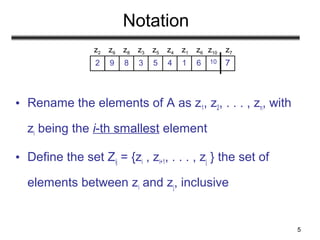
• Rename the elements of A as z1, z2, . . . , zn, with
zi being the i-th smallest element
• Define the set Zij = {zi , zi+1, . . . , zj } the set of
elements between zi and zj, inclusive
106145389 72
z1z2 z9 z8 z5z3 z4 z6 z10 z7
6
Total Number of Comparisons
in PARTITION
i+1 n
=X
i n-1
∑
−
=
1
1
n
i
∑+=
n
ij 1 ijX
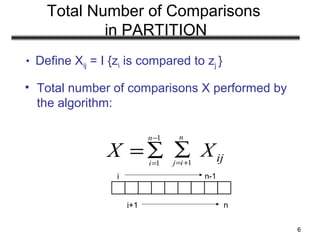
• Total number of comparisons X performed by
the algorithm:
• Define Xij = I {zi is compared to zj }
7
Expected Number of Total
Comparisons in PARTITION
• Compute the expected value of X:
=][XE
by linearity
of expectation
the expectation of Xij is equal
to the probability of the event
“zi is compared to zj”
=





∑ ∑
−
= +=
1
1 1
n
i
n
ij
ijXE [ ]=∑ ∑
−
= +=
1
1 1
n
i
n
ij
ijXE
∑ ∑
−
= +=
=
1
1 1
}Pr{
n
i
n
ij
ji ztocomparedisz
indicator
random variable
8
Comparisons in PARTITION :
Observation 1
• Each pair of elements is compared at most once
during the entire execution of the algorithm
– Elements are compared only to the pivot point!
– Pivot point is excluded from future calls to PARTITION
9
Comparisons in PARTITION:
Observation 2
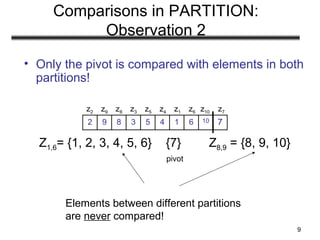
• Only the pivot is compared with elements in both
partitions!
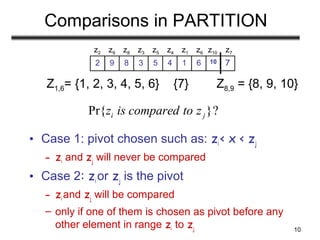
z1z2 z9 z8 z5z3 z4 z6 z10 z7
106145389 72
Z1,6= {1, 2, 3, 4, 5, 6} Z8,9 = {8, 9, 10}{7}
pivot
Elements between different partitions
are never compared!
10
Comparisons in PARTITION
• Case 1: pivot chosen such as: zi < x < zj
– zi and zj will never be compared
• Case 2: zi or zj is the pivot
– zi and zj will be compared
– only if one of them is chosen as pivot before any
other element in range zi to zj
106145389 72
z1z2 z9 z8 z5z3 z4 z6 z10 z7
Z1,6= {1, 2, 3, 4, 5, 6} Z8,9 = {8, 9, 10}{7}
Pr{ }?i jz is compared to z
11
Probability of comparing zi with zj
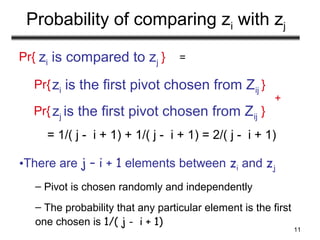
= 1/( j - i + 1) + 1/( j - i + 1) = 2/( j - i + 1)
zi is compared to zj
zi is the first pivot chosen from Zij
=Pr{ }
Pr{ }
zj is the first pivot chosen from Zij
Pr{ }
OR+
•There are j – i + 1 elements between zi and zj
– Pivot is chosen randomly and independently
– The probability that any particular element is the first
one chosen is 1/( j - i + 1)
12
Number of Comparisons in PARTITION
1 1 1 1
1 1 1 1 1 1 1
2 2 2
[ ] (lg )
1 1
n n n n i n n n
i j i i k i k i
E X O n
j i k k
− − − − −
= = + = = = = =
= = < =
− + +
∑ ∑ ∑∑ ∑∑ ∑
)lg( nnO=
⇒ Expected running time of Quicksort using
RANDOMIZED-PARTITION is O(nlgn)
∑ ∑
−
= +=
=
1
1 1
}Pr{][
n
i
n
ij
ji ztocomparediszXE
Expected number of comparisons in PARTITION:
(set k=j-i) (harmonic series)
13
Alternative Average-Case
Analysis of Quicksort
• See Problem 7-2, page 16
• Focus on the expected running time of
each individual recursive call to Quicksort,
rather than on the number of comparisons
performed.
• Use Hoare partition in our analysis.
14
Worst-Case Analysis
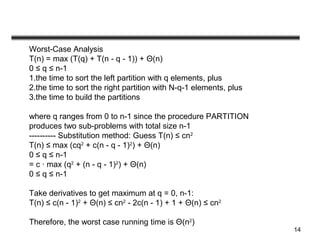
T(n) = max (T(q) + T(n - q - 1)) + Θ(n)
0 ≤ q ≤ n-1
1.the time to sort the left partition with q elements, plus
2.the time to sort the right partition with N-q-1 elements, plus
3.the time to build the partitions
where q ranges from 0 to n-1 since the procedure PARTITION
produces two sub-problems with total size n-1
---------- Substitution method: Guess T(n) ≤ cn2
T(n) ≤ max (cq2
+ c(n - q - 1)2
) + Θ(n)
0 ≤ q ≤ n-1
= c · max (q2
+ (n - q - 1)2
) + Θ(n)
0 ≤ q ≤ n-1
Take derivatives to get maximum at q = 0, n-1:
T(n) ≤ c(n - 1)2
+ Θ(n) ≤ cn2
- 2c(n - 1) + 1 + Θ(n) ≤ cn2
Therefore, the worst case running time is Θ(n2
)

Randomizing quicksort algorith with example

  • 1.
    1 Randomizing Quicksort • Randomlypermute the elements of the input array before sorting • OR ... modify the PARTITION procedure – At each step of the algorithm we exchange element A[p] with an element chosen at random from A[p…r] – The pivot element x = A[p] is equally likely to be any one of the r – p + 1 elements of the subarray
  • 2.
    2 Randomized Algorithms • Noinput can elicit worst case behavior – Worst case occurs only if we get “unlucky” numbers from the random number generator • Worst case becomes less likely – Randomization can NOT eliminate the worst-case but it can make it less likely!
  • 3.
    3 Randomized PARTITION Alg.: RANDOMIZED-PARTITION(A,p, r) i ← RANDOM(p, r) exchange A[p] A[i]↔ return PARTITION(A, p, r)
  • 4.
    4 Randomized Quicksort Alg. :RANDOMIZED-QUICKSORT(A, p, r) if p < r then q ← RANDOMIZED-PARTITION(A, p, r) RANDOMIZED-QUICKSORT(A, p, q) RANDOMIZED-QUICKSORT(A, q + 1, r)
  • 5.
    5 Notation • Rename theelements of A as z1, z2, . . . , zn, with zi being the i-th smallest element • Define the set Zij = {zi , zi+1, . . . , zj } the set of elements between zi and zj, inclusive 106145389 72 z1z2 z9 z8 z5z3 z4 z6 z10 z7
  • 6.
    6 Total Number ofComparisons in PARTITION i+1 n =X i n-1 ∑ − = 1 1 n i ∑+= n ij 1 ijX • Total number of comparisons X performed by the algorithm: • Define Xij = I {zi is compared to zj }
  • 7.
    7 Expected Number ofTotal Comparisons in PARTITION • Compute the expected value of X: =][XE by linearity of expectation the expectation of Xij is equal to the probability of the event “zi is compared to zj” =      ∑ ∑ − = += 1 1 1 n i n ij ijXE [ ]=∑ ∑ − = += 1 1 1 n i n ij ijXE ∑ ∑ − = += = 1 1 1 }Pr{ n i n ij ji ztocomparedisz indicator random variable
  • 8.
    8 Comparisons in PARTITION: Observation 1 • Each pair of elements is compared at most once during the entire execution of the algorithm – Elements are compared only to the pivot point! – Pivot point is excluded from future calls to PARTITION
  • 9.
    9 Comparisons in PARTITION: Observation2 • Only the pivot is compared with elements in both partitions! z1z2 z9 z8 z5z3 z4 z6 z10 z7 106145389 72 Z1,6= {1, 2, 3, 4, 5, 6} Z8,9 = {8, 9, 10}{7} pivot Elements between different partitions are never compared!
  • 10.
    10 Comparisons in PARTITION •Case 1: pivot chosen such as: zi < x < zj – zi and zj will never be compared • Case 2: zi or zj is the pivot – zi and zj will be compared – only if one of them is chosen as pivot before any other element in range zi to zj 106145389 72 z1z2 z9 z8 z5z3 z4 z6 z10 z7 Z1,6= {1, 2, 3, 4, 5, 6} Z8,9 = {8, 9, 10}{7} Pr{ }?i jz is compared to z
  • 11.
    11 Probability of comparingzi with zj = 1/( j - i + 1) + 1/( j - i + 1) = 2/( j - i + 1) zi is compared to zj zi is the first pivot chosen from Zij =Pr{ } Pr{ } zj is the first pivot chosen from Zij Pr{ } OR+ •There are j – i + 1 elements between zi and zj – Pivot is chosen randomly and independently – The probability that any particular element is the first one chosen is 1/( j - i + 1)
  • 12.
    12 Number of Comparisonsin PARTITION 1 1 1 1 1 1 1 1 1 1 1 2 2 2 [ ] (lg ) 1 1 n n n n i n n n i j i i k i k i E X O n j i k k − − − − − = = + = = = = = = = < = − + + ∑ ∑ ∑∑ ∑∑ ∑ )lg( nnO= ⇒ Expected running time of Quicksort using RANDOMIZED-PARTITION is O(nlgn) ∑ ∑ − = += = 1 1 1 }Pr{][ n i n ij ji ztocomparediszXE Expected number of comparisons in PARTITION: (set k=j-i) (harmonic series)
  • 13.
    13 Alternative Average-Case Analysis ofQuicksort • See Problem 7-2, page 16 • Focus on the expected running time of each individual recursive call to Quicksort, rather than on the number of comparisons performed. • Use Hoare partition in our analysis.
  • 14.
    14 Worst-Case Analysis T(n) =max (T(q) + T(n - q - 1)) + Θ(n) 0 ≤ q ≤ n-1 1.the time to sort the left partition with q elements, plus 2.the time to sort the right partition with N-q-1 elements, plus 3.the time to build the partitions where q ranges from 0 to n-1 since the procedure PARTITION produces two sub-problems with total size n-1 ---------- Substitution method: Guess T(n) ≤ cn2 T(n) ≤ max (cq2 + c(n - q - 1)2 ) + Θ(n) 0 ≤ q ≤ n-1 = c · max (q2 + (n - q - 1)2 ) + Θ(n) 0 ≤ q ≤ n-1 Take derivatives to get maximum at q = 0, n-1: T(n) ≤ c(n - 1)2 + Θ(n) ≤ cn2 - 2c(n - 1) + 1 + Θ(n) ≤ cn2 Therefore, the worst case running time is Θ(n2 )