Faults
Terminology
Structural Geology
-Devaki Nandana V V
18GG20036
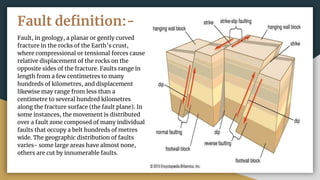
Fault definition:-
Fault, in geology, a planar or gently curved
fracture in the rocks of the Earth’s crust,
where compressional or tensional forces cause
relative displacement of the rocks on the
opposite sides of the fracture. Faults range in
length from a few centimetres to many
hundreds of kilometres, and displacement
likewise may range from less than a
centimetre to several hundred kilometres
along the fracture surface (the fault plane). In
some instances, the movement is distributed
over a fault zone composed of many individual
faults that occupy a belt hundreds of metres
wide. The geographic distribution of faults
varies- some large areas have almost none,
others are cut by innumerable faults.
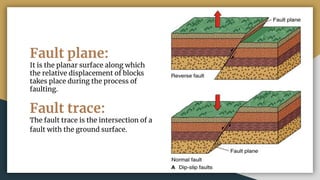
Fault plane:
It is the planar surface along which
the relative displacement of blocks
takes place during the process of
faulting.
Fault trace:
The fault trace is the intersection of a
fault with the ground surface.
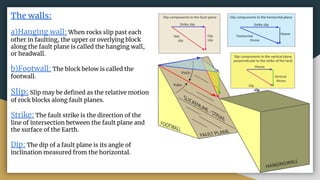
The walls:
a)Hanging wall: When rocks slip past each
other in faulting, the upper or overlying block
along the fault plane is called the hanging wall,
or headwall.
b)Footwall: The block below is called the
footwall.
Slip: Slip may be defined as the relative motion
of rock blocks along fault planes.
Strike: The fault strike is the direction of the
line of intersection between the fault plane and
the surface of the Earth.
Dip: The dip of a fault plane is its angle of
inclination measured from the horizontal.
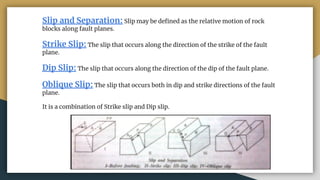
Slip and Separation: Slip may be defined as the relative motion of rock
blocks along fault planes.
Strike Slip: The slip that occurs along the direction of the strike of the fault
plane.
Dip Slip: The slip that occurs along the direction of the dip of the fault plane.
Oblique Slip: The slip that occurs both in dip and strike directions of the fault
plane.
It is a combination of Strike slip and Dip slip.
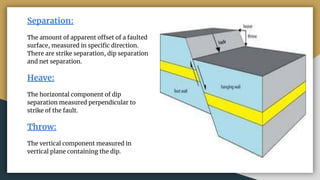
Separation:
The amount of apparent offset of a faulted
surface, measured in specific direction.
There are strike separation, dip separation
and net separation.
Heave:
The horizontal component of dip
separation measured perpendicular to
strike of the fault.
Throw:
The vertical component measured in
vertical plane containing the dip.
Classification of
faults:
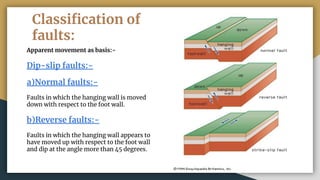
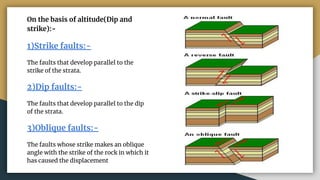
Apparent movement as basis:-
Dip-slip faults:-
a)Normal faults:-
Faults in which the hanging wall is moved
down with respect to the foot wall.
b)Reverse faults:-
Faults in which the hanging wall appears to
have moved up with respect to the foot wall
and dip at the angle more than 45 degrees.
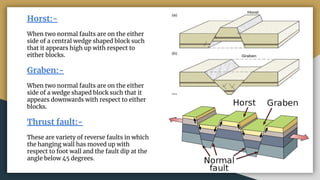
Horst:-
When two normal faults are on the either
side of a central wedge shaped block such
that it appears high up with respect to
either blocks.
Graben:-
When two normal faults are on the either
side of a wedge shaped block such that it
appears downwards with respect to either
blocks.
Thrust fault:-
These are variety of reverse faults in which
the hanging wall has moved up with
respect to foot wall and the fault dip at the
angle below 45 degrees.
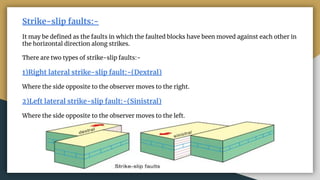
Strike-slip faults:-
It may be defined as the faults in which the faulted blocks have been moved against each other in
the horizontal direction along strikes.
There are two types of strike-slip faults:-
1)Right lateral strike-slip fault:-(Dextral)
Where the side opposite to the observer moves to the right.
2)Left lateral strike-slip fault:-(Sinistral)
Where the side opposite to the observer moves to the left.
On the basis of altitude(Dip and
strike):-
1)Strike faults:-
The faults that develop parallel to the
strike of the strata.
2)Dip faults:-
The faults that develop parallel to the dip
of the strata.
3)Oblique faults:-
The faults whose strike makes an oblique
angle with the strike of the rock in which it
has caused the displacement
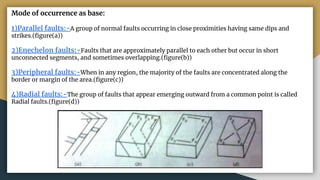
Mode of occurrence as base:
1)Parallel faults:-A group of normal faults occurring in close proximities having same dips and
strikes.(figure(a))
2)Enechelon faults:-Faults that are approximately parallel to each other but occur in short
unconnected segments, and sometimes overlapping.(figure(b))
3)Peripheral faults:-When in any region, the majority of the faults are concentrated along the
border or margin of the area.(figure(c))
4)Radial faults:-The group of faults that appear emerging outward from a common point is called
Radial faults.(figure(d))
Some other kinds of faults:-
1)Wrench fault
2)Transform fault
3)Tear fault
4)Translational faults
5)Rotational faults
6)Listric faults
7)Scissor faults
Some other terms:-
Tip line: The line where fault displacement is zero.
Fault scarp: Topographic exposure of fault plane.
Slickensides: Striations or mineral lineations on fault plane
Fault zones: Fault zones consist of numerous closely spaced fault surfaces, commonly
separating masses of broken rock.
Nappe: A large body or sheet of rock that has been moved a distance of about 2 km or more
from its original position by faulting or folding
THANK YOU!!!

Faults terminology

  • 1.
  • 2.
    Fault definition:- Fault, ingeology, a planar or gently curved fracture in the rocks of the Earth’s crust, where compressional or tensional forces cause relative displacement of the rocks on the opposite sides of the fracture. Faults range in length from a few centimetres to many hundreds of kilometres, and displacement likewise may range from less than a centimetre to several hundred kilometres along the fracture surface (the fault plane). In some instances, the movement is distributed over a fault zone composed of many individual faults that occupy a belt hundreds of metres wide. The geographic distribution of faults varies- some large areas have almost none, others are cut by innumerable faults.
  • 3.
    Fault plane: It isthe planar surface along which the relative displacement of blocks takes place during the process of faulting. Fault trace: The fault trace is the intersection of a fault with the ground surface.
  • 4.
    The walls: a)Hanging wall:When rocks slip past each other in faulting, the upper or overlying block along the fault plane is called the hanging wall, or headwall. b)Footwall: The block below is called the footwall. Slip: Slip may be defined as the relative motion of rock blocks along fault planes. Strike: The fault strike is the direction of the line of intersection between the fault plane and the surface of the Earth. Dip: The dip of a fault plane is its angle of inclination measured from the horizontal.
  • 5.
    Slip and Separation:Slip may be defined as the relative motion of rock blocks along fault planes. Strike Slip: The slip that occurs along the direction of the strike of the fault plane. Dip Slip: The slip that occurs along the direction of the dip of the fault plane. Oblique Slip: The slip that occurs both in dip and strike directions of the fault plane. It is a combination of Strike slip and Dip slip.
  • 6.
    Separation: The amount ofapparent offset of a faulted surface, measured in specific direction. There are strike separation, dip separation and net separation. Heave: The horizontal component of dip separation measured perpendicular to strike of the fault. Throw: The vertical component measured in vertical plane containing the dip.
  • 7.
    Classification of faults: Apparent movementas basis:- Dip-slip faults:- a)Normal faults:- Faults in which the hanging wall is moved down with respect to the foot wall. b)Reverse faults:- Faults in which the hanging wall appears to have moved up with respect to the foot wall and dip at the angle more than 45 degrees.
  • 8.
    Horst:- When two normalfaults are on the either side of a central wedge shaped block such that it appears high up with respect to either blocks. Graben:- When two normal faults are on the either side of a wedge shaped block such that it appears downwards with respect to either blocks. Thrust fault:- These are variety of reverse faults in which the hanging wall has moved up with respect to foot wall and the fault dip at the angle below 45 degrees.
  • 9.
    Strike-slip faults:- It maybe defined as the faults in which the faulted blocks have been moved against each other in the horizontal direction along strikes. There are two types of strike-slip faults:- 1)Right lateral strike-slip fault:-(Dextral) Where the side opposite to the observer moves to the right. 2)Left lateral strike-slip fault:-(Sinistral) Where the side opposite to the observer moves to the left.
  • 10.
    On the basisof altitude(Dip and strike):- 1)Strike faults:- The faults that develop parallel to the strike of the strata. 2)Dip faults:- The faults that develop parallel to the dip of the strata. 3)Oblique faults:- The faults whose strike makes an oblique angle with the strike of the rock in which it has caused the displacement
  • 11.
    Mode of occurrenceas base: 1)Parallel faults:-A group of normal faults occurring in close proximities having same dips and strikes.(figure(a)) 2)Enechelon faults:-Faults that are approximately parallel to each other but occur in short unconnected segments, and sometimes overlapping.(figure(b)) 3)Peripheral faults:-When in any region, the majority of the faults are concentrated along the border or margin of the area.(figure(c)) 4)Radial faults:-The group of faults that appear emerging outward from a common point is called Radial faults.(figure(d))
  • 12.
    Some other kindsof faults:- 1)Wrench fault 2)Transform fault 3)Tear fault 4)Translational faults 5)Rotational faults 6)Listric faults 7)Scissor faults
  • 13.
    Some other terms:- Tipline: The line where fault displacement is zero. Fault scarp: Topographic exposure of fault plane. Slickensides: Striations or mineral lineations on fault plane Fault zones: Fault zones consist of numerous closely spaced fault surfaces, commonly separating masses of broken rock. Nappe: A large body or sheet of rock that has been moved a distance of about 2 km or more from its original position by faulting or folding THANK YOU!!!