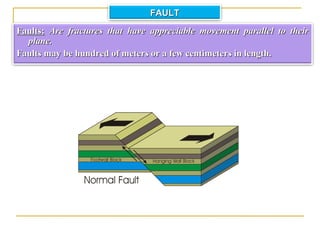
Faults:Faults: Are fractures that have appreciable movement parallel to theirAre fractures that have appreciable movement parallel to their
plane.plane.
Faults may be hundred of meters or a few centimeters in length.Faults may be hundred of meters or a few centimeters in length.
FAULTFAULT
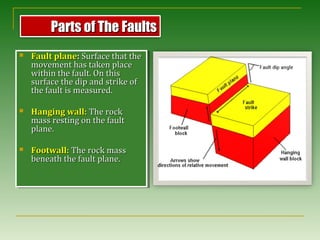
 Fault planeFault plane:: Surface that theSurface that the
movement has taken placemovement has taken place
within the fault. On thiswithin the fault. On this
surface the dip and strike ofsurface the dip and strike of
the fault is measured.the fault is measured.
 Hanging wall:Hanging wall: The rockThe rock
mass resting on the faultmass resting on the fault
plane.plane.
 Footwall:Footwall: The rock massThe rock mass
beneath the fault plane.beneath the fault plane.
 Fault planeFault plane:: Surface that theSurface that the
movement has taken placemovement has taken place
within the fault. On thiswithin the fault. On this
surface the dip and strike ofsurface the dip and strike of
the fault is measured.the fault is measured.
 Hanging wall:Hanging wall: The rockThe rock
mass resting on the faultmass resting on the fault
plane.plane.
 Footwall:Footwall: The rock massThe rock mass
beneath the fault plane.beneath the fault plane.
Parts of The FaultsParts of The Faults
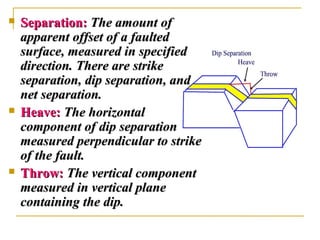
 Separation:Separation: The amount ofThe amount of
apparent offset of a faultedapparent offset of a faulted
surface, measured in specifiedsurface, measured in specified
direction. There are strikedirection. There are strike
separation, dip separation, andseparation, dip separation, and
net separation.net separation.
 Heave:Heave: The horizontalThe horizontal
component of dip separationcomponent of dip separation
measured perpendicular to strikemeasured perpendicular to strike
of the fault.of the fault.
 Throw:Throw: The vertical componentThe vertical component
measured in vertical planemeasured in vertical plane
containing the dip.containing the dip.
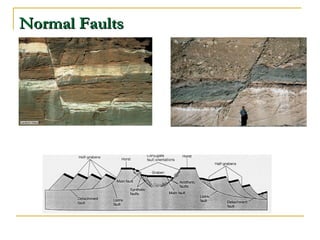
Normal FaultsNormal Faults
Thrust FaultThrust Fault
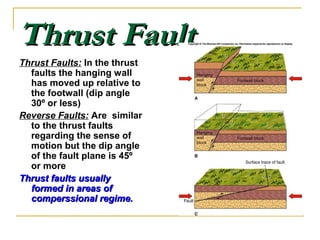
Thrust Faults: In the thrust
faults the hanging wall
has moved up relative to
the footwall (dip angle
30º or less)
Reverse Faults: Are similar
to the thrust faults
regarding the sense of
motion but the dip angle
of the fault plane is 45º
or more
Thrust faults usuallyThrust faults usually
formed in areas offormed in areas of
comperssional regime.comperssional regime.
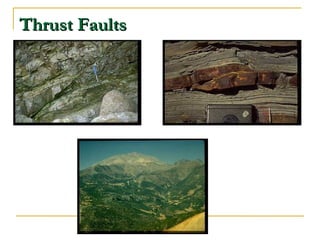
Thrust FaultsThrust Faults
Strike-Slip FaultStrike-Slip Fault
Strike-slip Faults: Are faults
that have movement along
strikes.
There are two types of strike
slip faults:
A] Right lateral strike-slip fault
(dextral): Where the side
opposite the observer moves
to the right.
B] Left lateral strike-slip fault
(sinistral): Where the side
opposite the observer moves
to the left.
Note that the same sense ofNote that the same sense of
movement will also bemovement will also be
observed from the other sideobserved from the other side
of the fault.of the fault.
Strike-SlipStrike-Slip
FaultsFaults
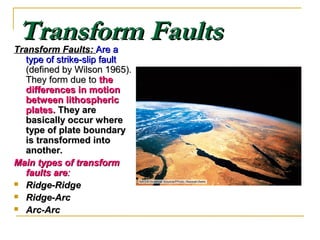
Transform FaultsTransform FaultsTransform Faults:Transform Faults: Are aAre a
type of strike-slip faulttype of strike-slip fault
(defined by Wilson 1965).(defined by Wilson 1965).
They form due toThey form due to thethe
differences in motiondifferences in motion
between lithosphericbetween lithospheric
plates.plates. They areThey are
basically occur wherebasically occur where
type of plate boundarytype of plate boundary
is transformed intois transformed into
anotheranother..
Main types of transformMain types of transform
faults arefaults are::
 Ridge-RidgeRidge-Ridge
 Ridge-ArcRidge-Arc
 Arc-ArcArc-Arc
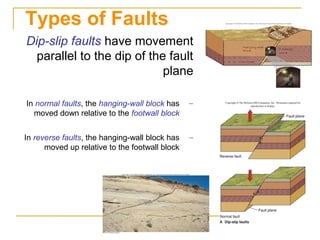
Types of Faults
•Dip-slip faults have movement
parallel to the dip of the fault
plane
–In normal faults, the hanging-wall block has
moved down relative to the footwall block
–In reverse faults, the hanging-wall block has
moved up relative to the footwall block
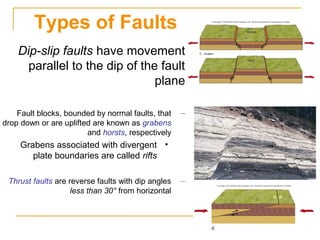
Types of Faults
•Dip-slip faults have movement
parallel to the dip of the fault
plane
–Fault blocks, bounded by normal faults, that
drop down or are uplifted are known as grabens
and horsts, respectively
•Grabens associated with divergent
plate boundaries are called rifts
–Thrust faults are reverse faults with dip angles
less than 30° from horizontal
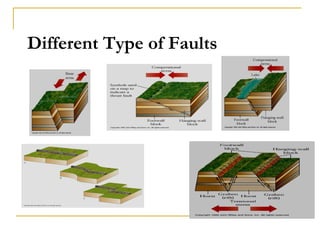
Different Type of Faults

Final fault

  • 2.
    Faults:Faults: Are fracturesthat have appreciable movement parallel to theirAre fractures that have appreciable movement parallel to their plane.plane. Faults may be hundred of meters or a few centimeters in length.Faults may be hundred of meters or a few centimeters in length. FAULTFAULT
  • 3.
     Fault planeFaultplane:: Surface that theSurface that the movement has taken placemovement has taken place within the fault. On thiswithin the fault. On this surface the dip and strike ofsurface the dip and strike of the fault is measured.the fault is measured.  Hanging wall:Hanging wall: The rockThe rock mass resting on the faultmass resting on the fault plane.plane.  Footwall:Footwall: The rock massThe rock mass beneath the fault plane.beneath the fault plane.  Fault planeFault plane:: Surface that theSurface that the movement has taken placemovement has taken place within the fault. On thiswithin the fault. On this surface the dip and strike ofsurface the dip and strike of the fault is measured.the fault is measured.  Hanging wall:Hanging wall: The rockThe rock mass resting on the faultmass resting on the fault plane.plane.  Footwall:Footwall: The rock massThe rock mass beneath the fault plane.beneath the fault plane. Parts of The FaultsParts of The Faults
  • 4.
     Separation:Separation: Theamount ofThe amount of apparent offset of a faultedapparent offset of a faulted surface, measured in specifiedsurface, measured in specified direction. There are strikedirection. There are strike separation, dip separation, andseparation, dip separation, and net separation.net separation.  Heave:Heave: The horizontalThe horizontal component of dip separationcomponent of dip separation measured perpendicular to strikemeasured perpendicular to strike of the fault.of the fault.  Throw:Throw: The vertical componentThe vertical component measured in vertical planemeasured in vertical plane containing the dip.containing the dip.
  • 5.
  • 6.
    Thrust FaultThrust Fault ThrustFaults: In the thrust faults the hanging wall has moved up relative to the footwall (dip angle 30º or less) Reverse Faults: Are similar to the thrust faults regarding the sense of motion but the dip angle of the fault plane is 45º or more Thrust faults usuallyThrust faults usually formed in areas offormed in areas of comperssional regime.comperssional regime.
  • 7.
  • 8.
    Strike-Slip FaultStrike-Slip Fault Strike-slipFaults: Are faults that have movement along strikes. There are two types of strike slip faults: A] Right lateral strike-slip fault (dextral): Where the side opposite the observer moves to the right. B] Left lateral strike-slip fault (sinistral): Where the side opposite the observer moves to the left. Note that the same sense ofNote that the same sense of movement will also bemovement will also be observed from the other sideobserved from the other side of the fault.of the fault. Strike-SlipStrike-Slip FaultsFaults
  • 9.
    Transform FaultsTransform FaultsTransformFaults:Transform Faults: Are aAre a type of strike-slip faulttype of strike-slip fault (defined by Wilson 1965).(defined by Wilson 1965). They form due toThey form due to thethe differences in motiondifferences in motion between lithosphericbetween lithospheric plates.plates. They areThey are basically occur wherebasically occur where type of plate boundarytype of plate boundary is transformed intois transformed into anotheranother.. Main types of transformMain types of transform faults arefaults are::  Ridge-RidgeRidge-Ridge  Ridge-ArcRidge-Arc  Arc-ArcArc-Arc
  • 10.
    Types of Faults •Dip-slipfaults have movement parallel to the dip of the fault plane –In normal faults, the hanging-wall block has moved down relative to the footwall block –In reverse faults, the hanging-wall block has moved up relative to the footwall block
  • 11.
    Types of Faults •Dip-slipfaults have movement parallel to the dip of the fault plane –Fault blocks, bounded by normal faults, that drop down or are uplifted are known as grabens and horsts, respectively •Grabens associated with divergent plate boundaries are called rifts –Thrust faults are reverse faults with dip angles less than 30° from horizontal
  • 12.